

We’ve shortlisted eight of the best reverse osmosis systems in 2026 based on our lab data, analysis, and decade of water filter testing experience.
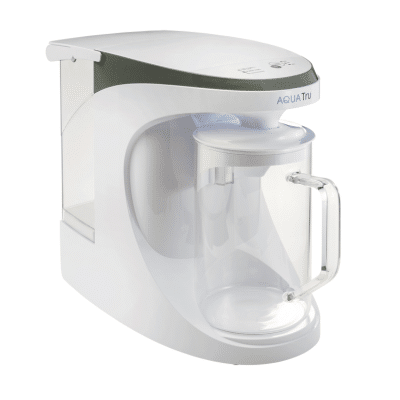
Aquatru Carafe
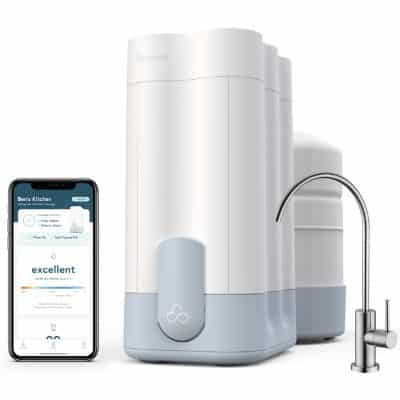
Cloud RO
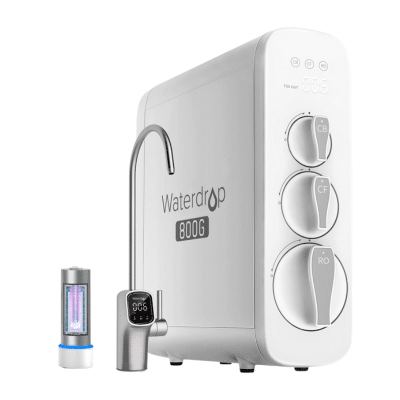
Waterdrop G3 P800
Quick Answer: Best Reverse Osmosis Systems of 2026 by Category
- Best Overall: AquaTru Carafe (9.57/10). The only system to eliminate 100% of contaminants with health effects in our test water. IAPMO certified to NSF 42, 53, 58, and 401 for 83 contaminants. 4:1 efficiency ratio.
- Best Under-Sink RO: Cloud RO (9.24/10). NSF 58 certified, built-in remineralization, 1:1 efficiency ratio, integrated usage and filter sensors and app tracking
- Best Tankless RO: Waterdrop G3 P800 (9.21/10). IAPMO certified to NSF 42, 53, and 58. 800 GPD flow rate, 3:1 efficiency ratio, UV sterilization add on.
- Best Feature-Loaded Countertop: Waterdrop A1 (9.12/10). NSF 58 certified, hot and cold dispensing from 41°F to 203°F.
- Best Advanced Countertop: Philips Water Dispenser (8.98/10). Removable carafe, hot & cold water on demand.
- Best Budget Tankless: Frizzlife PD600-TAM3 (8.94/10). 600 GPD flow, $0.10 per gallon maintenance cost, optional remineralization upgrade.
- Best Budget Tank-Based: APEC ROES-PH75 (8.87/10). WQA performance certified for TDS reduction, $269 upfront, built-in remineralization.
- Best Tank Based for Certifications: AquaTru Under Sink Gen 2 (8.80/10). IAPMO certified for the reduction of 84 contaminants. Modern design. Easy filter changes.
Methodology: We lab tested each system with SimpleLab Tap Score using our own municipal water in Colorado, then scored each across 6 weighted categories: contaminant reduction, design, maintenance, filtration rate, setup, and company offerings. See full methodology.
Our Testing & Selection Process
How We Test Reverse Osmosis Systems: Every system on this list is independently lab-tested on real residential water supplies here in Colorado, scored across six weighted categories (contaminant reduction, design, filtration rate, setup, maintenance, and company policies), and verified against public NSF, WQA, and IAPMO certification databases. We don’t accept payment for inclusion or rankings, and affiliate compensation does not affect scoring. Full methodology and selection criteria below.
We use a bespoke performance analysis for all our water filter testing projects, which gives us a comprehensive understanding of each product’s abilities across numerous categories.
For our Best Reverse Osmosis Systems guide, we selected the filters that scored highest for their performance overall, giving them the edge over the other systems we tested.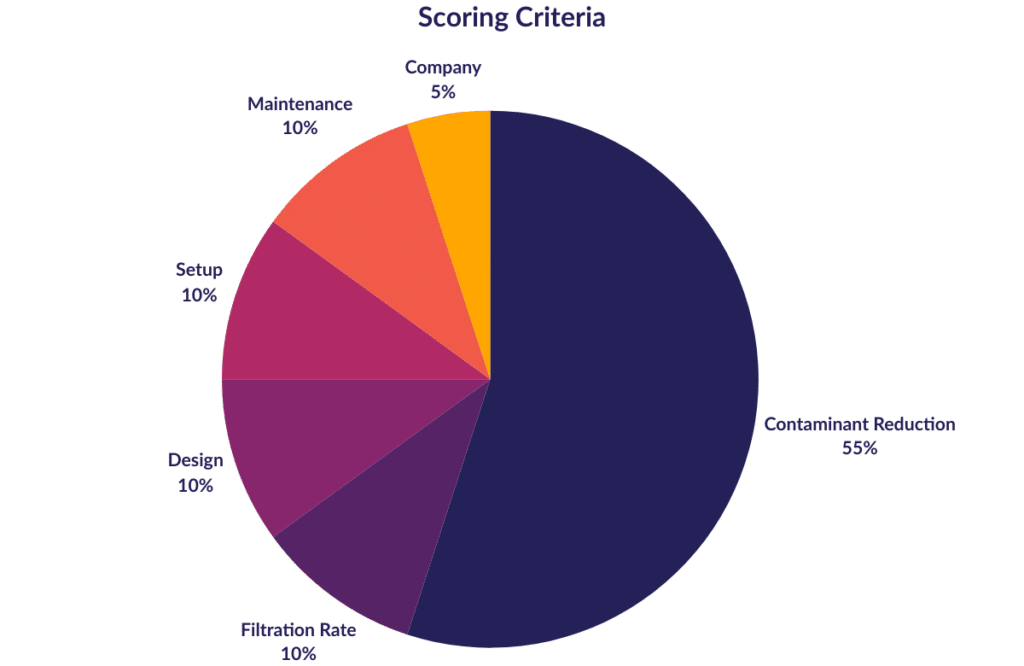
Alongside overall scoring performance, we also evaluate contaminant reduction, design quality, filtration speed, setup and maintenance, warranty, and other company offerings, as well as non-scoring factors like upfront price and efficiency ratio, when choosing the winners.
Our tests use objective and quantifiable data wherever possible. When necessary, we use subjective assessment to round out our testing process, supported by data when it’s available.
You can see our complete testing and scoring process here.
We chose the best reverse osmosis units by comparing the test data and performance statistics for all the filters we reviewed, then selecting those with the highest scores. We focused particularly on the contaminant reduction category, which holds the most weight in our scoring system due to its high importance.
To be included within our best RO systems list, each product needed to:
-Earn an overall performance score of 8.83 or higher
-Have a contaminant reduction score of at least 9.00 to meet our high performance expectations for RO systems
-Be available within the USA
We automatically excluded some products from this guide, including:
-Outdated or inefficient RO systems that waste more than 1 gallon of water per 1 gallon purified
-Systems without an RO membrane (classed as water filters and not purifiers)
-Units with more setbacks than advantages, or those that were simply poorer than their competitors across most performance categories
Article Update History
- 07/09/2026 – Added AquaTru Under Sink Gen 2
- 06/08/2026 – Add Philips, removed RKIN U1
- 03/04/2026 – Added Frizzlife PD600 TAM3 and APEC ROES-PH75
- 11/22/2025 – Added Waterdrop A1, Removed Waterdrop N1
The Best RO Systems of 2026
| Product | AquaTru Carafe | 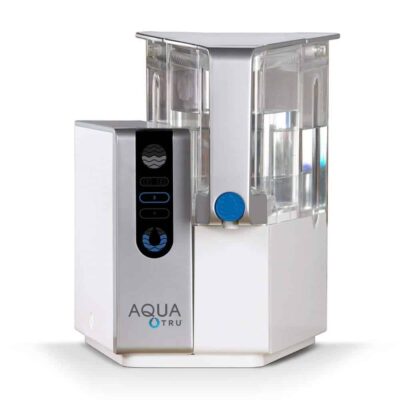 AquaTru Classic |  Cloud RO | 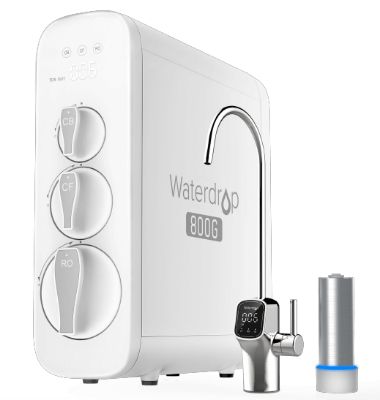 Waterdrop G3 P800 | 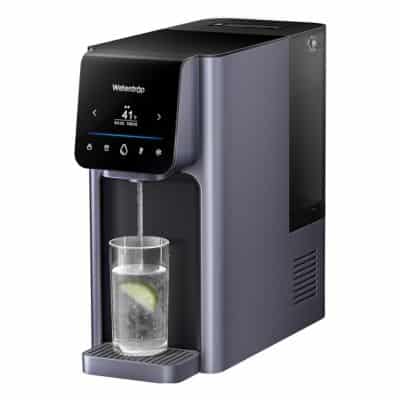 Waterdrop A1 | 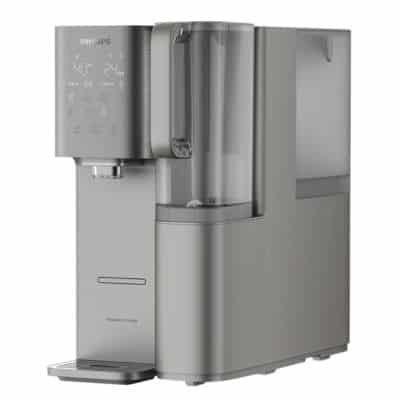 Philips Water Dispenser |  Frizzlife PD600-TAM3 | 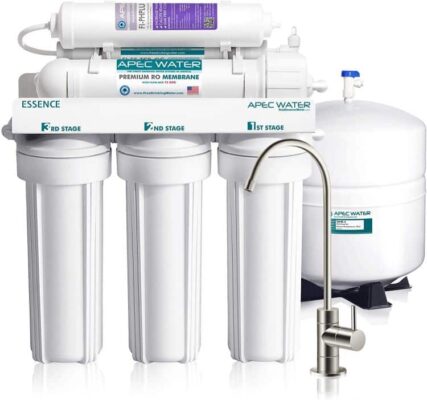 APEC ROES-PH75 |
|---|---|---|---|---|---|---|---|---|
| Score | 9.57 | 9.54 | 9.24 | 9.21 | 9.12 | 8.98 | 8.94 | 8.87 |
| Price | $359+ | $449+ | $599 | $999 | $650 | $799 | $376 | $269 |
| Certifications | NSF/ANSI 42, 53, 58, and 401 | NSF 42, 53, 58, and 401 | NSF 58 | NSF/ANSI 58, 372 | NSF 58 | Not Certified | Not Certified | NSF 58 |
| Filter Capacity | 300 – 1,200 gallons | 600 – 1,200 gallons | 500 – 1,500 gallons | 800 gallons | 225 – 550 gallons | 528 gallons | 900 – 1,800 gallons | 600 – 1,200 gallons |
| Cost per Gallon | $0.19 | $0.11 | $0.26 | $0.11 | $0.26 | $0.23 | $0.12 | $0.10 |
| Warranty | 1 year | 1 year | 1 year | 1 year | 1 year | 2 years | 1 year | 1 year |
| Read Review | AquaTru Carafe review | Aquatru review | Cloud RO review | Waterdrop G3 P800 review | Waterdrop A1 review | Philips Water Dispenser review | Frizzlife PD600-TAM3 review | APEC ROES-PH75 review |
AquaTru Carafe: Best Overall (9.57/10)
The AquTru Carafe is the top-scoring reverse osmosis system out of all the units we tested. It improved our water quality more than any other system and is performance certified for every single contaminant that it’s listed to reduce, with one of the best efficiency ratios we’ve seen for an RO filter. We awarded the system an overall weighted score of 9.57 out of 10.00.
Best For
Anyone looking for the best-performing countertop reverse osmosis system that’s certified for 100% of the manufacturer’s contaminant reduction claims and has a high efficiency ratio to minimize water waste.
Product Specs
| Price | $349.00+ |
| Contaminants Reduced | 83+ |
| Certifications | NSF/ANSI 42, 53, 58, & 401 |
| Process | Mechanical + Carbon + Reverse Osmosis |
| Filter Capacity | 300 gal. & 1,200 gal. |
| Annual Cost | ~$60 |
| Warranty | 1 year |
Why It’s Best
We tested the AquaTru Carafe and Classic systems with our city water in Colorado. We then upgraded the VOC filter to include remineralization media (sold with the Alkaline Classic model) to introduce minerals into our RO water. The base model for the Carafe is about $349 and the Classic is around $450 upfront, with an added $20-$70 if you choose one of the upgraded configurations.
What Contaminants Does AquaTru Remove?
Key Finding: The AquaTru Carafe completely eliminated 100% of all contaminants with health effects detected in our Colorado tap water, including fluoride, chloroform, and uranium, the only system in this guide to achieve full elimination. It scored 9.91 out of 10.00 in contaminant reduction, the highest score we’ve awarded in this category.
The key reason why AquaTru takes the top spot on our list is its superior contaminant reduction. In our testing, both the Carafe and the Classic systems received the best score in this category (9.91) of all the filters we’ve tested so far.
We took samples of our water before and after purifying it in the system, then sent it for lab testing with SimpleLab Tap Score.
Our post-filtration test results showed that the system had removed 100% of all contaminants with possible health effects detected in our water. This included fluoride, chloroform, and uranium, which were detected at concentrations above the lab’s Health Guideline Level.
| Contaminant | Measurement | Pre-Filtration | Post-Filtration | % Change |
|---|---|---|---|---|
| Total THMs | μg/L | 2.08 | 0 | -100.00% |
| Chloroform | μg/L | 2.08 | 0 | -100.00% |
| Chloride | mg/L | 28.5 | 0 | -100.00% |
| Sulfate | mg/L | 8 | 0 | -100.00% |
| Nitrate (as N) | mg/L | 4.2 | 0 | -100.00% |
| Fluoride | mg/L | 0.9 | 0 | -100.00% |
| Molybdenum | mg/L | 0.0019 | 0 | -100.00% |
| Copper | mg/L | 0.31 | 0 | -100.00% |
| Barium | mg/L | 0.0228 | 0.0024 | -89.47% |
| Strontium | mg/L | 0.135 | 0.011 | -91.85% |
| Uranium | mg/L | 0.0096 | 0 | -100.00% |
| Manganese | mg/L | 0 | 0.0037 | #DIV/0! |
| Carbonate | mg/L | 0.08 | 0.00899 | -88.76% |
| Sodium | mg/L | 11.2 | 1.91 | -82.95% |
| Bicarbonate | mg/L | 82.75 | 19.490023 | -76.45% |
| Magnesium | mg/L | 7.32 | 0.47 | -93.58% |
| Calcium | mg/L | 30.5 | 1.8 | -94.10% |
| Total Dissolved Solids | mg/L | 164 | 14 | -91.46% |
| Hardness (Total) | mg/L | 106.96 | 6.45 | -93.97% |

The system’s contaminant reduction score was further boosted by its IAPMO certifications to NSF Standards 42, 53, 58, and 401, for the removal of all 83 contaminants that AquaTru claims to reduce.
So far, we’ve only tested the base model Carafe, without the remineralization media in the VOC filter. As a result, calcium, magnesium, and sodium in our water all decreased significantly (a normal result when using reverse osmosis).
If you want to maintain alkalinity and avoid substantial mineral loss, we recommend AquaTru’s remineralization upgrade. We have tested the Classic system with this filter, and the pH of our water increased from 7.3 to 10.7. Carbonate and bicarbonate concentrations also increased, helping us avoid the unwanted mineral loss/ acidity effects of this method of purification
Key Finding: The AquaTru Classic uses identical filtration technology to the Carafe and matched its 9.91 contaminant reduction score, eliminating 100% of all contaminants with health effects in our testing. The Classic’s larger cartridges yield a lower maintenance cost of $0.14 per gallon compared to the Carafe’s $0.29 per gallon.
| Test Date | Parameter | Type | Measurement | Pre-Filtration | Post-Filtration | % Reduction |
|---|---|---|---|---|---|---|
| Apr 9, 2023 | Total THMs | Disinfection Byproducts | µg/L | 0 | 0 | #DIV/0! |
| Apr 9, 2023 | Chloride | Inorganics | mg/L | 9.2 | 0 | -100.00% |
| Apr 9, 2023 | Fluoride | Inorganics | mg/L | 1.5 | 0 | -100.00% |
| Apr 9, 2023 | Nitrate (as N) | Inorganics | mg/L | 2.1 | 0 | -100.00% |
| Apr 9, 2023 | Phosphorus | Inorganics | mg/L | 1.1 | 0 | -100.00% |
| Apr 9, 2023 | Sulfate | Inorganics | mg/L | 7.6 | 0 | -100.00% |
| Apr 9, 2023 | Barium | Metals | mg/L | 0.014 | 0.00E+00 | -100.00% |
| Apr 9, 2023 | Copper | Metals | mg/L | 0.0525 | 0 | -100.00% |
| Apr 9, 2023 | Lead | Metals | mg/L | 0.0009 | 0 | -100.00% |
| Apr 9, 2023 | Molybdenum | Metals | mg/L | 0.0047 | 0 | -100.00% |
| Apr 9, 2023 | Strontium | Metals | mg/L | 0.108 | 0 | -100.00% |
| Apr 9, 2023 | Uranium | Metals | mg/L | 0.0182 | 0 | -100.00% |
| Apr 9, 2023 | Zinc | Metals | mg/L | 0.559 | 0 | -100.00% |
| Apr 9, 2023 | Calcium | Minerals | mg/L | 23.9 | 0.7 | -97.07% |
| Apr 9, 2023 | Magnesium | Minerals | mg/L | 6.08 | 0.36 | -94.08% |
| Apr 9, 2023 | Sodium | Minerals | mg/L | 9.91 | 0 | -100.00% |
| Apr 9, 2023 | pH | Properties | – | 7.4 | 8 | 8.11% |
| Apr 9, 2023 | Total Dissolved Solids | Properties | mg/L | 112 | 12 | -89.29% |
| Apr 9, 2023 | Conductivity | Properties | µmhos/cm | 190 | 17.4 | -90.84% |
| Apr 9, 2023 | Hardness (Ca,Mg) | Properties | mg/L | 84.72 | 3.23 | -96.19% |
| Apr 9, 2023 | Hardness (Total) | Properties | mg/L | 85.79 | 3.23 | -96.23% |
| Apr 9, 2023 | Grains per gallon | Properties | Grains | 5.02 | 0.19 | -96.22% |
| Apr 9, 2023 | Alkalinity (as CaCO3) | Properties | mg/L | 76 | 10 | -86.84% |
| Apr 9, 2023 | Langelier Saturation Index | Properties | – | -0.74 | -2.4 | 224.32% |
| Apr 9, 2023 | Sodium Adsorption Ratio | Properties | – | 2.56 | 0 | -100.00% |
| May 19, 2024 | Total THMs | Disinfection Byproducts | μg/L | 2.08 | 0 | -100.00% |
| May 19, 2024 | Chloroform | Disinfection Byproducts | μg/L | 2.08 | 0 | -100.00% |
| May 19, 2024 | Chloride | Inorganics | mg/L | 28.5 | 0 | -100.00% |
| May 19, 2024 | Sulfate | Inorganics | mg/L | 8 | 0 | -100.00% |
| May 19, 2024 | Nitrate (as N) | Inorganics | mg/L | 4.2 | 0 | -100.00% |
| May 19, 2024 | Fluoride | Inorganics | mg/L | 0.9 | 0 | -100.00% |
| May 19, 2024 | Molybdenum | Metals | mg/L | 0.0019 | 0 | -100.00% |
| May 19, 2024 | Copper | Metals | mg/L | 0.31 | 0 | -100.00% |
| May 19, 2024 | Barium | Metals | mg/L | 0.0228 | 0 | -100.00% |
| May 19, 2024 | Strontium | Metals | mg/L | 0.135 | 0 | -100.00% |
| May 19, 2024 | Uranium | Metals | mg/L | 0.0096 | 0 | -100.00% |
| May 19, 2024 | Bicarbonate | Minerals | mg/L | 82.75 | 6.18 | -92.53% |
| May 19, 2024 | Calcium | Minerals | mg/L | 30.5 | 0.9 | -97.05% |
| May 19, 2024 | Carbonate | Minerals | mg/L | 0.08 | 14.3 | 17775.00% |
| May 19, 2024 | Magnesium | Minerals | mg/L | 7.32 | 9.78 | 33.61% |
| May 19, 2024 | Potassium | Minerals | mg/L | 0 | 1.1 | #DIV/0! |
| May 19, 2024 | Sodium | Minerals | mg/L | 11.2 | 1.67 | -85.09% |
| May 19, 2024 | Sodium Adsorption Ratio | Properties | 0.47 | 0.11 | -76.60% | |
| May 19, 2024 | Conductivity | Properties | umhos/cm | 279 | 120 | -56.99% |
| May 19, 2024 | Total Dissolved Solids | Properties | mg/L | 164 | 71 | -56.71% |
| May 19, 2024 | Alkalinity (as CaCO3) | Properties | mg/L | 68 | 54 | -20.59% |
| May 19, 2024 | pH | Properties | pH | 7.3 | 10.7 | 46.58% |
| May 19, 2024 | Hardness (Ca,Mg) | Properties | mg/L | 106.3 | 42.52 | -60.00% |
| May 19, 2024 | Hardness (Total) | Properties | mg/L | 106.96 | 42.52 | -60.25% |
| May 19, 2024 | Grains per gallon | Properties | Grains | 6.26 | 2.49 | -60.22% |
| May 19, 2024 | Langelier Saturation Index | Properties | -0.81 | 1.34 | -265.43% |
Is AquaTru Certified?
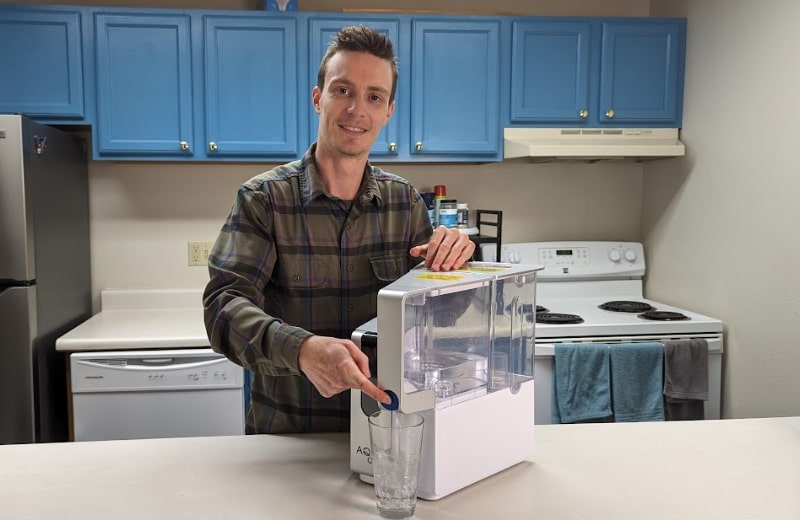
Both AquaTru models have IAPMO certifications for materials safety and structural integrity as part of their performance standards, as well as an IAPMO certification to NSF 372 for lead-free design.
One of the main reasons why the Carafe received the higher overall performance score is that it uses a glass carafe to collect the purified water instead of a plastic water tank. Glass is higher-quality than plastic, earning the Carafe an overall design score of 10.00, while the Classic received a 9.70.

How Hard Is It to Set Up and Maintain the AquaTru Carafe?
AquaTru is also one of the only reverse osmosis systems to achieve the top setup score of 10.00, thanks to its countertop plug-and-play design. Both units arrived pre-installed. We simply inserted the filters and followed the simple priming process.
Maintenance is also quick and easy. Both models have long filter lifespans and minimal cleaning requirements, contributing to a 9.75 score in this category. The Carafe is very affordable to maintain with an ongoing cost of just $0.29/ gallon, while the Classic has an even lower maintenance cost of $0.14/ gallon thanks to its larger filters.
We also had to periodically empty the wastewater tank. But of all the countertop RO systems we used, the AquaTru needed the least frequent empties thanks to its impressive 4:1 recovery rate. That’s the best we’ve come across for any reverse osmosis system, meaning that only 1 gallon of water is wasted for every 4 gallons purified.
How Fast Does the AquaTru Carafe Filter Water?
The only point of improvement we identified was the AquaTru’s filtration speed. In our testing, the unit purified 8 cups of water in 16 minutes and 28 seconds, which equated to a flow rate of 0.03 GPM. This pulled the filtration rate score down to 7.00.
Read the full reviews here: AquaTru Carafe Review / AquaTru Classic System Review
| Criteria | Results |
|---|---|
| Overall Score | 9.57 |
| Health Related Contaminants | 9.90 |
| Aesthetic Related Contaminants | 9.90 |
| Performance Certification | Certified for 100% of reduction claims |
| Filtration Rate | 0.04 GPM |
| Component Quality | Outstanding |
| Component Certification | Exceptional |
| Setup | Exceptional |
| Servicing Requirements | Outstanding |
| Costs | $0.14 – $0.29/ gallon |
| Warranty Length | 1 year |
| Shipping | Free shipping |
| Returns | 30 days |
Cloud RO: Best Under-Sink Reverse Osmosis System (9.24/10)
Cloud RO received the third-highest performance score after the AquaTru Countertop and Carafe models: 9.24. It’s the best-performing under-sink RO system we tested, reducing all contaminants with health effects in our water and offering a fresh take on the traditional, inefficient under-sink tank-based units. It has a small footprint, and its built-in battery pack means you don’t need to plug it into a power outlet.
Best For
Anyone who prefers being able to purify their tap water on demand with an under-sink RO filtration system, but wants a smaller, more modern, and less wasteful alternative to conventional systems.
Product Specs
| Price | $649 |
| Contaminants Reduced | 200+ |
| Certifications | NSF 58 |
| Process | Carbon + Reverse Osmosis + Remineralization |
| Filter Capacity | Pre/Post Filters 500 gallons, RO membrane 1,500 gallons |
| Annual Cost | ~$200 |
| Warranty | 1 year |
Why It’s Best
We tested Cloud with a challenging municipal water supply in a townhome in Denver, Colorado. The system costs around $650, so it’s costlier than most other under-sink RO filters you’ll come across, but there’s usually a sale knocking $100-$200 off the price.
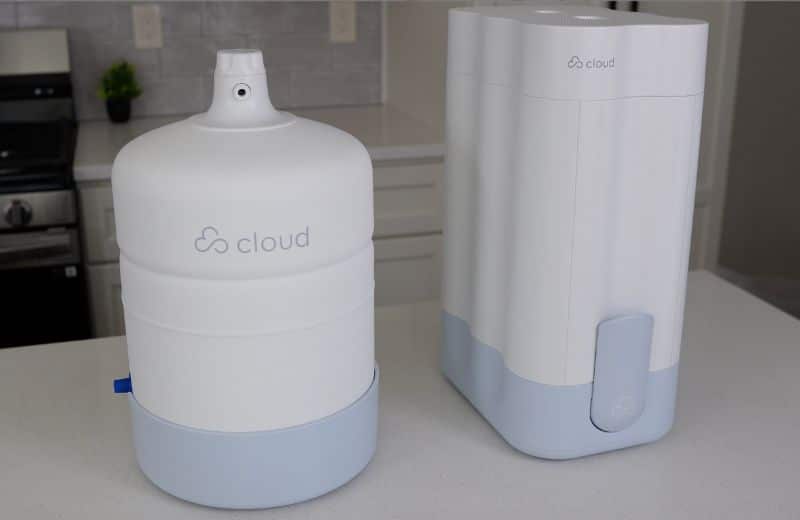
Cloud comes in a single configuration, with a built-in remineralization filter included. It consists of two units: the main unit, which contains all four filter cartridges and the battery pack, and a 2.8-gallon purified water holding tank.
What Contaminants Does Cloud RO Remove?
Key Finding: Cloud RO eliminated fluoride, both disinfection byproducts detected above the Health Guideline Level, plus aluminum, copper, manganese, molybdenum, and strontium. It reduced sulfate by 94% and barium by 78%, earning a 9.42 contaminant reduction score. It’s our top-scoring under-sink RO.
When we tested Cloud, more than 10 contaminants with possible health effects were detected in our unfiltered water. These included three types of disinfection byproducts and uranium (detected above the HGL), as well as barium, nitrate, nitrite, total chromium, copper, molybdenum, fluoride, manganese, and boron. It also greatly reduced barium by 97%, sulfate by 95%, and total chromium by 93%.
That’s a really good result that awarded the system a score of 9.42. But boron was reduced by just 26%, nitrate by 48%, and vanadium by 50%. That means it’s not as thorough as the AquaTru system, which eliminated 100% of all contaminants by comparison. Plus, the system has an NSF certification for TDS reduction, which is a great start, but we’d like to see it obtain certifications for all other contaminants claimed to reduce.
That’s a really good result that awarded the system a score of 9.42. But it’s not as thorough as the AquaTru system, which eliminated 100% of all contaminants by comparison. Plus, the system has an NSF certification for TDS reduction, which is a great start, but we’d like to see it obtain certifications for all other contaminants claimed to reduce.
We were pleased that Cloud’s remineralization filter is built-in instead of being an upgrade at an extra cost. Our purified water still contained 99% less calcium, 68% less magnesium, and 90% less sodium than the unfiltered water. But the pH of our water increased from 8.0 to 8.7, and without the remineralization filter, we probably would have seen this decrease.
How Is Cloud RO Designed?
Cloud impressed us with its design, especially compared to some of the conventional under-sink systems we’ve tested previously.
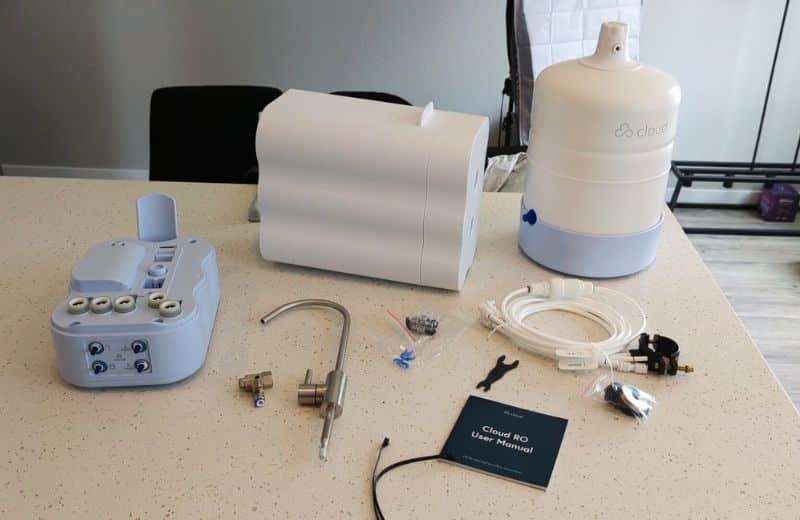
It’s made from BPA-free food-grade plastic and has built-in sensors that track tank volume, water consumption, and water filter lifespan. We downloaded the Cloud app to make it easy to track these stats as well as our purified water’s TDS reading and the system’s battery status, which is a super helpful addition.
Cloud also has a materials safety certification as a component of its NSF 58 performance certification.
Looking at how purified water is delivered, Cloud, like AquaTru, dispenses purified water from a holding tank. But the key difference between the two is that Cloud uses water pressure to deliver the filtered water on demand, providing near-instant access when you turn on the faucet.
In our flow rate testing, at a feed water temperature of 57.5°F and a static water pressure of 50 PSI, it took an average time of 124.29 seconds to fill to the 12-ounce line of our jug, equating to 65.17 GPD — only slightly lower than Cloud’s projected 80 GPD.
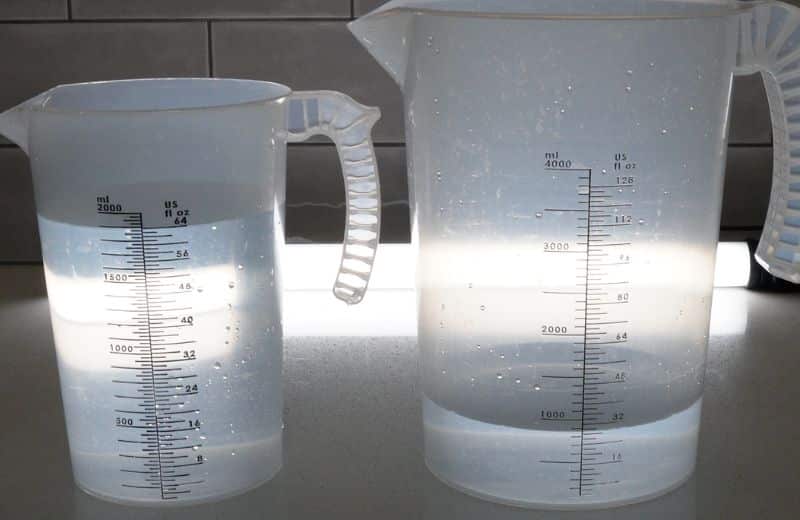
The system’s pure-to-wastewater ratio of 1:1 means it’s not as efficient as the AquaTru, but it’s still far more efficient than conventional systems, which typically waste up to 4 gallons of water for every 1 gallon purified. In our own recovery rate analysis, 66 ounces of wastewater were recorded in the time it took to purify 64 ounces of water. That means for every 1 ounce of water purified, 1.03 ounces of water goes to drain — very similar to Cloud’s 1:1 claim.
All good so far — but an unexpected setback of Cloud was that TDS creep appeared to be an issue in our tests. After leaving it to sit idle overnight, we took a 1st draw TDS reading of 284 PPM, which is indicative of TDS creep, especially when we compared it to our second draw sample reading ot 68 PPM, taken after running water through the system for 2 minutes.
What’s Involved in Installing and Maintaining Cloud RO?
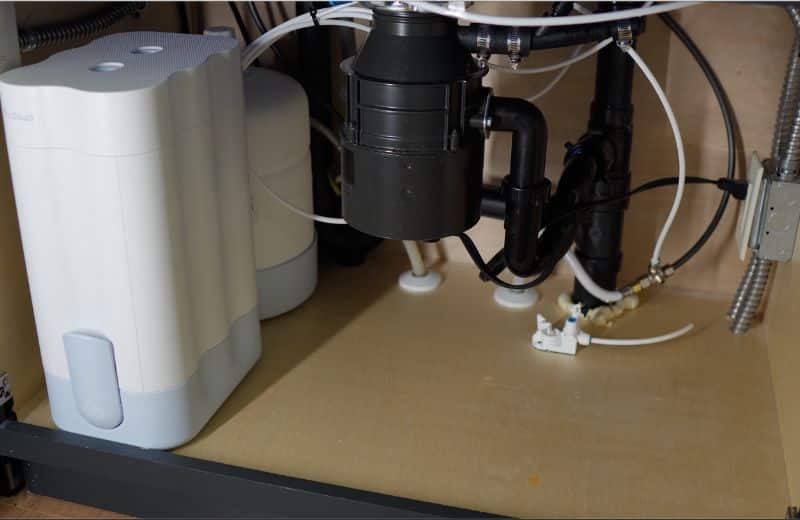
Because Cloud is an under-sink RO system, we knew it wouldn’t be as easy to install as the AquaTru countertop system, and it received a lower setup score of 7.50. The system has more components that need to be installed separately, including the dedicated lead-free faucet, tank, and drain line.
But Cloud’s design is fairly minimalist, with all filters contained within a single unit and a detachable base, meaning we could install the base first without having the bulky filter unit getting in the way.
That simplified the installation process somewhat, and we found the instructions in the user manual helpful. But we still needed some DIY skills for tasks like drilling into our countertop to install the dedicated faucet and installing the drain line, and the process was time-consuming.
Once the install was out of the way, maintenance was nice and easy, awarding Cloud a 10.00 score in this category. The system’s app alerted us when replacement filters were needed, saving us the job of making our own calendar reminders.
We calculated that the unit’s ongoing spend is $0.26/ gallon. This is over twice AquaTru’s maintenance spend—a contributing factor was likely Cloud’s battery (which needs replacing every 1.5 years), something that AquaTru doesn’t have.
Once installed, Cloud was whisper-quiet in our sound tests: at 1 foot, it produced 29.0 decibels, and at 3 feet, it produced 28.9 decibels. It’s what we expect for a conventional RO system that doesn’t use an internal pump.
Read the full review here: Cloud RO Review
| Criteria | Results |
|---|---|
| Overall Score | 9.24 |
| Health Related Contaminants | 9.90 |
| Aesthetic Related Contaminants | 3.50 |
| Performance Certification | Certified for 16% of reduction claims |
| Filtration Rate | 80 GPD |
| Component Quality | Exceptional |
| Component Certification | Certified |
| Setup | Below Average |
| Servicing Requirements | Exceptional |
| Costs | $0.26/ gallon |
| Warranty Length | 1 year |
| Shipping | Free on all orders in the US |
| Returns | 90 days |
Waterdrop G3 P800: Best Tankless RO System (9.21/10)

Sticking in the under-sink category, the Waterdrop G3 P800 is the best tankless RO system we’ve tested. This system has an impressively fast water production rate and a modern, high-tech design. It completely removed most of the impurities in our water, and we found it easy and affordable to maintain. It received an overall performance score of 9.21.
Best For
Anyone looking for the best under-sink RO filtration system for a small under-sink space, or folks who simply prefer the convenience of a tankless unit.
Product Specs
| Price | $539 – $999 |
| Contaminants Reduced | 10+ |
| Certifications | NSF/ANSI 42, 53, 58, 372 |
| Process | Mechanical + Carbon + RO |
| Filter Capacity | 550/ 1100/ 2900 gallons |
| Annual Cost | ~$145 |
| Warranty | 1 year |
Why It’s Best
We tested the Waterdrop G3 P800 with city water in Parker, Colorado. The unit has one of the highest upfront costs of all the POU systems we tested, at just under $1,000. The price jumps up and down by around $300, and you can often take advantage of a sale, but it’s still a big investment.
So, what are you paying for? The fact that this Waterdrop model is tankless, with an internal pump to send water straight through the system to your faucet, definitely contributes to its high price tag.
The system has a couple of other unique features, too, including a smart faucet, built-in TDS meters, and a UV purifier (with a 99.9% sterilization rate), which protects against bacteria growth within the filters. But disappointingly, there’s no built-in remineralization filter—only the option to buy and install a filter separately from Waterdrop at an extra cost of around $30.
What Contaminants Does the Waterdrop G3 P800 Reduce?
Key Finding: The Waterdrop G3 P800 completely eliminated 6 of 9 health-related contaminants detected in our test water, including lead and arsenic (both above the Health Guideline Level), and significantly reduced strontium, barium, and nitrate. It holds IAPMO certifications to NSF 42, 53, and 58.
The Waterdrop G3 P800’s contaminant reduction results are comparable to AquaTru’s and Cloud’s, although not quite as impressive.
14 contaminants with health effects were detected in our unfiltered water, with three DBPs, fluoride, and uranium exceeding the HGL.
Without remineralization, G3 eliminated all contaminants detected above the HGL, apart from fluoride, which was reduced by 78%. It also completely removed barium, copper, selenium, molybdenum, vanadium, strontium, and total chromium, and reduced nitrate by 75%.
With the added remineralization filter, the G3 eliminated all contaminants detected above the HGL, including fluoride. It completely removed barium, copper, selenium, molybdenum, and vanadium. Additionally, strontium was reduced by 97%, and total chromium by 88%.
We could also see from our results that the remineralization filter was doing its job, restoring alkalinity to 27 PPM (without remineralization, it dropped to 0) and maintaining a slightly alkaline pH of 7.5 (without remineralization, it dropped to 7).
There were a couple of more disappointing results that we noted: boron was reduced by just 19% (to 0.338/0.34 PPM) with both configurations, and 0.24 PPM nitrite appeared in the filtered water in our with-remineralization test, possibly from the biofilm in the remineralization cartridge, which converted trace nitrate to nitrite.
The system received a 9.50 score for reducing contaminants with health effects, but its overall score for our lab tests was pulled down to 9.20. This was because it reduced the calcium and magnesium minerals in our water by 87%, causing the pH to drop from 7.3 to 6.3 and affecting the filtered water’s aesthetic score. Testing the G3 P800 with the remineralization filter would likely improve this score.
On a more positive note, Waterdrop’s performance certifications were better than Cloud RO’s. The system has been IAPMO certified to NSF 42, for removing chlorine, and NSF 58 and NSF 53, for reducing TDS, fluoride, cadmium, hexavalent chromium, and selenium. Great—but still no certifications across the board like AquaTru.
Does the Waterdrop G3 P800 Have Smart Features?
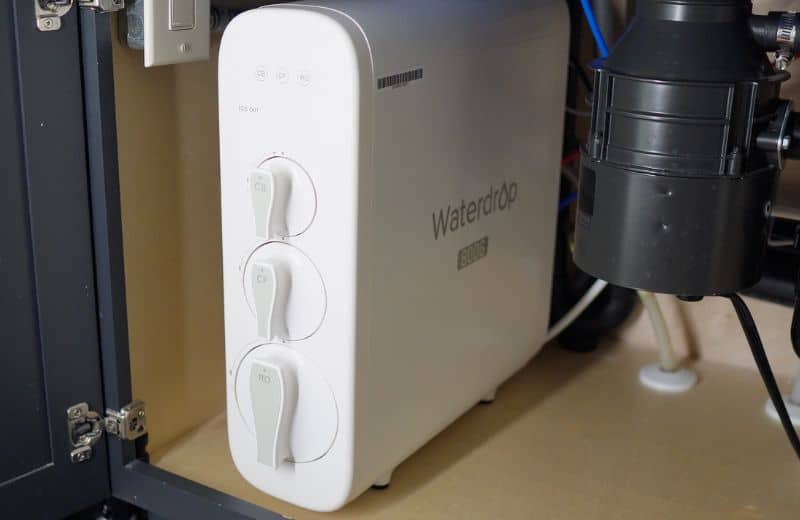
Waterdrop is similar to Cloud when it comes to smart design features. It’s a sleek, space-saving system made from polypropylene and polypropylene, and it received a 9.70 design score from us.
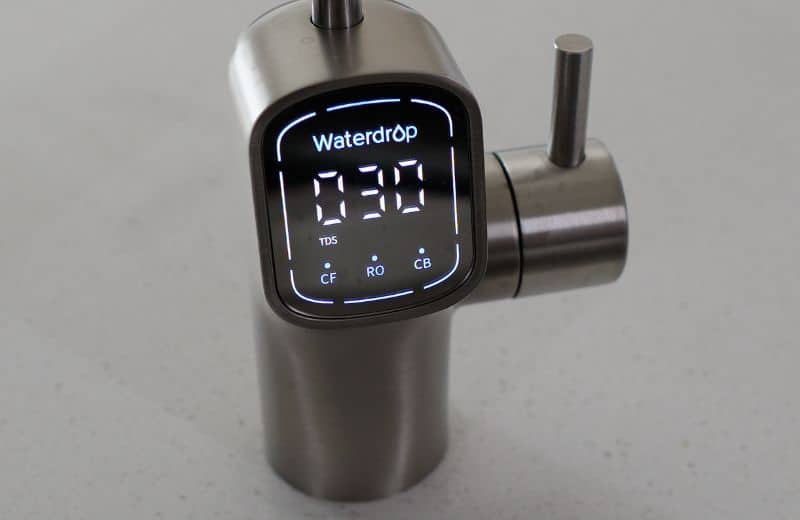
The unit comes with a lead-free smart faucet with an included TDS meter. You can compare the TDS reading at the faucet with the meter on the unit body to check the filters are still working as they should.
We were pleased to see that, like Cloud and AquaTru, Waterdrop has obtained a materials safety certification for the G3 P800 as a component of its NSF performance certifications. It also has an IAPMO certification to NSF Standard 372 for a lead-free design.
Another standout design feature of the G3 P800 is its 800 GPD water production (much higher than you’d actually need), awarding it a 10.00 score from us. In our own flow rate testing, at a feed water temperature of 58.3°F, it took 9.14 seconds to fill to the 12-ounce line of our measuring jug, translating to an excellent flow rate of 886.54 GPD.
And because of its high flow design, the system’s 3:1 efficiency ratio is also great, especially for a tankless system. This makes it a close contender to the AquaTru (with a 4:1 pure-to-wastewater ratio). In our own tests, 29 ounces of wastewater were recorded by the time the unit had dispensed 64 ounces of purified water, equal to a pure-to-wastewater ratio of approximately 1:0.45. That means for every 1 ounce of water purified, 0.45 ounces of water goes to drain.
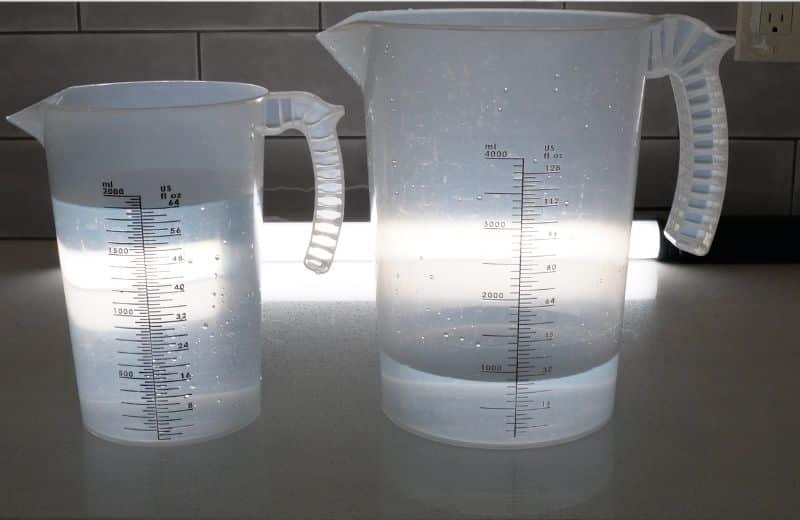
Another standout design feature of the G3 P800 is its 800 GPD water production (much higher than you’d actually need), awarding it a 10.00 score from us. And because of its high flow design, the system’s 3:1 efficiency ratio is also great, especially for a tankless system. This makes it a close contender to the AquaTru (with a 4:1 pure-to-wastewater ratio).
A setback of all tankless under-sink RO systems is that they’re susceptible to TDS creep, which can affect their water output and performance efficiency. But when we measured TDS creep ourselves after letting the G3 sit idle overnight for 10 hours, it had a 1st draw TDS reading of 67 PPM, which is not indicative of TDS creep, since TDS had been reduced by almost 600 PPM (feed water TDS: 656 PPM). We’ve discussed TDS creep in more detail here.
How Hard is the Waterdrop G3 P800 to Install?
The G3 P800 is tankless, but the installation process was similar to installing Cloud, minus the water-holding tank.
That meant we encountered a lot of the same challenges, including installing the drain line and dedicated faucet. The lower 7.00 setup score reflected the additional time and effort it took us to install the system.
But, like Cloud, Waterdrop’s model is designed to be as easy to install as possible. All three filters (a carbon block and sediment pre-filter, an activated carbon coconut filter, and a semi-permeable RO membrane) are contained within the main body of the unit. This minimized the individual connections we needed to make.
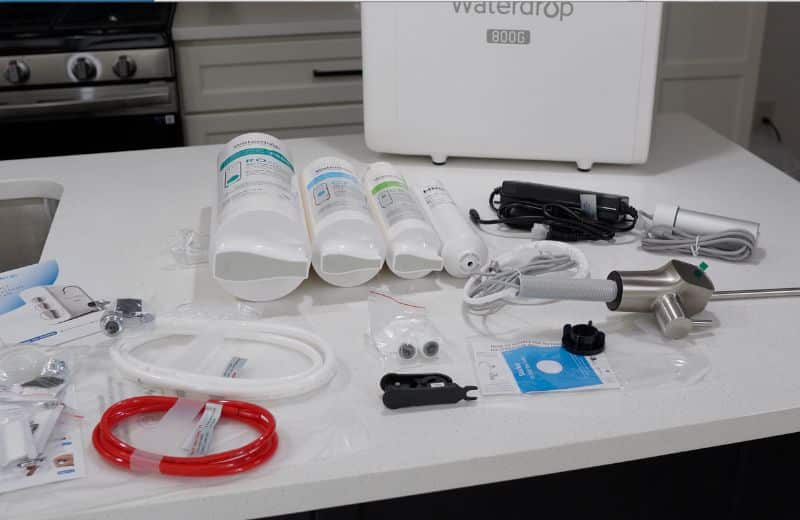
Maintenance was much easier, and we awarded Waterdrop a 10.00 score in this category. We knew when to replace the filters thanks to the built-in filter change reminder. Without the remineralization filter, the system’s ongoing maintenance cost came in at just $0.11/ gallon (or $0.13/ gallon with the filter). This equates to a total annual cost of $124.75, and a 5-year ownership cost (including the cost of the upfront purchase) of $1,622.77.
Despite the built-in pump, the G3 is still a pretty quiet unit, with our phone app measuring 43–46 decibels while it was in operation.
Read the full review: Waterdrop G3 P800 Review
| Criteria | Results |
|---|---|
| Overall Score | 9.21 |
| Health Related Contaminants | 9.50 |
| Aesthetic Related Contaminants | 3.50 |
| Performance Certification | NSF 42, 53, 58 |
| Filtration Rate | 800 GPD |
| Component Quality | Outstanding |
| Component Certification | Certified |
| Setup | Weak |
| Servicing Requirements | Exceptional |
| Costs | $0.11/ gallon |
| Warranty Length | 1 year |
| Shipping | Free shipping to lower 48 states |
| Returns | 30 days |
Waterdrop A1: Best Feature-Loaded Countertop RO (9.12/10)
The Waterdrop A1 is the third-highest-scoring countertop RO system on this list, following both AquaTru models. It received an overall weighted score of 9.12, impressing us by completely removing almost every single health-related contaminant (and greatly reducing the rest). It’s also IAPMO certified for TDS reduction and has a higher-tech design than AquaTru, including hot and cold water dispensing. But, it doesn’t remineralize purified water, and it’s one of the most expensive POU systems we’ve tested.
Best For
Product Specs
| Price | $650 |
| Contaminants Reduced | 10+ |
| Certifications | NSF/ANSI 58 |
| Process | Mechanical + Carbon + RO + UV |
| Filter Capacity | CF filter 225 gal.; RO membrane 550 gal. |
| Annual Cost | ~$130 |
| Warranty | 1 year |
What Did Our Lab Tests Show for the Waterdrop A1?
Key Finding: The Waterdrop A1 eliminated uranium and fluoride (both detected above the Health Guideline Level), along with chlorine, sulfate, copper, phosphorus, molybdenum, and strontium. It reduced nitrate by 92.31% and barium by 82.26%, and holds IAPMO certification to NSF 58 for TDS reduction.
When we assessed its contaminant reduction capabilities, the A1 met our performance expectations for an RO system. It eliminated uranium and fluoride (both of which were detected at levels exceeding the HGL), as well as chlorine, sulfate, copper, phosphorus, molybdenum, and strontium. It almost completely removed nitrate and barium (by 92.31% and 82.26%, respectively).
The system also has an IAPMO certification to NSF 58 for TDS reduction (as confirmed by our own testing, where TDS was reduced by >95%). It’s not as extensively certified as AquaTru, but this still contributed to its contaminant reduction score of 9.54.
What stopped the A1 from being the highest achiever in this category? The main factor that let it down was its lack of remineralization. Unlike most other RO systems we tested, it doesn’t come with a remin filter, nor can you get one as an optional upgrade. That meant our purified water was mineral-deficient (with the filter having greatly reduced calcium, magnesium, sodium, carbonate, and bicarbonate), resulting in a slightly acidic pH of 6.5.
How Efficient is the Waterdrop A1?
One of the A1’s biggest selling points compared to similar systems like the AquaTru is its hot and cold water on demand (from 41℉ to 203℉. This feature alone might make it a real contender for you, but how does it perform on the whole?
When we’re reviewing reverse osmosis systems, efficiency ratio is a key point of interest for us. The A1 wastes 1 gallon of water for every 2 gallons of water purified, making it superior to Cloud RO but around half as efficient as AquaTru (with its excellent 4:1 pure-to-waste ratio).
We also measured the Waterdrop A1’s filtration rate, which came in at around 0.042 GPM based on its ability to filter a full tank in 4 minutes and 40 seconds. It received one of the lowest scores of all the filters we tested in this category: just 7.00.
Like all the other RO filters we tested, the A1 has a mostly plastic design. It also joins every other unit aside from Philips in having a design certification—specifically, it’s certified for lead-free materials, contributing to its design score of 9.40. It’s one of the higher-tech RO systems we’ve used, with a digital display screen with numerous presets for water volume and temperature, a TDS monitor, and a couple of energy-saving modes.
Where the A1 really excelled was in our maintenance testing and calculations. It earned a score of 10.00, with its filter life tracker making it easy to know when to buy replacements and its affordable maintenance spend of $0.269 per gallon.
As a countertop unit, the A1 joins AquaTru in having a no-install setup process. It took less effort to set up than Cloud RO or the G3 model, but we still had to refill and empty the water tanks manually. Plus, the process was long, taking just over 41 minutes, pulling down the score in this category to 8.00.
Related review: Waterdrop N1 Review
| Criteria | Results |
|---|---|
| Overall Score | 9.12 |
| Health Related Contaminants | 9.80 |
| Aesthetic Related Contaminants | 8.00 |
| Performance Certification | NSF/ANSI 58 |
| Filtration Rate | 0.042 GPM |
| Component Quality | Excellent |
| Component Certification | Exceptional |
| Setup | Fair |
| Servicing Requirements | Exceptional |
| Costs | $0.269/ gallon |
| Warranty Length | 1 year |
| Shipping | Free to contenental US |
| Returns | 30 days |
Philips Water Dispenser: Best Advanced Countertop (8.98/10)
The Philips Countertop Reverse Osmosis Water Dispenser is a 6-stage RO unit that delivers both hot and cold purified water. It followed closely after the Waterdrop A1 with an overall weighted score of 8.98, demonstrating high contaminant reduction efficiency in our testing without significantly affecting the pH of our water. We were pleased with its easy setup and maintenance requirements and built-in remineralization stage, but it lacks performance certifications, and the price may put some folks off.
Best For
Anyone looking to invest in a countertop unit that delivers both hot and cold purified water.
Product Specs
| Price | $799.00 |
| Contaminants Reduced | 10+ |
| Certifications | Not Certified |
| Process | Mechanical + Carbon + RO + UV + Remin |
| Filter Capacity | 528 gal. |
| Annual Cost | ~$130 |
| Warranty | 2 years |
How did the Philips water dispenser perform in our lab testing?
Key Finding: The Philips Countertop Reverse Osmosis Water Dispenser eliminated uranium (detected above the Health Guideline Level) and most other health-related contaminants in our test water, including copper, sulfate, zinc, molybdenum, phosphorus, and nitrate. It reduced fluoride by 92.86%, barium by 82.9%, and strontium by 81.25%, earning a contaminant reduction score of 9.34. The system is not currently performance certified.
The water that we used to test the Philips Countertop RO contained 10 contaminants with possible health effects. 2 of these, uranium and fluoride, were present in concentrations exceeding the HGL. Those not exceeding the HGL included copper, sulfate, barium, zinc, strontium, molybdenum, phosphorus, and nitrate.
The Philips system did an exceptional job of eliminating most of these contaminants, and greatly reducing the others. Of those not entirely eliminated, Barium was reduced by 82.9%, strontium by 81.25%, and fluoride by 92.86%.
Unexpectedly, two impurities appeared in our filtered water: 0.0021 PPM manganese and 1.58 PPM potassium. Most likely, the increase in these contaminants was due to minor media leaching in the remineralization stage.
Speaking of remineralization, the unit still reduced 84% calcium and 95% magnesium overall, even with the mineral-adding filter. But the pH of our water dropped only modestly, from 7.6 (slightly alkaline) to 7.0 (neutral).
The only letdown here is that this Philips model still isn’t performance certified.
Does the Philips Aquaporin RO dispense hot and cold water?
The Philips Countertop RO is similar to the Waterdrop A1 when we look at its design. It got a 7.50 score in this category, pulled down by its lack of a materials safety certification*, but it has many modern features that might appeal to you.
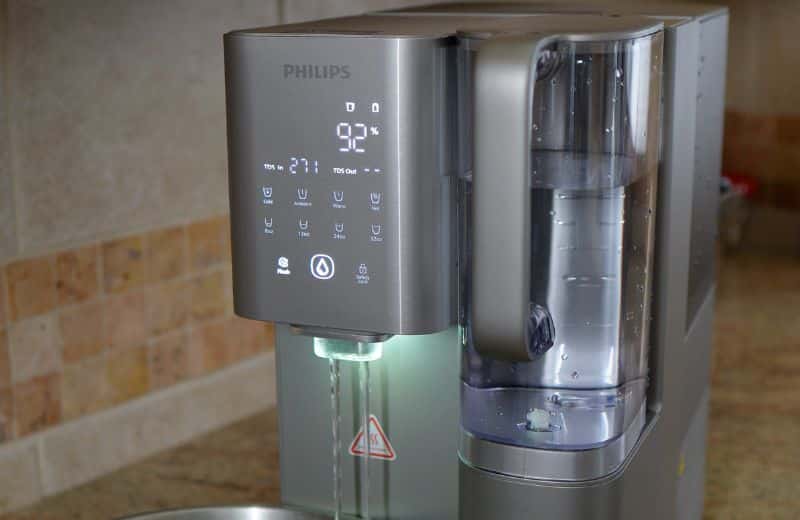
This is another countertop unit with a digital display panel, and there are a lot of different options and presets: a real-time TDS monitor, 6 water temperature presets (ranging from a cool 40°F to a hot 203°F) and 4 water volumes, plus a child safety lock and an automatic flush button.
The unit is made from Acrylonitrile Butadiene Styrene, or ABS, a plastic known for its impact resistance, and it feels pretty sturdy and durable.
The Philips Countertop RO is another system that dispenses water via an internal pump, and its filtration rate measured in at 0.07 GPM
We were also impressed with the unit’s 3:1 efficiency ratio, making it one of the more efficient countertop RO systems we’ve tested.
Is the Philips water dispenser easy to setup and use?
As expected for a countertop system, the Philips Countertop RO was quick and easy to install. Setup involved cleaning the tanks with soap and water and flushing water through the filters, which is easy thanks to the automatic flush button and took us just over 24 minutes (despite the user manual stating it takes 1.5 hours).
Maintenance was equally simple, with just one filter to replace. We could simply check the digital display screen to know when it was time to replace the filter, eliminating the need to make our own calendar reminders.
Finally, calculated the system’s ongoing spend at $0.23 per gallon, making it just as affordable as the other countertop RO systems we’ve tested.
Read full review: Philips Countertop RO review
| Criteria | Results |
|---|---|
| Overall Score | 8.98 |
| Health Related Contaminants | 9.70 |
| Aesthetic Related Contaminants | 9.90 |
| Performance Certification | Not Certified |
| Filtration Rate | 0.07 GPM |
| Component Quality | Good |
| Component Certification | Unsatisfactory |
| Setup | Excellent |
| Servicing Requirements | Exceptional |
| Costs | $0.23/ gallon |
| Warranty Length | 2 years |
| Shipping | Free shipping to lower 48 states |
| Returns | 30 days with conditions |
Frizzlife PD600-TAM3: Best Budget Tankless RO System (8.94/10)
The Frizzlife PD600-TAM3 is a close contender to the Waterdrop G3 as another top-performing under-sink tankless system. It might not have Waterdrop’s extensive performance certifications, but its capable contaminant reduction performance with added remineralization and simple, affordable maintenance earned it a weighted test score of 8.94.
Best For
Product Specs
| Price | $376 |
| Contaminants Reduced | 10+ |
| Certifications | – NSF 372 (lead-free materials only) |
| Process | Carbon pre-filter + RO membrane + Alkaline remineralization filter |
| Filter Capacity | 900 – 1,800 gallons |
| Annual Cost | ~$130 |
| Warranty | 1 year |
What Did Our Lab Tests Show for the Frizzlife PD600-TAM3?
Key Finding: The Frizzlife PD600-TAM3 completely eliminated 3 disinfection byproducts (dibromochloromethane, bromodichloromethane, and bromoform), uranium, and fluoride, all initially detected at concentrations above the Health Guideline Level. It reduced 10 additional contaminants by at least 90% but holds no performance certifications for contaminant reduction.
In our Tap Score testing, the Frizzlife PD600-TAM3 completely eliminated many of the contaminants detected in our feed water, including 3 disinfection byproducts (dibromochloromethane, bromodichloromethane, and bromoform), and uranium and fluoride; all initially detected at concentrations exceeding the HGL.
The system also reduced barium, total chromium, copper, manganese, molybdenum, selenium, strontium, sulfate, and vanadium by at least 90%. But only 38.8% of boron was reduced, along with just 50% of nitrate, resulting in a score of 9.30 in the contaminants with health effects testing category.
Chlorine was also eliminated, and we tested the model with an added final-stage remineralization filter, which increased pH from 7.4 to 8.13 (versus without the remin filter, which reduced pH to 6.6). The unit also prevented the aesthetic effects of low pH RO water, receiving a score of 9.90 in this category.
Ultimately, what let Frizzlife down was its lack of any contaminant reduction performance certifications. It’s the only system in this list so far to not be certified for reducing any contaminants, despite misleading certification information on the product page, resulting in a low score of 6.00.
How Does the Frizzlife PD600-TAM3 Perform on Flow Rate, TDS Creep, and Efficiency?
The Frizzlife PD600-TAM3 has a listed flow rate of 600 GPD. In our own flow rate testing, at a feed water temperature of 60.9°F, we recorded an average flow rate of 0.44 GPM (gallons per minute), converting to just over 639 GPD. This earned the system a high score of 10.00.
We also tested efficiency ratio by unhooking the end of the wastewater line and placing it inside a 1-gallon measuring cup. We recorded the volume of wastewater produced in the time it took to fill 12 ounces of water, then repeated the test, this time filling to 64 ounces:
- 12-ounce test: 12 ounces of wastewater produced; pure-to-drain ratio of 1:1.
- 64-ounce test: 42 ounces of wastewater produced; pure-to-drain ratio of 1.52:1 (closer to the manufacturer’s 2:1 claim).
Finally, we measured TDS creep by letting the system sit idle overnight for 10 hrs, then filling a glass with the first draw water sample and immediately taking a TDS reading with our handheld TDS meter:
- Our feed water TDS measured 645 PPM.
- The 1st draw TDS reading was 474 PPM.
- The 2nd draw TDS reading (after letting water flow through the system for 2 minutes) was 49 PPM with the remineralization filter, and 40 PPM without this filter.
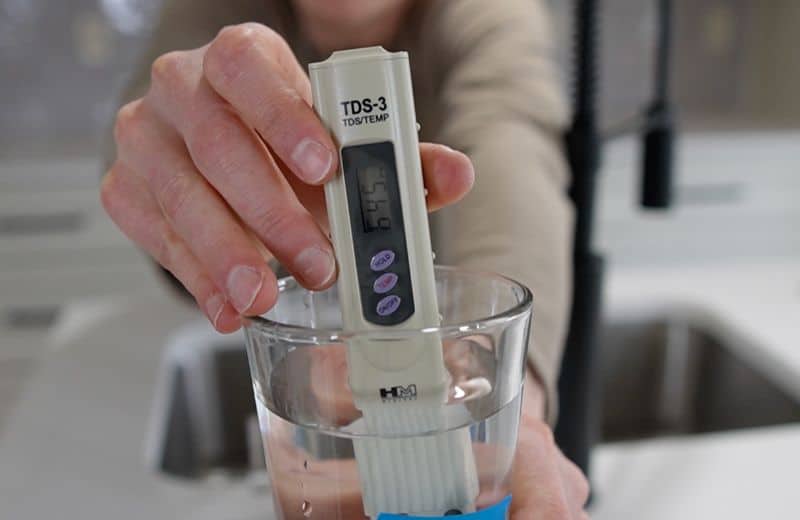
That means the unit had a TDS creep of 434 PPM (the difference between the 1st and 2nd draw). We recommend running your faucet for around 10-15 seconds to flush out the water with elevated TDS from TDS creep.
Is the Frizzlife PD600 Easy to Set Up?
In our own hands on testing, we recorded a mixed bag of results.
For its design, the unit received a score of 8.80. It’s constructed from food-grade polypropylene, with a lead-free faucet and a digital display that gives you a real-time TDS reading and filter lifespan indicators.
The ¼” quick-connect components feel cheaper and flimsier than in similar systems, but we were impressed that the shutoff valve is stainless steel rather than plastic. Plus, the system has an IAPMO certification to NSF 372, for lead-free design.
As with all the other under-sink RO systems we’ve tested, the PD600-TAM3 has a time-consuming install process. It took us 90 minutes in total, and we experienced a couple of issues along the way that could have been avoided: the gasket in the 3-way feed water valve falls out easily, and the tubing isn’t color-coded.
Flushing the system took 20 minutes; less time-intensive than many similar systems, contributing to an overall setup score of 7.00.
Thankfully, maintenance is simple. There are just 2 filters to replace (3 with the added remin filter), and the filter lifespan tracker removes the guesswork. The unit has a low ongoing spend of just $0.10/ gallon, and we recorded its energy usage (for the built-in pump) as just 3 watt hours per gallon, resulting in the top maintenance score of 10.00.
With the unit up and running, we took the opportunity to test its noise levels. At a 1-foot distance away, our app measured 48.4 decibels, and at 3 feet away, it measured 44.7 dB. It was one of the loudest RO systems we tested, producing almost twice as much noise as some of the tank-based systems we reviewed.
Read the full review here: Frizzlife PD600 review
| Criteria | Results |
|---|---|
| Overall Score | 8.94 |
| Health Related Contaminants | 9.30 |
| Aesthetic Related Contaminants | 9.90 |
| Performance Certification | Not Certified |
| Filtration Rate | 600 GPD |
| Component Quality | Fair |
| Component Certification | NSF 372 |
| Setup | Weak |
| Servicing Requirements | Exceptional |
| Costs | $0.10/ gallon |
| Warranty Length | 1 year |
| Shipping | Free on orders > $25 for US orders |
| Returns | 30 days |
APEC ROES-PH75: Best Budget Tank-Based RO System (8.87/10)
The APEC ROES-PH75 is the second-highest-scoring conventional RO system in this list, following Cloud RO. This under-sink unit might not have the techy features of a more modern system, but it’s one of the most affordable tank-based models we’ve tested so far. Plus, it removed most contaminants in our testing, with certifications for TDS reduction, materials safety, and lead-free design all contributing to its overall performance score of 8.87.
Best For
Product Specs
| Price | $268.99 |
| Contaminants Reduced | 10+ |
| Certifications | NSF/ANSI 58 |
| Process | Sediment + Carbon + RO + Remineralization |
| Filter Capacity | 6-24 months |
| Annual Cost | ~$97 |
| Warranty | 1 year (Limited) |
How Did the APEC ROES-PH75 Perform in Our Lab Tests?
Key Finding: The APEC ROES-PH75 eliminated all 5 contaminants detected above the Health Guideline Level in our test water (3 disinfection byproducts, fluoride, and uranium), plus molybdenum, selenium, sulfate, and vanadium. It holds a WQA performance certification for TDS reduction and a materials safety certification.
The APEC ROES-PH75 shone in our lab testing, eliminating all contaminants detected above the HGL (3 disinfection byproducts, fluoride, and uranium), along with molybdenum, selenium, sulfate, and vanadium.
It also greatly reduced barium, strontium, and chromium, and did a slightly poorer job of reducing nitrate by 64% and boron by 49%. We awarded a score of 9.40 for reducing contaminants with health effects.
We chose to test the ROES-PH75 with included remineralization, and our on-site pH meter readings showed an increase in pH from 7.59 to 8.77 (slightly alkaline). Plus, 100% chlorine was eliminated, contributing to a top aesthetic score of 9.90.
The unit has been performance certified by the WQA to reduce TDS, just like Cloud RO, earning it a score of 8.00 in this category.
How Did the APEC ROES-PH75 Perform in Our Efficiancy, Flow, and TDS Creep Testing?
In our dedicated RO tests, the ROES-PH75 performed better in some areas than in others.
Starting with the positives, TDS creep wasn’t an issue with this unit, as confirmed by our testing. We measured this by letting the system sit unused for 10 hrs, then filled a glass with the first draw water sample and immediately took a TDS reading with our handheld TDS meter.
Our feed water had a TDS of 647 PPM, while the 1st draw TDS reading was 49 PPM, and the 2nd draw TDS reading (after letting water flow through the system for 2 minutes) was 44 PPM.
The difference between the 1st and 2nd draw was just 5 PPM, telling us that TDS creep is not a significant issue with this unit.
As for filtration rate, the ROES-PH75 has a listed flow rate of up to 75 GPD. We wanted to see how it performed in our real testing conditions, with a feed water temperature of 60.4°F and water pressure of 48 PSI. To do this, we filled a graduated measuring container with purified water, timing how long it took to reach the 12-ounce fill line.
Our recorded time was 189.47 seconds, which translates to a flow rate of 0.03 GPM (gallons per minute), or 42.74 GPD. Remember, APEC only claims up to 75 GPD, and our cooler feed water and lower incoming pressure likely affected flow rate in our testing.
We also measured APEC’s efficiency ratio to see how it compared to the listed pure-to-waste ratio of 1:3 in our real-world test conditions. We disconnected the drain line and directed the wastewater into a measuring container, while filling a separate container with measured volumes of purified water:
- When the 12-ounce line was reached, we’d collected 128 ounces of wastewater, equalling a ratio of around 1:10.6.
- When filling to 64 ounces, we recorded 328 ounces of drain water; a recovery rate of 1:5.1.
We expected this improved result with our larger draw. RO systems require a short period to stabilize when they’re first turned on, and a smaller draw captures more of that less efficient startup phase; hence the poorer recovery rate in test 1.
How Hard is the APEC ROES-PH75 to Install and Maintain?
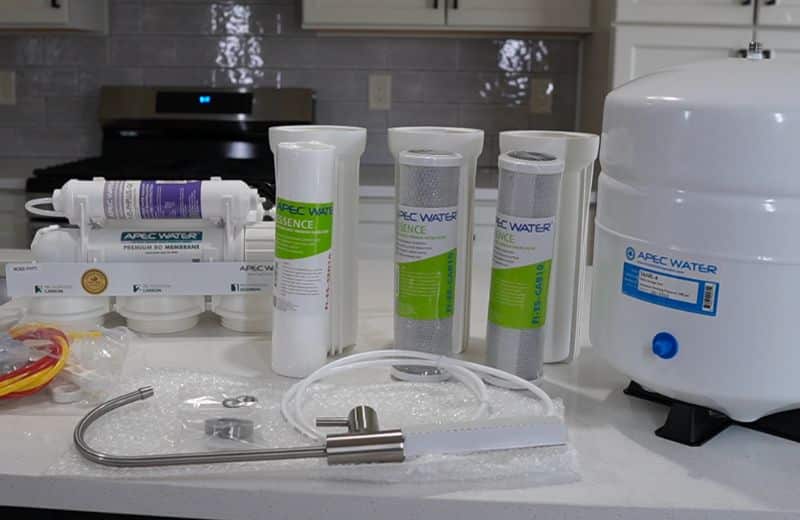
The ROES-PH75 has a simple design, made from WQA-certified plastics, including polypropylene. The lead-free faucet has a chrome overlay, and the overall build feels sturdy and durable. Plus, it has a WQA certification for lead-free design and a materials safety certification as a component of its performance certification, earning it one of the highest design scores we’ve awarded so far: 9.70.
You don’t get any of the helpful tech features that we typically see with tankless systems, like TDS monitors and filter lifespan trackers. But from a build quality and certification perspective, APEC performed better than many of the higher-tech systems we reviewed.
With that said, the no-frills design doesn’t take away from the challenging install. The process took us 90 minutes, and a few features (such as non-color-coded filters and housings and no quick-mount nut for the faucet) extended the process unnecessarily.
We spent 3 hours flushing one tank’s worth of water, then we waited another 2-3 hours for the tank to refill, with this time-consuming process contributing to the unit’s lower setup score of 7.00.
The ROES-PH75 is affordable to maintain, with an ongoing filter replacement cost of $0.10-$0.21 per gallon (assuming that we use it to purify 2-4 gallons of water per day). But since there’s no display screen with filter change alerts, there’s a bit more work that goes into making your own phone calendar reminders, which pulled the maintenance score down slightly to 9.25.
While the ROES-PH75 was in operation, we measured noise output at 1 foot and 3 feet away. At 1 foot, the unit produced 24.3 decibels, and at 3 feet, it produced 23.9 decibels. That’s very quiet, and it’s possible that our app was even picking up some noise from the refrigerator in the kitchen rather than the unit itself.
Read the full review: APEC ROES-PH75 Review
| Criteria | Results |
|---|---|
| Overall Score | 8.87 |
| Health Related Contaminants | 9.40 |
| Aesthetic Related Contaminants | 9.90 |
| Performance Certification | NSF/ANSI 58 |
| Filtration Rate | 75 GPD |
| Component Quality | Outstanding |
| Component Certification | NSF/ANSI 58 & 372 |
| Setup | Weak |
| Servicing Requirements | Good |
| Costs | $0.10-$0.21 / gallon |
| Warranty Length | 1 year |
| Shipping | Free Shipping to US domestic 48 contiguous states |
| Returns | 30 days |
AquaTru Under Sink Gen 2: Best Tank Based for Certifications (8.80/10)
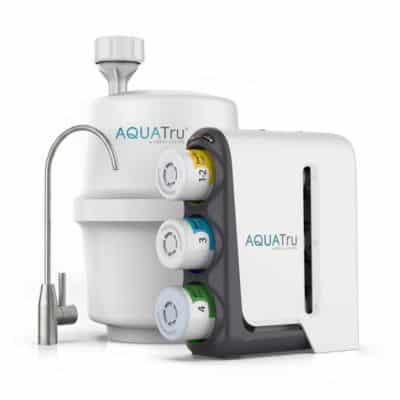
The AquaTru Under Sink Gen 2 rounds off this list as an alternative to Cloud RO, with a similarly modern, forward-thinking design (it’s AquaTru’s newly released upgrade of the original Legacy model).
The system wasn’t quite as thorough as Cloud when removing contaminants from our water, but it’s more comprehensively certified and around $200 cheaper upfront.
What We Like
| Price | $395+ |
| Contaminants Reduced | 84 |
| Certifications | NSF/ANSI 42, 53, 58 & 401 |
| Process | Sediment + Carbon, RO Membrane, VOC Carbon Filter |
| Filter Capacity | Pre-filter: 600 gal; VOC filter: 600 gal; RO membrane: 1,200 gal |
| Annual Cost | ~$193.22 |
| Warranty | 1 year (3-year extended warranty available for $50) |
What Did the AquaTru Under Sink Remove From Our Water?
Our test water for the AquaTru Under Sink was challenging, with more than a dozen contaminants with possible health effects detected. 4 of these exceeded the HGL: bromoform and dibromochloromethane (two disinfection byproducts in the THMs group), along with fluoride and uranium.
The rest of the contaminants were detected at concentrations not exceeding the HGL: boron, copper, sulfate, nitrate, strontium, barium, total chromium, selenium, vanadium, manganese, and molybdenum.
Our post-filtration lab report showed that both total THMs were fully removed, along with uranium, fluoride, and the majority of contaminants detected below the HGL. Manganese was reduced by just 15%, and boron was reduced by 13%. These results translated to a score of 9.05 for reducing contaminants with health effects.
We got the AquaTru Under Sink without a remineralization filter, so unsurprisingly, pH dipped from 8.1 to 6.7 (mildly acidic), alkalinity went to zero, calcium was reduced by 99.76%, and magnesium and potassium by 100%. You can upgrade to a remineralization model, which costs $25 extra and includes an alkalizing version of the VOC filter, to avoid this pH reduction and significant mineral loss.
Impressively, AquaTru has been certified by IAPMO to remove every single contaminant it’s claimed to reduce (that’s 84 contaminants in total!), to NSF Standards 42, 53, 58, and 401. This earned it the highest score of 10.00 in this subcategory.
What Was Our Experience with Installation, Maintenance, Design Quality, & Filtration Rate?
The AquaTru Under Sink received a lower score of 7.50 for its challenging installation (including connecting the drainline and drilling a hole for the faucet), although it did have several features — like color-coded tubing and connections, push-to-connect fittings, and filters that twist in and out — that simplified the process.
From start to finish, the setup took us 60 minutes, followed by the break-in flush for the filters, which involved filling and emptying the purified water tank twice (a process that took 2-3 hours each).
A unique bonus of this Gen 2 model is that it has an integrated leak detector alarm that sounds audibly when water is detected. This helps with both detecting leaks inside and outside the unit.
It has a sturdy, durable Tritan plastic design, with several thoughtful design features, including the TruPureTM RO Sanitizer, which offers easy access to the holding tank for annual cleaning. Combined with its materials safety certification as a component of its performance certifications, AquaTru received a score of 9.70 for its design.
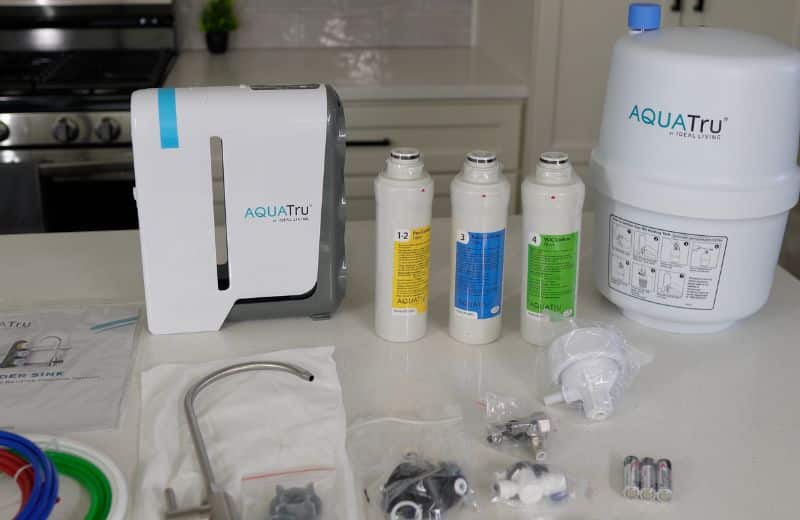
Once installed, we measured a flow rate of 32.65 GPD at a feed water temperature of 67.5°F and water pressure of 49 PSI. That makes it one of the slowest filtration speeds we’ve recorded for an under-sink RO system, and around 20 GPD slower than AquaTru’s listed membrane rating, resulting in a score of 6.40.
On a more positive note, maintenance for the system is particularly easy thanks to the integrated filter tracker, which alerts you when a replacement filter is needed. The system has a cost-per-gallon of $0.18, equivalent to a total annual cost of $193.22, or a 5-year ownership cost of $1,361.11. It’s both easy and affordable to service, contributing to its high maintenance score of 9.75.
How Did It Perform in Our Other RO-Specific Tests?
In our efficiency ratio testing, we collected 41 ounces of wastewater while the system filled our measuring container to the 12-ounce mark. That’s a recovery rate of around 1:3.42, meaning that 3.42 ounces of water are wasted per 1 ounce purified.
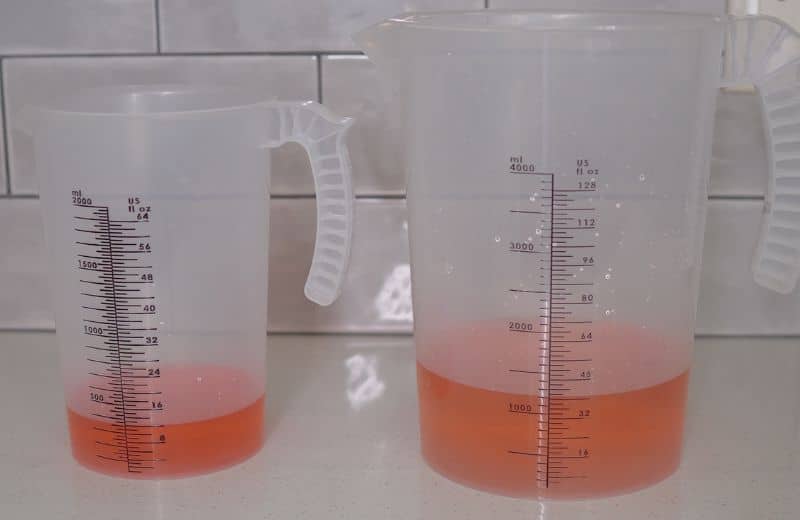
We then repeated the process with a larger purified water draw of 64 ounces. This time, 209 ounces of drain water were produced, equating to a recovery rate of 1:3.27 (so, 3.27 ounces wasted per 1 ounce purified). This AquaTru model definitely isn’t the most efficient system we’ve tested, but it’s also within the normal range for a conventional under-sink RO system.
We also tested the system for signs of TDS creep. Our initial, before-filtration reading was 695 PPM, and our first-draw sample from the RO faucet measured just 15 PPM—not indicative of TDS creep.
We then let water run through the system for 2 minutes before taking a second draw reading, which had a TDS reading of 13 PPM. The difference between the 1st and 2nd draw was just 2 PPM.
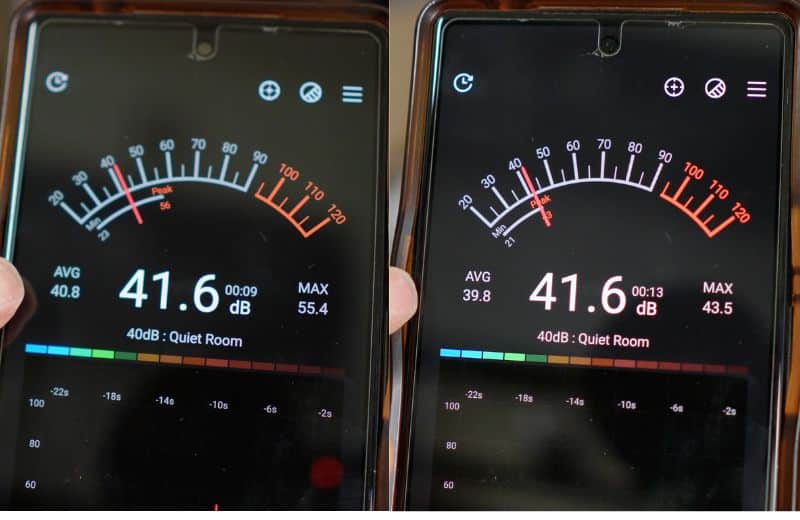
After installing the AquaTru Gen 2, we measured sound decibels at 1 foot and 3 feet away. At 1 foot, the unit produced 40.8 decibels, and at 3 feet, it produced 39.8 decibels. That’s actually around the volume of a tankless system, so louder than expected.
| Criteria | Results |
|---|---|
| Overall Score | 8.80 |
| Health Related Contaminants | 9.00 |
| Aesthetic Related Contaminants | 9.90 |
| Performance Certification | NSF/ANSI 42, 53, 58 & 401 |
| Filtration Rate | 54 GPD |
| Component Quality | Outstanding |
| Component Certification | Materials Safety Certified |
| Setup | Below Average |
| Servicing Requirements | Outstanding |
| Costs | $0.18/ gallon |
| Warranty Length | 1 year |
| Shipping | Free Shipping to all 50 states |
| Returns | 30 days |
Other Systems We’ve Tested That Didn’t Make the List
How to Select the Best Reverse Osmosis System
The best reverse osmosis system for you depends on your budget, contaminant removal goals, and other desired outcomes. Make sure to consider all the factors that could influence your purchasing decision before you start shopping.
Here, we’ve shared everything we personally considered – which you will also find helpful to consider – when deciding on the best reverse osmosis filtration system for different situations.
- Contaminants in source water – First, we considered the contaminants in our source water. We know from regular testing that our water contains trace levels of fluoride, lead, nitrate, disinfection byproducts, minerals and salts, and other impurities. Our advice is to test your water to find out what it contains and what you want to remove. Generally, the greater the total dissolved solids concentration, the faster the filters will become clogged. Plus, an excess of certain minerals, like hardness ions and iron, might damage the RO membrane. We generally only review RO systems for city water, but if you’re on a private well and want to benefit from RO purification, our advice is to install suitable pre-filtration (such as sediment or iron filters, or water softeners) upstream of the reverse osmosis system.
- System type – We identified four key types of reverse osmosis water filters: tank-based under-sink systems, tankless under-sink systems, countertop systems, and whole-home systems. Of these system types, we reviewed the first three. We’ve made a separate guide for whole-house RO systems since there are specific factors that only apply to these units.
- Efficiency ratio – We also considered the efficiency ratio of the systems we were reviewing, or the gallons of water that were wasted for every gallon purified. Conventional RO systems generally waste 3-4 gallons of water for every 1 gallon purified, but we determined that many of the modern systems have much better efficiency ratios of 1:1 gallons to 4:1 gallons, meaning that only one gallon of water is wasted for every 1-4 gallons of water purified.
- Water usage – This was something that we considered when reviewing the countertop and tank-based systems in particular. Our aim was to find systems that would offer a practical, convenient solution for the average family of 2-4. We found that using more water than average might have effects on the system. For instance, a tank-based system stores drinking water to be delivered to your faucet, and using too much water at once could empty the storage tank. If your RO water requirements are a lot higher than the average family’s, we recommend a tankless under-sink water filtration system that delivers purified water on demand, rather than a countertop unit with tanks that you’ll need to empty and fill constantly.
- Water pressure – In our research, we found that the reverse osmosis process can only work effectively when enough pressure is applied to force the water through the semi-permeable membrane (the RO filter) to the other side. Water pressure isn’t an issue with countertop systems, which use an electric pump to send water through the system. But for under-sink reverse osmosis filters, most manufacturers say that your water pressure should be at least 60 PSI for optimal functioning. We strongly advise installing a pressure booster pump if your water pressure is lower than this.
- Storage capacity – For RO systems with a storage tank (both tank-based under-sink systems and countertop systems), storage capacity was something else for us to compare and consider. We found that most under-sink systems had a storage tank of around 1.5-3 gallons, while the countertop systems could hold around 0.5-0.75 gallons of filtered water.
- Remineralization needs – We knew that reverse osmosis, being the most thorough water treatment process, removed everything from water, including healthy minerals and salts. While we can get magnesium and calcium from other sources, obtaining them through drinking water is an easy way to ensure we’re getting our daily mineral requirements. When choosing the systems for this guide, we looked for those with a built-in remineralization filter or at least an optional add-on filter, allowing for minerals to be added back into the filtered water before dispensing.
Why Buy A Reverse Osmosis Water Filter?
First, we wanted to know why we, or anybody else, should invest in a reverse osmosis water filter.
To learn this, we researched water quality data to understand how our drinking water might be impacted by common contaminants in the US.
Water Quality Facts and Figures
In our research, we came across a number of studies that supported our belief that water purification could be beneficial to the average US homeowner on a city drinking water supply. Some of the most notable studies were:
- A USGS study, which found that just under half of the nation’s tap water was contaminated with at least one type of PFAS chemical. PFAS are a group of synthetic chemicals with several known health effects, including cancer.
- An NRDC analysis, which found detectable lead levels in over half of the US population’s water supplies in the 2018-2020 period.
- A Consumer Reports investigation, conducted with The Guardian, which discovered “alarming” levels of PFAS, lead, and arsenic in water samples obtained from municipal supplies across the US.
The research and data confirmed to us that water quality is something to be concerned about in the US, despite how our local water utilities may try to assure us otherwise. The reality is that many of the contaminants in our drinking water aren’t regulated, and organizations like the Environmental Working Group argue that the regulations that are in place simply aren’t strict enough to protect public health. Plus, contaminants like lead and other heavy metals may enter our drinking water supplies after filtration at the treatment plant. Since we can’t rely on our local authorities to keep us safe from these impurities, at-home water treatment is the best alternative.
Why is reverse osmosis particularly beneficial for removing contaminants? This water purification method is more thorough and comprehensive than non-RO water filtration, with numerous studies documenting its ability to effectively remove a range of contaminants, including:
- Lead and arsenic – This study concluded that RO “guarantees” the rejection of more than 99% rejection of these metals
- PFAS – This review noted that reverse osmosis offered a rejection rate as high as >99 % for these chemicals
- Disinfection byproducts – This study found that reverse osmosis achieved up to 80.8% removals for most disinfection byproducts.
We concluded that reverse osmosis was one of the most reliable solutions for removing the majority of drinking water contaminants, and was a good choice for people who preferred to spend more money upfront on the most comprehensive treatment option.
Advantages of Reverse Osmosis Filter Systems
A reverse osmosis water filtration system boasts a number of benefits that set it apart from alternative water treatment methods. Based on our own experience testing and reviewing reverse osmosis filters for this guide, we identified the following advantages of these systems:
- Very thorough contaminant removal: The RO process can remove the majority of impurities and pollutants, including chlorine, pesticides, nitrates, bacteria, fluoride, pharmaceuticals, lead, PFAS, and arsenic. Reverse osmosis is more thorough than any other filtration method because it uses a semi-permeable membrane, with tiny pores that reject contaminants as small as microorganisms.
- Improve water quality and safety: By removing the majority of TDS, an RO system can significantly improve the quality of your water and eliminate the safety concerns associated with certain trace contaminants.
- Easy to maintain: A reverse osmosis water filtration system is fairly simple in design, so you won’t need to worry about taking everything apart for a stringent regular cleaning process. There are usually 2-4 filters to replace, but this is easy to do and only required every 6-24 months on most modern systems.
- Cost-effective: While RO systems are more expensive than other filter types, when you compare their performance to these alternative options, the cost is more than worth it. With a reverse osmosis system, you’ll no longer need to spend money on filtered water from the supermarket, so the unit should pay for itself within a few years.
- Upgrades & smart features available: Many of the modern reverse osmosis systems we’ve reviewed today have numerous built-in smart features, like TDS and filter life monitoring, remineralization, and hot and cold water dispensing.
Frequently Asked Questions
Q: What is the best reverse osmosis system in 2026?
A: Based on our independent lab testing of over a dozen RO systems, the AquaTru Carafe is the best reverse osmosis system overall, scoring 9.57/10. It was the only unit to completely eliminate 100% of contaminants with health effects in our test water, holds IAPMO certifications to NSF 42, 53, 58, and 401 for 83 contaminants, and has a 4:1 efficiency ratio (only 1 gallon of water wasted per 4 gallons purified).
Q: What’s the best under-sink reverse osmosis system?
A: Cloud RO is the best under-sink reverse osmosis system based on our testing, scoring 9.24/10. It’s NSF 58 certified, includes built-in remineralization at no extra cost, has a 1:1 efficiency ratio, and uses a compact tank-free design that fits in smaller under-sink spaces than conventional systems.
Q: What’s the best tankless reverse osmosis system?
A: The Waterdrop G3 P800 is the best tankless reverse osmosis system in our testing, with an overall score of 9.21/10. It produces 800 gallons per day, has a 3:1 efficiency ratio (high for a tankless unit), and holds IAPMO certifications to NSF 42, 53, and 58.
Q: Are reverse osmosis systems worth it?
A: Reverse osmosis is the most thorough point-of-use water treatment available for residential drinking water. In our lab testing, top-performing RO systems eliminated contaminants that no other filter type fully removed, including fluoride, lead, arsenic, uranium, disinfection byproducts, and PFAS. If your water test shows any of these contaminants at concerning levels, an RO system is the most reliable solution.
Q: How much do reverse osmosis systems cost?
A: The reverse osmosis systems in our guide range from $269 (APEC ROES-PH75) to $999 (Waterdrop G3 P800), with ongoing filter replacement costs of $0.08 to $0.26 per gallon. Tank-based under-sink units are typically the most affordable upfront, while tankless and high-tech countertop units cost more but offer faster water production, smart features, and better space efficiency.
Q: Do reverse osmosis systems waste a lot of water?
A: Conventional reverse osmosis systems waste 3 to 4 gallons of water per 1 gallon purified. Modern RO systems are significantly more efficient: the AquaTru Carafe wastes only 1 gallon per 4 gallons purified (a 4:1 ratio), the Waterdrop G3 P800 achieves a 3:1 ratio, and Cloud RO operates at 1:1. We don’t include any RO system in this guide with a worse efficiency ratio than 1:1.
Q: Do reverse osmosis systems remove healthy minerals from water?
A: Reverse osmosis removes calcium, magnesium, sodium, and other minerals along with contaminants because RO membranes filter out almost everything dissolved in the water. To address this, every RO system in our top recommendations either includes a remineralization filter or offers one as an upgrade. In our testing, remineralization increased the pH of our purified water from acidic (around 6.3 to 6.6) to mildly alkaline (8.0 to 10.7).
Q: Are reverse osmosis systems NSF certified?
A: Some are, but not all. AquaTru holds IAPMO certifications to NSF Standards 42, 53, 58, 372, and 401, the most comprehensive certification list of any system we tested. Cloud RO, Waterdrop G3 P800, Waterdrop A1, and APEC ROES-PH75 hold NSF 58 certification. The Philips Countertop RO and Frizzlife PD600-TAM3 are not currently performance certified for contaminant reduction. NSF certification is independent third-party verification that a system reduces the contaminants its manufacturer claims to reduce.
Q: How long do reverse osmosis filters last?
A: Filter lifespans vary by stage and by system. Pre-filters and post-filters typically need replacement every 6 to 12 months, while the RO membrane itself lasts 2 to 5 years depending on feed water quality. The systems in our guide have filter capacities ranging from 225 gallons (Waterdrop A1 CF filter) to 2,900 gallons (Waterdrop G3 P800 membrane). Modern units include filter life trackers that alert you when replacement is needed.
Q: Can I install a reverse osmosis system myself?
A: Countertop RO systems (AquaTru Carafe, AquaTru Classic, Waterdrop A1, Philips Countertop RO) require no installation and are plug-and-play. Under-sink RO systems (Cloud RO, Waterdrop G3 P800, Frizzlife PD600-TAM3, APEC ROES-PH75) require basic DIY skills including drilling a hole in your countertop for the dedicated faucet, connecting to the cold water line, and installing a drain line. In our testing, under-sink installs took 60 to 90 minutes. If you’re not comfortable with plumbing tasks, a plumber install typically runs $150 to $300.
About Our Experts
Brian Campbell, WaterFilterGuru.com’s Founder and WQA Certified Water Treatment Specialist, researched, tested, and reviewed the reverse osmosis systems featured here. Check out his author bio below.
Great article, and thanks for all you do!
I’m finding that most under sink RO systems require a dedicated faucet. This is problematic for a cook that would like RO water for cooking purposes. Additionally, this system would ideally serve my fridge as well. Do any of the systems you recommend handle an existing kitchen faucet and a fridge water/ice maker line?
See this article! https://waterfilterguru.com/how-to-connect-reverse-osmosis-system-to-refrigerator/
Do you have a discount code for the Aquatru Carafe?
Yes, get it here https://waterfilterguru.kit.com/1f97b72a45
If I get the Springwell CF1 (along with the FS1 for water conditioning) for the whole house, what additional benefits would be gained with an RO system for the kitchen? Our house is 2 years old, built to code in Los Angeles (plumbing is a mix of coper and PEX). p.s. All of the various guides on this site are wonderful! Thank you, much appreciated.
It really depends on the water quality and contaminants present. A point of use RO system provides much more thorough contaminant reduction than a whole house carbon + kdf filter like the Springwell CF1. It would address many inorganics (fluoride, for example) and heavy metals that the whole house filter might not be sufficient at addressing.
I really enjoyed your thorough review process, but felt nothing here really fit my needs. I was hoping there would be a link to the full set of systems tested and their various scores so I could find one more closely matching my needs, but if that link exists it didn’t stick out to me.
Would have loved a longer list of options that were specifically targeted at under sink-only (non-countertop) systems where installation difficulty wasn’t a significant factor (totally fine having a plumber handle it). I’m looking for a system that has 4 stage (main 3 + remineralization) that performs adequately for removing most if not all of the harmful contaminants, including Hexavalent chromium (CR-6), has a simple (and inexpensive) filter replacement process, can hookup to both the faucet and refrigerator, and ideally doesn’t need a tank, and has a great waste water ratio. The cloud RO looks neat, but has a completely unnecessary app. More technology being added to something that doesn’t inherently need it isn’t something I want. RO works in a completely analog manner and isn’t inherently improved with an app. I don’t want “smart” features unless they are actually necessary
A top 5 of actually under-sink RO systems that more broadly covered different needs/use cases would have been awesome, especially as most other “Top X” lists in the search results seem to be garbage. One of them simply weighted the number of filtration steps as the main factor in their score, despite the number of steps not inherently improving the quality of the final output
Thanks for reading and for your feedback. All of this is currently in the works and you can expect this article to be updated with more under-sink specific RO systems when I get them tested, analyzed and reviewed.
I love the taste of the water after filtering with a Zero Water jug system. However, I would like something that connects to the water line and has a faucet so that I can have more space. Also, I would like to feed the refrigerator water line. Which system do you suggest that has the performance of the Zero Water system?
Any reverse osmosis system! The Cloud RO is the best performing conventional system we’ve tested, and the Waterdrop G series is the best tankless system. All RO systems have a dedicated faucet, and you can easily hook them up to feed your fridge/ ice maker too.