

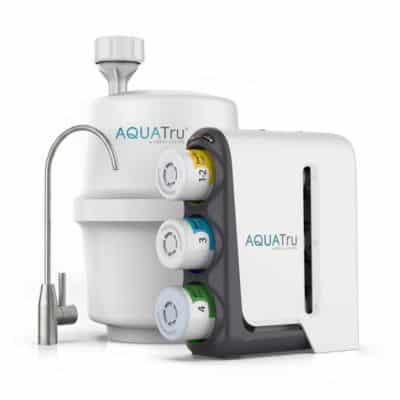
AquaTru has recently launched the Under Sink Gen 2, an upgraded version of its original AquaTru Under Sink RO system, with several added features (notably, a built-in leak detection and filter life indicator). The unit combines 4 stages of filtration in 3 filter cartridges, stacked vertically in a slim housing. It’s a tank-based system that stores 1.7 gallons of purified water ready for use.
What We Like
What We Don’t Like
| Price | $395 |
| Contaminants Reduced | 84 |
| Certifications | NSF/ANSI 42, 53, 58 & 401 |
| Process | Sediment + Carbon, RO Membrane, VOC Carbon Filter |
| Filter Capacity | Pre-filter: 600 gal; VOC filter: 600 gal; RO membrane: 1,200 gal |
| Annual Cost | ~$193.22 |
| Warranty | 1 year (3-year extended warranty available for $50) |
Quick Verdict: Is the AquaTru Under Sink Worth It?
The AquaTru Under Sink Gen 2 earned an overall score of 8.80/10 in our testing. It reduced TDS from 695 PPM to 13 PPM (a 98.13% reduction) and removed 100% of fluoride, uranium, and total THMs in our Tap Score lab test, and it is IAPMO certified to NSF/ANSI 42, 53, 58, and 401 for all 84 contaminants it claims to reduce.
Buy it if: you want certified, lab-verified contaminant removal in a compact under-sink footprint, with low maintenance costs ($0.18 per gallon) and built-in filter tracking and leak detection.
Skip it if: you need fast dispensing or maximum efficiency. We measured 32.65 GPD against the 54 GPD rating and a 1:3.27 pure-to-drain ratio, so a tankless RO with a booster pump will beat it on both.
See how we test and score water filters for our full methodology.
This is AquaTru’s first big upgrade for their under sink reverse osmosis system, and we wanted to see how it performed objectively in our own hands on testing. Here, we’re sharing our data across a range of performance tests, including contaminant reduction, filtration rate, pure-to-wastewater ratio, and TDS creep.
▶️ Video Review
📊 Scoring Data
We tested the AquaTru Under-Sink Gen 2 using our comprehensive data-driven scoring system. We then used the performance data we gathered to assign scores across 6 categories: contaminant reduction, filtration rate, design quality, installation, maintenance, and company policies.
From here, we could compare the system to similar systems we’ve tested, helping us to understand how it matches up to competitors.
Additionally, for RO systems, there are several unique performance factors that we evaluate, including efficiency ratio and recovery rate. You’ll find our notes on these later in this review.
See how the AquaTru Gen-2 performed in the table below.
| Criteria | Results |
|---|---|
| Overall Score | 8.80 |
| Health Related Contaminants | 9.00 |
| Aesthetic Related Contaminants | 9.90 |
| Performance Certification | NSF/ANSI 42, 53, 58 & 401 |
| Filtration Rate | 54 GPD |
| Component Quality | Outstanding |
| Component Certification | Materials Safety Certified |
| Setup | Below Average |
| Servicing Requirements | Outstanding |
| Costs | $0.18/ gallon |
| Warranty Length | 1 year |
| Shipping | Free Shipping to all 50 states |
| Returns | 30 days |
🚰 Contaminant Reduction
Score: 9.14The sole purpose of any water filter is to remove contaminants, so this is the primary point of interest in our performance testing.
The AquaTru Gen 2 has 4 stages of filtration and is marketed to remove sediment, chlorine, fluoride, microplastics, chromium-6, lead, arsenic, nitrate, VOCs, PFAS, and more.
To assign scores in the contaminant reduction category, we test our own water using laboratory analysis, as well as searching performance databases for contaminant reduction certifications.
Key Finding: The system removed 100% of fluoride, uranium, and total THMs in our Tap Score lab test, all four contaminants that exceeded Health Guideline Levels in our unfiltered water.
Our Performance Testing
Score: 9.05

To evaluate AquaTru’s contaminant reduction performance, we took two samples of our water: one straight from our kitchen faucet, and one from AquaTru’s dedicated faucet after installing and flushing the system.
We then sent these samples to Tap Score for lab testing. Our test results were delivered via email, in two interactive reports, making it easy to compare contaminant concentrations side-by-side. We chose to evaluate the safety of these contaminants using the Health Guideline Levels (the report also allows you to compare your data to the EPA’s Maximum Contaminant Levels).
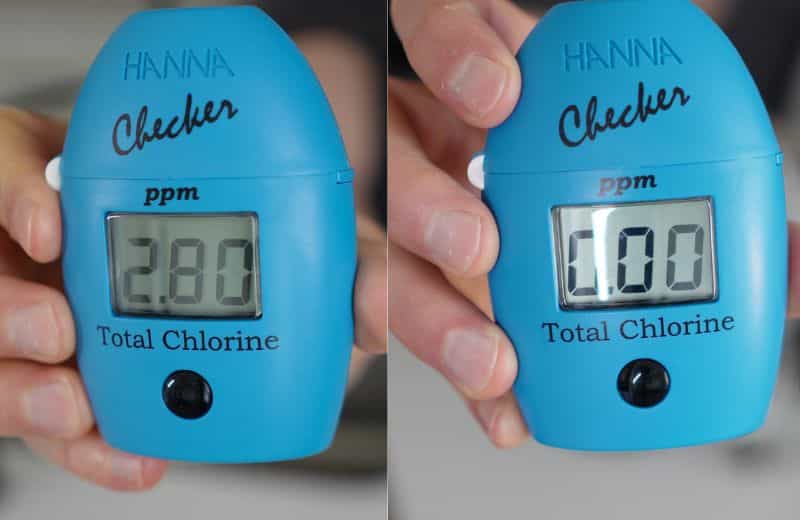
We also tested for chlorine in our water on-site using a digital colorimeter, immediately after collecting a sample. This gave us the most accurate data, since chlorine is volatile and dissipates quickly from water.
Health-Related Contaminants
Score: 9.00
More than a dozen contaminants with possible health effects were detected in our baseline sample, with 4 of these exceeding the HGL: bromoform and dibromochloromethane (two disinfection byproducts in the THMs group), along with fluoride and uranium.
The rest of the contaminants were detected at concentrations not exceeding the HGL: boron, copper, sulfate, nitrate, strontium, barium, total chromium, selenium, vanadium, manganese, and molybdenum.
We’ve listed all the contaminants detected and their concentrations in the table below.
| Analyte | Unit | Result Value | No-Remin | Difference |
|---|---|---|---|---|
| Alkalinity (as CaCO3) | PPM | 349 | 0 | -100.00% |
| Bicarbonate | PPM | 420 | 0 | -100.00% |
| Bromoform | PPB | 4.32 | 0 | -100.00% |
| Carbonate | PPM | 2.44 | 0 | -100.00% |
| Chromium (Total) | PPM | 0.0111 | 0 | -100.00% |
| Copper | PPM | 0.269 | 0 | -100.00% |
| Dibromochloromethane | PPB | 4.15 | 0 | -100.00% |
| Fluoride | PPM | 1.7 | 0 | -100.00% |
| Hardness | PPM | 251 | 0 | -100.00% |
| Langelier Saturation Index | 0.841 | 0 | -100.00% | |
| Magnesium | PPM | 15.7 | 0 | -100.00% |
| Molybdenum | PPM | 0.00124 | 0 | -100.00% |
| Nitrate (as N) | PPM | 3.3 | 0 | -100.00% |
| Potassium | PPM | 3.02 | 0 | -100.00% |
| Selenium | PPM | 0.00489 | 0 | -100.00% |
| Strontium | PPM | 0.81 | 0 | -100.00% |
| Sulfate | PPM | 157 | 0 | -100.00% |
| Total THMs | PPB | 8.47 | 0 | -100.00% |
| Uranium | PPM | 0.0124 | 0 | -100.00% |
| Vanadium | PPM | 0.00332 | 0 | -100.00% |
| Grains per gallon | Grains | 14.7 | 0.0261 | -99.82% |
| Expanded Hardness | PPM | 253 | 0.452 | -99.82% |
| Calcium | PPM | 74.9 | 0.179 | -99.76% |
| Barium | PPM | 0.0337 | 0.000703 | -97.91% |
| Specific Conductivity | umhos/cm | 1340 | 32.4 | -97.58% |
| Total Dissolved Solids | PPM | 779 | 20 | -97.43% |
| Sodium | PPM | 178 | 6.31 | -96.46% |
| Chloride | PPM | 102 | 4.1 | -95.98% |
| pH | pH | 8.1 | 6.7 | -17.28% |
| Sodium Adsorption Ratio | 4.88 | 4.1 | -15.98% | |
| Manganese | PPM | 0.00262 | 0.00222 | -15.27% |
| Boron | PPM | 0.436 | 0.376 | -13.76% |
| Chloride-to-Sulfate Mass Ratio | 0.65 | Very High |
Our post-filtration lab report showed that both total THMs were fully removed. THMs are regulated carcinogens in drinking water, so the fact that AquaTru can handle them is really reassuring.
Uranium and fluoride were also completely removed, along with the majority of contaminants detected below the HGL. There were a couple of exceptions: manganese was reduced by just 15%, from 0.00262 to 0.00222 PPM, and boron was reduced by 13%, from 0.436 to 0.376 PPM.
RO systems famously struggle to reduce boron because of its uncharged form at neutral pH, allowing it to slip through most membranes. Most similar systems we tested produced similar results for boron reduction, so it’s not exclusively an AquaTru problem.
As for manganese, it was only detected in very low trace levels to start with, but the fact that it wasn’t greatly reduced is unusual. RO systems can usually remove manganese effectively. Our theory is that the manganese in our water was present as a dissolved ionic metal, and the microscopic ions were able to slip straight through the RO membrane.
Aesthetics, pH, and Mineral Content
Score: 9.90
Reverse osmosis strips most impurities from water, including healthy minerals. But many of the modern systems we’ve tested use remineralization post-filters, which reintroduce some of the removed minerals that contribute to alkalinity, raising pH.
We got the AquaTru Under Sink without a remineralization filter. But you can upgrade to a remineralization model, which costs $25 extra and includes an alkalizing version of the VOC filter. It’s the same filter that’s used in the AquaTru Alkaline Classic (a countertop RO model), which we’ve also tested — see our review here.
Since we used the Gen 2 with the standard, non-remineralizing VOC filter, minerals were greatly reduced from our water, pH dipped from 8.1 to 6.7 (mildly acidic), and alkalinity went to zero. Specifically, calcium was reduced by 99.76%, and magnesium and potassium by 100%.
That’s expected behavior for RO without a remineralization stage, not a flaw of this particular system. But it’s worth noting that unenhanced purified RO water can have a less pleasant taste than a remineralized alternative due to the output being slightly acidic.
TDS & TDS Creep
Key Finding: TDS dropped from 695 PPM to 13 PPM (98.13%), with just 2 PPM of first-draw TDS creep after 10 hours idle, the smallest creep we have recorded for an under-sink RO system.
TDS creep occurs when RO systems are left unused for a short period (such as overnight), allowing dissolved minerals to migrate across the membrane to the “purified” side and causing a brief surge of high-TDS
We’ve found that it’s typically an issue with tankless systems, since these bypass the storage tank and send water straight through the RO membrane to the faucet. But in our tests, a small number of tank-based systems have shown signs of TDS creep, which is why we also measure this effect with tankless models.
We tested TDS both on site, and with lab analysis.
We used a TDS meter to take TDS measurements on-site. We then compared TDS in our feed water sample with our initial output TDS after letting the AquaTru Under-Sink sit idle for 10 hours.
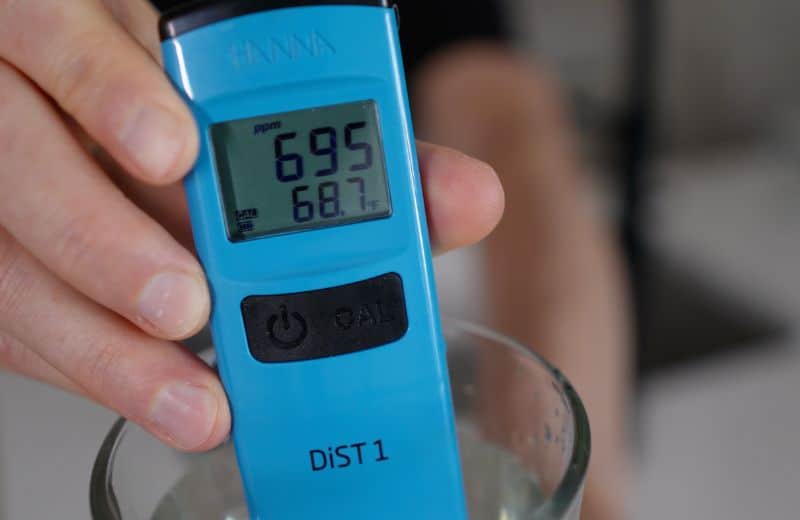
Our initial, before-filtration reading was 695 PPM, and our first-draw sample from the RO faucet measured just 15 PPM—not indicative of TDS creep.
We then let water run through the system for 2 minutes before taking a second draw reading from a sample collected in a separate glass. This time, the TDS reading was 13 PPM.
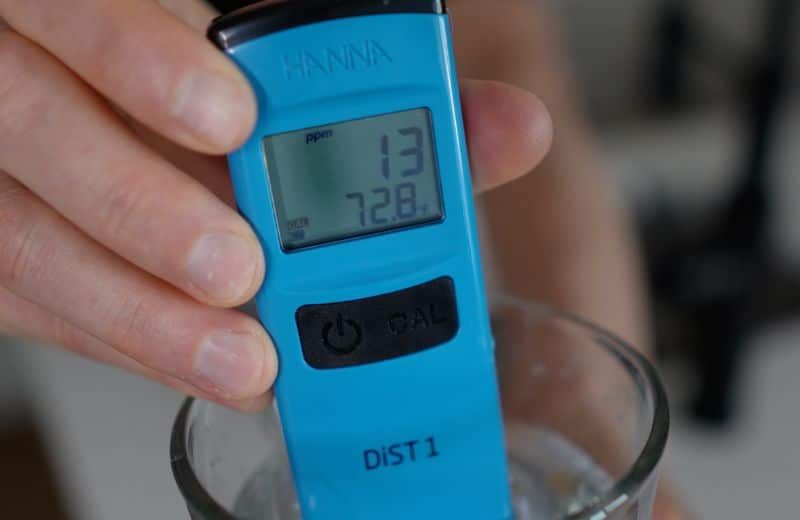
The difference between the 1st and 2nd draw was 2 PPM. Not only did this AquaTru model reduce TDS down to lower concentrations than any other RO system we’ve tested, but it had the smallest difference between the 1st and 2nd draw of any system we’ve tested.
| Test Condition | TDS (PPM) |
|---|---|
| Feed Water | 695 |
| 1st Draw (After 10 hrs idle) | 15 |
| Stable TDS (Without Remin Filter) | 13 |
| TDS Reduction | 98.13% |
| TDS Creep | 2 |
Even for the RO systems that didn’t show signs of TDS creep, the normal range for the 1st draw TDS reading was 40–70 PPM. AquaTru’s consistently low TDS is a big selling point.
Performance Certifications
Score: 10.00
Our contaminant reduction scores are purely based on the contaminants detected in our own water, which is where our testing has limitations. We know that many folks will want to know whether the system can effectively reduce contaminants like lead, PFAS, and arsenic, none of which were present in our test water.
That’s why we also look for official performance certifications awarded by the NSF, WQA, or IAPMO, validating the removal of contaminants that we were unable to measure ourselves.
AquaTru has been certified by IAPMO to remove every single contaminant it’s claimed to reduce (that’s 84 contaminants in total!), to NSF Standards 42 (for contaminants with aesthetic effects), 53 (contaminants with health effects), 58 (awarded to RO systems), and 401 (for emerging contaminants).
You can follow the links above to see the full list of contaminants included in these certifications, but highlights include chlorine, lead, fluoride, barium, chromium, arsenic, nitrate, nitrite, VOC, microplastics, and PFOA/PFOS.
IAPMO certifies to NSF/ANSI standards using controlled challenge testing, so you can rely on these certifications as proof that the system capably removes the listed contaminants.
🚦Filtration Rate
Score: 6.40Key Finding: We measured 32.65 GPD against a 54 GPD membrane rating, roughly 40% below spec under our 49 PSI, 67.5°F test conditions.
The AquaTru Under Sink has a membrane rating of 54 GPD (gallons per day), which is within the normal range of 50–100 GPD for a tank-based RO system.
That doesn’t mean everyone will get the same filtration rate from the system, as the speed of water flow through the filters is influenced by factors including water temperature and pH, along with incoming water pressure.
Our feed water temperature and water pressure are lower than ideal for RO purification, at 67.5°F and 49 PSI, so we expected flow rate to be slightly below the manufacturer’s rating.
To measure AquaTru’s flow rate under our own test conditions, we filled a graduated measuring container with purified water and timed how long it took. We recorded footage of this process and uploaded it onto an editing tool, moving through frame by frame to get precise start and end points.
| Test Metric | Result |
|---|---|
| Time to Fill 12 oz | 248.09 seconds |
| Measured Flow Rate | 0.02 GPM |
| Gallons Per Hour | 1.36 GPH |
| Converted GPD | 32.65 GPD |
| Manufacturer Claim | 54 GPD |
In our tests, it took 248.09 seconds to fill a measuring jug to the 12-ounce line, based on the average taken from 3 identical tests. This translates to a flow rate of 0.02 GPM, or 1.36 GPH (gallons per hour).
In gallons per day, that’s approximately 32.65 GPD, which is one of the slowest filtration speeds we’ve recorded for an under-sink RO system, and around 20 GPD slower than AquaTru’s listed membrane rating.
Efficiency Ratio
Reject water is produced as a result of the RO process, and we measure the efficiency ratio of each RO system we test to understand how much water will go to drain.
Since our recorded flow rate was slow, we expected the AquaTru Gen 2’s efficiency ratio to be fairly poor, too. These tend to be interlinked: slower-flowing water through the RO membrane results in a higher volume of water being drained.
To conduct our recovery rate testing, we disconnected the drain line and directed the wastewater into a measuring container, while we filled a separate container with 12 ounces of purified water.
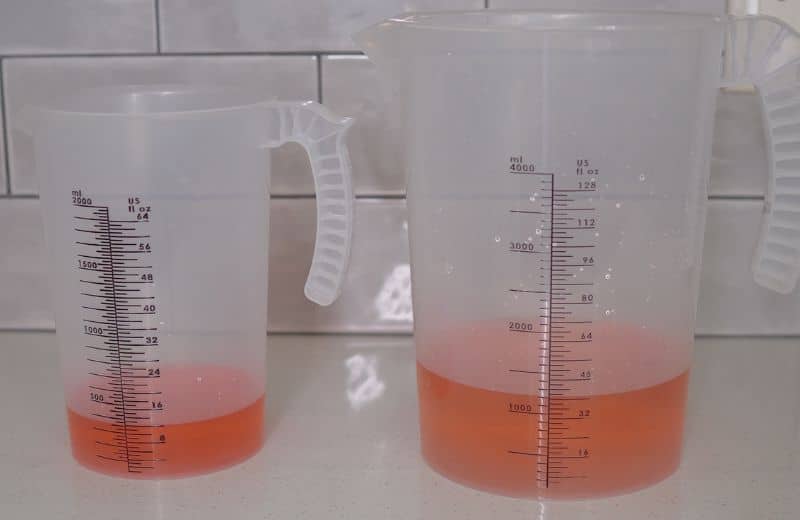
When the 12-ounce line was reached, 41 ounces of wastewater had been collected, translating to an efficiency ratio of around 1:3.42. That means 3.42 ounces of water are wasted per 1 ounce purified.
We then repeated the process with a larger purified water draw of 64 ounces (½ gallon). This time, 209 ounces of drain water were produced, equating to an efficiency ratio of 1:3.27 (so, 3.27 ounces wasted per 1 ounce purified), and recovery rate of 23.4%. That’s only marginally better than our smaller volume test.
| Test Volume | Wastewater Produced | Pure-to-Drain Ratio |
|---|---|---|
| 12 oz Test | 41 oz | 1:3.42 |
| 64 oz Test | 209 oz | 1:3.27 |
| Claimed by Manufacturer | — | Not specified |
In all, this AquaTru model definitely isn’t the most efficient system we’ve tested. But it’s also within the normal range for a conventional under-sink RO system that relies on water pressure alone for purification, with no internal booster pump.
📐 Design
Score: 9.70Key Finding: The unit carries an IAPMO materials safety certification and packs 4 filtration stages into a manifold just 4 inches wide.
We evaluated the AquaTru Gen 2’s design based on its component quality and whether or not it has been awarded design certifications.
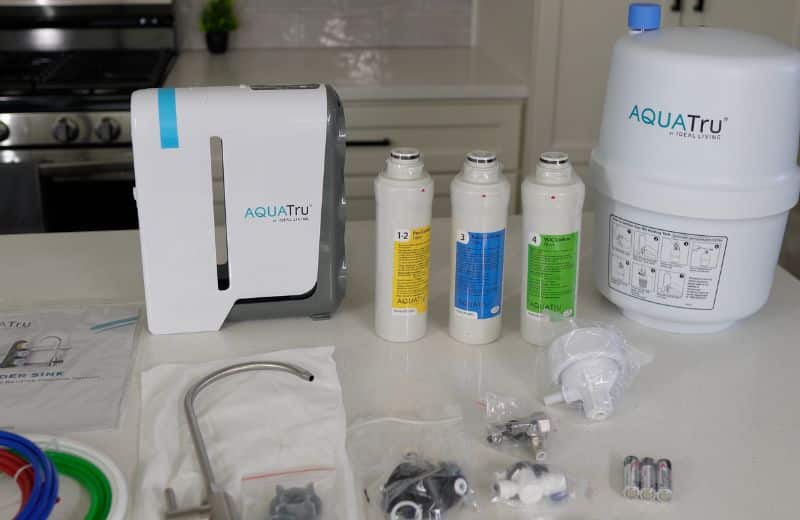
The unit is nice and compact. The main manifold that houses the filters is around 11 inches tall, 11 inches deep, and just 4 inches wide, so it’s a good space-saving option. But there is a tank, which takes up extra room when we compare it to tankless models (it’s 11 inches in diameter and 14 inches tall).
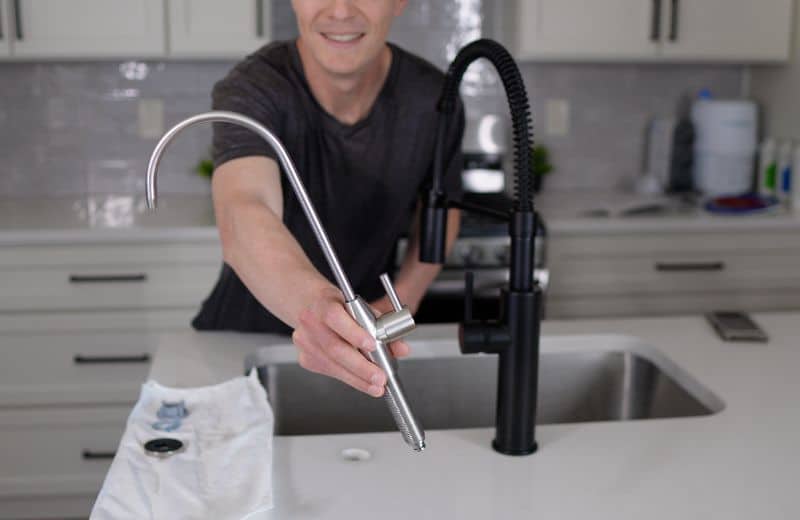
There’s also a dedicated faucet, which is available in various finishes: stainless steel, polished chrome, and matte black.
Component Quality
Score: 9.50
This AquaTru model is made from food-grade plastic with some metal components, including a stainless steel cold water shutoff valve. It also has several thoughtful design features, including the TruPure RO Sanitizer, which offers easy access to the holding tank for annual cleaning.
New Model Upgrades
We’ve tested both the original AquaTru Legacy Under-Sink RO system and this new Gen 2 model. The Gen 2 has several design improvements that we want to mention here.
First, there’s no wall bracket with this new unit. Instead, it’s designed to be free-standing and sits on the cabinet floor. That means you have more flexibility with where you install the system under your sink.
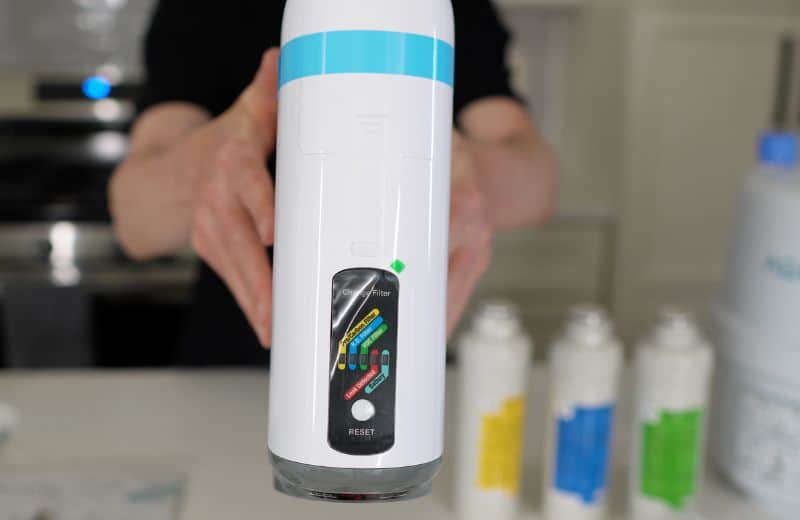
There’s also an integrated filter life tracker/alarm in the Gen 2, as well as an integrated leak sensor/alarm. We’ve discussed both of these in more detail later.
Filter Materials
There are 3 separate filter cartridges in the AquaTru Gen 2:
- A pre-filter, which combines sediment and carbon filtration media
- An RO filter
- A VOC carbon filter
These are all filter stages that we see commonly in RO systems, and, as our testing shows, they’re clearly effective at what they do.
Materials Safety Certification
Score: 10.00
The AquaTru Under Sink has a materials safety certification as a component of its performance certification, also awarded by IAPMO.
While these certifications aren’t legally required, they help reassure us of a product’s quality and design safety, telling us that it has been assessed and deemed safe for use under strict test conditions by a trusted third party.
⚙️ Setup
Score: 7.50Key Finding: Installation took 60 minutes with color-coded push-to-connect tubing, and the built-in leak alarm covers all 14 potential leak points we identified.
Installing an under-sink RO system can be quite tricky. Not only are you connecting the system to your water line, but you’re also drilling a hole in your countertop for a faucet and installing a drain line.
We installed the AquaTru Under Sink ourselves; a process that took 60 minutes from start to finish. The install was fast because we already had faucet and drain connections ready, as we’ve installed and tested many other RO systems in the same under-sink location.
Some aspects of setup were easier for this system than for others. For instance, the box contains a multi-use pipe-cutting and quick-connect fitting removal tool, and many components already have a quick-connect fitting attached.
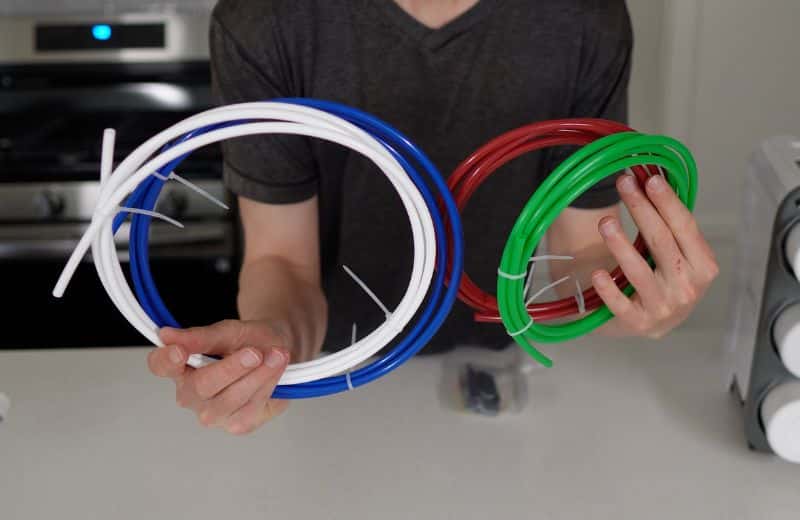
Plus, the tubing and connections are color-coded, everything is push-to-connect, and the filters twist in and out (no sumps like other conventional ROs, which makes installing and replacing them much easier).
A unique bonus of this Gen 2 model is that it has an integrated leak detector alarm that sounds audibly when water is detected. This helps with both detecting leaks inside and outside the unit.
We detected 14 potential leak points at the fittings and connections, although no leaking occurred during our testing. The leak detector offers a lot of peace of mind, as we know the unit will alert us instantly the moment a leak is detected.
Once we’d installed the system, we followed the instructions for the break-in flush. This involved filling and emptying the purified water tank twice (a process that took 2-3 hours each). The third tank of water is usable.
Noise
After installing the AquaTru Gen 2, we used a phone app to measure the noise produced (in decibels) while it was running. As a conventional system, it doesn’t use an internal pump, which makes it quieter than tankless models.
We measured sound decibels at 1 foot and 3 feet away:
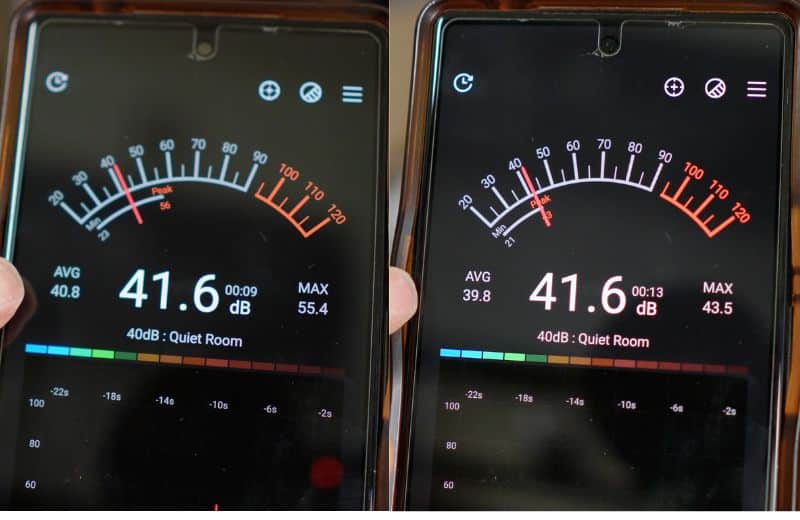
- At 1 foot, the unit produced 40.8 decibels.
- At 3 feet, it produced 39.8 decibels.
🔧 Maintenance
Score: 9.75Key Finding: At $0.18 per gallon and $193.22 per year, this is one of the most affordable under-sink RO systems we have tested to maintain.
AquaTru performed well in our maintenance tests, with simple servicing requirements and affordable long-term filter costs.
Servicing Requirements
9.50
Replacing the filters is easy in the Gen 2. The pre-filter lasts 6 months or 600 gallons, the RO filter lasts 2 years or 1200 gallons, and the VOC filter lasts 1 year or 600 gallons.
The good news is that you don’t have to make your own reminders to replace these filters on your phone calendar, as this new-and-improved model now features an integrated filter tracker, which alerts you when a replacement filter is needed.
Plus, the filters are now installed horizontally rather than vertically, which makes it easy to swap them out, and, as we mentioned, the filters twist in and out for convenience.
Costs
Score: 10.00
Alongside its upfront cost, the AquaTru Under Sink also has an ongoing filter replacement cost to be aware of. We calculated a cost-per-gallon of $0.18 for the system, equivalent to a total annual cost of $193.22, or a 5-year ownership cost of $1,361.11.
That makes it one of the most affordable under-sink RO systems we’ve tested (the average range is $1,000–$2,000). We think it’s pretty great value for money, especially given that it’s a new-and-improved take on the previous system, with better features.
🏢 Company
Score: 8.80Key Finding: The standard warranty is 1 year, shorter than most RO competitors we have reviewed, though a 3-year extension is available for $50.
Our final scoring category evaluated AquaTru as a company, based on its warranty, shipping, and returns offerings.
Warranty
Score: 8.50
All AquaTru products are backed by a 1-year limited warranty, meaning you’ll be entitled to a repair or a replacement if your product has defects in materials and workmanship for one year from the original purchase date.
There’s a shipping and processing fee that you’ll have to cover, and the warranty only applies to the unit itself, not the filters.
We’ve seen longer warranties, especially for reverse osmosis systems. There is an extended 3-year warranty, but it costs $50 extra.
Shipping
Score: 10.00
AquaTru ships to all 50 states, as well as Puerto Rico and Canada. Find out more about shipping here.
Returns
Score: 8.00
As an AquaTru customer, you can try the Under Sink Gen 2 for 30 days and return it for free (excluding shipping fees) for any reason within this period.
We’ve seen returns periods up to 90 days and sometimes even longer. But, at least, AquaTru doesn’t require you to return the system unopened and unused, as many other manufacturers do.
AquaTru’s returns policy can be viewed here.
💰 Value For Money
We think the AquaTru Under Sink Gen 2 is one of the best-value under-sink RO systems we’ve tested.
It delivered textbook RO performance, removing the majority of contaminants in our water, and it’s backed by the strongest certification credibility we could ask for. Plus, it has a sturdy, certified design, and multiple modern features that make maintenance easier. All that for a unit that’s competitively priced and more affordable to maintain than its competitors.
It’s not perfect, though — its flow rate is fairly slow, and it’s not the most efficient under-sink system we’ve tested by a mile. We don’t think these are dealbreakers, but they’re considerations to keep in mind when you’re deciding on the best under-sink RO system for you.
❔ AquaTru Under Sink FAQ
Q: Does the AquaTru Under Sink Gen 2 remove fluoride?
A: Yes. In our third-party lab testing with Tap Score, the AquaTru Under Sink Gen 2 reduced fluoride from 1.7 PPM to 0 PPM, a 100% reduction. Fluoride was one of four contaminants that exceeded the Health Guideline Level in our unfiltered water, and the system removed all four completely.
Q: How fast is the AquaTru Under Sink Gen 2?
A: The system has a manufacturer membrane rating of 54 GPD, but we measured 32.65 GPD (0.02 GPM) in our own testing, one of the slowest rates we have recorded for an under-sink RO system. Our feed water temperature (67.5°F) and pressure (49 PSI) were below ideal RO conditions, which likely contributed.
Q: How much water does the AquaTru Under Sink Gen 2 waste?
A: In our testing, the system produced 3.27 to 3.42 ounces of wastewater per 1 ounce of purified water depending on draw volume, with a 23.4% recovery rate in our half-gallon test. That is within the normal range for a conventional under-sink RO system without a booster pump, but less efficient than many tankless models we have tested.
Q: Is the AquaTru Under Sink Gen 2 certified?
A: Yes. It is IAPMO certified to NSF/ANSI Standards 42, 53, 58, and 401, covering all 84 contaminants it is claimed to reduce, including lead, PFOA/PFOS, arsenic, fluoride, chlorine, and VOCs. It also carries an IAPMO materials safety certification.
Q: AquaTru Under Sink Gen 2 vs AquaTru Classic: which should you buy?
A: The Under Sink Gen 2 (8.80) is a tank-based under-sink system with a dedicated faucet, while the AquaTru Classic (9.54) is a countertop unit that requires no installation. Choose the Under Sink Gen 2 if you want purified water on tap and a clear countertop. Choose the Classic if you rent or want zero installation. Read our full AquaTru Classic review for complete test data.
Hi Brian, I just tried to create this coupon (“Discount: Get up to 25% off – Click Here for Code). I didn’t receive it via email though. Could you help me to get one?
Thank you!
Sincerely,
Lucy
I Lucy, the email is delivered automatically. Please check or spam and promotions folders, it likely ended up there. If you can’t find it, reach out to [email protected] and we’ll send you the code manually