

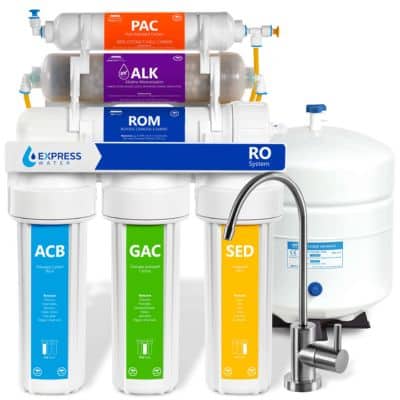
The Express Water RO5DX is a conventional under-sink reverse osmosis system that sends water through five filter cartridges, including an RO membrane, to purify drinking water at the kitchen sink. It’s one of Express Water’s more budget-friendly RO options, intended to offer great value with a more basic design and none of the smart features you see on a more expensive model.
What We Like
What We Don’t Like
| Price | $445.95 |
| Contaminants Reduced | 16+ |
| Certifications | NSF/ANSI 58 |
| Process | Sediment + Carbon + Reverse Osmosis + Remineralization |
| Filter Capacity | 50–100 GPD |
| Annual Cost | ~$273 |
| Warranty | 1 year |
We tested the Alkaline system upgrade, which included an additional alkalizing post-filtration cartridge. Our comprehensive testing process involved measuring the system’s contaminant reduction, design quality, flow rate, wastewater production, TDS creep, install time, ease of maintenance, and more.
📊 Scoring Data
We use the same scoring system for every water filter we review, which combines data and individual scores from six key performance assessments. We tested the Express Water RO5DX as part of a larger project involving many of the most popular RO systems available today, then ranked it with an overall weighted score.
This overall score is calculated based on scores awarded to sub-categories of contaminant reduction, flow rate, design quality, servicing requirements and costs, and the manufacturer’s warranty, shipping, and returns offerings. We also gathered additional data for efficiency ratio, TDS creep, flushing, and several other factors that matter for reverse osmosis systems, although we don’t currently use these as ranking factors.
See the next table for the Express Water RO5DX’s performance scores.
| Criteria | Results |
|---|---|
| Overall Score | 8.13 |
| Health Related Contaminants | 8.40 |
| Aesthetic Related Contaminants | 8.50 |
| Performance Certification | NSF 58 |
| Filtration Rate | 50-100 GPD |
| Component Quality | Outstanding |
| Component Certification | Exceptional |
| Setup | Weak |
| Servicing Requirements | Good |
| Costs | $0.25/gallon |
| Warranty Length | 1 year |
| Shipping | Free shipping to the contiguous US |
| Returns | 30 days with stipulations |
🚰 Contaminant Reduction
Score: 8.26Contaminant reduction is where RO systems like the RO5DX excel. Reverse osmosis is designed to purify water, rather than simply filtering select contaminants. That means you can generally expect the majority of impurities to be removed from your water, regardless of what it contains*.
We used data from our own real-world water quality testing to score the system in this category, complemented by evidence of official performance certifications by IAPMO, the NSF, or the WQA.
Our Performance Testing
Score: 9.62
To determine how the Express Water RO5DX impacted our water quality, we took two samples of water and sent them to our lab-testing partner, Tap Score, for analysis:

- The first baseline sample was straight from our kitchen faucet.
- The second filtered water sample was taken from the RO5DX’s dedicated faucet, after installing the unit and flushing it following the manufacturer’s flushing instructions, then conducting all our other testing for flow rate, recovery rate, and so on.
After several days, Tap Score emailed us with links to our two digital reports (one for each sample), listing all the impurities detected in each sample.
Chlorine was the only contaminant we tested for on-site, using Hach chlorine test strips included in our sample-taking kit. Chlorine is a highly volatile contaminant and dissipates quickly, which means, for accuracy, it needs to be detected as quickly as possible.
Health-Related Contaminants
Score: 9.30
Our baseline sample contained 16 contaminants with possible health effects, including:
- 3 disinfection byproducts
- Uranium
- Copper
- Barium
- Fluoride
- Nitrate
- Boron
- Strontium
- Chromium
All 3 disinfection byproducts (dibromochloromethane, bromodichloromethane, and bromoform) were detected at levels exceeding the HGL, as well as uranium and fluoride.
We’ve listed all the contaminants detected, and their concentrations, in the next table.
| Analyte | Type | Unit | Unfiltered | Express Water RO5DX | Difference |
|---|---|---|---|---|---|
| Langelier Saturation Index | Properties | 0.73 | -1.1 | -250.68% | |
| Bromodichloromethane | Disinfection Byproducts | PPB | 4.29 | 0 | -100.00% |
| Bromoform | Disinfection Byproducts | PPB | 11.4 | 0 | -100.00% |
| Copper | Metals | PPM | 0.287 | 0 | -100.00% |
| Dibromochloromethane | Disinfection Byproducts | PPB | 11.9 | 0 | -100.00% |
| Fluoride | Inorganics | PPM | 2.4 | 0 | -100.00% |
| Manganese | Metals | PPM | 0.0011 | 0 | -100.00% |
| Molybdenum | Metals | PPM | 0.002 | 0 | -100.00% |
| Selenium | Metals | PPM | 0.0041 | 0 | -100.00% |
| Strontium | Metals | PPM | 0.566 | 0 | -100.00% |
| Total THMs | Disinfection Byproducts | PPB | 27.59 | 0 | -100.00% |
| Uranium | Metals | PPM | 0.0036 | 0 | -100.00% |
| Vanadium | Metals | PPM | 0.0017 | 0 | -100.00% |
| Sulfate | Inorganics | PPM | 122 | 1.1 | -99.10% |
| Calcium | Minerals | PPM | 52.1 | 0.847 | -98.37% |
| Barium | Metals | PPM | 0.033 | 0.000723 | -97.81% |
| Sodium | Minerals | PPM | 237 | 13.1 | -94.47% |
| Specific Conductivity | Minerals | umhos/cm | 1500 | 101 | -93.27% |
| Total Dissolved Solids | Properties | PPM | 875 | 60 | -93.14% |
| Chloride | Inorganics | PPM | 128 | 10 | -92.19% |
| Hardness (Total) | Properties | PPM | 183.11 | 14.51 | -92.08% |
| Bicarbonate | Minerals | PPM | 471.09 | 37.34 | -92.07% |
| Grains per gallon | Properties | Grains | 10.7 | 0.85 | -92.06% |
| Hardness | Properties | PPM | 182 | 14.5 | -92.03% |
| Alkalinity (as CaCO3) | Properties | PPM | 391 | 34 | -91.30% |
| Chromium (Total) | Metals | PPM | 0.0047 | 0.00048 | -89.79% |
| Sodium Adsorption Ratio | Properties | 7.64 | 1.5 | -80.37% | |
| Magnesium | Minerals | PPM | 12.6 | 3.01 | -76.11% |
| Potassium | Minerals | PPM | 3.96 | 1.37 | -65.40% |
| Boron | Inorganics | PPM | 0.487 | 0.207 | -57.49% |
| Carbonate | Minerals | PPM | 2.74 | 1.72 | -37.23% |
| Nitrate (as N) | Inorganics | PPM | 1.4 | 1 | -28.57% |
| pH | Properties | pH | 8.1 | 9 | 11.11% |
| Chloride-to-Sulfate Mass Ratio | Properties | 1.05 | 9.09 | 765.71% |
Our filtered water test results showed that the Express Water RO5DX had greatly reduced or removed all these contaminants. All the contaminants that initially exceeded the HGL were completely eliminated, along with 100% copper, manganese, molybdenum, selenium, strontium, and vanadium.
The system also reduced between 89% and 99% of barium, total chromium, and sulfate. However, it only reduced boron by 57%, and nitrate by 28%.
We have a couple of theories as to why boron wasn’t eliminated:
- A high feed water pH of 9-10 is needed for reverse osmosis to effectively remove boron. We measured the pH of our feed water at 7.39, which may contribute to why boron reduction wasn’t higher.
- There’s also the possibility that boron could have been reduced during the purification process, then reintroduced as an incidental trace mineral from the remineralization media.
As for nitrate, our only theory is less likely: that it was also somehow re-entering our water from the remineralization filter.
We had higher-than-expected levels of nitrate and boron in our purified water with a couple of the other RO systems we tested, too. It’s possible that using cooler test water (with a temperature of 58.6°F) with a pH closer to neutral and a lower water pressure of 48 PSI affected the rejection rates for these dissolved ions, especially smaller impurities like nitrate. Boron in particular is very pH-dependent: at neutral pH, it exists mainly as uncharged boric acid, which passes through RO membranes much more easily and isn’t efficiently rejected.
Aesthetics, pH, and Mineral Content
Score: 8.50
We expected the RO5DX to achieve a high aesthetic score because we used the system with the added remineralization filter in our testing. Remineralization prevents the aesthetic side effects of reverse osmosis by raising pH and alkalinity (RO water lacks minerals and is often mildly acidic).
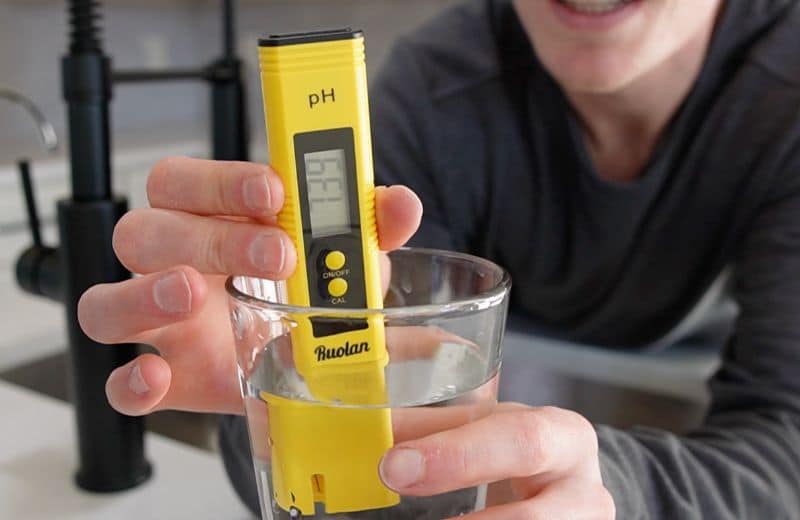
In our testing, the unit increased the pH of our water from 8.1 to 9.0 (we also tested pH on-site using a handheld pH meter, and pH was increased from 7.35 to 8.94). The system also removed 100% chlorine: an expected result. But the Tap Score algorithm flagged the higher 9.0 pH as having potential taste impacts, which brought down the score in this category.
The minerals in our purified water had still been reduced overall—calcium by 98%, magnesium by 76%, sodium by 94%, and potassium by 65%. This is an expected outcome even with a remineralization filter, which:
- Reintroduces some minerals and increases alkalinity
- But doesn’t compensate for the significant mineral loss during the RO purification process.
TDS & TDS Creep
Our Tap Score report contained TDS measurements for both water samples, and we also measured TDS ourselves on-site using our own TDS meter.
We were keen to know how the system affected TDS at different phases of use, as well as whether TDS creep was an issue.
You can learn about TDS creep here, but essentially, it’s a phenomenon where the TDS levels in the initial draw of filtered water are higher, occurring when the reverse osmosis system isn’t used for a short period.
This period of non-use causes the pressure in the semi-permeable membrane to equalize, temporarily raising TDS. It’s typically more of an issue with tankless systems, which lack a storage tank to buffer the initial, lower-quality water produced immediately after the system turns on. So, we didn’t expect this to be a significant issue with the RO5DX.
To measure TDS creep, we let the system sit idle overnight for 10 hrs. We then opened the faucet and filled a glass of water with the first draw sample, and immediately measured TDS with a handheld TDS meter.
| Test Condition | TDS (PPM) |
|---|---|
| Feed Water | 656 |
| 1st Draw (After 10 hrs idle) | 67 |
| 2nd Draw (With Remin Filter) | 43 |
| 2nd Draw (Without Remin Filter) | 34 |
| TDS Reduction | 93–95% |
| TDS Creep | 33 PPM |
Our feed water had a TDS of 635 PPM, which is classified as “poor” by the WHO in terms of how it affects the palatability of water.
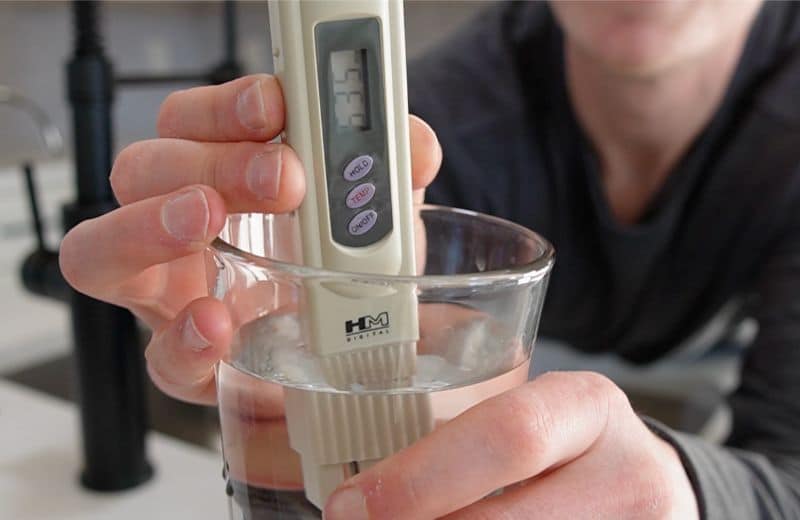
The Express Water RO5DX had a 1st draw TDS reading of 61 PPM, which is not indicative of TDS creep, since TDS had been reduced by almost 600 PPM.
We kept the water flowing through the system for 2 minutes after taking the initial reading of the first draw sample. Once 2 minutes had passed, we filled a separate glass and measured the lowest stable TDS, which was 44 PPM, or 54 PPM after remineralization.
That means this Express Water unit had a TDS creep of just 18 PPM (the difference between the 1st and 2nd draw), which is very minimal. In comparison, some tankless systems we tested had a TDS creep of 400+.
Performance Certifications
Score: 7.00
We gather as much data as possible from our own water quality testing, but we know there are limitations with our small-scale analysis. Most notably, we can only assess a water filter’s ability to remove the contaminants detected in our own water supply.
For that reason, performance certifications also contribute to a filter’s contaminant reduction score. RO system manufacturers can obtain certifications that prove their filters can reduce a broad range of contaminants, providing the reassurance of performance verification under strict testing conditions.
The RO5DX is certified under NSF 58 to reduce TDS. That’s one out of the 158 impurities claimed to be reduced on the marketing page— just 0.06% of the claims.
A certification for TDS reduction is a great start, and in fact the most important for any RO system, but we know that many folks will be more interested in confirming that the system can reduce specific contaminants with health effects, like lead, arsenic, uranium, DBPs, and so on. TDS is simply an indicator of water quality based on the concentration of dissolved solids it contains.
Related: My APEC ROES reverse osmosis system review
🚦Filtration Rate
Score: 6.0The RO5DX has a listed flow rate of 50-100 GPD (gallons per day). This is quite a bit slower than some of the tankless under-sink systems we’ve tested, but it’s within the “normal” range (50-75 GPD) for a tank-based unit.
In our own flow rate testing, at a feed water temperature of 58.6°F and with an incoming water pressure of 48 PSI, we measured the time it took (in seconds) for the unit to fill a graduated measuring container up to a specified fill line with purified water.
We wanted to be as precise as possible with our measurements, down to the millisecond. To achieve this, we took video footage of the process, uploaded it onto an editing tool, and moved through the video frame by frame until we had:
- The precise starting point (water leaving the faucet)
- The exact ending point (container filled to the specified fill line)
We recorded the average time to fill to the 12-ounce line of our measuring jug, repeating the same test 3 times. The average recorded time was 156.61 seconds, translating to a flow rate of 0.04 GPM (gallons per minute), or 2.16 GPH (gallons per hour).
That’s approximately 51.84 GPD (gallons per day), which is on the lower end of the manufacturer’s claimed purified water production rate of 50-100 GPD.
| Test Metric | Result |
|---|---|
| Time to Fill 12 oz | 156.61 seconds |
| Measured Flow Rate | 0.04 GPM |
| Gallons Per Hour | 2.16 GPH |
| Converted GPD | 51.84 GPD |
| Manufacturer Claim | 50–100 GPD |
Efficiency Ratio
An RO system’s efficiency ratio, or pure-to-wastewater ratio, tells you how much water is purified versus how much is wasted for any given volume.
Of the RO systems we’ve tested so far, the tank-based under-sink systems are generally the least efficient. Some tankless and countertop RO systems waste only 1 gallon of water for every 3 or 4 gallons purified. But the RO5DX’s claimed efficiency ratio is 1:1-3, meaning that 1-3 gallons of water are wasted per 1 gallon of pure water produced.
We wanted to compare the manufacturer’s claimed efficiency ratio with our own results, so we unhooked the end of the wastewater line and placed it inside a 1-gallon measuring cup. We then collected 12 ounces of purified water in a separate cup and recorded the volume of wastewater produced during this time.
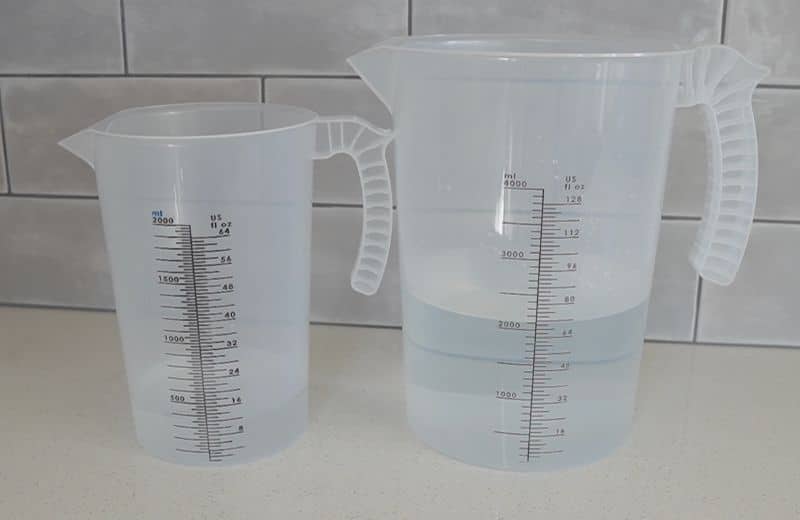
The RO5DX produced 71 ounces of wastewater for the 12 ounces of water purified, which equates to approximately 1:5.9 (meaning that for every 1 ounce of purified water, about 5.9 ounces go to drain).
Temperature and water pressure are two of the biggest factors that affect RO performance. The RO membrane depends on pressure to push water through it, and most residential membranes are rated around 60–80 PSI and 77°F. With our own water supply at 48 PSI and 58°F, this lower pressure and cooler water compound each other, slowing permeate flow, increasing concentrate (drain) flow, and significantly reducing recovery rate. So, it makes sense to see a noticeably lower production and more water going to drain.
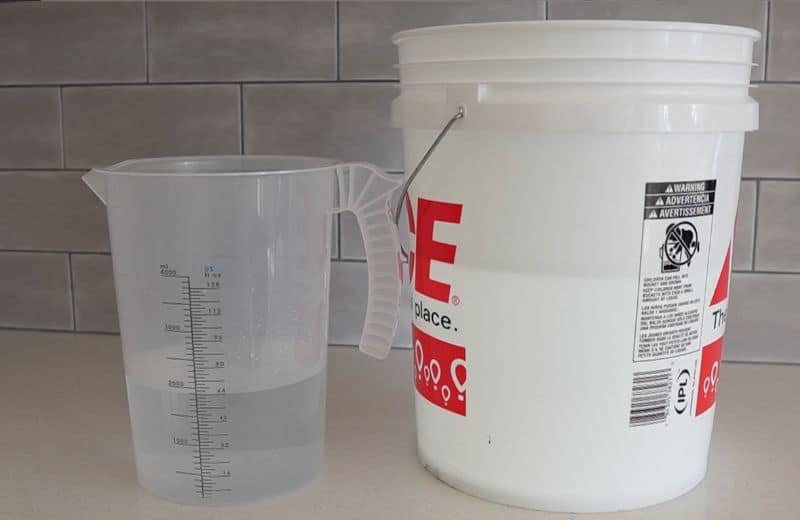
We then repeated the test, this time measuring the volume of wastewater produced when dispensing 64 ounces of purified water. In this test, 336 ounces of wastewater were recorded, equal to a pure-to-wastewater ratio of approximately 1:5.25. That means for every 1 ounce of water purified, 5.25 ounces of water goes to drain.
| Test Volume | Wastewater Produced | Pure-to-Drain Ratio |
|---|---|---|
| 12 oz Test | 71 oz | 1:5.9 |
| 64 oz Test | 336 oz | 1:5.25 |
| Claimed by Manufacturer | — | 1:1–3 |
This result was marginally better with our larger-volume test than with our smaller-volume test. Our theory is that this is because of backpressure on the RO membrane. When the system sits unused, water remains on both sides of the membrane, causing the pressures to gradually equalize across it. As a result, the membrane isn’t immediately operating at full differential pressure when you turn it back on, and it takes a short moment to re-establish proper crossflow and flushing.
In this initial startup phase, more water goes to drain relative to the purified product. So, when we collected just 12 ounces of purified water, this captured mostly that less efficient period, while the system had time to stabilize and operate at its slightly better recovery rate during the larger 64-ounce draw.
Booster Pump Efficiency
We installed a booster pump upstream of the RO5DX to see if the increased water pressure would improve the system’s efficiency.
After installing the pump, we measured how much wastewater the unit produced when producing 0.5 gallons of purified water. We recorded 1.92 gallons (or 246 ounces) of wastewater in 9 minutes and 34 seconds, resulting in a flow rate of 3.13 GPH (or 75 GPD) and a pure-to-drain ratio of 1:3.84.
Both results show that installing a booster pump effectively improved filtration and recovery rate, boosting flow rate by around 23 GPD and increasing recovery rate by 42% (compared to our first 12-ounce draw) and 29% (compared to our first 64-ounce draw).
As for energy used, the pump used 4 watt hours per gallon, which is pretty similar to the measurements we were getting for built-in pumps for tankless RO systems.
📐 Design
Score: 9.70The RO5DX has a fairly big and bulky design, with all six filters attached to the main unit (three are mounted vertically below the housing and three are stacked horizontally on top). It measures 17 x 15 x 5 inches and weighs just under 13 lbs.
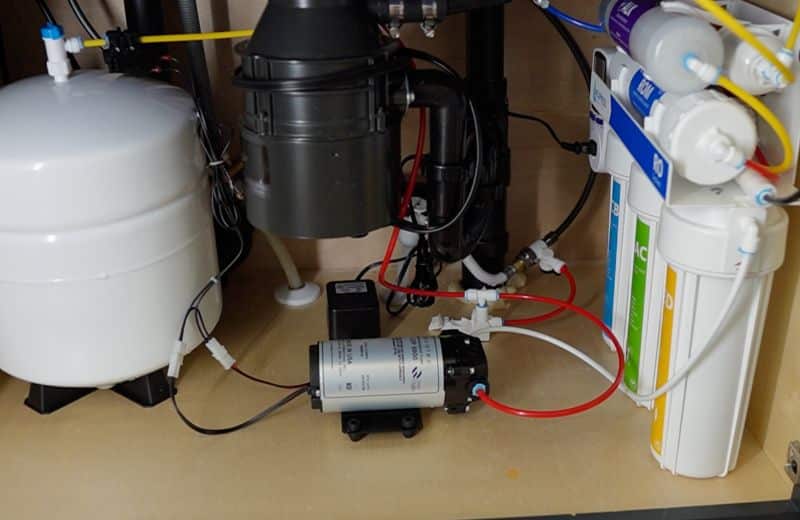
Since this is a tank-based model, there’s also a tank that holds purified water, with a holding capacity of 3.2 gallons. Plus, there’s a dedicated faucet that’s installed next to your existing faucet, so you have a separate water supply for the RO unit.
It’s pretty basic design-wise, without some of the smart features we’ve seen on the more modern (often tankless) systems, like built-in TDS monitors and filter lifespan trackers.
As we mentioned, we got the system with the alkalizing water filter upgrade, and there are a few other upgrades to consider, too:
- A UV upgrade that includes a UV light before the final carbon filter stage, designed to address microbiological contaminants
- A UV and alkalizing configuration containing both the additional remineralization filter and UV light
- A deionization upgrade that features an ion exchange filter designed to address remaining TDS in the water, resulting in purer water with an even lower TDS. The marketing page also says this filter is “great for softening hard water at your point of use without adding sodium”. Our own test data shows that total hardness was reduced by 92% anyway, even after remineralization and without the ion exchange filter
To score the system in this category, we evaluated the quality of its components and researched online to see if it has any certifications for design or materials safety.
Component Quality
Score: 9.00
The RO5DX has a majority-plastic design, which is the standard for most water filters—plastic is flexible and lightweight, so it’s a more practical alternative to stainless steel or glass, especially for inline systems like this one.
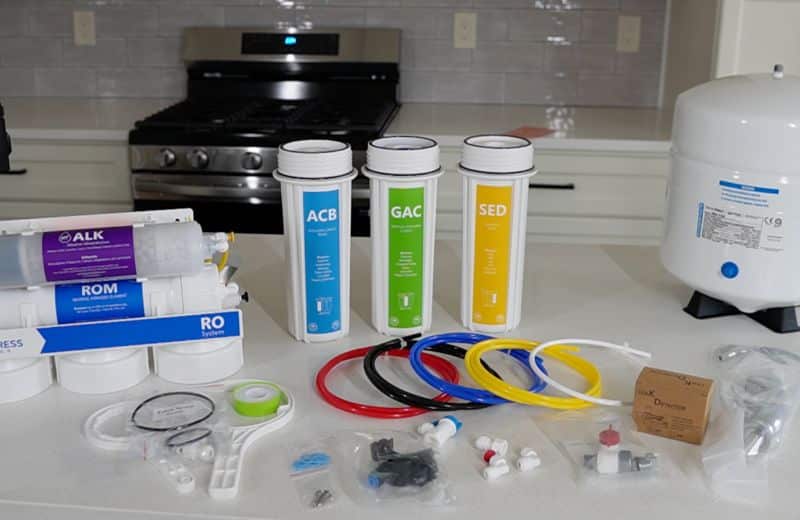
The plastic components are NSF certified and food-grade, and we know that the filter housings are made from polypropylene (regularly used in RO systems for its high durability and low moisture absorption).
All components feel solid and sturdy, contributing to the system’s high score in this category.
Filter Materials
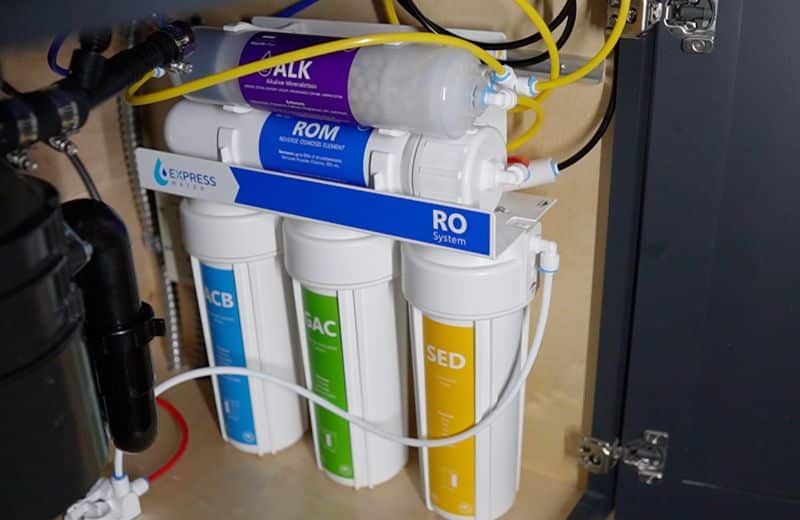
There are six filter stages in the RO5DX alkaline configuration:
- A sediment filter
- A GAC granular activated carbon
- A carbon block filter
- An RO membrane
- A PAC inline post-activated carbon filter
- An alkaline remineralization filter
Express Water lists some of the materials used in these filters:
- The sediment filter is made from melt-blown polypropylene
- The RO membrane is a thin-film composite membrane
- The carbon post-filter is made from 100% coconut shell
- The remineralization filter is made from natural stone, calcite, and ceramic
Materials Safety Certification
Score: 10.00
The RO5DX has been certified for materials safety as part of its NSF 58 performance certification for TDS reduction.
Design certifications aren’t required by law, but they give us extra insight into the safety and quality of a water filter’s components beyond what we can understand from our own subjective data.
⚙️ Setup
Score: 7.00Like all the under-sink RO systems we tested, the RO5DX has a pretty lengthy and involved installation process, as reflected in its setup score.
The unit comes with almost everything that’s needed to get it installed, but you’ll need your own equipment (drill, screwdriver, adjustable wrench) as well as a pipe cutter or similar tool, plumber’s tape, towels, and ¼ and ½ inch drill bits (specifically for the drain saddle and RO faucet).
There are a few design features that simplify installation as much as is possible for this type of system.
We found that installing the faucet for this system was much easier than for similar products thanks to the quick-connect fitting on the faucet tube. That said, you’ll still need to drill a hole in your countertop unless you already have one (we used an existing hole that was previously used for a soap dispenser).
Another handy feature is that all connections are color-coded with the plug and corresponding tube, essentially eliminating any confusion around what goes where. Plus, the only nut that we needed to tighten from below the sink is molded into the plastic bracket, allowing for easy hand-tightening, so we didn’t have to use a wrench for this job.
The instructions in the user manual are detailed and easy to follow, and there’s an installation video that you can follow if you’re more of a visual learner.
We noted a total of 19 leak points at the fittings—that means 19 opportunities for the unit to leak at any point throughout its operation. The RO5SX comes with a leak detector and mechanical shutoff valve, which uses compressed pads that expand when they get wet, physically triggering the valve to close the inlet water supply. This is a reassuring feature to have and something that’s not included with every RO system we’ve tested.
A setback of this system is how long it took to get it ready for use after installation. The manual warned us that we’d be in it for the long haul, with an estimated start-up time of 8-12 hours.
Initial flushing took just under 30 minutes, followed by a pressure test, which took around 10 minutes. We then had to fill and drain the tank three times; a process that took about 3 hours each. Next, we had to let water sit in the tank overnight, adding another 8 hours to the process. We finished off with a final tank fill before use, which took another 3 hours.
So, while the installation process took us 2.5 hours, we couldn’t use the system until almost a full day later. This is a big time commitment, but it’s not unexpected for a tank-based RO system. It’s just worth being aware of when you’re considering getting it for yourself.
Noise
Once the unit was up and running, we measured its noise levels while in operation. Since the RO5DX is a tank-based system, it uses incoming water pressure rather than a built-in water pump. Because of that, we expected it to have a relatively quiet performance compared to tankless units.
We used a phone app to measure sound decibels at 1 foot and 3 feet away. At 1 foot, the unit produced 25 decibels, and at 3 feet, it produced 24.5 decibels. That’s nice and quiet—for reference, the average refrigerator produces noise levels between 32 and 47 decibels, while a fan oven emits between 40 and 60 decibels.
🔧 Maintenance
Score: 9.25The RO5DX is affordable to maintain, but there’s a bit more thought that needs to go into servicing, preventing it from earning the top score in this category.
Servicing Requirements
8.50
There are quite a few maintenance instructions for the RO5DX outlined in the user manual.
The main job is replacing the filters. The carbon and sediment pre-filters last around 6 months, the RO membrane and carbon post-filter last 12 months, and the remineralization filter around 6-12 months. Since the unit doesn’t have filter lifespan trackers, you’ll need to make your own calendar reminders for buying and installing replacements, which involves a bit of extra work.
Whenever you replace a filter, you have to unhook the entire unit from the water supply, so you can use a filter wrench to open the filter cartridges. This adds at least another 30 minutes of time to what is already a lengthy process due to the post-install flushing requirements (see below).
You then need to restart the system, which involves:
- Opening the RO faucet and letting water flow for 15-30 minutes
- Opening the tank and waiting 2-3 hours for it to fill
- Opening the faucet to drain the entire system
- Repeating this filling and emptying process three times
In all, this process takes up to 9 hours, meaning you have to wait this long before you can start using the system again after a filter change—not ideal.
Aside from replacing the filters, Express Water provides instructions for sanitizing the system (recommended once a year) with bleach. You’ll also need to flush the system by filling and emptying the water tank 4 times if the filters have experienced “extended disuse”.
Costs
Score: 10.00
We calculated that the RO5DX has an overall ongoing spend of $0.25 per gallon, based on each of the 6 filters’ estimated lifespans and usage of 2-4 gallons per day.
That makes it an affordable choice in terms of maintenance, although not the lowest-spend under-sink RO system we’ve tested.
🏢 Company
Score: 8.20As a company, Express Water offers a decent warranty and shipping, but its deceptive returns policy pulled down its score in this category.
Warranty
Score: 8.50
Express Water provides a 1-year warranty against any defects in the parts or manufacturing of its systems.
The warranty entitles you to new replacement parts in exchange for any defective parts and is valid in the 50 US states (including Alaska and Hawaii). It’s also valid internationally, but if you’re located overseas, you’ll be responsible for shipping costs and possible customs fees.
The warranty page provides a phone number or email to contact if you have a problem and you’re within the warranty period. There’s also a form to register your system for the warranty, but it’s not clear whether registration is essential for coverage (the instructions for filing a warranty claim simply say “be sure to have a copy of your purchase”).
You can find warranty information here.
Shipping
Score: 9.50
There’s nothing in the shipping policy that explicitly mentions free shipping, but we tested an order with a $10 value and received free shipping. From this, we’re assuming that Express Water offers free shipping to the contiguous US.
View Express Water’s shipping policy here.
Returns
Score: 6.50
Express Water offers a 30-day returns policy, but it’s deceptively marketed and not as reassuring as it’s made out to be. You’ll need to cover any return shipping fees, and there’s a 15% restocking fee if you return the product used, despite the manufacturer using the term “30-day money-back guarantee”.
The correct term should be “returns policy” in this case, since it’s not a true money-back guarantee like with other systems we’ve tested, where we can try it first without penalty.
Here’s Express Water’s returns policy for more information.
💰 Value For Money
So, how would we rate the RO5DX in terms of value for money? We think it’s pretty good for what it offers. It’s one of the most affordable under-sink RO systems we’ve tested so far; impressive given its performance certification and the alkalizing filter upgrade. It did a great job at reducing most contaminants in our water, as well as raising pH and alkalinity.
That said, it does have a more basic, no-frills design, so it might not be for you if you’re looking for a modern, highly efficient unit with tech features like filter change reminders and built-in TDS meters. Plus, its only certification for TDS reduction isn’t that inspiring, the lengthy start-up process is a bit of a nightmare, and maintenance is a pain because the entire unit has to be unhooked to replace a filter.
If you’re looking for a simple tank-based RO system that does exactly what it says, the RO5DX is worth considering. But if you’re looking for a more efficient system with a faster water flow and certifications to remove more contaminants, we recommend choosing a tankless system instead.
Found this review helpful?
Comment below or share this article!
“The RO5DX produced 71 ounces of wastewater for the 12 gallons of water purified, which equates to approximately 1:5.9 (meaning that for every 1 ounce of purified water, about 5.9 ounces go to drain).”
Based on the rest of the text, you meant “12 ounces” instead of “12 gallons”
Sure did! thanks for catching the typo and letting me know. Fixed