

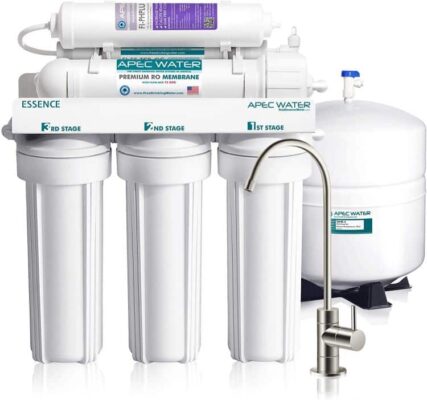
The APEC ROES-PH75 is a conventional under-sink RO system with a dedicated faucet and 4-gallon water tank. It’s among APEC’s most affordable under-sink offerings, over half the cost of its tankless systems. There are several configurations in the ROES series, and we chose to test the 6-stage 75 GPD model with a final remineralization stage.
What We Like
What We Don’t Like
Product Specs
| Price | $268.99 |
| Contaminants Reduced | 10+ |
| Certifications | NSF/ANSI 58 |
| Process | Sediment + Carbon + RO + Remineralization |
| Filter Capacity | 6-24 months |
| Annual Cost | ~$133 |
| Warranty | 1 year (Limited) |
▶️ Video Review
We evaluated the ROES-PH75 through a detailed, multi-factor testing process that measured contaminant removal, waste ratio, flow performance, TDS creep, operating noise, and our overall installation and maintenance experience. All our data is discussed in this review.
📊 Scoring Data
We assess every water filter using our in-house scoring system, which combines results from all major testing categories into a single overall, weighted score. For this review, we tested the APEC ROES-PH75 and benchmarked its performance against the highest-rated RO systems we’ve evaluated to date.
The final weighted score is based on six core areas: contaminant reduction, flow rate, build and design quality, installation complexity, maintenance and ongoing costs, and the manufacturer’s warranty, shipping, and returns policies.
We also measured additional factors unique to RO systems such as efficiency ratio, recovery rate, noise output, and other performance details that provide useful context, even though they aren’t currently included in the overall ranking.
See how APEC performed in the table below.
| Criteria | Results |
|---|---|
| Overall Score | 8.87 |
| Health Related Contaminants | 9.40 |
| Aesthetic Related Contaminants | 9.90 |
| Performance Certification | NSF/ANSI 58 |
| Filtration Rate | 75 GPD |
| Component Quality | Outstanding |
| Component Certification | NSF/ANSI 58 & 372 |
| Setup | Weak |
| Servicing Requirements | Good |
| Costs | $0.10-$0.21 / gallon |
| Warranty Length | 1 year |
| Shipping | Free Shipping to US domestic 48 contiguous states |
| Returns | 30 days |
🚰 Contaminant Reduction
Score: 9.28We know that most folks looking to buy a system like the ROES-PH75 aren’t just trying to address one or two contaminants; they’re after a complete purification solution. The RO systems we’ve tested have all generally delivered strong, broad-spectrum contaminant removal, so our expectations for this APEC unit were high.
When determining scores in this category, we focus primarily on our own results from Tap Score lab testing. The overall contaminant reduction score is also influenced by any official certifications from organizations like the NSF, IAPMO, or the WQA, which provide more confidence in the unit’s performance.
Our Performance Testing
Score: 9.43

To see how the ROES-PH75 actually changed our water quality under everyday conditions, we took pre- and post-filtration* water samples and sent them to Tap Score for laboratory testing. We received detailed reports outlining every detected contaminant, making it easy to directly compare our results.
We reviewed this data against the Health Guideline Levels (HGLs) as our primary benchmark (Tap Score reports also include MCLs for context on regulatory limits). Alongside this lab testing, we also measured chlorine ourselves using Hach test strips—something that’s best done on-site due to chlorine’s volatility, which causes it to dissipate from water quickly.
Health-Related Contaminants
Score: 4.70
The ROES-PH75 received one of the highest lab test scores we’ve awarded to an RO system, and its performance when reducing contaminants with health effects was a big contributing factor here.
Test data for our unfiltered water sample highlighted 16 contaminants with possible health effects:
- Fluoride
- Uranium
- 3 disinfection byproducts
- Barium, copper, and strontium
- Boron
- Nitrate
- Chromium
- Selenium
- Sulfate
- Vanadium
- Manganese
- Molybdenum
5 of these contaminants were detected at levels exceeding the HGL: fluoride, uranium, and the 3 disinfection byproducts (dibromochloromethane, bromodichloromethane, and bromoform).
See the full list of contaminants detected in the next table.
| Analyte | Unit | Unfiltered | APEC ROES-PH75 | Difference |
|---|---|---|---|---|
| Alkalinity (as CaCO3) | PPM | 391 | 37 | -90.54% |
| Barium | PPM | 0.033 | 0.000649 | -98.03% |
| Bicarbonate | PPM | 471.09 | 44.81 | -90.49% |
| Boron | PPM | 0.487 | 0.248 | -49.08% |
| Bromodichloromethane | PPB | 4.29 | 0 | -100.00% |
| Bromoform | PPB | 11.4 | 0 | -100.00% |
| Calcium | PPM | 52.1 | 4.98 | -90.44% |
| Carbonate | PPM | 2.74 | 0.13 | -95.26% |
| Chloride | PPM | 128 | 10.4 | -91.88% |
| Chromium (Total) | PPM | 0.0047 | 0.000618 | -86.85% |
| Copper | PPM | 0.287 | 0 | -100.00% |
| Dibromochloromethane | PPB | 11.9 | 0 | -100.00% |
| Fluoride | PPM | 2.4 | 0 | -100.00% |
| Grains per gallon | Grains | 10.7 | 0.8 | -92.52% |
| Hardness | PPM | 182 | 13.7 | -92.47% |
| Hardness (Total) | PPM | 183.11 | 13.74 | -92.50% |
| Langelier Saturation Index | 0.73 | -1.5 | -305.48% | |
| Magnesium | PPM | 12.6 | 0.311 | -97.53% |
| Manganese | PPM | 0.0011 | 0.00155 | 40.91% |
| Molybdenum | PPM | 0.002 | 0 | -100.00% |
| Nitrate (as N) | PPM | 1.4 | 0.5 | -64.29% |
| pH | pH | 8.1 | 7.8 | -3.70% |
| Potassium | PPM | 3.96 | 0 | -100.00% |
| Selenium | PPM | 0.0041 | 0 | -100.00% |
| Sodium | PPM | 237 | 14.2 | -94.01% |
| Sodium Adsorption Ratio | 7.64 | 1.67 | -78.14% | |
| Specific Conductivity | umhos/cm | 1500 | 90.1 | -93.99% |
| Strontium | PPM | 0.566 | 0.0179 | -96.84% |
| Sulfate | PPM | 122 | 0 | -100.00% |
| Total Dissolved Solids | PPM | 875 | 54 | -93.83% |
| Total THMs | PPB | 27.59 | 0 | -100.00% |
| Uranium | PPM | 0.0036 | 0 | -100.00% |
| Vanadium | PPM | 0.0017 | 0 | -100.00% |
| Chloride-to-Sulfate Mass Ratio | 1.05 | 1.42 | 35.24% |
Post-filtration, all the contaminants detected above the HGL were eliminated. The ROES-PH75 also reduced 100% of molybdenum, selenium, sulfate, and vanadium. It greatly reduced barium by 98%, strontium by 96%, and chromium by 86%.
Less impressively, it reduced nitrate by 64% and boron by 49%. We think these contaminants weren’t effectively reduced due to our low feed water pressure (48 PSI) and cool feed water (60.4°F), which affect the membrane’s ability to filter effectively. Boron is especially tricky because at neutral pH it mostly exists as uncharged boric acid, which passes through membranes easily, and dissolved manganese can also be harder to remove.
There was one unexpected result: manganese increased by 40% post-filtration, from 0.0011 PPM to 0.00155 PPM. We think this trace increase is likely coming from the remineralization filter.
Aesthetics, pH, and Mineral Content
Score: 9.90
We chose to test the ROES-PH75 with included remineralization so we could assess how effectively this final stage reintroduced minerals and prevented pH loss.
The RO process produces mildly acidic water, which can have taste effects, and the purpose of a remineralization filter is to prevent this by replacing some of the rejected minerals and boosting alkalinity.
Our on-site results (measured using a pH meter) showed that the ROES-PH75 increased pH from 7.59 to 8.77 (slightly alkaline). Interestingly, the Tap Score results said otherwise: pH actually dropped slightly from 8.1 to 7.8. In both tests, our purified water still had an alkaline pH, not the acidic pH we’d expect to see without remineralization.
Calcium and magnesium were reduced by 90% and 97% respectively, while sodium was reduced by 94% and potassium was completely eliminated. So, our purified water still had a significantly lower mineral content even after remineralization. But the important distinction is that pH didn’t drop to acidic (less than 7.0).
TDS & TDS Creep
We evaluated TDS by comparing TDS measurements from two sources:
- Data from our Tap Score lab testing
- Readings from our on-site testing using a TDS meter
In our Tap Score tests, our baseline sample had a TDS reading of 875, and our purified water had a TDS of 54: a 93% reduction, similar to other systems we tested like the Aquasana Smartflow.
We conducted several on-site tests to find out whether or not the system had an issue with TDS creep.
| Test Condition | TDS (PPM) |
|---|---|
| Feed Water | 647 |
| 1st Draw (After 10 hrs idle) | 49 |
| Stable TDS (After 2 minutes flow) | 44 |
| TDS Reduction (Lab Test) | 93% |
| TDS Reduction (875 → 54 PPM) | 93% |
| TDS Creep Difference | 5 PPM |
The basic explanation for TDS creep is when TDS levels in the initial draw of filtered water are higher than normal, occurring after the reverse osmosis system hasn’t been used for some time (such as overnight). While the system isn’t being used, the pressure in the semi-permeable membrane begins to equalize, causing TDS to temporarily increase.
In our testing, this has been more of an issue with tankless systems, as these don’t have any means of buffering the initial, lower-quality water produced straight after turning the system on.
The ROES-PH75 is a conventional unit, so we didn’t expect TDS creep to be significant. To find out, we measured the TDS of our feed water (which read 647 PPM at the time), then took a TDS reading from a first-draw sample from the unit’s faucet, after letting it sit idle overnight for 10 hrs.
We then took our 1st draw TDS reading from the ROES-PH75, which measured 49 PPM—not indicative of TDS creep.
After keeping the water flowing through the system for 2 minutes, we took a 2nd draw reading from a sample collected in a separate glass. This time, our TDS reading was 44 PPM.
The difference between the 1st and 2nd draw was just 5 PPM, telling us that TDS creep is not a significant issue with this unit.
Performance Certifications
Score: 8.00
When we test our own water supply, we can only evaluate a filter’s ability to reduce the contaminants detected in our feed water. That’s why performance certifications from official third-party organizations are also a scoring factor in this category.
The most common certification for RO systems is NSF/ANSI 58, under which manufacturers can get their products tested and verified to reduce a range of contaminants.
The ROES-PH75 is performance certified by the WQA to reduce TDS: arguably the most important certification that can be obtained for a reverse osmosis filter. But we know many folks also want confirmation that a filter can effectively reduce specific contaminants with health effects, like lead and arsenic.
While the TDS certification is a good start, the unit is only certified for 1 out of the 51 contaminants it’s claimed to reduce on the product page, which is somewhat disappointing and resulted in a lower score in this category.
🚦Filtration Rate
Score: 7.50The ROES-PH75 has a listed flow rate of up to 75 GPD (gallons per day), as is typical for a tank-based unit.
We wanted to see how our own real-world test conditions, including our feed water temperature of 60.4°F and water pressure of 48 PSI, impacted flow rate. To do this, we filled a graduated measuring container with purified water, timing how long it took to reach the fill line.
Our timings were measured to the millisecond, captured using an editing tool to move through our video footage frame by frame until we had the precise starting point (water leaving the faucet) and the exact ending point (container filled to the specified fill line).
| Test Metric | Result |
|---|---|
| Time to Fill 12 oz | 189.47 seconds |
| Measured Flow Rate | 0.03 GPM |
| Gallons Per Hour | 1.78 GPH |
| Converted GPD | 42.74 GPD |
| Manufacturer Claim | 75 GPD |
In our first test, we recorded the time taken to fill to the 12-ounce line of our measuring jug. This test was repeated three times and resulted in an average recording of 189.47 seconds. This translates to a flow rate of 0.03 GPM (gallons per minute), or 1.78 GPH (gallons per hour).
In gallons per day, that’s approximately 42.74 GPD. Remember, APEC only claims up to 75 GPD, and our cooler feed water and lower incoming pressure likely affected flow rate to some extent in our testing.
Efficiency Ratio
Efficiency ratio shows how much purified water an RO system produces compared to how much water it sends to drain during operation.
In our experience, conventional under-sink systems with a tank tend to be less efficient than tankless models, which have a built-in booster pump rather than relying on incoming water pressure.
We couldn’t find the ROES-PH75’s recovery rate listed online, but according to APEC’s AI chat tool, it has a pure-to-waste ratio of 1:3, meaning that 3 gallons of water are drained for every 1 gallon of purified water produced.
To measure this ourselves, we disconnected the drain line and directed the wastewater into a measuring container while we filled a separate container with 12 ounces of purified water. When the 12-ounce line was reached, we’d collected 128 ounces of wastewater, equalling a ratio of around 1:10.6.
| Test Volume | Wastewater Produced | Pure-to-Drain Ratio |
|---|---|---|
| 12 oz Test | 128 oz | 1 : 10.6 |
| 64 oz Test | 328 oz | 1 : 5.1 |
| Claimed by Manufacturer | — | 1 : 3 |
That means 10.6 ounces of water is wasted per 1 ounce purified, making the ROES-PH75 the least efficient RO system we’ve tested by a mile.
It’s worth noting that most RO membranes perform best with a water pressure of 60-80 PSI and a temperature of around 77°F, so our own water pressure of 48 PSI and temperature of 60.4°F likely reduced the system’s efficiency. Even so, many other tank-based systems we tested in very similar conditions were much more efficient in the 12-ounce test.
We then repeated the process with a larger purified water draw of 64 ounces (½ gallon). This time, we recorded 328 ounces of drain water; a recovery rate of 1:5.1. This result is significantly improved—we can see that the system wastes around half the amount of water with this larger draw compared to the 12-ounce draw.
This improved result is expected, as RO systems require a short period to stabilize when they’re first turned on, and a smaller draw captures more of that less efficient startup phase. With our larger water draw, the ROES-PH75 spent more time operating at steady pressure and flow, allowing the membrane to run more efficiently and improving its pure-to-drain ratio.
Booster Pump Efficiency
This APEC model doesn’t come with a built-in pump, and we were keen to see how installing a booster pump upstream of the unit would increase water flow and efficiency.
We installed the pump, then collected 0.5 gallons (64oz) of purified water, measuring wastewater volume during this process. We recorded 1.92 gallons (or 264 ounces) of wastewater in just under 10 minutes, resulting in a flow rate of 3.06 GPH (or 73.44 GPD) and a pure-to-drain ratio of 1:3.84.
These results show us that installing a booster pump can effectively improve the system’s filtration and recovery rate. Flow rate was boosted by around 30 GPD, and recovery rate was increased by 26% (compared to our first 64-ounce draw).
Booster pumps need power to operate, so energy usage is something else we wanted to measure. In our testing, the pump used 0.004 kilowatt hours, which was a similar energy usage as the built-in pumps for the tankless RO systems we tested.
📐 Design
Score: 9.70For all the filters we test, there are two factors that contribute to our scoring for design: component quality and the presence of certifications for design or materials safety.
The APEC ROES-PH75 has the stereotypical conventional RO system design, with the first three filter stages being attached vertically from a metal bracket, and the additional filter stages stacked horizontally on top. The unit measures 15.5 (length) x 5.25 (width) x 17.5 (height) inches and weighs 1.41 kilograms, with a 4-gallon water tank and chrome faucet included.
As we mentioned, we got the ROES-PH75 with an additional remineralization stage. Other models to consider include:
- The ROES-50, which has a slightly slower flow rate of up to 50 GPD and no remineralization
- The ROES-100, with (you guessed it) a flow rate of up to 100 GPD and no remineralization
- The ROES-UV75, with an added UV sterilizer.
- Just a note on how this one is marketed: it “Kills Parasites In Un-Chlorinated Water For Extra Protection Against All Microbial Pathogens”. This suggests (without explicitly stating) that you can use the system with untreated water. We don’t recommend this—this final UV stage is simply a protection against any bacteria growth within the unit itself, and it’s downstream of the RO membrane anyway. That means the RO membrane would be the main barrier against microorganisms, and untreated water would cause it to foul.
- The ROES-PHUV75, with an added remineralization filter and a UV sterilizer.
If you’re looking for a high-tech unit with a control screen and TDS monitors, you’ll need to consider upgrading to a tankless or countertop system in a higher price bracket. Conventional RO units like this APEC model rarely offer these features (although there are exceptions, such as Cloud RO, which we’ve reviewed here).
Component Quality
Score: 9.50
The ROES-PH75 has a plastic and metal construction, using WQA-certified plastics in its construction. It held up well in our testing, with a sturdy build that feels like it’s made to last.
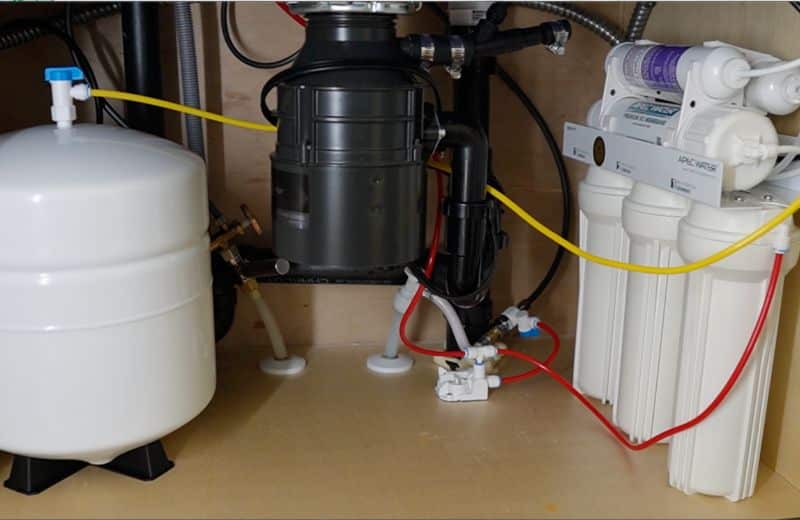
We did some digging and found that polypropylene is one of the plastics listed as used in the unit’s design. We only know that the faucet is chrome-plated and made from a lead-free metal.
Filter Materials
There are 6 separate filter stages in the ROES-PH75:
- A 5-micron polypropylene sediment filter
- Two extruded carbon block filters
- An RO membrane
- A GAC acid-washed carbon post-filter
- A calcite remineralization filter
We commonly see these media used in RO systems as they complement one another well: the sediment filter protects the RO membrane, the carbon pre-filters reduce poor tastes/odors and chemicals not addressed by the membrane (and protect it from disinfection chemicals), the post-filter further enhances taste, and the remineralization filter boosts pH.
Materials Safety Certification
Score: 10.00
When a water filter is certified for materials safety by the NSF, IAPMO, or the WQA, it provides extra confirmation that it’s safely constructed for its intended purpose.
There are two certifications that we look for when reviewing water filters:
- NSF/ANSI 372, for lead-free design
- Materials safety, which is a component of a performance certification (NSF/ANSI 42, 53, 58, etc.)
The ROES-PH75 has both of these certifications: its materials safety certification is a component of its NSF 58 performance certification, and it also has a WQA certification for lead-free design.
⚙️ Setup
Score: 7.00Like the other under-sink RO systems we’ve tested, the ROES-PH75 has a time-consuming setup process. We installed it ourselves, and while we didn’t find it difficult, it does require a high level of concentration and some technical/plumbing knowledge.
The entire process took 90 minutes and included installing the faucet (which requires a dedicated hole drilled into the countertop) and hooking up the drain line. If you don’t already have a faucet hole and drain line adapter installed, the process will likely take 2 or more hours.
We noted a few factors that made some parts of setup more challenging than they needed to be:
- The filters and housings aren’t color-coded like others, so we had to spend a bit more time making sure we were installing the right filters in the right housings.
- The tubing is color-coded, but only red and yellow, so not quite as helpful as some of the other systems we’ve tested.
- While the faucet comes with tubing already inserted, installing it was annoying as we had to use a wrench to get the bolt tight underneath. It does not have a quick-mount nut.
After installing the system, we followed the manufacturer’s instructions to flush the filters. It took 3 hours to flush one tank’s worth of water, then we waited another 2-3 hours for the tank to refill, before we could start using the water purified by the system.
It’s one of the quicker flushing processes we’ve followed—for instance, the Express Water RO5DX requires a full 3 tanks of water to be flushed before the purified product can be used.
We detected 19 possible leak points (connections or seals at the fittings that could allow water to escape), and the system did leak from the drainline at the manufacturer installed membrane drain connection. We were able to fix this by installing a blue locking clip.
Noise
With the ROES-PH75 up and running, we used a phone app to measure the noise produced during operation in decibels. As it doesn’t use a booster pump, we expected it to be quieter than a tankless system with a built-in pump.
We measured sound decibels at 1 foot and 3 feet away:
- At 1 foot, the unit produced 24.3 decibels.
- At 3 feet, it produced 23.9 decibels.
That’s very quiet, and it’s possible that our app was even picking up some noise from the refrigerator in the kitchen rather than the RO unit itself.
🔧 Maintenance
Score: 9.25Here’s how the ROES-PH75 performed in our maintenance tests.
Servicing Requirements
8.50
The ROES-PH75 has 6 filters to change, and this is the most important maintenance task to keep the system running properly.
As is common with conventional RO systems, this APEC unit doesn’t have an integrated filter life tracker or filter change reminder.
The user manual contains a replacement schedule for each filter stage (every 6-12 months for the first 3 filters, every 2-4 years for the RO membrane and carbon post-filter, and every 6-12 months for the remineralization filter), but the unit doesn’t proactively track and warn you. That means there’s a bit more effort involved in making your own phone calendar reminders.
To replace the filters, you’ll need to shut off the water supply to the system and turn off the RO tank ball valve, then open the faucet to release pressure. You then need to disconnect the unit and follow the specific maintenance instructions for the filter you’re replacing. This might involve using a wrench to unscrew or disconnect the filter housing before replacing the cartridge inside.
According to the user manual, only the RO membrane and remineralization filter require you to flush a tank’s worth of water before you can start using the purified water from the system. This is unusual—the other systems we’ve tested all require you to perform a system flush regardless of the filter you’re changing.
APEC also recommends changing the filter housing o-rings every year, at the same time as replacing the 3 pre-filters, as well as replacing the filter housings once every 5 years.
Costs
Score: 10.00
We calculated that the ROES-PH75 has an overall ongoing spend of $0.10-$0.21 per gallon (assuming that we use the system to purify 2-4 gallons of water per day).
APEC doesn’t provide information on each filter’s capacity in gallons, so we used our time-based “effective gallons” cost estimator to work out the overall cost-per-gallon instead.
To calculate this figure, we multiplied the recommended replacement interval by our assumed daily usage to estimate how much water each filter would realistically treat before it would need replacing. We then divide the replacement cost by that figure.
The ROES-PH75 is affordable to maintain even with 6 filters to replace, earning it the top score in this category.
🏢 Company
Score: 8.35Finally, we assigned a score to APEC as a company, based on its warranty, shipping, and returns offerings.
Warranty
Score: 8.50
APEC warrants the ROES-PH75 for 1 year after your purchase date against any defects in materials and workmanship. This is the standard warranty period for an under-sink RO system.
The warranty entitles you to a free repair or replacement, or a full refund, throughout the warranty period.
You can find the warranty information at the bottom of the user manual.
Shipping
Score: 9.50
All products purchased on the APEC website are shipped for free to customers in the US domestic 48 contiguous states.
APEC ships orders placed prior to 12:00 pm PST within the same day, with next-day delivery options available.
View APEC’s shipping policy here.
Returns
Score: 7.00
Under APEC’s returns policy, you can return your order within 30 days of the purchase date, as long as you call or email customer service and obtain a Return Merchandise Authorization number beforehand.
You’ll need to package the system either in its original box or a box of similar holding strength, and everything should be included as you received it.
There are a couple of stipulations to be aware of:
- As the customer, you’ll be responsible for the return shipping fees.
- You’ll only receive a full refund if the system is unopened and unused. Otherwise, you’ll need to pay a 10-50% restocking fee, depending on your reason for return and the system’s performance when tested by the manufacturer.
Here’s APEC’s returns policy for more information.
💰 Value For Money
The ROES-PH75 is one of the highest-scoring conventional RO systems we’ve tested so far, and we think it offers good value for money overall.
It reduced or removed all contaminants in our testing, and the remineralization filter prevented pH from decreasing into acidic territory. Plus, it’s certified for TDS reduction, and it holds two design certifications, and we had no complaints about its build quality.
That said, the installation process is time-consuming and tricky, and filtration and efficiency ratio are pretty poor when we compare the unit to other RO systems.
If you’re looking for a budget-friendly RO system with official certifications and remineralization, we think the ROES-PH75 is a good fit. But if you can stretch your budget to a more efficient tankless system with a built-in pump and helpful tech features like TDS monitors and filter lifespan trackers, we’d recommend this option instead.
Found this review helpful?
Comment below or share this article!