

The best countertop reverse osmosis systems are extremely high-performing and can reduce hundreds of impurities from water. They’re also highly efficient and waste less water than conventional RO systems, and are easy to install due to their plug-and-play designs.
We conduct our own hands-on testing to obtain the data we need to review and compare water filters. All the RO systems in this guide were personally tested by Brian, the founder of Water Filter Guru, WQA Certified Water Specialist (CWS), and Certified Water Treatment Representative (CWR), who has been testing and reviewing water filters for over 10 years.
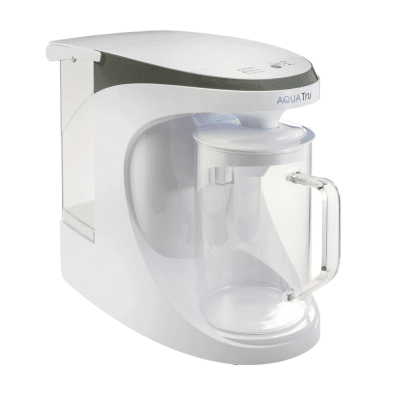
AquaTru
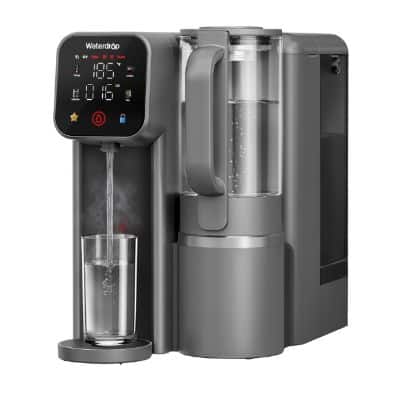
Waterdrop M6H

Bluevua ROPOT(UV)
Quick Answer: The Best Countertop Reverse Osmosis Systems of 2026
After lab-testing 12 countertop RO systems with independent Tap Score analysis, the AquaTru Carafe and Waterdrop M6H tie for the top score at 9.53/10. The Carafe is our top pick because it is IAPMO certified (NSF/ANSI 42, 53, 58, and 401) for all 84 contaminants it claims to reduce. The M6H left the lowest TDS of the four systems we tested on the same 803 PPM water (24 PPM) and costs the least to run.
- Best overall: AquaTru Carafe (9.53). Certified for all 84 reduction claims. Eliminated fluoride, uranium, copper, and total THMs in both of our lab tests.
- Best budget: Waterdrop M6H (9.53). Cut TDS from 803 PPM to 24 PPM and costs $0.083 per gallon to run.
- Best glass carafe with UV: Bluevua ROPOT(UV) (9.47). Cut TDS by 94.4% with the highest production rate we measured (125.4 GPD). Not performance certified.
- Best for hot and cold water: Philips Countertop RO Dispenser (8.98). Built-in remineralization kept pH at 7.0 (from 7.6). Not performance certified.
- Best with hydrogen infusion: RKIN U1 (8.83). Eliminated fluoride, lead, and uranium. Strontium rose from 0.108 PPM to 2.42 PPM.
- Runner-up for on-demand hot water: Sans Water Purifier (8.71). Eliminated uranium and fluoride. Remineralization raised pH from 7.2 to 9.7.
- Most affordable hot and cold dispenser: APEC ROCT-Plus (8.58). Reduced fluoride by 85% at a filter cost of $0.078 per gallon.
Methodology: Every system was tested in our own home by Brian Campbell, WQA Certified Water Specialist, using before-and-after water samples sent to Tap Score. See how we test and score water filters.
Our Testing & Selection Process
How we tested these countertop RO systems: We bought and tested 12 countertop RO systems ourselves, and the 7 best are reviewed below. For each one, we sent a pre-filtration and post-filtration water sample to an accredited lab and measured the actual percentage reduction of every detected contaminant, including health-related contaminants like fluoride, uranium, and nitrate. We then scored each system across 6 weighted factors (9 sub-factors total): contaminant reduction, design, maintenance, filtration rate, setup, and company. We also independently verified every certification claim against the IAPMO, NSF, and WQA databases, because several manufacturers in this category market third-party “certifications” that do not actually cover contaminant reduction.
We test and rank the filters in our “best” guides using our own data-driven scoring system comprising 6 key scoring factors, made up of 9 sub-factors. For our Best Countertop Reverse Osmosis System guide, we selected and shortlisted each of the filters based on the scores they obtained for their performance, design quality, value, and more.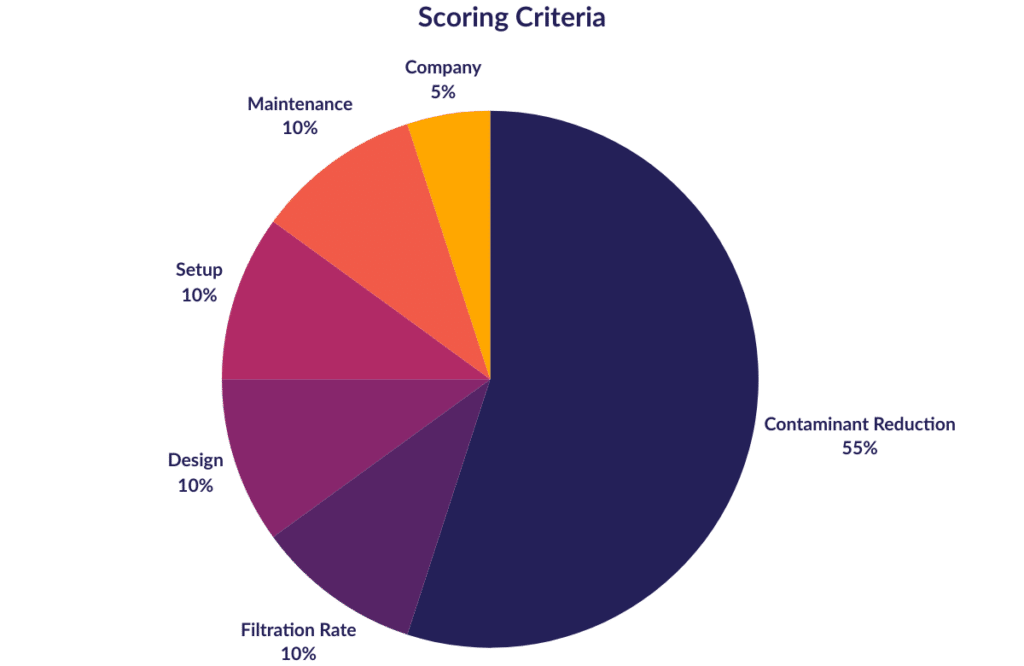
Additionally, we compared the systems’ technologies, efficiency ratios, and water-holding capacities, though these are not scoring factors. Whenever we can, we award our performance scores based on quantifiable data. But some categories – such as setup and design – benefit from our own subjective opinion.
To choose the best systems, we shortlisted the products that had the best overall scores, paying special attention to their contaminant reduction scores.
RO systems are high-end products and tend to be more expensive, but we still wanted to recommend a few different options to suit different budgets and preferences. We excluded some water filters from this guide for a few reasons, including if they didn’t qualify as reverse osmosis systems (i.e. using a semi-permeable membrane to purify water) or they weren’t available within the USA. We also ruled out systems that simply weren’t as good as their competitors. For instance, filters that did a poorer job at reducing contaminants, got poor scores for design, setup, and maintenance, were sold by a new or unreliable company, or were of poorer value overall, didn’t make the list.
Note: Our reviewing process takes time. We’re continuously trying and reviewing new RO systems, so if we haven’t yet reviewed a system, it’s probably on our list to try.
The Best Countertop Reverse Osmosis Systems
| Product | AquaTru Carafe | Waterdrop M6H | Bluevua ROPOT | 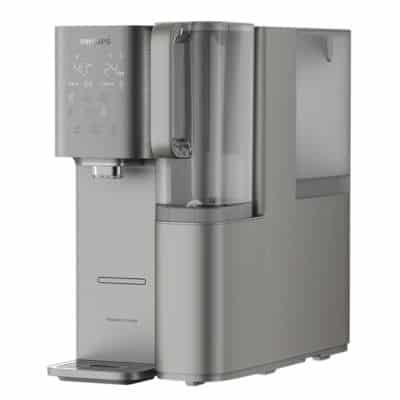 Phillips |  RKIN U1 |  Sans | 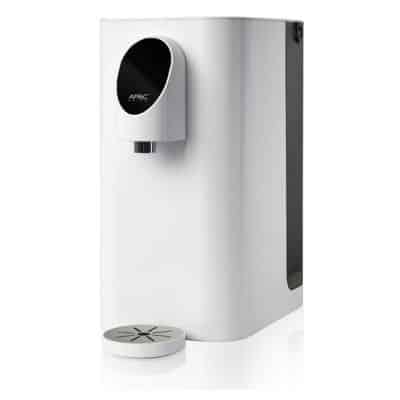 APEC ROCT-Plus |
|---|---|---|---|---|---|---|---|
| Score | 9.53 | 9.53 | 9.47 | 8.98 | 8.83 | 8.71 | 8.58 |
| Price | $375.00+ | $319.00 | $454.00 | $799.00 | $749.95 | $499.99 | $417.99 |
| Certifications | NSF/ANSI 42, 53, 58, and 401 | NSF/ANSI 58 | NSF/ANSI 372 | Not Certified | Not Certified | Not Certified | Not Certified |
| Filter Capacity | 300 / 600 / 300 gallons | 1,100 gallons | 538 / 1,056 / 260 gallons | 528 gallons | 6, 12, 24 months | 600 – 1,200 gallons | 1,100 gallons |
| Cost per Gallon | $0.33 | $0.08 | $0.30 | $0.23 | $0.08 | $0.14 | $0.078 |
| Warranty | 1 year | 1 year | 1 year | 2 years | 1 year | 3 years | 2 years |
| Read Review | AquaTru review | Waterdrop M6H review | Bluevua ROPOT review | Phillips water dispenser review | RKIN U1 review | Sans water purifier review | APEC ROCT-Plus review |
AquaTru Carafe: Best Countertop RO System Overall (9.53/10)
The AquaTru Carafe is our top recommended countertop reverse osmosis system because it earned the highest contaminant reduction score of any countertop RO system we’ve tested (9.91, shared with the AquaTru Classic) and is certified for every one of its 84 reduction claims. Its overall score of 9.53 ties the Waterdrop M6H for the highest on this list: the Carafe leads on contaminant reduction and certification, while the M6H is faster and cheaper to run.
We recommend both AquaTru models: the smaller, more compact AquaTru Carafe and the full-size AquaTru Classic.
Best For
Product Specs
| Price | $375.00+ |
| Contaminants Reduced | 84 certified |
| Certifications | NSF/ANSI 42, 53, 58, & 401 |
| Process | Mechanical + Carbon + Reverse Osmosis |
| Filter Capacity | 300 / 600 / 300 gallons |
| Annual Cost | ~$244 |
| Warranty | 1 year |
Why It’s Best
The AquaTru Carafe is the best overall countertop RO system because it earned our highest contaminant reduction score (9.91), with Tap Score Health and Aesthetic scores of 99 in both tests and certification for all 84 of its claims.
In both lab tests, it eliminated fluoride, uranium, copper, and total THMs. On our harder 2026 water (803 PPM TDS), it also reduced nitrate by 87.8%, strontium by 98.8%, and boron by 53.3%, leaving 60 PPM of TDS.
It’s also the only countertop RO product to have obtained performance certifications for every single contaminant it’s claimed to reduce. Its measured recovery of 70.2% (2.36:1) was the second best of the four countertop RO systems in our 2026 cohort.
How did the AquaTru Carafe perform in our lab tests?
Key Finding: We’ve lab-tested the AquaTru Carafe twice. The first test, conducted in 2024, was on soft municipal water containing 164 PPM TDS. The second, in September 2026, was on hard, high-TDS municipal water containing 803 PPM TDS. In both tests, it eliminated fluoride, uranium, copper, and total THMs, and on the 2026 water it reduced TDS from 803 PPM to 60 PPM (92.5%). It’s also the only system on this list that’s certified (IAPMO to NSF 42, 53, 58, and 401) for every one of the 84 contaminants it claims to reduce.
The two AquaTru models hold two of the three highest scores of any countertop RO system we’ve tested (the Carafe ties the Waterdrop M6H at 9.53):
- The AquaTru Carafe got a slightly higher score of 9.53 due to its glass collection vessel (the Classic system collects water in a plastic vessel).
- The AquaTru Classic system received a score of 9.52 out of 10
These are two of the highest scores our scoring system has ever awarded.
Both systems use the same filter technology (the only difference is that the AquaTru Carafe’s filters are smaller), so both performed very similarly in our testing.
In both tests, the Carafe received Tap Score Health and Aesthetic scores of 99, eliminating fluoride, uranium, copper, and total THMs.
The system also reduced 100% of chlorine in our water, earning a score of 9.90 for reducing aesthetic contaminants. Plus, in 2026, our lab results showed a 53.3% decrease in boron; the best boron result among the four countertop RO systems we tested on the same water.
So far, we’ve only tested the Carafe with the standard VOC filter, and in both tests, calcium, magnesium, and sodium were significantly reduced in our water. But we’ve tested the larger Classic model with the remineralization upgrade, which increased the pH of our water from 7.3 to 10.7 and greatly increased carbonate and bicarbonate concentrations.
A standout performance feature of the AquaTru is that it’s IAPMO certified to NSF Standards 42, 53, 58, and 401 for the reduction of all 84 contaminants that AquaTru claims it can reduce. Many of its competitors aren’t certified at all, and others are only certified to reduce a handful of contaminants.
There is one unusual result worth mentioning: 0.0037 PPM of manganese appeared post-filtration in 2024, and 0.00194 PPM appeared in September 2026. These concentrations are both well below the Health Guideline Level of 0.3 PPM.
Is the Aquatru Carafe efficient and cost-effective to maintain?
AquaTru’s marketed recovery rate is an impressive 4:1, meaning that 1 gallon of water is wasted for every 4 gallons purified. But in our testing, the unit used 94 ounces of tap water and left 28 ounces of water to dump when filling the included carafe. That’s a 70.2% recovery rate, or an efficiency ratio of 2.36:1, well short of AquaTru’s 4:1 figure.
On the flipside, our filtration speed testing actually exceeded AquaTru’s claim of 35 GPD (gallons per day). It took an average of 14 minutes and 55 seconds to produce 64 ounces of purified water across three timed batches, translating to an effective GPD rating of 48.3. But it was still substantially slower than the three countertop RO systems tested on the same water, translating to a score of 7.00 in this category.
What Should I Know About Aquatru’s Design, Setup, and Maintenance Requirements?
The Carafe also got the best design score that a countertop RO unit can receive: 10.00 (equal only to the Bluevua ROPOT and Waterdrop M6H, which also use a glass collection carafe). It’s certified for materials safety as part of its performance certifications, and also holds an IAPMO certification to NSF 372 for lead-free design.
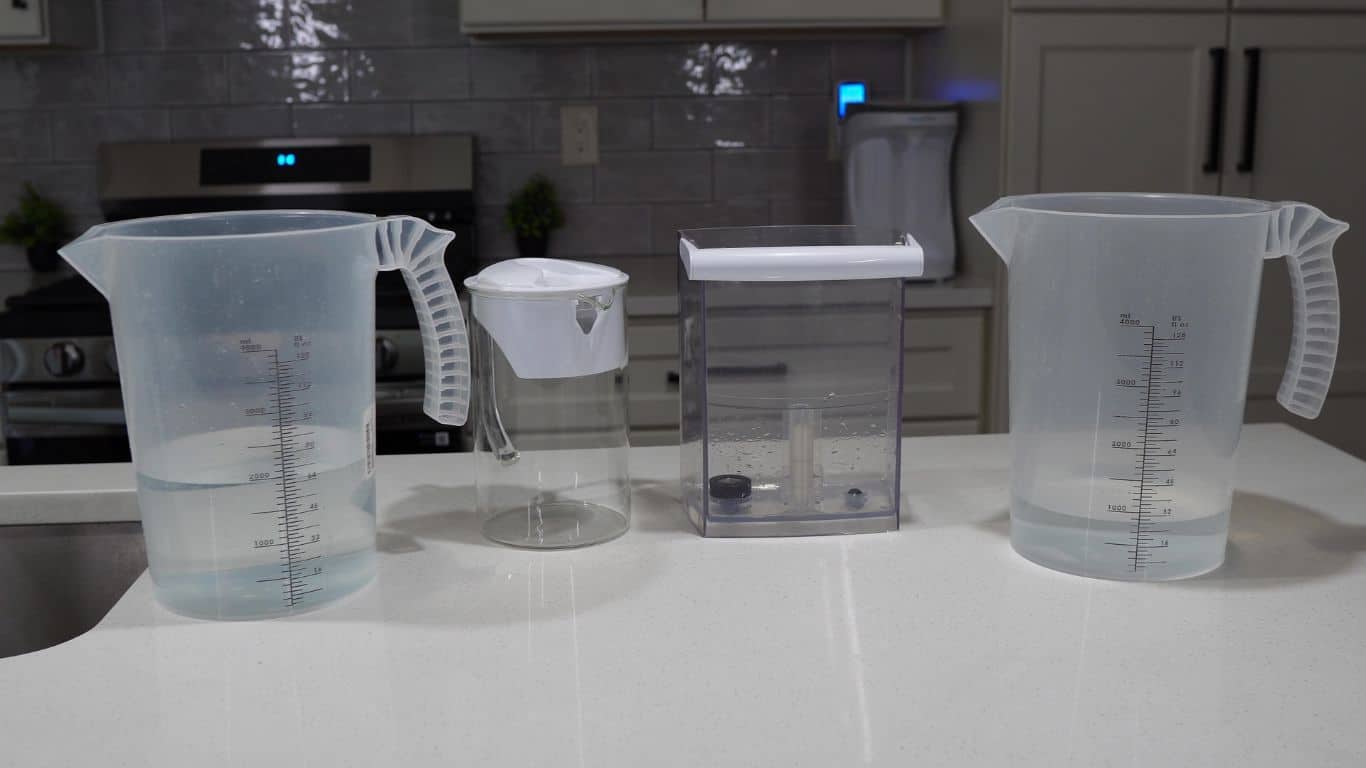
The Carafe received high scores of 10.00 for setup and 9.50 for maintenance (the Classic scored 10.00 and 9.75). We didn’t have to prime the filters, and the unit arrived partially assembled. In our 2026 testing, we recorded a setup time of 69.7 minutes from unboxing to the first usable glass of purified water, requiring four full tank flushes, with no tools or app required. That said, it had the longest setup time of the four countertop RO systems we tested.
There’s a display screen that indicates when a filter needs replacing, and at our assumed daily water use of 2 gallons, it costs $243.03 a year in filters, and $244.39 to operate (including electricity). This translates to $0.335 per gallon, and $1,596.95 over 5 years.
We think the AquaTru Carafe is the best countertop reverse osmosis system for folks who want a top-performing, fully certified unit with a glass vessel for purified water and the option for a remineralization upgrade.
Read the full reviews here: AquaTru Carafe Review / AquaTru Classic Review
| Criteria | Results |
|---|---|
| Overall Score | 9.53 |
| Health Related Contaminants | 9.90 |
| Aesthetic Related Contaminants | 9.90 |
| Performance Certification | Certified for 100% of reduction claims |
| Filtration Rate | 48.3 GPD |
| Component Quality | Exceptional |
| Component Certification | Exceptional |
| Setup | Exceptional |
| Servicing Requirements | Outstanding |
| Costs | $0.33/ gallon |
| Warranty Length | 1 year |
| Shipping | Free shipping |
| Returns | 30 days |
Waterdrop M6H: Best Budget Countertop RO System (9.53/10)
The Waterdrop M6H ties with AquaTru’s overall weighted score of 9.53, but it has a couple of unique features, including the ability to deliver purified water at any temperature, and the lowest ongoing cost of all the countertop RO systems we’ve tested in 2026 ($0.083 per gallon), with just 1 filter to replace.
In our lab testing, this unit reduced TDS down to 24 PPM, while AquaTru retained 60 PPM of TDS on the same water, and it filled its pitcher in 4.71 minutes against AquaTru’s 14.92 minutes.
Best For
Product Specs
| Price | $319 |
| Contaminants Reduced | 10+ claimed (1 certified) |
| Certifications | NSF/ANSI 58 & 372 |
| Process | Activated Carbon + Reverse Osmosis |
| Filter Capacity | 1,100 gallons or 12 months |
| Annual Cost | ~$60.31 |
| Warranty | 1 year |
What Did Our Lab Results Show?
Key Finding: The Waterdrop M6H cut TDS from 803 PPM to 24 PPM (97.0%) in our 2026 Tap Score test, the lowest filtered TDS of the four countertop RO systems we ran on the same water. It eliminated fluoride, uranium, total THMs, sulfate, strontium, and copper, but reduced boron by only 29.1%. It is IAPMO certified to NSF/ANSI 58 for TDS reduction only.
In our lab testing, the M6H reduced our feed water TDS from 803 PPM to 24 PPM, which was the lowest filtered water reading of the four countertop RO systems we tested on the same supply. It also completely eliminated total THMs, fluoride, uranium, strontium, sulfate, and copper, and reduced nitrate by 90.2%, from 4.1 PPM to 0.4 PPM.
Plus, free chlorine dropped from 2.99 PPM to 0 in our field tests, and unlike the other systems, it didn’t introduce any impurities, earning it a lab-test subscore of 9.52
We were less impressed with the boron result. Our lab reports showed that it had dropped from 0.375 PPM to 0.266 PPM: a reduction of just 29.1%. While reverse osmosis does struggle with boron, the M6H had the second-lowest boron reduction of the four countertop RO systems we tested on the same water (only the DREO was lower, at 21.3%).
The unit can be purchased with a remineralization upgrade (the M6HG, costing an extra $20). We tested the standard M6H model, with no remineralization, so unsurprisingly, calcium, magnesium, potassium, and alkalinity were greatly reduced or removed. pH also dropped from 8.0 (slightly alkaline) to 6.8 (slightly acidic).
The M6H has been certified by IAPMO for TDS reduction only, though Waterdrop lists more than 10 contaminants as third-party tested. This translates to a certification score of 8.00, pulling the overall contaminant reduction score down to 9.37.
Is the Waterdrop M6H Affordable to Buy and Maintain?
The Waterdrop M6H is the most affordable countertop RO system we tested in our 2026 cohort, at $319 upfront (at the time of this review), requiring just one $59.99 filter replacement per year. With its electricity cost, the unit’s annual operating spend is just $60.31, which is equal to $0.083 per gallon. Over five years, including the purchase price, the spend comes to $620.53. That’s less than half the five-year cost of the AquaTru Carafe ($1,596.95).
When it comes to knowing when to replace the filters, you can check the display screen for the filter lifespan alert or use the scannable NFC tag that lets you check the filter life on your phone. This ease of maintenance, combined with its ongoing affordability, earned Waterdrop a score of 10.00 for Servicing.
What Was Setup & Filtration Like?
The Waterdrop M6H was the quickest to set up of all the countertop RO systems we tested in our 2026 cohort, taking just 18.5 minutes and earning a top score of 10.00. Unlike the other systems, it needs just one automatic flush to prepare the filters, taking 8 minutes and 26 seconds.
From a design standpoint, you’re not getting less just because you’re spending less. It’s the only unit with a dedicated wastewater tank, the digital display was the best of all the countertop RO systems in our comparison, and the gasketed glass pitcher is a nice design upgrade, contributing to its score of 10.00 in this category.
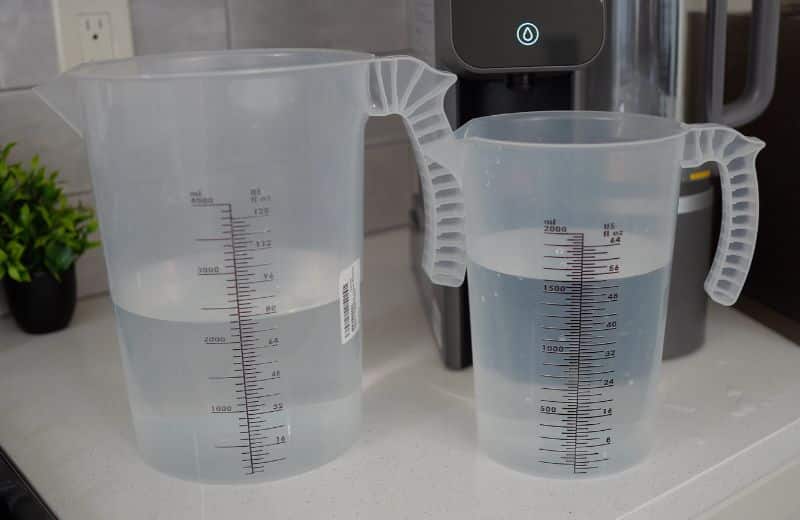
It purifies water quickly, too, taking just 4.71 minutes on average to fill its 40-ounce pitcher, earning it a Filtration Speed score of 9.50. Its effective production rate of 95.6 GPD was faster than its 75 GPD rating and almost twice as fast as the AquaTru Carafe. It’s also pretty quiet when it’s running, measuring 46.2 decibels on average at a distance of 1 foot away.
But efficiency was a letdown. The M6H delivered 78 ounces of purified water and 54 ounces of reject water when purifying one full feedwater tank, which is a 59.1% recovery percentage; the lowest of all the countertop RO systems in the 2026 batch. That’s a pure-to-wastewater ratio of 1.44:1, less than half of Waterdrop’s 3:1 claim.
We think you should consider the Waterdrop M6H if you have a smaller budget and want to purify water at any temperature both quickly and effectively (albeit not that efficiently).
| Criteria | Results |
|---|---|
| Overall Score | 9.53 |
| Health Related Contaminants | 9.50 |
| Aesthetic Related Contaminants | 9.90 |
| Performance Certification | NSF 58 & 372 |
| Filtration Rate | 95.6 GPD |
| Component Quality | Exceptional |
| Component Certification | Certified |
| Setup | Exceptional |
| Servicing Requirements | Exceptional |
| Costs | $0.08/ gallon |
| Warranty Length | 1 year |
| Shipping | Free shipping to lower 48 states |
| Returns | 30 days |
Bluevua ROPOT (UV): Best Glass-Carafe RO With UV (9.47/10)
The Bluevua ROPOT(UV) is the third countertop RO system we’ve reviewed that collects water in a glass container. It has built-in UV disinfection and reduced TDS by 94.4%, from 803 PPM to 45 PPM in our lab testing. It also completely removed fluoride, uranium, sulfate, and total THMs, and reduced nitrate to 0.2 PPM, but it’s not performance certified.
Compared to our top picks, it produced purified water at the highest rate (125.4 GPD), with a lower cost-per-gallon and lower filtered TDS than AquaTru. Plus, it delivered a higher recovery percentage than the Waterdrop M6H. Its overall weighted score came to 9.47.
Best For
Product Specs
| Price | $454.00 |
| Contaminants Reduced | 16+ (claimed) |
| Certifications | NSF/ANSI 372 (materials safety only) |
| Process | Mechanical + Carbon + RO + UV + Remin |
| Filter Capacity | 538 / 1,076 / 260 gallons |
| Annual Cost | ~$221.52 |
| Warranty | 1 year |
How did the Bluevua ROPOT perform in our lab tests?
Key Finding: In our second Tap Score test (September 2026), the Bluevua ROPOT(UV) cut TDS from 803 PPM to 45 PPM (94.4%) and eliminated fluoride, uranium, sulfate, and total THMs. It reduced nitrate by 95.1%, the best result of the four systems tested on that water, but boron by only about 40%, and trace manganese (0.00102 PPM) and antimony (0.000528 PPM) appeared in the filtered water. It is not performance certified.
We’ve tested the Bluevua twice, once in 2024 and once in September 2026. In our first test, the ROPOT(UV) eliminated all uranium in our testing but reduced fluoride by only 83%. The system also completely removed nitrate, chlorine, sulfate, copper, and molybdenum by 100%, and reduced barium by 77% and strontium by 75%.

In our second lab test on more challenging water, the unit reduced TDS from 803 PPM to 45 PPM and eliminated uranium, sulfate, and total THMs. This time, it also completely removed fluoride, but it didn’t eliminate nitrate. Still, nitrate reduction (by 95.1%, from 4.1 PPM to 0.2 PPM) was better than the other RO systems we tested in the 2026 cohort. Boron was reduced by just 40%, and trace manganese (0.00102 PPM) and antimony (0.000528 PPM) appeared in the filtered water (manganese also appeared in test 1).
The filter received a Tap Score Health score of 96 and an Aesthetic score of 99, contributing to its Contaminant Reduction score of 9.25.
Disappointingly, the ROPOT(UV) isn’t performance certified, despite Bluevua misleadingly claiming to have an “Official Third Party Certification” and using its WQA Gold Seal certificate (for lead-free design only) to suggest this is for contaminant reduction. This cost it points in the certification half of its contaminant reduction score.
How Quickly and Efficiently Did It Purify Water?
If you’re looking to filter water quickly, the Bluevua ROPOT(UV) should tick your boxes. It had the highest production rate of the four countertop RO systems we tested, filling a 57.5-ounce carafe in 5.16 minutes on average. With an effective gallon-per-day figure of 125.4 (slightly higher than its 100 GPD listed rating), it scored a 10.00 for Filtration Rate, the highest of all the filters in this review so far.
We were less impressed with its 1.95:1 pure-to-waste ratio, although it did closely match Bluevua’s own listed rate of 2:1. We recorded 78 ounces of purified water against 40 ounces of reject water from one full feed tank, translating to a recovery rate of 66%. It ranks third in efficiency among the four countertop RO units we tested in 2026.
What other features make the Bluevua ROPOT unique?
There were a few features of the Bluevua ROPOT system that we enjoyed.
The system feels sturdy, with a polyamide and polypropylene plastic design, and we were pleased to see at least one certification: NSF/ANSI 372, awarded by the WQA for lead-free design. The UV purification light is a nice touch and protects the unit from bacteria buildup in the filters, but it should still only be used with treated, potable water.

We appreciated the convenience of the water collecting directly in the glass carafe, so we didn’t have to stand around manually dispensing it ourselves.
And speaking of the glass carafe, Bluevua is one of the only manufacturers to use a glass collection vessel, which you’ll prefer if you don’t want to expose your purified water to microplastics. This earned it a design score of 10.00.

Setup was quick and easy, taking just 35.8 minutes and requiring five full tank flushes (2.18 gallons). The system received another 10.00 in this category, with no unexpected tasks for a plug-and-play countertop RO system. We also found it easy to stick to the maintenance schedule, with the display screen notifying when filter changes were required, although there are five filters on three different replacement schedules.
Bluevua’s total maintenance spend came to $0.30/ gallon at our assumed water usage of 2 gallons per day. That’s $221.52 a year, or $1,561.58 over five years (including the purchase price). That’s the second-highest running cost of all four countertop RO systems we tested, contributing to its overall maintenance score of 9.50.
We think the Bluevua ROPOT(UV) is ideal for folks who aren’t bothered about performance certifications and specifically want a system with built-in UV purification that collects water in a glass carafe, with the highest production rate of our 2026 cohort.
| Criteria | Results |
|---|---|
| Overall Score | 9.47 |
| Health Related Contaminants | 9.60 |
| Aesthetic Related Contaminants | 9.90 |
| Performance Certification | Not Certified |
| Filtration Rate | 125.4 GPD |
| Component Quality | Exceptional |
| Component Certification | NSF 372 |
| Setup | Exceptional |
| Servicing Requirements | Outstanding |
| Costs | $0.30/ gallon |
| Warranty Length | 1 year |
| Shipping | Free Shipping to continental US |
| Returns | 30 days |
Philips Countertop RO Dispenser: Best for Hot and Cold Water (8.98/10)
The Philips Countertop RO Water Dispenser is the next-highest scoring system on this list. It stood out for its ability to dispense RO water at any temperature, and it performed well at removing harmful impurities while maintaining alkalinity thanks to the included remineralization filter. It has a rated 3:1 efficiency ratio, but its plastic-heavy build, lack of certifications, and lower filtration rate score resulted in an overall score of 8.98.
What We Like
Product Specs
| Price | $799.00 |
| Contaminants Reduced | 10+ claimed (0 certified) |
| Certifications | Not Certified |
| Process | Mechanical + Carbon + RO + UV + Remin |
| Filter Capacity | 528 gal. |
| Annual Cost | ~$130 |
| Warranty | 2 years |
What contaminants did the Philips water dispenser remove in our testing?
Key Finding: The Philips RO removed nearly all metals and inorganics by 80 to 100%, including total elimination of nitrate, sulfate, zinc, phosphorus, copper, molybdenum, and uranium. Thanks to its built-in remineralization media, the pH of our water dropped only modestly, from 7.6 to 7.0, instead of turning acidic like most RO output. It is not performance certified.
When we tested the Philips water dispenser model, our baseline water contained 0.032 PPM uranium (exceeding the HGL of 0 PPM) and 1.4 PPM fluoride (exceeding the HGL of 0.799 PPM). Copper, sulfate, barium, zinc, strontium, molybdenum, phosphorus, and nitrate were also detected, this time at concentrations below the HGL.
The Philips RO removed nearly all metals and inorganics by 80–100%, including total elimination of nitrate, sulfate, zinc, phosphorus, copper, molybdenum, and uranium. You can see the full results in the chart below.
We did also see significant reductions (84-95%) in calcium, alkalinity, and magnesium, as is typical with an RO system. But, thanks to the built-in remineralization media, the pH of our water only dropped modestly, from 7.6 (slightly alkaline) to 7.0 (neutral).
Unexpectedly, trace concentrations of manganese and potassium were detected in our purified water when they’d been absent in the baseline sample. Most likely, the increases were due to the remineralization stage.
We were disappointed to see that the system hasn’t been performance certified for its contaminant reduction claims, which was ultimately why it received a slightly lower contaminant reduction score of 9.34.
How fast does the Philips countertop RO purify water?
It took 6 minutes and 20 seconds for the Philips Countertop unit to filter a full tank of water, equating to a flow rate of 0.07 GPM (gallons per minute). It’s not the slowest-to-filter countertop RO unit we’ve ever used, but it still joined the Waterdrop N1 in receiving an uninspiring 7.50 in this category.
On a better note, the unit has an impressive rated efficiency ratio of 3:1. Still not quite as water-saving as AquaTru, but not far off. It has a modern design, and the hot and cold water dispensing feature might be a game-changer for some folks, but its plastic-heavy construction and lack of a design certification brought its score down to 7.50.
We found the setup process easy, taking us just over 24 minutes and earning the filter a score of 9.00. Maintenance is also a hassle-free experience as there’s just a single filter to change and the filter life indicator removes the guesswork around when a replacement is needed. Plus, it has a low ongoing spend of just $0.23 per gallon, contributing to its high score of 10.00.
Philips’ 2-year warranty and shipping policy are good, but its returns policy has a few annoying terms and conditions, resulting in a company score of 8.85.
| Criteria | Results |
|---|---|
| Overall Score | 8.98 |
| Health Related Contaminants | 9.70 |
| Aesthetic Related Contaminants | 9.90 |
| Performance Certification | Not Certified |
| Filtration Rate | 0.07 GPM |
| Component Quality | Good |
| Component Certification | Unsatisfactory |
| Setup | Excellent |
| Servicing Requirements | Exceptional |
| Costs | $0.23/ gallon |
| Warranty Length | 2 years |
| Shipping | Free shipping to lower 48 states |
| Returns | 30 days with conditions |
RKIN U1: Best Countertop RO With Hydrogen Infusion (8.83/10)
The RKIN U1 is the most advanced, tech-forward RO system we’ve tested. It eliminated the majority of contaminants in our water and then delivered it at any temperature, hot or cold, at the press of a button. It’s also one of three systems on this list with built-in remineralization (with the Philips and Bluevua).
Best For
Product Specs
| Price | $749.95 |
| Contaminants Reduced | 10+ |
| Certifications | Not Certified |
| Process | Mechanical + Carbon + RO + Alkaline + Hydrogen infusion |
| Filter Capacity | 6, 12, 24 months |
| Annual Cost | ~$180 |
| Warranty | 1-year warranty & 1 year money-back guarantee |
Our Take
The RKIN U1 has the second-highest price on this list (after the Philips), but it also offers far more in terms of features and benefits. It delivers hot and cold water at a temperature of your choice, remineralizes water with a built-in filter, and is the only system of the countertop filtration systems we’ve tried with a hydrogen infusion stage.
The unit performed very similarly to AquaTru when reducing contaminants. But it got a slightly lower health-related contaminant score due to the addition of some substances.
How did the RKIN U1 perform in our lab tests?
Key Finding: The RKIN U1 eliminated 100% of chlorine, copper, fluoride, lead, molybdenum, uranium, and zinc in our testing. Its built-in remineralization stage is a genuine perk, but we measured strontium rising from 0.108 PPM to 2.42 PPM in the filtered water, most likely from that same remineralization media, which pulled down its health-contaminant score.
The RKIN U1 secured a 9.00 score for contaminant reduction. It eliminated 100% chlorine, copper, fluoride, lead, molybdenum, uranium, and zinc, and greatly reduced barium, nitrate, and sulfate.
But its overall score was impacted by the fact that strontium increased from 0.108 PPM to 2.42 PPM in our filtered water, most likely from the remineralization filter. The unit also lacks a performance certification.
The system got good scores in the setup and maintenance categories: 10.00 and 9.75 respectively. The U1 is also a plug-and-play system, and it has a flush function that you can activate by pressing a button, so we didn’t have to manually prime or flush the filters. Our estimated ongoing cost for the system was $0.0809/ gallon, making it one of the most affordable to maintain in the long run, despite its high upfront cost.

The U1’s filtration rate let it down slightly – it was just 0.07 GPM. It also has a 1:1 efficiency ratio, so it’s less efficient than every other system on this list.
In the design category, we were pleased with the U1’s component quality, but it was lacking a materials safety certification.
In our opinion, the U1 is the best choice for folks who want the leading high-tech RO system with a host of perks and add-ons that are rarely found all in one unit. If you use a lot of hot water and want to purify it easily, the U1 makes sense for you. Similarly, you could check out the APEC ROCT-PLUS which offers comparable features.
| Criteria | Results |
|---|---|
| Overall Score | 8.83 |
| Health Related Contaminants | 9.30 |
| Aesthetic Related Contaminants | 9.90 |
| Performance Certification | Not certified for any reduction claims |
| Filtration Rate | 0.07 GPM |
| Component Quality | Good |
| Component Certification | Not certified |
| Setup | Exceptional |
| Servicing Requirements | Outstanding |
| Costs | $0.08/gallon |
| Warranty Length | 1 year |
| Shipping | Free shipping on orders over $175 to lower 48 states |
| Returns | 30 days |
Related Review: Top Ranked Apartment Water Filters
Sans Water Purifier: Runner-up for On-Demand Hot Water (8.71/10)
The Sans RO Water Purifier has a few unique benefits: a glass carafe, hot water dispensing, and optional remineralization. It performed pretty well across all testing categories and has a great 3:1 pure-to-wastewater ratio, but it wasn’t the best system overall, with a few setbacks—you can’t select your exact hot water temperature, the purified water is stored in a plastic tank before dispensing into the carafe, and the unit has no certifications for its design safety or contaminant removal performance.
Best For
Product Specs
| Price | $499.99 |
| Contaminants Reduced | 10+ |
| Certifications | – Not Certified |
| Process | Carbon + RO + UV + Remin |
| Filter Capacity | 600 / 1,200 gallons |
| Annual Cost | ~$125 |
| Warranty | 3 years |
What did the Sans water purifier remove in our tests?
Key Finding: The Sans RO eliminated all uranium and fluoride (both above the health guideline level in our water) plus 100% of nitrate, phosphorus, molybdenum, copper, chlorine, and zinc. Its remineralization filter raised our water’s pH from 7.2 to 9.7. It is not performance certified; the “test report” on the company site is the manufacturer’s own third-party lab testing, not a certification.
Starting with contaminant removal, Sans received an 8.66 score in this category. It eliminated all uranium and fluoride (both detected above the HGL in our water), as well as 100% nitrate, phosphorus, molybdenum, copper, chlorine, and zinc. It also greatly reduced sulfate by 80%, barium by 96%, and strontium by 85%.
There were no anomalies with our test results, although carbonate in our water did increase by 7,262%. This was likely because we got the system with the remineralization filter integrated into the final carbon VOC filter, with our results suggesting that the filter is made from calcite (a form of calcium carbonate), which dissolves into the water.
Speaking of remineralization, we still saw an overall decrease in calcium and magnesium, but the pH of our water increased from 7.2 to 9.7 (alkaline), demonstrating that the filter was working correctly.
Disappointingly, Sans hasn’t yet obtained any performance certifications; there’s a test report on the website, but that’s from the company’s own third-party lab testing.

The system’s 0.046 GPM filtration rate makes it one of the slower models we’ve tested, earning it a score of 7.00 in this category. It filters water into a glass carafe, but first, the purified water gets stored in a plastic internal tank first—a weird design choice in our opinion.
Despite this, we still awarded the unit a 9.50 component quality score, as it feels sturdy and well-made, but its lack of a materials safety certification pulled the overall design score down to 8.10.
Like the other systems we reviewed, the Sans RO was easy to assemble and maintain, receiving setup and maintenance scores of 10.00 and 9.75. The unit arrived with the filters installed and ready to use after flushing (an easy but time-consuming process that took 36 minutes overall), and its cost-per-gallon of $0.14 makes it super affordable to use long-term.
Is Sans worth the cost?
The Sans RO Water Purifier is a bit pricier than similar systems and doesn’t offer that many features to justify its cost. We think it’s great if you want an RO unit that delivers hot water and has a built-in UV cleaning feature, but without all the extra features (and bulk) of the RKIN U1. But, the internal plastic storage tank negates the purpose of the glass carafe for purified water collection.
The unit performed well overall, and while it didn’t get the highest scores overall, it still greatly reduced or removed all detectable contaminants in our water, with no unexpected or concerning outcomes.
| Criteria | Results |
|---|---|
| Overall Score | 8.71 |
| Health Related Contaminants | 8.90 |
| Aesthetic Related Contaminants | 9.90 |
| Performance Certification | Not Certified |
| Filtration Rate | 0.046 GPM |
| Component Quality | Outstanding |
| Component Certification | Unsatisfactory |
| Setup | Exceptional |
| Servicing Requirements | Outstanding |
| Costs | $0.14/ gallon |
| Warranty Length | 3 years |
| Shipping | Free Shipping |
| Returns | 30 days |
APEC ROCT-Plus: Most Affordable Hot and Cold Dispenser (8.58/10)
Coming in behind Sans is the Apec ROCT-PLUS, with an overall weighted score of 8.58. It’s another hot and cold water dispenser, with a decent 3:1 pure-to-drain ratio and the claimed ability to reduce 56 contaminants. In our testing, it removed or reduced most contaminants without significantly impacting pH, but it doesn’t have a remineralization filter, it’s not certified for its performance, and its design is mostly plastic, again with no certifications.
Best For
| Price | $417.99 |
| Contaminants Reduced | 56+ claimed (0 certified) |
| Certifications | – Not Certified |
| Process | Mechanical + Carbon + Reverse Osmosis + UV tank sanitization |
| Filter Capacity | 1,100 gallons |
| Annual Cost | ~$86 |
| Warranty | 1 year (standard) / 2 years (with registration) |
What contaminants did the APEC ROCT-Plus remove in our testing?
Key Finding: The APEC ROCT-Plus eliminated 100% of chlorine, copper, nitrate, phosphorus, molybdenum, uranium, and zinc, and reduced fluoride by 85%. Its filter cost works out to $0.078 per gallon. It has no remineralization filter and is not performance certified, and we detected trace manganese (0.0028 PPM) post-filtration.
In our own water quality testing, the APEC ROCT-PLUS did a great job at removing most contaminants, eliminating 100% chlorine, copper, nitrate, phosphorus, molybdenum, uranium, and zinc, and reducing barium by 90%, fluoride by 85%, sulfate by 82.35%, and strontium by just over 50%.
This isn’t the most comprehensive contaminant reduction we’ve seen from an RO system, and manganese was detected post-filtration at 0.0028 PPM when it was absent pre-filtration. This, combined with the filter’s lack of performance certifications, resulted in a respectable but not perfect contaminant reduction score of 9.00.
Since the system doesn’t include a remineralization filter (built-in or otherwise), we also saw significant reductions in calcium, magnesium, sodium, carbonate, bicarbonate, total hardness, and alkalinity. But the pH of our water only reduced slightly, from 7.6 to 7.0, saving APEC from receiving a low aesthetic score.
How much are the APEC ROCT-Plus replacement filters?
Of the other tests and measurements we conducted ourselves, the ROCT-PLUS scored well in the maintenance category. Its easy filter replacements, built-in filter change reminders, and low filter cost of $0.078 per gallon all resulted in a score of 9.75.
But the unit let us down in the actual setup process, as we had to manually dispense water: a time-consuming job that required 12 cycles recommended for “best tasting water after flushing” according to the user manual. Each cycle took just under 4 minutes, resulting in a total flush time of around 46 minutes. While the process wasn’t difficult, the time and hassle involved resulted in a setup score of 7.50.
We were also pretty unimpressed with the ROCT-PLUS from a design perspective. While we appreciated its techy features, including its custom water temperatures and internal UV light, it has no design certifications and is mostly made from plastic.
As for filtration rate, this APEC model was pretty in line with the rest of the countertop RO systems we reviewed, with a 0.058 GPM flow calculation earning it a score of 7.50.
Overall, the ROCT-PLUS is a decent option, but we had a better overall experience with other systems that offer the exact same thing.
| Criteria | Results |
|---|---|
| Overall Score | 8.58 |
| Health Related Contaminants | 9.30 |
| Aesthetic Related Contaminants | 9.90 |
| Performance Certification | Not Certified |
| Filtration Rate | 0.058 GPM |
| Component Quality | Good |
| Component Certification | Not Certified |
| Setup | Below Average |
| Servicing Requirements | Outstanding |
| Costs | $0.078/ gallon |
| Warranty Length | 1 year (standard) / 2 years (with registration) |
| Shipping | Variable based on service and location |
| Returns | 30 days |
Considerations When Buying a Countertop RO Filter
Water Source
Your water source is worth considering when looking for a countertop RO water filtration system.
In general, RO removes the great majority of contaminants from water, but some contaminants may cause membrane fouling. It’s important to consider if any pre-treatment is required, based on the operating parameters of the specific model you are considering.
Produced Water vs Waste Water
The nature of the reverse osmosis process is that as water is produced, water is wasted. When water is forced through the RO membrane, there has to be somewhere for the contaminants, which aren’t able to pass through the membrane, to go. Instead of building up in the chamber in front of the RO membrane, they’re continuously sent down a drain during the RO process. This naturally wastes water while the contaminants are removed.
Most conventional RO systems have a 4:1 ratio, which means that for every 4 gallons of wasted water, 1 gallon of purified water is produced. However, countertop reverse osmosis systems are more efficient. The three we measured in 2026 recovered between 59% and 70% of their feed water (1.44:1 to 2.36:1), and some are rated as high as 3:1.
Remineralization Needs
Some reverse osmosis water filters designed for countertop use have alkaline remineralization filters that reintroduce healthy minerals to your drinking water after filtration. If you prefer the taste of mineral water, or you like the health benefits that come from drinking it, you’ll want to look for a filter that offers an optional remineralization stage.
You can buy these filters separately for an under-sink filter, but it’s naturally more difficult with a reverse osmosis water filter system, which either does or doesn’t have the room for a remineralization stage.
Storage Capacity
This consideration is applicable if you’re looking to buy an RO filter that doesn’t connect to a faucet. This type of filter will have a storage tank for water, and once all that water has been used up, it’ll be your job to refill it. It goes without saying, then, that you’ll want the greatest possible storage capacity to reduce your work. Most RO filter systems have a storage capacity of at least 1 gallon, so set this as your benchmark.
Filter Lifespan
You should always be aware of the lifespan of an RO system’s water filters before you buy it. Filters that have a short lifespan will contribute to a higher system cost in the long run. Aim to find a pre-filter and post-filter with a 6-month lifespan, and a minimum of 2 years for the reverse osmosis filter membrane.
Counter Space Available
No matter what kind of reverse osmosis countertop system you’re looking at, you need to have the space available for it. If your countertop space is fairly limited, look at the systems with a smaller footprint that don’t take up so much room width-ways.
To avoid buying a system that’s too big and having to send it back, measure your available space and compare it to the dimensions of any of the reverse osmosis water filters you’re considering. Luckily, you don’t have to worry about under-sink space for installation, but you don’t want the system to clutter your only available side space, either.
Certifications
A certification can provide peace of mind that a portable countertop reverse osmosis system has been third-party tested and approved for its contaminant removal claims.
Two certifications you’ll see a lot of when searching for reverse osmosis filters are NSF/ANSI 58, the performance standard for RO systems (including TDS reduction), and NSF/ANSI 372, which covers lead-free materials only. You may also find systems that are certified for NSF 42, for chlorine removal, and 53, for health risk contaminants like lead or PFAS.
Article Update History
- 11/20/2026 – Added Waterdrop M6H; removed Waterdrop A1, Simpure Y7P
- 11/15/2026 – Updated AquaTru scores to reflect current filter replacement costs and return policy
- 1/15/2026 – Added APEC ROCT-Plus
- 12/08/2025 – Added Phillips Aquaporin
- 11/22/2025 – Added Waterdrop A1, Removed Waterdrop N1
Frequently Asked Questions
Q: What is the best countertop reverse osmosis system?
A: Based on our lab testing of 12 countertop RO systems, the AquaTru Carafe and Waterdrop M6H share the top score of 9.53/10. The Carafe is our top pick because it is the only system on this list certified for all 84 contaminants it claims to reduce, and it eliminated fluoride, uranium, copper, and total THMs in both of our lab tests. The M6H left the lowest TDS in our 2026 testing (24 PPM from 803 PPM) and costs $0.083 per gallon to run against $0.335 for the Carafe.
Q: Do countertop RO systems need to be installed or plumbed in?
A: No. Every countertop RO system we tested is plug-and-play. You fill a tap water tank manually and the unit purifies it without any connection to your plumbing (or, with some models, the water collects in a carafe). This is the main practical difference from an under-sink RO system.
Q: Do countertop reverse osmosis systems remove fluoride?
A: Yes. Every system on this list eliminated or greatly reduced fluoride in our lab tests. The AquaTru Carafe, Waterdrop M6H, RKIN U1, and Sans eliminated it. The Bluevua ROPOT(UV) eliminated it in our 2026 test and reduced it by 83% in 2024. The Philips reduced it by 92.9% and the APEC ROCT-Plus by 85%. RO is one of the most effective home methods for fluoride reduction.
Q: Do countertop RO systems waste a lot of water?
A: Less than traditional under-sink RO systems, but more than most brands advertise. In our 2026 testing, the AquaTru Carafe recovered 70.2% of its feed water (2.36:1 against a 4:1 claim), the Bluevua ROPOT(UV) 66% (1.95:1 against a 2:1 claim), and the Waterdrop M6H 59.1% (1.44:1 against a 3:1 claim). The Philips, Sans, and APEC ROCT-Plus are rated at 3:1 and the RKIN U1 at 1:1. A conventional tank-based RO system typically wastes 4 gallons for every 1 purified.
Q: Does RO water need to be remineralized?
A: Reverse osmosis removes minerals like calcium and magnesium along with contaminants, which lowers the pH of the water and can make it taste flat. Whether you remineralize is a preference. If you want it, look for a system with built-in or optional remineralization. On this list, the Philips, RKIN U1, and Bluevua ROPOT(UV) include built-in remineralization. The AquaTru, Waterdrop M6H (sold as the M6HG), and Sans offer it as an optional upgrade.
Q: Are countertop RO systems certified?
A: Most are not certified for contaminant reduction, which is why this matters when choosing one. On this list, only the AquaTru Carafe holds a full performance certification (IAPMO to NSF/ANSI 42, 53, 58, and 401) covering all 84 of its reduction claims. The Waterdrop M6H is IAPMO certified to NSF/ANSI 58 for TDS reduction only. The Bluevua ROPOT(UV) is certified to NSF/ANSI 372 for lead-free materials only, which does not cover contaminant reduction. The Philips, RKIN U1, Sans, and APEC ROCT-Plus are not performance certified.
Q: How much does it cost to run a countertop RO system?
A: Running costs on this list range from about $0.08 to $0.34 per gallon. Our 2026 figures include electricity at 2 gallons per day: $0.083 per gallon for the Waterdrop M6H ($60.31 a year), $0.303 for the Bluevua ROPOT(UV) ($221.52 a year), and $0.335 for the AquaTru Carafe ($244.39 a year). On filter cost alone, the APEC ROCT-Plus works out to $0.078 per gallon, the RKIN U1 $0.08, the Sans $0.14, and the Philips $0.23. Even the most expensive on this list is far cheaper per gallon than bottled water.
Q: Is a countertop or under-sink RO system better?
A: A countertop system is better if you rent, lack under-sink space, or want no installation. An under-sink system is better if you want filtered water on demand from your faucet and have cabinet space. Performance can be comparable; the AquaTru Carafe outperformed many under-sink systems in our broader RO testing.