

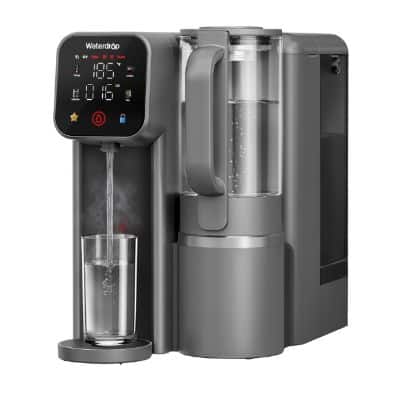
The Waterdrop M6H is a countertop reverse osmosis system with a feature that’s becoming increasingly popular with this type of unit: purified water delivery at any temperature. You might be interested in the M6H for this feature alone, but how it actually performs is more important than what extra benefits it might offer.
We tested this Waterdrop model ourselves to get a firsthand understanding of its contaminant reduction capabilities. This review also includes our analysis of the unit’s filtration speed, efficiency ratio, upfront and ongoing costs, setup and maintenance requirements, and more. Overall, it scored 9.53 out of 10.
What We Like
What We Don’t Like
| Price | $319 |
| Contaminants Reduced | 10+ claimed (1 certified) |
| Certifications | NSF/ANSI 58 & 372 |
| Process | Activated Carbon + Reverse Osmosis |
| Filter Capacity | 1,100 gallons or 12 months |
| Annual Cost | ~$60.31 |
| Warranty | 1 year |
Quick Verdict: Is the Waterdrop M6H Worth It?
The Waterdrop M6H scored 9.53 out of 10 in our testing, tied with the AquaTru Carafe for the highest score of any countertop reverse osmosis system we’ve tested. In our Tap Score lab test, it reduced TDS from 803 PPM to 24 PPM (a 97.0% reduction), the lowest filtered reading of the four countertop RO systems we tested on the same water. It filled its 40-ounce pitcher in 4.71 minutes and costs $0.083 per gallon to run. Its real drawbacks are a measured water recovery of 59.1% (1.44:1 against Waterdrop’s 3:1 claim) and a certification that covers TDS only.
Buy It If: You want a countertop RO system with low running costs and a 40-ounce glass pitcher that fills in under 5 minutes. It’s also a great choice if you’re looking for a unit with a high-quality design that delivers purified hot water from the same spout.
Skip It If: You’re prioritizing high-efficiency systems that waste minimal water. The M6H had a 59.1% recovery in our testing, the lowest of the four countertop RO systems we tested on the same water. It’s also a less appealing option if you want a system that’s certified to remove contaminants beyond TDS, or you have less than 18 inches of counter height.
Methodology: We test all reverse osmosis systems using a weighted scoring system that covers 6 key categories. Contaminant reduction accounts for the largest portion (55%) of the overall score, but filtration rate, design, setup, maintenance, and company policies also make up the weighting. You can read about the full process in our water filter testing methodology.
📊 Scoring Data
At Water Filter Guru, we evaluate every water filter we review using real data from our series of subjective and objective tests.
Our detailed scoring system combines multiple performance factors to award each product a weighted, averaged overall score. We use this data to compare all the similar water filters we’ve tested, giving us a fair side-by-side comparison.
We tested the Waterdrop M6H in September 2026, using the same feed water as the other countertop RO systems in this comparison. We assessed the unit’s lab results and its everyday operation.
See the next table to see how the M6H performed against other countertop RO systems we’ve put through the same testing process.
| Criteria | Results |
|---|---|
| Overall Score | 9.53 |
| Health Related Contaminants | 9.50 |
| Aesthetic Related Contaminants | 9.90 |
| Performance Certification | NSF/ANSI 58 |
| Filtration Rate | 95.6 GPD |
| Component Quality | Exceptional |
| Component Certification | NSF/ANSI 58 & 372 |
| Setup | Exceptional |
| Servicing Requirements | Exceptional |
| Costs | $0.08/ gallon |
| Warranty Length | 1 year |
| Shipping | Free shipping to lower 48 states |
| Returns | 30 days |
What We Measured
- A certified Tap Score laboratory panel of feed and filtered water, covering more than 100 analytes
- Field measurements of TDS, pH, and free chlorine in our feed, purified, and reject water
- Three timed water filtration batches recorded on video
- Feed and wastewater volumes over 1 full tank
- Electricity use while the system was producing purified water and on standby
- Noise at a distance of 1 foot away
- Dispensing temperature and wattage at all 6 hot water presets
- Setup time, from unboxing to usable water
- Countertop footprint and weight
What We Didn’t Measure
- Lead or arsenic reduction, since neither was detected in our feed water
- PFAS reduction, as PFAS wasn’t included in the lab panel
- Filter lifespan to exhaustion
- Hot water energy use per cup (we measured wattage, not the energy consumed for a defined serving)
- Filter change time and mess
🚱 How Well Does the Waterdrop M6H Remove Contaminants?
Score: 9.37Key Finding: The M6H reduced our feed water TDS from 803 PPM to 24 PPM, the lowest filtered water reading of the 4 countertop RO systems we tested with the same water. It also reduced fluoride, sulfate, uranium, strontium, copper, and total THMs to non-detectable levels, and it was the only unit that introduced no detectable contaminants.
What Was Our Test Water Quality Like?
We deliberately tested our recent batch of countertop RO systems with challenging feed water, with higher TDS and hardness than typical municipal water. The baseline TDS reading was 803 PPM, with 307 PPM hardness and 354 PPM alkalinity.
There were a number of contaminants exceeding the Health Guideline Level that were detected in our Tap Score report:
- 1.7 PPM fluoride (exceeding the HGL of 0.799 PPM)
- 0.0148 PPM uranium (exceeding the HGL of 0)
- 4.27 PPB bromodichloromethane (exceeding the HGL of 0)
- 3.41 PPB bromoform (exceeding the HGL of 0)
- 8.82 PPB dibromochloromethane (exceeding the HGL of 0.1 PPB)
- 0.777 PPM copper (exceeding the HGL of 0.3 PPM)
Our test also detected several contaminants in levels not exceeding the HGL, including nitrate, boron, strontium, barium, total chromium, selenium, molybdenum, and vanadium.
| Analyte | Unit | Baseline | Waterdrop M6H | Difference |
|---|---|---|---|---|
| Alkalinity (as CaCO3) | PPM | 354 | 0 | -100.00% |
| Barium | PPM | 0.0327 | 0 | -100.00% |
| Bicarbonate | PPM | 428 | 0 | -100.00% |
| Boron | PPM | 0.375 | 0.266 | -29.07% |
| Bromodichloromethane | PPB | 4.27 | 0 | -100.00% |
| Bromoform | PPB | 3.41 | 0 | -100.00% |
| Calcium | PPM | 91.4 | 0.484 | -99.47% |
| Carbonate | PPM | 1.97 | 0 | -100.00% |
| Chloride | PPM | 107 | 4.8 | -95.51% |
| Chloride-to-Sulfate Mass Ratio | 0.572 | 0 | -100.00% | |
| Chromium (Total) | PPM | 0.0032 | 0 | -100.00% |
| Copper | PPM | 0.777 | 0 | -100.00% |
| Dibromochloromethane | PPB | 8.82 | 0 | -100.00% |
| Expanded Hardness | PPM | 310 | 1.21 | -99.61% |
| Fluoride | PPM | 1.7 | 0 | -100.00% |
| Grains per gallon | Grains | 18 | 0.0706 | -99.61% |
| Hardness | PPM | 307 | 1.21 | -99.61% |
| Langelier Saturation Index | 0.832 | 0 | -100.00% | |
| Magnesium | PPM | 19.2 | 0 | -100.00% |
| Molybdenum | PPM | 0.0012 | 0 | -100.00% |
| Nitrate (as N) | PPM | 4.1 | 0.4 | -90.24% |
| pH | pH | 8 | 6.8 | -15.00% |
| Potassium | PPM | 3.39 | 0 | -100.00% |
| Selenium | PPM | 0.00535 | 0 | -100.00% |
| Sodium | PPM | 162 | 7.78 | -95.20% |
| Sodium Adsorption Ratio | 4.02 | 3.08 | -23.38% | |
| Specific Conductivity | umhos/cm | 1380 | 38.8 | -97.19% |
| Strontium | PPM | 0.979 | 0 | -100.00% |
| Sulfate | PPM | 187 | 0 | -100.00% |
| Total Dissolved Solids | PPM | 803 | 24 | -97.01% |
| Total THMs | PPB | 16.5 | 0 | -100.00% |
| Uranium | PPM | 0.0148 | 0 | -100.00% |
| Vanadium | PPM | 0.00126 | 0 | -100.00% |
Which Contaminants Did The Waterdrop M6H Remove?
The Waterdrop M6H received a Tap Score Health score of 95 and an aesthetics score of 99. These translate into 9.50 and 9.90 respectively in our scoring calculator.
Total THMs
Our feed water initially contained 16.5 PPB of total trihalomethanes, a group of disinfection byproducts that are commonly found in chlorinated tap water. Specifically, three total THMs were detected: 4.27 PPB bromodichloromethane, 3.41 PPB bromoform, and 8.82 PPB dibromochloromethane.
Post-filtration, all three of these THM compounds had been completely eliminated to undetectable levels.
Fluoride
In our baseline sample, 1.7 PPM of fluoride was detected by our Tap Score lab test. This exceeded the HGL of 0.799 PPM.
In comparison, the filtered water we collected directly from the Waterdrop M6H contained no detectable fluoride levels: a 100% reduction. Waterdrop lists fluoride among the contaminants the M6H has been third-party tested to remove, but there’s no official certification covering fluoride reduction.
Uranium
Uranium was another contaminant that exceeded the HGL in our feed water. Initially, concentrations of 0.0148 PPM were detected, exceeding the HGL of 0.
In our filtered water, no uranium was detected, so this was also completely removed by the M6H.
Copper
Copper exceeded the HGL in our baseline sample. 0.777 PPM copper was detected, exceeding the HGL of 0.3 PPM
The Waterdrop M6H also removed copper to undetectable levels.
Total Chromium & Selenium
Total chromium and selenium were both detected in trace concentrations in our unfiltered water: 0.0032 PPM of total chromium and 0.00535 PPM of selenium.
Both were completely eliminated by the M6H, with post-filtration concentrations of 0.
Molybdenum & Vanadium
Finally, molybdenum and vanadium were completely eliminated, from starting concentrations of 0.0012 PPM and 0.00126 PPM, respectively down to 0 PPM for both.
What Did the Waterdrop M6H Struggle To Remove?
A couple of the contaminants detected in our baseline sample weren’t completely removed by the Waterdrop M6H.
Boron was the weakest result in our test panel. Its concentration was reduced by just 29.1%, from 0.375 PPM to 0.266 PPM. That was the second-lowest boron reduction among the 4 countertop RO systems we tested using the same feed water, ahead of the DREO 113 (21.3%) and behind the Bluevua ROPOT(UV) (39.5%) and the AquaTru Carafe (53.3%).
That said, boron is a known challenge for reverse osmosis systems, so it’s rare for RO to achieve anything close to 100% boron reduction. This contaminant can pass through membranes more readily when it’s present as uncharged boric acid, which is common in water with a pH around neutral.
The M6H was also unable to completely eliminate nitrate, although our results were much better: the lab measured a 90.2% reduction, from 4.1 PPM to 0.4 PPM.
Did The M6H Strip Healthy Minerals From Our Water?
We tested the Waterdrop M6H without the remineralization filter, although you can upgrade to the M6HG, which includes remineralization, for an extra $20.
Because our tests were without remineralization, we anticipated a noticeable reduction in minerals, alkalinity, and pH, especially given how thoroughly the system had removed the other contaminants and impurities in our tests.
Unsurprisingly, the unit removed most of the measured minerals from our baseline sample:
- Calcium dropped from 91.4 PPM to 0.484 PPM, a 99.5% reduction
- Magnesium was reduced from 19.2 PPM to below the lab’s detection limit, a close-to-100% reduction
- Sulfate, potassium, and alkalinity were also no longer detected in the filtered sample
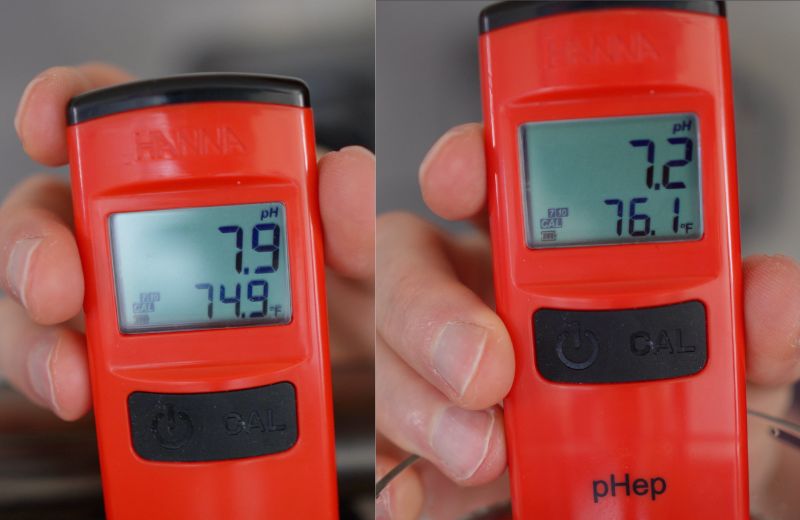
- pH fell from 8.0 (slightly alkaline) to 6.8 (slightly acidic) in the lab samples, while our on-site meter read 7.9 before and 7.2 after
If you buy the non-alkalizing version of the system and you’re sensitive to taste, you might not enjoy drinking the slightly acidic purified water produced by this model. We think that when an RO system comes with an optional remineralization upgrade, it’s almost always worth the extra spend. But since we haven’t tested the M6HG, we can’t directly recommend it based on our test data.
What Did Our Field Tests Show?
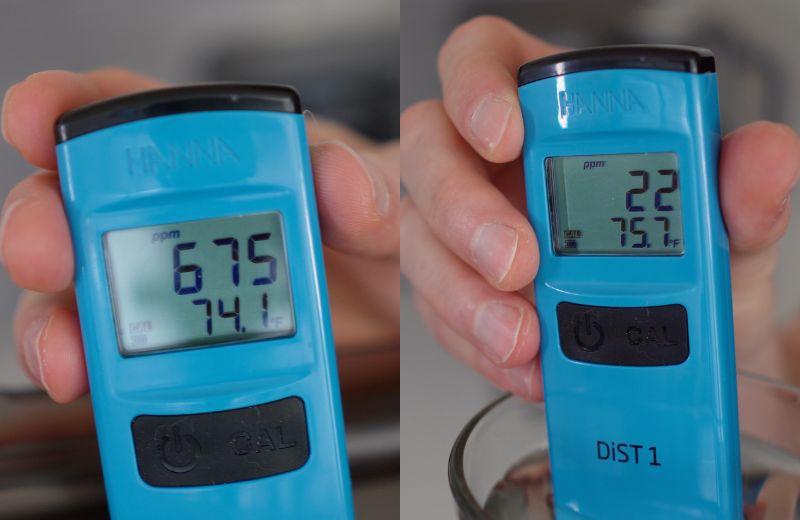
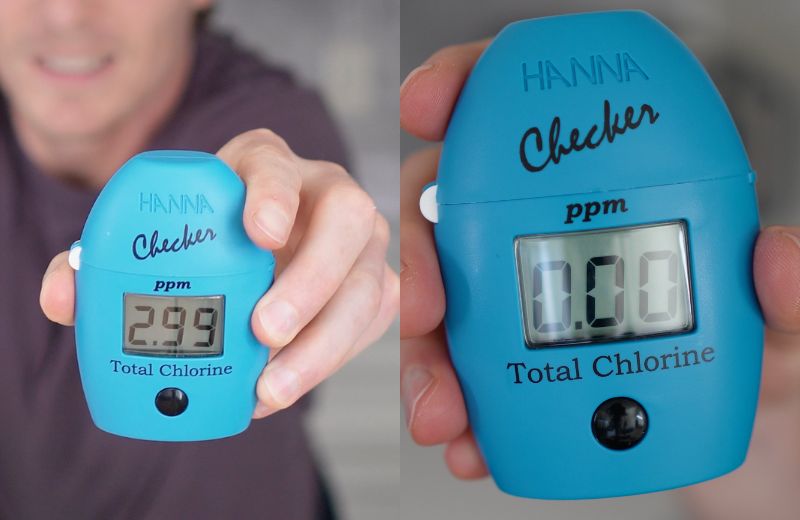
We measured TDS, pH, and chlorine on-site using a handheld TDS meter and digital colorimeter. We’ve found that taking on-site measurements for these parameters delivers more accurate results, and it’s the only option for chlorine, which dissipates quickly from water and needs to be tested immediately.
Here’s what our field tests showed:
TDS dropped from 675 PPM to 22 PPM in both draws
pH dropped from 7.9 to 7.2 PPM
Free chlorine dropped from 2.99 PPM to 0
We also measured the TDS of the reject water (the water exiting the RO system via the drain line, containing the contaminants and dissolved solids that are unable to pass through the membrane). Our TDS meter took a reading of 1,815 PPM, which is far more concentrated than the incoming tap water.
That helps explain the instruction in the user manual to dump the remaining water in the feed tank rather than adding fresh water to what’s left.
| Test Condition | TDS (PPM) |
|---|---|
| Feed Water (Lab Test) | 803 |
| Filtered Water (Lab Test) | 24 |
| TDS Reduction (Lab Test) | 97.0% |
| Feed Water (Field Test) | 675 |
| First Draw (Field Test) | 22 |
| Second Draw (Field Test) | 22 |
| TDS Reduction (Field Test) | 96.7% |
If we compare the filtered TDS results to the other systems we tested on the same feed water, we can see that the M6H has the lowest concentrations of all 4. In comparison, the AquaTru Carafe reduced TDS down to 60 PPM, the Bluevua ROPOT to 45 PPM, and the DREO 113 to 98 PPM.
| Countertop RO System | Filtered TDS (Tap Score lab) |
|---|---|
| Waterdrop M6H | 24 PPM |
| Bluevua ROPOT(UV) | 45 PPM |
| AquaTru Carafe | 60 PPM |
| DREO 113 | 98 PPM |
In all, the Waterdrop M6H delivered one of the best contaminant reduction performances of all the countertop RO systems we’ve tested, completely removing almost every contaminant without adding anything unwanted into the purified water.
Our Testing Limitations
Our results come from a single-point test, using the Waterdrop M6H while its filters were still fresh (meaning it hadn’t filtered many gallons of water at the time of testing).
Filtration capacity will naturally decline over time as the system is used. Since our testing was carried out while the M6H was still relatively new, our data represents the best-case numbers for fresh filters.
We were also only able to test the system’s ability to remove the contaminants detected in our water, so some of the manufacturer’s claims, including lead, PFAS, and arsenic reduction, couldn’t be validated.
Is the Waterdrop M6H Performance-Certified?
Score: 8.00
Waterdrop lists more than 10 contaminants as third-party tested, but only one of those claims is certified. The M6H has been certified by IAPMO for TDS reduction only.
That’s a bit disappointing if you’re looking for an RO system that has been certified to reduce specific contaminants with known health effects, like lead, arsenic, or PFAS.
Our Results Vs Waterdrop’s Contaminant Reduction Claims
Here’s how our own test results compare to Waterdrop’s contaminant reduction claims for the M6H:
| Claimed contaminant | Our test result |
|---|---|
| TDS | 97% reduction to 24 PPM |
| PFOA | Not on our lab panel |
| PFOS | Not on our lab panel |
| Nitrate | 90.2% reduction to 0.4 PPM |
| Fluoride | 100% reduction to 0 |
| Arsenic | Not detected in our baseline sample |
| Lead | Not detected in our baseline sample |
| Copper | 100% reduction to 0 |
| Turbidity | Not on our lab panel |
| Chlorine | 100% reduction, 2.99 PPM to 0 (field test) |
You can see from this table that 2 of the 10 contaminants that the Waterdrop M6H is claimed to remove (arsenic and lead) weren’t detected in our baseline sample, and 3 (PFOA, PFOS, and turbidity) weren’t part of our lab panel. That means we can’t draw conclusions from our own testing on the filter’s ability to remove these contaminants.
🚦Filtration Rate
Score: 9.50Key Finding: The Waterdrop M6H filled its 40-ounce pitcher in 4.71 minutes on average, giving it an effective production rate of 95.6 GPD, faster than its 75 GPD rating.
How Quickly Does the Waterdrop M6H Deliver Purified Water?
We calculated the Waterdrop M6H’s filtration rate by recording the time it took to fill the included 40-ounce glass pitcher. It took an average of 4.71 minutes across three timed batches to reach the 40-ounce point (the actual time varied from 4.12 to 5.15 minutes), giving it one of the fastest average times of all the RO systems we tested.
We timed each batch using video, starting with an empty pitcher and stopping when the unit shut off automatically. The M6H can dispense water while the tank is still filling, so you don’t need to wait for the next batch to finish before you can dispense.
| Test Run | Time to Fill 40 oz |
|---|---|
| Test 1 | 4.12 minutes |
| Test 2 | 5.15 minutes |
| Test 3 | 4.85 minutes |
| Average | 4.71 minutes |
There’s just one small annoyance: the machine takes around 15 to 20 seconds to resume filtering after you reinstall the pitcher. It’s definitely not a dealbreaker, but we think it’s worth noting all the same, as some other units in our comparison restart straight away.
| Test Metric | Result |
|---|---|
| Time to Fill 40 oz | 4.71 minutes (average) |
| Measured Flow Rate | 0.066 GPM |
| Gallons Per Hour | 3.98 GPH |
| Converted GPD | 95.6 GPD |
| Manufacturer’s Claim | 75 GPD |
How Does Our Measured Output Compare to Its 75 GPD Rating?
Waterdrop rates the M6H at 75 gallons per day (GPD). Based on our measured 40-ounce pitcher volume and 4.71-minute average batch time, our calculated output rate was 95.6 GPD. So, in our tests, it was actually faster than the rated figure by just over 20 GPD.
How did we measure the M6H’s production speed? We divided the pitcher volume by the time it took to fill, then scaled that rate to 24 hours.
You wouldn’t technically get 95.6 gallons per day from this unit, though (in case you were tempted to try). You still need to account for the 40-ounce purified water pitcher and 135-ounce feedwater tank, which limit how much water you can filter before you need to refill or empty the machine.
When compared to the other countertop RO systems in our comparison, the M6H was the second-fastest. The Bluevua ROPOT(UV) reached an effective GPD of 125.4, while the DREO 113 had a recorded rate of 92.8 GPD, and for the AquaTru Carafe, we measured an effective GPD of 48.3. By our measured batch times and volumes, the M6H produced water at roughly twice the AquaTru Carafe’s pace (95.6 against 48.3 effective GPD).
How Loud Is The M6H?
Noise output is something else you might be interested in knowing before you buy a countertop RO system, and it’s not the kind of thing you can learn from the product listing alone.
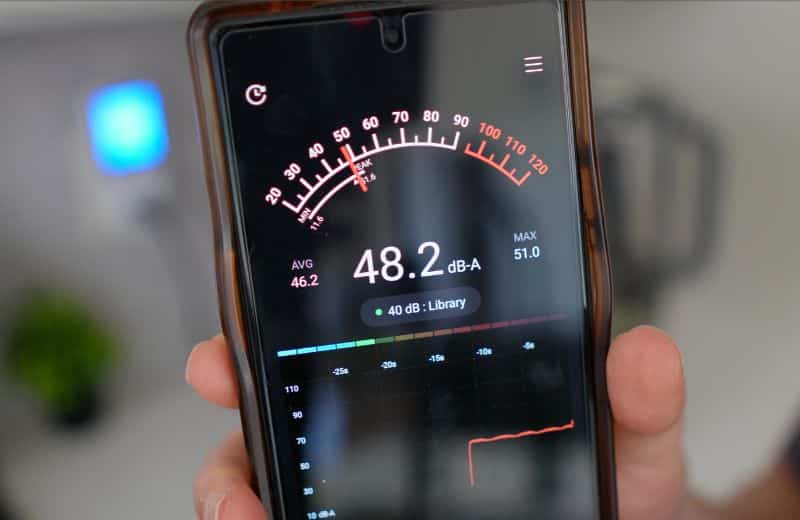
We measured the M6H’s noise output using a sound level meter app. At a distance of 1 foot away, the app recorded an average noise level of 46.2 decibels, with a peak of 51 decibels during the 4.71-minute batch.
That puts the unit between the quieter DREO 113 (with an average noise level of 38.4 dB) and the louder Bluevua ROPOT(UV) (with an average noise level of 55.7 dB). It’s not silent, but it was quieter than two other countertop RO systems in our comparison.
Water Waste & Energy
Score: Not Scored
Key Finding: When purifying one full feedwater tank of water, the M6H delivered 78 ounces of purified water and 54 ounces of reject water. That’s a 59.1% recovery percentage, or a pure-to-wastewater ratio of 1.44:1, against Waterdrop’s 3:1 claim. This was the lowest efficiency ratio of all the countertop RO systems we tested in this recent batch.
How Much Water Does the Waterdrop M6H Waste?
Waterdrop claims the M6H has a pure-to-reject ratio of 3:1, meaning that for every 3 ounces of water purified, 1 ounce of water is rejected.
In our test, we filled the feed tank until it was full, then measured the volume of wastewater and purified water produced. We measured:
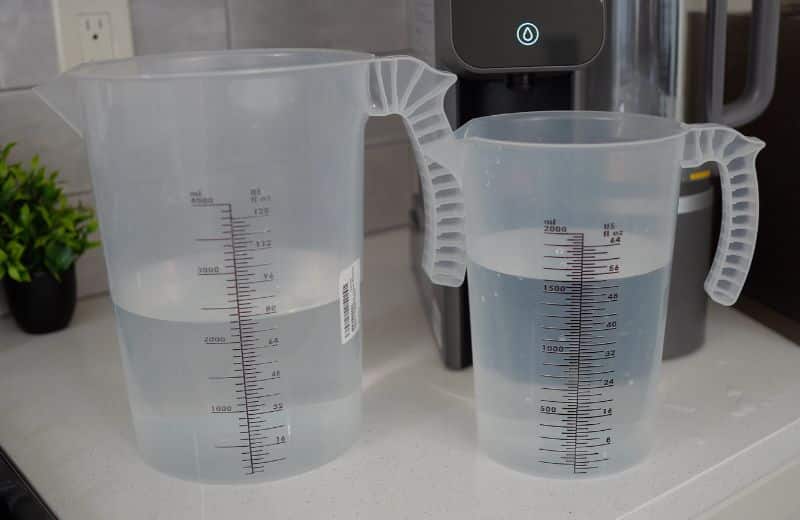
- 78 ounces of purified water
- 54 ounces of reject water
That’s an efficiency ratio of 1.44:1, meaning that for every 1.44 ounces of water purified, 1 ounce of water is rejected. This translates to a recovery rate of 59.1%, significantly below Waterdrop’s claim (which equates to a recovery percentage of 75%).
| Test Metric | Measured Result |
|---|---|
| Feed Water Used | 132 oz |
| Purified Water Produced | 78 oz |
| Reject Water Produced | 54 oz |
| Purified-to-Reject Ratio | 1.44:1 |
| Recovery Rate | 59.1% |
| Reject Water per Gallon of Purified Water | 0.69 gallons |
Our measured recovery rate was the lowest among the four countertop RO systems we tested. The DREO 113 had a recovery percentage of 76.5%, the AquaTru Carafe’s was 70.2%, and the Bluevua ROPOT(UV)’s was 66.1%.
Out of all our test data, this highlights the M6H’s clearest performance drawback. If you want an efficient system that can help you minimize wastewater production, we recommend choosing a unit with a higher recovery rate, like DREO or AquaTru.
How Much Electricity Does It Use?
When we used the Waterdrop M6H to produce room-temperature purified water, our measurements for electricity use were very low. The figure for our recorded batch was 0.001 kWh, with a standby draw of 0.06 watts, equivalent to about 0.0014 kWh per day. For some context, a standard refrigerator uses between 0.5 and 2 kWh per day.
At an electricity cost of $0.1834 per kWh and assuming that you purify 2 gallons of room-temperature water per day, our estimate for annual electricity cost for the M6H is $0.32.
📐 Design
Score: 10.00Key Finding: The Waterdrop M6H has the best digital display of the countertop RO systems in our comparison, a gasketed 40-ounce glass pitcher with automatic shutoff, and the only dedicated wastewater tank (50 ounces). Its main design compromises are its 22-pound weight, the 18 inches of counter height needed to lift out the feed tank, and hot water that ran cooler than labeled: the 203°F preset delivered 174.9°F.
What Is The Waterdrop M6H’s Build Quality Like?
The Waterdrop M6H scored a perfect 10.00 for design, thanks to its generally high-quality build, with practical, well-thought-out features and a glass collection pitcher.
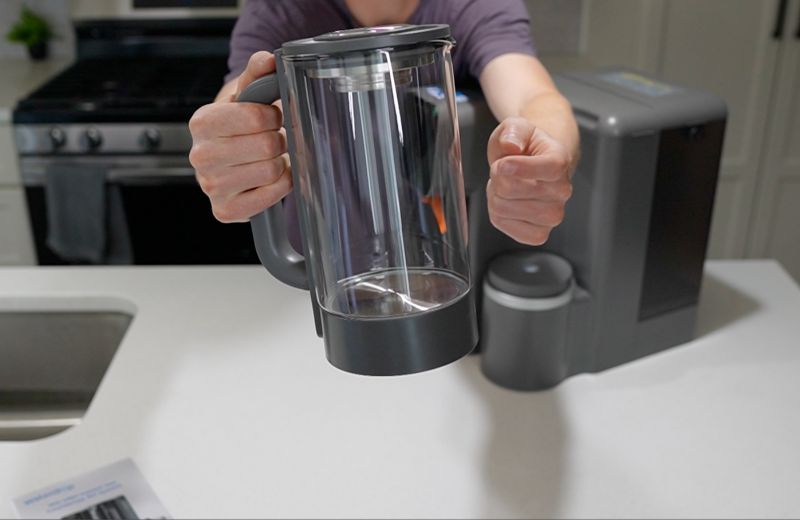
It had the best display screen of all the units in our countertop RO comparison, and it’s the only system we tested that has both a gasketed glass pitcher and a separate waste tank. Because it fills its own pitcher, you don’t need to fit a separate drinking glass beneath the spout. The unit body and feed tank are both plastic.
The main features are:
- A 40-ounce borosilicate glass pitcher with a silicone-gasket lid that fits securely
- Automatic shutoff, so dispensing stops when the pitcher is full
- A color display screen with volume and temperature controls, presets, favorites, filter life information, tank prompts, and a filter replacement alert
- NFC filter tracking, which lets you tap your phone against the filter tag to check its life (no app needed)
- A dedicated 50-ounce wastewater tank
- Stickers on the unit that explain the indicator lights and troubleshooting, with a QR code that links to the app, FAQs, installation video, replacement filters, and warranty information
The M6H is the only countertop RO system we tested in this recent batch that has a dedicated wastewater tank. The AquaTru, DREO, and Bluevua all return this water to their feed tanks, but the M6H keeps them separate. You might prefer this as it gives you more room in the feed tank to top up with water when you’re purifying a big batch.
There’s just one design feature that didn’t impress us: the feed tank lid rests on the top rather than forming a tight seal. It’s only a minor drawback, but one that’s worth being aware of all the same.
What Are the Display Screen & Hot Water Heating Like?
The Waterdrop M6H’s display screen is one of its best design features. The icons are clear and make it easy to choose your water volume or temperature, as well as checking filter life and identifying a tank or filter issue warning. You can also save your favorite settings to make them even quicker and easier to access.
A key reason why you might be interested in this model is its purified hot water delivery. You can press a button and get instant, on-demand water at almost any temperature, with 6 presets from 113°F to 203°F. It heats the water as you dispense it rather than storing hot water in a tank, which would use more space and energy.
We took temperature readings of dispensed water samples at all 6 preset temperatures to see how they compared to their labels. Our results show that the lower temperature settings came close to their labels, but the higher the temperature preset, the more that gap grew. The top 203°F setting measured 174.9°F at the spout, 28.1°F below the label.
| Temperature Preset | Actual Temperature (Our Test) |
|---|---|
| 113°F | 112.6°F |
| 131°F | 129.7°F |
| 149°F | 143°F |
| 167°F | 156.2°F |
| 185°F | 165.5°F |
| 203°F | 174.9°F |
This might not be a big issue in your eyes, but just keep in mind that the higher temperatures we recorded fall short of the hotter water that’s generally recommended for tea and pour-over coffee.
We also noted that the unit’s power draw peaked at around 1.5 kW when it was dispensing hot water. That’s a substantial load compared with its room temperature filtration, so you might want to check your outlet arrangements before you buy.
What Does the M6H Measure and Weigh?
It’s worth knowing the size and weight of any countertop RO system you’re considering buying, so you can be sure it’ll fit in your available space and can be carried or transported as needed.
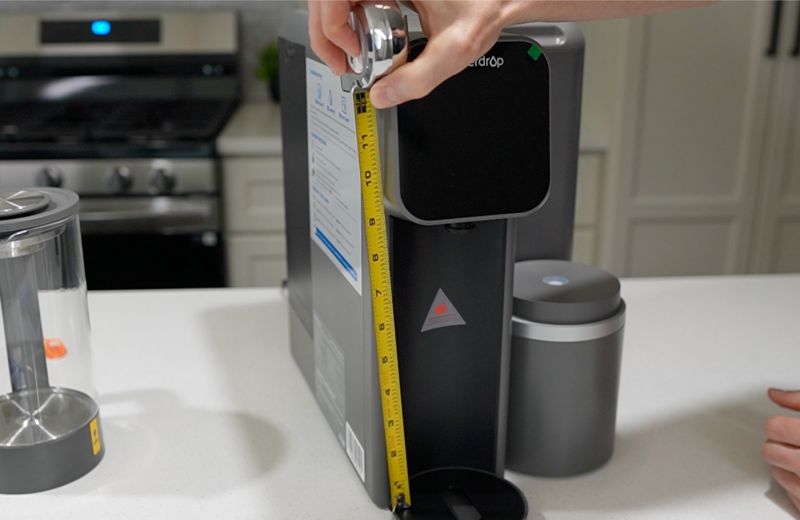
The M6H measures 15.9 by 9.3 by 14.5 inches according to its specifications. Our measured footprint was 13.75 by 9 inches, with a height of about 14 inches. You’ll need about 18 inches of vertical countertop space so you can lift out the rear feedwater tank, giving you 4 inches of clearance above the machine.
The unit’s weight comes in at 22 pounds, so it’s one of the heavier countertop RO systems in our comparison. When it’s full, the feedwater tank alone weighs around 10.7 pounds. Its rectangular design means you can carry it one-handed under a cabinet, but it can also be awkward to balance when you’ve filled it to the maximum fill line.
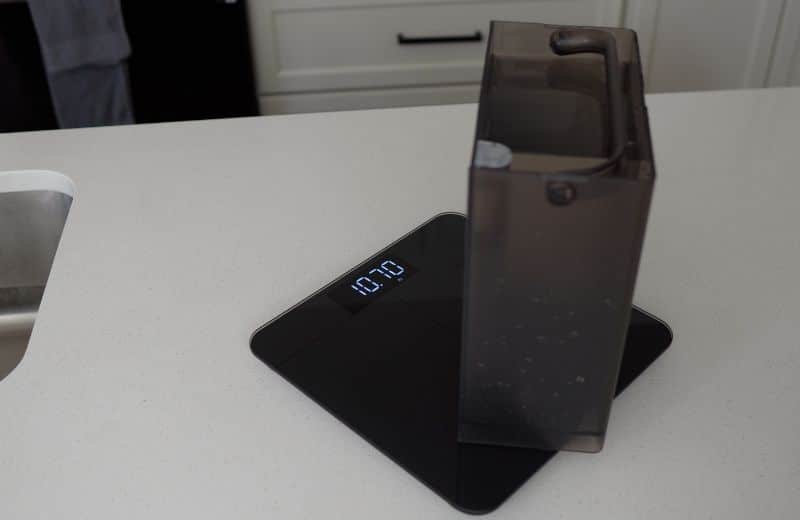
With that in mind, we don’t think this is a particularly portable countertop filter, and it’s not going to be suitable for every kitchen, especially those with low cabinets.
Is the Waterdrop M6H Design Certified?
The Waterdrop M6H has a design certification issued by IAPMO under two NSF/ANSI Standards: it’s certified for materials safety under its NSF/ANSI 58 performance certification, as well as for lead-free design (NSF/ANSI 372).
Note that NSF/ANSI 372 is for design materials only and simply confirms that the system and all its elements have been inspected and tested by IAPMO to verify compliance with the requirements under Section 1417(d) of the Safe Drinking Water Act and Section 116875 of the California Health & Safety Code. It doesn’t mean the product is certified for lead removal.
⚙️ Setup
Score: 10.00Key Finding: It took us 18.5 minutes to get the Waterdrop M6H from the box to usable water, including one automatic flush that lasted 8 minutes and 26 seconds and used 55 ounces of water. That was the fastest setup of the four countertop RO systems we tested on the same water (the others took 28 to 69.7 minutes), with no manual flushing or app required.
How Long Does the Waterdrop M6H Take to Set Up?
The Waterdrop M6H took 18.5 minutes to set up, from unboxing to dispensing usable water, in our testing. That gave it the fastest setup time of all four countertop RO systems we tested, needing just one automatic flush before it could be used.
The setup process is simple, as you’d expect for any plug-and-play unit like this. You install the single cartridge from the top (no tools required), then connect the unit to your power. The M6H will then run its automatic flush before you can start using the system for drinking water.
| Countertop RO System | Setup Time |
|---|---|
| Waterdrop M6H | 18.5 minutes |
| DREO 113 | 28 minutes |
| Bluevua ROPOT(UV) | 35.8 minutes |
| AquaTru Carafe | 69.7 minutes |
The other countertop reverse osmosis systems took longer in our tests: the DREO 113 had a 28-minute setup, while the Bluevua ROPOT(UV) took 35.8 minutes, and the AquaTru Carafe took 69.7 minutes. These other models also needed multiple flushes before they could be used.
How Much Water Do You Flush Before the First Glass?
The M6H used 55 ounces of water, equal to around 0.42 gallons, during the initial flush. The manual tells you to pour out the first two pitchers of water (apparently water tastes best from the third pitcher).
We did notice that the water in our first flush looked foamy when we discarded it. With that in mind, we’d recommend pouring out one extra pitcher before you drink from it.
In our tests, the other countertop RO units used between 2.18 and 4.31 gallons of water during setup, compared with just 0.42 gallons for the M6H.
You don’t need to download an app to set up or use the Waterdrop M6H, as everything you need to know is displayed on the unit’s digital screen.
🔧 Maintenance & Cost to Own
Score: 10.00Key Finding: With one $59.99 filter replacement per year, the Waterdrop M6H costs an estimated $60.31 a year to run, or $0.083 per gallon, at 2 gallons per day. Its five-year ownership cost of $620.53 is less than half that of the AquaTru Carafe ($1,596.95) and the Bluevua ROPOT(UV) ($1,561.58).
How Often Do You Change the Waterdrop M6H Filter?
The Waterdrop M6H uses a single filter cartridge (called the M6RF), which is instantly a benefit if you want to keep maintenance to a minimum. In comparison, many of the countertop systems we’ve tested use at least two or three filters, each with their own replacement schedules.
This cartridge is rated by Waterdrop for 1,100 gallons* or 12 months, whichever comes first. At our assumed use of 2 gallons of water per day, that’s about 730 gallons per year, requiring one filter replacement per year.
The unit has a helpful filter alert, along with an NFC tag that lets you check the filter life on your phone. That means you don’t need to make your own reminders, as you can simply check the unit itself for the filter status.
What Is The M6H’s Annual Running Cost?
At our assumed water usage of 2 gallons per day and electricity cost of $0.1834 per kWh, the M6H’s annual operating cost comes to just $60.31. That includes the price of a single $59.99 replacement cartridge and $0.32 of electricity for producing purified water at room temperature.
| Countertop RO | Annual Cost |
|---|---|
| AquaTru Carafe | $244.39 |
| Waterdrop M6H | $60.31 |
| Ninja HydraSense | $247.54 |
| DREO RO Water Filter 113 | $139.89 |
| Bluevua ROPOT(UV) | $221.52 |
| Aquatru Classic | $157.28 |
The M6H was the cheapest system to run in this table. Its annual operating cost is around 4x lower than the AquaTru Carafe’s, and around 3.7x lower than Bluevua’s.
Why is it so much more affordable?
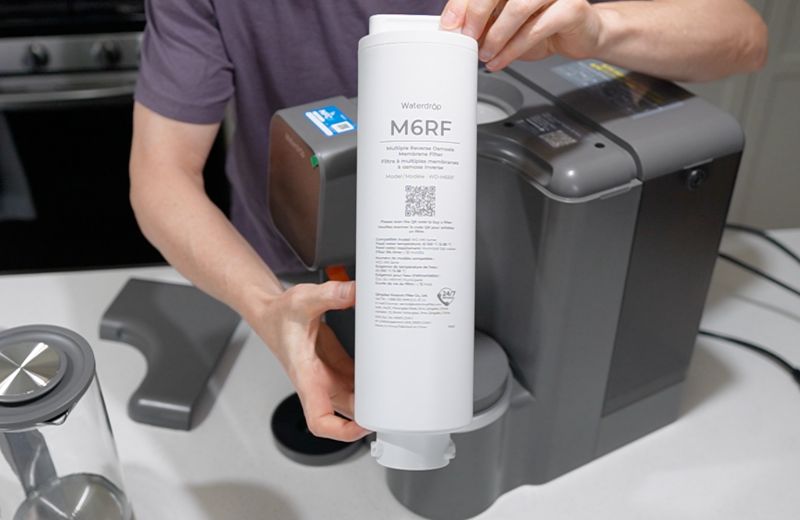
The main reason is that it uses just one filter cartridge. In comparison, AquaTru uses three filters with different replacement schedules, and Bluevua uses five cartridges, including the mineral cartridge.
Keep in mind that these figures are estimates and not a guarantee of what you’ll spend, as the actual figure depends on your household water usage and electricity rates.
What Does 5 Years of Ownership Cost?
If we combine the purchase price with the annual ownership cost x5, the M6H costs $620.53 over five years. That’s a lot cheaper than the AquaTru or Bluevua models.
| Countertop RO | 5-year Cost |
|---|---|
| AquaTru Carafe | $1,596.95 |
| Waterdrop M6H | $620.53 |
| DREO RO Water Filter 113 | $899.42 |
| Bluevua ROPOT(UV) | $1,561.58 |
Waterdrop sells the M6RF cartridge through its website, as well as Amazon and Best Buy. The listed price is $59.99, or $56.99 with autoship (Waterdrop’s filter subscription offering).
🏢 Company, Warranty, & Returns
Score: 8.65Key Finding: Waterdrop backs the M6H with a 1-year limited warranty, free shipping to the lower 48 states, and a 30-day return window in which you pay the return shipping, for a company score of 8.65.
Does Waterdrop Offer a Warranty?
Waterdrop offers a 1-year limited warranty for the M6H countertop RO system. You can register for the warranty through the QR code on the unit, and this is where you’ll find warranty information that’s specific to the product (Waterdrop’s general warranty information advises you to do this).
You can make a warranty claim by contacting the Waterdrop Customer Service team. If the product is found to be defective due to a quality issue, rather than misuse, you’ll either receive a replacement product, a free repair service, or a full refund.
View Waterdrop’s warranty and terms here.
What Are Waterdrop’s Shipping and Returns Policies?
Waterdrop ships from warehouses in the US to the lower 48 for free, with no minimum order spend. It also offers shipping to Alaska and Hawaii, but at an extra charge.
All Waterdrop products are backed by a 30-day risk-free return policy, which allows you to return a used product within 30 days of your receipt. The product needs to be disassembled and returned in the box as it was delivered, and you’ll be responsible for the return shipping cost. There’s no restocking fee inside the 30-day window. Returns made after 30 days carry a 10% restocking fee (waived if you’re returning the product due to a quality issue).
That might not be the longest returns policy we’ve seen, and it earned a returns sub-score of 8.00, but we appreciate that Waterdrop does provide options for customers who try a product and decide it’s not for them.
Waterdrop’s returns and refund policy can be found here.
💰 Final Verdict: Does the Waterdrop M6H Offer Good Value for Money?
As one of the top-performing and highest-scoring countertop RO systems we’ve tested, we think the Waterdrop M6H offers pretty great value for money. It removed contaminants more thoroughly than many of its similarly-priced competitors (its 24 PPM lab TDS result was the lowest of the four systems we tested on the same feed water), with no unusual results or new impurities detected post-filtration.
It’s a good option to consider if you want to keep your running costs low and purify water quickly, or if you’re looking for a solution that offers convenient hot water dispensing. Compared to our recent testing batch, the M6H has the lowest filtered water TDS, the lowest running costs, the fastest setup, and the second-fastest production rate.
But it’s not necessarily right for everyone. If you’re prioritizing RO systems that are certified to remove more than just TDS, or you want an efficient unit that wastes minimal water, you’ll probably want to redirect your attention to a model like the AquaTru Carafe (certified for all 84 contaminants it’s claimed to remove, with a pure-to-reject ratio of 2.36:1).
❔ Frequently Asked Questions
Q: Is the Waterdrop M6H NSF certified?
A: The Waterdrop M6H is certified by IAPMO to NSF/ANSI 58 for TDS reduction only and to NSF/ANSI 372 for lead-free materials. The other contaminants Waterdrop lists as third-party tested, including lead, fluoride, PFOA, and PFOS, are not certified reductions. In our Tap Score lab test, fluoride went from 1.7 PPM to non-detectable and TDS went from 803 PPM to 24 PPM, but those are test results, not certifications.
Q: Does the Waterdrop M6H remove fluoride?
A: Yes, the Waterdrop M6H removed fluoride in our lab test. Our tap water contained 1.7 PPM of fluoride, and none was detected in the filtered sample. That is consistent with reverse osmosis in general, since RO membranes reject fluoride well. Waterdrop lists fluoride as third-party tested, but fluoride is not part of the M6H certification.
Q: Does the Waterdrop M6H remove lead or PFAS?
A: We cannot confirm lead or PFAS reduction from our own testing. Our tap water had no detectable lead or arsenic, and PFAS was not on our lab panel. The M6H certification covers TDS reduction and lead-free materials, not lead or PFAS reduction. If those are your main concern, look at the AquaTru Carafe, which is certified for all 84 of its reduction claims, including lead and PFAS.
Q: How much water does the Waterdrop M6H waste?
A: The Waterdrop M6H wasted more water in our testing than Waterdrop claims. Over one full feed tank, we collected 78 ounces of purified water and 54 ounces of reject water, a pure-to-reject ratio of 1.44:1 and a recovery rate of 59.1%. Waterdrop rates the M6H at 3:1, which would be 75%. That was the lowest recovery of the four countertop RO systems we tested on the same water, behind the DREO 113 (76.5%), the AquaTru Carafe (70.2%), and the Bluevua ROPOT(UV) (66.1%).
Q: Why does the M6H tell you to dump the reject water instead of topping off the tank?
A: The M6H tells you to dump the reject water because it is concentrate. In our testing, the reject water measured 1,815 PPM TDS against 675 PPM in our tap water. Pouring it back in would feed the membrane water nearly three times as concentrated, which would raise the filtered TDS and likely shorten the cartridge life. The M6H collects reject water in its own 50-ounce tank so this cannot happen by accident, but you still have to empty that tank.
Q: How hot does the Waterdrop M6H get?
A: The Waterdrop M6H did not get as hot as its presets say in our testing. We measured 112.6°F on the 113°F setting, 129.7°F on 131°F, 143°F on 149°F, 156.2°F on 167°F, 165.5°F on 185°F, and 174.9°F on the 203°F setting, with the heater drawing 875 to about 1,520 watts. The two lowest presets were accurate, while the top preset fell 28.1°F short. That is hot enough for cocoa, oatmeal, and instant coffee, but short of the temperature most tea and pour-over coffee guides call for.
Q: How long does it take to purify a batch of water?
A: The Waterdrop M6H took 4.71 minutes on average to fill its 40-ounce pitcher across three timed runs (4.12, 5.15, and 4.85 minutes). That works out to 95.6 gallons per day against its 75 GPD rating. You can dispense water while a batch is still filtering, and there is a 15-to-20-second pause after you reinstall an emptied pitcher before filtering resumes.
Q: How often do you replace the filter, and what does it cost?
A: The Waterdrop M6H uses one M6RF cartridge, rated by Waterdrop for 1,100 gallons or 12 months, at a replacement cost of $59.99 ($56.99 on autoship). At 2 gallons of water a day, you will use one cartridge a year. We calculated an annual operating cost of $60.31, including the $0.32 of electricity we measured, or $0.083 per gallon. The screen on the unit and an NFC tag track filter life, with no app required.
Q: Does the Waterdrop M6H add minerals back?
A: No, the Waterdrop M6H does not add minerals back. We tested the base model, which has no remineralization stage. In our lab test, calcium dropped from 91.4 PPM to 0.484 PPM, magnesium dropped from 19.2 PPM to non-detectable, and pH fell from 8.0 to 6.8. If you want remineralized water, Waterdrop sells the M6HG, which adds a remineralization stage. We have not tested the M6HG.
Q: Waterdrop M6H vs. AquaTru Carafe: which should I buy?
A: Both scored 9.53 out of 10 overall in our testing, so the choice comes down to priorities. The AquaTru Carafe is certified for all 84 of its contaminant reduction claims against 1 of 10 for the M6H, and it recovered 70.2% of its feed water against 59.1%. The M6H left less TDS on the same water (24 PPM against 60 PPM), filled its 40-ounce pitcher in 4.71 minutes against 14.92 minutes for the 64-ounce AquaTru carafe, and costs $0.083 per gallon to run against $0.335. Buy the AquaTru Carafe for certified lead and PFAS reduction and less wastewater. Buy the M6H for lower running costs, faster batches, and hot water.
Q: Waterdrop M6H vs. Waterdrop A1: which countertop RO should I buy?
A: The Waterdrop M6H scored higher in our testing: 9.53 overall against 9.12 for the Waterdrop A1. We tested the A1 in an earlier cohort on different water, so the lab percentages are not directly comparable. The A1 lost points for filtration rate (7.00 against 9.50 for the M6H) and setup (8.00 against 10.00). You can read our Waterdrop A1 review for its full results.
Q: Waterdrop M6H vs. M6HG vs. M6SL vs. M6CG: what is the difference?
A: The Waterdrop M6 models share the same platform and differ in how they dispense water. The M6H makes room-temperature and instant hot water. The M6HG is the same unit with added remineralization. The M6SL is room-temperature only, with a remineralization stage. The M6CG dispenses hot and cold water. We have only tested the M6H, so the lab results in this review apply to that model alone.
Q: Will the Waterdrop M6H fit under kitchen cabinets?
A: The Waterdrop M6H needs about 18 inches of vertical space. Our unit measured 13.75 by 9 inches at the base and about 14 inches tall, and you need roughly 4 more inches above it to lift out the rear feed tank. The unit weighs 22 pounds, and the feed tank alone weighs about 10.7 pounds when full.
Q: How loud is the Waterdrop M6H?
A: The Waterdrop M6H averaged 46.2 decibels at a distance of 1 foot while purifying a batch in our testing, with a peak of 51 decibels. That made it quieter than the AquaTru Carafe (47.8 decibels) and the Bluevua ROPOT(UV) (55.7 decibels), and louder than the DREO 113 (38.4 decibels).
Found this review helpful?
Comment below or share this article!