

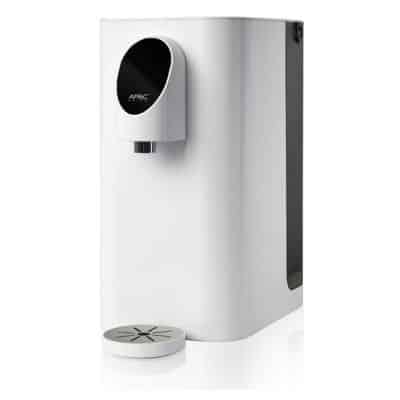
The APEC ROCT PLUS is a countertop RO hot and cold water dispenser sold by APEC WATER. It has a 3:1 pure-to-drain ratio, four custom purified water temperatures, and the claimed ability to reduce 56 contaminants, ranging from metals like aluminum to pharmaceuticals, PFAS to disinfection byproducts.
What We Like
What We Don’t Like
| Price | $417.99 |
| Contaminants Reduced | 56+ |
| Certifications | – Not Certified |
| Process | Mechanical + Carbon + Reverse Osmosis + UV tank sanitization |
| Filter Capacity | 1,100 gallons |
| Annual Cost | ~$86 |
| Warranty | 1 year (standard) / 2 years (with registration) |
Table of Contents
▶️ Video Review
As part of our countertop RO system analysis project, we’ve been working through reviewing the most popular hot water-dispensing units available in the US today. We followed the same testing process for the ROCT PLUS, combining our own objective assessments with Tap Score lab data to measure its overall performance.
📊 Scoring Data
In all our water filter reviews, we use our data-driven scoring system to test and compare each product across a series of 6 performance categories. We tested the APEC ROCT-PLUS system and ranked it based on our assessment results, comparing its performance to the other countertop RO systems we’ve already analyzed.
We score each performance category based on several criteria, with sub-categories of contaminant reduction, design quality, certifications for performance and design, servicing requirements and costs, and shipping, warranties, and returns offerings offered by the manufacturer. See how the ROCT PLUS performed in the table below.
| Criteria | Results |
|---|---|
| Overall Score | 8.58 |
| Health Related Contaminants | 9.30 |
| Aesthetic Related Contaminants | 9.90 |
| Performance Certification | Not Certified |
| Filtration Rate | 0.058 GPM |
| Component Quality | Good |
| Component Certification | Not Certified |
| Setup | Below Average |
| Servicing Requirements | Outstanding |
| Costs | $0.078/ gallon |
| Warranty Length | 1 year (standard) / 2 years (with registration) |
| Shipping | Variable based on service and location |
| Returns | 30 days |
🚰 Contaminant Reduction
Score: 9.00Reverse osmosis systems are ideal for folks who want to remove as much as possible from their water rather than focusing on specific contaminants. That means we expect the best when we’re testing systems like the ROCT-PLUS.
The system combines all its filter stages into a single cartridge, which, while convenient for maintenance, can sometimes be detrimental (as all media are together, the surface area for each stage is typically smaller).
To measure its contaminant reduction performance, we used Tap Score to test our own water before and after filtering it through the system. We also researched NSF, IAPMO, and WQA databases to see if the unit has any performance certifications for contaminant reduction.

Our Performance Testing
Score: 9.62
We tested two samples of water for our performance testing: one sample of unfiltered tap water, and one dispensed directly from the ROCT-PLUS.
To prevent our results from being skewed by our sample-taking method, we followed our testing lab Tap Score’s recommended process carefully. This involved filling a bucket with clean water, then swirling it around to mix it. We then poured most of the water from the bucket into the APEC RO system, and then took a “before” sample from the bucket. The “after” sample was taken straight from the unit once it had been filtered.
Tap Score sent us our results in two digital test reports, which made it simple for us to compare the concentrations of contaminants in each sample and determine the ROCT-PLUS’s contaminant reduction performance.
Health-Related Contaminants
Score: 9.70
Our baseline water sample contained 11 health-related contaminants. Two of these, fluoride and uranium, were present in concentrations exceeding the HGL:
- 1.4 PPM fluoride, exceeding the HGL of 0.799 PPM
- 0.032 PPM uranium, exceeding the HGL of 0 PPM
The other detected contaminants included nitrate, barium, chlorine, copper, sulfate, zinc, strontium, molybdenum, and phosphorus. Many of these are associated with health effects like kidney and liver problems, developmental issues, and cancer, when ingested in excess over a long duration.
| Analyte | Type | Unit | Pre | Post | Difference |
|---|---|---|---|---|---|
| Alkalinity (as CaCO3) | Properties | PPM | 81 | 18 | -77.78% |
| Barium | Metals | PPM | 0.031 | 0.0028 | -90.97% |
| Bicarbonate | Minerals | PPM | 98.37 | 21.93 | -77.71% |
| Calcium | Minerals | PPM | 26.9 | 2.8 | -89.59% |
| Carbonate | Minerals | PPM | 0.18 | 0.01 | -94.44% |
| Chloride | Inorganics | PPM | 13.5 | 2.7 | -80.00% |
| Chloride-to-Sulfate Mass Ratio | Properties | 1.59 | 1.8 | 13.21% | |
| Copper | Metals | PPM | 0.0654 | 0 | -100.00% |
| Fluoride | Inorganics | PPM | 1.4 | 0.2 | -85.71% |
| Grains per gallon | Properties | Grains | 5.55 | 0.62 | -88.83% |
| Hardness | Properties | PPM | 94 | 10 | -89.36% |
| Hardness (Ca,Mg) | Properties | PPM | 94 | 10 | -89.36% |
| Hardness (Total) | Properties | PPM | 94.94 | 10.53 | -88.91% |
| Langelier Saturation Index | Properties | -0.66 | -2.8 | 324.24% | |
| Magnesium | Minerals | PPM | 6.58 | 0.84 | -87.23% |
| Manganese | Metals | PPM | 0 | 0.0028 | N.A. |
| Molybdenum | Metals | PPM | 0.006 | 0 | -100.00% |
| Nitrate (as N) | Inorganics | PPM | 2.6 | 0 | -100.00% |
| pH | Properties | pH | 7.6 | 7 | -7.89% |
| Phosphorus | Inorganics | PPM | 1.1 | 0 | -100.00% |
| Sodium | Minerals | PPM | 10.7 | 3.5 | -67.29% |
| Sodium Adsorption Ratio | Properties | 0.48 | 0.47 | -2.08% | |
| Specific Conductivity | Properties | umhos/cm | 234 | 46.7 | -80.04% |
| Strontium | Metals | PPM | 0.144 | 0.062 | -56.94% |
| Sulfate | Inorganics | PPM | 8.5 | 1.5 | -82.35% |
| Total Dissolved Solids | Properties | PPM | 138 | 29 | -78.99% |
| Uranium | Metals | PPM | 0.0322 | 0 | -100.00% |
| Zinc | Metals | PPM | 0.248 | 0 | -100.00% |
So, how did the ROCT PLUS perform?
It did a great job at removing most contaminants, eliminating 100% chlorine, copper, nitrate, phosphorus, molybdenum, uranium, and zinc, and reducing barium by 90% (from 0.031 PPM to 0.0028 PPM), fluoride by 85% (from 1.4 PPM to 0.2 PPM), and sulfate by 82.35% (from 8.5 PPM to 1.5 PPM). Strontium was also reduced, although only by just over 50%, from 0.144 PPM to 0.062 PPM.

Is it the best contaminant reduction we’ve seen from an RO system?
No—the AquaTru eliminated everything, and the Waterdrop A1 and N1 models came close to doing the same. That said, we’re still pretty pleased with this result, as the remaining contaminants were only detected at minor trace levels.
There was just one unexpected result: manganese was detected post-filtration at 0.0028 PPM when it was absent pre-filtration. This could be due to leaching from the media, or it could be that it simply wasn’t picked up in our baseline lab test, as it’s only detected post-filtration in very low concentrations.
Aesthetics, pH, and Mineral Content
Score: 9.90
The APEC ROCT-PLUS doesn’t have a remineralization filter*, so we were concerned that our purified water might have some unpleasant aesthetic effects, including an acidic pH.
Overall, we did see a reduction in minerals:
- Calcium was reduced by 89.59%, from 26.9 PPM to 2.8 PPM.
- Magnesium was reduced by 87.23%, from 6.58 PPM to 0.84 PPM.
- Sodium was reduced by 67.29%, from 10.7 PPM to 3.5 PPM.
Carbonate and bicarbonate (which indicate the presence of minerals like calcium and magnesium) were also reduced: carbonate by 94% and bicarbonate by 77.71%.
Unsurprisingly, total hardness was reduced by 89%, from 94 PPM to 10 PPM, but TDS was only reduced by 78.99%, from 138.0 PPM to 29.0 PPM. Comparatively, many of the other RO systems we tested reduced TDS by 95%+.
While alkalinity was reduced by 77.78%, we were pleasantly surprised to see that the pH of our water didn’t drop too dramatically. It was only reduced by 7.89%, from 7.6 (slightly alkaline) to 7.0 (neutral). We didn’t notice any unpleasant taste effects post-purification.
Performance Certifications
Score: 6.00
When a water filter is certified, it tells us that it has undergone extensive testing by a reputable third-party organization, like the NSF, IAPMO, or WQA, and is deemed capable of removing select contaminants as claimed by the manufacturer.
Unfortunately, we couldn’t find any certifications for the APEC ROCT PLUS, which brought its score down in this category.
Certifications aren’t mandatory, but a small handful of the countertop RO systems we’ve tested (including AquaTru and the Waterdrop A1) have obtained them. They’re reassuring for customers, as we know that certifications are legitimate proof of performance (with no bias!). We’d like to see APEC get its countertop RO system certified in the future.
🚦Filtration Rate
Score: 7.50As a pressurized RO system, the ROCT-PLUS unit’s filtration rate is measured in gallons per minute, or GPM.
We measured the system’s flow rate at 0.058 GPM, which isn’t great, but is actually pretty in line with the other countertop RO systems we’ve tested (most are between 0.04 and 0.07 GPM).
You definitely don’t get the flow you’d get from a faucet, but you do get a steady stream of water from the dispenser when you press the button.
Efficiency Ratio
Efficiency ratio isn’t something we’ve included in our scoring system as it only applies to reverse osmosis systems. That said, we think it’s important to mention in any reverse osmosis review, as it dictates how much water the system will waste and how often you’ll need to empty and fill the tanks.
| Model | Purified Water (Units) | Wastewater (Units) |
|---|---|---|
| AquaTru | 4 | 1 |
| APEC ROCT-PLUS | 3 | 1 |
| Waterdrop A1 | 3 | 1 |
| Waterdrop N1 | 3 | 1 |
The APEC ROCT PLUS has a pure-to-drain ratio of 3:1, meaning for every three gallons of purified water produced, 1 gallon of water is wasted. That makes it one of the most efficient countertop systems we’ve tested, only slightly behind AquaTru (which has a 4:1 efficiency ratio) and in line with systems including the Waterdrop A1 and N1.
Why do RO systems waste water?
During the membrane separation process, the rejected contaminants aren’t collected or adsorbed in the media and need to leave the system to prevent clogging. The simplest way to do this is by flushing them out with a small amount of wastewater. The more efficient RO systems limit water waste by recycling water back through the filters before it’s flushed away.
📐 Design
Score: 7.50We assessed the ROCT-PLUS’s design quality and looked for design-related certifications to determine an overall score in this category.
The unit is sleek and slim, with an off-white and black exterior and a compartment at the back that holds the filters and tanks. As is standard for a countertop RO system, it needs to be plugged into an electricity supply to be used. It has a 5-liter tank capacity and measures 7 ⅞ inches (width) by 14 ¼ inches (depth) by 15 ⅝ inches (height).
Component Quality
Score: 8.50
This APEC unit has a polypropylene plastic design, something we’re used to seeing with countertop RO systems. While it feels sturdy, it’s not the highest-quality design we’ve come across.
If you’re personally not a fan of the idea of purifying your water with a system that uses plastic components, you may want to consider one with a glass water collection tank. That way, you know that the purified water isn’t coming into contact with any plastics, so there’s no risk of leaching. The AquaTru Carafe is the best countertop RO filter we’ve tested so far that has this feature.
Filter Materials
There’s just a single filter cartridge used in the ROCT PLUS: a composite reverse osmosis filter.
It’s a 0.001-micron membrane filter that (as claimed by APEC) can remove everything from dust and sediment to chlorine VOCs, fluoride, heavy metals, bacteria, and even “colors” and “cloudiness” (aka turbidity).
We’re not told exactly what types of media are used in this filter, but it most likely combines activated carbon with some form of woven sediment filter, along with the RO semi-permeable membrane. APEC only really mentions the membrane aspect, but sediment filter media is needed to protect this later stage of filtration, and activated carbon captures contaminants that the membrane can struggle to remove.
This APEC model also features an internal UV light, but this is used to sanitize the internal tank rather than as a water purification stage.
Materials Safety Certification
Score: 6.00
The ROCT-PLUS doesn’t have a materials safety certification, hence its lower score in this category.
Design certifications tell us that we can trust the quality and safety of a water filter’s design, with third-party evidence to reassure us. Again, they’re not essential, but they’re definitely nice to have.
Tech Design Features
It’s now become pretty normal for countertop RO systems to have high-tech, digitally-powered features that make the user experience more convenient or beneficial.
The APEC ROCT PLUS’s display screen lets you take advantage of its techy functions, including a custom water temperature key, presets for coffee, room temperature water, and baby milk, and an 8-ounce water volume key. There’s also a child lock for safety (essential since the system can be used to dispense very hot water) and a manual water dispensing key.
You can also use the screen to check the temperature of the water that’s being dispensed, as well as the filter life and water temperature. The UV light indicator stays lit to tell you it’s working, and there’s also a water quality indicator that illuminates as red (bad), violet (good), and blue (excellent), so you can check that the filter is working as it should.
⚙️ Setup
Score: 8.00Given that this APEC unit is designed to sit on a countertop, rather than be installed at a water line, we expected setup to be pretty straightforward.
And this was true for the most part, with just eight setup instructions to follow in the user manual and no difficult plumbing work involved.
We just had to open the top cover and install the filter, then remove the tank and fill it with tap water. Then, we placed it back on the unit and powered up the system. We could sit back and wait as it flushed for five minutes, then we had to manually dispense water according to the instructions.
This bit was easy but time-consuming, requiring 12 cycles recommended for “Best tasting water after flushing” according to the user manual. Each cycle took just under 4 minutes, resulting in a total flush time of around 46 minutes.
Setup Time Breakdown Table
| Step | Step Duration | Number of Cycles | Total Duration |
|---|---|---|---|
| Unboxing & washing tank | 00:05:00 | 1 | 5 minutes |
| Manual flushing cycles | 00:03:50 | 12 | 46 minutes |
| Total Setup Time | - | - | 51 minutes |
🔧 Maintenance
Score: 9.75APEC got its highest scores in the maintenance category, earning a respectable 9.75 overall thanks to its simple, affordable servicing schedule.
Servicing Requirements
9.50
With just a single filter to replace, the ROCT PLUS is one of the lowest-hassle RO systems to maintain.
You can check the display screen for the filter indicator light. When the filter needs replacing soon, the indicator light turns yellow (it stays off until this point). When the filter needs replacing now, it turns red, so you can tell at a glance when a filter change is due.
The convenience of having the filter lifespan tracked for you (albeit only on a timer-based system, so accuracy may vary) is the main reason why the ROCT-PLUS received a high score in this category.
Plus, the internal UV sanitizes the internal holding tank automatically, so this isn’t something to be concerned about. That said, you still have to manually wash the feed tank and feed tank components with soap and water (we did this once a week) to get rid of any buildup.
APEC ROCT-PLUS Maintenance Breakdown
| Feature | What You Need to Know | Impact on Score |
|---|---|---|
| Filter Indicator Light | Yellow = replace soon; Red = replace now; off = still within lifespan | Positive — very user-friendly |
| Lifespan Tracking System | Timer-based, convenient but not perfectly precise | Positive — adds maintenance convenience |
| Internal UV Sanitization | Automatically sanitizes the internal holding tank | Positive — reduces manual cleaning |
| Feed Tank Cleaning | Needs weekly washing with soap and water | Neutral — expected maintenance |
| Tap Water Tank Cleaning Difficulty | Hard to reach corners; tight plastic components make cleaning difficult | Negative — lowered score |
We discovered that the tap water tank was very difficult to clean. Its internal plastic pieces make it hard to fit your hand inside, and this is especially going to be an issue if you have big hands—they just won’t fit in at all. Even using the brush only, it’s still hard to get into every nook and cranny, which ultimately dropped the score slightly here.
Costs
Score: 10.00
Although the ROCT-PLUS has a single filter cartridge to replace, its ongoing cost is still similar to many multi-filter competitor countertop models that we tested.
We calculated the unit’s cost-per-gallon as $0.078, based on its projected lifespan of 18 months or 1056 gallons and the price of a single replacement filter.
| Item | Cost | Lifespan | Gallons | Cost per Gallon |
|---|---|---|---|---|
| Single RO composite filter | $417.99 | ~12 months | 1,100 gallons | $0.078 |
It’s very similarly priced to the RKIN U1 and the Waterdrop N1, and slightly more affordable than AquaTru, Sans, and the Philips Countertop RO. The Aquasana Clean Water Machine is a powerful alternative to countertop reverse osmosis systems.
🏢 Company
Score: 8.10APEC’s warranty is pretty good, but its shipping and returns policies aren’t the best we’ve seen for a countertop RO system.
Warranty
Score: 9.00
The exact warranty period for the ROCT PLUS depends on whether or not you register your purchase online. If you don’t, the warranty lasts for 1 year. But if you do, the warranty period is extended for 2 years.
As always, there are a few Ts&Cs to be aware of, including:
- You need to have purchased the filter brand-new from one of the participating websites, including the official APEC website, as well as several big box stores and marketplaces.
- If you’re based in Hawaii, Alaska, or Puerto Rico, you’ll be responsible for return shipping fees.
You can find more warranty & registration information on this page.
Shipping
Score: 8.00
APEC’s shipping fees are variable based on the method of service you choose and where you’re located.
Since you can buy the ROCT-PLUS from multiple other websites and stores, whether or not you’ll need to pay for shipping depends on where you buy the unit from.
Returns
Score: 7.00
If you’re dissatisfied for any reason within 30 days of buying the ROCT PLUS, you’ll be able to return it for a refund under APEC’s 30-day return policy. There are a couple of things to note:
- You’ll need to contact APEC to obtain a return number before you send it back.
- The unit should be in its original box, or a box of similar strength, containing all the items you received with it.
- You’ll be responsible for paying the return shipping fee.
You’ll only receive a full refund if the filter is in its box, new and unopened. Otherwise, your return will be subject to a 10% restocking fee, or a 50% restocking fee if the system is used and tested non-defective, as well as the return shipping fee.
This is pretty sneaky, as it means you don’t actually get a full refund if you try the unit and simply decide it’s not for you. But APEC doesn’t mention a “money-back guarantee” or “satisfaction guarantee”, which proves why it’s important to read the fine print and not just assume that all brands follow the same formula for returns.
Here’s APEC’s shipping and returns policy for more information.
💰 Value For Money
The ROCT-PLUS gets a lot of things right, but it’s not the highest-scoring countertop RO system, and there are several reasons for that.
While it removed or reduced most contaminants in our water without significantly impacting pH, it doesn’t have a remineralization filter, and it’s not certified for its performance. It also has a bit of a tedious setup process, and its design is mostly plastic, again with no certifications.
Whether or not any of these setbacks are dealbreakers for you comes down to personal preference. You might simply be swayed by the fact that it’s one of the more affordable multi-temperature dispensing countertop RO units available, and it’s definitely not a bad choice.
That said, the Waterdrop A1 is similarly priced and received higher scores in our testing, with certifications for design and performance, so we recommend checking this system out before you make a final decision.