

ZeroWater products are famously marketed to remove 99.9% of total dissolved solids (TDS), something that might have piqued your interest if you’ve been considering buying a reverse osmosis system.
There’s no denying the appeal of a water filter that can apparently perform similarly to RO, purifying your water at a fraction of the upfront cost. But how does ZeroWater actually compare to reverse osmosis? We’ve tested the Legacy ZeroWater and the Culligan ZeroWater filters, along with many of the most popular RO systems, and we’re drawing on our own test data for a detailed comparison of ZeroWater vs reverse osmosis.
Quick Verdict: ZeroWater or Reverse Osmosis?
Both ZeroWater and reverse osmosis systems have delivered outstanding performance in our lab testing, reducing dissolved solids to near-zero levels and removing the vast majority of the contaminants that we measured. Actually, we found that the biggest differences weren’t in purification performance. Instead, it was cost, water waste, filter lifespan, and install location/use case that were the most obvious disparities between the two.
Choose ZeroWater if you rent your home or want to spend less than $30 upfront. The Legacy and Culligan ZeroWater filters are both solid choices if your water is relatively low in TDS and you don’t want any wastewater production during filtration.
Choose reverse osmosis if your family collectively drinks around a gallon or more of filtered water each day, or if you want to reduce your long-term running costs to around $0.08–$0.19 per gallon rather than $0.70–$0.90 per gallon. RO is also worth considering if your source water has a high enough TDS reading that a ZeroWater filter would need to be replaced (due to fast media saturation) every few days.
In our lab testing, the Culligan ZeroWater reduced our water’s TDS from 138 PPM to 5 PPM, matching the performance of the RO systems we tested using the same water source. But at $0.90 per gallon, it costs roughly 5 to 11 times more to run than the countertop RO systems we’ve tested.
Learn more about our testing process here: How We Test Water Filters
🚫ZeroWater and Reverse Osmosis Remove Contaminants Differently
In our tests, ZeroWater and reverse osmosis systems have both achieved surprisingly similar results, but the processes they use to remove contaminants differ.
| Feature | ZeroWater | Reverse Osmosis |
|---|---|---|
| Filtration method | Activated carbon + ion exchange | Sediment + carbon filters + RO membrane |
| TDS reduction | >90% in our testing | >90% in our testing |
| Filter lifespan | About 20–25 gallons | Hundreds to thousands of gallons |
| Running cost | About $0.70–$0.90/gal | About $0.08–$0.19/gal |
| Water waste | None | Varies by system |
| Installation | No installation | Varies by system |
| Electricity | No | Varies by system |
| Best suited for | Renters, small households, low-TDS water | Higher water volume needs, high-TDS water, long-term use |
How Does a ZeroWater Filter Work?
ZeroWater filters use a 5-stage filter that combines activated carbon with a mixed-bed ion exchange resin. The activated carbon does the bulk of the legwork in reducing chlorine, organic compounds, and impurities that affect taste and odor. The ion exchange resin removes dissolved minerals and other charged contaminants, swapping them for hydrogen and hydroxide ions, which combine to form pure water.
These processes explain why a new ZeroWater filter often produces a reading of 000 on the included TDS meter. The ion exchange resin removes dissolved ions from the water itself, and the carbon filter handles many of the contaminants that may otherwise linger in the filtered water.
There is a trade-off, though: the resin has a finite capacity. With every dissolved mineral or ion that’s removed, some of that capacity is used. So, the higher the TDS of your source water, the faster the filter becomes exhausted. That’s why ZeroWater filters typically last much longer when they’re used with relatively soft, low-TDS municipal water compared to water that contains high concentrations of dissolved ions.
How Does Reverse Osmosis Work?
Reverse osmosis systems use several stages of filtration rather than a single cartridge. Most include a sediment pre-filter along with one or more activated carbon filters, a semi-permeable RO membrane, and a final carbon polishing filter.
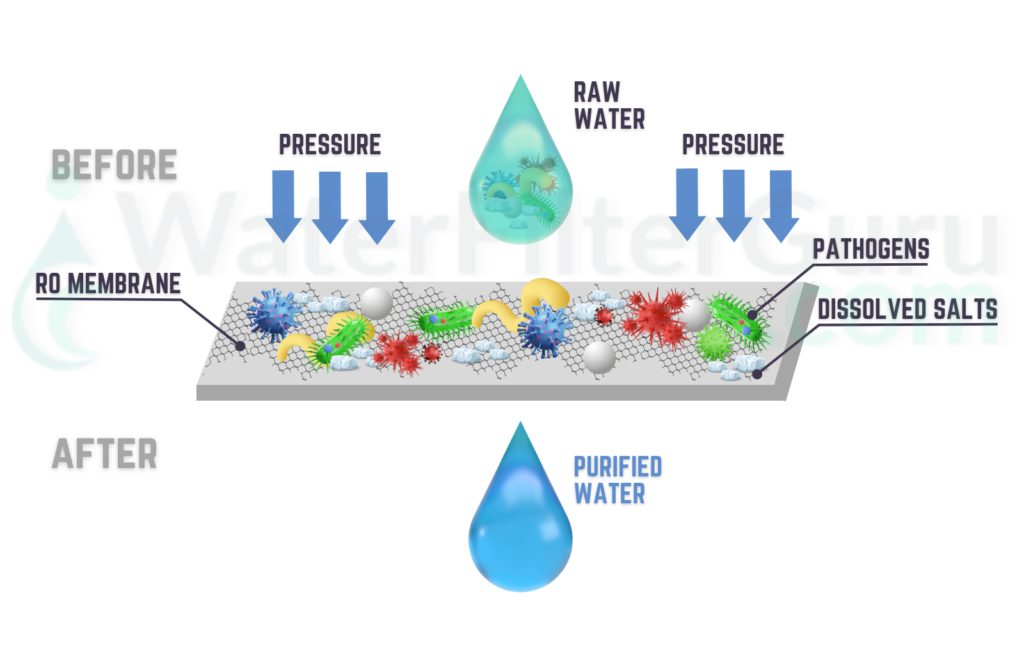
The reverse osmosis membrane is the defining feature of any RO system. Rather than exchanging dissolved ions like ZeroWater, it physically separates water molecules from most dissolved contaminants by forcing water through an extremely fine membrane under pressure. The contaminants rejected by the membrane are continuously flushed away through a drain line.
Because the membrane continuously rejects dissolved solids instead of storing them inside the media, it doesn’t lose capacity in the same way that ZeroWater’s ion exchange resin does. You still do need to replace an RO membrane, but the typical service life extends to hundreds or even thousands of gallons rather than the 20–25 gallons rated for a ZeroWater filter.
| Filtration stage | ZeroWater | Reverse Osmosis |
|---|---|---|
| Sediment filtration | Part of multi-stage filter | Yes |
| Activated carbon | Yes | Yes |
| Ion exchange | Yes | Sometimes |
| RO membrane | No | Yes |
| Removes dissolved ions | Yes, through ion exchange | Yes, through membrane rejection |
| Wastewater | No | Yes |
| Filter capacity | Limited | Depends on filter stage |
Is ZeroWater the Same as Reverse Osmosis Water?
No, ZeroWater isn’t the same as reverse osmosis water. Although they both produce demineralized water with very low TDS, they achieve this result with very different filtration technologies.
In our lab testing using municipal water, the Culligan ZeroWater pitcher delivered very similar contaminant reduction results to the reverse osmosis systems we’ve tested with the same source water. The filter greatly reduced TDS, from 138 PPM to 5 PPM, eliminating all fluoride, uranium, barium, copper, nitrate, chloride, and sulfite detected in the feed water. But this RO-like set of results doesn’t mean that ZeroWater and reverse osmosis technologies are interchangeable.
The biggest differences are how each filter type is managed over time. We’ve found that RO systems generally cost much less per gallon to operate, which is largely thanks to their dramatically longer filter lifespans. ZeroWater, on the other hand, doesn’t require the difficult installation of an under-sink reverse osmosis unit, and it doesn’t waste any water during filtration.
When you’re deciding which technology is the best fit for your home, it’s these practical differences that will help you decide on one over the other.
| ZeroWater | Reverse Osmosis |
|---|---|
| Uses ion exchange resin | Uses a semi-permeable membrane |
| Stores removed ions in the filter media | Membrane rejects contaminants which are washed down the drain |
| Filter capacity is limited | Membrane can process much more water |
| No wastewater | Produces reject water |
| Pitcher-based | Countertop or under-sink systems |
📊 Our Test Results: ZeroWater Matched RO on Contaminant Reduction
Key Finding: In our third-party lab testing, the Culligan ZeroWater pitcher reduced TDS from 138 PPM to 5 PPM and eliminated 100% of the fluoride, uranium, barium, copper, nitrate, and sulfate in our water, a performance comparable to the reverse osmosis systems we’ve tested.
What Did the Culligan ZeroWater Remove in Our Testing?
In our testing, the Culligan ZeroWater achieved one of the strongest sets of lab results we’ve recorded for any water filter. It reduced TDS from 138 PPM to just 5 PPM: a 96.4% reduction.

It also completely removed every contaminant with health effects in our water, including:
- Fluoride
- Uranium
- Barium
- Copper
- Zinc
- Nitrate
- Chloride
- Sulfate
- Calcium
- Magnesium
- Sodium
The filter reduced water hardness from 94 PPM to 0 PPM, and pH was reduced from 7.6 (slightly alkaline) to 6.6 (slightly acidic). This is an expected result given that ZeroWater removes charged ions from water, including the minerals responsible for alkalinity.
What Did the Legacy ZeroWater Remove in Our Testing?
When we tested the Legacy ZeroWater, our water samples were taken at an earlier date, and a different set of contaminants was detected.
The Legacy model reduced TDS from 137 PPM to 8 PPM, a 94.2% reduction, and conductivity was reduced by 95.2%.
It completely removed:
- Chlorine
- Fluoride
- Nitrate
- Chloride
- Sulfate
- Barium
- Uranium
- Strontium
- Hardness
Copper was reduced by 97.1%, from 0.163 PPM to 0.0047 PPM. Calcium was reduced by 99.2%, and pH dropped from 7.4 (slightly alkaline) to 7.0 (neutral).
In this test, the lab reported 3.4 PPB of chloroform in our filtered water sample (detected at 0 PPB in our baseline sample). We don’t think this means that the ZeroWater filter added or generated this disinfection byproduct.
THMs like chloroform are volatile and can dissipate from water over time. There’s a high chance that these compounds were originally present in our tap water but had dissipated from our baseline sample before it was analysed by the lab. So, what looks like a genuine increase after filtration was most likely just a testing anomaly.
How Did Our Tested Reverse Osmosis Systems Perform?
How did ZeroWater’s contaminant reduction performance compare to reverse osmosis in our testing? We’ve outlined our RO results in the next sections.
Countertop RO Systems (Using Same Baseline Sample as Culligan ZeroWater)
Here, we’ll discuss our results for the reverse osmosis systems we tested with the same baseline sample as the Culligan ZeroWater pitcher. These were:
All three countertop RO systems delivered excellent contaminant reduction results.
The Waterdrop A1 reduced TDS from 138 PPM to 6 PPM, virtually matching the Culligan ZeroWater. It completely removed fluoride, uranium, and copper, reduced nitrate by 92.3%, and lowered pH from 7.6 to 6.5.
The APEC ROCT-PLUS reduced TDS from 138 PPM to 29 PPM, while removing 85.7% of fluoride, 91.0% of barium, and 100% of uranium. It also reduced hardness by 89.4%.
The Philips Countertop RO reduced TDS from 138 PPM to 27 PPM, removing 92.9% of fluoride, 82.9% of barium, and 100% of uranium. In this test, hardness was reduced by 87.2%.
Under-Sink RO Systems (Using A More Challenging Water Source)
We tested the following under-sink RO systems with a more challenging water source:
Initially, the baseline sample had a TDS of 875 PPM — more than 6x the TDS of our countertop RO and ZeroWater test sample. With that in mind, they shouldn’t be directly compared against the results above. But they do demonstrate something important: that reverse osmosis continues to perform effectively even with high-TDS water.
The Frizzlife PD600-TAM3 reduced TDS from 875 PPM to 61 PPM (a 93% reduction). It also reduced fluoride by 95.8%, eliminated total THMs and uranium, and reduced sodium by 95.2%. Hardness was also reduced by 89%.
The Express Water RO5DX performed even better, eliminating fluoride, total THMs, and copper from the same high-TDS source water.
Could you use ZeroWater as effectively as these RO systems when presented with high-TDS water? Technically, yes — but it wouldn’t be economically viable.
Ultimately, we don’t have the data to confirm that ZeroWater performs very effectively with high-TDS water, as we’ve only tested it with a TDS of 137–138 PPM.
But to speculate based on what we do know, ZeroWater clearly has the capability to remove enormous amounts of dissolved solids. However, the ion exchange resin’s finite capacity would mean that TDS would consume the filter much faster. That’s where RO has the practical advantage, as it’s designed to continually reject dissolved solids regardless of source TDS.
💲ZeroWater Costs 5 to 11x More Per Gallon Than Reverse Osmosis
Key Finding: Based on our measured filter costs and rated capacities, the Culligan ZeroWater costs $0.90 per gallon of filtered water, versus $0.08–$0.19 per gallon for the countertop reverse osmosis systems we’ve tested.
Why do ZeroWater Filters Cost So Much More Per Gallon?
ZeroWater filters cost so much more per gallon than reverse osmosis because of their limited resin capacity.
| Product | Type | Upfront | Cost per gallon |
|---|---|---|---|
| Apec ROCT-Plus | Countertop RO | $417.99 | $0.08 |
| RKIN U1 | Countertop RO | $1,099.00 | $0.08 |
| Waterdrop N1 | Countertop RO | $299.00 | $0.09 |
| Simpure Y7P | Countertop RO | $369.99 | $0.10 |
| AquaTru Classic | Countertop RO | $449.00 | $0.11 |
| Sans | Countertop RO | $449.00 | $0.14 |
| AquaTru Carafe | Countertop RO | $359.00 | $0.19 |
| Phillips | Countertop RO | $799.00 | $0.22 |
| Waterdrop A1 | Countertop RO | $649.00 | $0.27 |
| Legacy ZeroWater | Pitcher | approx. $25 | $0.70 |
| Culligan ZeroWater | Pitcher | $24.99 | $0.90 |
The ZeroWater ion exchange resin (used in both the Culligan and Legacy filters) doesn’t have an unlimited ability to remove dissolved ions. As it processes water, the resin becomes progressively more and more exhausted. The more dissolved solids your water contains, the faster that will happen.
We calculated the ongoing cost of the Culligan ZeroWater filter based on the $18 filter replacement cost, assuming that each filter will last 20 gallons (we pulled this capacity directly from the certification listings) in reflection of the 138 PPM baseline used in our testing. That gave us a running cost of $0.90 per gallon.
If your tap water has a higher initial TDS reading, don’t assume that you’ll be able to use ZeroWater to filter up to 20 gallons, like us. The resin will have more work to do with every gallon, and it’ll become saturated with dissolved solids at a faster rate, so its useful life will likely be shorter. How much shorter depends on your water’s starting TDS, but it may mean that the cost of replacements stacks up over time and becomes difficult to justify.
On the other end, if you receive city water that’s already relatively low in dissolved solids, you may get more than 20 gallons of useful life from the filter before it needs to be replaced.
When Does Reverse Osmosis Pay for Itself?
RO systems cost significantly more than ZeroWater’s filter pitchers, but reverse osmosis can pay for itself over time. Exactly how long will it take before your upfront investment in an RO unit pays for itself? Let’s do a comparison to figure this out.
The Culligan ZeroWater costs $24.99 (at the time of writing this guide). In comparison, the countertop RO systems we tested ranged from $299 to $1,099.
And then we need to look at their running costs: the Culligan ZeroWater has a cost-per-gallon of $0.90, while the countertop RO systems in our dataset cost $0.08 to $0.19 per gallon.
The basic calculation is:
RO gallons needed to break even = (RO purchase price – $24.99) ÷ (ZeroWater cost-per-gallon – RO cost-per-gallon).
Let’s take the Waterdrop N1 as an example, which has an upfront cost of $299 and costs $0.09 per gallon to operate. The calculation would be:
($299 – $24.99) ÷ ($0.90 – $0.09) = approx. 338 gallons.
At different levels of daily water consumption, that’s around:
| Daily filtered water | Approx. time |
|---|---|
| 1 gallon/day | 338 days |
| 2 gallons/day | 169 days |
| 3 gallons/day | 113 days |
In other words, if you used the Waterdrop N1 to purify 2 gallons of water per day, that would make up its initial upfront cost in roughly five and a half months, based on the above measured running costs.
But not all RO systems are as affordable as the N1! At the other end of the range, if we consider the RKIN U1, this costs $1,099 upfront and $0.08/gallon in our testing. To repeat the calculation with this data:
($1,099 – $24.99) ÷ ($0.90 – $0.08) = approx. 1,310 gallons.
That works out to roughly:
| Daily filtered water | Approx. time |
|---|---|
| 1 gallon/day | 1,310 days or 3.6 years |
| 2 gallons/day | 655 days or 1.8 years |
| 3 gallons/day | 437 days or 1.2 year |
Hopefully, this makes one thing clear: there isn’t a single point at which RO pays for itself. It all depends on the upfront and ongoing costs of the system, as well as how much water you filter.
So yes, RO is more affordable in the long run and can often pay for itself relatively quickly. But that doesn’t mean everyone should buy a reverse osmosis system for this reason. Actually, if you only need a smaller volume of filtered water (for a household with 1 or 2 people, for instance), you might still prefer ZeroWater for its low upfront cost and lack of water waste.
✅Other Differences That Decide It
Now we’ve shared the contaminant reduction test data in this ZeroWater vs reverse osmosis comparison, here are the other key differences that set the two filter technologies apart.
Does Reverse Osmosis Waste Water?
Yes, reverse osmosis wastes water, and this is ZeroWater’s strongest genuine advantage over RO.
The reverse osmosis process involves forcing water through a membrane with tiny pores. Dissolved solids larger than these pores rebound off the membrane surface and are flushed down a drainline with some water (known as reject water).
The amount of water that’s wasted by reverse osmosis can vary pretty significantly from one system to the next. Many modern systems are much more efficient than the conventional systems of the past — the most efficient RO unit we’ve tested so far (the AquaTru Classic) had a 4:1 pure-to-drain ratio, meaning only 1 part water is wasted for every 4 parts purified.
On the other end, the least efficient system we’ve tested (the APEC RO-PH90) had a 1:4 efficiency ratio; so 4 parts water sent to drain for every 1 part purified. See the table below for our measured ratios across all the RO systems we’ve tested.
| System | Pure: Drain |
|---|---|
| AquaTru | 4:1 |
| Waterdrop G3 | 3:1 |
| Philips Countertop RO | 3:1 |
| Sans | 3:1 |
| Waterdrop A1 | 2:1 |
| Cloud RO | 1:1 |
| Aquasana | 0.75:1 |
| Culligan Aquasential | 1:1.5 |
| Express Water Conventional | 1:3 |
| APEC RO-PH90 | 1:4 |
| ZeroWater (any model) | no water wasted |
ZeroWater is the undisputed winner when we’re comparing it to RO for water waste. Neither of its filters wastes water or uses a drain line, which means every drop of water you pour into your pitcher is either filtered or remains in the reservoir. There’s no wastewater to account for.
If you care about water conservation or you just want to avoid any unnecessary increases in your water bill, this will probably be a meaningful difference to consider. You might pay more for ZeroWater’s filters in the long run, but at least you’re not paying for water that never reaches your glass.
Which is Faster and More Convenient?
Convenience is subjective, but we can comment on filtration speed for ZeroWater versus RO based on our own timings.
The Culligan ZeroWater has the advantage of being easy to use and accessible. It takes around 5 minutes to set up, with no DIY knowledge and no extensive filter flushing required. In our testing, it took 418 seconds to filter 28 ounces (the entire reservoir) of water, which works out to around 1.9 gallons per hour. It’s a gravity filter, so you’ll need a bit of patience and shouldn’t expect an instant supply of filtered water.
In comparison, the countertop RO systems we’ve tested require a bit more setup, often involving filter flushing, and they take up more counter space. Generally, these systems also need access to a power outlet and have to be refilled and emptied manually. They are, however, DIY-friendly to assemble, like ZeroWater.
Most countertop units use an internal tank, so they dispense filtered water when you press a button once there is water in the tank. The speed of filtration comes down to how water exits the system (either via a pump system or gravity). Generally, filtration rates are pretty similar to pitchers like the ZeroWater — for example, we measured a filtration rate of 2.4 gallons per hour for the AquaTru Classic.
| Feature | ZeroWater | Countertop RO | Under-sink RO |
|---|---|---|---|
| Installation | Very easy | DIY-friendly | More involved |
| Plumbing changes | No | No | Usually required |
| Power outlet | No | Usually yes | Usually yes |
| Filtration style | Gravity | Pump/gravity | Pump |
| On-demand water | No | Usually from internal tank | Yes |
| Counter space | Low | Higher | Minimal counter footprint |
| Example measured rate | 1.9 gal/hr | AquaTru: 2.4 gal/hr | Depends on system |
You might find that an under-sink reverse osmosis system is the most convenient solution for you because, unlike ZeroWater, it delivers purified water on-demand (driven by a pump) whenever you turn on the dedicated faucet. But you’ll need to commit to a more DIY-intensive installation process that involves modifying your under-sink plumbing setup, which could be a convenience dealbreaker for you.
What About pH and Healthy Minerals?
Both ZeroWater and reverse osmosis remove dissolved minerals, which coincides with a reduction in TDS and pH.
In our testing:
- The Culligan ZeroWater reduced pH from 7.6 to 6.6
- The Legacy ZeroWater reduced pH from 7.4 to 7.0.
Reverse osmosis systems behave similarly in that they remove dissolved solids, but many of them now include (or offer at an extra cost) a remineralization stage that adds minerals back into the water once it has been filtered. This helps to restore taste and pH.
ZeroWater doesn’t offer any built-in remineralization, so you’d need to reintroduce minerals manually, such as by filtering the water through a separate alkalizing pitcher or using trace mineral drops.
| Feature | ZeroWater | Countertop RO | Under-sink RO |
|---|---|---|---|
| Installation | Very easy | DIY-friendly | More involved |
| Plumbing changes | No | No | Usually required |
| Power outlet | No | Usually yes | Usually yes |
| Filtration style | Gravity | Pump/gravity | Pump |
| On-demand water | No | Usually from internal tank | Yes |
| Counter space | Low | Higher | Minimal counter footprint |
| Example measured rate | 1.9 gal/hr | AquaTru: 2.4 gal/hr | Depends on system |
The good news is that most healthy adults eating a balanced diet don’t need to access these healthy minerals in their water. That said, you may want to remineralize your water as a taste preference. In which case, RO systems offering remineralization are more convenient, but you still have options with ZeroWater.
Which Certifications Does Each Hold?
The Culligan ZeroWater is IAPMO certified to:
- NSF/ANSI 42, for aesthetic effects
- NSF/ANSI 53, for health-related contaminants
- NSF/ANSI 401, for emerging contaminants
- NSF/ANSI 372, for lead-free construction
Certifications vary from one reverse osmosis system to the next. Some of the systems we’ve tested have been certified, while others have not.
Among the countertop systems, the AquaTru Classic is one of the most extensively certified countertop RO systems we’ve tested: it’s IAPMO certified to NSF Standards 42, 53, 58, and 401 for the removal of 83 contaminants. Many other systems are less comprehensively certified; for instance, the Waterdrop N1 only holds an NSF 372 certification for lead-free design, with no performance certifications.
ZeroWater holds an advantage over many of the RO systems we’ve reviewed. Having been tested and officially deemed capable of safely and effectively addressing 23 drinking water contaminants, it’s an appealing option if you’re only considering certified systems but you don’t want to spend hundreds upfront on a reverse osmosis filter.
🆚 ZeroWater vs Reverse Osmosis: Which Should You Buy?
So, when should you consider ZeroWater, and when should you choose reverse osmosis? Here are our different recommendations for different situations.
If you’re renting, your budget is small, and/or you have low-TDS city water:
We recommend the Culligan ZeroWater. It’s inexpensive upfront and requires no installation, delivering near RO-level contaminant reduction in our testing with no water waste. You can read our full Culligan ZeroWater review here.
If you’re looking for the best no-install option:
Go for the AquaTru Carafe. It’s our highest-scoring filter, receiving an overall weighted score of 9.57, and it removed 100% of all contaminants with health effects in our testing. Plus, it has some of the most extensive performance certifications we’ve come across. Read our AquaTru Carafe review here. To see how AquaTru competes with ZeroWater head-to-head, read this comparison review.
If you’re buying for a large household or a home that has high-TDS water:
Choose an under-sink RO system. You’ll appreciate the much lower filter replacement cost and the convenience of purified water on tap. See our best under-sink RO systems review roundup here.
FAQ
Q: Is ZeroWater as good as reverse osmosis?
A: In our lab testing using municipal water, the Culligan ZeroWater achieved contaminant reduction results that are comparable to reverse osmosis. It nearly eliminated TDS and removed 100% of all contaminants with health effects in our water, including fluoride (tricky to remove with a non-RO system), nitrate, barium, and uranium. But it has higher long-term costs due to its very short filter lifespan, so it’s not as “good” as reverse osmosis when we specifically look at its affordability in the long run.
Q: Why does my ZeroWater filter die so fast?
A: Your ZeroWater filter will die quickly if you’re using it with high-TDS water or you have a large household that filters a lot of water every day. ZeroWater filters use an ion exchange resin, which has a fixed capacity. The higher the TDS of your water, the faster that capacity is used up. If your tap water has high levels of dissolved solids, you’ll most likely need to replace the filter before it hits the rated 20–25 gallons.
Q: Is 0 TDS water safe to drink?
A: Yes, 0 TDS water is safe to drink for healthy adults. Most of the minerals your body needs come from food, with a report by the National Research Council (US) Safe Drinking Water Committee noting that obtaining them from your drinking water may only be important “when the intake of a particular nutrient by the general population or a particular group is marginal”. The main difference people notice between water sources containing and lacking minerals is taste.
Q: What is the difference between the Culligan ZeroWater and the Legacy ZeroWater?
A: The main difference between the Culligan and Legacy ZeroWater filters is design. While the filter cartridge itself appears to be the same, the Culligan ZeroWater has some design upgrades that make inserting the filter easier. This upgraded model is also more extensively certified than the Legacy ZeroWater, and the filter has a shorter lifespan (20 gallons for the Culligan, with a cost-per-gallon of $0.90, versus 25 gallons for the Legacy, with a cost-per-gallon of $0.70).
Q: Does ZeroWater waste water like reverse osmosis?
A: No, ZeroWater doesn’t waste any water like reverse osmosis. All the filter that you add to the reservoir enters the filtered water chamber. Unlike RO, the ZeroWater filtration process doesn’t involve sending any water to drain.
Q: Does ZeroWater add microplastics to water?
A: We’ve seen several comments about a report (behind a paywall) that claims ZeroWater adds over 1000% of microplastics. We didn’t test for microplastics ourselves, so we’re unable to comment on whether or not ZeroWater adds microplastics to filtered water. ZeroWater has published independent test results claiming that its 5-stage filter removes 99.9% of microplastics, but this isn’t supported by any official certification.
Q: Can you use ZeroWater or reverse osmosis with well water?
A: No, we don’t recommend using ZeroWater or reverse osmosis with well water unless you treat it with adequate pre-filtration first. Private wells contain contaminants that aren’t normally present in treated city water, like arsenic, iron, manganese, high hardness, and possibly even microorganisms like bacteria. These could foul an RO membrane and affect its long-term performance. Plus, high-TDS well water would exhaust the ZeroWater ion exchange resin very quickly, so it’d end up being an expensive method to treat large volumes of water.