

The best water filter pitchers are affordable, portable, and reduce dozens of contaminants using gravity-fed water filtration.
We use our own evidence-based testing to review and compare water filters.
I’ve personally tested all the water filters on this list, leveraging my experience as a WQA Certified Water Specialist (CWS) and Certified Water Treatment Representative (CWR) to review each product as both an expert and a customer.

Culligan ZeroWater
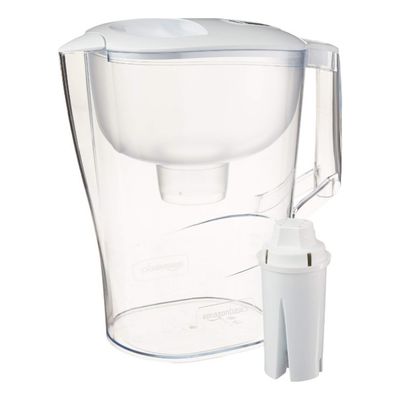
Amazon Basics
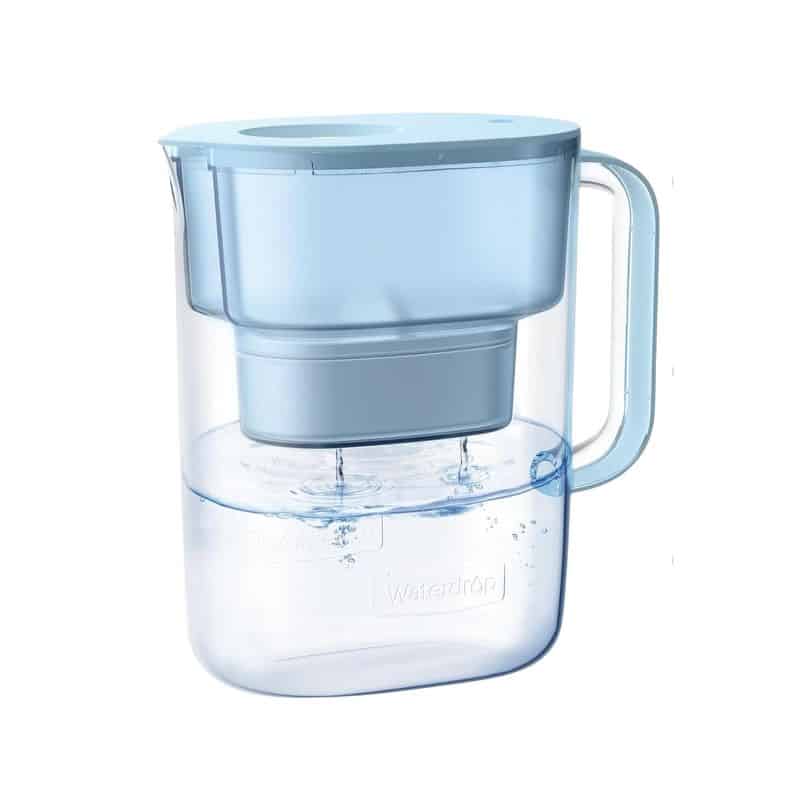
Waterdrop PT-07B
Quick Answer: Best Water Filter Pitchers of 2026 by Category
- Best Overall: Culligan ZeroWater (9.33/10). Removed 100% of the health-related contaminants in our Tap Score lab testing, including uranium and fluoride above health guideline levels, and is IAPMO certified for 100% of its reduction claims.
- Best Budget: Amazon Basics (8.79/10). Removed 100% of lead and both THMs detected in our water, and all 9 of its reduction claims are WQA certified to NSF/ANSI 42, 53, and 401.
- Best for Fast Filtration and Low Running Cost: Waterdrop PT-07B (8.15/10). Filtered at 8.40 GPH in our testing, the fastest pitcher we’ve tested, at $0.05 per gallon, though it is certified only to NSF/ANSI 42.
- Best for Fluoride and Build Quality: Clearly Filtered (8.01/10). Removed 100% of fluoride and uranium in our lab testing and earned the highest component quality score on this list, though only 1 of its 365+ reduction claims is certified (NSF/ANSI 42).
Methodology: Scores come from our own first-party lab testing through Tap Score, with contaminant reduction weighted at 55% of the total. See our full testing methodology.
Our Testing & Selection Process
How We Tested These Pitchers
Every score on this page comes from our own hands-on testing, not manufacturer claims. We send before-and-after water samples to Tap Score by SimpleLab, an accredited third-party lab, and score each pitcher across six weighted categories: contaminant reduction (55%), filtration rate (10%), design (10%), setup (10%), maintenance (10%), and company policies (5%). Contaminant reduction carries the most weight because it’s the reason you buy a pitcher. Purchase price is reported separately and is not part of the performance score, so a cheap pitcher can’t buy its way up the rankings.
Filter condition at the time of lab testing: We collect the lab samples for each pitcher last after all of our hands-on testing is complete and after several days of normal, real-life use in our kitchen. By the time we pull the before-and-after samples for Tap Score, each filter has roughly 7–10 gallons of water through it. The contaminant reduction scores in this guide therefore reflect a lightly used filter rather than a brand-new one. Performance can still decline as a filter approaches its rated capacity, and we plan to add filter-longevity testing in a future update.
We use a metrics-driven process to test water filters for their performance. Our aim is to evaluate a system’s performance capabilities, value for money, and suitability for a specific situation or intended outcome.
For our Best Water Filter Pitchers guide, we cherry-picked the filters that obtained the highest scores across each of our scoring categories, with a particular focus on contaminant reduction.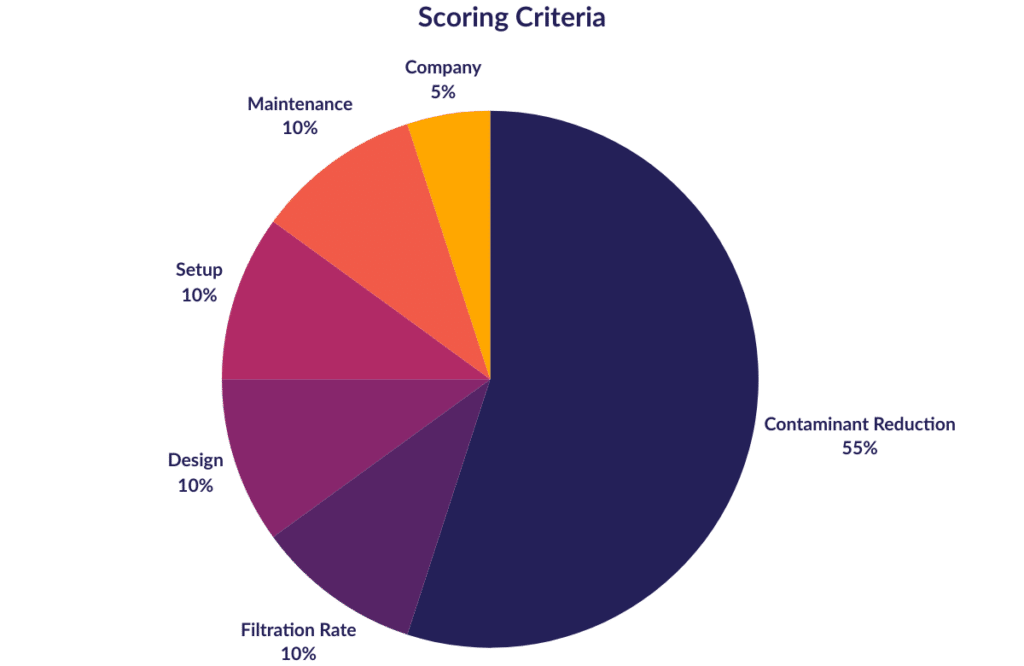
We scored these pitchers based on how effectively they reduced contaminants in our water, what we thought about their design quality, their ease of setup and maintenance, and more. We also compared filter materials and technologies, and evaluated third-party lab test results when the manufacturer provided them, though these are not scoring factors.
To ensure the fairest comparisons, we use fact-based, numerical data whenever we can. But some testing categories require us to conduct our own subjective assessment, giving our personal insight into a specific aspect of a product’s performance.
You can see our complete testing and scoring process here.
To choose the best water filter pitchers, we evaluated all the filters we’ve reviewed and compared their testing data side-by-side.
We selected the highest-scoring products, paying close attention to the filters that reduced the most contaminants in our water.
The water filter pitchers we’ve recommended each have their own unique filter technologies and produce different outcomes. We aimed to provide enough variety to offer targeted recommendations for specific budgets and situations.
We automatically excluded some products from this guide, including:
1. Countertop dispensers, units that require electricity to operate, and systems that can’t be classed as gravity-fed water filter pitchers.
2. Filters with availability/stock issues, or those not available in the USA.
3. Systems that were unable to match up to their competitors due to poorer contaminant reduction performance, those sold by lesser-known or less trustworthy brands, or those offering poorer value on the whole.
Article Update History
- 11/06/2026: Added Waterdrop PT-07B
- 11/06/2026: Removed Epic Pure, Santevia MINA, and LARQ Pure-Vis Advanced
- 08/31/2026: Added Amazon Basics
- 11/07/2025: Added Culligan ZeroWater, removed Legacy ZeroWater
The 4 Best Water Filter Pitchers
| Product | Culligan ZeroWater | Amazon Basics | Waterdrop PT-07B |  Clearly Filtered |
|---|---|---|---|---|
| Score | 9.33 | 8.79 | 8.15 | 8.01 |
| Price | $24.99+ | $25.50 | $19.99 | $110.00 |
| Certifications | NSF/ANSI 42, 53, 401 & 372 | NSF/ANSI 42, 53, 401 & 372 | NSF/ANSI 42 | NSF/ANSI 42, 372 |
| Filter Capacity | 20 gallons | 40 gallons | 200 gallons | 100 gallons |
| Cost per Gallon | $0.93 | $0.09 | $0.05 | $0.55 |
| Warranty | 90 days | 1 year | 90 days | 2 years |
| Read Review | Culligan ZeroWater review | Clearly Filtered review |
Culligan ZeroWater: Best Overall Water Filter Pitcher (9.33/10)
The Culligan ZeroWater Pitcher is the highest-scoring water filter pitcher we tested, earning an overall weighted score of 9.33. It removed more contaminants than any other water filter pitcher we tested and is IAPMO certified for 100% of its contaminant reduction claims. It also has a sturdier, better-quality construction than most other pitchers (with the exception of Clearly Filtered), but it did demineralize our water, and it has the highest maintenance cost of all the filters on this list.
Best For
Product Specs
| Price | $24.99+ |
| Contaminants Reduced | 25+ (manufacturer claim) |
| Certifications or Testing | NSF/ANSI 42, 53, 401 & 372 |
| Holding Capacity | 7-40 cups |
| Filter Lifespan | 20 gallons |
| Approx. Annual Cost | ~$337.63 |
How did the Culligan ZeroWater perform in our lab tests?
Key Finding: In our lab testing, the Culligan ZeroWater removed 100% of all health-related contaminants, including uranium and fluoride present above health guideline levels, and is one of only two pitchers we’ve tested certified for 100% of their reduction claims.
In our Tap Score testing, the Culligan ZeroWater Pitcher outperformed all the other water filter pitchers we reviewed, removing 100% of all contaminants with health effects in our water, including uranium and fluoride, both initially detected in concentrations exceeding the HGL. It also eliminated sulfate, chlorine, nitrate, zinc, copper, strontium, barium, and molybdenum.

ZeroWater filters use a dual ion exchange process, which greatly reduces or removes all charged ions. As a result, we also saw reductions or eliminations of carbonate, calcium, magnesium, bicarbonate, sodium, and hardness. The pH of our water was reduced from 7.6 (slightly alkaline) to 6.6 (slightly acidic), or 7.8 to 5.1 in our field test, leading to a lower aesthetics score of 8.00. Since a big part of the filter’s marketing is its ability to reduce TDS down to 0, there’s no included remineralization media to mitigate these effects.
Overall, though, the pitcher still earned the highest contaminant reduction score on this list (9.65), partly due to its exceptional health-related contaminant reduction and partly because it’s IAPMO certified to NSF 42, NSF 53, and NSF 401 for every contaminant it’s claimed to reduce. The Amazon Basics is the only other pitcher on this list certified for 100% of its claims.
How fast does it filter, and how is it built?

When we consider just how thoroughly the Culligan ZeroWater Pitcher filtered our water, its filtration rate of 2.68 GPH (gallons per hour) is pretty impressive. It took an average of 314.7 seconds to fill a full 30-ounce reservoir over 3 timed tests, earning it a score of 9.50.
Culligan ZeroWater also scored well in the design category with a 9.40, second on this list only to Clearly Filtered (9.70). Most of the other pitchers we tested had construction issues, with thin, flimsy-feeling plastic. The Culligan ZeroWater pitcher has a BPA-free polypropylene and ABS plastic build that feels sturdy, and it’s IAPMO certified for materials safety and lead-free design. You can choose from several pitcher sizes and capacities, from the smallest 7-cup model to the largest 40-cup glass dispenser.
100% of the 30-ounce volume is filtered as usable water, and it’s one of the lightest pitchers we tested, at 3.3 pounds when empty and 5.3 pounds when full. It scored a 10 in our dribble test, and we didn’t record any issues with leaks or unfiltered water bypassing the reservoir when we poured. The pitcher can also easily be handled and poured one-handed and fits nicely in a refrigerator door.
We were able to get the pitcher set up and ready to use in less than 5 minutes, with no filter soaking or flushing required, earning it a high setup score of 9.50. There’s a built-in TDS meter with an orange filter replacement light that illuminates once 006 PPM of TDS is detected in the filtered water, making it easy to know when a new filter is needed. But it had the highest filter replacement cost of all the filters we tested for this review ($18.50 per filter or $0.93 per gallon, based on its 20-gallon capacity, as outlined in its certification listing). This translates to a cost per year of $337.63 and a 5-year filter cost of $1,688.13 ($1,713.12 including the $24.99 upfront purchase price), resulting in the lowest maintenance score on this list at 8.00.
Looking at Culligan’s company policies, the 90-day warranty is one of the lowest we’ve seen for a water filter pitcher, and you’ll have to pay for shipping unless you spend more than $99 on your order. The ambiguous returns policy (each return is treated “uniquely”) was also a letdown, contributing to its company score of 7.60.
| Criteria | Results |
|---|---|
| Overall Score | 9.33 |
| Health Related Contaminants | 9.70 |
| Aesthetic Related Contaminants | 8.00 |
| Performance Certification | NSF/ANSI 42, 53, 401 |
| Filtration Rate | 2.68 GPH |
| Component Quality | Excellent |
| Component Certification | NSF/ANSI 42, 53, 401 & 372 |
| Setup | Outstanding |
| Servicing Requirements | Exceptional |
| Costs | $0.93/ gallon |
| Warranty Length | 90 days |
| Shipping | Free shipping within the continental US on orders above $99 |
| Returns | Limited returns |
Amazon Basics Pitcher: Best Budget Water Filter Pitcher (8.79/10)
The Amazon Basics Water Filter Pitcher is our top pick for a cheap, simple pitcher filter backed by extensive certifications. It costs just $25.50, with a replacement filter spend of $0.09 per gallon, totaling a cost of $31.94 per year. The pitcher removed 100% of lead and total THMs in our testing, and, like the Culligan ZeroWater pitcher, it’s certified for 100% of claims made on the product listing.
Best For
Product Specs
| Price | $25.50 |
| Contaminants Reduced | 9 (manufacturer claim) |
| Certifications | NSF/ANSI 42, 53, 401 & 372 |
| Process | Multi-stage filtration |
| Filter Capacity | 40 gallons |
| Annual Cost | ~$31.94 |
| Warranty | 1 year |
Why Did The Amazon Basics Pitcher Make This List?
The Amazon Basics pitcher delivered a solid performance, achieving the third-highest overall weighted score of the 15 water filter pitchers we’ve tested so far.
While it didn’t blow us away with its contaminant reduction abilities, its certified performance and design, affordable maintenance, and decent company policies bumped up its scores across the board.
What Did the Amazon Basics Pitcher Remove in Our Lab Tests?
Key Finding: The Amazon Basics pitcher removed 100% of lead and both total THMs in our lab testing, and at $0.09 per gallon it has the lowest ongoing cost of any pitcher we’ve tested, with all 9 of its reduction claims WQA certified to NSF/ANSI 42, 53, and 401.
When we tested the Amazon Basics pitcher, it removed 100% of lead (from 0.0044 PPM to non-detectable concentrations) and 100% of two total THMs: 3.93 PPB bromoform and 4.15 PPB dibromochloromethane.
It also greatly reduced chlorine by 99.3%, uranium by 96.04%, copper by 99.02%, barium by 96.78%, strontium by 97.11%, and removed nickel entirely. But, with its fairly conventional design, it was unable to remove fluoride at all, it struggled with nitrate, manganese, and sulfate, and contaminants like boron, selenium, and vanadium were only reduced by 20 to 30%.
Plus, sodium was increased from 162 PPM to 267 PPM (likely from the ion exchange resin, but worth noting if you’re on a low-sodium diet), and silver actually appeared post-filtration. Silver is often used in water filters because it prevents the growth of bacteria in the filter media, and our data showed that the detection was well below the HGL at a concentration of 0.00174 PPM.
What really separates the Amazon Basics pitcher from many others we tested is its certifications. All 9 contaminants that it’s claimed to remove are certified, which gives it a 100% claim-to-certification ratio. The pitcher’s certifications cover NSF/ANSI Standards 42 (for aesthetic effects), 53 (for contaminants with potential health effects), and 401 (for certain emerging contaminants), bumping up its contaminant reduction score to 8.37.
How Did The Amazon Basics Pitcher Perform Across Our Other Testing Areas?
The Amazon Basics pitcher isn’t the fastest pitcher we tested, with a flow rate of 1.90 GPH, but its design impressed us. 100% of the reservoir feels usable, with zero dead volume, and we found no pour bypass or leaks. The plastic feels cheap, but it’s certified to NSF/ANSI Standard 372 for lead-free design, something that sets it apart from most other pitchers we tested and contributed to its design score of 8.80.
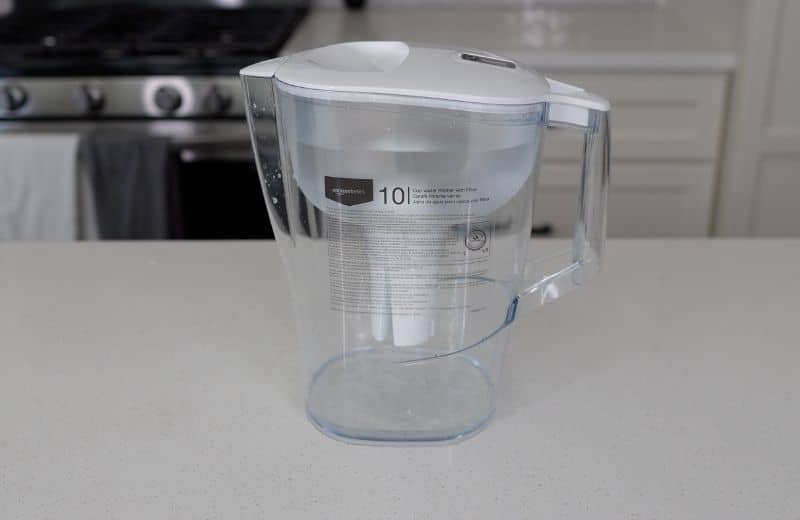
The pitcher’s easy 10-minute assembly earned it a score of 9.50, with no filter soaking required. The pitcher uses the Brita Standard cartridge format, so you can use compatible Brita Standard filters in the pitcher. And with its affordable $0.09-per-gallon ongoing costs and equally simple servicing requirements, it earned one of the highest maintenance scores of 9.75.
Ultimately, the Amazon Basics pitcher is the cheapest pitcher we’ve tested that’s certified for every one of its reduction claims, using proven (if slightly limited) technology. It’s not going to solve every water quality problem, but it’s ideal for everyday filtration on a budget.
| Criteria | Results |
|---|---|
| Overall Score | 8.79 |
| Health Related Contaminants | 8.10 |
| Aesthetic Related Contaminants | 9.90 |
| Performance Certification | NSF/ANSI 42, 53, 401 |
| Filtration Rate | 1.90 GPH |
| Component Quality | Fair |
| Component Certification | NSF/ANSI 372 & CSA B483.1 |
| Setup | Outstanding |
| Servicing Requirements | Outstanding |
| Costs | $0.09/ gallon |
| Warranty Length | 1 year |
| Shipping | -Free next day shipping for prime members -Free shipping with minimal order threshold for non prime members |
| Returns | Free 30-day returns |
Waterdrop PT-07B: Best for Fast Filtration and Low Running Cost (8.15/10)
The Waterdrop PT-07B is the cheapest water filter pitcher to run that we’ve tested to date, with a cost per gallon of just $0.05 or an annual filter replacement cost of $17.75. Overall, it scored 8.15, owing to its good contaminant reduction performance (it removed 100% lead and total THMs in our testing), certifications for removing chlorine taste and odor and for materials safety, and its fast filtration rate (the fastest of all the pitchers we’ve tested) of 8.40 GPH.
Best For
| Price | $19.99 |
| Contaminants Reduced | 9 (manufacturer claim) |
| Certifications | NSF/ANSI 42 |
| Process | Carbon + Ion Exchange |
| Filter Capacity | 200 gallons |
| Annual Cost | ~$17.75 |
| Warranty | 3 months |
What Did (and Didn’t) the Waterdrop PT-07B Remove From Our Water?
Key Finding: The Waterdrop PT-07B removed 100% of lead and total THMs, but was unable to remove fluoride (1.0 PPM before, 1.2 PPM after). Low concentrations of silver appeared to be added to the water. The pitcher is certified only for chlorine, taste, and odor.
In our lab tests, the Waterdrop PT-07B reduced 100% of lead (down from the initial 0.0044 PPM detection), as well as 100% of bromoform and dibromochloromethane, which originally exceeded the HGL. Copper was reduced by 96.41%, to 0.0175 PPM, and uranium by 86.58%, to 0.00204 PPM.
Barium was reduced by 89.42% (to 0.00329 PPM), strontium by 88.96% (to 0.107 PPM), and nickel by 100%. Additionally, in our field tests, chlorine was completely eliminated by 100%.
We also saw an 87.48% hardness reduction, from 314 PPM to 39.3 PPM, with calcium levels dropping by 88.3% and magnesium dropping by 85.0%. Potassium increased by 785%, from 3.65 PPM to 32.3 PPM, and sodium increased by 51%, from 162 PPM to 245 PPM. This points to the filter using ion exchange technology, which exchanges minerals including calcium and magnesium with other ions, like sodium and potassium.
Fluoride was one of the biggest letdowns. The replacement filter listing for the PT-07B mentions fluoride as a contaminant that the filter removes, but our lab measured a fluoride increase, from 1.0 PPM to 1.2 PPM.
Also disappointingly, nitrate was reduced by just 5.41%, chromium dropped by 15.74%, and selenium was reduced by 14.73%. Boron, sulfate, vanadium, manganese, and molybdenum were also reduced only slightly, and a small amount of silver (0.000535 PPM) was detected post-filtration when it was initially undetected in our baseline sample. (Silver is a material that’s often used in filters to prevent the buildup of microorganisms inside the media.)
Of the 9 contaminants that the PT-07B is claimed to reduce, only chlorine and taste/odors are supported by an official NSF Standard 42 certification, resulting in a certification score of 8.00 and contributing to its overall contaminant reduction score of 7.15.
What Were the Waterdrop PT-07B’s Strengths?
The PT-07B filtered a full 51-ounce reservoir in under 3 minutes (a flow rate of 8.40 GPH), more than twice as fast as any other pitcher we’ve lab tested, earning it a top score of 10.00 for its filtration rate.
The pitcher has a 51-ounce usable capacity with just 0.1 ounces of dead volume, so almost all of the water you can add can be filtered and used. At 2.26 pounds empty, it’s light enough to handle easily and fits in most refrigerator doors. It’s also certified for materials safety as part of its NSF 42 performance certification, contributing to its design score of 8.80.
Setup for the PT-07B involves soaking the filter for 10 minutes and filtering/discarding two batches of water, and its fast filtration means you can have usable filtered water in around 20 minutes, resulting in a high score of 9.50.
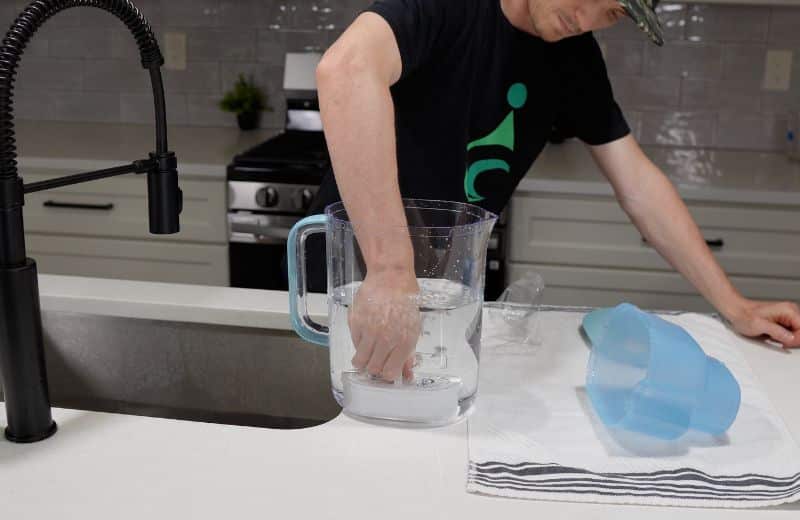
The PT-07B is the cheapest pitcher to run that we’ve tested, at a cost of $0.05 per gallon or $17.75 per year. Its affordability and simple, tool-free filter changes, with a filter replacement light built into the pitcher, earned it a maintenance score of 9.75.
What Are The Trade-Offs We Identified?
We only identified a couple of trade-offs for this affordable pitcher. The first is that the warranty is only three months, tied with the Culligan ZeroWater’s 90 days for the shortest warranty on this list, pulling the company score down to 8.25.
We also noted that while the PT-07B is made from BPA-free plastic, it has a cheaper, flimsier feel than other pitchers, and pouring before the upper reservoir empties can dislodge the entire reservoir, spilling unfiltered water into your glass. You can avoid this issue by waiting until the upper reservoir is empty before you pour, but it’s a design flaw that Waterdrop could easily fix.
Ultimately, we think this is a great pitcher if you mainly want to reduce chlorine, lead, THMs, and uranium with a filter that’s both fast and cheap to run. It wouldn’t be our recommended choice if you want fluoride or nitrate removal, you’re on a sodium-restricted diet, or you’re looking for the reassurance of a longer warranty.
| Criteria | Results |
|---|---|
| Overall Score | 8.15 |
| Health Related Contaminants | 6.90 |
| Aesthetic Related Contaminants | 9.90 |
| Performance Certification | NSF 42 |
| Filtration Rate | 8.40 GPH |
| Component Quality | Fair |
| Component Certification | Certified |
| Setup | Outstanding |
| Servicing Requirements | Outstanding |
| Costs | $0.05/ gallon |
| Warranty Length | 3 months |
| Shipping | Free within the continental US |
| Returns | 30 days |
Clearly Filtered: Best for Fluoride and Build Quality (8.01/10)
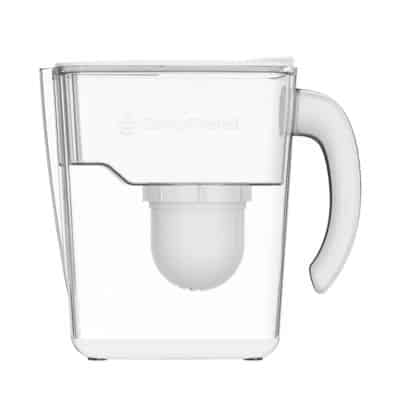
The Clearly Filtered pitcher completely removed chlorine, copper, phosphorus, uranium, and fluoride in our lab tests, but it’s only certified (NSF/ANSI 42) to reduce 1 of the 365+ contaminants it’s claimed to reduce, and it has one of the slowest filtration rates at 0.97 GPH, resulting in an overall weighted score of 8.01.
Best For
| Price | $110.00 |
| Contaminants Reduced | 365+ (manufacturer claim) |
| Certifications | NSF/ANSI 42 & 372 |
| Holding Capacity | 10 Cups |
| Filter Lifespan | 100 gallons |
| Annual Cost | $200.75 |
| Warranty | 2 years |
How did Clearly Filtered perform in our lab tests?
Key Finding: The Clearly Filtered pitcher reduced 100% of fluoride in our testing and uses the highest-grade materials of any pitcher on this list, certified to NSF/ANSI 42 and 372.
We awarded the Clearly Filtered Pitcher a score of 7.36 for overall contaminant reduction. It reduced 100% of fluoride, and its 100% uranium, phosphorus, chlorine, and copper reduction were also great results.
The CF pitcher also reduced 86% barium, 67% strontium, and 53% molybdenum. But its score was affected by the presence of 0.0054 PPM of cobalt in our filtered water (it hadn’t been detected pre-filtration).
It’s WQA certified to NSF/ANSI 42 to reduce 1 of the 365+ contaminants it’s claimed to reduce; its previous NSF/ANSI 53 certification is no longer listed. That’s not the most impressive proof of performance that we’ve seen, resulting in a lower certification score of 7.00.
Did Clearly Filtered Impress Us?
The Clearly Filtered Water Pitcher is one of the few water filter pitchers that completely eliminated both fluoride and uranium in our testing.
We also noted that the pitcher’s BPA-free Tritan plastic construction felt sturdier and thicker than other pitchers. The new pitcher design has a flip lid attached to the upper reservoir, which is an improvement from the original design. It received a design score of 9.70 and is WQA certified for lead-free design, on top of holding a materials safety certification as a component of its performance certifications.
In our usability testing, the pitcher had a usable ratio of 99.8%, and it scored a 10/10 on our spill test, meaning it poured cleanly with no leaks or spillage. We did note that the entire upper reservoir slips when pouring out the last of the bottom reservoir, but it doesn’t fall out. At a weight of 3 pounds when empty and 6.85 pounds when full, it’s easy to pour one-handed, and its 11.5 x 5.5 x 10.5-inch footprint fits comfortably in standard refrigerator doors.
How Could Clearly Filtered Improve?
We identified several areas for improvement with the Clearly Filtered pitcher.
First, it has one of the slowest filtration rates of any water filter pitcher we’ve tested. When we tested the previous iteration of the pitcher, it had a 2.27 GPH filtration rate, but the updated model took 1839 seconds (just over 30 minutes) to filter the 0.49-gallon reservoir in our testing, resulting in a much slower flow rate of 0.97 GPH.
There’s also setup, which sounds easy in theory but is annoying in practice. Rather than having to filter and discard several batches of water (which is time-consuming), you can prime the filter using the included priming bag, which took less than 10 minutes. But we had issues with the priming method, as it takes a lot of strength to get the priming bag sealed with the filter, and it leaks from the top unless you really tighten it. Still, the speed of setup earned Clearly Filtered a score of 9.50 in this category.
Finally, the pitcher’s cost per gallon of $0.55 puts it in the more expensive bracket, although its long 100-gallon filtration capacity means you’ll only need around 3.7 replacement filters per year, at an annual cost of $200.75, or $1,003.75 in filters over 5 years ($1,113.75 including the $110.00 upfront price). Servicing is simple, although each new filter involves the same annoying priming process, contributing to a maintenance score of 8.75.
We think the Clearly Filtered Pitcher makes the most sense for people who are happy to pay a slightly higher upfront and ongoing cost to effectively address contaminants that a carbon- or ion-exchange-based pitcher would struggle to remove, like fluoride, with a system that’s certified for performance and materials safety.
| Criteria | Results |
|---|---|
| Overall Score | 8.01 |
| Health Related Contaminants | 7.27 |
| Aesthetic Related Contaminants | 9.90 |
| Performance Certification | Certified for <1% of reduction claims |
| Filtration Rate | 0.97 GPH |
| Component Quality | Outstanding |
| Component Certification | Certified |
| Setup | Outstanding |
| Servicing Requirements | Outstanding |
| Costs | $0.55/ gallon |
| Warranty Length | 2 years |
| Shipping | Free shipping |
| Returns | 30 days |
Filters That Didn’t Make the Cut
We’ve tested 15 water filter pitchers in total. These are the ones not featured in our current top 4, grouped by why.
Replaced by a newer model:
- Legacy ZeroWater Pitcher. Replaced by the new Culligan ZeroWater and being phased out.
Lower contaminant reduction scores: each scored below the lowest contaminant reduction score among our top 4 (7.15, Waterdrop PT-07B).
- Nakii: 6.26
- PUR Plus Pitcher: 5.28
- LifeStraw Home Pitcher: 4.34
- Brita Elite Pitcher: 4.29
- Waterdrop Chubby Pitcher: 4.24
- Aarke: 4.04
Tested, but not featured in this update: these pitchers performed well in our testing but are not part of our current top 4 as these were tested on a different, easier water source. See each full review for complete lab results and scores.
- Epic Pure: legacy model, no longer available
- Epic Pure XP: 7.29 contaminant reduction, 7.97 overall
- Santevia MINA
- LARQ Pure-Vis Advanced
None of the lower-scoring pitchers above are tested or certified to reduce most of the contaminants in our water (like uranium, fluoride, and molybdenum), so we were unsurprised when they did a poor job of reducing them. That doesn’t necessarily mean they’re incapable of reducing contaminants, just that they couldn’t address our own water quality concerns.
That’s why testing your water before buying a filter is so important: you want to ensure that the system you choose can effectively address your unique water quality issues.
Frequently Asked Questions
Q: What is the best water filter pitcher?
A: Based on our lab testing, the Culligan ZeroWater is the best water filter pitcher, with an overall score of 9.33/10. It removed 100% of the health-related contaminants in our water, including uranium and fluoride above health guideline levels, and it is IAPMO certified for 100% of its reduction claims. The trade-off is cost: at $0.93 per gallon, it has the highest ongoing filter cost of any pitcher on this list.
Q: Which water filter pitcher is cheapest to run?
A: The Waterdrop PT-07B has the lowest running cost of any pitcher we’ve tested, at $0.05 per gallon (about $17.75 a year at one gallon per day), followed by the Amazon Basics at $0.09 per gallon. The Amazon Basics is the cheapest to run of the pitchers certified for all of their reduction claims. At the other end, the Clearly Filtered costs $0.55 per gallon and the Culligan ZeroWater $0.93 per gallon, so the best pitcher for contaminant reduction is also the most expensive to maintain.
Q: Do water filter pitchers remove fluoride?
A: Most do not. Of the four pitchers on this list, only the Culligan ZeroWater (ion exchange) and the Clearly Filtered reduced fluoride by 100% in our lab testing. The Amazon Basics did not reduce fluoride at all, and fluoride rose from 1.0 PPM to 1.2 PPM after filtration through the Waterdrop PT-07B, even though its replacement filter listing mentions fluoride. If fluoride reduction is your goal, confirm it with lab data or a certification listing, because it isn’t a standard pitcher capability.
Q: Do water filter pitchers remove healthy minerals?
A: Some do. The Culligan ZeroWater’s dual ion exchange filter reduced or removed calcium, magnesium, bicarbonate, and hardness in our testing and lowered our water’s pH from 7.6 to 6.6, with no remineralization media to offset it. The Waterdrop PT-07B reduced hardness by 87.48%, from 314 PPM to 39.3 PPM. If you want to keep minerals in your water, avoid pitchers designed to reduce TDS toward zero.
Q: Can a water filter pitcher increase sodium?
A: Yes. Pitchers that use ion exchange media can swap hardness minerals for sodium or potassium. In our lab testing, sodium rose from 162 PPM to 267 PPM after filtration through the Amazon Basics and from 162 PPM to 245 PPM through the Waterdrop PT-07B, and potassium rose from 3.65 PPM to 32.3 PPM through the PT-07B. If you’re watching your sodium intake, factor this in when choosing a pitcher.
Q: Does the ZeroWater TDS meter tell you if your water is safe?
A: No. A TDS meter measures total dissolved solids, which includes harmless minerals like calcium and magnesium as well as metals, but it can’t detect uncharged contaminants like some pesticides, herbicides, and PFAS. The Culligan ZeroWater’s built-in meter is useful for knowing when to change the filter, but the only way to know what’s in your water is a certified lab test.
Q: Are there any glass water filter pitchers?
A: None of the four pitchers on this list has a glass vessel. Even pitchers and dispensers with a glass body house the filter cartridge itself in plastic, so if avoiding plastic contact entirely is your priority, a distiller that dispenses into a glass vessel is a closer fit.
Q: How long do water filter pitcher filters really last?
A: It depends on the cartridge and your water. Rated capacities on the four pitchers on this list range from 20 gallons (Culligan ZeroWater) to 200 gallons (Waterdrop PT-07B). Our contaminant reduction scores reflect performance with a fresh filter, and pitcher cartridges lose capacity as they near their rated limit, so replacing on schedule matters more with pitchers than with larger systems. On hard or heavily contaminated water, filters can exhaust sooner than their rating.
Q: Do water filter pitchers remove microplastics?
A: We haven’t lab-tested pitchers for microplastics yet, so none of our scores reflect microplastic reduction. Fine-pore carbon media should capture some larger particles, but performance across the full size range is unproven, so look for a current certification listing that specifically names microplastics rather than relying on marketing claims.
Q: Are water filter pitchers worth it?
A: For city tap water, yes, for most households. The pitchers we tested reduced a meaningful range of contaminants for a low upfront cost and no installation. They’re not a fit if you need high daily volume, whole-home protection, or removal of contaminants like bacteria from untreated water, which call for a different system type.
Thanks for these in-depth reviews. Could you also review Aquaphor with its aqualen filters? I wonder if it’s really better than Amazon Basics pitchers
Hi
I appreciate your reviews. I use Zero water pitcher when my under sink Aquasana filter
Is expired. But they changed the lid of the filter from a screw on cover to a piece of glued
on plastic Now most of the filters I open have residues of plastic and glue on them and I can’t
use them. What are your thoughts on that? I have written the company about the problem
They certainly ruined a pretty good product.
I personally think the filter redesign addressed issues with the legacy design. Specifically how hard it was to get a proper seal and prevent leaking. Check out my updated review here https://waterfilterguru.com/culligan-zerowater-review/
Do they filter the hormones or antibiotics that may remains in the water?
Depends on the filter. Those that use activated carbon should be able to reduce trace personal care and pharmaceutical products (PCPPs). Even better, find a system certified for the reduction of hormones like estrone like the Culligan ZeroWater
Have you tested or do you recommend cyclopure which removes PFAS only?
I have not tested it
The “Epic Pure” water filter on their site mentions they reduce microplastics by 99%. Is that true? You have mentioned that only “Clearly Filtered” does that? So I am confused.
Also what about the material used to manufacture the filter. Are they also made with Tritan for for both “Epic Pure” & “Clearly Filtered”?
Please compare both these water pitcher & filters on the below these 2 counts (since other aspects seem to be dead heat) –
1. Reduction of microplastics
2. Material used to make both the water pitcher and the actual filter
Thanks a lot Brain!
Great question, and I can see why it’s confusing. To clarify, I’ve not specifically tested either pitcher for microplastics yet, so I don’t have any firsthand data for you. Also, neither Epic nor Clearly Filtered has official third-party certification for microplastics reduction. So when you see claims like “99% reduction,” that’s marketing language rather than certification-backed proof. Clearly Filtered has been much more transparent with data and independent testing than Epic.
As for the materials: both Epic Pure and Clearly Filtered pitchers use Tritan plastic for the reservoir and housing. Tritan has NSF certifications for food-contact safety (NSF 51) and drinking-water components (NSF 61), which means it’s been tested for extraction of harmful substances. The filters themselves are generally made from a blend of activated carbon and proprietary media encased in plastic housings, also usually Tritan or a similar BPA-free plastic.
So, in short: neither has certified proof for microplastics reduction, but both use Tritan plastic in their pitcher construction and filter housings (or so they claim).
Thanks a lot for the thoughtful question!
Hi Brian –
First of all a HUGE vote of THANKS for publishing such valuable information on water filters. Really kudos to you!
Now my questions & situation – First a very basic dumb question. Since piped municipal water (which I get in my home) is already treated by the local water company why do we at all need water filters? I have the water quality report (https://delcowater.org/waterquality/) of my local water company & all substances are in the recommended range. The only thing which I feel we should worry about in general is the contaminants coming from the water pipe (lead, etc) & micro-plastics in general. Please correct me if I am wrong.
Anyway pending a decision I am relying on bottled spring water. I am on the lookout for a counter top water filter pitcher. From the Top-3 you have posted, all seem to be doing an equally good job contaminant reduction though traces of Cobalt & Chloroform reduced the scores of two of the filters. But what about only the “Health-Related” contaminants – are all 3 similar? What about PFA reduction by these 3.
Of these 3, my choice would be “Clearly Filtered Pitcher” because – A. The material of the jug seems to be superior to others (BPA & BPAs free). After all no use of having a great filtered water but lying in a plastic jug potentially leaching microplastics (?). B. Somewhere you mentioned that this one reduces microplastics though that is not mentioned anywhere. Why do you say that as that is one of my top concerns. (You also mentioned PUR Plus does that, but seems that filter did not pass your basic tests).
I am also tempted to consider Epic Pure pitcher instead if you so advise. AMAZON Reviews for Epic Pure are higher than “Clearly Filtered Pitcher”, though the medical grade material of the latter seems to be a winner in my view. Please advise.
Looking forward to hearing from you…
Appreciate the kind words thank you! On your first question: utilities are required to meet legally enforceable maximum contaminant levels (MCLs), but those limits are set by balancing treatment cost and feasibility with health risk, so they don’t always reflect the most conservative, health-first targets. Not every contaminant is regulated, either. Examples include things like many pharmaceuticals, 1,4-dioxane in some jurisdictions, and microplastics so even if your report shows everything “in range,” there can still be gaps. And water can be recontaminated after it leaves the plant as it moves through mains and your home’s plumbing (lead, copper, and particulate rust are classic distribution-system issues). From a residential treatment perspective, I prefer to reference the most conservative health-based guidelines when interpreting reports, not just the federal MCLs.
Regarding PFAS and pitchers: in general, any high-quality carbon media with enough contact time *can* reduce PFAS, but I don’t have firsthand lab data for every pitcher on your shortlist. One important update: Clearly Filtered had been certified by WQA to NSF/ANSI 53 for PFAS reduction, but just yesterday it was brought to my attention that the certification listing has been removed. I’ve reached out to CF for clarification and will update my content accordingly. In the meantime, treat all marketing around PFAS with cautious optimism and, where possible, look for current, verifiable certifications.
Microplastics: I’ve not specifically tested for microplastics yet, so I don’t have any firsthand data for you, and neither of the pitchers you mentioned is certified for microplastics reduction. That said, their fine-pore carbon blocks should capture a portion of larger particles; the open question is how they perform across the full size range found in real tap water. If microplastics are your top concern, that’s another reason certifications matter.
Material safety: BPA/BPS-free claims are good, but what I care about most is extraction/material-safety testing as part of reputable certifications (this is where standards ensure the plastics aren’t leaching concerning levels of anything into the water). Clearly Filtered’s pitcher and filter components have historically aligned with those material-safety expectations, and in my testing their overall contaminant reduction was strong. Still, remember that my testing is limited and not conclusive; what worked well in my source water may not behave the same in yours. For example, PUR struggled with the naturally occurring fluoride level in my water so performance is very water-dependent.
I hope this helps
Are there any glass water filter pitchers that you’d recommend?
thanks!
None that I’ve tested yet.
That’s exactly what I want. There are none. Glass is my healthy choice. Keep in touch with me on Facebook. I’ll let you know.if I find one and you let me know. We can do without food but not water. L A water is dangerous. I was told if you let cold water run a minute it cleans out. Gayle Palitz
It’s a shame that none of them were the rectangle ones with a spigot; that’s the sort I’m looking to get.
That’s just a different vessel – the filter elements are the same. For example the Epic Pure Dispenser and the ZeroWater dispenser use the same filter elements as the pitcher versions.
Brian,
Have you tested/reviewed the LifeStraw filter pitcher? It has a glass vessel but a silicon filter.
Trying to determine the safety of this. Thank you
Not yet but it’s on my list for next time I test pitchers
You did so much work looking at all these products, but they’re ALL MADE OF PLASTIC. So you filter the water and then let it sit in a plastic container. And BPA-free doesn’t mean a whole lot. When companies stopped using BPA, they switched it up a little (BPS, etc) and called it “BPA-free.” More and more evidence comes out about how toxic plastic is in general–ingesting (or breathing in) microplastics and nanoplastics. If that isn’t on your radar now, it will be soon.
Do you have any reviews of glass (or stainless?) pitcher-style or other counter-top water filters that don’t contain plastic? Thanks.
Not yet. Unfortunately, currently, the vast majority of water filters use plastic components. If not the pitcher vessel itself, the filter is still housed in plastic. Your best bet to completely avoid plastic exposure would be distillation into a glass vessel.
Thanks for your testing.
As a single person with a small refrigerator, I’d like a narrow pitcher, less than 3 inches. Since 33% of Americans are single-person households, I doubt my need is unusual. I don’t suppose you’ve come across any good pitchers that are smaller?
The best I’ve found are featured in this article. When I test more I’ll update here accordingly. PUR has a small 7 cup pitcher
The ZeroWater Ready-Pour Pitcher link listed only links to a 5 stage filter, but you mention a 6 stage filter. Why the discrepancy, or a typo?
That would be a typo on our end, thanks for the heads up! This has been corrected. ZeroWater is a 5-stage filter
Didn’t LARQ do a 3rd-party lab test of their water pitcher somewhere in 2021? It’s on their website, and here’s the direct link to their performance report. I heard they tested it to NSF/ANSI 42, 53 & 401 standards.
While third party testing is a great first step, it’s good to note that third party testing and official performance certifications are not the same thing!
Have you ever tested the “best water filter ever” from the wellness enterprise? I am curious how it stacks up to the rest of the filters that were reviewed.
I’ve not, but I can add it to my list to look into!
Hi. Has Epic Pure solved its premature filter failure problem? (Read the reviews on Amazon; many people are complaining about this, I worry when any product gets 23% negative reviews. )
Premature filter failure? Filter lifespan is dependent on multiple factors and will be different from situation to situation. Type and concentration of contaminants present and usage directly affect how fast a filter will reach capacity and need to be replaced. The more contaminated the water, the shorter the filter lifespan.
I understand that but some are complaining it happens very quickly, sometimes within days or a couple of weeks. Read the 1-3 star reviews on Amazon and let me know what you think. Thanks!
I can’t really speak to the experience those folks have had as I don’t have information or data about their situation and how they’ve used the filter. I’m always wary of reviews on Amazon as their review system is so easily manipulated too.
hi, i also experienced filter slow down within days (2 filters bought on amazon), we use the nano as we have well water. We leave plenty of time for the filtration to complete, like overnight. And I also noticed the filtration rate varies and will speed up after having slowing down in first couple days.
Does the TDS included w/ the Zero Water Filter System measure the safety of the water? Could it test at 0 but still have toxic levels of lead, etc?
No, a TDS meter does not tell you if water is healthy or safe or not. It measures the total dissolved solids, which includes both healthy minerals (like calcium and magnesium) as well as more dangerous contaminants like metals. Additionally, a TDS meter does not provide any information about uncharged contaminants, like some pesticides, herbicides and PFAs. The best way to find out what’s in your water and determine it’s safety is by testing with a certified lab.
I tested my tap water through Tap Score. Our water utility gets our water from Lake Tahoe. The test results are OK so far except for HAA5 specifically DCA: Dichloroacetic Acid is elevated: 0.0025 PPM. I am looking for both a water filter pitcher and an undercounter filter (I currently have InSink Erator F-3000) that will remove or lower to a healthy level the DCA. Any suggestions?
Activated carbon is an effective method to reduce Dichloroacetic Acid, so any water filter that uses activated carbon media should do a good job addressing this for you
Our VOC water tests also indicated an elevated level of: Total THMs at 2.96 and Chloroform at 2.96 (HGL 0.22). So we’d like to add that to the list of what we want to filter out of our drinking water. We do have elevated: uranium, Lead and Arsenic; but I think most filters can lower these contaminants.
We look forward to hearing from you. We are especially concerned about the Chloroform level as we have regular visitors who are 3 years old and 5 months old….
Excellent comparison and very useful. Isn’t it worrying that filter jugs like EPIC PURE, Santevia MINA or LARQ increase sulfate or chloride levels after the filtering process? Does this pose any security risk? I am surprised that EPIC PURE is in position 1 in the ranking, considering this data
Hey Sergi, thanks for the comment! While we observed slight increases in the impurities mentioned, the levels were well below the Health Guideline Level benchmark, so we did not consider them too much of a concern.
I live in Windsor Ontario Canada and our water is currently disinfected using ozonation . I am looking to upgrade from the Pur Plus system and I am particularly concerned about plastic microcontaminants that ozonation does not address. I am only interested in a water pitcher system . Thankyou for your time.
Hey Barbara, the Clearly Filtered water pitcher performed well in our testing and has been tested to reduce microplastics, but it’s not yet certified to do so. If you are looking for a pitcher thats specifically certified to reduce microplastics, check out the PUR Plus.
Please help me understand why the Zero water was rated #3 when it removed almost 100% of everything that it was being tested for and the con was only that it had a expensive filter. It seems like that is the best filter hands down amongst the 5 filters.
The ZeroWater received an 8.62/10 when put through our data-driven scoring system. It’s overall contaminant reduction score (8.34) was dragged down due to the presence of disinfection byproducts in the filtered water. The overall score was greatly impacted by this because Contaminant Reduction is given the highest weight, and makes up 55% of the total score. It’s maintenance score of 8.25 was also lowered due to the expensive ongoing filter replacement cost of $0.70/ gallon. The Company score was also lowered due to a lack of return window. You can read the full ZeroWater review here where we dive deep into the data behind each of the scores.
Is the PUR Plus the only one certified to reduce arsenic?
The PUR Plus is not certified to reduce arsenic. I’m not aware of any pitchers that are certified to reduce arsenic, only that have been 3rd party tested to do so
Is the chloroform found in Zero Water a big deal ? I use Zero Water but am now concerned.
I don’t think the chloroform, a disinfection byproduct, is coming from the ZeroWater filter itself. Still, the fact it was detected post-filtration indicates ZeroWater may not be the best option for addressing THMs like chloroform