

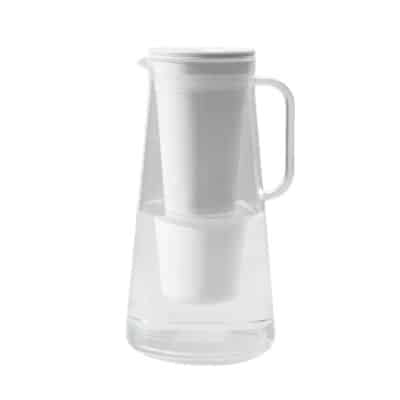
If you’ve heard of LifeStraw already, it’s probably for its namesake: the LifeStraw Water Filter Straw, which lets you drink from natural, untreated water sources outdoors. The company has since ventured into producing filters for indoor use, too, including the LifeStraw home water filter pitcher, with a twist: it’s apparently the “only filter pitcher that removes bacteria, parasites, and microplastics”, along with 30+ other contaminants.
What We Like
What We Don’t Like
| Price | $49.95 |
| Contaminants Reduced | 30+ claimed / 19 certified |
| Certifications | NSF/ANSI 42, 53 & 401 |
| Process | 0.2-micron membrane + Carbon + Ion Exchange |
| Filter Capacity | 40 gallons (carbon) / 264 gallons (membrane) |
| Annual Cost | ~$189.17 |
| Warranty | 3 years |
Quick Verdict: Is the LifeStraw Home Water Filter Pitcher Worth It?
The LifeStraw Home received an overall weighted score of 6.49, significantly lower than the top-performing water filter pitchers we tested, which achieved scores of 8.50 and higher. That puts this LifeStraw model in our “failing” category.
The filter’s performance in our contaminant reduction testing was primarily to blame here, receiving a Contaminant Reduction score of just 4.34, driven by a health sub-score of 3.50 from our lab testing, despite high scores elsewhere: 9.10 for design, 9.50 for setup, and 9.00 for maintenance. Contaminant reduction is, indisputably, the most important determiner of a water filter’s value, and it accounts for 55% of the overall scores we award.
But we think it’s worth clarifying that our own testing limitations likely prevented the pitcher from receiving higher scores for contaminant reduction. Our scores reflect testing on treated city water only. The LifeStraw Home’s membrane microfilter targets microbiological contaminants that our lab panel doesn’t measure, so its score may be different if it were tested with a different source water. That said, if you’re concerned about the contaminants typically present in municipal water, our testing suggests there are better options if you are concerned about the contaminants typically present in municipal water.
Buy It If: Your priority is microbiological protection on top of more “typical” contaminant reduction for a municipal water supply, or you want to remove lead (it removed 100% lead in our test) without the mineral reduction or sodium addition of a typical ion exchange filter.
Skip It If: Your main water quality concerns are dissolved contaminants like fluoride, nitrate, uranium, and chromium (none of which was removed in our testing), you want to completely eliminate chlorine (our test measured a chlorine reduction of 77.64%), or you’re cost-conscious (this LifeStraw model is the third-most expensive pitcher to run in our test group, at $0.52 per gallon).
Our Methodology: We test all water filter pitchers using a weighted scoring system that covers 6 key categories. Contaminant reduction accounts for the largest portion (55%) of the overall score, but filtration rate, design, setup, maintenance, and company policies also make up the weighting. Our testing methodology is explained in our guide to how we test water filters.
📊 Scoring Data
At Water Filter Guru, we use the same set of processes to test and evaluate every water filter we review.
All tests are scored and logged in our detailed scoring system, which weighs multiple performance factors to give a balanced overall rating. We can then easily and fairly compare all the water filters we’ve tested in different categories.
See the next table to see how the LifeStraw Home pitcher performed against other water filter pitchers we’ve put through the same testing process.
| Criteria | Results |
|---|---|
| Overall Score | 6.49 |
| Health Related Contaminants | 3.50 |
| Aesthetic Related Contaminants | 9.90 |
| Performance Certification | NSF/ANSI 42, 53 & 401 |
| Filtration Rate | 1.59 GPH |
| Component Quality | Good |
| Component Certification | Certified |
| Setup | Outstanding |
| Servicing Requirements | Fair |
| Costs | $0.52/ gallon |
| Warranty Length | 3 years |
| Shipping | Free shipping on orders $75+ (US lower 48 only) |
| Returns | 45 days |
🚱 How Well Does the LifeStraw Home Essential Pitcher Remove Contaminants?
Score: 4.34Key Finding: The LifeStraw Home pitcher removed 100% of lead and 100% of total THMs in our test water without adding sodium, but it removed no uranium (the only pitcher of 7 in our test group that didn’t), and it posted the group’s lowest copper (68.85%) and chlorine (77.64%) reductions. It also didn’t reduce fluoride or nitrate, neither of which it claims to.
What Was Our Test Water Quality Like?
We used a tricky water supply in our recent batch of water filter pitcher tests, including our LifeStraw Home test.

Our Tap Score test data showed that the water had a higher hardness and TDS concentration than typical municipal water, which gave us an insight into how the filter performed when challenged. The baseline TDS reading was 807 PPM, with 314 PPM hardness and 370 PPM alkalinity.
Over a dozen contaminants with potential health effects were detected in our baseline sample, including 6 that exceeded the Health Guideline Level:
- 1 PPM fluoride (exceeding the HGL of 0.799 PPM)
- 0.488 PPM copper (exceeding the HGL of 0.3 PPM)
- 0.0044 PPM lead (exceeding the HGL of 0)
- 0.0152 PPM uranium (exceeding the HGL of 0)
- 3.93 PPB bromoform (exceeding the HGL of 0)
- 4.15 PPB dibromochloromethane (exceeding the HGL of 0.1 PPB)
Contaminants in concentrations not exceeding the HGL included boron, barium, chlorine, nitrate, strontium, total chromium, sulfate, vanadium, selenium, nickel, manganese, and molybdenum.
| Analyte | Unit | Baseline | Post-Filtration | % Change |
|---|---|---|---|---|
| Alkalinity (as CaCO3) | PPM | 370 | 347 | -6.22% |
| Barium | PPM | 0.0311 | 0.012 | -61.41% |
| Bicarbonate | PPM | 447 | 421 | -5.82% |
| Boron | PPM | 0.378 | 0.366 | -3.17% |
| Bromoform | PPB | 3.93 | 0 | -100.00% |
| Calcium | PPM | 94.1 | 93.6 | -0.53% |
| Carbonate | PPM | 2.06 | 1.22 | -40.78% |
| Chloride | PPM | 113 | 114 | 0.88% |
| Chloride-to-Sulfate Mass Ratio | 0.543 | 0.551 | 1.47% | |
| Chromium (Total) | PPM | 0.00413 | 0.00407 | -1.45% |
| Copper | PPM | 0.488 | 0.152 | -68.85% |
| Dibromochloromethane | PPB | 4.15 | 0 | -100.00% |
| Expanded Hardness | PPM | 316 | 290 | -8.23% |
| Fluoride | PPM | 1 | 1 | 0.00% |
| Grains per gallon | Grains | 18.3 | 16.9 | -7.65% |
| Hardness | PPM | 314 | 290 | -7.64% |
| Langelier Saturation Index | 0.864 | 0.635 | -26.50% | |
| Lead | PPM | 0.0044 | 0 | -100.00% |
| Magnesium | PPM | 19.2 | 13.5 | -29.69% |
| Manganese | PPM | 0.00136 | 0 | -100.00% |
| Molybdenum | PPM | 0.00119 | 0.00118 | -0.84% |
| Nickel | PPM | 0.00106 | 0 | -100.00% |
| Nitrate (as N) | PPM | 3.7 | 3.7 | 0.00% |
| pH | pH | 8 | 7.8 | -2.50% |
| Potassium | PPM | 3.65 | 3.64 | -0.27% |
| Selenium | PPM | 0.00543 | 0.005 | -7.92% |
| Sodium | PPM | 162 | 159 | -1.85% |
| Sodium Adsorption Ratio | 3.97 | 4.06 | 2.27% | |
| Specific Conductivity | umhos/cm | 1390 | 1340 | -3.60% |
| Strontium | PPM | 0.969 | 0.471 | -51.39% |
| Sulfate | PPM | 208 | 207 | -0.48% |
| Total Dissolved Solids | PPM | 807 | 780 | -3.35% |
| Total THMs | PPB | 8.08 | 0 | -100.00% |
| Uranium | PPM | 0.0152 | 0.0155 | 1.97% |
| Vanadium | PPM | 0.0015 | 0.00154 | 2.67% |
Which Contaminants Did The LifeStraw Home Pitcher Remove?
Lead
0.0044 PPM of lead was detected in our baseline sample. Post-filtration, lead was reduced by 100%, down to 0. Lead is also one of the pitcher’s WQA-certified claims under NSF/ANSI 53. For context, 5 of the other 6 pitchers in our test group also removed 100% of lead.
Why such a low Health score for a filter that removed all the lead? Our Health sub-score is based on Tap Score’s rating of what’s still in the filtered water, not on the percentage removed. In this case (as you’ll see from our data as you read on), uranium remained at full strength against a Health Guideline Level of 0, fluoride stayed above its guideline, and some copper was left behind.
Total THMs
Our baseline sample initially contained 8.08 PPB of total trihalomethanes, a group of disinfection byproducts that are commonly found in chlorinated tap water. Two total THMs were detected: 4.15 PPB dibromochloromethane and 3.93 PPB bromoform.
Post-filtration, both THM compounds had been completely eliminated to undetectable levels. THM reduction isn’t something that LifeStraw claims, so this result was a positive surprise.
Manganese and Nickel
0.00136 PPM of manganese and 0.00106 PPM of nickel were detected in our unfiltered water. After filtration in the LifeStraw Home, both contaminants had been reduced to undetectable levels.
Again, neither manganese nor nickel are mentioned in LifeStraw’s contaminant reduction claims, so these results feel like an added bonus.
Copper
Copper was initially detected at a concentration of 0.48 PPM in our baseline sample. Post-filtration, it had been reduced by 68.85%, to 0.152 PPM.
This filtered water concentration of copper no longer exceeds the HGL of 0.3 PPM, but it’s still a fairly disappointing result. Copper is one of the pitcher’s WQA-certified claims under NSF/ANSI 53, and 68.85% was the lowest copper reduction in our test group. The other 6 pitchers reduced copper by 96.4% to 100%.
Barium & Strontium
The LifeStraw Home delivered a fairly middling barium and strontium reduction performance.
Barium was reduced by 61.41%, from 0.0311 PPM to 0.012 PPM, and strontium was reduced by 51.39%, from 0.969 PPM to 0.471 PPM. LifeStraw doesn’t claim that the pitcher removes either of these contaminants.
Chlorine
Our field testing, using a digital colorimeter for instant detection, produced a less impressive result for chlorine reduction. Free chlorine was reduced from 1.61 PPM to 0.36 PPM, a 77.64% reduction.
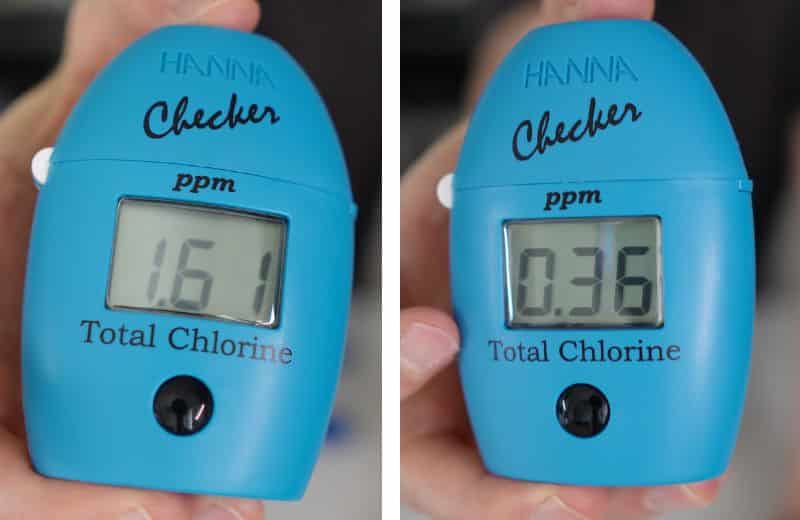
That still leaves quite a bit of chlorine in the filtered water, which you might notice if you’re sensitive to chlorine taste or smell. It’s also the poorest chlorine-removal result we’ve recorded in this cohort of water filter pitchers.
Chlorine is, generally, the minimal expectation for contaminant reduction for any drinking water filter. Interestingly, LifeStraw actually has an NSF/ANSI 42 certification for chlorine taste and odor, but this certification only requires a filter to reduce the influent chlorine concentration by at least 50%.
What Did the LifeStraw Home Pitcher Struggle To Remove?
Some of the contaminants detected in our baseline sample were only reduced slightly, or not removed at all, by the LifeStraw Home pitcher:
- Fluoride concentrations stayed the same, at 1.0 PPM pre- and post-filtration.
- Nitrate also stayed the same at 3.7 PPM.
- Uranium technically increased by 1.97%, from 0.0152 PPM to 0.0155 PPM, within normal analytical variance, simply telling us that no uranium was removed.
- Selenium was reduced by 7.92%, from 0.00543 PPM to 0.005 PPM.
- Total chromium was reduced by just 1.45%, from 0.00413 PPM to 0.00407 PPM.
- Boron was reduced by 3.17%, from 0.378 PPM to 0.366 PPM.
- Sulfate was reduced by 0.48%, from 208 PPM to 207 PPM.
- Vanadium was effectively unchanged, reading 0.0015 PPM before filtration and 0.00154 PPM after filtration (a 2.67% increase that’s within normal analytical variance).
- Molybdenum was reduced by 0.84%, from 0.00119 PPM to 0.00118 PPM.
The smaller reductions of 0–3% likely just point to incidental differences in the contaminant concentrations between the two samples.
To be fair, LifeStraw doesn’t claim fluoride or nitrate reduction, and this is more a limit of filter pitchers than of this one: only 1 of the 7 pitchers in our test group removed fluoride, and none removed nitrate. Uranium is the result that stands out. The other 6 pitchers reduced uranium by 84% to 100%, and the LifeStraw Home didn’t reduce it at all
Why do we think the LifeStraw Home struggled to remove these contaminants? We believe it comes down to the prioritising of the microfiltration cartridge.
The 0.2-micron membrane acts as a physical barrier for microorganisms and particles, but dissolved ions can pass straight through it. The carbon and ion-exchange filter stage is relatively small, and the smaller a filter’s surface area, the fewer the opportunities for contaminant reduction.
So, does LifeStraw have its priorities in the wrong order? In our opinion, yes. The idea of bacteria removal is appealing for obvious reasons (nobody wants to get sick from their water), but unless something has gone wrong, public drinking water supplies aren’t contaminated with microbes anyway. We think a filter that’s designed more in favor of removing common dissolved contaminants like nitrate, metals, and fluoride has more universal appeal.
TDS & Minerals
Nobody buys a water filter pitcher with the intention of removing minerals (in fact, some pitchers are specifically designed to add in minerals that contribute to alkalinity and taste). But mineral reduction is a side effect of many of the ion exchange-using water filter pitchers we’ve tested, which exchange calcium and magnesium (along with certain metal ions) with sodium.
But the LifeStraw Home didn’t add sodium to our water. In fact, sodium actually decreased slightly, from 162 PPM to 159 PPM. This was an unexpected result, since the filter is marketed to use ion exchange media.
In comparison, the Amazon Basics pitcher, which we tested with the same feed water, increased sodium by over 64%, from 162 PPM to 267 PPM. That could be a problem if you’re sensitive to water taste or you’re on a medically advised low-sodium diet.
As for calcium and magnesium, these were retained:
- Calcium dropped by 0.53%, from 94.1 PPM to 93.6 PPM
- Magnesium fell by 29.69%, from 19.2 PPM to 13.5 PPM
Overall hardness dropped by just 7.64%, from 314 PPM to 290 PPM. LifeStraw puts emphasis on the fact that the Essential pitcher retains minerals, and this is consistent with our data.
Plus, TDS doesn’t really change. In our testing, the baseline TDS of 807 PPM dropped by just 3.35%, to 780 PPM. Our on-site field measurement using a TDS meter actually recorded a 1.62% increase, from 679 PPM to 690 PPM.
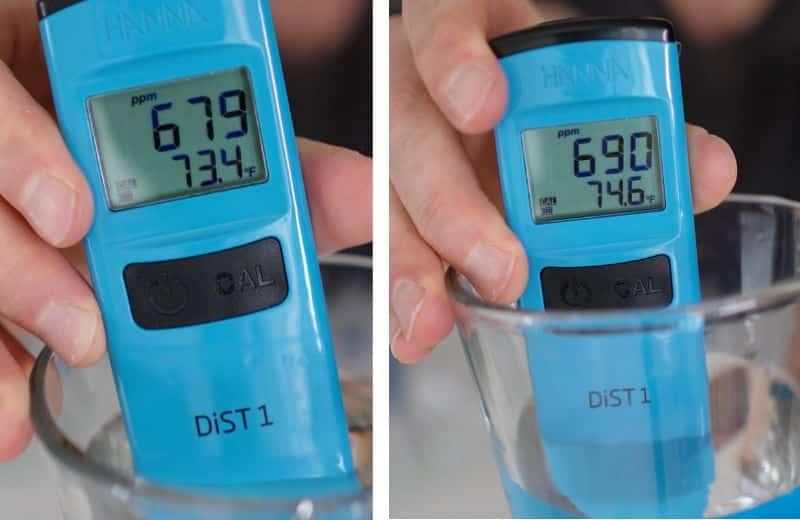
Given that the LifeStraw Home isn’t designed to remove dissolved solids, this isn’t a surprising result. It also doesn’t claim to be a TDS reduction pitcher, so testing your filtered water with a TDS meter isn’t a useful way to judge whether it’s working.
Were There Any Testing Limitations?
It’s worth mentioning our testing limitations when evaluating the LifeStraw Home’s contaminant reduction performance.
First, we tested the filter when it was still relatively fresh, meaning it hadn’t filtered many gallons of water. Since the media was new, we likely obtained better results than if we’d tested the filter near the end of its lifespan, when the media was more depleted.
Second, our Tap Score laboratory tests didn’t evaluate the reduction of microbiological impurities, like bacteria, microplastics, and parasites. This is worth highlighting, since it’s one of LifeStraw’s biggest marketing claims.
We could only test the filter’s ability to address the dissolved contaminants present in our water, like lead, fluoride, and uranium. We could only analyze data from our treated city water, so our scores may have been different if we’d tested the LifeStraw Home with different source water.
Is the LifeStraw Home Pitcher Performance-Certified?
Score: 9.00
Key Finding: The LifeStraw Home is certified for 19 contaminant reduction claims, the most of any pitcher in our test group. Two of its three signature claims are covered: cysts (parasites like Giardia and Cryptosporidium)and microplastics. Its bacteria claim isn’t certified.
We found evidence of WQA certifications to NSF/ANSI Standards 42 (covering aesthetic effects), 53 (for contaminants with potential health effects), and 401 (for emerging contaminants) for the LifeStraw Home pitcher.
It’s certified for 19 of the roughly 30 claimed contaminants on the product listing, or 63.3%. This gives it the best certification coverage of all the water filter pitchers in its test group: the Amazon Basics is certified for 9 contaminants, the Clearly Filtered is certified for 3, the Waterdrop PT-07B is certified for 1, and the Epic Pure XP isn’t certified.
| LifeStraw Home Headline Claim | Certification Status | Standard |
|---|---|---|
| Cysts / parasites | ✅ Certified | NSF/ANSI 53 |
| Microplastics | ✅ Certified | NSF/ANSI 401 |
| Bacteria | ❌ Not certified | No NSF P231 certification found |
But our scores in this category are awarded based on the percentage of the manufacturer’s claims that are supported by certifications. Because around 11 of the contaminants it’s claimed to reduce are not certified, the LifeStraw Home’s score was pulled down to 9.00.
We also want to highlight that only part of the pitcher’s headline claim is certified. The WQA listing includes cyst reduction under NSF/ANSI 53, which covers parasites like Giardia and Cryptosporidium, and microplastics reduction under NSF/ANSI 401. The bacteria claim isn’t certified: we didn’t find any official certifications to NSF P231, the Standard covering microbiological purification. LifeStraw claims to use a “rigorous” and “unparalleled” third-party testing process, but third-party test results don’t hold the same weight as verified certifications.
Our Results Vs the Pitcher’s Contaminant Reduction Claims
Here’s a quick breakdown of how our results compare to the 19 contaminants that the LifeStraw Home is certified to remove:
| Standard | Certified Contaminant | Our Test Result |
|---|---|---|
| NSF/ANSI 42 | Aesthetic Chlorine | 77.64% reduction, 1.61 to 0.36 PPM (on-site test) |
| NSF/ANSI 42 | Nominal particulate Class I | Not included in our lab panel |
| NSF/ANSI 42 | Taste and odor | Not included in our lab panel |
| NSF/ANSI 53 | Cadmium | Not detected in our baseline sample |
| NSF/ANSI 53 | Copper | 68.85% reduction, 0.488 to 0.152 PPM |
| NSF/ANSI 53 | Cyst | Not included in our lab panel |
| NSF/ANSI 53 | Lead | 100% reduction, 0.0044 to 0 PPM |
| NSF/ANSI 53 | Mercury | Not detected in our baseline sample |
| NSF/ANSI 53 | Turbidity | Not included in our lab panel |
| NSF/ANSI 401 | Atenolol | Not included in our lab panel |
| NSF/ANSI 401 | Bisphenol A | Not included in our lab panel |
| NSF/ANSI 401 | Carbamazepine | Not included in our lab panel |
| NSF/ANSI 401 | Estrone | Not included in our lab panel |
| NSF/ANSI 401 | Linuron | Not included in our lab panel |
| NSF/ANSI 401 | Meprobamate | Not included in our lab panel |
| NSF/ANSI 401 | Microplastics | Not included in our lab panel |
| NSF/ANSI 401 | Nonyl phenol | Not included in our lab panel |
| NSF/ANSI 401 | Phenytoin | Not included in our lab panel |
| NSF/ANSI 401 | Trimethoprim | Not included in our lab panel |
Most of the contaminants the pitcher is certified to reduce either weren’t detected in our baseline sample or aren’t covered by our lab panel. That means we can’t draw conclusions from our own testing on the filter’s ability to reduce them.
LifeStraw also markets PFAS reduction, but no PFAS claim appears on the WQA listing, and our lab panel didn’t include PFAS, so we can’t speak to it either way
🚦Filtration Speed
Score: 9.00Key Finding: The LifeStraw Home filtered a full reservoir of water in 8 minutes 4 seconds, equal to a filtration rate of 1.59 GPH. This puts it in the middle of the pack in our recent testing cohort.
We recorded the time it took for the LifeStraw Home pitcher to filter a full 27.29-ounce reservoir of water. The filter managed a time of 8 minutes and 4 seconds, giving it a filtration rate of 1.59 gallons per hour (GPH) at a feed water temperature of 73.3°F.
This puts it 5th among the 7 pitchers in our recent testing cohort. Here’s how the LifeStraw Home compared to the other pitchers in this group:
| Product | Filtration Rate (GPH) |
|---|---|
| Clearly Filtered Pitcher | 0.97 |
| Epic Pure XP | 0.76 |
| Amazon Basics | 1.90 |
| Waterdrop PT-07B | 8.40 |
| LifeStraw Home | 1.59 |
| Aarke | 2.44 |
| Nakii | 4.07 |
The pitcher’s reservoir is relatively small, so you’ll be filtering small batches more frequently rather than waiting longer for a larger reservoir to fill.
Using our gravity pitcher scoring system, a filtration rate of 1.59 GPH falls into the 1.50–1.74 GPH band, resulting in a score of 9.00.
📐 Design and Usability
Score: 9.10Key Finding: The LifeStraw Home had the second-best build quality of our recent water filter pitcher testing cohort, with a 98.9% usable reservoir and a flawless pour test, and it’s certified for materials safety as a component of its performance certifications.
LifeStraw sells the Home pitcher in both plastic and glass options (both use the same filter cartridges). We tested the plastic version, so that’s what we’re scoring in this section. If you want to minimize contact between your filtered water and plastic, the glass version of the pitcher is a great option to consider.
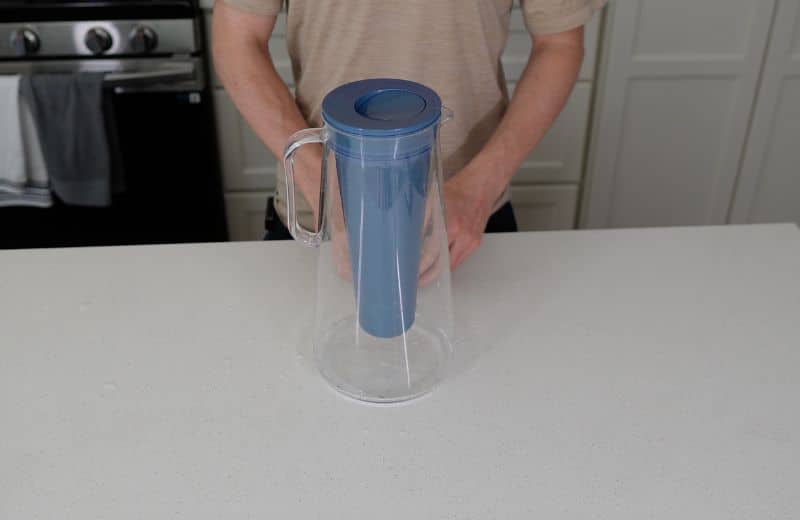
We noted that the LifeStraw Home feels better-made than several of the other pitchers in our test group, earning it a component quality score of 8.50. That’s fourth in the cohort, behind the Aarke (10.00), Clearly Filtered (9.50), and Epic Pure XP (9.50). The plastics feel noticeably sturdier and higher-quality. LifeStraw says the plastic pitchers are made from BPA-free Tritan, while the glass pitchers are made from borosilicate glass with an acrylonitrile-styrene (AS) plastic reservoir. The filter cartridges themselves are made from polypropylene.
The pitcher’s pouring performance was excellent, with the upper reservoir staying securely in place even when it still contained water (we didn’t have this experience with all the pitchers we tested!). We found no unfiltered water bypasses or leaks from the lid or spout. It also passed our dribble test with a top score of 10.00 and can be comfortably poured one-handed.
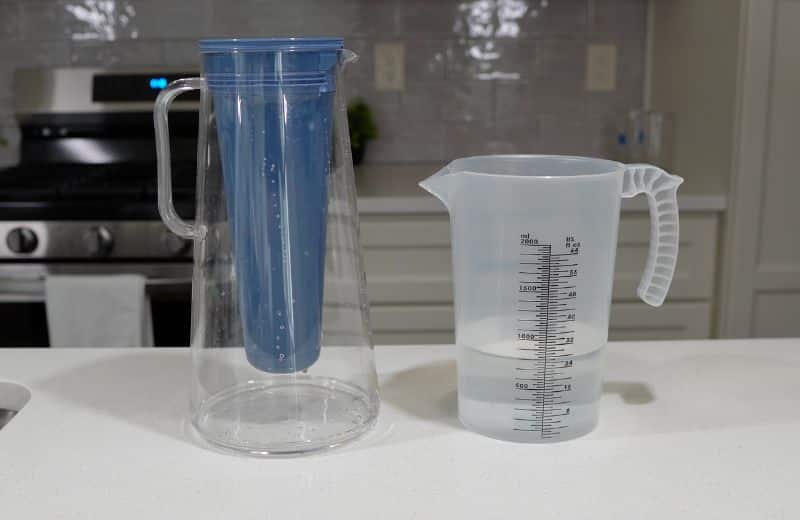
Of the 27.29-ounce reservoir, 27.0 ounces is usable. That means there’s just 0.29 ounces of dead volume, giving the pitcher a 98.9% usable ratio. That’s fifth of the 7 pitchers in our test group, though the spread is small: every pitcher landed between 97.6% and 100%.
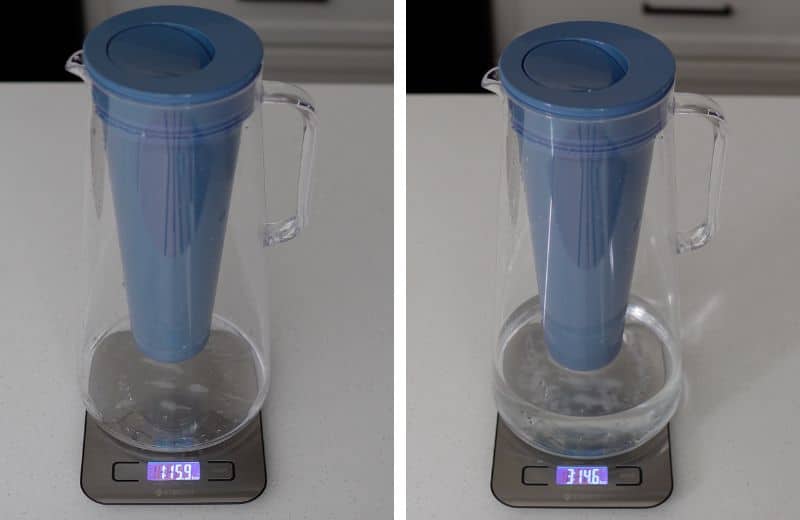
The 10-cup pitcher measures 6 x 6 x 12.5 inches, which should fit a standard fridge door. It weighs 1.99 pounds when it’s empty, and 3.91 pounds when it’s full.
What’s In The Filter?
The filter cartridge in the LifeStraw Home combines two separate filtration stages:
- A 0.2-micron polysulfone hollow-fiber membrane, which provides the microfiltration stage.
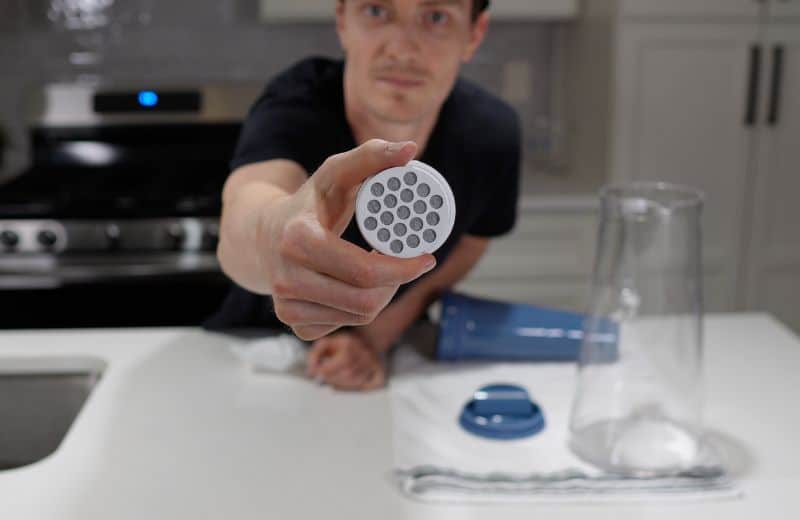
- A separate activated carbon and ion exchange cartridge that addresses dissolved contaminants and taste.
The two components connect using push-pull gaskets, but it’s worth noting that they have separate replacement schedules.
Are There Any Design Setbacks?
There’s one obvious omission that might be a design setback for you: there’s no filter life indicator.
Since there are two filters to replace on separate schedules, it would be particularly useful if you could check each filter lifespan at a glance on the pitcher itself, but instead, you’ll need to keep track of them with your own calendar reminders.
Is the LifeStraw Home Pitcher Design Certified?
The LifeStraw Home pitcher is certified for materials safety as a component of its WQA-awarded performance certifications.
That means the pitcher has been tested and certified to comply with minimum requirements for the safety of its materials, proving that the plastic, carbon, and other physical parts of the pitcher won’t leak toxic chemicals or heavy metals into your drinking water.
⚙️ Setup
Score: 9.50Key Finding: Setup for the LifeStraw Home is an easy job, but you’ll need to wait around 30 minutes for your first drinkable batch of water.
We awarded the LifeStraw Home a score of 9.50 for setup. The process is simple, although with a few more steps than you’ll find with a typical carbon pitcher, involving:
- Rinsing the carbon filter under running water for 1 minute
- Running 1 flush cycle through the membrane on its own
- Installing the carbon filter and running another flush cycle
- Filling the pitcher for the 3rd time (this batch of water is ready to drink)
The main downside to this process is the waiting time. In our testing, it took around 30 minutes for us to get usable water, with most of that time spent waiting for the gravity filtration. That’s longer than the pitchers we tested that had a simple rinse-and-go cartridge, but the process isn’t complicated by any means.
The instructions that came in the box were clear and nicely illustrated, earning a score of 9/10.
🔧 Maintenance and Cost
Score: 9.00Key Finding: At a cost of $0.52 per gallon, or $189.17 per year, the LifeStraw Home is nearly 6x more expensive to run than the Amazon Basics pitcher. Maintenance is simple but more of a hassle than single-cartridge pitchers because you have two separate filters to replace.
How Much Do the Replacement Filters Cost?
The LifeStraw Home is a mid-range pitcher upfront, costing $49.95 at the time of this review. But its maintenance costs are on the higher end, largely due to the fact that there are two separate filters to replace:
- The carbon filter costs $16.95 and is rated for 40 gallons, equal to around 2 months of use.
- The membrane filter costs $24.95 and has a longer filtering capacity of 264 gallons, or around 1 year.
- Together, the blended cost of both filters gives the LifeStraw Home an overall cost-per-gallon of $0.52.
Assuming you filter 1 gallon of water per day, you’ll need around 9.13 carbon filters and 1.38 membrane filters per year. That works out at around $189.17 per year for replacement filters, or $945.86 over a period of 5 years. Actual filter lifespan depends on your water quality and how much water you filter every day.
The LifeStraw Home is the third-most expensive pitcher to run in our test group:
The higher filter replacement cost brought the pitcher’s Costs sub-score down to 8.50. Its Servicing Requirements sub-score was 9.50.
| Product | Purchase Price |
|---|---|
| Clearly Filtered Pitcher | $100.00 |
| Epic Pure XP | $89.00 |
| Amazon Basics | $25.50 |
| Waterdrop PT-07B | $20.00 |
| LifeStraw Home | $49.95 |
| Aarke | $135.00 |
| Nakii | $27.50 |
Is The LifeStraw Home Pitcher Easy to Maintain?
We found replacing the filters in the LifeStraw Home pitcher easy, with no DIY skills or special knowledge required.
That said, you’ll need to keep track of two replacement filter schedules, and with no filter life indicator on the pitcher, you’ll have to keep your own calendar or gallon log.
🏢 Company, Warranty, & Returns
Score: 8.90Key Finding: The LifeStraw Home is backed by a strong 3-year warranty and a decent 45-day returns period, with free shipping on orders over $75.
Does LifeStraw Offer a Warranty?
All LifeStraw Products, including the Home pitcher range, are warranted to be “free from defects in material and workmanship for a period of 3 years.” The warranty excludes LifeStraw’s carbon filters.
To be eligible for a return or refund under the warranty, you’ll need to have used your pitcher in compliance with the user guide, and the warranty doesn’t apply to normal wear and tear or damage due to misuse.
You can read the full warranty terms here.
What Are LifeStraw’s Shipping and Returns Policies?
LifeStraw’s free shipping offering applies to all orders over $75 in the US lower 48. That means you’ll need to pay for shipping on your initial pitcher order and all replacement filter orders. The standard shipping time is 5 to 7 days.
As for returns, if you’re not satisfied with your order, you’ll be able to return it within the 45-day returns period. But there are some stipulations: your item must be unused and in its original condition, you’ll need a valid proof of purchase, and shipping fees are not refundable.
See LifeStraw’s shipping policy and returns policy for more information.
💰 Final Verdict: Does the LifeStraw Home Pitcher Offer Good Value for Money?
The LifeStraw Home has a lot of things going for it: in our testing, it removed 100% lead and total THMs while adding no sodium, and it has been certified to remove 19 contaminants under 3 separate NSF/ANSI Standards. We were pleased with the quality of its design, and the 3-year product warranty is decent.
Ultimately, though, on the back of our comprehensive testing, we’re still a little confused about the pitcher’s performance and marketing. Since it’s designed for home use with treated water, its biggest selling point — bacteria and parasite reduction — is pretty irrelevant, as these contaminants aren’t typically present in treated city water.
Plus, the filter was unable to address fluoride, uranium, or nitrate in our tests, and with two filters to replace, it’s more of a hassle (and more expensive) to maintain than single-cartridge pitchers.
It’s worth reiterating, though, that our scores reflect testing on treated city water only. With the LifeStraw Home’s membrane microfilter designed to target microbiological contaminants that our lab panel doesn’t measure, it might have received a different score if we’d used a different test source water.
We think this pitcher is best suited to you if your priority is microbiological protection, or if you want to filter out contaminants like lead and disinfection byproducts without adding sodium. But if your water contains fluoride, nitrate, uranium, or PFAS, we think you’re better off with a pitcher that’s certified for them, like the Culligan ZeroWater (certified for fluoride, nitrate, and total PFAS, and it removed 100% of the fluoride and uranium in our test), or with a reverse osmosis system, which is also the better route for arsenic.
❔ Frequently Asked Questions
Q: Does the LifeStraw Home pitcher remove lead?
A: Yes, in our lab testing, the LifeStraw Home pitcher did remove lead. Our feed water contained 0.0044 PPM of lead, and the filtered sample contained 0 PPM, a 100% reduction. LifeStraw’s ion-exchange stage targets lead, and the product carries WQA certification to NSF/ANSI 53. Our result is a single fresh-filter measurement at a relatively low starting lead concentration.
Q: Does the LifeStraw Home remove bacteria and viruses?
A: LifeStraw claims the 0.2 micron membrane removes bacteria and parasites (and microplastics), but it doesn’t claim to remove viruses smaller than 0.2 microns. We couldn’t verify any of this — our lab panel measures dissolved chemistry, not microorganisms — and these claims are not part of the pitcher’s third-party certifications, which cover NSF/ANSI 42, 53, and 401.
Q: Does the LifeStraw Home remove fluoride?
A: No, the LifeStraw Home didn’t remove fluoride in our tests. Our baseline sample had 1.0 PPM of fluoride before filtration and 1.0 PPM after 0.00% reduction. Neither a 0.2 micron membrane nor a small carbon/ion-exchange cartridge is a fluoride removal technology. For this, you need reverse osmosis, activated alumina, or bone char.
Q: Does the LifeStraw Home add sodium or soften water?
A: No, the LifeStraw Home didn’t add sodium or soften our water. Our test data showed that sodium went from 162 PPM to 159 PPM — effectively unchanged — which makes it one of the only pitchers in our test group that’s safe to recommend on a sodium-restricted diet. It aso barely softens water: hardness fell only 7.64% (from 314 to 290 PPM), because LifeStraw deliberately retains calcium and magnesium.
Q: Why didn’t my TDS meter change after filtering?
A: A TDS meter won’t show much difference before and after filtering in the LifeStraw Home because this pitcher doesn’t remove dissolved solids, and doesn’t claim to. Our lab measured TDS at 807 PPM before and 780 PPM after filtration (-3.35%); our field meter actually read slightly higher TDS post-filtration. The membrane catches particles and microorganisms, not dissolved ions. A TDS meter tells you nothing useful about whether this pitcher is working.
Q: How often do you need to change the LifeStraw Home filters?
A: The LifeStraw Home pitcher has two filters on two schedules, so how often you should replace them differs. The carbon/ion-exchange cartridge is rated 40 gallons or about 2 months ($16.95), while the membrane filter is rated 264 gallons or about a year ($24.95). At one gallon per day, that’s roughly 9 carbon filter changes and 1–2 membrane filter changes a year, about $189.17 annually. There’s no filter-life indicator, so you’ll need to track both schedules yourself. Keep in mind that actual filter lifespan depends on your water quality and how much water you filter every day.
Found this review helpful?
Comment below or share this article!