

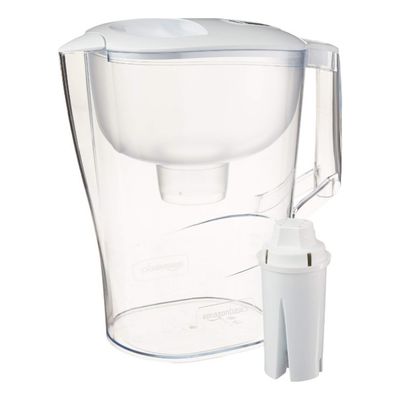
The Amazon Basics Water Filter Pitcher is an affordable, certified water filtration pitcher that might not seem anything special but performed surprisingly well in our testing, exceeding our (admittedly fairly low) expectations.
In this review, we’re discussing our subjective and objective test data across several performance categories, including contaminant removal, filtration speed, upfront and ongoing costs, setup and maintenance requirements, and more. Overall, it scored 8.79 out of 10.
What We Like
What We Don’t Like
| Price | $25.50 |
| Contaminants Reduced | 9 (manufacturer claim) |
| Certifications | NSF/ANSI 42, 53, 401 & 372 |
| Process | Activated Carbon + Ion Exchange |
| Filter Capacity | 40 gallons/cartridge |
| Annual Cost | ~$31.94 |
| Warranty | 1 year limited warranty |
Quick Verdict: Is the Amazon Basics Water Filter Pitcher Worth It?
The Amazon Basics Water Filter Pitcher scored 8.79 out of 10 in our testing, the third-highest score of the 15 water filter pitchers we’ve tested, and it’s the Best Budget pick in our guide to the best water filter pitchers. In our Tap Score lab test, it removed 100% of detected lead, from 0.0044 PPM down to 0, and 100% of total THMs, from 8.08 PPB to 0, and all 9 of its contaminant reduction claims are WQA certified. It’s not the most capable pitcher we’ve tested, but if you simply want inexpensive, certified filtration and reliable everyday use, it’s among the products we’d recommend.
The pitcher received particularly high scores for its ongoing cost (10.00), certifications (10.00), and maintenance (9.75). Its lab test results had more room for improvement, with a lab sub-score of 8.19, which brings Contaminant Reduction to 8.37 once certifications are factored in. It substantially reduced copper (99.02%), uranium (96.04%), and hardness (96.66%), but it didn’t reduce fluoride or nitrate, and sodium rose from 162 PPM to 267 PPM.
The pitcher’s biggest strength is that its marketing is actually honest (you’d think that should be the standard for all manufacturers, but no). Rather than making an enormous list of unsupported promises, it claims to remove just a small handful of contaminants, and every claim is backed by certifications. The filter cartridge is also compatible with Brita pitchers, so if you want to upgrade the filter itself without having to buy a new pitcher, you could do so.
Buy it if: You want inexpensive filtered water at $0.09 per gallon, you’re specifically looking for a filter with certified contaminant reduction claims, and your main water quality concerns are chlorine taste, copper, and disinfection byproducts.
Skip it if: You want fluoride or nitrate reduction (the pitcher didn’t meaningfully reduce either in our tests), you need PFAS or arsenic reduction (it isn’t certified for either, and neither appears in our lab results), or you’re on a sodium-restricted diet, as the filter added around 105 PPM of sodium to our test water.
Methodology: We test all water filter pitchers using a weighted scoring system that covers 6 key categories. Contaminant reduction accounts for the largest portion (55%) of the overall score, but filtration rate, design, setup, maintenance, and company policies also make up the weighting. You can read about the full process in our water filter testing methodology.
📊 Scoring Data
At Water Filter Guru, we use data from our hands-on testing and subjective analysis to evaluate every water filter we review.
We’ve established a detailed scoring system, which weighs multiple performance factors to give a balanced overall rating. With this data, we can easily compare all the similar water filters we’ve tested, giving us a fair side-by-side comparison.
The table below shows how the Amazon Basics Water Filter Pitcher scored in each category. You can compare it with the other water filter pitchers we’ve put through the same testing process.
| Criteria | Results |
|---|---|
| Overall Score | 8.79 |
| Health Related Contaminants | 8.10 |
| Aesthetic Related Contaminants | 9.90 |
| Performance Certification | NSF/ANSI 42, 53, 401 |
| Filtration Rate | 1.9 GPH |
| Component Quality | Fair |
| Component Certification | NSF/ANSI 372 & CSA B483.1 |
| Setup | Outstanding |
| Servicing Requirements | Outstanding |
| Costs | $0.09/ gallon |
| Warranty Length | 1 year limited warranty |
| Shipping | -Free next day shipping for prime members -Free shipping with minimal order threshold for non prime members |
| Returns | 30 days |
🚱 How Well Does the Amazon Basics Water Filter Pitcher Remove Contaminants?
Score: 8.37Key Finding: The Amazon Basics pitcher removed 100% of the lead (0.0044 PPM) and 100% of the total THMs (8.08 PPB) in our feed water, neither of which is among its 9 certified claims, but it increased sodium from 162 PPM to 267 PPM and didn’t reduce fluoride (1.0 PPM before filtration, 1.2 PPM after). Silver also appeared post-filtration at 0.00174 PPM, below the Health Guideline Level of 0.009 PPM.
What Was Our Test Water Quality Like?
Our test water is considerably harder, higher in TDS, and more mineral-heavy than typical municipal water, so we were able to evaluate the Amazon Basics pitcher’s performance when put to the test with a more challenging water source.
The baseline TDS reading was 807 PPM, with 314 PPM hardness and 370 PPM alkalinity.
There were a number of contaminants exceeding the Health Guideline Level that were detected in our Tap Score report:
- 0.0044 PPM lead (exceeding the HGL of 0)
- 1 PPM fluoride (exceeding the HGL of 0.799 PPM)
- 0.0152 PPM uranium (exceeding the HGL of 0)
- 3.93 PPB bromoform (exceeding the HGL of 0)
- 4.15 PPB dibromochloromethane (exceeding the HGL of 0.1 PPB)
- 0.488 PPM copper (exceeding the HGL of 0.3 PPM)
Our test also detected several contaminants in levels not exceeding the HGL, including boron, barium, chlorine, nitrate, strontium, total chromium, sulfate, vanadium, selenium, nickel, manganese, and molybdenum.
| Analyte | Unit | Baseline | Post-Filtration | % Change |
|---|---|---|---|---|
| Alkalinity (as CaCO3) | PPM | 370 | 257 | -30.54% |
| Barium | PPM | 0.0311 | 0.001 | -96.78% |
| Bicarbonate | PPM | 447 | 313 | -29.98% |
| Boron | PPM | 0.378 | 0.241 | -36.24% |
| Bromoform | PPB | 3.93 | 0 | -100.00% |
| Calcium | PPM | 94.1 | 2.74 | -97.09% |
| Carbonate | PPM | 2.06 | 0.182 | -91.17% |
| Chloride | PPM | 113 | 112 | -0.88% |
| Chloride-to-Sulfate Mass Ratio | 0.543 | 0.596 | 9.76% | |
| Chromium (Total) | PPM | 0.00413 | 0.00329 | -20.34% |
| Copper | PPM | 0.488 | 0.00476 | -99.02% |
| Dibromochloromethane | PPB | 4.15 | 0 | -100.00% |
| Expanded Hardness | PPM | 316 | 10.5 | -96.68% |
| Fluoride | PPM | 1 | 1.2 | 20.00% |
| Grains per gallon | Grains | 18.3 | 0.612 | -96.66% |
| Hardness | PPM | 314 | 10.5 | -96.66% |
| Langelier Saturation Index | 0.864 | -1.73 | -300.23% | |
| Lead | PPM | 0.0044 | 0 | -100.00% |
| Magnesium | PPM | 19.2 | 0.884 | -95.40% |
| Manganese | PPM | 0.00136 | 0.00139 | 2.21% |
| Molybdenum | PPM | 0.00119 | 0.00104 | -12.61% |
| Nickel | PPM | 0.00106 | 0 | -100.00% |
| Nitrate (as N) | PPM | 3.7 | 3.5 | -5.41% |
| pH | pH | 8 | 7.1 | -11.25% |
| Potassium | PPM | 3.65 | 4.37 | 19.73% |
| Selenium | PPM | 0.00543 | 0.00409 | -24.68% |
| Silver | PPM | 0 | 0.00174 | Not detected in baseline |
| Sodium | PPM | 162 | 267 | 64.81% |
| Sodium Adsorption Ratio | 3.97 | 35.8 | 801.76% | |
| Specific Conductivity | umhos/cm | 1390 | 1240 | -10.79% |
| Strontium | PPM | 0.969 | 0.028 | -97.11% |
| Sulfate | PPM | 208 | 188 | -9.62% |
| Total Dissolved Solids | PPM | 807 | 725 | -10.16% |
| Total THMs | PPB | 8.08 | 0 | -100.00% |
| Uranium | PPM | 0.0152 | 0.000602 | -96.04% |
| Vanadium | PPM | 0.0015 | 0.00113 | -24.67% |
Which Contaminants Did The Amazon Basics Pitcher Remove?
Lead
In our testing, the Amazon Basics pitcher performed particularly well at removing lead. Our feed water contained 0.0044 PPM of lead, exceeding the Health Guideline Level of 0.
After filtration, the Tap Score lab test didn’t detect any lead at all, representing a 100% reduction. We were positively surprised by this result, since lead isn’t listed as one of the contaminants that this pitcher can remove, and it’s not certified to remove lead, either.
Total THMs
Our feed water initially contained 8.08 PPB of total trihalomethanes, a group of disinfection byproducts that are commonly found in chlorinated tap water. Specifically, two total THMs were detected: 3.93 PPB bromoform, and 4.15 PPB dibromochloromethane.
Post-filtration, both THM compounds had been completely eliminated to undetectable levels.
Fluoride & Nitrate
Fluoride was initially detected in concentrations of around 1.0 PPM, while nitrate had a reading of 3.7 PPM.
The Amazon Basics performed less impressively here: fluoride actually increased by 20%, to 1.2 PPM, and nitrate was reduced by just 5.41%, to 3.5 PPM.
The 0.2 PPM increase in fluoride falls within normal analytical variation, so we wouldn’t interpret this as the filter actually adding fluoride. It just tells us that the filter is unable to address fluoride at all.
Uranium
Uranium was greatly reduced by 96.04%, from 0.0152 PPM to 0.000602 PPM.
Again, uranium isn’t listed as a contaminant that the pitcher can remove, nor is it certified for uranium reduction.
Copper & Chlorine
Copper is listed on the Amazon Basics product page, and it’s one of the contaminants that the filter has been WQA certified to remove.
In our tests, the filter reduced copper by 99.02% (very close to a complete elimination), from 0.488 PPM to 0.00476 PPM.
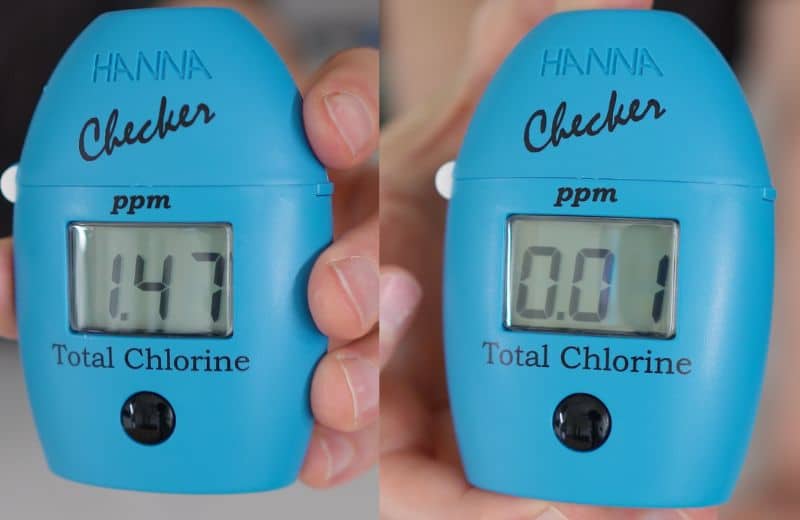
Chlorine is another contaminant that’s highlighted on the product listing for certified removal. In our on-site chlorine testing, our feedwater sample contained 1.47 PPM of free chlorine, and this was reduced to just 0.01 PPM post-filtration: a 99.3% reduction.
Barium, Strontium, & Nickel
The Amazon Basics pitcher also did an excellent job of removing barium, strontium, and nickel from our water. None of these contaminants is specifically mentioned in the pitcher’s listing.
Barium was reduced from 0.0311 PPM to 0.001 PPM: a 96.78% reduction. Strontium was reduced from 0.969 PPM to 0.028 PPM: a 97.11% reduction. And nickel was completely eliminated, from 0.00106 PPM to 0.
What Did the Amazon Basics Pitcher Struggle To Remove?
Some of the contaminants detected in our baseline sample were only reduced slightly by the Amazon Basics Pitcher.
- Boron was reduced by 36.24%, from 0.378 PPM to 0.241 PPM
- Selenium was reduced by 24.68%, from 0.00543 PPM to 0.00409 PPM
- Vanadium was reduced by 24.67%, from 0.0015 PPM to 0.00113 PPM
- Total chromium was reduced by 20.34%, from 0.00413 PPM to 0.00329 PPM
- Molybdenum was reduced by 12.61%, from 0.00119 PPM to 0.00104 PPM
- Sulfate was reduced by 9.62%, from 208 PPM to 188 PPM
None of these contaminants are claimed to be removed by the pitcher, but we thought the results were still worth highlighting.
Were There Any Anomalies?
There were several anomalies that we noted in our Amazon Basics filtered water test data.
First, silver actually appeared post-filtration, when it hadn’t been present in our baseline sample. The post-filtration concentration of 0.00174 PPM was below the Health Guideline Level of 0.009 PPM, so it doesn’t raise a health concern based on our tests.
The manufacturer doesn’t claim that the filter uses silver, but it’s often found in water pitcher filters because it has bacteriostatic properties, meaning it prevents the growth of bacteria inside the filter media.
Another anomaly we noted was a slight increase in manganese, from 0.00136 PPM to 0.00139 PPM (a 2.21% increase). Since this isn’t a meaningful change, it just tells us that the filter can’t remove this contaminant.
We also saw a substantial change in the corrosivity characteristics of our water. The Langelier Saturation Index (which measures the balance of calcium carbonate to predict whether the water will form scale or cause corrosion) moved from +0.864 to -1.73. Plus, pH fell from 8.0 (slightly alkaline) to 7.1 (neutral), or 7.8 (slightly alkaline) to 6.7 (slightly acidic) in our on-site tests.
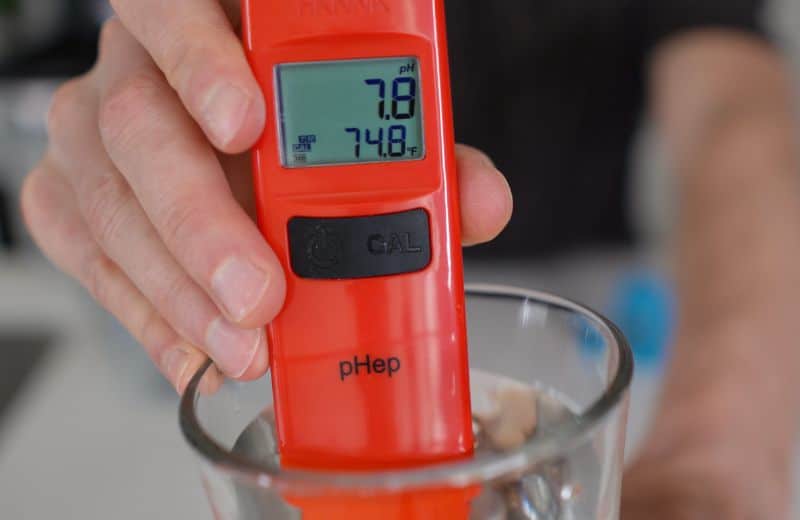
Since the Amazon Basics pitcher is a standalone filter that’s not connected to your plumbing, the slightly corrosive filtered water isn’t a cause for concern.
Other Results Worth Mentioning
TDS & Hardness
We want to mention TDS and hardness in our evaluation, since the results might not be what you would expect to see.
The TDS reading of our water dropped by just 10.16%, from 807 PPM to 725 PPM. Hardness, in comparison, dropped much more significantly, by 96.66%. The baseline reading of 314 PPM dropped right down to 10.5 PPM.
It’s worth noting that these two results are telling us different things. Hardness mainly reflects calcium, magnesium, and similar minerals. The Amazon Basics pitcher’s ion exchange resin effectively reduced these minerals: calcium dropped by 97.09%, and magnesium by 95.40%.
But the resin replaces these minerals with sodium, which is another dissolved solid. So, while it removes a large amount of calcium and magnesium, it simultaneously adds sodium to the water.
It’s essentially swapping one set of dissolved ions for another, which softens the water* without having much of an effect on TDS.
TDS can be a confusing subject, but the important thing to understand is that a water filter that effectively removes specific contaminants, like the Amazon Basics pitcher, typically won’t reduce TDS. Total dissolved solids reduction is more common with purification systems, like RO filters, which greatly reduce or remove everything from water, not just specific target contaminants.
Our Testing Limitations
Our results come from a single-point test, using the Amazon Basics pitcher filter while it was still fresh (meaning it hadn’t filtered many gallons of water at the time of testing).
It’s normal for filtration capacity to decline over time as the filter cartridge is used. Because our testing was carried out while the filter was still relatively new, our data represents the best-case numbers for a new cartridge. We can’t guarantee that the filter will deliver exactly the same contaminant reductions throughout its 40-gallon rated lifespan.
✅ Is the Amazon Basics Pitcher Performance-Certified?
Score: 10.00Key Finding: The Amazon Basics pitcher is certified for 100% of the 9 contaminants it’s claimed to reduce. It’s the only water filter pitcher in this test cohort that backs every single contaminant reduction claim with an official certification.
The Amazon Basics pitcher has a WQA Gold Seal certification to NSF/ANSI Standards 42 (covering aesthetic effects), 53 (for contaminants with potential health effects), and 401 (for certain emerging contaminants). The only contaminants listed on the product page are those that are certified, meaning that no claims are unverified.
In comparison, the Clearly Filtered pitcher has fewer than 1% of its 365+ claims certified, the Waterdrop PT-07B has 2 out of 9, and the Epic Pure XP has no certified contaminant reduction claims.
That gives this Amazon pitcher an obvious advantage: all the claims it makes are actually backed by third-party certification. That means you’re not being asked to take an enormous list of unsupported removal claims on trust.
Our Results Vs the Pitcher’s Contaminant Reduction Claims
Here’s a quick breakdown of how our results compare to the 9 contaminants listed on the Amazon Basics product page:
| Certified Contaminant | Our Test Result |
|---|---|
| Chlorine taste & odor | 99.3% reduction to 0.01 PPM |
| Zinc | Not detected in our baseline sample |
| Copper | 99.02% reduction to 0.00476 PPM |
| Cadmium | Not detected in our baseline sample |
| Mercury | Not detected in our baseline sample |
| Benzene | Not detected in our baseline sample |
| Atenolol | Not tested in our baseline sample |
| Linuron | Not tested in our baseline sample |
| Trimethoprim | Not tested in our baseline sample |
You can see from this table that 4 of the 9 contaminants that the Amazon Basics pitcher is certified to remove weren’t present in our baseline sample, and 3 weren’t part of our lab test. That means we can’t draw conclusions from our own testing on the filter’s ability to remove these contaminants.
We do think the Amazon Basics pitcher’s certified contaminant list is a little random. Benzene is a volatile organic compound, Atenolol is a medication, Linuron is a pesticide, and Trimethoprim is an antibiotic.
Of course, nobody wants these contaminants in their water, but it’s unclear why Amazon has specifically singled them out and obtained certifications for their removal, especially when there are many more contaminants that are much more commonly found in drinking water.
🚦Filtration Speed
Score: 9.50Key Finding: The Amazon Basics pitcher filtered 40 ounces of water in 9 minutes and 51 seconds, equal to a flow rate of 1.90 GPH, making it roughly 2.5x faster than the Epic Pure XP.
We timed the process of filtering a full 40-ounce reservoir to see how the pitcher’s flow rate compared with similar models we’ve tested.
It took 9 minutes and 51 seconds to filter a full batch of water, at a feed water temperature of 73.3°F. That translates to a filtration rate of 1.90 gallons per hour (GPH).
That means it’s not the fastest pitcher we’ve tested, but it’s still perfectly usable for gravity filtration. Of the 7 filter pitchers we tested in this cohort, the Amazon Basics ranked fourth, and it ranks ninth of the 14 pitchers in the table below.
| Product | Filtration Rate (GPH) |
|---|---|
| Waterdrop PT-07B | 8.40 |
| Nakii | 4.07 |
| Waterdrop Chubby | 3.52 |
| Brita Elite | 2.92 |
| Pur PLUS | 2.82 |
| ZeroWater (legacy) | 2.62 |
| Aarke | 2.44 |
| Epic Pure (legacy) | 2.23 |
| Amazon Basics | 1.90 |
| LifeStraw Home | 1.59 |
| Santevia MINA | 1.43 |
| Clearly Filtered | 0.97 |
| Epic Pure XP | 0.76 |
| Larq Purevis | 0.60 |
If you’re a smaller one- or two-person household, the Amazon Basics pitcher should be able to keep up with normal drinking water demand.
Remember, with any water filter, it’s not a case of “the faster the filtration, the better”. Our score of 9.50 reflects the filtration speed, but actually, the longer the contact time between the water and the filter media, the more thoroughly contaminants can be reduced. So, while you don’t want to be waiting hours to access filtered water, your goal shouldn’t be to find the fastest-filtering pitcher, either.
📐 Design and Usability
Score: 8.80Key Finding: The Amazon Basics is the only one of the seven pitchers in this round of testing with 100% usable reservoir volume, outperforming pitchers that cost three or four times as much.
The Amazon Basics pitcher might not be fancy, but its simple design proves that performance is more important than appearance or techy features. It has 40 ounces of usable filtered water and no dead reservoir volume, which means it has a 100% usable ratio. It’s the only pitcher in our test group where every ounce of the stated reservoir capacity was usable.
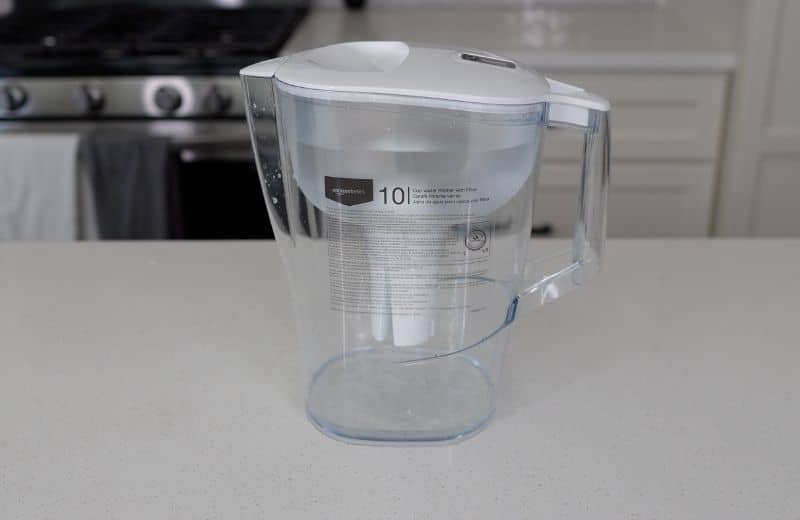
This pitcher also had the best pour behavior of our testing group. The upper reservoir stayed securely in place even when it still contained water, and there was no unfiltered water bypass (an issue we noted with other pitchers in this group: the Waterdrop PT-07B’s upper reservoir can dislodge and spill when there’s still water in it, and the considerably more expensive Epic Pure XP allowed unfiltered water from the upper reservoir to drain into the spout).
We awarded the pitcher a score of 10.00 for its dribble and spill performance, as it poured cleanly into the cup every time. We also found it easy to pour one-handed.
In terms of design quality, the body and lid are made from BPA-free plastic, although the exact type of plastic used isn’t mentioned in the listing or user manual. The lid has a built-in electronic filter change reminder, along with Secure Lid technology that helps prevent leaks and a nice little handle that makes it easy to pull off.
We noted that the plastic feels cheaper and flimsier than others in this testing group. It works perfectly fine, but it doesn’t feel premium.
The pitcher measures 9.75 x 5.75 x 10 inches, so it’s nice and compact, and should fit in most refrigerator doors. It weighs 1.63 pounds empty and 4.26 pounds when it’s full.
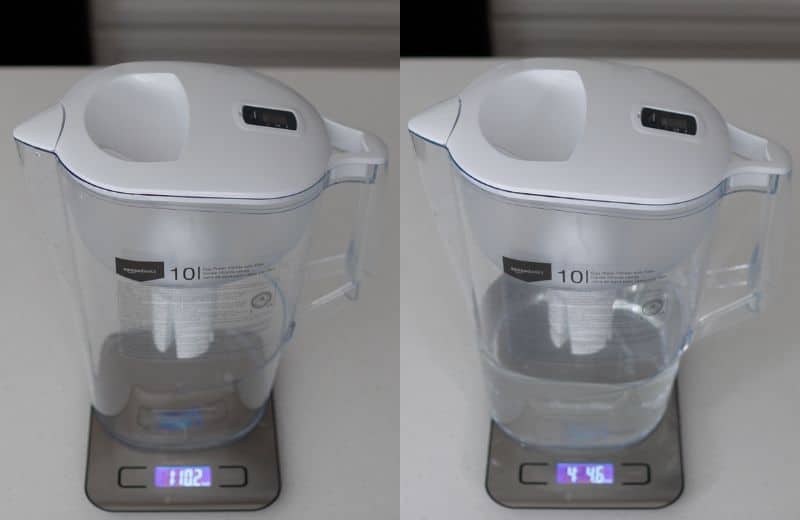
Ultimately, it’s very much a copy (some would even say knockoff) of Brita, which isn’t necessarily a bad thing the price is fair and our performance testing yielded good results.
Is the Amazon Basics Pitcher Design Certified?
The Amazon Basics pitcher has obtained a WQA certification to NSF/ANSI Standard 372 for lead-free design and to CSA B483.1.
That means the pitcher has been tested and certified to comply with minimum requirements for the evaluation of lead content in drinking water products, materials, and components based on the existing laws, regulations, and restrictions for lead content.
⚙️ Setup
Score: 9.50Key Finding: Setup took us a few minutes of hands-on work and about 20 minutes in total to reach usable filtered water. There’s no long pre-soak, just a quick submerge, a shake to release air bubbles, and two discarded batches. The pitcher uses the Brita Standard cartridge format, so compatible Brita Standard filters fit it too.
The process of assembling and preparing this Amazon pitcher for use is simple, taking us just a few minutes. We followed the instructions in the user manual to rinse the filter, shake it to release air bubbles, and fit it inside the pitcher.
We then filled and discarded the first 2 batches of water before use. We then allowed about 20 minutes to get to usable filtered water once we’d done this.
If you currently own a Brita pitcher but want to switch to the Amazon Basics pitcher, it’s worth knowing that the Brita filters will fit in the Amazon Basics cartridge slot. So, if you have any spare Brita replacement filters that you want to use or you just want to buy replacement Brita filters, you can do so.
And vice versa: the Amazon Basics filter cartridges will fit in the Brita Standard-format pitchers.
🔧 Maintenance and Cost
Score: 9.75Key Finding: At a cost of $0.09 per gallon and $31.94 per year, the Amazon Basics pitcher is more than 6x cheaper to run than the Clearly Filtered ($0.55) and Epic Pure XP ($0.59). It’s also quick and easy to maintain thanks to its easy-replace cartridge and filter change timer.
How Much Do the Replacement Filters Cost?
The Amazon Basics pitcher is cheap to buy and cheap to keep running. Upfront, the pitcher costs $25.50, and replacement cartridges are just $3.50 each. With a filter lifespan of 40 gallons, that puts the running cost at $0.09 per gallon.
Using our standard assumption of 1 gallon per day, we calculated that one cartridge lasts around 1.3 months. That means you’ll need 9–10 cartridges per year, which equates to an estimated annual filter cost of $31.94. Over five years, that’s $159.69 spent on replacement filters.
Here’s how the Amazon Basics pitcher’s purchase price compares to the other pitchers we tested in this group:
| Product | Purchase Price | Cost per Gallon | 5-Year Filter Cost |
|---|---|---|---|
| Clearly Filtered Pitcher | $100.00 | $0.55 | $1,003.75 |
| Epic Pure XP | $89.00 | $0.59 | $1,076.75 |
| Amazon Basics | $25.50 | $0.09 | $159.69 |
| Waterdrop PT-07B | $20.00 | $0.05 | $88.97 |
| LifeStraw Home | $49.95 | $0.52 | $945.82 |
| Aarke | $135.00 | $0.32 | $575.71 |
| Nakii | $27.50 | $0.06 | $101.35 |
The Amazon Basics is one of the cheapest pitchers in this group to buy, and one of the cheapest to run at $0.09 per gallon, although the Waterdrop PT-07B ($0.05 per gallon) and Nakii cost less in filters over 5 years.
The pitcher is also cheaper than the technology it’s based on. We used the same calculations to work out a cost-per-gallon for the Brita Standard filter, arriving at a higher ongoing spend of $0.20 per gallon (versus the Amazon Basics filter’s $0.09 per gallon). That makes it roughly 56% cheaper for essentially the same filtration technology.
| Cost Metric | Amazon Basics |
|---|---|
| Pitcher price | $25.50 |
| Replacement filter | $3.50 |
| Filter capacity | 40 gallons |
| Cost per gallon | $0.09 |
| Estimated filters/year | 9.1 |
| Estimated annual filter cost | $31.94 |
| Estimated 5-year filter cost | $159.69 |
Is The Amazon Basics Pitcher Easy to Maintain?
We found the Amazon Basics pitcher easy to maintain. Replacing the filter follows the same steps as installing the initial filter, including quickly submerging the filter, shaking it to release air bubbles, and filtering and discarding two batches of water.
While this process is simple enough, it’s worth knowing that you’ll be changing filters pretty often. Assuming you filter around 1 gallon of water per day, our 9.1 cartridge changes per year estimate gives the Amazon Basics one of the highest filter replacement frequencies in its test group.
The electronic MEMO indicator in the lid is beneficial in reminding you when a new filter is needed, although we’d still use actual daily water consumption as a more useful guide instead.
🏢 Company, Warranty, & Returns
Score: 8.65Key Finding: The Amazon Basics pitcher has a 1-year limited warranty, but its low price comes without the specialist water treatment support offered by some dedicated filtration brands.
Does Amazon Offer a Warranty?
Amazon offers a 1-year limited warranty for the Amazon Basics pitcher. The warranty will only apply if you use the pitcher as intended, without subjecting it to “accident, misuse, neglect, fire or damage from other external causes, alteration, repair, or commercial use”.
You can make a warranty claim by contacting the Amazon Customer Service team. If your claim is accepted, you’ll either receive a replacement product or a full refund.
View Amazon’s warranty and terms here.
What Are Amazon’s Shipping and Returns Policies?
Amazon’s shipping offering depends on whether or not you’re an Amazon Prime member.
If you’re a Prime member, you’ll receive free next-day shipping. If you’re a non-Prime member, you’ll only get free shipping if your purchase meets the minimum order threshold. Otherwise, you’ll pay a fee that’s based on the type of shipping you select and where you’re located.
You can find more information about Amazon’s shipping rates and policies here.
Because the pitcher is fulfilled by Amazon, you get the standard Amazon returns process: new, unopened items sold and fulfilled by Amazon can be returned within 30 days of delivery for a full refund.
This isn’t the same as some of the dedicated money-back guarantees we’ve seen offered by some other brands, which allow you to try their product and decide if you want to keep it within the returns period. You can only return an unused pitcher.
To expand on that point, this is one of the limitations of buying from Amazon in general. There’s no dedicated consumer-facing water treatment brand behind the product offering personalised service on water quality and any issues you might face. But for the price you pay, that’s understandable.
💰 Final Verdict: Does the Amazon Basics Pitcher Offer Good Value for Money?
The Amazon Basics pitcher is one of the lowest-cost water filter pitchers we’ve reviewed. While that doesn’t automatically make it good value for money, its performance in our testing (including its significant reduction or removal of chlorine, lead, copper, and disinfection byproducts), along with its certifications for all contaminants listed on the product page, does.
We think you’ll appreciate this pitcher if you want straightforward filtration without paying for a long list of contaminant reduction capabilities that you might not need. Not sure what you do need? Start by testing your water. It’ll tell you which contaminants are an issue in your water supply, so you can decide what you want to remove.
If you need a filter for fluoride or nitrate, which this pitcher didn’t reduce in our tests, or for arsenic or PFAS, which it isn’t certified for, we’d skip the budget pitcher category altogether and look at reverse osmosis instead.
❔ Frequently Asked Questions
Q: Does the Amazon Basics pitcher filter remove lead?
A: The Amazon Basics pitcher isn’t marketed for lead removal, but in our lab testing, the pitcher reduced 100% of lead, from an initial baseline reading of 0.0044 PPM to non-detectable concentrations. The pitcher is certified to NSF/ANSI 372 for lead-free materials, but this is specifically for its design, not for lead reduction. We should also add a disclaimer for our results: the initial lead concentrations in our water were low, and we tested the filter while it was still fairly fresh (meaning the media was still new and not depleted).
Q: Are Amazon Basics filters the same as Brita filters?
A: The Amazon Basics filters and Brita filters use the same cartridge format. The Amazon Basics cartridge is Brita Standard compatible, so it fits Brita Standard-format pitchers, and Brita Standard cartridges fit the Amazon Basics pitcher. Both filters use multi-stage activated carbon plus ion exchange resin with a 40-gallon rated capacity. The main difference is price: Amazon Basics has a cost per gallon of $0.09 versus $0.20 for the Brita Standard or $0.17 for the Brita Elite (yes, the Brita Elite is cheaper per gallon than the Brita Standard thanks to its higher 120-gallon rated capacity).
Q: Does the Amazon Basics pitcher remove fluoride?
A: No, the Amazon Basics pitcher doesn’t appear to remove fluoride according to our own testing for this contaminant. Our lab results showed fluoride concentrations of 1.0 PPM before filtration and 1.2 PPM after, so there was no reduction at all. Importantly, though, Amazon doesn’t claim that the pitcher removes fluoride, and the activated carbon with cation exchange resin used in the cartridge isn’t a fluoride removal technology. For fluoride, you need reverse osmosis, activated alumina, or bone char.
Q: Why did my TDS meter barely change after filtering with the Amazon Basics pitcher?
A: You won’t notice a significant reduction in TDS after filtering with the Amazon Basics pitcher because its ion exchange filter swaps ions rather than removing them. Our test results showed that hardness dropped by 96.66%, from 314 PPM to 10.5 PPM, while total dissolved solids fell by only 10.16%, from 807 PPM to 725 PPM. The reason is sodium: it increased from 162 PPM to 267 PPM as the resin released sodium in exchange for calcium and magnesium. A TDS meter can’t tell you what those dissolved solids are, so it’s the wrong tool for judging a filter’s contaminant reduction performance.
Q: Does the Amazon Basics pitcher add sodium to water?
A: Yes, the Amazon Basics pitcher does add sodium to water, and quite a lot of it at that. In our testing, sodium increased by 64.81%, from 162 PPM to 267 PPM. That works out to roughly 63 mg of sodium in an 8 oz glass compared to roughly 38 mg straight from the tap. Because of this result, if you’re on a sodium-restricted diet, we’d advise against this pitcher. It’s worth noting, though, that our feed water was unusually hard at 314 PPM, so softer source water will produce a smaller sodium increase (because fewer sodium ions are used to replace fewer hardness ions).
Q: How often do you need to change the Amazon Basics filter?
A: The filter cartridge in the Amazon Basics pitcher is rated for 40 gallons, which Amazon puts at about two months. At our testing assumption of one gallon per day, that’s 40 days, or just under six weeks (9.1 cartridges per year). Actual filter life depends on your water quality and usage. With replacement filters costing $3.50 each, that’s a cost of $31.94 annually. The pitcher includes an electronic MEMO reminder in the lid, but we recommend tracking your actual gallons of water use rather than relying entirely on the timer.
Q: Amazon Basics vs Brita Elite: which water filter pitcher is better?
A: The Amazon Basics pitcher scored higher in our testing: 8.79 out of 10 overall versus 6.59 for the Brita Elite. It also scored higher for contaminant reduction (8.37 versus 4.29) and costs less to run ($0.09 per gallon versus $0.17). The Brita Elite has two advantages: its filter is rated for 120 gallons rather than 40, so you’ll change it about three times a year instead of nine, and it filtered faster in our testing (2.92 GPH versus 1.90 GPH). You can read our full Brita Elite pitcher review for the complete test data.
Found this review helpful?
Comment below or share this article!