

Jolie and eskiin are two shower filter brands that target customers looking to improve their skin and hair health by removing damaging contaminants from shower water. Jolie is “clinically proven to reduce dryness, irritation, and hair shedding”, while eskiin claims to boost “your skin’s glow and your hair’s shine”.
In our own experience reviewing more than a dozen shower filters, we’ve found that there’s more marketing BS in this product category than any other. To see if any of these brands’ claims held up, we reviewed eskiin vs Jolie using our own hands on testing and objective data.

Jolie
Best For:
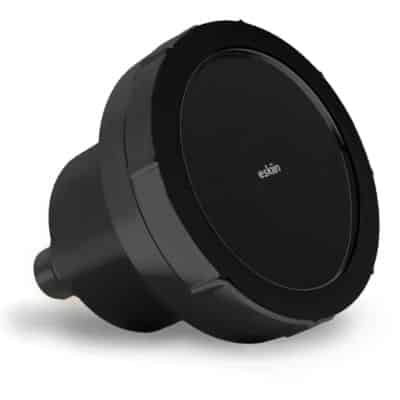
eskiin
Best For:
Quick Verdict: Should You Buy eskiin or Jolie?
Neither. Both scored 7.29 out of 10 in our testing, the lowest score of any shower filter in our published rankings, and they tie on every one of our six scoring categories: contaminant reduction 6.00, filtration rate 10.00, design 7.20, setup 9.00, maintenance 9.50, company 8.35.
If you have already decided you are buying one of these two, buy Jolie, for exactly one measured reason: Jolie cut chlorine by 54% in our on-site colorimeter test (2.70 PPM before filtration, 1.23 PPM after), while eskiin cut chlorine by 0% (1.68 PPM before, 1.79 PPM after). Neither reduced disinfection byproducts. Neither reduced hardness. Neither holds an NSF/ANSI 177 certification, and Jolie falsely claims on its own FAQ page that it does.
Buy Jolie if: you want at least partial chlorine reduction, or you specifically want one of its five finishes (it offers vibrant red and brushed gold; eskiin offers three finishes).
Buy eskiin if: you prefer its look and you accept that it reduced nothing measurable in our testing. It is $16 cheaper upfront ($149 vs $165) and $0.001 per gallon cheaper to maintain.
Skip both if: you actually want filtration. The Weddell Duo scored 9.19, removed 100% of chlorine and every DBP we detected, holds an NSF/ANSI 177 certification, costs $89.99 (less than either of these), and is the cheapest of any shower filter we have tested to maintain at $0.012 per gallon.
Methodology: We buy every filter we test, take before and after water samples, and send them to the Tap Score laboratory for analysis, with chlorine measured on site by digital colorimeter because it dissipates in transit. Contaminant reduction carries 55% of the overall score. See how we test water filters.
In this comparison, we’ve put them head-to-head across a number of performance categories, measuring their ability to:
- Remove contaminants we’re concerned about in our shower water
- Filter our water without significantly affecting flow rate
- Be installed and maintained easily and hold up well from a design quality perspective
We’ve rounded off this review with a summary of our findings and our verdict on which filter is objectively best.
Interestingly, Jolie and eskiin performed very similarly in our tests. That’s why it’s so hard to recommend one over the other: they pretty much had identical strengths and (many, many) weaknesses across the board.
The only real distinction is that Jolie reduced chlorine in our testing, while eskiin reduced none. But in terms of design quality, filtration rate, and even upfront and ongoing spend, they were equal contenders.
And neither stood up to the best shower head filters we’ve tested.
🧪 How These Two Filters Were Tested
Key Finding: Jolie and eskiin were tested in separate batches, in different Colorado homes, on municipal water with materially different baseline chemistry, so the correct way to read this comparison is direction of change per filter, not a spec-for-spec race.
Our Jolie baseline water measured 128.19 PPM total hardness, 2.70 PPM chlorine, and 8.83 PPB total THMs. Our eskiin baseline water measured 250.32 PPM total hardness, 1.68 PPM chlorine, and 15.03 PPB total THMs. Both are chlorinated municipal supplies in Colorado, both were sampled before and after filtration using the same Tap Score Advanced City Water panel, and chlorine was read on site with the same model of digital colorimeter in both tests.
What that means in practice: a result like “Jolie reduced chlorine by 54% and eskiin reduced it by 0%” holds, because each filter is measured against its own baseline. A raw flow rate figure from one test is not directly comparable to a raw flow rate figure from the other, because the two homes had different line pressure and we changed our flow measurement protocol between the two test batches. Where a number in this comparison is not method-comparable, we say so in that section.
📊 Our Testing Data
We tested and compared Jolie and eskiin across 6 main assessment criteria. We’ve listed their scores across each of these performance categories in the table below.
| Factor | Jolie | eskiin |
|---|---|---|
| Contaminant Reduction | 6.00 | 6.00 |
| Filtration Rate | 10.00 | 10.00 |
| Design | 7.20 | 7.20 |
| Setup | 9.00 | 9.00 |
| Maintenance | 9.50 | 9.50 |
| Company | 8.35 | 8.35 |
The score for each testing category is based on our subcategory scoring. See the next table for a detailed look at the data from each test we conducted.
| Factor | Jolie | eskiin | Winner |
|---|---|---|---|
| Overall Score | 7.29 | 7.29 | Tie |
| DBPs | 6.00 | 6.00 | Tie |
| Disinfectant Residual | 6.00 | 6.00 | Tie |
| Hardness | 6.00 | 6.00 | Tie |
| Performance Certification | Not Certified | Not Certified | Tie |
| Chlorine reduction measured | 54% (2.70 to 1.23 PPM) | 0% (1.68 to 1.79 PPM) | Jolie |
| Filtration Rate | 2.20 GPM | 1.74 GPM | Jolie |
| Component Quality | Fair | Fair | Tie |
| Component Certification | Not Certified | Not Certified | Tie |
| Setup | Excellent | Excellent | Tie |
| Servicing Requirements | Excellent | Excellent | Tie |
| Cost per gallon | $0.026 | $0.025 | eskiin |
| Upfront price | $165 | $149 | eskiin |
| Warranty Length | None (60-day return only) | None (60-day return, 7-day defect replacement) | Tie |
| Shipping | Free to contiguous US | Free to contiguous US | Tie |
| Returns | 60 days | 60 days | Tie |
🚰 Contaminant Reduction
Key Finding: Jolie reduced chlorine by 54% (2.70 PPM down to 1.23 PPM) and eskiin reduced it by 0% (1.68 PPM up to 1.79 PPM). Neither filter reduced a single disinfection byproduct, and neither reduced hardness, so both scored the same 6.00 for contaminant reduction.
Jolie and eskiin’s manufacturers make some bold claims about how their filters can enhance shower water quality and, in turn, improve skin and hair health.
In this category, we compared our contaminant reduction data for each filter to see which was best at reducing unwanted impurities and improving our water quality. Specifically, we tested each filter’s ability to reduce contaminants that are problematic in shower water:
- Disinfection byproducts (DBPs), which are problematic in shower vapor and through dermal (skin) exposure
- Disinfection residual (chlorine, chloramine, etc.), which can have dermal effects
- Water hardness, which affects both hair and skin
You can see more exactly how we score shower filters here.
We also searched certification databases online to see if any of the systems had been certified for their contaminant reduction performance.
Our Test Results
We used several testing processes to evaluate Jolie and eskiin for contaminant reduction, including Tap Score lab tests and our own on-site testing.
| Contaminant Name | Unfiltered | Jolie | Difference | Unfiltered | Eskiin | Difference |
|---|---|---|---|---|---|---|
| Alkalinity (as CaCO3) | 124.42 | 120.36 | -3.26% | 379 | 373 | -1.58% |
| Arsenic | 0.0002311 | 0.0002047 | -11.42% | |||
| Barium | 0.03189 | 0.03227 | 1.19% | 0.0337 | 0.0324 | -3.86% |
| Bicarbonate | 148.14 | 144.92 | -2.17% | 458.64 | 451.38 | -1.58% |
| Boron | 0.01897 | 0.01244 | -34.42% | 0.438 | 0.449 | 2.51% |
| Bromochloromethane | 0.25 | 0.14 | -44.00% | |||
| Bromodichloromethane | 2.62 | 2.96 | 12.98% | 2.12 | 2.65 | 25.00% |
| Bromoform | 0.08 | N.A. | 8.24 | 9.1 | 10.44% | |
| Calcium | 34.43656 | 34.27139 | -0.48% | 74 | 76.7 | 3.65% |
| Carbonate | 1.68 | 0.86 | -48.81% | 1.68 | 1.65 | -1.79% |
| Chloride | 19.881 | 21.153 | 6.40% | 92.8 | 97 | 4.53% |
| Chloride-to-Sulfate Mass Ratio | 1 | 0.97 | -3.00% | 0.64 | 0.64 | 0.00% |
| Chloroform | 5.47 | 4.19 | -23.40% | |||
| Chromium (Total) | 0.00368 | 0.00477 | 29.62% | |||
| Cobalt | 0.000004 | 0.000004 | 0.00% | |||
| Conductivity | 322.8 | 331.7 | 2.76% | |||
| Copper | 0.07381 | 0.02928 | -60.33% | 0.274 | 0.276 | 0.73% |
| Dibromochloromethane | 0.74 | 1.03 | 39.19% | 4.67 | 6.7 | 43.47% |
| Fluoride | 0.004 | 0.245 | 6025.00% | 1.7 | 1.8 | 5.88% |
| Grains per gallon | 7.49 | 7.45 | -0.53% | 14.62 | 15.2 | 3.97% |
| Hardness | 127.82 | 126.62 | -0.94% | 249 | 259 | 4.02% |
| Hardness (Ca,Mg) | 127.82 | 126.62 | -0.94% | |||
| Hardness (Total) | 128.19 | 127.56 | -0.49% | 250.32 | 260.19 | 3.94% |
| Iron | 0.00072 | 0.00072 | 0.00% | |||
| Langelier Saturation Index | 0.4 | 0.11 | -72.50% | 0.67 | 0.68 | 1.49% |
| Lead | 0.0002713 | 0.0001689 | -37.74% | |||
| Lithium | 0.00421 | 0.00398 | -5.46% | |||
| Magnesium | 10.15845 | 9.96807 | -1.87% | 15.6 | 16.3 | 4.49% |
| Manganese | 0.00007 | N.A. | 0.0011 | 0 | -100.00% | |
| Molybdenum | 0.0002244 | 0.0002203 | -1.83% | 0.00127 | 0.00137 | 7.87% |
| Nickel | 0.0004253 | 0.000103 | -75.78% | |||
| Nitrate (as N) | 0.006 | 0.006 | 0.00% | 3 | 3.2 | 6.67% |
| pH | 8.39 | 8.11 | -3.34% | 7.9 | 7.9 | 0.00% |
| Phosphorus | 0.00587 | 0.00587 | 0.00% | |||
| Potassium | 2.01457 | 1.98357 | -1.54% | 2.93 | 2.98 | 1.71% |
| 0.00428 | 0.0041 | -4.21% | ||||
| Sodium | 12.2439 | 12.14987 | -0.77% | 178 | 181 | 1.69% |
| Sodium Adsorption Ratio | 0.47 | 0.47 | 0.00% | 4.9 | 4.89 | -0.20% |
| Specific Conductivity | 1300 | 1330 | 2.31% | |||
| Strontium | 0.18737 | 0.18462 | -1.47% | 0.739 | 0.75 | 1.49% |
| Sulfate | 19.887 | 21.748 | 9.36% | 145 | 152 | 4.83% |
| Thallium | 0.0000302 | N.A. | ||||
| Total Dissolved Solids | 206.7 | 212.5 | 2.81% | 756 | 773 | 2.25% |
| Total THMs | 8.83 | 8.26 | -6.46% | 15.03 | 18.46 | 22.82% |
| Uranium | 0.0005325 | 0.0005569 | 4.58% | 0.0124 | 0.0115 | -7.26% |
| Vanadium | 0.000166 | 0.000166 | 0.00% | 0.0015 | 0.00178 | 18.67% |
| Zinc | 0.00919 | 0.42455 | 4519.70% |
DBPs
We ranked Jolie and eskiin for disinfection byproducts reduction by assessing whether they could reduce any detected DBPs to below the Health Guideline Level (or to undetectable levels).
To test for DBPs, we collected two samples of water: an unfiltered baseline sample, and a sample of filtered water from the showerhead. We sent these samples to the Tap Score laboratory for detailed testing.
Jolie
In our Jolie tests, 4 disinfection byproducts were highlighted in our baseline sample:
- 5.47 PPB (parts per billion) of chloroform
- 2.62 PPB of bromodichloromethane
- 0.74 PPB of dibromochloromethane
- 0.25 PPB of bromochloromethane
Three of the four DBPs exceeded the Health Guideline Level, meaning they were present in potentially health-harmful concentrations. Bromochloromethane was detected below the Reporting Limit, so it couldn’t be evaluated.

Jolie didn’t affect the DBP concentrations in our water at all. Actually, a couple of THMs increased post-filtration, most likely caused by incidental fluctuations in our water supply on the day of testing.
eskiin
When we tested eskiin, 3 DBPs were detected in our baseline sample:
- 8.24 PPB of bromoform
- 2.12 PPB of bromodichloromethane
- 4.67 PPB of dibromochloromethane
Like Jolie, eskiin was unable to reduce any of these contaminants. Again, they all increased post-filtration, probably due to an incidental increase in these DBPs between our two tests.
Related: Compare eskiin vs Filterbaby
Disinfectant Residual
Score: 6.00
If your home receives a municipal water supply, it’s most likely treated with a disinfectant chemical like chlorine or chloramine. These can have skin and hair effects in shower water.
Our test location was a property that uses chlorinated water. We took our own on-site chlorine reading using a digital colorimeter. Since chlorine is highly volatile, lab testing isn’t viable, as it’d dissipate from the water during shipping and lead to a “false low” reading.
Jolie
In our Jolie tests, the colorimeter took a baseline reading of 2.70 PPM of chlorine. After installing the filter and repeating the same steps, the reading was 54% lower, at 1.23 PPM.
We expected more from Jolie, but at least it removed some chlorine…
eskiin
In our eskiin tests, 1.68 PPM of chlorine was detected in our baseline sample.
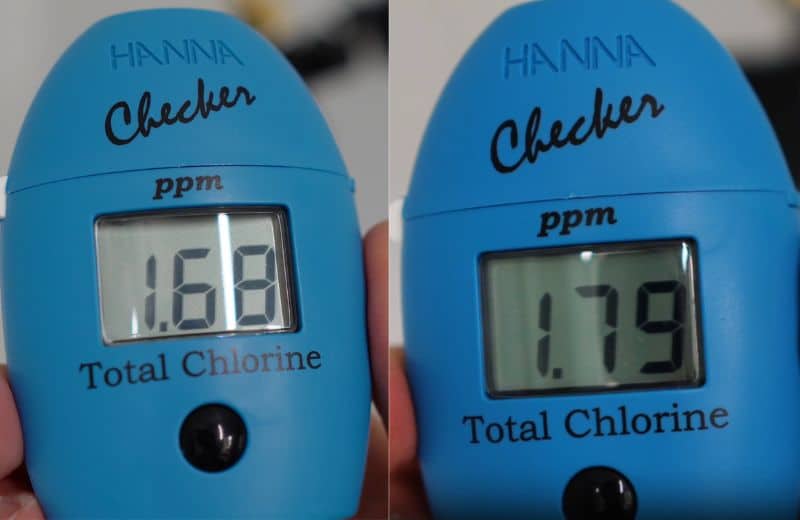
We then repeated our test with filtered water from the eskiin Shower Filter. This time, 1.79 PPM of chlorine was detected: a 6.55% increase (most likely incidental).
The fact that the filter was incapable of reducing chlorine even slightly in our testing is an extremely disappointing result — we expect chlorine reduction as a bare minimum for any shower filter we test.
Hardness
Hardness is a measure of the scale-causing calcium and magnesium minerals in water.
We used our lab data from our Tap Score tests to evaluate Jolie and eskiin’s hardness reduction performance.
Jolie
Here’s how the hardness of our two water samples compared in our Jolie tests:
- Our unfiltered water had a total hardness reading of 128.19 PPM, or 7.49 GPG, putting it in the “hard” category.
- Our on-site titration test detected a water hardness of 8 GPG.
The Jolie filter didn’t reduce our water hardness, which is unsurprising for a standard shower filter with no add-ons intended to address hard water.
eskiin
When we tested the eskiin filter, our baseline water was very hard, with a total hardness of around 250 PPM.
Post-filtration, hardness increased by just under 4%, to 260 PPM. Most likely, this was simply an incidental fluctuation in hardness levels between our test times.
What Did the Jolie Filter Add to Our Water?
Key Finding: Zinc in our filtered water rose from 0.00919 PPM to 0.42455 PPM after passing through the Jolie filter, an increase of over 4,500%, which we attribute to leaching from its KDF-55 media (KDF is manufactured from high purity zinc and copper).
Zinc is not known to have health effects in shower water at these concentrations, so it did not affect Jolie’s score. We report it because Jolie’s own marketing warns buyers about heavy metals in shower water, and the filter measurably increased the concentration of a heavy metal in ours. Fluoride also rose from 0.004 PPM to 0.245 PPM in the same sample. eskiin’s filter also uses KDF-55, but zinc was not reported in its lab panel, so we cannot say whether the same leaching occurred. Full data is in our Jolie review.
Certifications
Shower filter manufacturers can obtain an official performance certification by the NSF, WQA, or IAPMO to NSF Standard 177, for chlorine reduction.
The Jolie filter hasn’t been certified, despite the fact that Jolie misleadingly claims that it has been.
Jolie’s product page mentions that the filter “far exceeds certifications” and has been “tested in multiple labs”, and the FAQs state that the filter “uses best-in-class filter technology and is NSF Certified”. This isn’t true.
The eskiin Shower Filter also isn’t currently certified, but at least the manufacturer doesn’t claim it is.
🚦Filtration Rate
Key Finding: Both filters scored 10.00 for filtration rate. We recorded 2.20 GPM for Jolie and 1.74 GPM for eskiin, but those two figures came from different homes and different measurement protocols, so the gap between them is not a like-for-like result.
Shower filters can slightly impact flow rate and water pressure due to the physical resistance of the filter media as water flows through. But this shouldn’t be enough to have a significant effect on your showerhead usability.
Jolie was measured in our 2024 test batch by timing how long the showerhead took to fill 2 cups of water, averaged over three runs at 3.42 seconds each.
eskiin was measured in our 2026 batch by filling a graduated cup to the 1-gallon mark, filmed and measured frame by frame, at a feed pressure of 48 PSI against a 1.72 GPM unfiltered baseline. eskiin retained 100% of that baseline flow with no change in dynamic pressure.
Neither filter restricted flow enough to score below 10.00, and neither filter will noticeably weaken your shower.
| Product | Filtration Rate Score | Filtration Rate |
|---|---|---|
| Jolie | 10.00 | 2.20 GPM |
| eskiin | 10.00 | 1.74 GPM |
Jolie had a flow rate of 2.20 GPM, while in our eskiin test, we recorded an average flow rate of 1.74 GPM for the filter.
💲 Upfront Cost
Key Finding: Jolie costs $165 and eskiin costs $149, making both more expensive than the Weddell Duo ($89.99), which is the highest scoring shower filter we have tested and the only one with an NSF/ANSI 177 certification.
Both Jolie and eskiin are more expensive than we can justify for a shower filter, especially given their poor contaminant reduction performance.
- Jolie costs around $165
- eskiin is around $149
Other shower filters cost as little as $30 upfront, so with Jolie and eskiin costing significantly more, we’d expect them to offer something unique that made that cost worth it.
📐 Design
Key Finding: Both filters scored 7.20 for design, built from the same grade of lightweight plastic with no materials safety or lead-free certification, and their cartridges look near identical to each other under different branding.
We compared Jolie and eskiin in the design category by evaluating their build quality and finish options, as well as the types of materials used. We also look for certifications for materials safety to assign scores in this category.
You can check out how the filters compared in the table below.
| Product | Design Score | Component Quality | Materials Safety |
|---|---|---|---|
| Jolie | 7.20 | Fair | Not Certified |
| eskiin | 7.20 | Fair | Not Certified |
Appearance & Finish Options
Jolie and eskiin have an all-in-one design, meaning that the filter cartridge sits inside a dedicated showerhead rather than being installed inline, upstream of your existing shower head.
Both are attractive and modern, so you could consider either model if aesthetics are an important selling point for you.
Jolie has a few additional finish options compared to eskiin:

- Modern chrome
- Brushed steel
- Jet black
- Brushed gold
- Vibrant red
eskiin is available in three finishes:
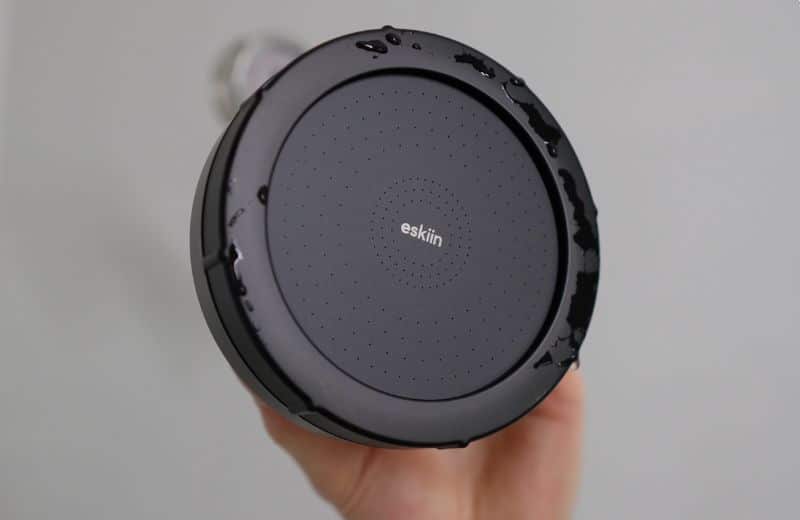
- Chrome
- Black
- Brushed nickel
Design Quality
Jolie and eskiin have majority plastic designs. They’re marketed and packaged as luxury products, but the filters themselves don’t have a luxury feel, and we identified several issues with its design.
Our biggest concern was that the plastic used in both showerhead constructions felt cheap and flimsy. In the eskiin filter, we also found what we thought was a bug or seed in the cartridge, but it turned out to be a small piece of rubber.
Filter Materials
Interestingly, the cartridge itself looks identical in both Jolie and eskiin filters, just with different branding. But the companies claim to use different filtration media:
- The Jolie filter uses KDF-55 and calcium sulfite.
- eskiin’s filter uses “15 layers” of filter media: high-density stainless steel mesh, PP cotton, vitamin C media, maifan stones, mineralized balls, magnetic energy balls, ceramic balls, alkaline balls, and calcium sulphite, KDF-55, coconut activated carbon, a repeat of the two pre-filtration stages, and 2 “toxin ultra filter membranes”.
eskiin is a perfect example of how simply stuffing as many filtration media into a water filter doesn’t guarantee that it’ll do more. In fact, in our own testing, the filter did nothing. Jolie performed only marginally better, but at least it reduced chlorine by 54%.
Materials Safety Certification
Neither Jolie nor eskiin has obtained a materials safety certification, nor do any of these filters have a lead-free design certification.
These certifications help to provide extra reassurance about design safety and durability, but they’re not commonly obtained by shower filter manufacturers.
⚙️ Setup
Key Finding: Both scored 9.00 for setup. We installed each in under five minutes by hand, with no tools required and no leaks, though eskiin’s initial flush water was noticeably discolored with black carbon specks from its filter media.
We compared the setup process for Jolie and eskiin to see which (if any) was easier to install.
We’ve shared our setup times and scores in the table below.
| Product | Setup Score | Setup Time |
|---|---|---|
| Jolie | 9.00 | Under 5 minutes |
| eskiin | 9.00 | Under 5 minutes |
Both filters could be installed and ready for use within minutes. We just unscrewed our existing showerhead and attached the new showerhead to the shower arm.
Jolie’s filter cartridge was preloaded, saving us from needing to insert it during setup.
We also flushed each filter for 1 and a half minutes before we conducted any of our other testing. The initial water leaving the eskiin showerhead was significantly more discolored than the other filters we’ve tested, with noticeable black carbon specks in the washout from the filter media.
🔧 Maintenance
Key Finding: Both scored 9.50 for maintenance. eskiin costs $0.025 per gallon and Jolie $0.026, a difference of roughly $56 over five years ($869 vs $925 including the purchase price), and both cartridges are rated for about 90 days.
To compare Jolie and eskiin in the maintenance category, we analyzed their servicing requirements and ongoing filter costs.
The next table highlights the scores awarded to both filters.
| Product | Maintenance Score | Servicing Requirements | Costs |
|---|---|---|---|
| Jolie | 9.50 | Excellent | $0.026/gal |
| eskiin | 9.50 | Excellent | $0.025/gal |
We awarded Jolie and eskiin identical scores of 9.50 for maintenance because both have similar filter change schedules and ongoing costs.
Servicing Requirements
Jolie and eskiin share one key maintenance task: replacing the filter. This is an important job for any shower filter. Continuing to use the same cartridge for years on end is essentially the same as not using a filter at all, as the media will become saturated with impurities and unable to effectively remove anything from your water.
For both units, replacing the filters is easy and simply involves removing the spray plate to gain access to the cartridge inside.
After replacing the filter, eskiin recommends flushing the filter for 30-60 seconds. We did the same for Jolie, although no flushing recommendations are provided.
Both filters have a lifespan of around 90 days.
Maintenance Costs
Replacement cartridges for the Jolie and eskiin shower filters are very similarly priced, and with their identical projected lifespans, that means their maintenance costs are almost exactly the same.
| Product | Cost per gallon |
|---|---|
| Hello Klean | $0.052 |
| Afina | $0.042 |
| FilterBaby | $0.034 |
| Aquatru Shower | $0.031 |
| Jolie | $0.026 |
| Canopy | $0.026 |
| Eskiin | $0.025 |
| HammerHead | $0.024 |
| Aquasana | $0.022 |
| Weddell Duo | $0.012 |
| AquaBliss | $0.012 |
| Sprite SL2 | $0.007 |
- The Jolie filter costs $0.026 per gallon, or approximately $925 over 5 years (including upfront price).
- The eskiin model has a cost-per-gallon of $0.025, or an estimated 5-year ownership cost of $869.
🏢 Company
Key Finding: Both scored 8.35 for company policies, and neither offers a product warranty. Jolie has a 60-day return window and nothing else. eskiin has the same 60-day return window plus a replacement filter if you report a damaged or defective unit within 7 days of delivery.
Our final point of comparison was Jolie and eskiin’s company policies, including their warranty, shipping, and returns offerings.
The table below shows the scores for each manufacturer across these subcategories.
| Product | Company Score | Warranty Length | Shipping | Returns |
|---|---|---|---|---|
| Jolie | 8.35 | 60 days | Free shipping to all contiguous US | 60 days |
| eskiin | 8.35 | None | Free shipping to all contiguous US | 60 days |
Warranty Length
Jolie doesn’t have a dedicated warranty: it only has a 60-day returns period. And, surprise surprise, eskiin is exactly the same.
It’s almost like one manufacturer looked at the other and decided to offer the exact same policies, so you can’t choose one over the other based on these alone.
That said, eskiin will send a replacement filter if you contact them about a damaged or defective product within 7 days of delivery, which could be classified as a warranty of sorts.
Shipping
Jolie and eskiin offers free shipping with no minimum spend to all contiguous United States. Fees apply for international shipping.
Returns
You can try out the Jolie filter and return it within the 60-day money-back period at no risk. There’s no fine print and no hidden terms and conditions here, either—as it says on the Jolie website: “No questions asked!”
eskiin’s returns policy entitles you to a refund (minus shipping fees) if you return your filter within 60 days of your purchase. The filter needs to be undamaged and returned in its original packaging, and a restocking fee may apply to some items, including subscription replacement filter cartridges.
🆚 Jolie or eskiin: Which Do We Recommend?
Key Finding: Jolie and eskiin are tied at 7.29, the lowest score of any shower filter in our rankings, and the only measurable difference between them is that Jolie removes some chlorine while eskiin removed none.
Comparing Jolie and eskiin has proven difficult, as they’re essentially carbon copies of one another. Plus, neither filter has blown us away or even managed to deliver the bare minimum in our testing.
The verdict? Both disappointing, neither worth your money.
Here’s Why You Might Choose Jolie:
- You actually want to remove chlorine from your water, even if Jolie only reduced chlorine by 54% in our tests.
- You specifically want one of Jolie’s unique finish options (maybe you have a deep desire for a vibrant red shower filter?)
You Might Still Prefer eskiin If:
- You specifically prefer eskiin’s design. While it’s very similar to Jolie, it’s not identical.
But Here’s Why Neither System is Perfect:
There are cheaper, certified alternatives offered by competitors.
Both are more expensive than the average shower filter and don’t offer anything special to justify their price.
Both failed to completely remove any of the contaminants we were concerned about in our shower water.
Neither has any performance certifications.
If you want the best shower filter we’ve tested, check out the Weddell Duo.
❔ Frequently Asked Questions
Q: Is eskiin or Jolie better?
A: Jolie, narrowly, and only because it removes some chlorine. Both scored 7.29 out of 10 and tied on all six of our scoring categories. In our on-site colorimeter tests Jolie reduced chlorine by 54%, from 2.70 PPM to 1.23 PPM, while eskiin reduced it by 0%, measuring 1.68 PPM before filtration and 1.79 PPM after. Neither filter reduced disinfection byproducts or hardness, and neither is certified.
Q: Does the eskiin shower filter remove chlorine?
A: Not in our testing. We measured 1.68 PPM of chlorine in our baseline shower water and 1.79 PPM after filtration. The small increase was almost certainly incidental fluctuation between readings, but the result shows the filter did not reduce chlorine at all, despite chlorine reduction being its main advertised purpose.
Q: Does the Jolie shower filter remove chlorine?
A: Partially. Our colorimeter read 2.70 PPM of chlorine before filtration and 1.23 PPM after, a reduction of 54%. That is well short of the 97% to 100% reductions we recorded from the best performing shower filters we have tested, but it is more than eskiin managed.
Q: Are eskiin and Jolie the same filter?
A: They are not the same product, but their cartridges look nearly identical to each other, just with different branding, and they performed almost identically in our testing. Jolie says its cartridge uses KDF-55 and calcium sulfite. eskiin claims 15 layers of media including KDF-55, coconut activated carbon, vitamin C, maifan stones and several types of mineral ball. The extra claimed stages produced no measurable benefit: eskiin reduced none of the three contaminants we test for, while Jolie reduced one.
Q: Is the Jolie shower filter NSF certified?
A: No. Jolie’s own FAQ page states that the filter “uses best-in-class filter technology and is NSF Certified”, and its product page claims it “far exceeds certifications”. We searched the NSF, WQA and IAPMO certification databases and found no listing. The eskiin filter is also uncertified, but eskiin does not claim otherwise.
Q: Which is cheaper to own, eskiin or Jolie?
A: eskiin, by a small margin. eskiin costs $149 upfront and $0.025 per gallon to maintain, for an estimated five-year ownership cost of $869. Jolie costs $165 upfront and $0.026 per gallon, for an estimated five-year cost of $925. Both are more expensive to own than most shower filters we have tested.
Q: What shower filter should I buy instead of eskiin or Jolie?
A: The Weddell Duo, which scored 9.19 in our testing. It is the only shower filter we have tested that removed 100% of chlorine and every disinfection byproduct we detected, it holds an NSF/ANSI 177 certification for chlorine reduction, it costs $89.99, and at $0.012 per gallon it is the cheapest shower filter we have tested to maintain.