


We bought the Jolie Shower Head Filter and tested it in our Colorado home to see which contaminants it could remove from our shower water.
We’ve compiled all our testing data into this review. You’ll find analysis of our subjective experiences along with objective data, which we gathered through our own in-house testing and information available on the company website. We measured the Jolie system’s contaminant reduction abilities, design quality, ease of setup and maintenance, and more.
What We Like
What We Don’t Like
| Price | $165.00 |
| Contaminants Reduced | 1 |
| Certifications | None |
| Process | KDF + Calcium Sulfite |
| Filter Capacity | 3,000 gallons |
| Annual Cost | ~$152 |
| Warranty | 60 days |
▶️ Video Review
📊 Scoring Data
The Jolie Shower Filter is priced at $165, making it one of the most expensive showerhead filters we’ve tested so far. We wanted to determine whether its price was justified by its performance, and this involved testing it across our 6 key scoring categories. We then combined and averaged our scores into an overall performance score. You can view the data in the table below.
| Criteria | Results |
|---|---|
| Overall Score | 7.29 |
| DBPs | 6.00 |
| Disinfectant Residual | 6.00 |
| Hardness | 6.00 |
| Performance Certification | Not Certified |
| Filtration Rate | 2.20 GPM |
| Component Quality | Fair |
| Component Certification | none |
| Setup | Excellent |
| Servicing Requirements | Excellent |
| Costs | $0.026/ gal. |
| Warranty Length | 60 days |
| Shipping | Free for lower 48 US states |
| Returns | 60 days |
🚰 Contaminant Reduction
Score: 6.00Our top priority was to learn how the Jolie Shower Head Filter would affect our water quality, and that involved testing the filter ourselves to see which contaminants it targeted in our shower water.
Our “contaminant reduction” scoring category is also influenced by whether or not the water filter has obtained a performance certification from the NSF/ANSI, IAPMO, or the WQA.
Our Performance Testing
Score: 6.00
We use a lab testing service called SimpleLab Tap Score for all our water filter testing. We appreciate the lab’s comprehensive, user-friendly test reports, and we followed their strict sample-taking process to ensure accurate results.

Our Tap Score kit included a chlorine test strip that we could use to take a chlorine reading in real time (the most accurate option given that chlorine evaporates from water over time). We also conducted a separate titration test to get an on-site water hardness reading.
For all our tests, we took two water samples: one straight from our showerhead, and one from our shower after installing the Jolie filter.
There are a couple of things you should know about our shower filter testing process specifically:
- First, the Jolie filter is intended to filter shower water only. So when evaluating our test results, we focused on contaminants that are known to have health effects due to inhalation and dermal exposure (rather than ingestion): chlorine, disinfection byproducts (DBPs), and water hardness.
- Second, we tested Jolie’s ability to filter cold water, even though most of us shower in hot water. This was because we wanted to accurately measure the filter’s ability to reduce disinfection byproducts, which dissipate into the air quickly, particularly from hot water, due to their volatile nature. Since these have health effects when inhaled, testing for DBP reduction was one of our top priorities.
DBPs
Score: 6.00
Our unfiltered water test highlighted four disinfection byproducts:
- 5.47 PPB of chloroform
- 2.62 PPB of bromodichloromethane
- 0.74 PPB of dibromochloromethane
- 0.25 PPB of bromochloromethane
Three of the four DBPs exceeded the Health Guideline Level, meaning they were present in potentially health-harmful concentrations. Bromochloromethane was detected in concentrations below the Reporting Limit, so it was unable to be evaluated.

Our post-filtration lab results showed that the Jolie filter didn’t affect the DBP concentrations in our water at all. Actually, a couple of THMs increased post-filtration. We don’t think the filter added disinfection byproducts to our water—the slight increase was most likely caused by incidental fluctuations in our water supply on the day of testing.
Compare Jolie with the popular eskiin showerhead to see which is better.
Disinfectant Residual
Score: 6.00
We used a chlorinated municipal water supply to test the Jolie Shower Filter.
We deviated from our Tap Score lab analysis for this portion of testing, instead conducting our own on-site tests with a digital colorimeter. This allowed us to obtain the most accurate results, with no chance for the chlorine to dissipate during transit to the lab.
To take this reading, we filled a vial with water and placed it into the colorimeter for calibration. We then removed the vial, added reagent paper, shook it for 20 seconds, and returned it to the colorimeter. The reading appeared on the screen after a couple of minutes.
Initially, the colorimeter took a reading of 2.70 PPM of chlorine. After installing the filter and repeating the same steps, the reading was 54% lower, at 1.23 PPM.
We expected more from Jolie, but it wasn’t the worst-performing shower filter we’ve tested when it comes to chlorine reduction.
Marketing vs Reality
Most of Jolie’s marketing focuses on the negative effects of chlorine, with the big selling point being that the Jolie filter can remove chlorine—hardly revolutionary as this is a basic expectation for any KDF-55 or calcium sulfite based filter. The filter did reduce some chlorine in our testing, but we didn’t experience a 100% elimination.
Jolie also makes a few claims about heavy metals, including: “Chlorine & heavy metals in the water are damaging to our skin and hair”, and “When you wash your hair with water that contains heavy metals, you’re essentially asking your hair color to grow dull or green… and resulting in damage to your hair and scalp.”


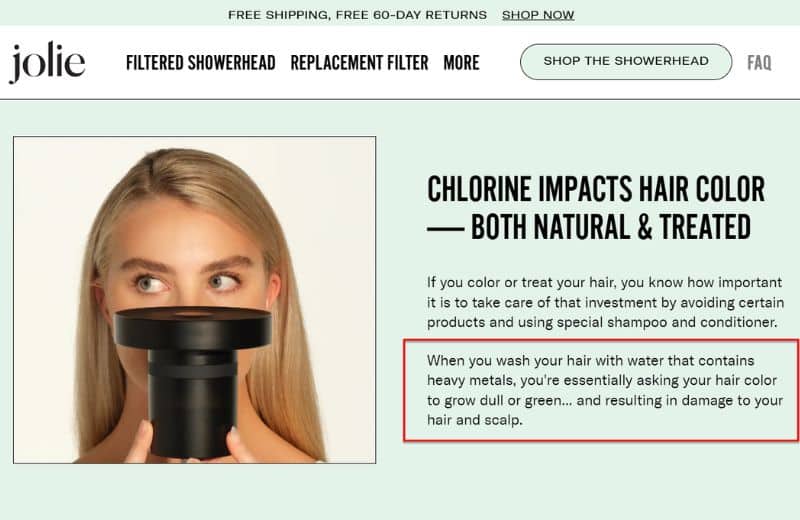
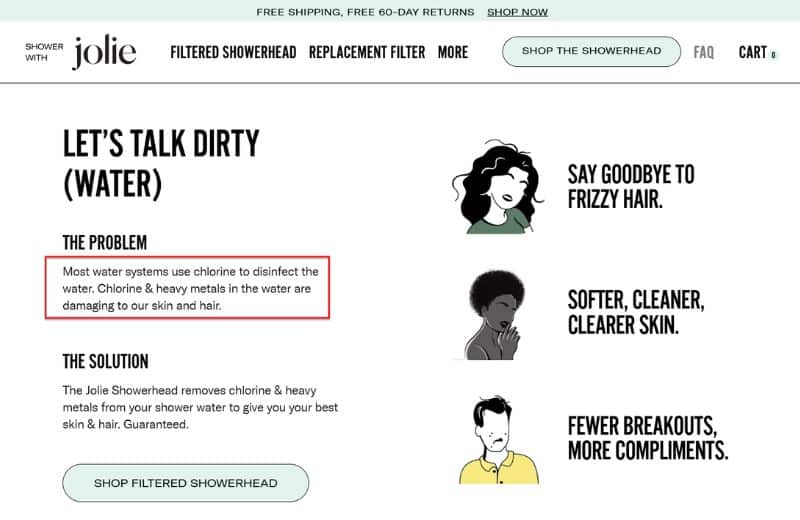
In our research, we found that high levels of copper (leached from plumbing or added to swimming pools) can give blonde hair a green tinge. However, for most people, the trace levels of copper found naturally in your tap water won’t turn your hair green. We found no studies or evidence to suggest that trace heavy metals in water can damage skin and hair.
Water Hardness
We used data from our Tap Score lab test and an on-site titration test to measure the before-and-after hardness of our shower water:
- Our unfiltered water Tap Score test report recorded a total hardness reading of 128.19 PPM, or 7.49 GPG, putting it in the “hard” category.
- Our on-site titration test detected a water hardness of 8 GPG.
The Jolie filter also did not reduce our water hardness, which is unsurprising for a standard shower filter with no add-ons intended to address hard water.
While most shower filters don’t contain the technology needed to remove chlorine, some do (and some remove chlorine incidentally as a result of using ion exchange resin). That’s why chlorine removal is one of our scoring factors in the contaminant reduction testing category.
Unexpected Outcomes
There were a couple of unexpected outcomes with our contaminant reduction testing that we want to highlight here.
The first is that the levels of zinc in our filtered water increased by over 4,500%, from 0.00919 PPM to 0.42455 PPM. We believe this leached into the water from the filter’s KDF media (which is made from high-purity zinc and copper).
Zinc isn’t known to have health effects in shower water. Even so, we wanted to point out the irony of a water filter brand claiming to remove heavy metals while significantly increasing the concentrations of a heavy metal from its own filtration media.
We also saw an increase in the concentrations of fluoride in our filtered water by 6,025%, from 0.004 PPM to 0.25 PPM. This is likely an incidental increase and simply tells us that the filter can’t reduce fluoride, which doesn’t have any known inhalation or dermal effects in trace amounts anyway.
Performance Certifications
Score: 6.00
The most common performance certification that shower filters can obtain is NSF 177 for chlorine reduction.
While certifications aren’t necessary, they provide extra reassurance that comes from knowing the manufacturer has passed stringent NSF testing requirements, rather than simply testing the filter in their own lab conditions (with possibly biased results). They also help us to understand how a filter can perform beyond the scope of our own testing.
The Jolie filter hasn’t been certified, which is disappointing—and this is made much worse by the fact that Jolie misleadingly claims that it has been.
Jolie’s product page mentions that the filter “far exceeds certifications” and has been “tested in multiple labs”, and the FAQs state that the filter “uses best-in-class filter technology and is NSF Certified”. NOT true.

🚦Filtration Rate
Score: 10.00Filtration rate is an important testing factor for shower filters since it can affect your showering experience. The last thing you want is for a water filter to significantly reduce your shower water pressure and affect how much water can exit the showerhead.
For all the shower filters we tested, we used the same process to measure filtration rate. This involved timing how long it took for the showerhead to fill 2 cups of water after the filter was installed. We repeated the test twice more and recorded the average time from all three tests.
The Jolie Showerhead Filter took an average time of 3.42 seconds to fill 2 cups of water, so its flow rate came in at 2.20 GPM.
That’s a pretty great flow rate from a showerhead filter, and we didn’t notice a dip in our shower pressure at all.
We conducted the testing while the filter was still fairly new, so we’d expect the flow rate to decrease over time as the filter media gets saturated with contaminants.
📐 Design
Score: 7.20The Jolie filter is an all-in-one showerhead filter that combines the filter and showerhead in a single unit. The unit consists of a round, flat showerhead with a cylindrical compartment that stores the filter at the back.

You can buy the filter in five finishes:
- Modern chrome
- Brushed steel
- Jet black
- Brushed gold
- Vibrant red
In terms of appearance, it’s modern and attractive, with the designers obviously prioritizing aesthetic appeal (unlike many other shower filters we tested, which had a clunky, practical build). But appearances aren’t everything.
Component Quality
Score: 8.00
The Jolie Shower Filter got a middle-ground score for component quality.
We noted that it’s similar in design to models costing $100 less, with the same flimsy plastic feel. Its filter size was also very similar to the Sprite filter’s, which is interesting given that Sprite costs just $35 upfront.
In all, we couldn’t see anything about the Jolie filter’s design quality that would go towards justifying its high price tag.
Filter Materials
The Jolie filter uses KDF-55 and calcium sulfite. Unlike similar systems, there’s no mention of the filter using activated carbon media.

Perhaps the manufacturer decided that activated carbon wasn’t necessary as KDF is already known for its ability to reduce chlorine. However, the filter’s performance could have been significantly improved by the addition of a solid carbon block filter with DBP reduction abilities.
Materials Safety Certification
Score: 6.00
Jolie hasn’t obtained a materials safety certification, so it got the lowest possible score in this category.
As with performance certifications, materials safety certifications aren’t a legal requirement. That said, they offer reassuring proof that a water filter has been deemed safe for use by a respectable third party.
⚙️ Setup
Score: 9.00Like most of the shower filters we tested, the Jolie filter was quick and easy to install.
The advantage of this type of filter is that installation is pretty much tool-free. We just unscrewed our existing showerhead and attached the new showerhead to the shower arm. Jolie’s filter cartridge was preloaded, saving us a job, and there’s a handy wrench included to make it easy to tighten the showerhead in place.
In terms of filter priming, Jolie doesn’t offer any specific instructions. For most shower filters, you just run water (any temperature) through the showerhead for 30 seconds to 1 minute to prime the filter. We followed the same process with the Jolie system.
🔧 Maintenance
Score: 9.50The Jolie filter’s maintenance requirements were easy and affordable, awarding it a high score in this category.
Servicing Requirements
9.00
There are two key maintenance tasks that you will need to commit to when you buy this filter:
- Replacing the filter
- Cleaning the exterior
There’s just one cartridge to replace inside the unit, with a water filtration capacity of 3,000 gallons, which equates to a lifespan of approximately three months.
While this is half the average six-month lifespan claimed by many other shower filter manufacturers, we appreciate Jolie’s honesty here. We suspect that many shower filter manufacturers claim a longer 6-month lifespan knowing that most people will be unaware of the signs of a filter that needs replacing.
Replacing the filter was easy—we just unscrewed the showerhead portion of the filter, giving us access to the cartridge inside the housing.
In terms of cleaning the exterior, you can simply clean the unit as you’d clean a normal showerhead, so there’s no additional or complicated maintenance required here.
Costs
Score: 10.00
The Jolie Shower Head is affordable to maintain, although with a higher ongoing cost than many of the other shower filters we tested.
The filter costs $0.026 per gallon, or approximately $925 over 5 years. That makes it pretty affordable, although not the cheapest—several similar filters had a 5-year filter replacement cost of less than $500.
| Product | Cost per gallon |
|---|---|
| Hello Klean | $0.052 |
| Afina | $0.042 |
| FilterBaby | $0.034 |
| Aquatru Shower | $0.031 |
| Jolie | $0.026 |
| Canopy | $0.026 |
| Eskiin | $0.025 |
| HammerHead | $0.024 |
| Aquasana | $0.022 |
| Weddell Duo | $0.012 |
| AquaBliss | $0.012 |
| Sprite SL2 | $0.007 |
🏢 Company
Score: 8.35Finally, we assessed Jolie’s company policies, including its warranty, shipping, and returns offerings. These are all important factors that are often ignored when it comes to assessing a water filter’s potential.
Warranty
Score: 7.00
Jolie doesn’t have a dedicated warranty: it only has a 60-day returns period. That meant it received the lowest score in this subcategory of all the shower filters we tested.
Shipping
Score: 9.50
Jolie offers free shipping with no minimum spend to all contiguous United States. Fees apply for international shipping.
This is a pretty good shipping offer, especially since many of Jolie’s competitors only offer free shipping if a minimum order threshold is met.
Returns
Score: 9.00
You can try out the Jolie filter and return it within the 60-day money-back period at no risk. There’s no fine print and no hidden terms and conditions here, either—as it says on the Jolie website: “No questions asked!”
If you’re hesitant to spend your money on a more expensive system, this offering might sweeten the deal for you somewhat.
View Jolie’s shipping and returns policy here.
🫰 Value For Money
So, with all our data shared, what’s our verdict on the Jolie filter’s overall value for money?
The long and short of it is, there’s nothing about this showerhead filter that justifies its expensive price tag.
It offers a basic contaminant reduction performance, has a lower-than-average filtration capacity, and is made from the same flimsy plastics as cheaper units. We could find no unique features or performance benefits that even partially explained why the Jolie Shower Filter costs so much more than similar systems.
The answer most likely lies in its marketing. The Jolie filter is quite clearly marketed at women, and there’s lots of research showing that products aimed at women are priced higher than similar products with no female-specific marketing by an average of around 30-40%.
In our opinion, you may as well spend $100 less on a carbon-based shower filter offering the same contaminant reduction performance. Or, even better, upgrade to a filter that’s designed to reduce more than just chlorine. Of all the shower filters we’ve tested so far, only the Weddell Duo was capable of reducing chlorine and DBPs, and only the ShowerStick tackled water hardness.
Are there any reasons why you should buy the Jolie model? Perhaps if you have a bigger budget and specifically like the appearance of the unit. Otherwise, your money can be better spent on a more affordable alternative that can be used with whatever showerhead you choose.
Found this review helpful?
Comment below or share this article!
Bought the Jolie on sale at Costco, assuming high quality, since most products sold at Costco perform well.
Haven’t used it yet. After reading this evaluation, I plan to return the Jolie and buy a brand rated higher at this site.