


We tested the Boroux Legacy stainless-steel gravity water filter to see how well it performed.
Boroux has done a lot to address many of the common complaints with Berkey-like water filters, and it has recently improved upon some of its own flaws, with a freshly obtained series of official WQA performance & design certifications, a dedicated fluoride-removal filter, and a new automatic priming tool that means we no longer have to spend ages using the old manual equipment.
That said, it’s still not perfect, with the Foundation Filters adding cobalt to our water and the Fluoride Filters (or priming pump) adding benzene and toluene.
| Factor | Foundation Filter | Fluoride Filter |
|---|---|---|
| Contaminant Reduction | 7.91 | 8.14 |
| Filtration Rate | 7.50 | 7.50 |
| Design | 10.00 | 8.40 |
| Setup | 8.50 | 8.50 |
| Maintenance | 8.75 | 8.75 |
| Company | 9.70 | 9.70 |
What We Like
What We Don’t Like
| Price | $399 |
| Contaminants Reduced | 85+ |
| Certifications | NSF/ANSI 42 & 401 |
| Process | Carbon |
| Filter Capacity | 200- 6,000 gallons/cartridge |
| Annual Cost | ~$20-$140 |
| Warranty | System, Lifetime. Filters, 1 year |
📊 Scoring Data
To obtain our scoring data for the Boroux Legacy, we used our own objective and subjective analysis to evaluate its performance, ease of use, design, and overall value for money. When our own data couldn’t be obtained or had limitations, we also looked for information on company websites and in third-party testing reports. In the next table, we’ve shared the scores awarded to this Boroux system across our testing categories.
| Criteria | Foundation Filter | Fluoride Filter |
|---|---|---|
| Overall Score | 8.31 | 8.28 |
| Health Related Contaminants | 7.80 | 8.30 |
| Aesthetic Related Contaminants | 9.90 | 9.90 |
| Performance Certification | NSF 42 & 401 | Not Certified |
| Filtration Rate | 0.75 GPH | 0.90 GPH |
| Component Quality | Exceptional | Exceptional |
| Component Certification | Exceptional | Unsatisfactory |
| Setup | Good | Good |
| Servicing Requirements | Below Average | Below Average |
| Costs | $0.011/ gallon | $0.11/ gallon |
| Warranty Length | System, Lifetime. Filters, 1 year | System, Lifetime. Filters, 1 year |
| Shipping | Free on orders over $60 | Free on orders over $60 |
| Returns | 101 days | 101 days |
🚰 Contaminant Reduction
Score: 7.91We tested the Boroux Legacy using a lab-testing service, SimpleLab’s Tap Score, to see which contaminants it could reduce in our water. A portion of the final score awarded in this category was influenced by whether or not the filtration unit had been officially performance-certified by the WQA, NSF, or IAPMO for its contaminant reduction abilities.
Our Performance Testing
Beginning with our own performance testing, we conducted two tests for each of the filters used in the Boroux Legacy: one to determine our initial, unfiltered water quality; and one to analyze our water quality post-filtration, to see what the Boroux filters had reduced.
Before we did this, we performed the red dye test (this is included with every set of filters you buy) to check that the filter elements were working properly.
Tap Score’s sample-taking protocol is strict to ensure the most accurate results, and we followed the instructions carefully.
The process involved filling a large bucket with water and taking a “before” sample from the bucket, then filling the Boroux unit with the remaining bucket water and taking an “after” sample of filtered water from the filter’s spigot.
Health-Related Contaminants
Boroux Foundation Filters
Score: 7.80
In our Boroux Foundation Filters test, our unfiltered water test highlighted 10 contaminants with possible health effects that were detected.
Uranium, chloroform, copper, and fluoride were all present in concentrations above the lab’s HGL, so they were the most concerning to us.

These impurities have been linked to a number of concerning health effects, including liver, kidney, immune, developmental, gastrointestinal, and carcinogenic effects.
The next table displays the contaminants detected in our water, and their concentrations.
| Contaminant | Measurement | Pre-Filtration | Post-Filtration | % Change |
|---|---|---|---|---|
| Barium | mg/L | 0.0228 | 0 | -100.00% |
| Chloroform | μg/L | 2.08 | 0 | -100.00% |
| Copper | mg/L | 0.31 | 0 | -100.00% |
| Molybdenum | mg/L | 0.0019 | 0 | -100.00% |
| Total THMs | μg/L | 2.08 | 0 | -100.00% |
| Uranium | mg/L | 0.0096 | 0 | -100.00% |
| Strontium | mg/L | 0.135 | 0.028 | -79.26% |
| Nitrate (as N) | mg/L | 4.2 | 1.2 | -71.43% |
| Calcium | mg/L | 30.5 | 24.9 | -18.36% |
| Hardness (Total) | mg/L | 106.96 | 91.37 | -14.58% |
| Total Dissolved Solids | mg/L | 164 | 145 | -11.59% |
| Fluoride | mg/L | 0.9 | 0.8 | -11.11% |
| Magnesium | mg/L | 7.32 | 7.08 | -3.28% |
| Bicarbonate | mg/L | 82.75 | 82.249769 | -0.60% |
| Sodium | mg/L | 11.2 | 11.9 | 6.25% |
| Chloride | mg/L | 28.5 | 31 | 8.77% |
| Sulfate | mg/L | 8 | 12.9 | 61.25% |
| Carbonate | mg/L | 0.08 | 0.301352 | 276.69% |
| Cobalt | mg/L | 0 | 0.0069 | n/a |
| Potassium | mg/L | 0 | 2.71 | n/a |
We were pleased to see that barium, chloroform, copper, molybdenum, and uranium were no longer detected in the filtered water, showing us that the Boroux Foundation filters had removed them completely.

Strontium was also reduced by 79%, nitrate by 71%, sulfate by 61%, and chloride by just under 9%. As anticipated, fluoride was only reduced by 11%.
There was one unexpected outcome in this testing category, too: 0.0069 PPM, which is 6.9 µg/L of cobalt appeared in our filtered water when it hadn’t been present in the unfiltered sample. Our hypothesis is that it had leached from the filter media, and while it was a very small amount, it still exceeds the Tap Score HGL of 2 µg/L by 240%.

So, should you be concerned?
According to the Handbook on the Toxicology of Metals, people consume between 5 and 50 micrograms of cobalt daily through their diet. And it’s actually helpful in low concentrations, playing a beneficial role as part of vitamin B12, which is essential for human health.
However, some evidence highlighted in this 2012 review in Regulatory Toxicology and Pharmacology suggests potential adverse effects from chronic oral exposure to cobalt, including effects on the immune and reproductive systems, cardiovascular outcomes, and endocrine responses.
However, according to the CDC, there are no adequate studies available on the oral toxicity of cobalt or cobalt compounds in humans and animals over a long time period
So the Health protective levels for cobalt in drinking water were established in response to “acute exposure studies” where this heavy metal was found to have adverse effects on the blood system and thyroid.
Boroux Proactive Fluoride Filters
Score: 8.30
When we learned that Boroux was working on a fluoride filter, we suggested they incorporate media capable of fluoride reduction into their Foundation filters rather than making separate elements. This ended up not happening, and, as with Berkey and some similar models, the Fluoride Filters are simply an optional upgrade.
Since we tested these filters at a different time, a unique set of contaminants was detected in our baseline sample. These included 1.4 PPM fluoride (exceeding the HGL of 0.799 PPM) and 0.032 PPM uranium (exceeding the HGL of 0 PPM).
Zinc, strontium, molybdenum, barium, nitrate, phosphorus, and copper were also detected at concentrations not exceeding the HGL.
The Boroux Fluoride Filter completely removed fluoride, phosphorus, copper, zinc, and uranium, which is exactly what we wanted to see. It also reduced 88% molybdenum, 82% strontium, 65% barium, and 38% nitrate.
Unlike the Foundation Filters, the Fluoride Filters didn’t introduce cobalt. That said, the foundation filters could still be leaching cobalt, but then the bone char carbon fluoride filters are removing it.
However, two petroleum compounds were detected post-filtration this time: benzene and toluene, each at 2.45 PPB. The benzene was above the HGL of 0 PPB, while the toluene was actually below the HGL of 70 PPB.
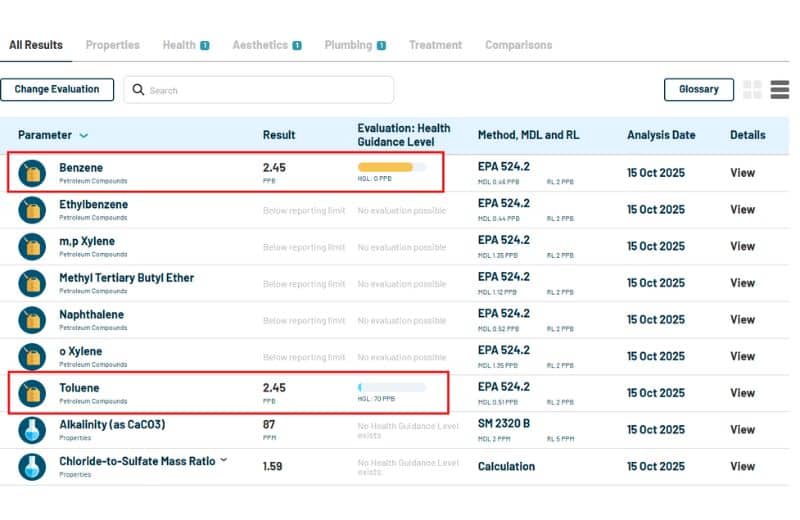
These weren’t detected in the baseline sample, suggesting leaching from filter materials or priming pump. We’re concerned about why these contaminants were detected, especially since they both pose health risks to humans even at trace levels (benzene is classified as a group 1 carcinogen by the IARC, and toluene exposure has been linked to liver, reproductive, neurological, carcinogenic, and respiratory effects.
One possibility is that benzene and toluene were introduced by the filter priming pump, since it was used to prime both the brand new foundation filters as well as fluoride filters we tested. Additional testing is required to confirm.
Aesthetic Contaminants
Score: 9.90
Chlorine was the only aesthetic contaminant detected in both baseline water samples*. Chlorine is a common disinfectant that affects water’s taste and smell, and it’s one of the key contaminants commonly removed to improve city water palatability.
Both the Boroux Foundation and Fluoride Filters use activated carbon, a highly adsorptive filter material that captures chlorine and its associated tastes and odors. So we were unsurprised to see that chlorine was reduced by 100% in our filtered water.
Performance Certifications
Score: 8.00 (Foundation Filters), 6.00 (Fluoride Filters)
When we originally reviewed the Boroux Legacy, its filters didn’t have any official performance certifications, although it had been third-party tested by IAPMO. We learned that Boroux was in the process of obtaining official performance certifications through the WQA, and these have finally been publicized.
The Foundation Filters are now certified for 2 out of the 84 contaminants they’re claimed to address on the Boroux website:
- NSF Standard 42, for Nominal Particulate Class I
- NSF 401, for microplastics
This is a big step in the right direction for large gravity-fed systems, as the majority of Boroux’s competitors don’t have any certifications at all.
That said, we still think Boroux could showcase its Foundation Filter elements in an even better light by initiating NSF 53 certifications for specific, concerning health-related contaminants, like lead, PFAs, and chromium. We’d also like to see certifications for the Fluoride Filters.
🚦Filtration Rate
Score: 7.50The Boroux Legacy is pretty average for a countertop gravity-fed filter when it comes to filtration rate.
When used with two Foundation Filters, we measured the unit’s filtration rate at 0.75 gallons per hour (GPH). The Fluoride Filters were slightly faster, with a flow rate of 0.9 GPH.
To compare this to a couple of other countertop stainless steel systems we tested, the ProOne Big+ had a very similar filtration rate of 0.77 GPH, and the Alexapure Pro had a rate of 1 GPH.
With this Boroux system, we noted that it filtered the first half of the top reservoir pretty fast, but got slower and slower as the pressure decreased (something that’s typical of these types of gravity systems). Even after just under 4 hours of filtering, the water was still about an inch and a half from the bottom of the filter.
You should get twice the filtration rate if you use the system with four filter elements (the maximum number that can be used), but that means spending more money upfront and on filter replacements. It might be worth it for you if you have a bigger family or you just want to filter as much water as possible through the system.
📐 Design
Score: 8.40There’s a lot that the Boroux Legacy does well when it comes to design, especially when we compare it to its competitors.
There were two key factors we used to score the system from a design perspective: its component quality, and whether or not it had obtained official certifications for its materials safety.
The Boroux Legacy looks just like any other stainless steel countertop system, with a cylindrical, stainless steel exterior that consists of two chambers.
It’s currently sold in four finishes:
- Silver stainless steel
- White stainless steel
- Black stainless steel
- Sage green

It’s available in two sizes, 3 gallons and now a smaller 1.8 gallon size. Previously they only had the large 3-gallon model, and it looks like they’ve heard customer feedback and requests for a smaller system that doesn’t take up as much counterspace.
As with all systems of this kind, you’re not going to get the most attractive or modern-looking unit, but the Legacy is practical and functional, which is the most important thing here.
Component Quality
Score: 10.00
The Boroux Legacy received one of the highest component quality scores we have ever awarded for a stainless steel countertop gravity system. It sidesteps a lot of the design issues that we’d noticed with other units.
The entire unit is made from stainless steel, which shouldn’t rust or corrode. Only a few components (such as the bases of the filter elements) are made of plastic.
Design Improvements, Flaws & Setbacks
The Boroux Legacy actually avoids many of the design flaws and setbacks that we’ve noted with similar stainless steel gravity systems, which we were pleased to see.
It’s great that Boroux has acknowledged the complaints received by customers of other manufacturers and has put in the effort to design its own systems to prevent these issues from occurring.
Here are some of the improvements that we noted with this particular design when we set it up and used it:
- There’s a stainless steel/ ceramic spigot included, rather than a plastic spigot, so filtered water isn’t coming into contact with plastic on its way out of the unit.
- A rubber base fits around the spigot, preventing leaks from the seal (as we have experienced with similar systems).
- The upper chamber is domed where the filters are installed, so when the water stops filtering, the filter media is not sitting in the water – only the plastic base of the filter element.
- The upper chamber is molded and fits into the lower chamber tightly

These are all great features and improvements, but there are still issues with this system’s design.
First, as we touched on earlier, the unit is only available in one large, 3-gallon holding capacity size. This makes it difficult and time-consuming to fill it with water from some kitchen sinks (including ours).
It took us 2:19 minutes to fully fill the top chamber using a pull-out spray handle. While this isn’t exactly a dealbreaker, we found it annoying having to stand around holding the handle rather than just turning the faucet on and walking away (as we could with other units like pitchers or countertop ROs, whose tanks fit under the faucet).
Unless you have a deep sink and a high faucet, or a pull-out spray faucet, you might end up needing to fill the unit using a separate jug or container.
We also noted that the lid doesn’t have a handle, so when it’s flipped, it can actually hit and cut off part of the top of the filter elements. This is an easy mistake to make, and fixing the issue will likely save Boroux a lot of complaints.
Filter Materials/Media
Activated carbon is the only filter media that’s listed as a component of the Boroux Foundation filters.
This media is non-toxic and is generally made from natural materials, like peat moss or coconut shell.
We also know that the filters contain silver, although this isn’t a filtering media itself – it just prevents the growth of microorganisms in the carbon media.
The Boroux Fluoride Filters are made from “dual-layer nano-carbon filtration“. We think this is just fancy marketing lingo Boroux made up to describe their filters. In reality, it’s likely bone-char carbon, the only type of activated carbon capable of reducing fluoride.
Certification
Score: 10.00 (Foundation Filter), 6.00 (Fluoride Filter)
The Boroux Foundation Filter now holds a WQA certification for two design-related certifications:
However, the Fluoride Filter isn’t currently certified, so it got the poorer score from us in this category.
⚙️ Setup
Score: 8.50We awarded Boroux’s setup score based on its ease of assembly, and how long the process took us. The company has recently made some pretty significant improvements to the filter priming process, which brought the original setup score of 6.5 up to 8.5.
Originally, Boroux used blue and tan filter priming equipment, and the process was time-consuming and annoying (exactly the same as with the Berkey filters).
But the new filter priming tool makes this part of the process so much faster. This time, it took us only 1.5 minutes to prime each of the four filters (so around 6 minutes in total, much faster than the original total priming time of 1 hour).
Aside from priming the filters, the actual unit assembly process was quick and easy, taking less than 20 minutes. We just washed and connected the six components. We then installed the primed filters and conducted the red dye test to check that there were no leaks.
Overall, setup took us just over 25 minutes from start to finish.
🔧 Maintenance
Score: 8.75We also assessed the Boroux Legacy’s servicing requirements and the long-term costs of the filters.
Servicing Requirements
Score: 7.50
Replacing the filters in the unit is easy enough, and after recently retesting the system, we increased the maintenance score to 7.50. The new automatic priming tool means you don’t need to spend ages manually priming the replacement filters before you can install them.
We also cleaned out the top and bottom water chambers once a week, which was a bit of a hassle due to their large size compared to the size of our sink. While not difficult, it does take some time to remove the filters and clean the unit, which is why it didn’t receive a higher score in this subcategory.
The manufacturer also recommends that you scrub the surface of the filters every 3-6 months using an abrasive scouring pad. This is to remove any built-up contaminants and restore a faster flow rate.
Costs
Score: 10.00
To determine the Boroux Legacy’s overall value for money, we calculated the cost-per-gallon of its filter elements.
The ongoing cost of the Foundation Filters came in at $0.011/ gallon (very affordable). The Fluoride Filters had a slightly higher cost-per-gallon of $0.11, owing to their shorter claimed capacity of 500 gallons per filter.
However, the claimed Foundation Filter capacity – 6,000 gallons per filter – seems extremely exaggerated, and this is just a claim for chlorine reduction only.
You can see in the manufacturer’s test report that other contaminants have only been tested for a few hundred gallons.
For example, they’ve only been tested to 400 gallons for common PFAS compounds, and only 200 gallons for herbicides like atrazine and 2,4-D.

That means we don’t know for sure that the filters will continue to effectively filter all contaminants throughout their claimed 6,000-gallon capacity.
It’s possible that, for instance, the filters might stop effectively addressing some contaminants after just 200 gallons, meaning that their overall effectiveness reduces over time.
We think this should be specified on the manufacturer’s website, rather than just boldly stating that the filters last 12,000 gallons – something that’s currently splashed all over the product pages and doesn’t tell the full story.
Just because the filters have been tested to reduce chlorine up to 6,000 gallons, doesn’t mean they will effectively reduce other contaminants up to 6,000 gallons. And this is evident in their own testing data which shows testing completed for certain contaminants after just 200 gallons of filtration.
🏢 Company
Score: 9.70To assess Boroux as a company, we looked at the warranty period, shipping, and returns for its products.
Warranty
Score: 10.00
Boroux offers a lifetime warranty against defects in materials and workmanship for its Legacy filtration system (including the chambers, spigot, washers, hole plugs, or wingnuts). The Foundation Filters and Fluoride Filters are warranted for a year against manufacturer defects.
You can view the warranty terms here.
Shipping
Score: 9.00
If you spend over $60 on your order, you’ll get free shipping when you buy from the manufacturer’s website.
Most Boroux products, including replacement filters, cost over $60, so you’ll probably always get your order shipped for free.
Boroux doesn’t currently ship to California or Iowa because these states require specific certifications that the Boroux Legacy doesn’t currently have.
Returns
Score: 10.00
Boroux offers a 101-day risk-free trial for all customers, entitling you to a 100% refund within the initial 101-day period after purchase if you’re not satisfied for any reason.
That’s a pretty decent returns policy that has been increased from the original 60-day money-back returns period.
💰 Value For Money
Boroux had originally been blending in with similar countertop gravity-fed systems, despite having a few design features that made it easier and less of a hassle to use.
But with its most recent series of updates, including obtaining official performance/design certifications and introducing an automatic priming tool, we think it now offers much better value for money.
Boroux’s pricing is now pretty much the same as Berkey’s, and you definitely do get more: a certified performance, simpler setup and maintenance processes, and a longer money-back guarantee period.
While it’s not the highest-scoring stainless steel gravity system we’ve tested (that accolade goes to the British Berkefeld), it’s now one of the top contenders in this filter category.
First I couldn’t find anywhere on the Boroux website to post a review. So I’ve used their black filters in combination with Berkey fluoride for one year. Taste is ok. However filters leave a film residue on the water in the bottom chamber. Two- the weird plastic wavy design makes it hard to clean. Theee, the black material is chipping away on the top part that’s most often is not submerged in water. I’ve never had these issues with Berkey original black filter. We have hard water and Berkey original filter did amazing job. Because during the clean up there was very little water residue on the metal surface of the chambers. I switched to Berkefeld/doulton – the British version 2 in 1 filter and fluoride. Less money, easier to clean, water tastes great. Takes up less space in the smaller units, so there is more space for water storage. I wish I could show you a photo of the floating residue. I use filtered water for my iron and for humidifier. Brand new iron and it’s already clogged up and humidifier has the same residue floating. I would not recommend Boroux. I see Berkey sellers are offering a new filter called Phoenix. Hope someone who used Berkey will test these properly.
Hi there! Does the score above (8.31) reflect the 12/9/25 update? Trying to decide between this filter and the British Berkefeld. Thanks in adance!
Yes that is correct
Great review Brian. We are enjoying our boroux and their customer service is top tier.
Cobalt is likely coming from the metal, not the filter. I’d do an extraction on the stainless unit and petcock. The filter utilized in the testing obviously had an affinity for heavy metals according to your results. It is highly doubtful then that cobalt precipitated from the filter.
It’s more likely from the stainless base or any associated unit metal objects in the delivery system from which the water is extracted.