

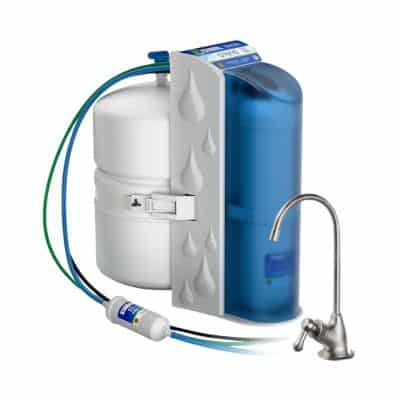
The Kind Water Pro-RO 6-Stage Reverse Osmosis System is a conventional under-sink RO system that has a unique design: the first four filter stages are contained within a single cartridge and the tank is clipped onto the back, reducing its footprint.
What We Like
What We Don’t Like
| Price | $446.45 |
| Contaminants Reduced | 13 certified contaminants (WQA NSF 58) |
| Certifications | NSF/ANSI 58 & CSA B483.1 (WQA certified) |
| Process | Sediment + Carbon + RO Membrane + Carbon + (claimed) Calcite Remineralization |
| Filter Capacity | 12 months (main cartridge), 6 months (inline filter) |
| Annual Cost | ~$321.27 |
| Warranty | 1 year |
Quick Verdict: Is the Kind Water Pro-RO Worth It?
The Kind Water Pro-RO scores 8.72/10 in our testing. In Tap Score lab tests of our Colorado city water, it cut total THMs from 22.7 PPB to 0 and removed uranium completely, but its marketed calcite remineralization stage added no measurable minerals: calcium fell 98.88% (73.3 PPM to 0.823 PPM) and pH dropped from 8.0 to 6.9.
Buy it if: your city water carries disinfection byproducts like THMs, or uranium, and you want a compact under-sink RO with just two replacement cartridges and no TDS creep.
Skip it if: fluoride is your main concern (0.3 PPM remained after filtration), you want mineralized or pH-balanced water, you need fast production (23.44 GPD, the slowest under-sink RO we’ve measured), or ongoing cost matters ($321.27 per year, the second-highest of the under-sink ROs we’ve tested).
See how we test and score water filters for our full methodology.
We were curious as to how combining a sediment filter, two carbon filters, and an RO membrane within the same cartridge could affect performance. To measure this, we conducted our own testing to evaluate its ability to purify a tricky municipal water supply in Colorado. We also assessed other performance factors, including filtration rate, pure-to-wastewater ratio, and TDS creep.
All the data we gathered in these tests has been discussed in this review.
📊 Scoring Data
Key Finding:
To compare the Pro-RO’s performance against the other RO systems we’ve reviewed already, we tested the unit using our comprehensive data-driven scoring system. Based on how the system performed, we assigned scores across 6 performance categories: contaminant reduction, filtration rate, design quality, installation, maintenance, and company policies.
Alongside these core metrics, we also reviewed a number of RO-specific performance factors, including efficiency ratio and recovery rate. These don’t currently influence the system’s final scores, but they provide additional insight that helps us understand its overall value in the reverse osmosis space.
See how the Kind Pro-RO performed in the table below.
| Criteria | Results |
|---|---|
| Overall Score | 8.72 |
| Health Related Contaminants | 9.50 |
| Aesthetic Related Contaminants | 9.90 |
| Performance Certification | NSF/ANSI 58 |
| Filtration Rate | 23.44 GPD (0.02 GPM) |
| Component Quality | Outstanding |
| Component Certification | Exceptional |
| Setup | Weak |
| Servicing Requirements | Good |
| Costs | $0.29/ gallon |
| Warranty Length | 1 year |
| Shipping | Free on all orders in the US |
| Returns | 120 days |
🚰 Contaminant Reduction
Score: 9.27Key Finding: Tap Score lab testing showed the Pro-RO brought all 5 contaminants that exceeded health guidelines in our water below those guidelines, removing THMs and uranium completely and cutting fluoride 86.36% (2.2 PPM to 0.3 PPM).
Our contaminant reduction testing evaluates the most important feature of any reverse osmosis system: its ability to purify drinking water.
The Pro-RO has 6 stages of filtration and is claimed to remove everything from sediment to chlorine, chloramine, VOCs, pesticides, salts, heavy metals, and TDS.
Our own laboratory and in-house tests have the biggest influence on the score we award in this category. But we also look for performance certifications for contaminant reduction, which are especially helpful in validating a filter’s ability to address impurities that our test water doesn’t contain.

Our Performance Testing
Score: 9.52
Starting with our own performance testing, we used Tap Score lab tests to identify most of the contaminants in our source water. Lab testing is a more accurate and comprehensive alternative to DIY tests, indicating concentrations of each contaminant down to the decimal.
We took two samples of our water: one baseline sample directly from our faucet, and one purified sample* from the dedicated RO faucet. Then, when we received our Tap Score test reports, we compared our data against the Health Guideline Levels (HGLs) as our primary benchmark.
To complement this testing, we conducted our own on-site tests for chlorine and pH. Our chlorine readings were taken using a digital colorimeter, and our pH testing was conducted with a pH meter.
Health-Related Contaminants
Score: 9.50
Most folks are interested in RO because they want to make their water safer to drink by removing contaminants with health effects. We put the Kind Water Pro-RO to the test with a tricky water supply, with elevated TDS, hardness, and sodium, and active disinfection byproducts.
17 contaminants were detected in our baseline sample, with 5 of these exceeding the HGL: bromodichloromethane, bromoform, and dibromochloromethane (three disinfection byproducts in the THMs group), along with fluoride and uranium.
The rest of the contaminants were detected at concentrations not exceeding the HGL: barium, boron, total chromium, copper, manganese, molybdenum, nitrate, nitrite, selenium, strontium, sulfate, and vanadium.
We’ve listed all the contaminants detected and their concentrations in the table below.
| Analyte | Unit | Result Value | Kind Water PRO-RO | Difference |
|---|---|---|---|---|
| Alkalinity (as CaCO3) | PPM | 356 | 0 | -100.00% |
| Barium | PPM | 0.0319 | 0 | -100.00% |
| Bicarbonate | PPM | 430 | 0 | -100.00% |
| Boron | PPM | 0.41 | 0.257 | -37.32% |
| Bromodichloromethane | PPB | 4.38 | 0 | -100.00% |
| Bromoform | PPB | 8.01 | 0 | -100.00% |
| Calcium | PPM | 73.3 | 0.823 | -98.88% |
| Carbonate | PPM | 1.98 | 0 | -100.00% |
| Chloride | PPM | 99.7 | 6.8 | -93.18% |
| Chloride-to-Sulfate Mass Ratio | 0.639 | Very High | N/A | |
| Chromium (Total) | PPM | 0.00308 | 0 | -100.00% |
| Copper | PPM | 0.233 | 0 | -100.00% |
| Dibromochloromethane | PPB | 10.3 | 0 | -100.00% |
| Expanded Hardness | PPM | 248 | 2.06 | -99.17% |
| Fluoride | PPM | 2.2 | 0.3 | -86.36% |
| Grains per gallon | Grains | 14.4 | 0.12 | -99.17% |
| Hardness | PPM | 247 | 2.06 | -99.17% |
| Langelier Saturation Index | 0.744 | N/A | N/A | |
| Magnesium | PPM | 15.5 | 0 | -100.00% |
| Manganese | PPM | 0.0011 | 0 | -100.00% |
| Molybdenum | PPM | 0.00119 | 0 | -100.00% |
| Nitrate (as N) | PPM | 2.5 | 0.7 | -72.00% |
| Nitrite (as N) | PPM | 0.5 | 0 | -100.00% |
| pH | pH | 8 | 6.9 | -13.75% |
| Potassium | PPM | 3.03 | 0 | -100.00% |
| Selenium | PPM | 0.00361 | 0 | -100.00% |
| Sodium | PPM | 178 | 9.93 | -94.42% |
| Sodium Adsorption Ratio | 4.92 | 3.01 | -38.82% | |
| Specific Conductivity | umhos/cm | 1210 | 54.8 | -95.47% |
| Strontium | PPM | 0.757 | 0 | -100.00% |
| Sulfate | PPM | 156 | 0 | -100.00% |
| Total Dissolved Solids | PPM | 707 | 33 | -95.33% |
| Total THMs | PPB | 22.7 | 0 | -100.00% |
| Uranium | PPM | 0.0118 | 0 | -100.00% |
| Vanadium | PPM | 0.00118 | 0 | -100.00% |
After filtering our water through the Pro-RO, all three total THMs were completely eliminated down to 0. This is a super reassuring result, especially since THMs are regulated carcinogens in drinking water.
Uranium was also completely removed, and fluoride was reduced by 86.36%, down to 0.3 PPM. This post-filtration fluoride concentration no longer exceeded the HGL, but many similar systems we’ve tested have removed fluoride entirely.
As for the contaminants below the HGL, most were removed 100%, with the exception of nitrate (reduced by 72%) and boron (reduced by just 37%).
Nitrate is typically removed at much higher rates (98%+), but many of the RO systems we tested performed similarly to the Pro-RO, so it’s possible that our lower-than-recommended incoming water temperature and pressure played a part in this slightly poorer result.
As for boron, RO systems famously struggle to reduce this contaminant (boric acid is uncharged at neutral pH and slips through most membranes), so the poor reduction isn’t a fault of this unit. Most similar systems we tested struggled with boron reduction, too.
Aesthetics, pH, and Mineral Content
Score: 9.90
The Pro-RO’s product page markets a pre-installed inline calcite remineralization filter, which is used as a final-stage treatment to reintroduce calcium and magnesium and balance pH.
So, we were expecting the pH of our water to increase, or at the very least, stay the same. We also expected to see 60-80% reductions of calcium and magnesium, rather than closer to 100%, indicating that the remineralization filter is introducing these minerals into the purified water.
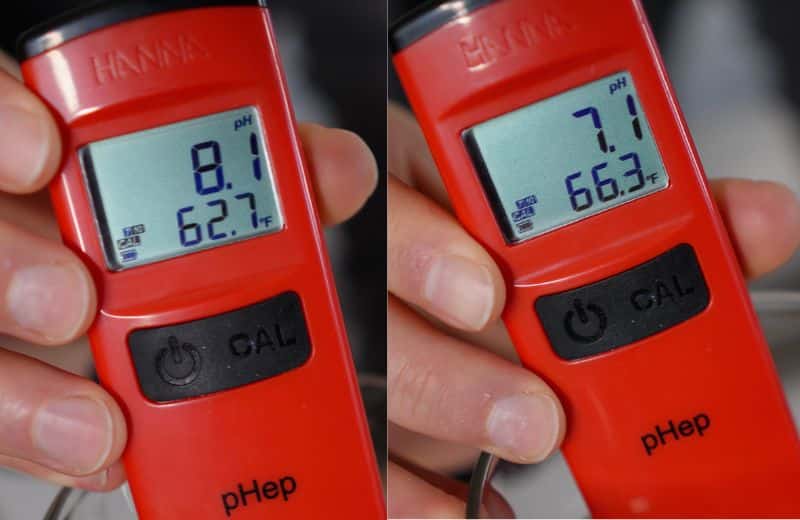
But the pH of our purified water actually dropped from 8.0 to 6.9 (or from 8.1 to 7.1 in our on-site pH tests); an unusual result given that calcite media should raise pH, not let it fall.
Another unexpected result was that calcium was reduced by 98.88%, from 73.3 to 0.823 PPM. Since calcite is calcium carbonate, again, it should measurably add calcium back.
Plus, alkalinity dropped from 356 all the way down to 0, and bicarbonate was eliminated, from 430 to 0. These are both markers of calcite activity, so we would expect them to be retained in our remineralized water.
Magnesium and potassium were completely eliminated, and hardness was reduced by 99.17% — unsurprisingly, given that all minerals that contribute to hardness had been essentially removed.
So what does that mean? We have a few possible theories:
- We received a faulty remineralization filter
- We tested our water during a calcite break-in period, where the filter wasn’t performing as well as it would beyond this period
- We made an installation or seating issue
- The inline cartridge simply has a weak design
The only way to narrow down these theories is to conduct a couple of retests: one after filtering more water through the filter, and one after installing a replacement filter.
If you buy this system, we recommend verifying your own output with hardness test strips and pH strips/a pH meter.
Water Corrosivity
We also want to touch on a result that ties into the reductions in pH and alkalinity that we recorded.
Our water’s chloride-to-sulfate mass ratio jumped to “very high” (sulfate was fully removed, while some chloride remained). Additionally, alkalinity fell from 356 PPM to 0, calcium fell to 0.823 PPM, and pH was reduced to 6.9. Tap Score didn’t report a Langelier Saturation Index for the purified sample (our tap water’s was 0.744), but water with no alkalinity, almost no calcium, and a pH below 7 is aggressive toward plumbing.
These data point to a potentially concerning result: our output water sample was corrosive, meaning it can accelerate plumbing corrosion (especially lead solder).
This is something we’d expect from a reverse osmosis system without remineralization, but with it should be mitigated by the calcite stage in the Pro-RO. Apparently it didn’t in our test, which is disappointing.
TDS & TDS Creep
TDS creep causes TDS levels to temporarily increase in water purified by an RO system after a period of disuse (such as overnight).
It primarily affects tankless systems that bypass the storage tank and send water straight through the RO membrane to the faucet. But several tank-based systems have shown signs of TDS creep in our tests, which is why we don’t limit our testing to tankless models.
We took on-site TDS measurements with a TDS meter. With this data, we compared TDS in our feed water sample with our initial output TDS after letting the Pro-RO sit idle for 9 hours.
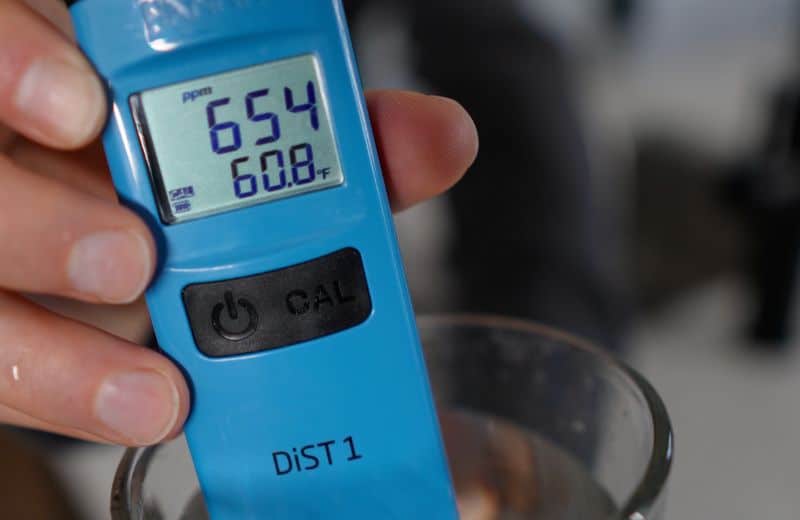
Our initial, before-filtration reading was 654 PPM, and our first-draw sample from the RO faucet measured 44 PPM—not indicative of TDS creep.
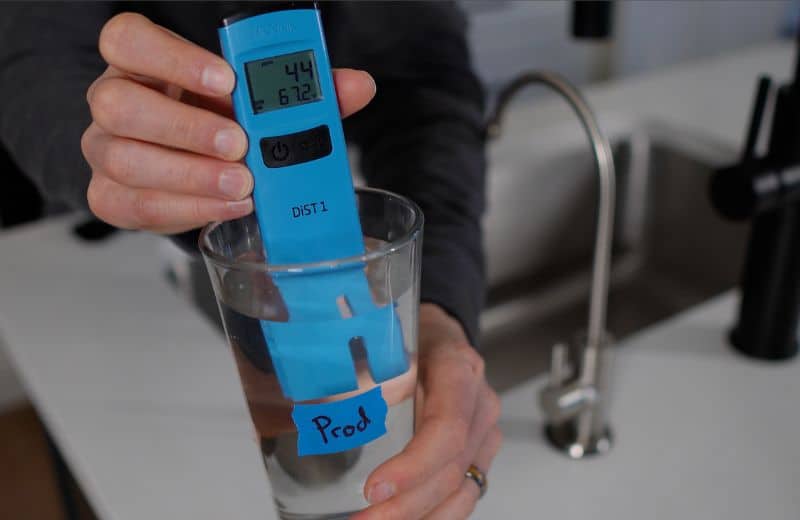
We then let water run through the system for 2 minutes before taking a second draw reading from a sample collected in a separate glass. This time, the TDS reading was 25 PPM (both before and after remineralization).
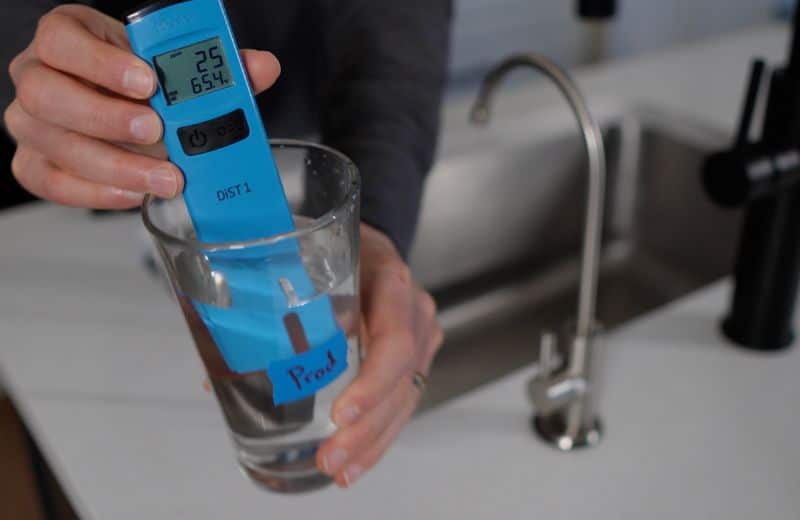
The difference between the 1st and 2nd draw was 19 PPM, which doesn’t suggest that TDS creep is an issue.
In comparison, some RO systems we tested had a first-draw reading in the hundreds, with a much lower second-draw reading in the 30-60 range. This does suggest TDS creep because the initial draw of water had temporarily higher concentrations of dissolved solids.
| Test Condition | TDS (PPM) |
|---|---|
| Feed Water | 654 |
| 1st Draw (After 9 hrs idle) | 44 |
| Stable TDS (With Remin Filter) | 25 |
| Stable TDS (Without Remin Filter) | 25 |
| TDS Reduction | 96.2% |
| TDS Creep | None Detected (19 PPM difference) |
Performance Certifications
Score: 7.00
Our source water didn’t have detectable lead, arsenic, mercury, cadmium, PFAS, or VOCs, so our Tap Score tests couldn’t validate the Pro-RO’s performance on those contaminants.
That’s why we also look for official performance certifications awarded by the NSF, WQA, or IAPMO, validating the contaminants that we were unable to measure ourselves.
The Pro-RO has obtained a WQA certification to NSF Standard 58 for the reduction of 13 contaminants: arsenic, barium, cadmium, copper, cysts, fluoride, chromium-6, lead, radium 226/228, selenium, TDS, trivalent chromium, and turbidity.
The WQA certifies to NSF/ANSI standards using controlled challenge testing, so it’s a big boost of confidence if you want to confirm that the system can address contaminants you actually care about removing.
This is a great result, but none of these contaminants are listed on the product page. Our scoring for performance certifications is based on the percentage of these listed contaminants that a filter has been certified to reduce, hence why the score we awarded in this category wasn’t higher.
Kind should definitely make it clearer on the product page that the Pro-RO has been certified to reduce these contaminants — it’s a missed opportunity to differentiate their product from the competitors and they spent all that time and money to get it certified, I’m surprised to see the marketing doesn’t match up.
🚦Filtration Rate
Score: 6.00Key Finding: The Pro-RO produced 23.44 GPD (0.02 GPM) with 60.8°F feed water at 51 PSI, the slowest of the 11 under-sink RO systems we’ve measured, although faster than the 12.3 GPD production rate listed in Kind’s manual.
The Kind Water Pro-RO has a membrane rating of 50 GPD (gallons per day), but the entire system has a projected flow rate of 14.61 GPD. That’s very low, even for a conventional RO system (most are rated at around 50–100 GPD).
The actual rate of filtration is influenced by factors including water temperature and pH, along with incoming water pressure. With our feed water temperature and pressure being on the lower end, at 60.8°F and 51 PSI, we were slightly concerned about just how slowly water would be delivered to our faucet.
The system’s rated production rate of 12.3 GPD (per Kind’s manual) translates to just 0.0085 GPM (gallons per minute), much lower than the average flow rate from a modern kitchen faucet of 1.5 to 2.2 GPM.
To measure the Pro-RO’s flow rate under our own test conditions, we filled a graduated measuring container with purified water and timed how long it took. We recorded footage of this process and uploaded it onto an editing tool, moving through frame by frame to get precise start and end points.
In our first test, it took 345.49 seconds to fill a measuring jug to the 12-ounce line, based on the average taken from 3 identical tests. This translates to a flow rate of 0.02 GPM, or 0.98 GPH (gallons per hour).
In gallons per day, that’s approximately 23.44 GPD: the slowest of the 11 under-sink RO systems we’ve tested, 9.21 GPD behind the next slowest (the AquaTru Under Sink Gen 2, at 32.65 GPD), but faster than Kind’s projected flow rate of 14.61 GPD.
| Test Metric | Result |
|---|---|
| Time to Fill 12 oz | 345.49 seconds |
| Measured Flow Rate | 0.02 GPM |
| Gallons Per Hour | 0.98 GPH |
| Converted GPD | 23.44 GPD |
| Manufacturer Claim | 12.3 GPD |
Efficiency Ratio
All RO systems waste water, and our testing in this category helps us understand which systems are more efficient than others.
Flow rate and efficiency ratio tend to be interlinked: when water flows more slowly through the RO membrane, a higher volume of water is drained.
Plus, our test water conditions don’t allow for the most efficient performance: our cooler water temperature of 60.8°F and lower incoming pressure of 51 PSI likely affect the speed of water through the membrane.
With that in mind, we expected the Pro-RO to waste more water than similar models due to its slower rate of filtration.
We conducted our recovery rate testing by disconnecting the drain line and directing the wastewater into a measuring container, while we filled a separate container with 12 ounces of purified water.
When the 12-ounce line was reached, 45 ounces of wastewater had been collected, translating to a pure-to-drain ratio of around 1:3.75 (a 21.05% recovery rate). That means 3.75 ounces of water is wasted per 1 ounce purified, which is more efficient than 4 of the 8 other tank-based RO systems we’ve tested.
| Test Volume | Wastewater Produced | Pure-to-Drain Ratio |
|---|---|---|
| 12 oz Test | 45 oz | 1:3.75 |
| 64 oz Test | 230 oz | 1:3.59 |
| Claimed by Manufacturer | – | Not Specified |
We then repeated the process with a larger purified water draw of 64 ounces (½ gallon). This time, 230 ounces of drain water were produced, equating to a pure-to-drain ratio of 1:3.59 (3.59 ounces wasted per 1 ounce purified), or a 21.77% recovery rate. That’s slightly better than our smaller volume test, but far behind tankless systems like the Waterdrop G3 P800, which recovered 68.82% of its water on the same 64-ounce draw.
📐 Design
Score: 9.70Key Finding: The Pro-RO fits its first four filtration stages into one cartridge and clips its 3-gallon tank onto the back for a footprint of about 9.75 inches wide by 13.5 inches deep, and it earned a perfect 10.00 for materials safety certification through its WQA NSF 58 listing.
There are two factors we look at when we award scores in the design category: our own notes on component quality, and the presence of design certifications.
A big selling point of the Pro-RO is its compact design. It’s fairly tall, at around 15.5 inches, but it’s just 9.75 inches wide, with a depth of 13.5 inches, even with the 3-gallon tank clipped onto the back.
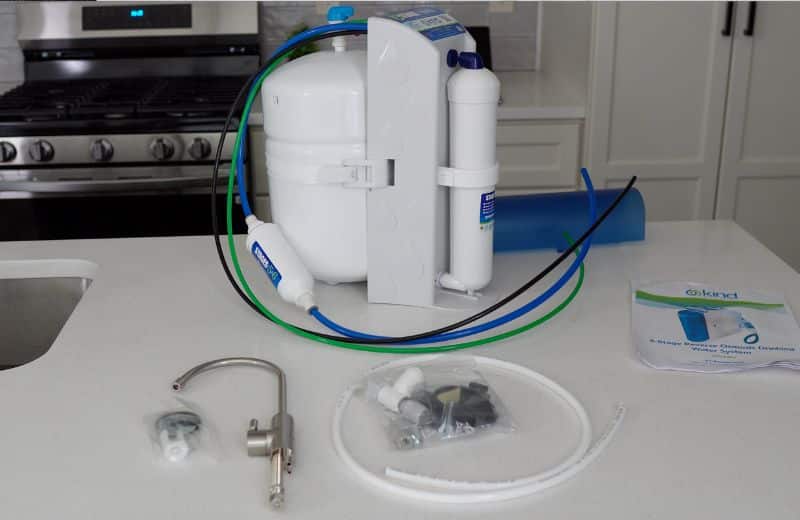
Also included in the box is a dedicated faucet, which is available in various finishes: chrome, brushed nickel, and oil-rubbed bronze. This is an optional add-on, presumably in case you want to choose your own RO faucet from another seller or you already have one installed from an existing RO system.
Component Quality
Score: 9.50
The Pro-RO has a high-quality design that uses NSF-certified plastics. It’s solid and sturdy-feeling, with very few small or flimsy components, so the risk of snapping or cracking due to wear is lower.
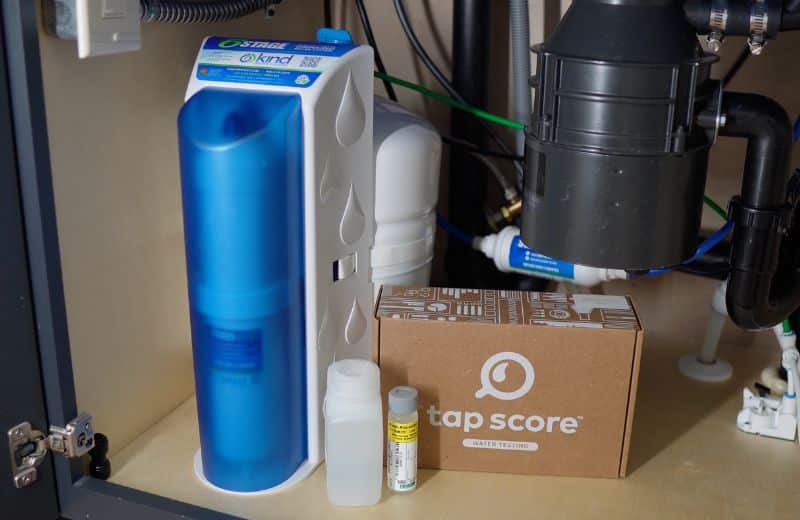
The product page doesn’t specify what kinds of plastics are used in the system. We contacted customer support, but we didn’t receive a response, even after sending a follow-up email.
Filter Materials
There are 2 separate filter cartridges in the Pro-RO:
- A 4-stage cartridge that combines a sediment and carbon pre-filter, a 50 GPD membrane, and a granular activated carbon (GAC) post-filter
- A 2-stage inline cartridge that features coconut shell carbon and calcite media
As we mentioned at the beginning of this review, we were concerned about how combining multiple filtration stages within a single cartridge would affect performance. But the system removed or reduced most contaminants in our water, which is exactly what we expect from RO.
Materials Safety Certification
Score: 10.00
Materials safety certifications provide validation of component quality and design safety from a trusted third party. These are awarded by the NSF, IAPMO, or the WQA, providing evidence of construction quality beyond the manufacturer’s own claims.
RO filters can obtain two design certifications:
- NSF/ANSI 372, for lead-free design
- Materials safety, obtained as part of a performance certification
The Pro-RO has been certified for materials safety as a component of its NSF 58 performance certification, telling us that it has been tested and confirmed safe under normal, expected use conditions.
⚙️ Setup
Score: 7.00Key Finding: Installation took 2 hours and left 11 potential leak points, because the Pro-RO’s airgap faucet (the only one among the RO systems we’ve tested) cancelled out the time saved by its pre-connected tank, hoses, and inline filter.
We expected the Pro-RO to have a challenging setup, both because of the trickier nature of installing RO systems and because of the added steps involved in installing the tank.
But actually, while there are no shortcuts when it comes to installing the drain line and dedicated faucet, some aspects of setup were easier for this system than for others, like APEC and iSpring conventional systems. This is largely thanks to a few considered design choices to minimize the work required by the installer.
For instance, the system comes mostly assembled out of the box, with all hoses already connected to the unit, and the tank already hooked up and connected. Even the inline GAC + remin filter is already connected, which meant we could essentially just install the system straight under our sink without having to connect the parts first.
That said, there were some unique challenges that came with installing this particular system.
First, the user manual is rougher than others we’ve come across, with pages printed out on printer paper and stapled together. That said, the quality of the instructions themselves is good, and we found them easy to follow for the most part.
Another issue was the faucet installation. The Pro-RO is the only unit we’ve tested so far that uses an airgap faucet, which meant we had to install everything in a different order. The user manual outlines the installation process if you want to see exactly what’s involved.
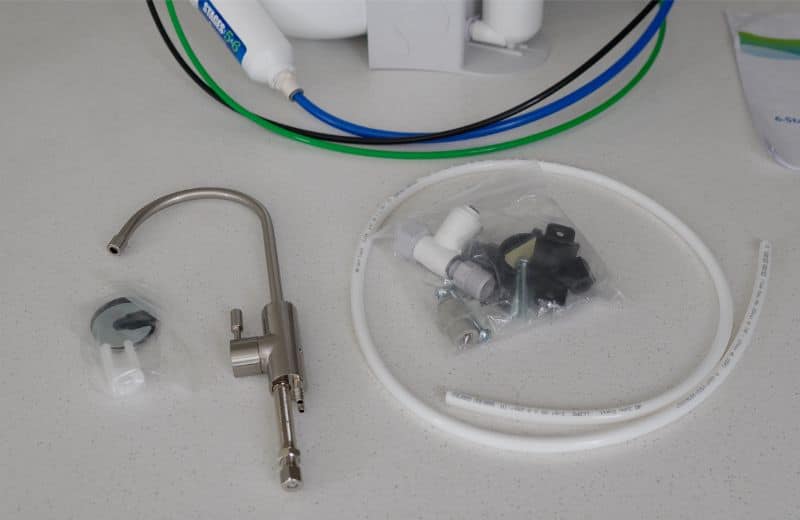
We found the faucet difficult to install compared to the others, because it takes so long fiddling with the washers and wrenches under the sink. As a result, the time we saved by the other tubes being preinstalled was essentially cancelled out by the extra time it took to do the faucet install. In all, the complete installation took 2 hours from start to finish.
We detected 11 potential leak points at the fittings and connections, although no leaking occurred during our testing.
Once we’d installed the system, we followed the instructions for the break-in flush. This involved an initial pressurization and flush with the tank bypassed, which took 15 minutes, followed by filling the tank, letting the water sit overnight, then emptying and refilling the tank at least 3 times (or until the chlorine smell is gone).
Noise
We used a phone app to measure the noise produced (in decibels) by the Pro-RO while it was running. Like most conventional systems, it doesn’t use an internal pump, so we didn’t expect it to be noisy when filtering our water.
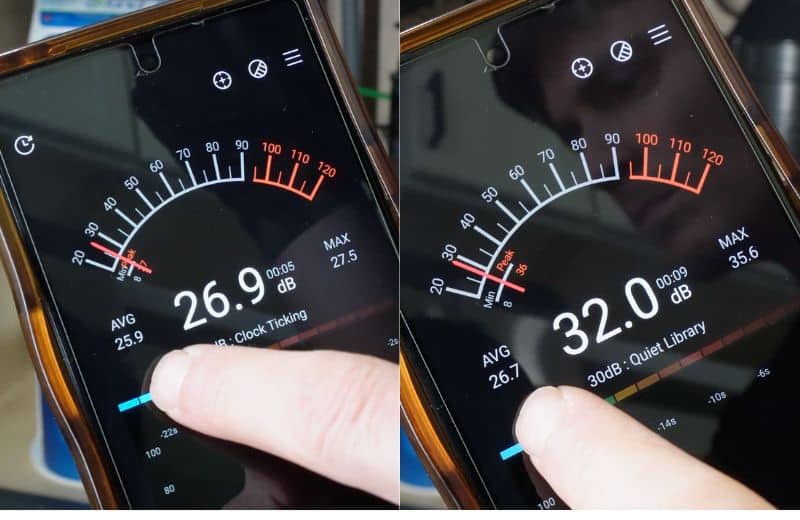
We measured sound decibels at 1 foot and 3 feet away:
- At 1 foot, the unit produced 25.9 decibels.
- At 3 feet, it produced 26.7 decibels.
That makes it one of the quieter units we’ve tested — we could barely hear it while it was on.
There’s a good chance that most of the noise picked up by the dB app is actually just background noise from the refrigerator in our kitchen, especially since the app picked up more noise when it was farther away (and closer to the fridge).
🔧 Maintenance
Score: 9.25Key Finding: The Pro-RO needs just two replacement cartridges (the main cartridge every 12 months and the inline filter every 6 months), but at $321.27 per year it has the second-highest ongoing cost of the 11 under-sink RO systems we’ve tested.
RO systems only keep on functioning with regular maintenance, and we score the products we test based on their servicing requirements and ongoing filter replacement costs.
The Pro-RO performed well in this category, being both easy and affordable to maintain.
Servicing Requirements
8.50
With just two filter cartridges to replace, this Kind Water model is easier to maintain than other RO systems, most of which have 3-5 separate filters. The larger filter has an estimated lifespan of 12 months, while the smaller inline filter lasts around 6 months.
Replacing the filters is easy, too: you just close the unit shut-off valves, open the faucet to relieve pressure, then remove and replace the existing cartridge with a new one. You then reopen the valves and flush the system at least once following the installation flushing instructions.
That said, there’s no integrated filter lifespan tracker as many tankless systems now have, which prevented the system from scoring higher in this category. While it’s not necessarily a dealbreaker for most folks, you lose the convenience of being able to tell at a glance when a filter needs replacing.
Costs
Score: 10.00
We calculated* that the Pro-RO has an overall ongoing spend of $0.29 per gallon, equivalent to a total annual cost of $321.27, or a 5-year ownership cost of $2,052.80.
That’s above the $1,000 to $2,000 range that most of the under-sink RO systems we’ve tested fall into, and the second-highest 5-year cost in our test group, behind only the Aquasana SmartFlow ($2,564.62). It still earns full marks in this category, because our cost score is based on cost per gallon and anything under $0.30 per gallon scores 10.00.
*Kind doesn’t publish a rated gallon capacity for the Pro-RO’s cartridges, so we estimated cost per gallon from the manufacturer’s replacement intervals (12 months for the main cartridge, 6 months for the inline filter) and 3 gallons of RO water per day. Your actual cost per gallon will vary with how much water you use.
🏢 Company
Score: 8.5Key Finding: Kind ships free across the US with no minimum and accepts returns for 120 days, but its 1-year warranty only applies to feed water with 1 PPM of chlorine or less, and our city water measured 2.9 PPM.
Our final scoring category evaluated Kind Water as a company, based on its warranty, shipping, and returns offerings.
Warranty
Score: 8.50
The Pro-RO is backed by a 1-year warranty. Kind’s manual spells out what the warranty covers: manufacturer-supplied parts that prove defective in material, workmanship, or factory preparation, for the first full calendar year after purchase. It’s a parts-only warranty (labor isn’t covered), and it excludes filters, membranes, O-rings, and other parts that need regular replacement.
It’s not the best warranty we’ve seen for an RO system (some are warranted for 5 years or more).
Plus, it only applies if your feed water contains 1 PPM of chlorine or less, doesn’t contain iron, hydrogen sulfide, or manganese, and has an operating temperature within 40–80 PSI and a temperature of 40–100°F.
You can find the warranty information here. The longer list of terms and exclusions is in the user manual.
Shipping
Score: 10.00
Kind Water offers free shipping on all orders in the US.
And that’s it! There are no terms or minimum spends to be aware of. It’s one of the most generous shipping policies we’ve come across in a while.
View Kind Water’s shipping policy here.
Returns
Score: 7.00
At first glance, Kind Water’s 120-day satisfaction guarantee looks great. Beyond just being a returns policy, the guarantee allows you to return the system within 120 days of your order if you’re not satisfied with it for any reason.
But there are several stipulations that lowered our score in this category:
- You need to get prior authorization from the manufacturer
- The product needs to be repackaged in the original box, with all the original components
- You, the customer, are responsible for return shipping fees
Here’s the Kind Water returns policy for more information.
💰 Value For Money
We think some folks will think the Kind Water Pro-RO is great value for money, while for others, there may be a better alternative to buy instead.
In our testing, the Pro-RO proved itself as a reliable contender for municipal water with disinfection byproduct concerns. It’s backed by strong certification credibility for both contaminant reduction and design safety, and we were pleased with the quality of its construction.
But our test data raises a real question mark on whether the marketed remineralization is actually working. Plus, the system left 0.3 PPM of fluoride in our water, while the APEC ROES-PH75 removed it completely (2.4 PPM to 0) in our testing. The Pro-RO’s 23.44 GPD filtration rate is also the slowest of any under-sink RO we’ve measured, although its water efficiency is middle of the pack for tank-based systems.
We think the Pro-RO isn’t the top pick if your primary concern is fluoride, nitrate, or guaranteed remineralized output. But if your water doesn’t contain these contaminants and you’re not too worried about remineralization, it’s definitely one to consider.
❔ Kind Water Pro-RO FAQ
Q: Is the Kind Water Pro-RO worth it?
A: For city water with disinfection byproducts or uranium, yes. It scored 8.72/10 in our testing and cut total THMs from 22.7 PPB to 0 in Tap Score lab tests. It’s a weaker buy if you want remineralized water, complete fluoride removal, fast production (23.44 GPD), or low running costs ($321.27 per year).
Q: Does the Kind Water Pro-RO remineralize water?
A: Not in our testing. Despite its marketed calcite stage, calcium fell 98.88% (73.3 PPM to 0.823 PPM), alkalinity dropped from 356 PPM to 0, and pH fell from 8.0 to 6.9 in Tap Score lab results. On-site, TDS read 25 PPM both before and after the remineralization stage, and the 1.0-unit pH drop we measured (8.1 to 7.1) was the largest of the 11 under-sink RO systems we’ve tested.
Q: Does the Kind Water Pro-RO remove fluoride?
A: It reduces fluoride, but not completely. In our Tap Score lab test, fluoride fell 86.36%, from 2.2 PPM to 0.3 PPM, which brought it below the health guideline level. The system is also WQA certified to NSF/ANSI 58 for fluoride reduction. Other RO systems we’ve tested, including the Cloud RO, removed fluoride entirely.
Q: How fast is the Kind Water Pro-RO?
A: We measured 23.44 gallons per day (0.02 GPM) with 60.8°F feed water at 51 PSI, the slowest of the 11 under-sink RO systems we’ve tested. That’s faster than the 12.3 GPD production rate in Kind’s manual but well below the 50 GPD rating of its RO membrane.
Q: How much water does the Kind Water Pro-RO waste?
A: In our 64-ounce test, it sent 230 ounces to the drain, a pure-to-drain ratio of 1:3.59 (21.77% recovery). That’s more efficient than 4 of the 8 other tank-based RO systems we’ve tested, but far less efficient than tankless systems like the Waterdrop G3 P800, which recovered 68.82% of its water on the same 64-ounce draw.
Q: How often do you replace the Kind Water Pro-RO filters, and what does it cost?
A: There are only two cartridges: the main 4-stage cartridge every 12 months and the inline carbon and calcite filter every 6 months. That adds up to $321.27 per year, or $0.29 per gallon at 3 gallons a day, and a 5-year ownership cost of $2,052.80, the second-highest of the under-sink RO systems we’ve tested.
Q: What does the Kind Water Pro-RO warranty cover?
A: Kind’s warranty covers manufacturer-supplied parts that prove defective in material or workmanship for the first full calendar year after purchase. It’s parts only (no labor), and it excludes filters, membranes, and O-rings. It also only applies if your feed water has 1 PPM of chlorine or less, no iron, hydrogen sulfide, or manganese, a pressure of 40 to 80 PSI, and a temperature of 40°F to 100°F. Our Colorado city water measured 2.9 PPM chlorine, so check your supply before counting on that coverage.
Q: Kind Water Pro-RO vs APEC ROES-PH75: which is better?
A: The APEC ROES-PH75 scored higher in our testing (8.87/10 vs 8.72/10). It removed fluoride completely (2.4 PPM to 0), produced 42.74 GPD versus the Pro-RO’s 23.44 GPD, and costs about $133 a year in filters versus $321.27. The Kind Pro-RO wastes less water (1:3.59 vs 1:5.1 on a 64-ounce draw) and has only two cartridges to replace.
Found this review helpful?
Comment below or share this article!