

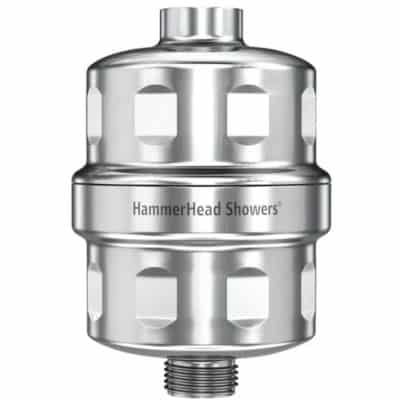
The Hammerhead Shower Filter is an inline shower filter that’s installed upstream of your existing showerhead. It’s designed to reduce “chlorine, heavy metals, and odors”, resulting in “softer hair and smoother skin” after showering.
What We Like
What We Don’t Like
| Price | $99.95 |
| Contaminants Reduced | 1 (chlorine, partial reduction verified in our testing) |
| Certifications | Not Certified |
| Process | KDF-55 + calcium sulfite |
| Filter Capacity | 10,000 gallons |
| Annual Cost | ~$70–$140 |
| Warranty | Limited lifetime |
Quick Verdict: Is the Hammerhead Shower Filter Worth It?
The Hammerhead Shower Filter scores 7.45/10 in our testing, with a 6.00 contaminant reduction score that ties for the lowest of any shower filter we have tested. It reduced free chlorine by just 54.17% (1.68 PPM down to 0.77 PPM) in our on-site testing, and our Tap Score lab results showed no reduction to disinfection byproducts or water hardness.
Buy it if: you want a durable, mostly metal inline filter that works with your existing showerhead, maintains water flow (99% retained in our testing), and is backed by the strongest warranty and returns policies of any shower filter brand we have reviewed (9.70 company score).
Skip it if: you want chlorine or DBPs actually removed from your shower water. The Weddell Duo was the only shower filter in our testing to remove 100% of both.
See our How We Test Water Filters methodology for full scoring details.
We conducted our own comprehensive series of tests in a Colorado home to see how this product performed in real-world conditions. Our analysis evaluated how effectively the filter could remove chlorine, disinfection byproducts, and hardness minerals, along with its construction quality, filtration rate, maintenance requirements, and several other factors affecting its value for money.
All our testing data for the Hammerhead Shower Filter has been shared and discussed in this review.
📊 Scoring Data
At Water Filter Guru, we conduct our own independent testing and analysis to gather the data used to produce all our water filter reviews.
We rank each product using our weighted scoring system, evaluating 6 different factors affecting performance, ease of use, and value for money. Along with contaminant reduction, we also assess filtration rate, design quality, ease of installation and servicing, and the manufacturer’s own policies.
After testing a filter, we’ll compare our scores to every other product we’ve analyzed to date.
You can see how the Hammerhead Shower Filter performs against the other top performing shower filters we’ve tested in the next table.
| Criteria | Results |
|---|---|
| Overall Score | 7.45 |
| DBPs | 6.00 |
| Disinfectant residual | 6.00 |
| Hardness | 6.00 |
| Performance Certification | Not Certified |
| Filtration Rate | 1.71 GPM |
| Component Quality | Outstanding |
| Component Certification | Not Certified |
| Setup | Excellent |
| Servicing Requirements | Excellent |
| Costs | $0.024/gallon |
| Warranty Length | Limited Lifetime |
| Shipping | Free on orders over $50 |
| Returns | 90 days |
🚰 Contaminant Reduction
Score: 6.00Key Finding: The Hammerhead Shower Filter reduced free chlorine by 54.17% in our testing (1.68 PPM to 0.77 PPM) and made no measurable reduction to disinfection byproducts or hardness.
With any water filter, our primary focus is contaminant reduction. We want to see that it fulfils its purpose: improving water quality by reducing (or ideally completely removing) the impurities that are known to be problematic.

We scored the Hammerhead Shower Filter for contaminant reduction based on our own on-site tests and third-party lab testing by Tap Score. Performance certifications also influence the overall score in this category, although not as heavily.
Our Performance Testing
Score: 6.00
Our performance testing focused on comparing the concentrations of contaminants in our shower before and after it was treated with the Hammerhead Shower Filter.
- Before we installed the filter, we took a baseline sample of unfiltered water from our showerhead.
- Next, we installed the filter upstream of our showerhead, flushed it for 1.5 minutes, conducted our flow rate tests, and then collected a sample of filtered water.
We sent both samples to Tap Score for laboratory testing.
We do things a bit differently when scoring shower filters for contaminant reduction. Since these filters aren’t designed for drinking water, we don’t focus on contaminants that can be harmful to health when ingested. Instead, we measure the before-and-after concentrations of contaminants that are specifically problematic in shower water:
- Disinfection byproducts, which are known to be carcinogenic (cancer-causing) and were found to pass through human skin relatively easily in a 2013 study, with skin absorption thought to contribute a meaningful portion of total exposure to these chemicals (sometimes even exceeding ingestion from drinking water).
- Disinfection residual (chlorine, chloramine, etc.), which many people are sensitive to, leading to dryness, redness, itchiness, and irritation to existing skin conditions.
- Water hardness, which can inflame skin and affect its pH, contributing to conditions such as eczema and atopic dermatitis.
All the shower filters we tested were only scored on their ability to remove these shower-specific risks. How we awarded these scores depended on the contaminant group in question:
- For any detected DBPs (which make up 50% of our overall contaminant reduction score for shower filters), we evaluated each filter’s ability to reduce them to below the Health Guideline Level (or to undetectable levels).
- For disinfection residual (making up 35% of our contaminant reduction score), we based our scores on the remaining concentration post-filtration.
- For hardness (totalling 15% of the contaminant reduction score), our scoring corresponded to percentage reduction.
We’ve discussed our testing process in more detail in our How We Test Water Filters documentation.
DBPs
Score: 6.00
Disinfection byproducts aren’t naturally occurring. Instead, they form when drinking water disinfectants (typically chlorine) react with organic matter that occurs naturally in the water.
The EPA regulates a handful of DBPs, including four THMs, several haloacetic acids, chlorite, chlorate, and bromate. But organisations like the EWG argue that the EPA’s legal limits aren’t stringent enough to eliminate their health risks through exposure in water, and hundreds of DBPs aren’t regulated at all.
3 DBPs were detected in our unfiltered shower water sample:
- 8.24 PPB (parts per billion) bromoform
- 2.12 PPB bromodichloromethane
- 4.67 PPB dibromochloromethane
Post-filtration, the concentrations of all three DBPs actually increased: bromoform by 51% (to 12.5 PPB), bromodichloromethane by 32% (to 2.8 PPB), and dibromochloromethane by 47% (to 6.87 PPB).
Most likely, DBPs were incidentally present in higher concentrations in our second test, and the Hammerhead Shower Filter was simply unable to filter them out.
The filter isn’t marketed to address DBPs, and the two media it contains—KDF-55 and calcium sulfite—aren’t generally effective at reducing these chemicals. In case you’re curious, we’ve found that activated carbon block tends to be the most effective media for reducing DBPs in shower filters.
Disinfectant Residual
Score: 6.00
We tested the Hammerhead Shower Filter with a chlorinated water supply. Disinfection with chlorine is the most common method of killing germs in tap water in the US, and has been used by water utilities for over 100 years.
While the low levels of chlorine used to disinfect water aren’t thought to be harmful to health, the presence of disinfectant residual can still have skin and hair effects in shower water. That’s why most shower filter brands, including Hammerhead, market their products primarily for chlorine removal.
We didn’t lab-test for chlorine, since its high volatility causes it to dissipate from water quickly, so it needs to be detected as soon as possible for accuracy. Instead, we used a digital colorimeter to take our own on-site chlorine reading instantly after collecting a sample.
This process involved collecting a sample with a vial and inserting it into the handheld colorimeter. After pressing a button to zero out the device, we removed the vial, added reagent powder, and shook it for 20 seconds. We then put it back into the colorimeter, and after around 2 and a half minutes, the reading appeared on the digital screen.
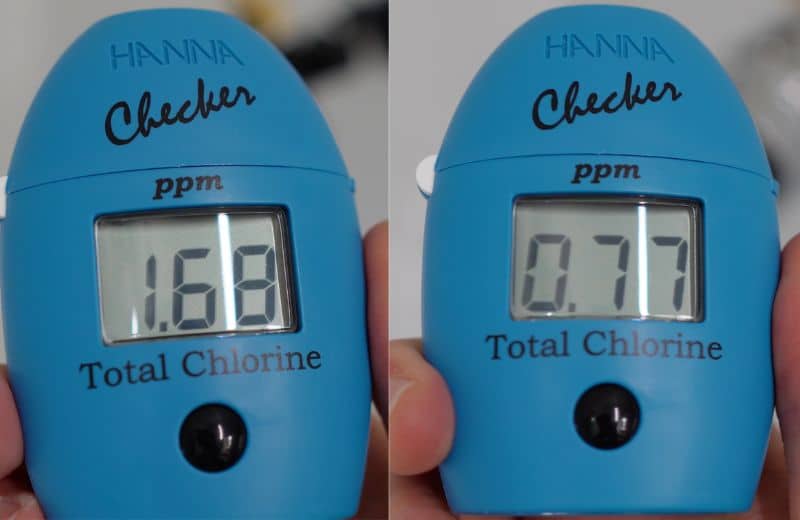
The colorimeter detected 1.68 PPM of chlorine in our baseline sample.
After installing the Hammerhead Shower Filter, we took a sample of filtered water and repeated our test process outlined above. This time, 0.77 PPM of chlorine was detected: a 54.17% reduction.
This is a disappointing result, especially since Hammerhead really talks up the fact that the filter has specifically been designed to target chlorine, saying:
“…it’s all about the quality of the materials and the surface area covered — not how many stages there are. That’s why we have locked in on these two chlorine-killers* and customized the size of both the KDF and Calcium Sulfite to maximize surface area without compromising your shower head pressure.”
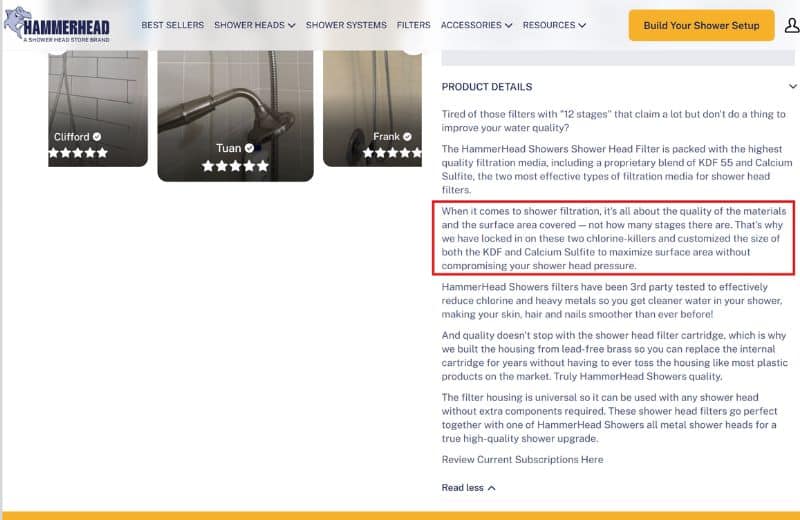
The manufacturer also mentions that the filter has been “3rd party tested to effectively reduce chlorine”, although the exact concentration of chlorine reduced in this testing isn’t mentioned.
Since the filter uses not one but two media that are generally highly effective for chlorine reduction, we’d expect to see a bit better reduction in our testing.
Hardness
Score: 6.00
If you’ve ever had to double up on your soap use or noticed a “sticky” feel on your skin after showering, you’re already aware of the effects of hardness minerals in your shower water.
To evaluate the Hammerhead Shower Filter’s hardness reduction performance, we compared our Tap Score test reports for our unfiltered and filtered water samples.
Our baseline water was very hard, with a total hardness of around 250 PPM.
Post-filtration, hardness had increased by around 1.5%, to 254 PPM, showing us that the filter is unable to address calcium and magnesium concentrations. Importantly, Hammerhead doesn’t claim to do this.
Most shower filters don’t address hardness. But we still evaluate hardness reduction in our testing because some filters contain media that can reduce calcium and magnesium concentrations, either incidentally or intentionally.
The Hammerhead Shower filter doesn’t contain any media that would reduce hardness, so this result is unsurprising. If you want to prioritize hardness reduction for your shower water, we recommend checking out our guide to the best hard water shower filters.
Performance Certifications
Score: 6.00
Our own chlorine reduction testing has its limitations. While we test in real-world conditions, official testing organizations follow strict, rigorous procedures in a laboratory setting to provide professional verification of a filter’s performance.
Shower filter manufacturers can obtain performance certifications by the NSF, WQA, or IAPMO to NSF/ANSI Standard 177, for chlorine reduction. Only a handful of the products we’ve tested so far have been certified, and at the moment, the Hammerhead Shower Filter isn’t one of them.
🚦Filtration Rate
Score: 10.00Key Finding: The Hammerhead Shower Filter retained 99% of our baseline shower flow, delivering 1.71 GPM against an unfiltered 1.72 GPM at 48 PSI.
In our filtration rate testing, most of the shower filters we’ve tested have had minimal impact on water flow.
To see how the Hammerhead filter performed in this category, we compared the “normal” flow rate from our showerhead against the new flow rate after installing the inline filter at the shower arm.
Our process involved filling a graduated measuring cup beneath the shower, then recording the time it took to fill to the 1-gallon mark. We repeated this test three times, first for our “normal” flow rate measurement, and then for our measurement with the inline filter installed.
We took video footage of the process and moved through our timings frame-by-frame in a video editing software. This allowed us to measure timings down to the millisecond, starting when the cup was fully under the shower stream and ending when the water had reached the 1-gallon mark.
We then converted these time measurements into gallons per minute.
At a feed water pressure of 48 PSI and a temperature of 61.5°F*, we recorded an average flow rate of 1.71 GPM for the filter. This meant it retained 99% of our baseline flow of 1.72 GPM. In our testing, dynamic PSI was essentially unchanged, so the flow retention result is a clean comparison.
📐 Design
Score: 8.10Key Finding: The Hammerhead Shower Filter’s lead-free brass housing earned a 9.50 component quality score, tied for the highest we have awarded to any shower filter.
The Hammerhead Shower Filter has an inline design, meaning that the filter is installed upstream of your existing shower head rather than being a component of a dedicated showerhead. This will suit you better if you like the design of your current showerhead and don’t want to replace it, but you still want the benefits of shower filtration.
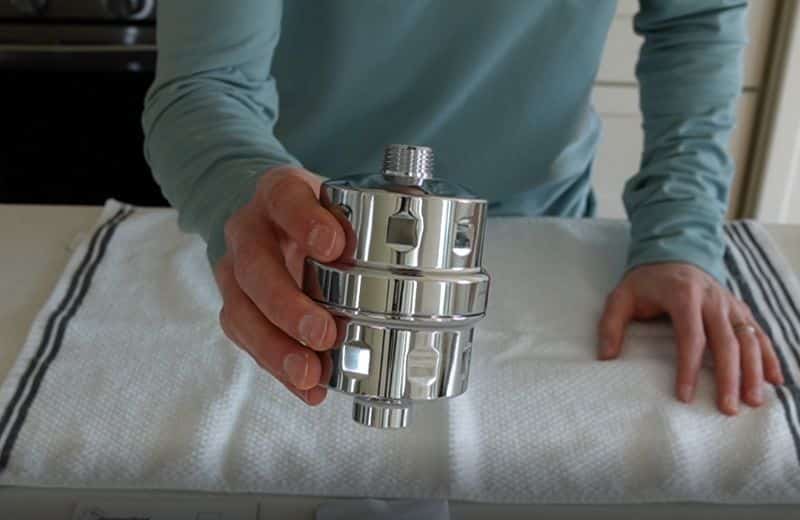
There are six finish options: chrome, brushed nickel, matte black, oil-rubbed bronze, brushed gold, and polished brass. There’s a good chance that you’ll find a color that blends in with the aesthetic of your shower.
Visually, it’s relatively small and unobtrusive, but we did note that it’s one of the heaviest filters we’ve tested. A big part of this is that the housing is metal (more on this later), weighing 1 lb 2.4 oz. The filter cartridge itself weighs 15.8 oz, which makes for a total weight of 2lb 2.3 oz.
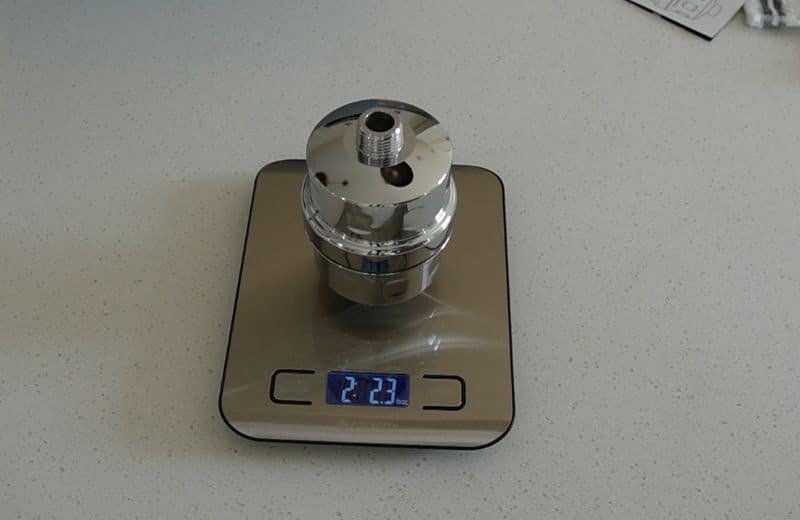
Something else to note is that, as an inline filter, this unit does cause your showerhead to extend down by around 6 inches, which could be a problem if you’re tall and already don’t have much room to stand underneath your shower.
Component Quality
Score: 9.50
The Hammerhead Shower Filter received one of the highest component quality scores we’ve awarded to a shower filter. Unlike most similar filters we’ve tested, the housing is made from metal (lead-free brass, according to the manufacturer) rather than plastic with a fake metal finish.
It feels sturdier and more durable than plastic models, and it’s a better option if you want to limit your exposure to microplastics in your shower water—although the filter cartridge is still, of course, made from plastic.
Filter Materials
Rather than cramming as many filter media into a single cartridge and trying to convince customers that this makes their product superior, Hammerhead has taken a different approach: combining just two filter media that are known to be highly effective in shower filters. These are:
- KDF-55
- Calcium sulfite
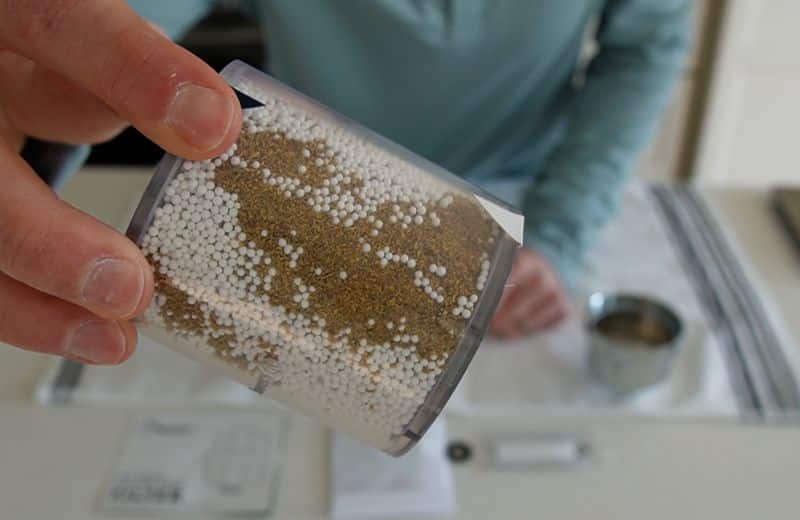
This makes a whole lot of sense to us. Since shower filter brands are all working with a very similar, relatively small surface area, focusing on using just a couple of the most effective filter media is likely to be more effective than trying to fit dozens of layers of media into the space.
That said, our test results still didn’t exactly prove Hammerhead’s claim that “it’s all about the quality of the materials and the surface area covered — not how many stages there are”. With these two media, we were hoping to see a higher rate of chlorine reduction than just 54%.
Materials Safety Certification
Score: 6.00
The Hammerhead Shower Filter isn’t certified for lead-free design or materials safety.
This could be a real opportunity for Hammerhead to distinguish itself with its plastic-free filter housing, especially since none of the shower filters we’ve tested have been certified for their design.
⚙️ Setup
Score: 9.00Key Finding: We installed the Hammerhead Shower Filter hand-tight in four steps with no leaks, after a 1.5 minute flush to clear loose filter media.
We found this Hammerhead model quick and easy to install, exactly as with the other shower filters we tested.
The box comes with paper instructions, which we could follow easily to install the filter in four steps. There’s also a QR code that takes you to an instruction video for a visual walkthrough of the process.
Plumber’s tape is included, but no adjustable wrench. If you don’t have a wrench, we found that hand-tightening the unit in place worked fine and didn’t result in leaks. We identified no compatibility or fit issues, but there were 3 potential leak points at the connections.
Before conducting any additional testing, we flushed the filter to remove any loose media. The manufacturer recommends flushing for 1 minute, but our actual flush time was slightly longer: 1 and a half minutes. The initial water leaving the showerhead was slightly gray in color, likely due to washout of the filter media.
🔧 Maintenance
Score: 9.50Key Finding: The Hammerhead Shower Filter’s reversible cartridge costs around $139.80 per year at a 3-month replacement interval, or $0.024 per gallon.
Once we’d got it installed and ready to use, we evaluated the Hammerhead Shower Filter for ease and cost of servicing.
Servicing Requirements
9.00
There’s just one filter cartridge that needs to be replaced in this Hammerhead model, with a long lifespan of 6-12 months, or 10,000 gallons, depending on use.
We think this could be slightly exaggerated—most shower filters we’ve tested have average lifespans of around 3 months. However, Hammerhead does offer a unique benefit: you can rotate the filter after 3 months to use both sides, which should extend its lifespan.
Replacing the cartridge is simple: just twist and remove the bottom half of the unit housing to detach it from the showerhead and take out the old cartridge. Place the new filter in the housing and follow the same flushing process to remove any debris before you start using your shower.
Costs
Score: 10.00
The Hammerhead Shower Filter is one of the few shower filters we tested with an upfront cost of less than $100 (at the time of reviewing), and its annual maintenance cost is relatively affordable, too.
| Product | Cost per gallon |
|---|---|
| Hello Klean | $0.052 |
| Afina | $0.042 |
| FilterBaby | $0.034 |
| Aquatru Shower | $0.031 |
| Jolie | $0.026 |
| Canopy | $0.026 |
| Eskiin | $0.025 |
| HammerHead | $0.024 |
| Aquasana | $0.022 |
| Weddell Duo | $0.012 |
| AquaBliss | $0.012 |
| Sprite SL2 | $0.007 |
We’ve assumed that we’ll need to replace the filter every 3 months, which will result in a maintenance cost of around $139.80 per year, or a cost-per-gallon of $0.024. The unit has an estimated 5-year ownership cost of $798.95.
🏢 Company
Score: 9.70Key Finding: Hammerhead’s limited lifetime warranty and 90-day returns policy earned a 9.70 company score, the highest of any shower filter brand we have tested.
Hammerhead received the highest company score of all the shower filter manufacturers we’ve reviewed so far.
Warranty
Score: 10.00
Hammerhead offers a limited lifetime warranty “for as long as the original consumer purchaser owns their home”—a clear sign that they believe in the quality and durability of their product.
The warranty guarantees that the showerhead will be leak-free and free from defects in material and manufacturing workmanship in normal use conditions. If the product develops a leak or drip during the warranty period, you’ll receive a free part or replacement.
Read more and register your filter for the Hammerhead warranty here.
Shipping
Score: 9.00
Shipping is free on orders over $50 on the Hammerhead website. Any orders under this minimum spend ship for a $5 flat rate.
Hammerhead currently ships within the US and Canada (only select products are shipped to Canada).
Find out more about shipping here.
Returns
Score: 10.00
Hammerhead’s returns policy is also one of the best we’ve seen. Under the 90-day satisfaction guarantee, you can return your product for a full refund if you decide it isn’t for you.
There are a few stipulations:
- Your filter should be in “good condition”
- The box should include all original components, instructions, and packaging
There’s a flat $10 fee that will apply if your return is for personal reasons (for instance, if you’ve changed your mind or you no longer need the filter). There’s no fee if you’re returning the filter due to a defect or missing parts.
Read Hammerhead’s returns T&Cs here.
💰 Value For Money
Key Finding: The Hammerhead Shower Filter’s 6.00 contaminant reduction score sits at the bottom of our shower filter test group, while strong company, cost, and flow scores lift its overall score to 7.45.
We don’t think the Hammerhead Shower Filter offers much value for money where it counts.
Its 6.00 contaminant reduction score is tied for the lowest in our shower filter test group: it didn’t completely remove any of the problem shower water contaminants, reducing chlorine by only around 54% and making no measurable difference to DBPs or hardness. Strong company, cost, and flow scores lift its overall score to 7.45, which lands it mid-pack in our rankings, but you’re paying for warranty coverage and build quality rather than filtration performance. Even the best warranty in the world doesn’t make up for weak contaminant reduction.
So, what would we recommend if you’re looking to actually make a difference to your shower water quality? The Weddell Duo performed well in our testing, being the only filter to have reduced 100% chlorine and 100% DBPs, so it’s definitely worth considering instead.
❔ Hammerhead Shower Filter FAQs
Q: Does the Hammerhead Shower Filter remove chlorine?
A: Partially. In our testing, the Hammerhead Shower Filter reduced free chlorine by 54.17%, from 1.68 PPM in our baseline shower water to 0.77 PPM post filtration, measured on site with a digital colorimeter. It did not remove chlorine completely.
Q: Does the Hammerhead Shower Filter remove disinfection byproducts (DBPs)?
A: No. In our Tap Score lab testing, the concentrations of all three DBPs detected in our water (bromoform, bromodichloromethane, and dibromochloromethane) were higher in our filtered sample than in our unfiltered baseline. The KDF-55 and calcium sulfite media it uses are not generally effective against DBPs.
Q: Does the Hammerhead Shower Filter soften hard water?
A: No. Our baseline water measured around 250 PPM total hardness, and our filtered sample measured 254 PPM. Hammerhead does not claim hardness reduction, and the filter contains no media that would address calcium or magnesium.
Q: Is the Hammerhead Shower Filter certified?
A: No. The Hammerhead Shower Filter has no NSF/ANSI Standard 177 performance certification for chlorine reduction and no materials safety certification, although the manufacturer states the housing is made from lead-free brass.
Q: How often do you need to replace the Hammerhead filter cartridge?
A: Hammerhead rates the cartridge for 6 to 12 months or 10,000 gallons, and the filter can be rotated after 3 months to use both sides. Based on the roughly 3-month average lifespan we see across shower filters, we calculated an annual replacement cost of around $139.80, or $0.024 per gallon.
Q: Hammerhead Shower Filter vs Weddell Duo: which is better?
A: The Weddell Duo outperformed the Hammerhead Shower Filter in our testing, scoring 9.19 overall against the Hammerhead’s 7.45. The Weddell Duo was the only shower filter we tested to remove 100% of chlorine and 100% of DBPs, while the Hammerhead reduced chlorine by 54.17% and did not reduce DBPs. The Hammerhead scored higher for company policies, with a limited lifetime warranty and a 90-day returns policy.
Found this review helpful?
Comment below or share this article!