

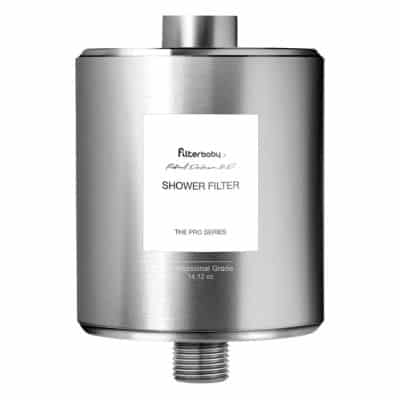
The Filterbaby shower filter Pro is an inline unit that’s heralded as a highly capable filtration solution that “blows other filters out of the water”. Its extensive contaminant reduction claims include chlorine and chloramine, hard minerals, microorganisms, and lead, as well as particulates as small as 0.001 millimeters and contaminants 100x smaller than a human hair.
What We Like
What We Don’t Like
| Price | $139 |
| Contaminants Reduced | Chlorine |
| Certifications | – Not Certified |
| Process | Sediment Filter + Activated Carbon Fiber |
| Filter Capacity | 3 months |
| Annual Cost | ~$196/year |
| Warranty | Lifetime (subscription required) |
▶️ Video Review
To find out whether this filter is all that it’s made out to be, we conducted our own hands-on testing in a Colorado home in real-world conditions. We focused specifically on the Filterbaby’s ability to remove chlorine, disinfection byproducts, and hardness minerals, as well as evaluating its construction quality, filtration rate, maintenance requirements, and several other factors affecting its ease of use and value for money.
In this review, we’ve discussed how the filter performed across all testing categories.
📊 Scoring Data
At Water Filter Guru, every review we share is built on data we collect ourselves through hands-on testing and detailed analysis, rather than relying on manufacturer claims.
We score products using a custom system that weighs multiple factors to give a balanced overall rating. We look beyond just contaminant removal, factoring in the speed of filtration, the quality of construction, the ease of installation and maintenance, and the policies set by the filter manufacturer.
Once we’ve finished testing, we input our results into our scoring system and compare the data to all the other filters we’ve reviewed so far, giving us a fair side-by-side comparison.
In the next table, you can see how the Filterbaby Pro stacks up against other shower filters we’ve put through the same testing process.
| Criteria | Results |
|---|---|
| Overall Score | 7.71 |
| DBPs | 6.00 |
| Disinfectant Residual | 8.00 |
| Hardness | 6.00 |
| Performance Certification | Not Certified |
| Filtration Rate | 1.63 GPM |
| Component Quality | Outstanding |
| Component Certification | Not certified |
| Setup | Excellent |
| Servicing Requirements | Excellent |
| Costs | $0.034/gallon |
| Warranty Length | Lifetime |
| Shipping | Free shipping for the contiguous US |
| Returns | 30 days |
🚰 Contaminant Reduction
Score: 6.63When we’re assessing any water filter, the first thing we examine is how effectively it removes unwanted substances. For shower water, a filter needs to actively improve water quality by reducing, or ideally eliminating, the contaminants with known health and aesthetic effects.
For the Filterbaby Pro, this score combines our own hands-on testing and independent Tap Score analysis with official certifications linked to performance. Our own on-site and lab testing takes the greatest weight, with performance certifications contributing at a lower percentage.
Our Performance Testing
Score: 6.70
To assess contaminant reduction performance, we compared the concentrations of key impurities in our shower water before and after installing the Filterbaby Pro.
First, we collected an initial sample from our showerhead to establish a baseline. We then fitted the filter just before the showerhead, let it run for around a minute and a half, and conducted our flow rate measurements. After this, we took a second sample, this time of the treated water.

Both samples were sent off to Tap Score, the lab we use for all our testing projects, for detailed analysis.
We assess shower filters differently from products intended to filter drinking water. Rather than focusing on substances that are harmful when ingested, we concentrate on those that can affect the skin and hair through dermal exposure, as well as those with known health effects when inhaled in shower vapor.
Disinfection byproducts are our biggest focus, since these have the most serious health effects in shower water. THMs, one of the most common DBP groups in chlorinated tap water, are known to increase cancer risks both through dermal (skin) and inhalation pathways in showers.
We also assess the before-and-after concentrations of chlorine, a disinfectant residual that causes skin dryness and irritation, even contributing to certain skin conditions, as well as total hardness, which can disrupt the skin’s natural balance and lead to issues such as eczema.
For all the shower filters we tested, we assigned scores in this category based on how effectively these shower-related substances were reduced. The weighting for each contaminant varies depending on its known health effects:
- DPBs make up half of the overall score, and we analyzed whether a filter could reduce them to below the Health Guideline Level or eliminate them completely.
- Residual disinfectants account for just over a third of the score, based on the concentration of chlorine remaining post-filtration.
- Hardness has a smaller impact, accounting for just 15% of the total score and tied to the percentage reduction achieved.
If you’re interested in learning more about how we run these tests, you can find a full breakdown in our How We Test Water Filters documentation.
| Type | Analyte | Unit | Unfiltered | Filterbaby | Difference |
|---|---|---|---|---|---|
| Minerals | Alkalinity (as CaCO3) | PPM | 379 | 375 | -1.06% |
| Metals | Barium | PPM | 0.0337 | 0.031 | -8.01% |
| Properties | Bicarbonate | PPM | 458.64 | 452.92 | -1.25% |
| Properties | Boron | PPM | 0.438 | 0.405 | -7.53% |
| Disinfection Byproducts | Bromodichloromethane | PPB | 2.12 | 8.32 | 292.45% |
| Disinfection Byproducts | Bromoform | PPB | 8.24 | 0 | -100.00% |
| Properties | Calcium | PPM | 74 | 74.5 | 0.68% |
| Metals | Carbonate | PPM | 1.68 | 2.09 | 24.40% |
| Minerals | Chloride | PPM | 92.8 | 98.3 | 5.93% |
| Properties | Chloride-to-Sulfate Mass Ratio | 0.64 | 0.67 | 4.69% | |
| Disinfection Byproducts | Chloroform | PPB | 0 | 20.6 | N.A. |
| Minerals | Chromium (Total) | PPM | 0.00368 | 0.00385 | 4.62% |
| Metals | Copper | PPM | 0.274 | 0.0465 | -83.03% |
| Disinfection Byproducts | Dibromochloromethane | PPB | 4.67 | 3.5 | -25.05% |
| Metals | Fluoride | PPM | 1.7 | 1.6 | -5.88% |
| Properties | Grains per gallon | Grains | 14.62 | 14.67 | 0.34% |
| Properties | Hardness | PPM | 249 | 250 | 0.40% |
| Properties | Hardness (Total) | PPM | 250.32 | 251.21 | 0.36% |
| Disinfection Byproducts | Langelier Saturation Index | 0.67 | 0.77 | 14.93% | |
| Metals | Magnesium | PPM | 15.6 | 15.6 | 0.00% |
| Inorganics | Manganese | PPM | 0.0011 | 0 | -100.00% |
| Inorganics | Molybdenum | PPM | 0.00127 | 0.00126 | -0.79% |
| Properties | Nitrate (as N) | PPM | 3 | 2.8 | -6.67% |
| Properties | pH | pH | 7.9 | 8 | 1.27% |
| Inorganics | Potassium | PPM | 2.93 | 3.01 | 2.73% |
| Inorganics | Selenium | PPM | 0.00428 | 0.00352 | -17.76% |
| Metals | Sodium | PPM | 178 | 179 | 0.56% |
| Properties | Sodium Adsorption Ratio | 4.9 | 4.92 | 0.41% | |
| Minerals | Specific Conductivity | umhos/cm | 1300 | 1310 | 0.77% |
| Minerals | Strontium | PPM | 0.739 | 0.738 | -0.14% |
| Metals | Sulfate | PPM | 145 | 147 | 1.38% |
| Minerals | Total Dissolved Solids | PPM | 756 | 765 | 1.19% |
| Inorganics | Total THMs | PPB | 15.03 | 32.42 | 115.70% |
| Metals | Uranium | PPM | 0.0124 | 0.0122 | -1.61% |
| Metals | Vanadium | PPM | 0.0015 | 0.00143 | -4.67% |
DBPs
Score: 6.00
Disinfection byproducts, or DBPs, don’t start out in a water supply. They’re formed later, when disinfectants such as chlorine react with organic matter that occurs naturally in the water.
In the US, the Environmental Protection Agency sets limits for certain DBPs, including specific trihalomethanes (THMs), haloacetic acids, chlorite, chlorate, and bromate. But groups like the Environmental Working Group have raised concerns that these limits aren’t health-protective enough, and many of these chemicals (there are over 600 known DBPS, with less than 100 having been studied for toxicity) still aren’t formally regulated at all.
In our unfiltered shower water, 3 DBPs were identified:
- 8.24 PPB (parts per billion) bromoform
- 2.12 PPB bromodichloromethane
- 4.67 PPB dibromochloromethane
After installing the Filterbaby Pro, our second test showed a 100% decrease in bromoform, a 292% increase in bromodichloromethane, to 8.32 PPB, and a 25% reduction in dibromochloromethane, to 3.5 PPB.
This is an unusual result — why would the filter completely eliminate one DBP, slightly reduce another one, and significantly increase another?
Most likely, both the increases and decreases in DBPs were caused by fluctuations in our source water, rather than the filter itself.
All three detected DBPs are highly volatile, which means they can change in concentrations significantly in samples taken at different times. If the filter was actually doing something to remove them, we’d expect to see a reduction of all of these THMs, not just some but not others.
With that in mind, this indicates that the filter is unable to address DBPs.
Disinfectant Residual
Score: 8.00
Our test water for the Filterbaby Pro was chlorinated, as is common with the majority of municipal water supplies across the US.
Although low concentrations of chlorine are considered safe to drink, disinfectant residual can still affect skin and hair and is often linked to dryness and irritation. That’s why so many shower filters, including this Filterbaby model, are positioned as a solution to reduce chlorine exposure in your shower water.
Rather than testing for chlorine using Tap Score lab analysis, we measured this contaminant on-site. Because chlorine dissipates quickly, lab testing can lead to inaccurate results because the sample can’t be tested immediately. To avoid this issue, we used a digital colorimeter to capture chlorine readings straight after collecting our sample.
The process involved filling a vial with water, placing it into the colorimeter to calibrate it, then removing it and adding reagent powder. After shaking the vial for around 20 seconds, we returned it to the colorimeter and waited a couple of minutes for the reading to appear.
Our initial sample contained 1.68 PPM of chlorine. After installing the filter and repeating the same steps, the reading dropped to 0.23 PPM. That works out to a reduction of just over 86%.
Given how strongly Filterbaby promotes this filter as being built specifically for chlorine removal, it’s reassuring to see a significant reduction in our own testing.
Hardness
Score: 6.00
If your soap doesn’t lather properly or your skin feels slightly sticky after a shower, hard water is usually the reason. Minerals including calcium and magnesium can interfere with how water interacts with your skin and the products you use for washing your hair and body.
To see whether the Filterbaby Pro made any difference here, we compared the hardness levels recorded in our Tap Score test reports before and after installing the filter.
You might also like: My Filterbaby vs eskiin comparison
Our baseline was very hard water, measuring roughly 250 PPM. After filtration, it was almost exactly the same, with a reading of just over 251 PPM. Practically, this tells us that Filterbaby is unable to reduce hardness minerals.
“Hard minerals” is one of the contaminants that the filter is supposed to remove, as listed in the product description, but this doesn’t line up with our own results.
It’s a common misconception that shower filters soften hard water (not helped by misleading claims from shower filter brands). Actually, most of these filters don’t contain the right media for addressing hardness, and only a few are able to reduce calcium and magnesium, either by design or as a side effect of their filtration method. Still, hardness reduction is included in our scoring system because we know that many folks are looking for a solution to this problem.
If reducing hardness is high on your priority list, it’s worth looking into the best way to soften hard water for just one shower if you are renting.
Performance Certifications
Score: 6.00
Our own contaminant reduction data is restricted to our specific real-world testing conditions, which is why we also look for official testing and certification by organizations like the NSF, WQA, and IAPMO. Certifications are awarded based on controlled and tightly regulated assessments in lab conditions.
Shower filter manufacturers can choose to get their products independently certified to NSF/ANSI Standard 177, for chlorine reduction.
So far, only a small number of filters we’ve reviewed in this category carry an NSF 177 certification. The Filterbaby Pro is currently not certified. Though they have communicated with me that this is in progress, so when I see the listing live I’ll circle back and update this article accordingly.
🚦Filtration Rate
Score: 10.00Most shower filters we’ve tested have had little to no effect on our water flow, and the Filterbaby Pro was no exception.
To measure filtration rate, we compared the “normal” flow from our showerhead with the flow after installing the inline filter at the shower arm. We captured the water in a graduated cup, timing how long it took to reach the 1-gallon mark. For both our unfiltered baseline and our post-installation tests, we repeated this process a total of three times.
We video-recorded our tests and analyzed the footage in an editing software, measuring from the moment the cup was fully beneath the shower stream until the moment the water reached the 1-gallon line. Using this process, we could calculate the flow rate down to the millisecond, which we then converted into gallons per minute.
With a feed water pressure of 48 PSI and a temperature of 61.7°F*, the Filterbaby Pro delivered an average filtration rate of 1.63 GPM, retaining 94% of our baseline flow. Dynamic pressure remained steady throughout, so our comparison was direct and reliable.
📐 Design
Score: 8.10The Filterbaby Pro is an inline filter, meaning it attaches upstream of your existing showerhead rather than replacing it. This is ideal if you like your current showerhead but still want to filter your shower water.
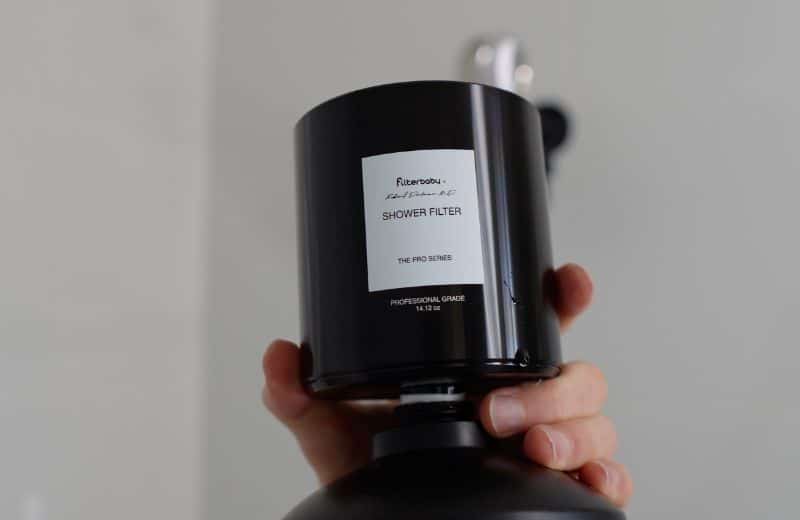
Appearance-wise, the filter is relatively unobtrusive and blends in well with most modern shower setups. There are three finishes to choose from in common shower colors: gold, chrome, and black. But it’s fairly large, measuring approximately 3.3 x 3.3 x 4.7 inches, and it does extend down quite a bit. This could be an issue if you’re tall and already have limited space beneath your showerhead.
Component Quality
Score: 9.50
As one of the few solid metal shower filters we’ve tested, this Filterbaby model has an immediate design quality advantage over the flimsier plastic alternatives.
It feels solid and durable, and the filter cartridge itself is clearly unique to the manufacturer. This isn’t always the case — many of the products we’ve tested have had very similar filter cartridges, suggesting multiple brands use the same supplier and similar/identical filters sold privately labeled under their own names.
Filter Materials
There are two filter media used in the Filterbaby Pro shower cartridge:
- A pleated microfilter (visible from the outside), which, according to the manufacturer, is “premium Japanese-made” and captures contaminants as small as 0.00001mm. This mostly just exists to protect the internal media.
- Activated carbon media (on the inside of the filter, not visible), which Filterbaby says will reduce “chlorine, chloramine, certain heavy metals, and more”.
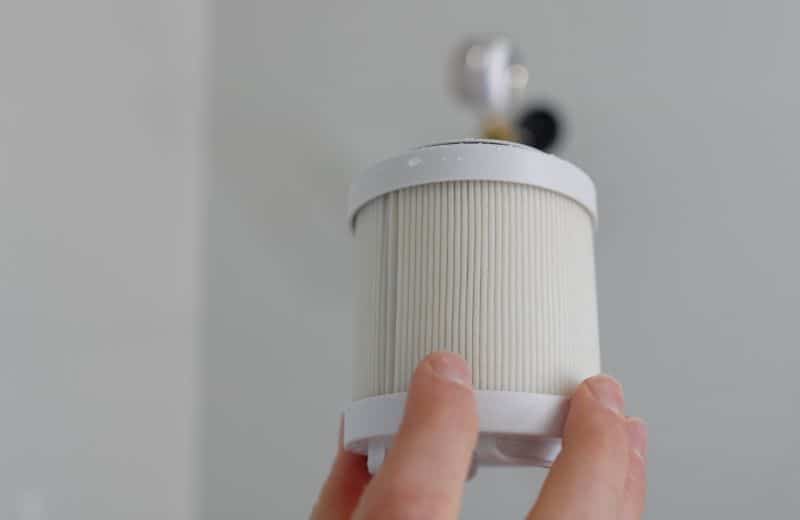
The filter might not offer the best performance across the board, but it did manage to greatly reduce chlorine in our testing — something that many of the other shower filters we tested, particularly those with a great big list of 7+ filter stages, were unable to do. The quality of the filtration media is much more important than the quantity, and activated carbon is known as one of the most effective solutions for reducing chlorine in tap water.
Materials Safety Certification
Score: 6.00
The Filterbaby Pro isn’t certified for lead-free design or materials safety.
Since it’s one of the very few filters we tested with plastic-free filter housing, we think obtaining a materials safety certification could be a great opportunity for Filterbaby to distinguish the Pro model from its competitors.
⚙️ Setup
Score:9.00Installing the Filterbaby Pro was a quick and easy job, following the written paper instructions that came in the box. There’s also a video installation guide on the product website if you prefer to learn by watching.
The box comes with plumber’s tape and an adjustable wrench for tightening the unit on your shower arm (not always essential; we decided to hand-tighten instead and it was fine).
Installation involves removing your existing showerhead, screwing the filter onto the shower arm, and screwing the existing showerhead onto the filter housing unit. We identified no compatibility or fit issues, but there were 3 potential leak points at the connections.
Before we started testing and using the filter, we flushed it for 1.5 minutes to remove any loose media. We noticed that the initial water leaving the showerhead was slightly gray in color, likely due to washout of the filter media.
🔧 Maintenance
Score: 9.50We evaluated the Filterbaby Pro’s maintenance requirements based on its filter replacement schedule and ongoing costs.
Servicing Requirements
9.00
This Filterbaby model uses just one filter cartridge, so maintenance definitely isn’t overwhelming.
The manufacturer recommends replacing the filter every 3 months, or more frequently if you live in an area where there is a higher level of physical contaminants and turbidity in the water. Our advice is to replace your filter early if you notice a significant reduction in water flow.
Replacing the cartridge is simple: just open the cap on the filter housing (you might need to use the included wrench if the cap is tight) and tip out the old cartridge. Put the new cartridge in place and close the cap, then reinstall the housing on your shower arm.
Plus, Filterbaby’s video guide for replacing the filter walks you through what to do if the cap on the filter housing gets stuck, suggesting this might be a common problem.
Costs
Score: 10.00
The Filterbaby Pro is priced on the higher end for a shower filter, at around $139.00 (at the time of our review). The good news is that replacing the filters is pretty affordable.
Assuming that we replace the filter every 3 months, we calculated that the annual replacement cost would be $196 per year, or a cost-per-gallon of $0.034. The unit has an estimated 5-year ownership cost of $1,119.
| Product | Cost per gallon |
|---|---|
| Hello Klean | $0.052 |
| Afina | $0.042 |
| FilterBaby | $0.034 |
| Aquatru Shower | $0.031 |
| Jolie | $0.026 |
| Canopy | $0.026 |
| Eskiin | $0.025 |
| HammerHead | $0.024 |
| Aquasana | $0.022 |
| Weddell Duo | $0.012 |
| AquaBliss | $0.012 |
| Sprite SL2 | $0.007 |
🏢 Company
Score: 8.00Filterbaby’s poorer warranty and returns policy prevented it from scoring higher in this category.
Warranty
Score: 8.00
The Filterbaby Pro is backed by a lifetime warranty, but this sounds better than it actually is.
There’s an automatic 90-day warranty that applies to all purchases, but to be eligible for the longer lifetime warranty, you have to subscribe to the manufacturer’s filter refill replacement program.
You can read more about Filterbaby’s warranty in the product FAQs.
Shipping
Score: 9.50
Shipping is free for the contiguous US on the Filterbaby website. Filterbaby products aren’t currently available to international customers.
Shipping info can also be found on the product FAQ page.
Returns
Score: 6.50
Filterbaby’s refund policy allows you to return your filter within 30 days if you’re not satisfied with your purchase.
There are a few stipulations:
- Your refund will be minus a shipping label fee + a $3.50 USD restocking fee
- A filter with damage or defects caused by misuse won’t qualify for a refund.
Read Filterbaby’s returns T&Cs here.
💰 Value For Money
We think the Filterbaby Pro Shower Filter is fairly good value for money, but it still has room to improve.
Starting with the positives, it greatly reduced chlorine (and believe it or not, it was one of the few shower filters we tested that actually managed this). It also has a more durable metal design.
But it was unable to sufficiently reduce two DBPs in our water, and it isn’t certified for chlorine reduction, which is disappointing.
If you just want to reduce chlorine with a sturdy shower filter that can be used with your existing showerhead, the Filterbaby Pro is a good choice. But if you want to protect yourself from disinfection byproducts in your shower water, we recommend the Weddell Duo, which is the only filter to have reduced 100% chlorine and 100% DBPs in our testing.
Found this review helpful?
Comment below or share this article!