

AquaTru is one of the most popular countertop RO manufacturers, and for good reason. We’ve tested more than a dozen of these systems, and AquaTru currently tops the leaderboard with the highest scores we’ve awarded so far.
There are two AquaTru models you can choose from: the AquaTru Classic and the smaller AquaTru Carafe. The most obvious difference between the two is their size, but there are other features that make each of these systems unique in its own right, and might convince you to buy one over the other.
We’ve personally tested the AquaTru Classic vs Carafe, and in this guide, we’ll be comparing them across our testing categories. By the end, you’ll know how they’re similar in their performance, and, importantly, in which areas they offer something different.
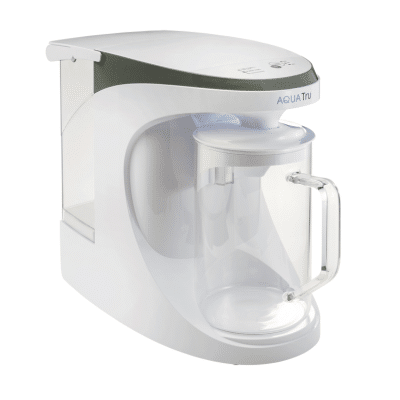
AquaTru Carafe
Best For:
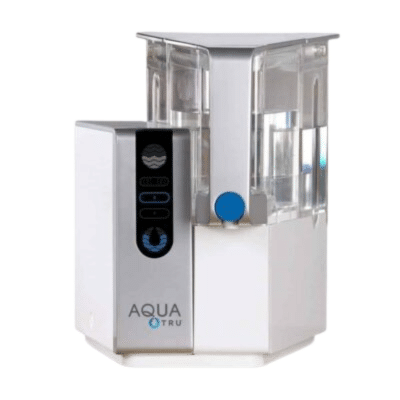
AquaTru Classic
Best For:
Quick Verdict: AquaTru Carafe vs Classic: Which Should You Buy?
Both systems use the same 4-stage filtration and delivered identical contaminant reduction in our lab testing (9.91/10 each), so this decision comes down to water collection, capacity, and running cost, not filtration performance. The Carafe edges ahead overall (9.57 vs 9.54) because it collects purified water in glass instead of a plastic tank.
Choose the AquaTru Carafe if: you want purified water collected in glass with no post-filter plastic contact, you have limited counter space, or you want to spend less upfront ($375 vs $475 base).
Choose the AquaTru Classic if: you filter larger volumes (0.75-gallon tank, faster 0.04 GPM filtration) or you want the lowest long-term cost ($0.14 per gallon vs $0.29).
Methodology: Scores come from our own hands-on and third-party lab testing. See how we test water filters.
The AquaTru Classic is available in four configurations: The AquaTru Classic, AquaTru Alkaline Classic, AquaTru Connect, and AquaTru Alkaline Connect. We’ve tested the first three configurations, but we’ll mainly be focusing on the AquaTru Alkaline Classic in this comparison review. We’ll mention other configurations when applicable.
The AquaTru Carafe is also available as a WiFi model, and you can upgrade the filter to an alkalizing VOC filter. We’ve so far only tested the Carafe with the standard VOC filter, without the remineralization media, so we’ll be referring to this configuration in our review.
In our testing, both systems offered a superior contaminant reduction performance, and both have identical certifications. But the AquaTru Carafe received the highest overall score because it collects water in a glass carafe rather than a plastic tank, so it’ll appeal to folks who don’t want to risk reintroducing microplastics into their water.
📊 Our Testing Data
All our water filter reviews are based on data we gathered from our own hands-on, comprehensive testing. You can see the scores we awarded to both units across these testing criteria in the table below.
| Factor | Aquatru Carafe | Aquatru Classic |
|---|---|---|
| Contaminant Reduction | 9.91 | 9.91 |
| Filtration Rate | 7.00 | 7.00 |
| Design | 10.00 | 9.70 |
| Setup | 10.00 | 10.00 |
| Maintenance | 9.75 | 9.75 |
| Company | 8.80 | 8.80 |
Each of our six key performance scores was a combination of multiple data points within a range of testing subcategories. We’ve shared this data in the next table.
| Factor | Aquatru Carafe | Aquatru Classic | Winner |
|---|---|---|---|
| Overall Score | 9.57 | 9.54 | Carafe |
| Health Related Contaminants | 9.90 | 9.90 | Tie |
| Aesthetic Related Contaminants | 9.90 | 9.90 | Tie |
| Performance Certification | NSF/ANSI 42, 53, 58, 401 & 372 | NSF/ANSI 42, 53, 58, 401 & 372 | Tie |
| Filtration Rate | 0.03 GPM | 0.08 GPM | Classic |
| Component Quality | Exceptional | Outstanding | Carafe |
| Component Certification | NSF/ANSI 42, 53, 58, 401 & 372 | NSF/ANSI 42, 53, 58, 401 & 372 | Tie |
| Setup | Exceptional | Exceptional | Tie |
| Servicing Requirements | Outstanding | Outstanding | Tie |
| Costs | $0.29/ gal | $0.14/ gal | Classic |
| Warranty Length | 1 year | 1 year | Tie |
| Shipping | Free | Free | Tie |
| Returns | 30 days | 30 days | Tie |
🚰 Contaminant Reduction: Identical Performance (9.91/10 Both)
Key Finding: Both AquaTru models eliminated their detected contaminants to non-detect levels and carry identical NSF/ANSI 42, 53, 58, 401, and 372 certifications, earning matched 9.91/10 scores.
If you’re interested in RO, a big part of the appeal is likely knowing that these systems can remove significantly greater concentrations of contaminants than your average water filter.
To rank and compare the AquaTru Classic and Carafe models in this category, we analyzed the data from our own on-site and lab testing, along with professional NSF/IAMPO/WQA certifications.
Our Lab Test Results

We used Tap Score lab tests provided by SimpleLab to conduct the majority of contaminant testing for the AquaTru systems.
In the next table, you can see the contaminants detected in our source water, as well as those detected in our filtered water, to understand how effectively each system improved our water quality.
| Category | Analyte | Unit | AquaTru Classic | AquaTru Carafe |
|---|---|---|---|---|
| Contaminants | Fluoride | mg/L | 100% (1.5 → ND) | 100% (0.9 → ND) |
| Contaminants | Nitrate (as N) | mg/L | 100% (2.1 → ND) | 100% (4.2 → ND) |
| Contaminants | Chloride | mg/L | 100% (9.2 → ND) | 100% (28.5 → ND) |
| Contaminants | Sulfate | mg/L | 100% (7.6 → ND) | 100% (8.0 → ND) |
| Contaminants | Copper | mg/L | 100% (0.053 → ND) | 100% (0.31 → ND) |
| Contaminants | Barium | mg/L | 100% (0.014 → ND) | 89% (0.023 → 0.0024) |
| Contaminants | Strontium | mg/L | 100% (0.108 → ND) | 92% (0.135 → 0.011) |
| Contaminants | Uranium | mg/L | 100% (0.018 → ND) | 100% (0.0096 → ND) |
| Minerals & Hardness | Total Dissolved Solids | mg/L | 89% (112 → 12) | 91% (164 → 14) |
| Minerals & Hardness | Total Hardness | mg/L | 96% (85.8 → 3.2) | 94% (107 → 6.5) |
| Minerals & Hardness | Calcium | mg/L | 97% (23.9 → 0.7) | 94% (30.5 → 1.8) |
| Minerals & Hardness | Magnesium | mg/L | 94% (6.08 → 0.36) | 94% (7.32 → 0.47) |
| Minerals & Hardness | Sodium | mg/L | 100% (9.91 → ND) | 83% (11.2 → 1.9) |
| Water Quality Parameters | pH | pH units | 7.4 → 8.0 | 7.3 → 7.0 |
Both systems performed nearly identically, offering the exact same contaminant reduction and boasting the same extensive list of performance certifications.
Health-Related Contaminants
We tested each AquaTru model on different occasions, which means different contaminants were detected in each baseline water sample.
But what didn’t change was how we collected our water samples. For both systems, we filled a clean bucket with tap water and swirled it around to make sure it was well-mixed, then poured most of the water into the AquaTru and dispensed our “after” sample once it had been purified. We then took a “before” sample straight from the bucket.
We’ve discussed our results for each test below.
Our AquaTru Classic Results
When we tested the AquaTru Alkaline Classic, our baseline tap water sample contained 13 contaminants with possible health effects: lead, fluoride, uranium, strontium, chlorine, molybdenum, nitrate, sodium, barium, copper, zinc, chloroform, and sulfate.
Three of these contaminants were detected at levels exceeding the Tap Score Health Guideline Level (HGL): fluoride, lead, and uranium.
We also detected around 2 PPM of chlorine using our own on-site test strips.

Once our water had been filtered, not a single one of these contaminants remained — not even in trace concentrations. That’s a fantastic result that exceeds many other reverse osmosis systems we’ve tested.
How the AquaTru Carafe Compared
In our AquaTru Carafe tests, 10 contaminants with possible health effects were detected by the Tap Score test in our water, along with around 2 PPM of chlorine detected on-site.
This time, uranium, chloroform, copper, and fluoride were all present in concentrations above the lab’s HGL.
Post-filtration, our test results showed that 8 out of these 10 contaminants, plus chlorine, had been eliminated 100% by the AquaTru Carafe.
Barium and strontium, the two contaminants that weren’t completely eliminated, were still greatly reduced; barium by 89% and strontium by 92%.
Aesthetics, pH, and Mineral Content
Since reverse osmosis removes virtually everything, we also measure how this affects healthy mineral concentrations and the pH of our water.
We haven’t yet tested the AquaTru Carafe with the remineralization filter upgrade, but we have tested this version of the AquaTru Classic. Since they use the same filters (the Classic just has larger cartridges), we can deduce that the Alkaline Carafe would perform similarly to the Alkaline Classic model.
When we tested the AquaTru Carafe, our filtered water lab data showed that:
- Calcium had been reduced by 94%
- Magnesium by 94%
- And sodium by 83%
This is expected for reverse osmosis that doesn’t use remineralization. In fact, it’s common to see even greater reductions than this; closer to 100%.
And that’s what we saw when we tested the AquaTru Classic without remineralization:
- Calcium was reduced by 97%
- Magnesium by 94%
- And sodium was completely removed
If you want to retain healthy minerals and their taste and alkalinity benefits in your water, the good news is that AquaTru’s VOC remineralization filter was effective in our testing.
Calcium still decreased by 97.5%, but magnesium was only reduced by 33%, and pH increased from 7.3 to 10.7.
Plus, carbonate and bicarbonate increased by 17,775% and 92% respectively in our purified water.
As we mentioned, because we didn’t test the AquaTru Carafe with the VOC remin filter, we can’t fairly compare the Classic and the Carafe here. But we can safely assume that this filter would offer a similar performance in the Carafe model.
Performance Certifications
Our own performance testing is limited in that it can only show us how a filter performs when treating our specific water source. That means we can’t provide insight into performance when it comes to reducing common contaminants not detected in our water, like PFAS and arsenic.
That’s why we also evaluate and compare water filters for their performance certifications, as awarded by impartial third-party organizations like the NSF and the WQA. These aren’t a legal obligation, but they can be helpful and reassuring when you’re investing in a filtration solution.
The good news is that both AquaTru models have been certified to NSF Standards 42, 53, 58, and 401 by IAPMO to remove 83 contaminants, including lead, fluoride, copper, TDS, PFOA/PFOS, barium, chromium, cysts, nitrate/nitrite, radium 226/228, selenium, arsenic perchlorate, and BPA.
🚦Filtration Rate: The Classic Is Faster (0.08 vs 0.03 GPM)
Key Finding: The Classic filters roughly 69 gallons per day (0.04 GPM) versus the Carafe’s 43 gallons per day (0.03 GPM), though both share the same 4:1 water efficiency ratio.
While they’re both countertop filtration systems, the AquaTru Carafe and Classic have their own unique filtration rates based on their individual setups.
To see how the systems performed in real-world conditions, we measured their flow rates by timing how long it took for them to filter our water. Here’s how they compared.
| Product | Filtration Rate Score | Filtration Rate |
|---|---|---|
| Aquatru Carafe | 7.00 | 0.03 GPM |
| Aquatru Classic | 7.00 | 0.04 GPM |
AquaTru Carafe:
- The smaller Carafe model filtered 8 cups of water in 16 minutes and 28 seconds, which converts to a flow rate of 0.03 GPM.
- That equals 43.2 GPD.
AquaTru Classic:
- The AquaTru Classic purified 11 cups in 15 minutes, 53 seconds, giving it a flow rate of 0.04 GPM (gallons per minute).
- That’s approximately 69 GPD (gallons per day).
Efficiency Ratio
Efficiency ratio is another important measure of performance that tells us how much of the water flowing into an RO system is retained and purified, versus how much goes to waste.
The AquaTru Classic is one of the most efficient countertop RO systems we’ve tested, with a claimed 4:1 performance efficiency. That means only 1 gallon of water is wasted for every 4 gallons of filtered water produced.
And good news: despite being smaller and having a slower flow rate, the AquaTru Carafe has the exact same efficiency ratio of 4:1.
We know that a system’s actual recovery rate can be different under real-world conditions, and we’re planning to measure wastewater production for both AquaTru models to see how our own data compares to the manufacturers’. We’ll update this review when we do.
Upfront Cost
Here’s how the AquaTru Classic and AquaTru Carafe configurations compare in terms of upfront cost*:
AquaTru Classic
- The AquaTru Classic (base model) costs $475
- The AquaTru Connect (the WiFi model) costs $50 extra
- The AquaTru Alkaline Classic costs $20 extra
- The AquaTru Alkaline Connect costs $70 extra
AquaTru Carafe
- The AquaTru Carafe (base model) costs $375
- The AquaTru Carafe Alkaline costs $20 extra
- The AquaTru Carafe Smart costs $50 extra
- The AquaTru Carafe Smart Alkaline costs $70 extra
Prices have been creeping up over the past couple of years, but AquaTru is still on the more affordable end for a countertop RO system, with most similar systems starting at $500. The Carafe is particularly appealing if you’re looking for a top-performing countertop RO system that’s a bit more affordable.
📐 Design: The Carafe Wins on Glass Collection (10.00 vs 9.70)
Key Finding: The Carafe collects purified water in glass rather than a plastic tank, the single feature that earns it a 10.00 design score against the Classic’s 9.70.
Out of the box, both AquaTru models are designed to sit on a countertop and filter water independently. You fill the water tank from your faucet and attach the tank to the base. Water will be purified automatically until the tank is filled.
| Product | Design Score | Component Quality | Materials Safety |
|---|---|---|---|
| Aquatru Carafe | 10.00 | Exceptional | Certified |
| Aquatru Classic | 9.70 | Outstanding | Certified |
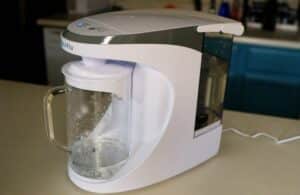
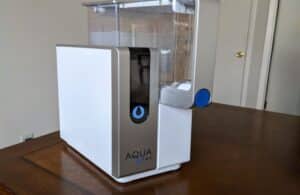
Because the Classic and Carafe are made by the same manufacturer, they have a number of design similarities, including many of the same component materials and identical certifications.
But our design comparison actually pinpoints one of the biggest differences between the systems, and this feature alone might determine for you which system you want to invest in.
Both systems store purified water ready for drinking, but their exact setups differ: the AquaTru Classic has a plastic tank and dispenses water at the press of a button, while the Carafe has a glass carafe that collects water as it purifies, so it’s ready to use without having to manually dispense it.
AquaTru’s tank has a water-holding capacity of 0.75 gallons, while the AquaTru Carafe pitcher holds around 0.625 gallons.
We’ll discuss how these design differences affect component quality in the next section.
Component Quality
Both AquaTru models are made from BPA-free Tritan plastic, with a plastic design that felt sturdy but not too heavy or bulky.
The Carafe model uses a glass carafe for purified water collection, which means that (unlike with the Classic) water doesn’t come into contact with a plastic tank after it has been purified.
That means you can better retain the quality and composition of your RO water without worrying about what microplastics might be leaching from the tank. Glass is one of the safest materials for food/water storage and doesn’t leach contaminants.
Filter Materials
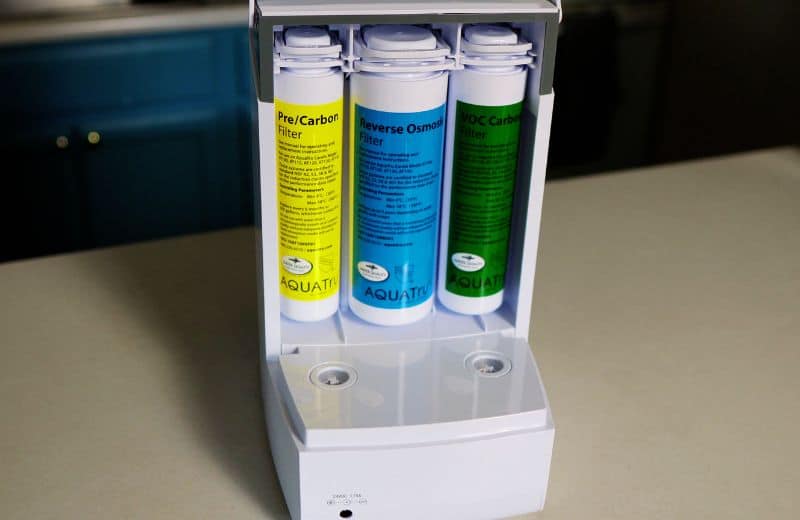
The AquaTru Carafe and Classic use several filter stages: a sediment pre-filter, an activated carbon VOC filter (which can be upgraded to a remineralization model), and a semi-permeable membrane.
In terms of their materials and intended performance, these filters are exactly the same in both units. The only difference is their size: the AquaTru Classic has bigger filters with a larger surface area, which gives them the benefit of a longer lifespan.
Smart Features & Connect App
Neither AquaTru filter is the most advanced or feature-heavy countertop RO system we’ve come across.
Many systems now offer water dispensing at any temperature, along with presets for dispensing different volumes of water at the touch of a button.
While AquaTru doesn’t offer this, both the Carafe and Classic do have a digital display screen, which provides both filter lifespan information and a water level icon to indicate when a tank refill is necessary.
As we mentioned earlier, you can also buy both systems with WiFi connection, which you can use to view helpful data like TDS and filter lifespan in the AquaTru Connect app. It’s great to see this offered as an optional upgrade for both models, as originally, it was only an option for the Classic.
Materials Safety Certification
If you don’t want to take a manufacturer’s design claims at face value, you can look for official certifications for materials safety or lead-free design.
This works the same as performance certifications: they’re conducted by official testing and certification organisations and verify that the product meets rigorous, predefined standards for safety, quality, and performance.
Both AquaTru systems hold an NSF 372 certification for lead-free design, plus a materials safety and structural integrity certification under their IAPMO performance certification.
⚙️ Setup: A Tie, Both Are Plug-and-Play (10.00 Both)
Key Finding: Both units set up in 5 to 10 minutes with no plumbing, earning identical 10.00 setup scores.
We’ve tested many RO systems, and plug-and-play countertop units like the AquaTru Classic and Carafe are the easiest to set up. They’re ideal for rentals or anyone who wants to avoid the hassle of DIY as much as possible.
This is another category that the systems performed very similarly in, thanks to their shared manufacturer.
You can see our setup scores and setup times for both units in the table below.
| Product | Setup Score | Setup Time |
|---|---|---|
| Aquatru Carafe | 10.00 | 5–10 minutes (plus priming) |
| Aquatru Classic | 10.00 | 5–10 minutes (plus priming) |
Both units arrived partially assembled, so we could simply set them up on our countertop of choice, wash out the tanks, and install the filters. No technical know-how is needed, and no need to hire a plumber!
For both systems, we needed to prime the filters before we could start using them. The instructions are the same: run 4 tanks of water through the system and discard the purified water each time. This is a time-consuming process, but at least it’s nice and simple and mostly hands off.
🔧 Maintenance: Tied on Score, but the Classic Costs Less to Run (9.75 Both)
Key Finding: Filter replacements cost $0.14 per gallon on the Classic versus $0.29 on the Carafe. The two models’ cartridges now cost the same per filter, but every Carafe cartridge has half the rated gallon capacity of its Classic counterpart.
Again, the AquaTru Carafe and Classic require similar maintenance, but their differences in filter sizes mean they’re not identical in what you can expect here.
See the next table for our maintenance scores for both systems.
| Product | Maintenance Score | Servicing Requirements | Costs |
|---|---|---|---|
| Aquatru Carafe | 9.75 | Outstanding | $0.29/gal |
| Aquatru Classic | 9.75 | Outstanding | $0.14/gal |
Despite their differences in filter replacement frequency and ongoing costs, both AquaTru models received the same scores of 9.75 in this category.
Servicing Requirements
While the Classic and Carafe use the same filters, they have different filter lifespans, which will impact their replacement schedules.
Both units have filter lifespan trackers on the display screen, with the option to view this information in the AquaTru app if you have a Connect system.
AquaTru provides identical time-based replacement estimates for both systems. The pre/carbon filter lasts up to six months, the VOC filter about a year, and the RO membrane up to two years. But the gallon ratings differ: the Carafe’s pre/carbon and VOC filters are rated for 300 gallons versus the Classic’s 600, and its RO membrane for 600 gallons versus the Classic’s 1,200.
This was initially confusing to us, as the Carafe’s filters are physically smaller. But AquaTru assumes that if you’re buying the smaller system, you’ll be purifying less water per day, which is why their timescales for filter replacements are the same.
This isn’t necessarily the case — you might buy the Carafe simply for its glass water collection, and you use more water than AquaTru predicts.
AquaTru Carafe filter replacement process:
AquaTru Classic filter replacement process:
As well as replacing the three filters according to their schedules, we washed the tanks once every few days and wiped down the unit exteriors as needed.
AquaTru recommends flushing the unit with pure water once a week to clean the filters. This is optional, so you don’t have to do it, but it can help extend the filter lifespan and maintain flow rate.
For both systems, we needed to empty the wastewater from the tank once it got full.
Maintenance Costs
Both AquaTru systems are affordable to maintain, although our calculated cost-per-gallon for the Carafe is slightly higher.
We’ve based these calculations on the filters’ rated lifespans in gallons, rather than AquaTru’s monthly estimates. Here’s how they differ:
| Model | Filter Stage | Filter Cost | Rated Capacity | Cost per Gallon |
|---|---|---|---|---|
| AquaTru Classic | Pre/Carbon Filter | $24.95 | 600 gal | $0.04 |
| AquaTru Classic | VOC Carbon Filter | $34.95 | 600 gal | $0.06 |
| AquaTru Classic | Reverse Osmosis Filter | $51.95 | 1,200 gal | $0.04 |
| AquaTru Classic | Total | $111.85 | — | $0.14/gal |
| AquaTru Carafe | Pre/Carbon Filter | $24.95 | 300 gal | $0.08 |
| AquaTru Carafe | VOC Carbon Filter | $34.95 | 300 gal | $0.12 |
| AquaTru Carafe | Reverse Osmosis Filter | $51.95 | 600 gal | $0.09 |
| AquaTru Carafe | Total | $111.85 | — | $0.29/gal |
Every one of the Carafe’s cartridges has half the rated filtering capacity of its Classic counterpart, at the same replacement price.
That works out to $0.14 per gallon for the Classic and $0.29 per gallon for the Carafe.
🏢 Company: A Tie, Same Manufacturer and Policies (8.80 Both)
Key Finding: Both systems carry AquaTru’s 1-year warranty, free shipping, and 30-day returns, since they share a manufacturer.
In this final comparison point, we usually compare the companies behind the filters we’re reviewing. But because the Carafe and Classic are both manufactured by AquaTru, they’re backed by the same warranty offerings and have the same shipping and returns policies.
Here’s what you should know about AquaTru’s offerings:
- All products (excluding the filters themselves) are backed by a 1-year limited warranty against defects in materials and workmanship. Option to upgrade to a 3 year warranty for an additional cost.
- AquaTru offers free shipping to all 50 states, Canada, and Puerto Rico.
- Both the AquaTru systems can be returned within 30 days of the purchase under the company’s returns policy, but you have to pay for the return shipping fees.
The table below displays the data we used to award the scores in this category.
| Product | Company Score | Warranty Length | Shipping | Returns |
|---|---|---|---|---|
| Aquatru Carafe | 8.80 | 1 year | Free | 30 days |
| Aquatru Classic | 8.80 | 1 year | Free | 30 days |
🆚 AquaTru Carafe or Classic: Which One’s for You?
Ultimately, both AquaTru filters have a lot going for them. They both offer identical value where it matters most, but you might prefer one over the other depending on your personal situation and preferences:
We Recommend the AquaTru Carafe to:
- Anyone looking for a system that dispenses RO water into a glass container, with no contact with a plastic tank first.
- Folks with smaller budgets who prefer to spend less on a unit upfront.
- You have less countertop space and need a system with a more space-saving design.
We Think the AquaTru Classic is Worth Considering If:
- You don’t mind paying a bit more upfront to potentially spend less on filter replacements in the long run.
- You’re a bigger family of 3+ and would benefit from the Classic’s larger 0.75-gallon purified water tank capacity
- You think you’ll value the system’s faster filtration rate.
Both Systems Are Great Because
- They received the highest overall scores in our testing and currently top our list of the best countertop RO systems.
- They have some of the most extensive performance and design certifications we’ve seen.
❔ Aquatru Carafe vs Classic FAQ
Q: Is the AquaTru Carafe or Classic better?
A: Both use the same 4-stage filtration and delivered identical contaminant reduction in our testing (9.91/10 each). The Carafe scores slightly higher overall (9.57 vs 9.54) because it collects water in glass and costs less upfront. The Classic is the better pick for larger households, with a 0.75-gallon tank, faster filtration, and a lower running cost of $0.14 per gallon versus $0.29.
Q: Can you use AquaTru Classic filters in the Carafe?
A: No. The two systems use the same filter media and stages, but the cartridges are physically different sizes and are not cross-compatible. The Classic’s cartridges are larger, which is why they last longer and cost less per gallon.
Q: Which AquaTru is cheaper?
A: It depends on the timeframe. The Carafe is cheaper to buy ($375 base versus the Classic’s $475). The Classic is cheaper to run, at $0.14 per gallon versus the Carafe’s $0.29, because its larger filters have a longer rated lifespan.
Q: Do the Classic and Carafe remove the same contaminants?
A: Yes. They use identical filtration technology and hold the same NSF/ANSI 42, 53, 58, 401, and 372 certifications. In our lab testing, both reduced their detected contaminants to non-detect or near-zero levels.
Q: Which AquaTru is better for a family?
A: The Classic. Its 0.75-gallon tank, faster 0.04 GPM filtration (about 69 gallons per day), and lower $0.11 per gallon cost make it the better fit for households of three or more.
Q: Does the Carafe filter as fast as the Classic?
A: No. The Carafe filters about 43 gallons per day (0.03 GPM), while the Classic filters about 69 gallons per day (0.04 GPM). Both share the same 4:1 efficiency ratio, so the difference is throughput, not waste.
This is really amazing work – thank you so much! Super helpful site to find from UK. Your testing is very carefully and thoroughly done. I will recommend your site to friends – thank you again.
Thanks for the feedback!