

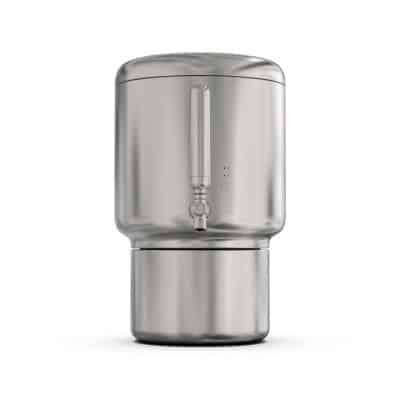
The Rorra Countertop System is a fresh take on the conventional stainless steel gravity-fed filter, using electrokinetic nanofiber filtration to remove select contaminants and improve water quality. It’s claimed to target 50+ harmful contaminants, filter up to 4x faster than the competition, and be rigorously tested by the NSF for contaminant reduction. Here’s my Rorra water filter review:
What We Like
What We Don’t Like
| Price | $384 |
| Contaminants Reduced | 50+ |
| Certifications | – Not Certified |
| Process | Electrokinetic Nanofiber Filtration |
| Filter Capacity | 203 gallons/cartridge |
| Annual Cost | ~$300 |
| Warranty | 12 months on system, 90 days on filter |
We jumped at the chance to test this relatively new-to-market water filter system to see what it could remove from our water and how it compares to other countertop models in terms of design quality, filtration speed, maintenance requirements, and more.
Table of Contents
📊 Scoring Data
When we’re testing and reviewing water filters, we analyze and compare them across the same six key performance areas. Our scoring system ranks filters based on their contaminant reduction, design, setup, maintenance, and company policies (including warranty and returns policy).
As much as possible, we base our scores on objective test data, such as our Tap Score lab testing and proof of official certifications for performance/design. But for certain performance categories, like setup and component quality, it makes more sense for us to assess filters based on our own objective testing and experience.
See how the Rorra Countertop System performed in the table below.
| Criteria | Results |
|---|---|
| Overall Score | 8.33 |
| Health Related Contaminants | 7.80 |
| Aesthetic Related Contaminants | 9.90 |
| Performance Certification | Not Certified |
| Filtration Rate | 3.0 GPH |
| Component Quality | Exceptional |
| Component Certification | Not Certified |
| Setup | Good |
| Servicing Requirements | Exceptional |
| Costs | $0.37/ gallon |
| Warranty Length | 12 months |
| Shipping | $16 shipping; free over an unspecified order minimum. |
| Returns | 30 days |
🚰 Contaminant Reduction
Score: 7.71A water filter’s contaminant reduction performance is, unquestionably, its most important feature. You’re not buying a filter just for it to sit on your countertop and look important. That’s why our contaminant reduction scoring has the biggest influence on a filter’s overall weighted score.
The bulk of our scoring in this category is determined by our own independent lab testing in partnership with our testing lab of choice, Tap Score. We also look at whether or not a filter has NSF, WQA, or IAPMO certifications to NSF Standards for reducing specific contaminants.

Our Performance Testing
Score: 9.62
We tested Rorra’s contaminant reduction performance by comparing the quality of two water samples: one baseline sample of our tap water before filtration, and one sample directly from the countertop dispenser after filtration.
We followed a strict protocol for taking our samples, as advised by Tap Score, to obtain the most accurate lab data. The process involved filling a clean bucket with tap water and swirling it to mix it well. We then filled the Rorra unit with most of the water from the bucket, waited for it to filter, and took a sample from the dispenser. Finally, we took a “before” sample directly from the bucket.
Tap Score sent us two interactive test reports outlining the contaminants detected in each sample. We compared these concentrations against the Health Guideline Levels (HGLs) rather than the EPA’s Maximum Contaminant Levels (MCLs), since HGLs are more stringent and health protective.
Health-Related Contaminants
Score: 9.70
Our baseline water contained 10 contaminants with possible health effects:
- 0.032 PPM uranium (exceeding the HGL of 0 PPM)
- 1.4 PPM fluoride (exceeding the HGL of 0.799 PPM)
- Sulfate
- Zinc
- Strontium
- Molybdenum
- Barium
- Nitrate
- Phosphorus
- Copper.
| Analyte | Type | Unit | Pre | Post | Difference |
|---|---|---|---|---|---|
| Alkalinity (as CaCO3) | Properties | PPM | 81 | 83 | 2.47% |
| Barium | Metals | PPM | 0.031 | 0 | -100.00% |
| Bicarbonate | Minerals | PPM | 98.37 | 100.4 | 2.06% |
| Calcium | Minerals | PPM | 26.9 | 17.8 | -33.83% |
| Carbonate | Minerals | PPM | 0.18 | 0.37 | 105.56% |
| Chloride | Inorganics | PPM | 13.5 | 13 | -3.70% |
| Chloride-to-Sulfate Mass Ratio | Properties | 1.59 | 1.49 | -6.29% | |
| Copper | Metals | PPM | 0.0654 | 0 | -100.00% |
| Fluoride | Inorganics | PPM | 1.4 | 1.4 | 0.00% |
| Grains per gallon | Properties | Grains | 5.55 | 4.08 | -26.49% |
| Hardness | Properties | PPM | 94 | 70 | -25.53% |
| Hardness (Ca,Mg) | Properties | PPM | 94 | 70 | -25.53% |
| Hardness (Total) | Properties | PPM | 94.94 | 69.91 | -26.36% |
| Langelier Saturation Index | Properties | -0.66 | -0.53 | -19.70% | |
| Magnesium | Minerals | PPM | 6.58 | 6.17 | -6.23% |
| Manganese | Metals | PPM | 0 | 0.0017 | N.A |
| Molybdenum | Metals | PPM | 0.006 | 0.0043 | -28.33% |
| Nitrate (as N) | Inorganics | PPM | 2.6 | 1.9 | -26.92% |
| pH | Properties | pH | 7.6 | 7.9 | 3.95% |
| Phosphorus | Inorganics | PPM | 1.1 | 0 | -100.00% |
| Potassium | Minerals | PPM | 0 | 3.48 | N.A |
| Sodium | Minerals | PPM | 10.7 | 19.5 | 82.24% |
| Sodium Adsorption Ratio | Properties | 0.48 | 1.01 | 110.42% | |
| Specific Conductivity | Properties | umhos/cm | 234 | 234 | 0.00% |
| Strontium | Metals | PPM | 0.144 | 0.044 | -69.44% |
| Sulfate | Inorganics | PPM | 8.5 | 8.7 | 2.35% |
| Total Dissolved Solids | Properties | PPM | 138 | 138 | 0.00% |
| Uranium | Metals | PPM | 0.0322 | 0 | -100.00% |
| Zinc | Metals | PPM | 0.248 | 0 | -100.00% |
Research into these impurities has linked them to health effects including cancer, skeletal and developmental issues, and gastrointestinal, liver, and kidney problems.
Post-filtration, we could see that Rorra had delivered a strong performance overall, although still with room for improvement.
Starting with the complete eliminations, barium was reduced from 0.031 PPM, and copper from 0.0654 PPM, both down to non-detectable levels. Plus, uranium (one of the contaminants exceeding the HGL) was reduced to 0, as was zinc (from an initial detection of 0.248 PPM). Finally, phosphorus was reduced from 1.1 PPM to 0.0 PPM.

Less impressively, nitrate was only reduced by 26.92%, from 2.6 PPM to 1.9 PPM. Molybdenum was reduced by 28.33%, from 0.006 PPM to 0.0043 PPM, and strontium was reduced by 69.44%, from 0.144 PPM to 0.044 PPM.
Fluoride wasn’t removed at all, which was disappointing but not altogether surprising. Most countertop gravity filters we’ve tested are lacking the technology to remove fluoride, and some come with separate fluoride filters that you can add on if you want to target this impurity.
Aesthetics, pH, and Mineral Content
Score: 9.90
The only contaminant we don’t detect with Tap Score lab testing is chlorine. Instead, we test for this volatile chemical on-site, so our results aren’t influenced by possible dissipation between taking the sample and testing at the lab.
Around 2 PPM of chlorine was detected in our unfiltered water, and the Rorra Countertop System completely eliminated concentrations down to undetectable levels. This resulted in the highest aesthetics score it could have achieved.
Interestingly, the filter reduced total hardness by around 26%, from 94 PPM to 70 PPM. Sodium: increased by 82.24%, from 10.7 PPM to 19.5 PPM. This may be the result of using the electrokinetic nanofilter media, although none of the documentation we could find in our research about this media claims that it reduces or introduces dissolved solids or charged ions. It’s possible that ion resin may also be involved, as this would explain the reduction in unwanted ions and increase in sodium, but the manufacturer doesn’t claim to use this media.
This suggests the use of ion exchange media that replaces unwanted ions with sodium, and is also targeting hardness minerals.
The pH of our water increased by 3.95%, from 7.6 to 7.9. Plus, bicarbonate increased slightly and carbonate more than doubled, which is likely a result of mild remineralization or carbonate buffering from the media. A nice bonus if you’re interested in alkaline water for its improved taste and possible health benefits!
Unexpected Outcomes
There were a couple of testing anomalies that we wouldn’t typically expect from a countertop water filter:
- Manganese, which was absent in our baseline sample, was detected post-filtration at 0.0017 PPM
- Potassium was also detected post-filtration, this time at 3.48 PPM, when it was absent pre-filtration
Again, we’re not 100% sure of the reason for this outcome. Our initial thoughts were that a potassium and sodium-loaded ion exchange resin is used, but the only media mentioned is the electrokinetic nanofilter. We’re also not sure about why manganese was introduced. Since it was only detected in very small trace amounts, we don’t find this outcome too concerning.
Performance Certifications
Score: 6.00
One of the main marketing points on the Rorra product page is its NSF testing to reduce more than 50 contaminants. There’s also a page on the website that’s dedicated to sharing the reports from this testing, which includes data from contaminant reduction testing to NSF Standards 42, 401, and 53.
There are a number of reasons why Rorra might have obtained NSF testing but not certifications:
- The cost of a full certification might be a factor. Rorra is a new company—we did some digging and found a press release announcing its launch in November 2024. It’s possible that the manufacturer might look to invest in official certifications once they’re more established.
- The countertop filter might, for whatever reason, be ineligible for any official certifications, and testing is the next-best thing.
Whatever the reason, Rorra is clearly hoping that simply using the NSF name will be enough to assure people of its performance abilities, and possibly even sway people who don’t understand the difference between testing and certifications.
Since we’re specifically looking for performance certifications, the Rorra Countertop System gets the lowest score from us here.
🚦Filtration Rate
Score: 10.00We’ve had a mixed experience with countertop filters when it comes to filtration rate. But Rorra delivered on its promise to filter “faster than the competition” with one of the fastest flow rates we’ve come across for a gravity-fed filter: 3 gallons per hour (GPH). This was based on its time to filter a single gallon of water, which we recorded at just over 20 minutes.
While you won’t be able to fill a big bottle with filtered water instantly, you’ll still get enough water for a small family’s drinking needs whenever you need it—as long as you keep on topping up the system as you’re dispensing water from the bottom.
📐 Design
Score: 9.10Our first impression of the Rorra Countertop System was that it’s designed pretty similarly to other cylindrical, stainless steel countertop gravity filters. The idea is that you fill the top of the unit with water, which travels through the filter and collects in the bottom. You can then lift the handle to dispense the water into a glass.
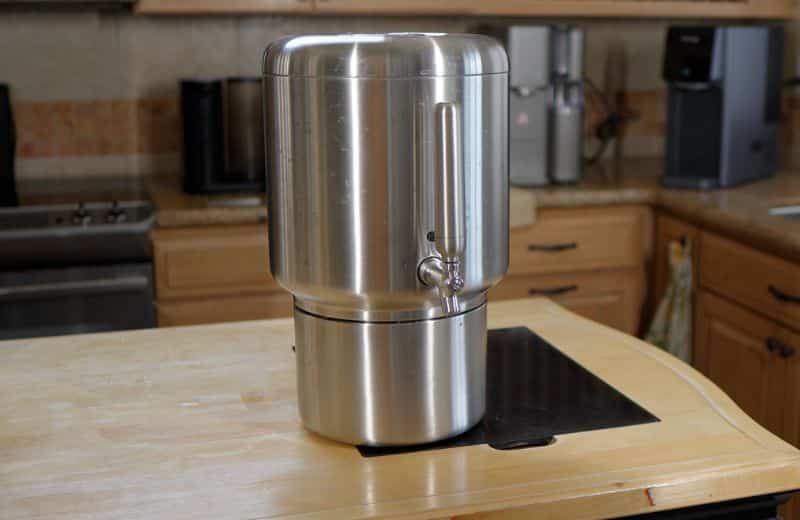
There’s just one unit size/capacity available right now (2.5 gallons), and just one finish (silver; medical-grade stainless steel.)
Component Quality
Score: 10.00
From a design quality and safety perspective, a big standout feature of this unit is its almost completely plastic-free design.
Most similar systems (we’re talking Berkey, Alexapure, ProOne, and British Berkefeld) have plastic filter housings and dispenser spouts. But Rorra’s plastic use is limited to small silicone o-rings and the filter’s end caps and mesh core, which are made from FDA food-grade virgin polypropylene. No, it’s still not entirely plastic-free, but it’s about as close as we’ve seen for a countertop unit of this kind.
Since it’s mostly made from medical-grade stainless steel, the Rorra system feels sturdy and durable, and it shouldn’t (in theory) rust or degrade over time.
Filter Materials
There’s just a single filter cartridge used in the Rorra Countertop System, made from electrokinetic nanofiber media. There’s not a whole lot of information out there on how this media works, and it’s not as common as media like activated carbon, KDF, and ceramic, which are typically found in countertop gravity filters.
From what we understand, filters like Rorra’s use charged nanofibers to attract and immobilize contaminants through electrostatic and electrochemical interactions as water passes through. They’re also capable of reducing smaller contaminants (down to bacteria and virus size, although this isn’t a claimed ability of the Rorra filter) compared to other media.
Materials Safety Certification
Score: 6.00
A handful of stainless steel gravity-fed filters we’ve tested have obtained NSF, WQA, or IAPMO certifications for materials safety or lead-free design.
So far, Rorra hasn’t followed in the footsteps of British Berkefeld, ProOne, and Boroux in obtaining an official design certification, although it does have NSF testing to Standard 372 (for lead-free design) and for California Prop 65 (for materials safety).
As we explained earlier, testing (even by the NSF) doesn’t hold the same weight as official certifications, so Rorra was awarded the lowest score in this category.
⚙️ Setup
Score: 8.50We’ve had a variety of experiences assembling and setting up countertop water filters, ranging from quick and easy (British Berkefeld and Alexapure) to tear-your-hair-out frustrating (Berkey and Waterdrop).
The good news is that Rorra is on the “quick and easy” end, with setup taking us just under 25 minutes from start to finish. We spent five of those minutes washing the parts—something that’s recommended before using a new system—and reassembling the unit.
The other 20 minutes were spent flushing the filter, which is standard procedure before using virtually any new water filter and removes any loose media or particles. Some countertop filters have difficult filter priming processes that require special tools, but with Rorra, you just filter and discard a single batch of water. The filter is then ready to use.
The only reason Rorra didn’t score higher in this category is that the filter flushing is quite time-consuming, by nature of the gravity filtration process.
🔧 Maintenance
Score: 9.75The Rorra Countertop System earned the highest maintenance score of all the units we tested in this category. Not only does it have an affordable ongoing filter replacement spend, but it’s also easier to know when to replace the filters than with any other system.
Servicing Requirements
10.00
The main servicing task for any water filter system is replacing the filter when it becomes saturated with contaminants. It can be difficult to know exactly when the filter needs replacing, and with most countertop systems, we’ll make a calendar reminder to let us know.
A big selling point of the Rorra unit is its filter replacement light, which eliminates the need to make your own reminders. This is a battery-powered setup that actually does more than just tell you when your filters should be replaced. It also:
- Tells you when the water volume has dropped below 72 ounces to remind you to refill soon
- Alerts you when the water volume is less than 16 ounces, telling you to refill now
This is a really useful feature, especially when we compare it to many of the other gravity countertop systems we’ve tested, which make it near-impossible to know the water level in the bottom chamber without taking the whole unit apart.
As for filter status, the indicator essentially runs on a timer and will tell you when the filter status is good (meaning it has more than 10 days of use left), when it’s nearing the end of its lifespan, and when it needs to be replaced.
Rorra Countertop Filter: Key Maintenance Features at a Glance
| Feature | Description |
|---|---|
| Filter Replacement Light | Shows when filter is good, near end, or needs replacement |
| Low Water Alert | Warns when water volume <72 oz (refill soon) |
| Empty Alert | Warns when water volume <16 oz (refill now) |
| Maintenance Tip | Wash chambers 1–2x per week to remove scale |
Aside from replacing the filters, we also disassembled the unit and washed out the chambers once or twice a week to remove any scale and other debris that might be building up.
Costs
Score: 9.50
Rorra isn’t one of the most affordable countertop gravity filters we’ve tested, and that’s likely because it has a shorter projected filter lifespan of around 90 days. In comparison, other systems claim to have filters that last 6-9 months or longer, although we do feel that some of these claims are likely exaggerated.
The unit still has an affordable ongoing spend, though, with replacement filters costing around $75 each. That gives it a cost-per-gallon of $0.37.
🏢 Company
Score: 8.50Rorra’s warranty, shipping, and returns policy are all pretty decent, although not the best we’ve seen for a gravity filter manufacturer.
Warranty
Score: 8.50
All Rorra systems are backed by a 12-month warranty against all defects in workmanship and materials. This entitles you to a free repair or replacement of any damaged or defective components. There are a few terms and conditions to be aware of:
- You need to have used the system “in compliance with the user manual”.
- The unit can’t have been previously repaired by the manufacturer.
- The warranty doesn’t protect against damage caused during delivery.
The only exception to this warranty is the water filter, which is warranted for its lifespan (90 days).
You can find warranty information on this page.
Shipping
Score: 9.00
Standard shipping on the Rorra website costs $16.00. The company does offer free shipping over a certain threshold, which isn’t defined anywhere on the site, but the countertop system qualifies.
Rorra is also currently offering a free shipping deal with the filter subscription, which means you’ll automatically receive (and therefore be billed for) a replacement filter every 90 days.
Returns
Score: 8.00
According to Rorra’s returns policy, you can return your system within 30 days of your purchase if you’re not satisfied with it for any reason. There are a few stipulations to keep in mind:
- Your item must be returned in its original packaging.
- You’ll also need the receipt or proof of purchase.
- You need to actually request the return first (otherwise it won’t be accepted).
Any returns made after this window will be subject to a 10% restocking fee as well as the return shipping fee.
Rorra’s returns policy can be found alongside its product warranty.
💰 Value For Money
Overall, we think the Rorra Countertop System is pretty good value for money, although whether or not it’s right for you depends on exactly what you’re looking for.
The system has several advantages over many similar models, with a design that uses very few plastic components, a simple setup process that doesn’t require filter priming, and a handy filter lifespan indicator. It also performed well at reducing or removing the contaminants with health effects in our water, and it’s affordable to own in the long run.
That said, there are a couple of setbacks that might be dealbreakers for you: the filter doesn’t have any official performance certifications, and it’s one of the most expensive stainless steel gravity units that we’ve tested.
Ultimately, if you’re not that fussed about certifications and can stretch your budget a bit further, Rorra might be a good option to consider. But if you want a more affordable, certified filter, the British Berkefeld system costs a fraction of the price and is certified to reduce four contaminants, with an easy setup process and a very similar design.
Found this review helpful?
Comment below or share this article!
So…the filter light. How does it “know” that I’ve filtered 200 gallons or does it only really use the 90 timer? If I use a gallon a day, that’s 90 days and if the 200 gallon number is real, then it should last at least 180 days, not 90. So which is it? 90 days by the timer or the actual gallons flowing through it? My guess is the 90 day timer, so we will buy another filter sooner than necessary (if the 200 gallon amount is really true and using around a gallon a day). Does anyone know this answer? I’d ask the mfr, but I expect I’ll get an answer that isn’t an answer.
Thanks for any opinion you might have.
Rod
I’ve not tried to validate this yet myself either