

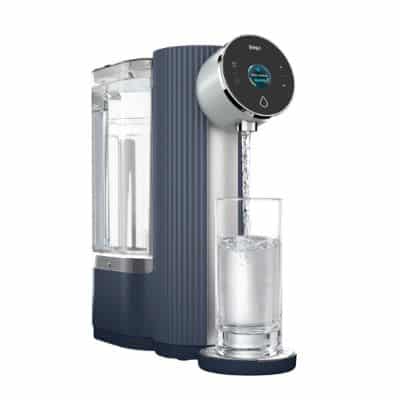
The Ninja HydraSense is a pump-pressurized activated carbon water filter that’s designed to improve water quality without the wastewater production of RO. We bought the unit ourselves and tested it at home, comparing our own lab data for feed water and filtered water samples, to evaluate its performance against Ninja’s marketing claims.
The main scoring categories that we’ll be discussing in this review relate to contaminants removed, filtration speed, ease of setup, maintenance requirements and costs, and company policies. We’ve compared the Ninja HydraSense against similar systems, so you can see clearly how it performs when put head-to-head with its closest competitors.
What We Like
What We Don’t Like
| Price | $250 |
| Contaminants Reduced | 27 certified claims |
| Certifications | NSF/ANSI 42, 53, 401 & 372 |
| Process | Mechanical + Activated Carbon |
| Filter Capacity | 120 gallons |
| Annual Cost | ~$247.54 |
| Warranty | 1 year |
Quick Verdict: Is the Ninja HydraSense Worth It?
The Ninja HydraSense scored 6.63 out of 10 in our testing. Tap Score rated our tap water 40 of 99 before filtration and 39 after, with the Health score unchanged at 35: fluoride stayed at 1.7 PPM and TDS went from 803 PPM to 793 PPM, while free chlorine (2.47 PPM), total THMs (16.5 PPB), and copper (0.777 PPM) dropped to non-detectable levels.
Buy it if: You’re on treated city water and mainly want chlorine taste and odor gone, or you want a filter certified to NSF/ANSI 42, 53, and 401 for lead, total PFAS, VOCs, and pharmaceuticals, with no wastewater and a 64-ounce fill in 50 seconds.
Skip it if: You need lower TDS, fluoride, or nitrate. Those call for reverse osmosis, and the AquaTru Carafe costs about the same per gallon to run ($0.335 against $0.339).
Methodology: We test all water filters using a weighted scoring system that covers 6 key performance categories. Contaminant reduction accounts for the largest portion (55%) of the overall score, but filtration rate, design, setup, maintenance, and company policies also make up the weighting. You can read about the full process in our water filter testing methodology.
📊 Scoring Data
At Water Filter Guru, we evaluate every water filter we review using real data from our series of subjective and objective tests.
Our detailed scoring system combines multiple performance factors to award each product a weighted, averaged overall score. We use this data to compare all the similar water filters we’ve tested, giving us a fair side-by-side comparison.
We tested the Ninja HydraSense in September 2026, assessing its lab results and its everyday operation. You can review the next table to see how it performed against other countertop filtration systems we’ve put through the same testing process.
| Criteria | Results |
|---|---|
| Overall Score | 6.63 |
| Health Related Contaminants | 3.50 |
| Aesthetic Related Contaminants | 9.90 |
| Performance Certification | NSF/ANSI 42, 53, 401 and NSF/ANSI/CAN 372 |
| Filtration Rate | 0.6 GPM |
| Component Quality | Outstanding |
| Component Certification | Exceptional |
| Setup | Exceptional |
| Servicing Requirements | Exceptional |
| Costs | $0.34/ gallon |
| Warranty Length | 1 year |
| Shipping | Free on orders over $99 |
| Returns | 60 days |
🚱 How Well Does the Ninja HydraSense Remove Contaminants?
Score: 4.44Key Finding: Our water had a Tap Score rating of 40 out of 99 pre-filtration and 39 after. TDS dropped slightly from 803 PPM to 793 PPM, fluoride stayed at 1.7 PPM, and the Tap Score Health score stayed at 35. Free chlorine, total trihalomethanes, and copper were reduced to undetectable levels, while aluminum and manganese were detected in the filtered water when they weren’t in the feed sample.
What Did the Lab Find In Our Test Water?
Our test water was challenging for any filter, especially one that relies on activated carbon, like the Ninja HydraSense, instead of reverse osmosis. It contained 803 PPM of total dissolved solids, measurable fluoride and nitrate, 307 PPM total hardness, free chlorine, and measurable disinfection byproducts.
The baseline Tap Score report rated our feed water 40 out of 99 overall, with a Health score of 35. A handful of contaminants were detected in concentrations exceeding the Health Guideline Level (HGL):
- 1.7 PPM fluoride (exceeding the HGL of 0.799 PPM)
- 0.0148 PPM uranium (exceeding the HGL of 0)
- 4.27 PPB bromodichloromethane (exceeding the HGL of 0)
- 3.41 PPB bromoform (exceeding the HGL of 0)
- 8.82 PPB dibromochloromethane (exceeding the HGL of 0.1 PPB)
- 0.777 PPM copper (exceeding the HGL of 0.3 PPM)
Our test also detected several contaminants in levels not exceeding the HGL, including barium, boron, strontium, molybdenum, nitrate, total chromium, selenium, and vanadium.
| Analyte | Unit | Baseline | Ninja HydraSense | Difference |
|---|---|---|---|---|
| Alkalinity (as CaCO3) | PPM | 354 | 362 | 2.26% |
| Aluminum | PPM | 0 | 0.0755 | Not detected in baseline |
| Barium | PPM | 0.0327 | 0.000784 | -97.60% |
| Bicarbonate | PPM | 428 | 437 | 2.10% |
| Boron | PPM | 0.375 | 0.329 | -12.27% |
| Bromodichloromethane | PPB | 4.27 | 0 | -100.00% |
| Bromoform | PPB | 3.41 | 0 | -100.00% |
| Calcium | PPM | 91.4 | 114 | 24.73% |
| Carbonate | PPM | 1.97 | 2.02 | 2.54% |
| Chloride | PPM | 107 | 108 | 0.93% |
| Chloride-to-Sulfate Mass Ratio | 0.572 | 0.578 | 1.05% | |
| Chromium (Total) | PPM | 0.0032 | 0.00302 | -5.63% |
| Copper | PPM | 0.777 | 0 | -100.00% |
| Dibromochloromethane | PPB | 8.82 | 0 | -100.00% |
| Expanded Hardness | PPM | 310 | 391 | 26.13% |
| Fluoride | PPM | 1.7 | 1.7 | 0.00% |
| Grains per gallon | Grains | 18 | 22.8 | 26.67% |
| Hardness | PPM | 307 | 390 | 27.04% |
| Langelier Saturation Index | 0.832 | 0.938 | 12.74% | |
| Magnesium | PPM | 19.2 | 25.5 | 32.81% |
| Manganese | PPM | 0 | 0.00487 | Not detected in baseline |
| Molybdenum | PPM | 0.0012 | 0.00115 | -4.17% |
| Nitrate (as N) | PPM | 4.1 | 3.9 | -4.88% |
| pH | pH | 8 | 8 | 0.00% |
| Potassium | PPM | 3.39 | 4.69 | 38.35% |
| Selenium | PPM | 0.00535 | 0.0049 | -8.41% |
| Sodium | PPM | 162 | 220 | 35.80% |
| Sodium Adsorption Ratio | 4.02 | 4.84 | 20.40% | |
| Specific Conductivity | umhos/cm | 1380 | 1360 | -1.45% |
| Strontium | PPM | 0.979 | 0.537 | -45.15% |
| Sulfate | PPM | 187 | 187 | 0.00% |
| Total Dissolved Solids | PPM | 803 | 793 | -1.25% |
| Total THMs | PPB | 16.5 | 0 | -100.00% |
| Uranium | PPM | 0.0148 | 0.0116 | -21.62% |
| Vanadium | PPM | 0.00126 | 0.00125 | -0.79% |
Which Contaminants Did The Ninja HydraSense Remove?
While the Ninja HydraSense was unable to remove certain contaminants at all, it did reduce the following contaminants down to undetectable concentrations in our testing:
Total THMs
Our feed water initially contained 16.5 PPB of total trihalomethanes, a group of disinfection byproducts that are commonly found in chlorinated tap water. This total concentration was made up of 4.27 PPB bromodichloromethane (exceeding the HGL of 0), 3.41 PPB bromoform (exceeding the HGL of 0), and 8.82 PPB dibromochloromethane (exceeding the HGL of 0.1 PPB).
Post-filtration, all three of these THM compounds had been completely eliminated to undetectable levels.
Copper
Copper was initially detected in concentrations exceeding the HGL (0.777 PPM against the HGL of 0.3 PPM). In our tests, copper dropped to undetectable levels post-filtration: a 100% reduction.
Ninja claims the HydraSense can remove 80+ contaminants, but copper isn’t specifically mentioned in the product listing as a contaminant removed.
Free Chlorine
We used a digital colorimeter to test for free chlorine in our water on site. Chlorine dissipates from water quickly, and we wanted to get an accurate detection, which meant testing our sample as soon as we’d collected it.
Pre-filtration, our field test measured 2.47 PPM free chlorine. This dropped down to 0 PPM after filtration in the Ninja HydraSense.
Barium
Barium is the only contaminant on this list that wasn’t completely eliminated, but it was still reduced substantially by the Ninja HydraSense.
Initially, our Tap Score test detected 0.0327 PPM of barium, which dropped to 0.000784 PPM post-filtration. This was the largest percentage reduction of the additional dissolved elements we measured.
What Did the Ninja HydraSense Struggle To Remove?
Many of the contaminants detected in our baseline sample weren’t completely removed by the Ninja HydraSense:
- Strontium decreased from 0.979 PPM to 0.537 PPM, a reduction of 45%.
- Uranium (which initially exceeded the HGL of 0) dropped from 0.0148 PPM to 0.0116 PPM, a 22% reduction, still exceeding the HGL.
- Boron decreased from 0.375 PPM to 0.329 PPM, a reduction of around 12%.
- Selenium levels fell from 0.00535 PPM to 0.0049 PPM, a reduction of around 8%.
- Total chromium decreased from 0.0032 PPM to 0.00302 PPM, a reduction of around 5.6%.
- Molybdenum levels dropped from 0.0012 PPM to 0.00115 PPM, a 4.2% reduction.
- Vanadium fell from 0.00126 PPM to 0.00125 PPM, a reduction of 0.8%.
We think the larger reductions (strontium, uranium, and possibly boron) were probably influenced by filtration in the Ninja HydraSense, but the smaller reductions are more likely to be incidental changes in our two water samples rather than the filter itself.
What About Fluoride and Nitrate?
1.7 PPM fluoride (exceeding the HGL of 0.799 PPM) and 4.1 PPM nitrate were initially picked up in our baseline test.
Post-filtration, nitrate had been reduced by just 0.2 PPM, to 3.9 PPM. Fluoride levels remained unchanged at 1.7 PPM.
In all, 4 of the 6 contaminants initially detected above the HGL were completely eliminated: bromodichloromethane, bromoform, dibromochloromethane, and copper. But uranium and fluoride still exceeded the HGL post-filtration, with fluoride completely unchanged.
What Happened to Minerals, pH, and TDS?
The Ninja HydraSense is a carbon filter, not an RO system, so we didn’t expect it to have much of an effect on the TDS of our water. And that proved to be correct in our testing, with TDS falling by just 10 PPM, from 803 PPM to 793 PPM. pH stayed the same, at 8.0 (slightly alkaline).
Our separate field test recorded 666 PPM TDS and a pH of 7.9. Post-filtration, TDS actually increased slightly to 688 PPM, and pH rose to 8.1.


There are only small differences in TDS when we compare our lab and field tests: the lab recorded a 1.2% reduction, while our field test measured a 3.3% increase. These point to the same conclusion: TDS was essentially unchanged.
We also saw changes in the mineral concentrations in our water:
- Calcium increased from 91.4 PPM to 114 PPM
- Magnesium increased from 19.2 PPM to 25.5 PPM
- Sodium increased from 162 PPM to 220 PPM
- Potassium increased from 3.39 PPM to 4.69 PPM
- Total hardness increased from 307 PPM to 390 PPM
These increases of 25–38% are too significant to be incidental, but TDS, conductivity, chloride, sulfate, and alkalinity all remained virtually unchanged post-filtration. That combination isn’t chemically consistent with a filter adding minerals, and the baseline sample was collected six weeks before the filtered sample. We’ve contacted the lab for an explanation and don’t attribute the increase to the HydraSense.
Were There Any Unusual Results?
There were two unusual results detected in our filtered water sample. Both aluminum and manganese were picked up post-filtration when they hadn’t been detected in our baseline water.
0.0755 PPM of aluminum appeared, exceeding the HGL of 0.07 PPM, along with 0.00487 PPM of manganese, below the HGL of 0.1 PPM.
We don’t want to speculate on the possible source of these contaminants without knowing for certain. Three of the five units we tested on the same water showed manganese post-filtration that wasn’t in the baseline: the HydraSense at 0.00487 PPM, the AquaTru Carafe at 0.00194 PPM, and the Bluevua at 0.00102 PPM. The HydraSense had the highest concentration of the three, and all three were below the HGL of 0.1 PPM.
Our Testing Limitations
The results we’ve shared above come from a single-point test, using the Ninja HydraSense while its filter was still fresh (meaning it hadn’t filtered many gallons of water at the time of testing).
It’s normal and expected for filtration capacity to decline over time as the system is used. Since our testing was carried out while the Ninja HydraSense was still relatively new, we treat our data as representing the best-case numbers for fresh filters.
We were also limited to testing only the contaminants that were detected in our water and covered by the lab panel, so we weren’t able to verify all of the manufacturer’s contaminant reduction claims.
Is the Ninja HydraSense Performance-Certified?
Score: 10.00
Where Ninja redeems itself in the contaminant reduction category is with its performance certifications. It has been certified by IAPMO to three NSF/ANSI Standards for the reduction of 27 contaminants:
- NSF/ANSI 42 (aesthetic effects): chlorine, taste & odor, chloramine, Particulate Class I
- NSF/ANSI 53 (health effects): VOCs, lead, mercury, cadmium, asbestos, turbidity, chlordane, MTBE, toxaphene, total PFAS
- NSF/ANSI 401 (emerging compounds/incidental contaminants): Atenolol, Carbamazepine, Estrone, Ibuprofen, Meprobamate, Naproxen, Phenytoin, Trimethoprim, BPA, DEET, Linuron, Metolachlor, nonylphenol, microplastics
That’s reassuring to have, especially if you’re looking for a filter that has been certified to remove the more common contaminants with health effects, like lead and PFAS.
Our Results Vs Ninja’s Contaminant Reduction Certifications
Here’s how our own test results compare to Ninja’s contaminant reduction certifications for the HydraSense:
| Certified Contaminant | Our Test Result |
|---|---|
| Chlorine, taste and odor | 100% reduction of free chlorine (2.47 PPM to 0 PPM, field colorimeter test) |
| Chloramine | Not tested in our baseline sample |
| Particulate Class I | Not tested in our baseline sample |
| VOCs | Total THMs (part of the VOC claim) fell from 16.5 PPB to not detected. No other VOC on our lab panel was detected in our baseline sample |
| Lead | Not detected in our baseline sample |
| Mercury | Not detected in our baseline sample |
| Cadmium | Not detected in our baseline sample |
| Asbestos | Not tested in our baseline sample |
| Turbidity | Not tested in our baseline sample |
| Chlordane | Not tested in our baseline sample |
| MTBE | Not detected in our baseline sample |
| Toxaphene | Not tested in our baseline sample |
| Total PFAS | Not tested in our baseline sample |
| Atenolol | Not tested in our baseline sample |
| Carbamazepine | Not tested in our baseline sample |
| Estrone | Not tested in our baseline sample |
| Ibuprofen | Not tested in our baseline sample |
| Meprobamate | Not tested in our baseline sample |
| Naproxen | Not tested in our baseline sample |
| Phenytoin | Not tested in our baseline sample |
| Trimethoprim | Not tested in our baseline sample |
| BPA | Not tested in our baseline sample |
| DEET | Not tested in our baseline sample |
| Linuron | Not tested in our baseline sample |
| Metolachlor | Not tested in our baseline sample |
| Nonylphenol | Not tested in our baseline sample |
| Microplastics | Not tested in our baseline sample |
You can see from this table that most of the HydraSense’s 27 certified claims cover contaminants that weren’t on our lab panel. Lead, mercury, cadmium, and MTBE were tested but not detected in our baseline sample, so chlorine and total THMs are the only certified claims our water could put to the test.
That means we can’t draw conclusions from our own testing on the filter’s ability to remove these contaminants. It also clearly demonstrates the value of third-party certifications like these, proving that a filter is capable of removing contaminants that we were unable to test for in our own water.
🚦Filtration Rate
Score: 8.00Key Finding: The Ninja HydraSense dispensed 64 ounces of water in 50 seconds (a rate of 0.60 gallons per minute) and filled our container to the 12-ounce mark in 10.7 seconds, faster than any countertop RO unit we tested.
How Fast Does the Ninja HydraSense Deliver Filtered Water?
We calculated the Ninja HydraSense’s filtration rate by recording the time it took to dispense 64 ounces of water over three tests. It took 50 seconds in total, which translates to a filtration rate of 0.60 GPM (gallons per minute), and was consistent across each test.
We also tested the HydraSense’s filtration speed from a cold start, and this time, it took just 10.7 seconds to dispense the first 12-ounce batch of water.
This highlights an obvious advantage when comparing the system with the countertop RO units we’d tested, which needed to produce and store filtered water in batches rather than dispensing on demand.
The HydraSense’s fast filtration speed is one of its biggest performance advantages. It earned a score of 8.00 for its filtration rate, based on the pressurized dispense scoring method we use for systems without a batch production stage.
Why is the Ninja Hydrasense Rated at 5 Gallons Per Day?
Ninja’s IAPMO listing for the HydraSense gives it a rating of 5 GPD. This is a batch system certification parameter rather than the pump’s actual dispensing rate.
The HydraSense doesn’t need to fill a separate purified water tank before it dispenses, so our measured rate of 0.60 GPM is the relevant figure for understanding how quickly it fills a glass in everyday use.
Is There Any Water Waste?
As a non-RO countertop filter with no reject stream or drainline, the Ninja HydraSense doesn’t produce any wastewater. 100% of the 100 ounces of feed water was retained as filtered water in our test, with no wastewater and complete water recovery.
If you’re looking for a filter that doesn’t waste water, the HydraSense is a suitable option for you.
How Loud is the Filter?
We recorded the noise produced by the HydraSense during filtration using a phone app that measures sound in decibels. At one foot away, the unit produced an average of 59.3 decibels, with a peak of 69.5 decibels.
That makes this Ninja filter the loudest unit in our 2026 countertop cohort. In comparison, the DREO averaged 38.4 decibels, the Waterdrop M6H measured 46.2 decibels, the AquaTru Carafe measured 47.8 decibels, and the Bluevua averaged 55.7 decibels.
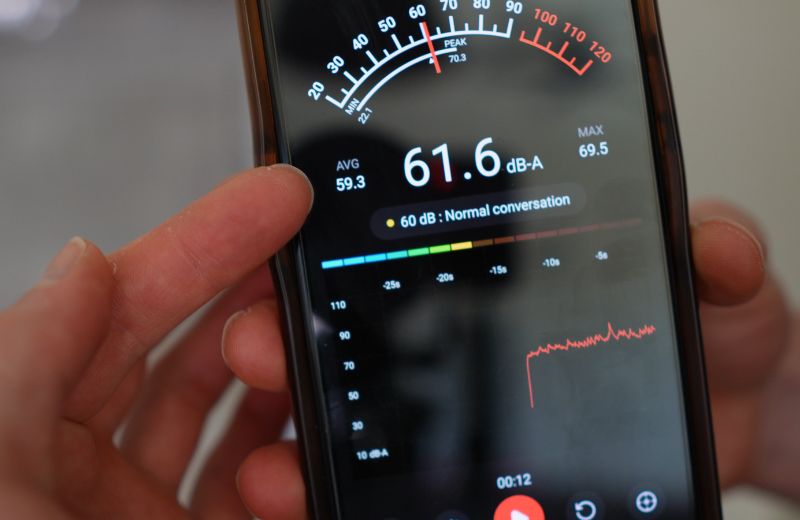
The noise doesn’t last long because the water comes out quickly, but you will notice it. If you want a full carafe in under a minute, you’ll need to be happy to trade this for a louder pump while water is dispensing.
⚡️Energy Use
Key Finding: The Ninja HydraSense used 0.0005 kWh of energy per 100-ounce tank filtered, but its steady 2.6-watt standby draw gave it the highest annual electricity cost of our 2026 countertop cohort.
The HydraSense used just 0.0005 kWh per 100-ounce tank in our calculation, which is equivalent to 0.00064 kWh per filtered gallon of water.
The pump itself doesn’t use much energy to dispense water, but the touchscreen and electronics are a different story. We measured a standby draw of 2.6 watts, which works out to around 22.8 kWh a year if you leave it plugged in continuously.
At our electricity rate of $0.1834 per kWh, that translates to an estimated $4.26 per year in electricity, assuming you filter 2 gallons of water per day. Around $4.18 of that cost comes from standby use, with around $0.09 attributed to pumping (we’ve rounded the figures for ease of reading).
That gives the HydraSense the highest annual electricity cost in our countertop cohort, despite it using the least energy to produce water. The difference might only be small in real money, but it shows that standby electricity consumption is actually more important than the pump itself.
📐 Design
Score: 9.70Key Finding: The Ninja HydraSense is the lightest unit in our 2026 countertop cohort at 6.6 pounds, with a measured footprint of 12.75 by 5 inches and a removable 96-ounce tank that fits in a refrigerator. Its touchscreen saves custom pour volumes, and the thinner plastic and gasketless tank lid are the main design compromises we found.
What Is The Ninja HydraSense’s Build Quality Like?
The Ninja HydraSense did well in the design category, with its narrow, lightweight construction and practical features contributing to its high score of 9.70.
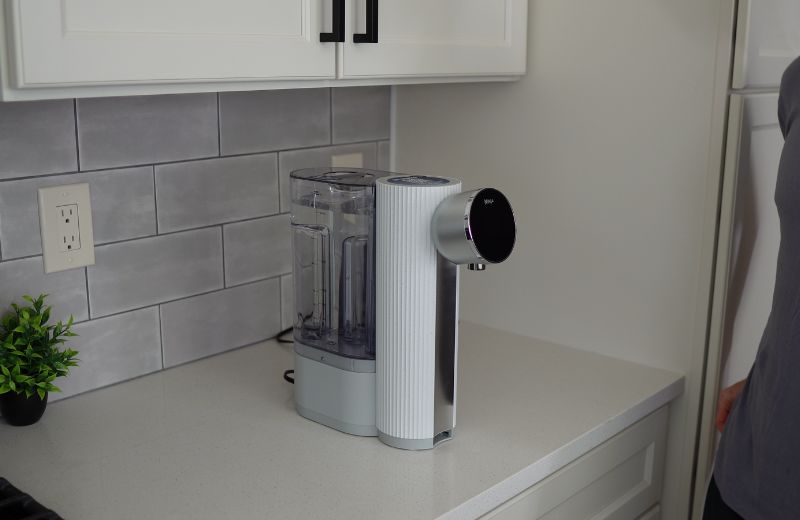
It weighs 6.6 pounds, which makes it the lightest unit in our most recent countertop filter test cohort, and its measured footprint is only 12.75 by 5 inches. The removable 96-ounce feed tank fits nicely in a refrigerator if you want to chill your water before you dispense it. There are stickers on the unit that provide setup guidance, which is a helpful bonus.
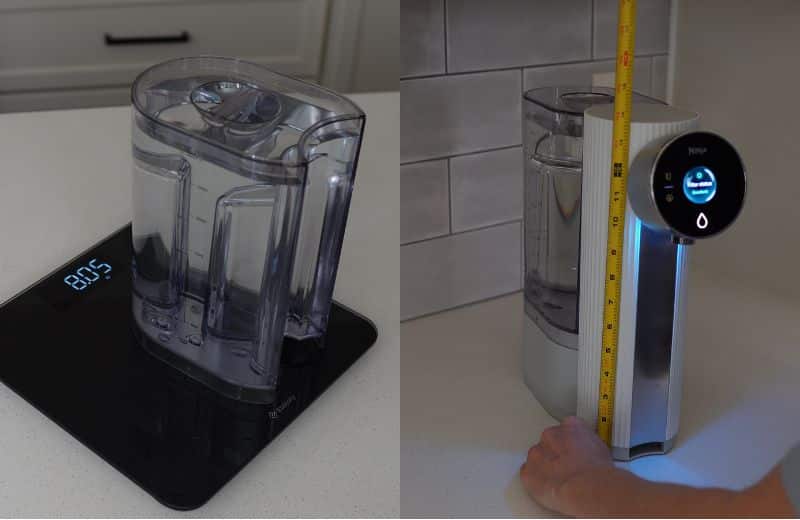
Ninja claims that the plastic used in the filter design is BPA-free. We noted that the unit feels thinner and less sturdy than the other plastic countertop systems we tested, and the tank lid fits tightly but doesn’t have a gasket. We liked the suction-cup feet for keeping the system in place, but it might be less effective on textured countertops.
What Are the Display Screen And Dispensing Options Like?
The HydraSense’s touchscreen is a modern feature that you don’t always find with a non-RO filter. It displays usage and filter life, with 6, 8, 10, and 12-ounce dispensing presets, as well as a slow-pour option, and the ability to save custom volumes.
A blue light shows on the screen when you’re dispensing, and a red light displays when the tank is empty. There’s an on-device counter that tracks the number of gallons you’re filtering and the remaining filter life, which is based on the cartridge’s 120-gallon or six-month rating.
We did find a difference between manual and saved dispensing volumes. When we set the machine by hand to dispense 64 ounces, it actually dispensed closer to 70 ounces. But the saved 64-ounce preset delivered exactly 64 ounces in our testing, so it gave us the more reliable result.
The spout dispenses directly into your glass, with no separate purified water tank.
Is the Ninja HydraSense Design Certified?
The Ninja HydraSense has a materials safety certification, which is another design bonus. It’s listed by IAPMO under NSF/ANSI/CAN 372 for lead-free materials
This official certification is awarded to products that have been tested by an IAPMO R&T recognized laboratory and demonstrates that all materials safety and structural integrity requirements have been met.
⚙️ Setup
Score: 10.00Key Finding: It took 10.83 minutes to have usable drinking water after unboxing the Ninja HydraSense and flushing the tank. That was the quickest setup of the five countertop units we tested in this cohort.
How Long Does the Ninja HydraSense Take to Set Up?
The Ninja HydraSense was the fastest countertop filter to set up in our cohort. We went from opening the box to having usable drinking water in 10.83 minutes, with no app or WiFi required.
The process is nice and easy: there’s only one filter cartridge to install and one tank to fill (which is removable for convenience). You then follow the instructions for flushing the system so it’s ready to produce usable drinking water. The unit itself has stickers that walk you through the setup, so you don’t have to keep checking the user manual.
If we look at the other filters in our cohort, the Waterdrop M6H took 18.5 minutes to set up, almost double our Ninja setup time. The DREO took about two and a half times as long at 28 minutes, while the Bluevua took even longer at 35.8 minutes. The AquaTru Carafe had the longest setup time: 69.7 minutes, more than six times the HydraSense’s setup time
| Water Filter | Setup Time | Flushes Required |
|---|---|---|
| Ninja HydraSense | 10.83 min | 1 |
| Waterdrop M6H | 18.5 min | 1 |
| DREO | 28 min | 4 |
| Bluevua | 35.8 min | 5 |
| AquaTru Carafe | 69.7 min | 4 |
How Much Flushing Does the Ninja HydraSense Need?
We flushed one full tank to the maximum fill line (100 ounces, or 0.78 gallons). We dispensed and discarded that water before we used the filter to produce a drinking batch. Ninja rates the tank at 96 ounces, and ours held 100 ounces when filled to the max line.
That was the only flush we were instructed to do in the user manual. The Waterdrop M6H also needed just one flush, but the DREO and AquaTru required four each, while the Bluevua needed five.
The HydraSense earned a Setup score of 10.00 in our scoring calculator. Its quick, one-flush setup and clear on-unit instructions make it a convenient choice if you want to avoid a lengthy install.
🔧 Maintenance & Cost to Own
Score: 9.75Key Finding: At 2 gallons per day, the Ninja HydraSense needs a new $39.99 filter every 60 days, which comes to $247.54 per year including electricity, or $0.339 per gallon: the highest annual operating cost of the five countertop units in our 2026 cohort. Our estimated 5-year ownership cost is $1,487.67 at the current $249.99 price.
How Often Should You Change the Ninja HydraSense Filter?
The Ninja HydraSense uses just one filter (model XSKWATFILSUS). Ninja rates it for 120 gallons, or 6 months, whichever comes first.
At our assumed water usage of 2 gallons per day, you’ll reach the 120-gallon limit in just 60 days. So, you can expect to replace the filter every 2 months rather than every 6. The 6-month interval is only realistic if you’re using the HydraSense to filter a much smaller volume of water every day; around 0.66 gallons or less.
We haven’t tested the filter for long enough to run it to exhaustion, so we can’t independently verify its full service life.
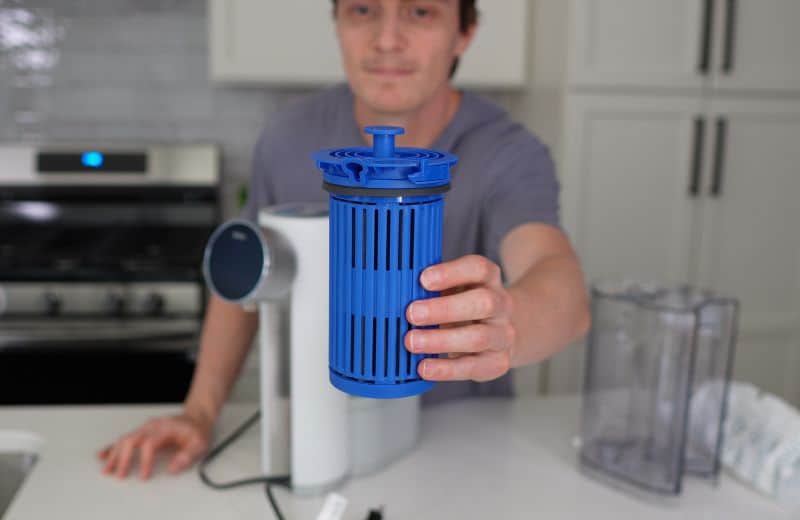
If you’re concerned you’ll forget to replace the cartridge, Ninja has made this easy with a filter gallon counter built into the unit itself. It tracks how much water is used, so you can see at a glance when you need a new filter. Replacement cartridges are available from SharkNinja and Amazon.
What Does the HydraSense Cost to Run Per Year?
We calculated the Ninja HydraSense’s annual running cost, based on the single-filter cost of $39.99 and our estimated daily water use of 2 gallons (or 730 gallons a year). The estimated annual filter cost comes in at $243.27. With the added $4.26 electricity cost, the annual operating cost comes to around $247.54, or $0.339 per gallon.
Ninja also sells a 2-pack of filters for $69.99, so you can save around $10 per two filter replacements. If you choose to buy all your replacement filters in packs of 2, your estimated annual filter cost would be about $212.89.
| Cost Comparison | Ninja HydraSense |
|---|---|
| Replacement filter price | $39.99 |
| 2-pack filter price | $69.99 |
| Annual filter cost (single filters) | $243.27 |
| Annual filter cost (2-pack) | $212.89 |
| Annual electricity cost | $4.26 |
| Total annual operating cost | $247.54 |
This is a high running cost, and the HydraSense’s biggest drawback. It costs about the same per gallon to operate as the AquaTru Carafe (at $0.335), but the AquaTru is a reverse osmosis system that took fluoride, uranium, and copper to non-detectable levels and reduced TDS by about 93% on the same water, so you’re getting much better value for money than with the HydraSense.
| Water Filter | 5-Year Ownership Cost |
|---|---|
| Ninja HydraSense | $1,437.67 |
| AquaTru Carafe | $1,596.95 |
| Waterdrop M6H | $620.53 |
We also calculated the filter’s five-year ownership cost (including the upfront purchase price), which came to $1,437.67. For context, the AquaTru Carafe came to $1,596.95, while the Waterdrop M6H is much cheaper, at $620.53.
🏢 Company, Warranty, & Returns
Score: 8.80Key Finding: SharkNinja backs the HydraSense with a 1-year limited warranty, free shipping on orders over $99, and a 60-day money-back window when you buy direct. The 60-day return period is the longest of the five units in our 2026 countertop cohort (the other four offer 30 days), and it lifts the Company score to 8.80.
What Warranty does Ninja Offer For the HydraSense?
SharkNinja offers a 1-year limited warranty for the HydraSense, which earned it a score of 8.50, the lowest of the three Company assessment factors in our testing.
The warranty entitles you to a replacement part or entire unit if you’re unable to fix the issue using Ninja’s troubleshooting guides. Depending on the issue, you may need to return the unit. You’ll also need to pay a shipping and handling fee (unspecified) when receiving a replacement unit.
If you buy a filter directly through the Ninja website, your product will be automatically registered for the warranty. Otherwise, you’ll need to register your product to get warranty coverage. You can register for the warranty here.
What Are Ninja’s Shipping and Returns Policies?
Orders over $99 are backed by free shipping on the Ninja website, earning Ninja a score of 9.00 in this subcategory. If your order amounts to less than this (as when buying replacement filters), you may need to pay a $10 shipping fee.
Read the shipping information page to learn more. Shipping from other websites like Amazon will be subject to a different policy.
If you buy directly from the Ninja website, you can return your order within 60 days of your purchase for a full refund (excluding shipping fees). Ninja says that returned products “must not be heavily worn, used or altered”, which suggests you can return a used item as long as it’s still in good, like-new condition.
Ninja’s return FAQs can be viewed here.
💰 Final Verdict: Does the Ninja HydraSense Offer Good Value for Money?
If you’re looking for a modern, non-RO countertop water filter that’s an attractive addition to your kitchen, the Ninja HydraSense looks the part. But in terms of its value for money, we think there are better-value alternatives to consider.
In our testing, the filter removed only a small handful of the contaminants detected in our feed water. It was unable to address fluoride, and aluminum and manganese appeared in the filtered water when they weren’t present initially.
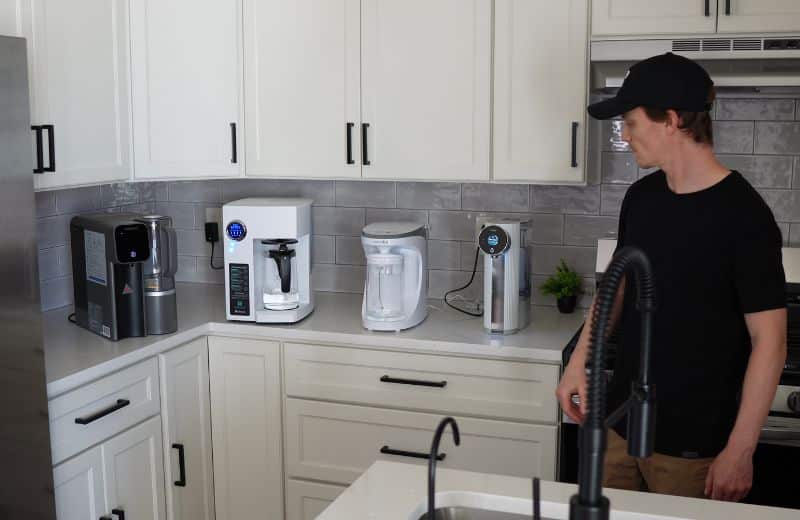
At an upfront cost of around $250 and our estimated annual operating cost of $247.54, it’s more expensive than many water filter pitchers we’ve tested that removed contaminants more thoroughly. It also had the highest annual operating cost of the five countertop units in this cohort, four of which are countertop RO systems: $247.54 against $244.39 for the AquaTru Carafe, $221.52 for the Bluevua, $139.89 for the DREO, and $60.31 for the Waterdrop M6H.
If you’re specifically looking to reduce or remove TDS, fluoride, or nitrate, we recommend the AquaTru Carafe, which eliminated 100% of most contaminants with health effects in our water and is performance certified to 5 NSF/ANSI Standards for 100% of its 84 contaminant reduction claims. Its cost per year of $244.39 is slightly lower than the HydraSense’s.
With that said, if your priority is removing chlorine, copper, lead, PFAS, and VOCs, and you don’t want the water waste associated with RO or the waiting associated with gravity-fed filters, the HydraSense may be exactly what you’re looking for.
Finally, if you don’t mind a longer wait for filtered water and only need carbon-based filtration, take a look at our roundup of the best water filter pitchers. The Culligan ZeroWater is the top-scoring filter in the pitcher category, having removed 100% of health-related contaminants in our lab tests, including uranium and fluoride, and being one of three pitchers we’ve tested with every reduction claim certified.
❔ Frequently Asked Questions
❔ Frequently Asked Questions
Q: Is the Ninja HydraSense NSF certified?
A: Yes, the Ninja HydraSense is certified to NSF/ANSI standards as a whole unit, and the certifier is IAPMO R&T. IAPMO lists the WF100X series to NSF/ANSI 42 (chlorine, taste and odor, chloramine, and Particulate Class I), NSF/ANSI 53 (VOCs, lead, mercury, cadmium, asbestos, turbidity, chlordane, MTBE, toxaphene, and total PFAS), NSF/ANSI 401 (13 emerging compounds, including pharmaceuticals, pesticides, and BPA, plus microplastics), and NSF/ANSI/CAN 372 for lead-free materials. That’s 27 certified reduction claims in total. Ninja advertises 80-plus contaminants because it counts the individual VOC and PFAS compounds one chemical at a time.
Q: Is the Ninja HydraSense a reverse osmosis system?
A: No, the Ninja HydraSense is not a reverse osmosis system. It is a pump-pressurized activated carbon filter with an ultra-fine mesh and no membrane, so it does not reduce dissolved solids, hardness, fluoride, or nitrate, and it produces no wastewater. In our Tap Score lab test, total dissolved solids went from 803 PPM in our tap water to 793 PPM after filtration.
Q: Does the Ninja HydraSense remove fluoride?
A: No, the Ninja HydraSense did not remove fluoride in our testing and is not certified for fluoride reduction. Activated carbon is not designed to remove fluoride, and in our Tap Score lab test, fluoride measured 1.7 PPM before and after filtration. If fluoride is your concern, look at the countertop RO systems we tested on the same water: the AquaTru Carafe, Waterdrop M6H, and Bluevua ROPOT all took fluoride to non-detectable levels.
Q: Does the Ninja HydraSense remove lead and PFAS?
A: We can’t confirm lead or PFAS reduction from our own testing, because our baseline tap water had no detectable lead and PFAS was not on our lab panel. The HydraSense is certified by IAPMO R&T to NSF/ANSI 53 for both lead and total PFAS reduction, and that certification is the evidence to rely on.
Q: Why did the Ninja HydraSense score so low in your testing?
A: The Ninja HydraSense scored 6.63 out of 10 because 55 percent of our overall score comes from contaminant reduction, and most of that comes from a Tap Score lab test of our own tap water, which contained fluoride, nitrate, uranium, hardness, and about 800 PPM of dissolved solids. Tap Score rated that water 40 of 99 before the HydraSense and 39 after it, with the same Health score of 35 both times. A carbon filter is not built to remove the contaminants that drive that number. It did remove chlorine, disinfection byproducts, and copper, and it scored 9.70 for design, 10.00 for setup, and 9.75 for maintenance. If your water is already low in dissolved solids and your concerns are chlorine, lead, PFAS, or VOCs, the overall score understates how useful the filter is to you. If you want lower TDS or fluoride, it is the wrong product.
Q: What showed up in the filtered water that wasn’t in the tap water?
A: Two metals showed up in the water filtered by the Ninja HydraSense that were not detected in our unfiltered sample: 0.0755 PPM of aluminum (above the Tap Score Health Guideline Level of 0.07 PPM) and 0.00487 PPM of manganese (below the HGL of 0.1 PPM). We have not confirmed the source of either.
Q: How often do you replace the Ninja HydraSense filter, and what does it cost?
A: Ninja rates the HydraSense filter at 120 gallons or 6 months, whichever comes first. At our assumed usage of 2 gallons a day, you reach 120 gallons in 60 days, so plan on about six filters a year. Each filter costs $39.99 (or $69.99 for a 2-pack), which comes to $247.54 a year including electricity, or $0.339 per gallon. The 6-month interval only applies if you filter less than two-thirds of a gallon a day.
Q: How fast is the Ninja HydraSense?
A: The Ninja HydraSense dispensed 64 ounces in 50 seconds in our timing, about 0.6 gallons per minute, and the first 12 ounces arrived 10.7 seconds after a cold start. There is no batch and no pure water tank, so there is nothing to wait for beyond the pump. The trade-off is noise: it measured 59.3 decibels from one foot while dispensing, louder than any of the four countertop RO units we tested alongside it, for under a minute at a time.
Q: Does the Ninja HydraSense waste water?
A: No, the Ninja HydraSense does not waste water. It has no membrane, so there is no reject stream: the 100 ounces we poured into the tank came out of the spout as 100 ounces of filtered water. The four countertop RO units we tested in the same cohort sent 24 to 41 percent of their feed water to waste.
Q: Ninja HydraSense vs. Brita Elite: which is better?
A: The two land within a tenth of a point in our scoring: the Ninja HydraSense scored 6.63 overall and the Brita Elite scored 6.59. Both received a Tap Score Health score of 35 on our water (tested on different dates), and both carry NSF/ANSI 42, 53, and 401 certifications. The differences are practical: the HydraSense pours a glass in seconds, holds 96 ounces, and needs an outlet, while the Brita Elite is silent, costs far less upfront, and filters slowly by gravity. Ninja’s claim of 10X more contaminants than the leading brand is measured against Brita’s standard filter, not the Elite.
Q: Ninja HydraSense vs. AquaTru Carafe: which should I buy?
A: Buy the AquaTru Carafe if you want dissolved solids, fluoride, and nitrate gone, and buy the Ninja HydraSense if you want chlorine, lead, PFAS, and VOC reduction with no wastewater and no waiting. The two cost almost the same to run ($0.339 against $0.335 per gallon), and the AquaTru costs about $125 more to buy. On the same water, the AquaTru Carafe cut TDS from 803 PPM to 60 PPM (the HydraSense: 803 PPM to 793 PPM), took fluoride to non-detectable levels (the HydraSense left it at 1.7 PPM), earned a Tap Score Health score of 99 (against 35), and holds 84 certified reduction claims (against 27). The AquaTru takes about 15 minutes to produce a 64-ounce batch, sends about 30 percent of its feed water to waste, and took about 70 minutes to set up. It scored 9.53 overall, tied with the Waterdrop M6H for the highest score of any water filter we’ve tested.
Q: What is the difference between the Ninja HydraSense WF1001 and WF1003?
A: The only difference between the Ninja HydraSense WF1001 and WF1003 is color. The WF1001 was the launch model (ours is the WF1001WH1, white), and the WF1003 (midnight blue) is the current model on Ninja’s site, alongside the WF1003WH1 (dove white), WF1003BK1 (black), and WF1003PK1 (rosewater pink). The IAPMO certification covers the whole WF100X series, and every unit uses the same XSKWATFILSUS filter cartridge.
Q: Ninja HydraSense vs. Aquasana Clean Water Machine: which scored higher?
A: The Aquasana Clean Water Machine scored higher in our testing: 8.40 overall against 6.63 for the Ninja HydraSense. The gap comes from contaminant reduction (7.86 against 4.44), where the Aquasana earned a Health subscore of 7.50 against the HydraSense’s 3.50 (tested on different dates). Both are powered countertop carbon filters with no wastewater, and both scored 8.00 for filtration rate.
Found this review helpful?
Comment below or share this article!