


We’ve personally tested more than 70 water filters, and in this guide, we’ve shared our roundup of the top-scoring and best under sink water filter systems based on contaminant reduction performance, design quality, setup and maintenance considerations, and the user experience overall.
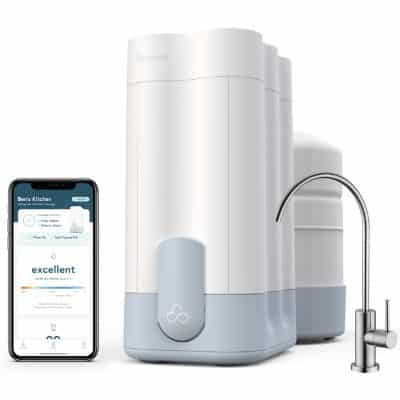
Cloud RO
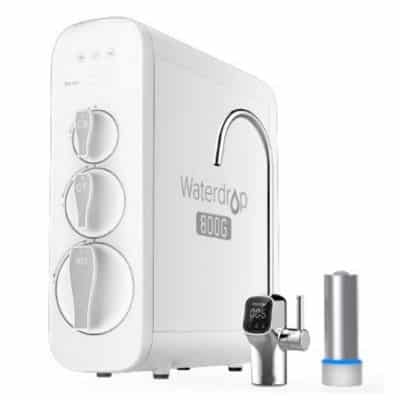
Waterdrop G3 P800
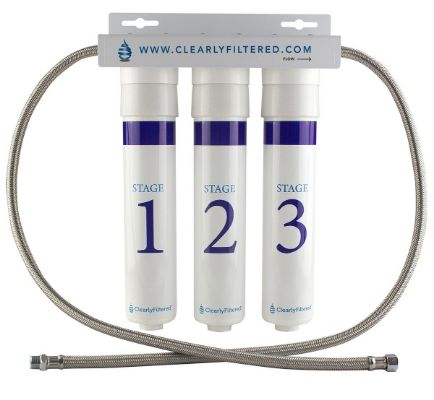
Clearly Filtered Under Sink
Quick Answer: The Best Under-Sink Water Filters of 2026
The best under-sink water filter we have tested is the Cloud RO (9.24/10), a tank-based reverse osmosis system that reduced or removed every health-related contaminant in our Denver tap water and earned the highest contaminant reduction score of any under-sink system we have tested. Findings come from hands-on installation in our own homes plus before-and-after water samples sent to an accredited third-party lab.
- Best overall: Cloud RO (9.24) removed 100% of aluminum, copper, manganese, molybdenum, and strontium, with on-demand tank delivery and a 1:1 efficiency ratio.
- Best tankless RO: Waterdrop G3 P800 (9.21) is certified for 100% of its reduction claims and pushes 800 gallons per day at $0.11 per gallon.
- Best non-RO filter: Clearly Filtered Under Sink (9.18) eliminated uranium, fluoride, and chloroform with a 15-minute DIY install and no water waste.
- Best budget tankless RO: Frizzlife PD600-TAM3 (8.94) reduced or removed twelve-plus health-related contaminants by at least 90% at roughly $0.10 per gallon, though it carries only a lead-free materials certification, not a performance certification.
- Best budget conventional RO: APEC ROES-PH75 (8.87) is WQA performance certified and eliminated every contaminant above the health guideline level, with built-in remineralization.
Testing by Brian Campbell, WQA Certified Water Specialist, based on hands-on use and before-and-after samples analyzed by an accredited laboratory.
Our Testing & Selection Process
How we tested these under-sink filters: We installed and lived with each system, then sent before-and-after water samples to an accredited third-party laboratory to measure exactly what each filter removed, and just as importantly, whether it added anything. Each system earns a weighted overall score out of 10 across six factors: contaminant reduction (weighted most heavily), filtration rate, design, setup, maintenance, and company policies. Because we test the filtered output and not just the manufacturer’s claims, our scoring captures real-world results that manufacturer testing may miss, including two systems in this guide that introduced new contaminants we did not start with. We have personally tested more than 70 water filters to date. Brian Campbell, who leads our testing, is a WQA Certified Water Specialist with 10+ years in water treatment.
We test all water filters ourselves to get a firsthand understanding of how they perform in real-world conditions.
Each filter receives an overall score, which is based on an average of 6 scoring factors: contaminant reduction, filtration rate, design, setup, maintenance, and company policies. Each factor is weighted based on its level of importance, with contaminant reduction being the most important and the most influential to the overall score. 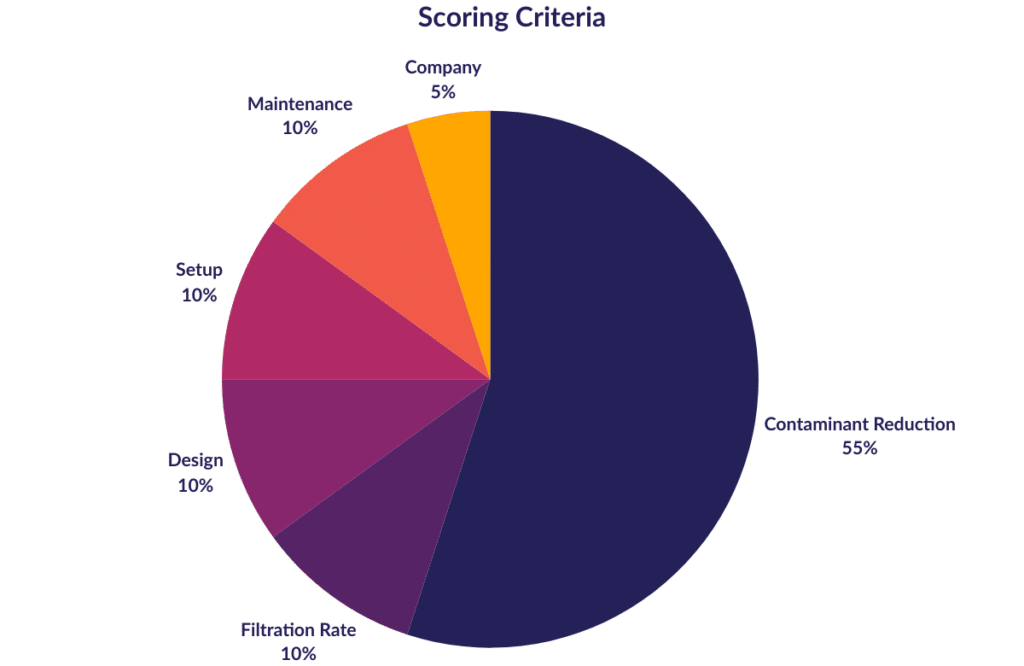
In addition, we also evaluate filter technologies and materials, as well as analyzing features that may be found in specific filter types, like efficiency ratio in reverse osmosis systems. While these are relevant to discuss, they’re not scoring factors, either because they don’t directly affect performance or because they’re not universally found across all water filters.
For our Best Under Sink Water Filter guide, we’re recommending the filters that obtained the highest overall scores.
We use numerical data where possible when analyzing and scoring water filters. But where this data isn’t available (for instance, for product quality and ease of setup & maintenance), we conduct our own subjective testing.
You can read about our testing and scoring process in more detail here.
The shortlisted best under-sink water filters are the highest-scoring filters in this product category. That means they performed better than other filters overall, receiving higher scores in categories including contaminant reduction, design, and ease of setup and maintenance.
The systems we’ve recommended each have their own unique filter technologies and are intended for different purposes. There are both reverse osmosis and non-RO systems in this list, allowing us to show you our top picks for all budgets and water treatment goals.
Some products didn’t make it onto this guide for specific reasons:
1. As this review roundup features under-sink systems only, we haven’t shared or recommended any other point-of-use filters, like faucet filters or countertop units.
2. We’ve also steered clear of manufacturers that have persistent stock issues, are known to be untrustworthy, or don’t ship their filters within the US.
3. Finally, the filters that simply performed more poorly than the top-scoring systems didn’t make the cut.
Article Update History
- 06/27/2026 – Removed Waterdrop X12 and Nu Aqua Efficiency series. Added Frizzlife PD600 TAM3 and APEC ROES-PH75
- 06/05/2026 – Cloud RO scores recalculated for accuracy
The Best Under-Sink Water Filters of 2026
| System | Cloud RO | Waterdrop G3P800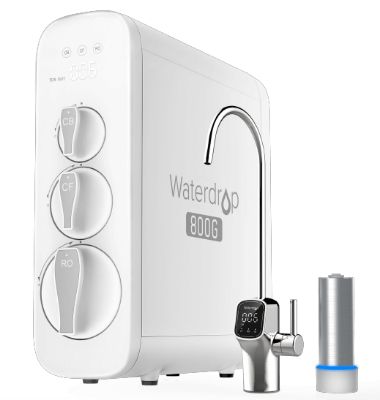 | Clearly Filtered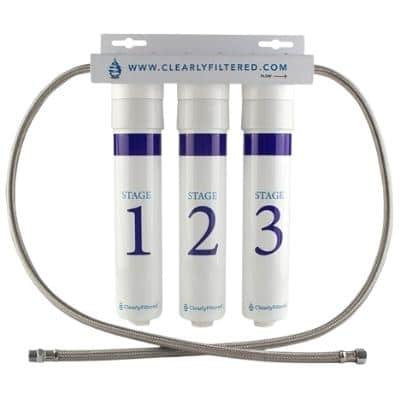 | Frizzlife PD600-TAM3  | Apec Roes-Ph75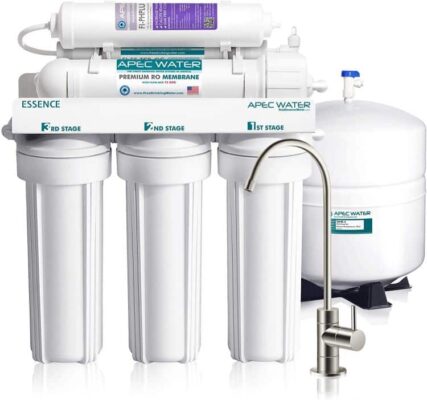 |
|---|---|---|---|---|---|
| Score | 9.24 | 9.21 | 9.18 | 8.94 | 8.87 |
| Type | Conventional RO | Tankless RO | Direct Connect | Under-sink RO | Under-sink RO |
| Price | $649 | $539 – $999 | $550 | $376 | $268.99 |
| Certifications or Testing | NSF 42, 53, 58 | NSF/ANSI 58, 372 | NSF 42, 372 | NSF 372 | NSF 58 |
| Filter Capacity | 500 / 1,500 gal. | 550/ 1100/ 2900 gal. | 2,000 Gallons | 900 – 1,800 gallons | 6-24 months |
| Cost per Gallon | $0.26 | $0.11 | $0.22 | $0.10 | $0.10 |
| Warranty | 1 year | 1 year | 2 years | 1 year | 1 year (Limited) |
| Read review | Cloud RO Review | Waterdrop G3P800 Review | Clearly Filtered Under Sink Review | Frizzlife PD600-TAM3 Review | APEC ROES-PH75 Review |
Cloud RO: Best Overall Under-Sink Filter (9.24/10)
Cloud RO is the highest-scoring and top-performing under-sink water filtration system we tested, achieving an overall weighted score of 9.24. In our testing, this tank-based reverse osmosis system reduced or removed all contaminants with health effects in our water, and impressed us with its modern, space-saving take on the conventional, clunky under-sink RO design.
Best For
Folks looking for an under-sink reverse osmosis filter that’ll purify their tap water on demand, without the water waste and pH reduction associated with conventional systems.
Product Specs
| Price | $649 |
| Contaminants Reduced | 200+ |
| Certifications | NSF 58 |
| Process | Carbon + Reverse Osmosis + Remineralization |
| Filter Capacity | Pre/Post Filters 500 gallons, RO membrane 1,500 gallons |
| Annual Cost | ~$200 |
| Warranty | 1 year |
🎬 Video Review
What did Cloud RO remove in lab testing?
Key Finding: In our initial Denver municipal water test, Cloud RO eliminated fluoride and both detected disinfection byproducts, and removed 100% of aluminum, copper, manganese, molybdenum, and strontium. It reduced sulfate by 94% and barium by 78%, and its remineralization stage raised pH from 8.4 to 9.7. In our second test with a more challenging water supply, Cloud actually performed better on a percentage basis, reducing all contaminants more effectively.
We tested Cloud twice with two different municipal water supplies in Colorado. For each test, we sent two samples to Tap Score for testing: one baseline sample of unfiltered tap water, and one of water purified and dispensed from Cloud RO.
In test 1, a number of contaminants with possible health effects were detected in our unfiltered water, including fluoride and two types of disinfection byproducts (both detected above the HGL), as well as copper and aluminum.

Cloud performed exactly as expected for an RO system, eliminating fluoride and both disinfection byproducts. It also removed 100% aluminum, copper, manganese, molybdenum, and strontium, and reduced sulfate by 94% and barium by 78%.
In test 2, our baseline sample had a TDS reading of 707 PPM — that’s almost 10x the dissolved solids concentration of our test 1 water source.
Barium, nitrate, nitrite, three disinfection byproducts, total chromium, copper, molybdenum, fluoride, manganese, boron, and uranium were among the contaminants with health effects detected, and all three DBPs were detected above the HGL.
This time, Cloud eliminated fluoride, all three disinfection byproducts, uranium, copper, strontium, selenium, manganese, potassium, molybdenum, and nitrate. It also greatly reduced barium by 97%, sulfate by 95%, and total chromium by 93%.
The system has an NSF certification for TDS reduction, which is a bit of a cop-out certification compared to specific contaminants we’re concerned about, but still helped bring its contaminant reduction score up to 9.42.
In all, it removed contaminants more thoroughly than any other under-sink system we tested, and the included remineralization filter prevented the negative aesthetic effects of RO purification, increasing the pH of our water from 8.4 to 9.7 (very alkaline).
How easy is Cloud RO to install and maintain?
We installed and used Cloud RO in our own home to see how it performed under the typical customer use conditions.
Cloud consists of two units: the main unit (containing four filter cartridges and the battery pack), and a 2.8-gallon purified water holding tank. Most components are made from BPA-free food-grade plastic, and the unit has a materials safety certification as part of its NSF 58 performance certification. We were impressed by its design, awarding a top score of 10.00 in this category.
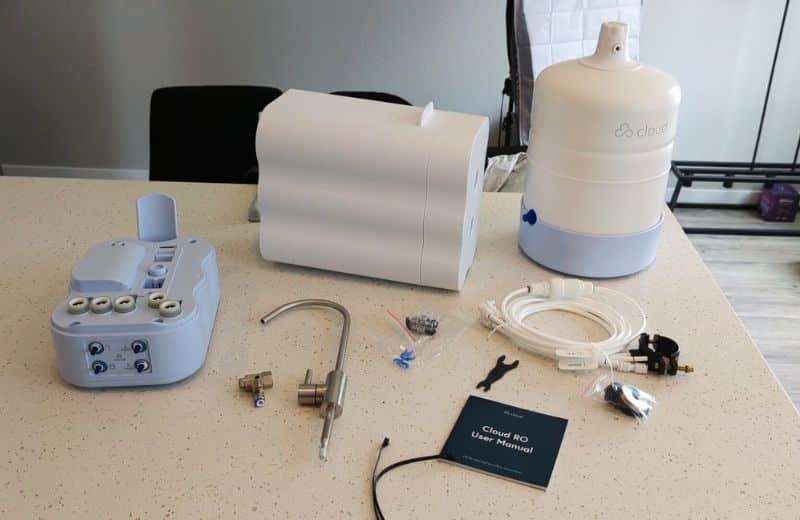
The system works by purifying water and storing it in the tank, then using pressure to deliver it on demand to the dedicated faucet. It has a decent flow of 80 GPD (gallons per day), and in our tests, at a feed water temperature of 57.5°F and a static water pressure of 50 PSI, it had a filtration rate of approximately 65.17 GPD. This earned it a score of 8.50.
As a reverse osmosis system, Cloud does waste water, but its pure-to-wastewater ratio of 1:1 means it’s far more efficient than conventional systems, which typically waste up to 4 gallons of water for every 1 gallon purified. This was corroborated by our own tests, which recorded a pure-to-wastewater ratio of approximately 1:1.3 when purifying 12 ounces, and 1:1.03 when purifying 64 ounces.
We also tested the installed system for TDS creep, and Cloud had a 1st draw TDS reading of 284 PPM. At first glance, this is indicative of TDS creep, especially when we compared it to our second draw sample reading, which we took after running water through the system for 2 minutes: 68 PPM.
But our contact at Cloud explained that this was actually caused by minerals leaching from the new remineralization media and should normalize after a few weeks.
As for setup, the unit was easy to install, and all the fittings and filters are pre-installed, but it still received a slightly lower score of 7.50 due to the extra installation requirements for an RO system (including installing the dedicated faucet and drain line).
It redeemed itself on the maintenance front, with its score of 10.00 reflecting its affordable ongoing spend of $0.26/ gallon and its easy filter changes, with built-in sensors and a dedicated app that tracks water filter lifespan.
| Criteria | Results |
|---|---|
| Overall Score | 9.24 |
| Health Related Contaminants | 9.90 |
| Aesthetic Related Contaminants | 3.50 |
| Performance Certification | Certified for 16% of reduction claims |
| Filtration Rate | 80 GPD |
| Component Quality | Exceptional |
| Component Certification | Certified |
| Setup | Below Average |
| Servicing Requirements | Exceptional |
| Costs | $0.26/ gallon |
| Warranty Length | 1 year |
| Shipping | Free on all orders in the US |
| Returns | 12 month guarantee |
Waterdrop G3 P800: Best Tankless RO Under-Sink System (9.21/10)

The Waterdrop G3 P800 comes in close second place behind Cloud, with an overall weighted score of 9.21. It’s another reverse osmosis system, but with a tankless design (meaning purified water bypasses a tank and is sent straight to the faucet). It performed very similarly to Cloud and is certified to remove more contaminants, but the setup process was slightly trickier and its shipping and returns policies aren’t as impressive.
Best For
Anyone looking for the best under-sink RO filtration system that’s more compact than a tank-based model but still offers the same comprehensive purification.
Product Specs
| Price | $539 – $999 |
| Contaminants Removed | 1,000+ |
| Certifications | NSF/ANSI 58, 372 |
| Process | RO |
| Filtration Capacity | 550/ 1100/ 2900 gallons |
| Annual Cost | ~$145 |
| Warranty | 1 year |
🎬 Video Review
What did the Waterdrop G3 P800 remove in lab testing?
Key Finding: Tested on Parker, Colorado city water, the G3 P800 completely removed 6 of 9 detected health-related contaminants, including lead and arsenic (both above the Tap Score HGL before filtration). In our with-remineralization test, the unit eliminated all contaminants detected above the HGL, including fluoride. It’s also IAPMO certified for 100% of its reduction claims across NSF 42, 53, and 58.
We tested the Waterdrop G3 P800 with city water in Parker, Colorado. Before filtration, 9 contaminants with health effects were detected, including lead and arsenic, both detected at concentrations above the Tap Score HGL.
When we tested it without the optional remineralization filter, the G3 P800 completely removed 6 of these (including lead and arsenic) and greatly reduced barium, nitrate, and strontium.
With remineralization, our results were even better: the G3 eliminated all contaminants detected above the HGL, including fluoride. It completely removed barium, copper, selenium, molybdenum, and vanadium. Additionally, strontium was reduced by 97%, and total chromium by 88%.
The system is also IAPMO certified to NSF 42, for removing chlorine, and NSF 58 and NSF 53, for reducing TDS, PFOA/PFOS, fluoride, cadmium, hexavalent chromium, and selenium, barium, and radium. Without the remineralization filter, calcium and magnesium were almost completely removed, and the pH of our water dropped from 7.3 to 6.3. With remineralization, pH was only reduced from 8.0 to 7.5.
Is the Waterdrop G3 P800 certified for materials safety?
Waterdrop is similar to Cloud when it comes to smart design features, receiving a 9.70 design score. It’s made from polypropylene and ABS, with a space-saving design featuring built-in TDS meters, a smart faucet, and a UV purifier (to protect against bacteria growth within the filters).
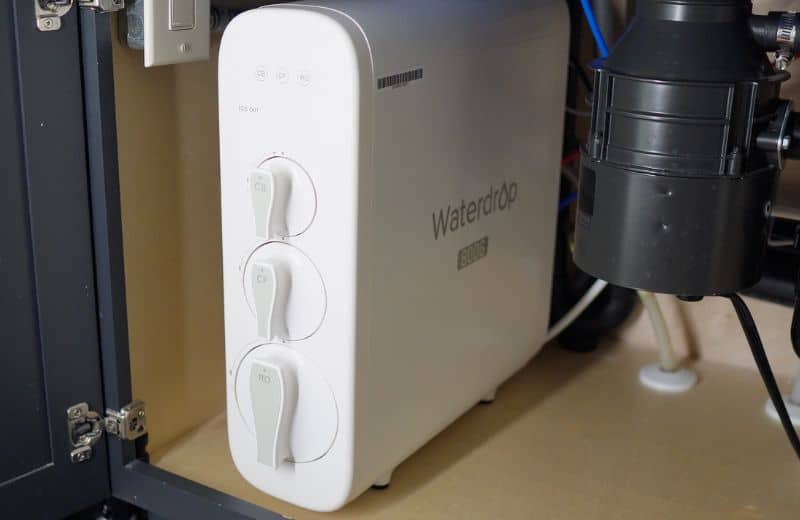
Like Cloud, the G3 has a materials safety certification as a component of its NSF performance certifications. Plus, it has an IAPMO certification to NSF Standard 372 for lead-free design.
We were able to install the system ourselves, and the installation process was similar to installing Cloud, but without the water-holding tank. The G3 received a 7.00 score for setup, being more time-consuming and requiring more effort to install than the non-RO systems we tested.
Maintenance was much easier, with the built-in filter change reminder and low ongoing spend of $0.11/ gallon contributing to the unit’s 10.00 score in this category.
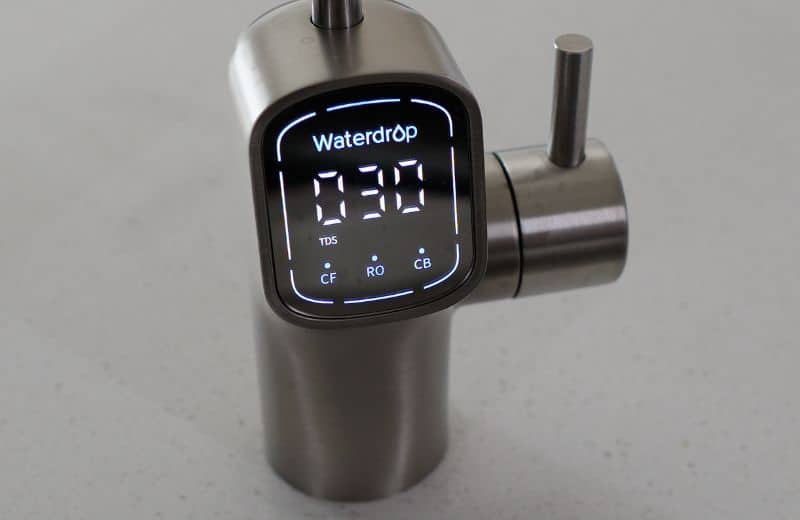
A big advantage of the G3 P800 is that it uses an internal pump to push water straight through the system to your faucet, giving it a fast water production rate of 800 gallons per day (10x the speed of Cloud’s filtration!) and a high score of 10.00. In our own testing, at a feed water temperature of 58.3°F, we measured the G3’s flow rate as approximately 886.54 GPD.
It’s also more efficient than Cloud, with a 3:1 pure-to-wastewater ratio. When we tested efficiency ourselves, the unit had a recovery rate of 1:0.6 when purifying 12 ounces of water, and 1:0.45 when purifying 64 ounces of water.
Tankless RO systems are susceptible to TDS creep, which may impact their efficiency and water output. But in our on-site tests, the unit’s first-draw reading was higher than the second-draw reading by just 33 PPM, which is not indicative of TDS creep.
| Criteria | Results |
|---|---|
| Overall Score | 9.21 |
| Health Related Contaminants | 9.50 |
| Aesthetic Related Contaminants | 3.50 |
| Performance Certification | Certified for 100% of reduction claims |
| Filtration Rate | 600 or 800 GPD |
| Component Quality | Outstanding |
| Component Certification | Certified |
| Setup | Weak |
| Servicing Requirements | Exceptional |
| Costs | $0.11/ gallon (w/o remineralization), $0.13/ gallon (w/ remineralization) |
| Warranty Length | 1 year |
| Shipping | Free to lower 48 US states |
| Returns | 30 days |
Clearly Filtered: Best Non-RO Under-Sink Filter (9.18/10)

The Clearly Filtered Under Sink system was the highest-scoring non-RO under-sink filter we’ve tested so far, with a few advantages versus the reverse osmosis systems: it costs less, is quicker and easier to install, and doesn’t waste water or reduce pH and alkalinity. We were impressed with how it performed in our lab tests, but it doesn’t quite match up to RO performance, and it’s only certified to reduce 1 contaminant.
Best For
Anyone looking for a non-RO under-sink system with a comprehensive contaminant reduction performance, easy setup, affordable maintenance, and no water waste.
Product Specs
| Price | $550 |
| Contaminants Reduced | 232+ |
| Certifications | NSF 42, 372 |
| Process | Carbon + Ion Exchange |
| Filter Capacity | 2,000 gallons |
| Annual Cost | ~$440 |
| Warranty | 2 years |
🎬 Video Review
What did the Clearly Filtered under-sink system remove?
Key Finding: On a treated, shared well water supply, this non-RO system eliminated uranium, fluoride, and chloroform, and reduced copper by 99.39%, all without water waste or a drain line. It is the highest-scoring non-RO under-sink filter we have tested (9.18 overall, 8.98 contaminant reduction) and installed in about 15 minutes.
We tested the Clearly Filtered 3-Stage Under the Sink System on a shared, treated well water supply containing traces of contaminants including uranium, fluoride, copper, and chloroform (a disinfection byproduct), detected at concentrations exceeding the Tap Score HGL.
The unit eliminated uranium, fluoride, and chloroform, and reduced copper by 99.39%. It also removed 100% of barium and strontium (two contaminants detected below the HGL), but it only reduced 23% nitrate, 5.6% molybdenum, and 21.25% sulfate.
Unexpectedly, sodium increased by 107% and potassium by over 1,000%, while calcium decreased by 92% and magnesium by 6%, pointing to the use of a sodium- and potassium-loaded ion exchange resin. In spite of this, the pH of our water increased from 7.3 to 9.3 (alkaline).
These testing results, paired with the filter’s WQA performance certification to NSF/ANSI Standard 42 for chlorine reduction, resulted in a contaminant reduction score of 8.98.
Is the Clearly Filtered under sink filter easy to install?
If you’re looking for an under-sink filter with a more DIY-friendly install process, this Clearly Filtered model should appeal. We awarded it a setup score of 9.50 as we found it significantly quicker and easier to install than the RO systems, with only a few parts and no drain line or dedicated faucet. The process took us just 15 minutes from unboxing to completion.
We measure flow rate for non-RO under-sink systems in gallons per minute, and the Clearly Filtered model had a recorded flow rate of 1.08 GPM. That’s around half the flow that you’d usually get from your kitchen faucet and is pretty decent for a filter in this category, resulting in a score of 9.00.
While the system doesn’t offer the same high-tech features as an under-sink RO unit, it still has a solid, well-thought-out design, with its sturdy construction and multiple design certifications (for materials safety and lead-free design) contributing to a design score of 9.70.
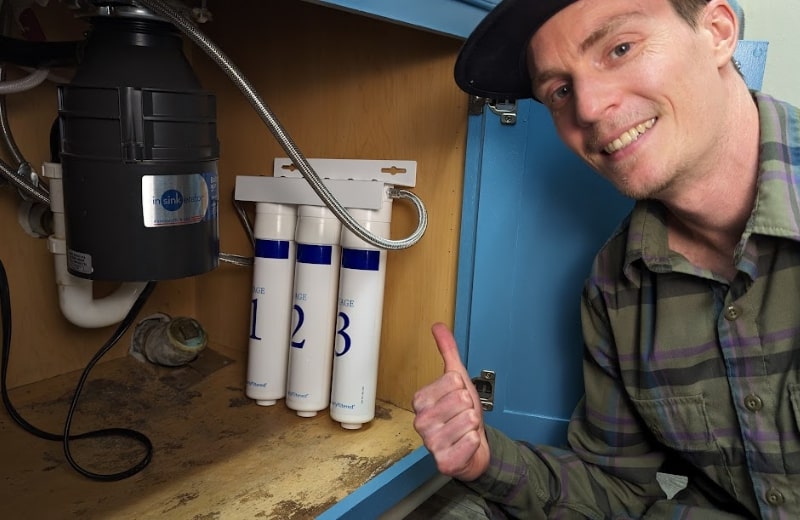
All three filters have the same projected lifespan, which simplifies maintenance, although you’ll have to make your own calendar notes to change the filters, as there’s no built-in reminder. Ongoing servicing is affordable at around $0.22/ gallon (slightly cheaper than Cloud but not as affordable as Waterdrop), translating to an overall maintenance score of 9.75.
| Criteria | Results |
|---|---|
| Overall Score | 9.18 |
| Health Related Contaminants | 9.50 |
| Aesthetic Related Contaminants | 9.90 |
| Performance Certification | Certified for <1% of reduction claims |
| Filtration Rate | 1.08 GPM |
| Component Quality | Outstanding |
| Component Certification | Certified |
| Setup | Outstanding |
| Servicing Requirements | Outstanding |
| Costs | $0.22/ gallon |
| Warranty Length | 2 years |
| Shipping | Free shipping, all orders to all states |
| Returns | 30 days |
Frizzlife PD600-TAM3: Best Budget Tankless RO (8.94/10)
The Frizzlife PD600-TAM3 is our top recommend under-sink RO system for small budgets, achieving an overall score of 8.94. With its external remineralization filter and space-saving tankless design, it offers a bit more than some of its competitors. We were generally impressed with its contaminant reduction, flow rate, and efficiency ratio, although it’s lacking official certifications for performance and materials safety, and its design quality doesn’t match up to others.
Best For
People looking for a more affordable alternative to the Waterdrop G3 P800 that offers a similarly fast flow rate, as well as a similar overall performance.
Product Specs
| Price | $376 |
| Contaminants Reduced | 14+ |
| Certifications | NSF 372 (lead-free materials only) |
| Process | Carbon pre-filter + RO membrane + Alkaline remineralization filter |
| Filter Capacity | 900 – 1,800 gallons |
| Annual Cost | ~$130 |
| Warranty | 1 year |
🎬 Video Review
What contaminants did the Frizzlife PD600-TAM3 remove in our lab testing?
Key Finding: This budget RO unit greatly reduced or removed barium, total chromium, copper, 3 disinfection byproducts, fluoride, manganese, molybdenum, selenium, strontium, uranium, sulfate, and vanadium. But it’s lacking a performance certification, resulting in a contaminant reduction score of 9.00.
When we tested the PD600-TAM3, 16 contaminants with possible health effects were detected in our baseline water sample, including:
- 3 disinfection byproducts
- Uranium
- Fluoride
- Several heavy metals, including copper and barium
- Nitrate
- Several metals and metaloids, including strontium and boron
- Chromium
5 of these contaminants were detected at levels exceeding the HGL: all 3 disinfection byproducts (dibromochloromethane, bromodichloromethane, and bromoform), as well as uranium and fluoride.
Post-filtration, our water quality was significantly better. Barium, total chromium, copper, the 3 disinfection byproducts, fluoride, manganese, molybdenum, selenium, strontium, uranium, sulfate, and vanadium were all reduced by at least 90%.
But there was still room for improvement: only 38.8% of boron was reduced, along with just 50% of nitrate.
As for pH and minerals, our feedwater had a pH of 7.4, making it slightly alkaline. The pH of our purified water was higher: 8.13. Calcium was still reduced by 86%, magnesium and sodium by 95%, and potassium by 100%.
So far, our results are similar to the Waterdrop G3’s — but the PD600-TAM3 had an issue with TDS creep, while the G3 did not. The PD600-TAM3 had a 1st draw TDS reading of 474 PPM, which is indicative of TDS creep, since the feed water TDS was 645 PPM. This was reduced to 40 PPM once we ran water through the system for 2 minutes.
How easy is the Frizzzlife filter to install?
The PD600-TAM3 is a space-saving under-sink unit that consists of one main tank (containing two filter cartridges) and a separate external remineralization filter.
It seems pretty sturdy, but we noted that the ¼” quick-connect components feel cheaper and flimsier than in similar RO systems we tested. However, the system does have an IAPMO certification to NSF 372, for lead-free design, resulting in a score of 10.00 and bringing its overall component quality score up to 8.00.
Setup was similar to the Waterdrop G3 and Cloud systems, with the tedious tasks of installing the faucet and drainline leading to a lower score of 7.00. The installation took 90 minutes in total; 3x the time suggested by Frizzlife, extended by certain issues (the 1/4 tubing isn’t pre-cut or color-coded, and the gasket in the 3-way feed water valve falls out easily).
But once installed, the unit’s listed filtration rate of 600 GPD meant we had instant access to purified water. In our own flow rate testing, at a feed water temperature of 60.9°F, it had a flow rate of just over 639 GPD — not quite as fast as the G3, but still earning it a top score of 10.00.
Where this system does fall short is performance efficiency. It has a listed efficiency ratio of 2:1, meaning 1 gallon of water is lost for every 2 gallons purified. In our on-site tests, it had a pure-to-drain ratio of 1:1 when filtering 12 ounces of water, and 1.52:1 when purifying 64 ounces. That’s not bad, but it doesn’t compare to high-efficiency systems like Cloud and Waterdrop.
But maintenance was as easy as for all the other under-sink RO systems in this list, with the system’s affordable cost-per-gallon of $0.10 and filter change lights earning it a score of 10.00.
| Criteria | Results |
|---|---|
| Overall Score | 8.94 |
| Health Related Contaminants | 9.30 |
| Aesthetic Related Contaminants | 9.90 |
| Performance Certification | Not Certified |
| Filtration Rate | 600 GPD |
| Component Quality | Fair |
| Component Certification | NSF 372 |
| Setup | Weak |
| Servicing Requirements | Exceptional |
| Costs | $0.10/ gallon |
| Warranty Length | 1 year |
| Shipping | Free on orders > $25 for US orders |
| Returns | 30 days |
APEC ROES-PH75: Best Budget Conventional RO (8.87/10)
Coming in behind Frizzlife, with an overall score of 8.87, is our top recommended budget-friendly conventional under-sink RO system: the APEC ROES-PH75. It’s WQA performance certified and holds two design certifications, offering built-in remineralization for convenience. But the installation process is time-consuming and tricky, and filtration and efficiency ratio are pretty poor when we compare the unit to other RO systems
Best For
Folks who want an affordable conventional under-sink RO system that comes with a built-in remineralization filter and NSF certifications.
Product Specs
| Price | $268.99 |
| Contaminants Reduced | 10+ |
| Certifications | NSF/ANSI 58 |
| Process | Sediment + Carbon + RO + Remineralization |
| Filter Capacity | 6-24 months |
| Annual Cost | ~$133 |
| Warranty | 1 year (Limited) |
▶️ Video Review
How did the ROES-PH75 perform in our lab tests?
Key Finding: The ROES-PH75 eliminated every contaminant that exceeded the HGL in our test and reduced or removed the majority of other contaminants. However, our lab detected a 40% increase in manganese post-filtration, likely introduced by the remineralization filter media. This mixed bag of results earned it a score of 9.28.
We tested the APEC ROES-PH75 with municipal water in Colorado. Our tests revealed that the unfiltered tap water contained 16 contaminants with health effects, including three types of disinfection byproducts, fluoride, and uranium (all present in concentrations exceeding the HGLs), as well as copper, nitrate, and other heavy metals.
The unit eliminated all the contaminants that exceeded the HGL, as well as 100% of molybdenum, selenium, sulfate, chlorine, and vanadium. The system also greatly reduced barium by 98%, strontium by 96%, chromium by 86%, nitrate by 64%, and boron by 49%.
Manganese increased by 40% post-filtration, from 0.0011 PPM to 0.00155 PPM. We think this trace increase is likely coming from the remineralization filter.
Our test reports did show that magnesium and calcium were nearly completely eliminated, but the pH of our water increased from 7.59 to 8.77 in our on-site pH meter tests. This suggests that the remineralization filter was doing its job in preventing a significant pH drop.
The system showed no evidence of TDS creep in our comparison tests, and its performance certification by the WQA to reduce TDS earned it an overall contaminant reduction score of 9.28.
How hard is the APEC ROES-PH75 to install?
The APEC ROES-PH75 2 has a simple, tank-based design, with three filters mounted vertically below, and two stacked horizontally on top.
It’s a plastic unit with a 4-gallon storage tank for purified water, along with materials safety certification as a component of its NSF 58 performance certification and a WQA certification for lead-free design, resulting in a design score of 9.70.
As with the other systems in this list, installation was a bit tricky due to the additional plumbing jobs needed for an RO system. The ROES-PH75 received a slightly lower score of 7.00 here, with a couple of unhelpful features making installation unnecessarily more time-consuming: the filters and housings aren’t color-coded, and the faucet doesn’t have a quick-mount nut.
Once installed, the unit is quick and easy to maintain and received a score of 9.25, reflecting its low cost-per-gallon of $0.12 but pulled down by its lack of integrated filter life tracker or filter change reminder.
APEC lists a 1:3 pure-to-drain ratio, but in our tests, it had a recovery rate of just 1:10.6. That means 10.6 ounces of water is wasted per 1 ounce purified, making the ROES-PH75 the least efficient RO system we’ve tested by a mile.
It also has a slower filtration rate of 42.74 GPD, slightly below APEC’s listed maximum flow rate of 75 GPD. As a result, it received a score of of 7.50 in this testing category
| Criteria | Results |
|---|---|
| Overall Score | 8.87 |
| Health Related Contaminants | 9.40 |
| Aesthetic Related Contaminants | 9.90 |
| Performance Certification | NSF/ANSI 58 |
| Filtration Rate | 75 GPD |
| Component Quality | Outstanding |
| Component Certification | NSF/ANSI 58 & 372 |
| Setup | Weak |
| Servicing Requirements | Good |
| Costs | $0.10/ gallon |
| Warranty Length | 1 year |
| Shipping | Free Shipping to US domestic 48 contiguous states |
| Returns | 30 days |
Frequently Asked Questions
Q: What is the best under-sink water filter?
A: Based on our hands-on testing and accredited lab analysis, the best under-sink water filter is the Cloud RO (9.24/10). It removed or reduced every health-related contaminant in our test water, earned the highest contaminant reduction score of any under-sink system we have tested, and delivers purified water on demand from its tank with a 1:1 efficiency ratio.
Q: Are under-sink reverse osmosis systems better than non-RO filters?
A: For thoroughness, yes. The RO systems we tested removed more contaminants more completely than non-RO filters. The tradeoff is that RO wastes some water, can lower pH unless remineralization is included, and takes longer to install. The best non-RO option we tested, the Clearly Filtered Under Sink (9.18), still eliminated uranium, fluoride, and chloroform while installing in about 15 minutes with no water waste, so it is a strong choice if you want simplicity over maximum contaminant reduction.
Q: Can an under-sink water filter add contaminants to your water?
A: It can, which is why we lab test the filtered output rather than trusting marketing claims. In this guide, the APEC ROES-PH75 showed a 40% increase in manganese after filtration, a trace amount we attribute to its remineralization media. Catching changes like this is only possible by testing the filtered water, since they never appear on a manufacturer’s claim sheet.
Q: Does an under-sink filter need to be NSF certified?
A: Certification is reassuring but not legally required. We distinguish between a system genuinely certified for the contaminants you care about and one with a narrow or materials-only certification. For example, the Waterdrop G3 P800 and APEC ROES-PH75 are certified for the bulk of their reduction claims, while the Clearly Filtered system is certified for under 1% of its claims and the Frizzlife PD600-TAM3 carries only a lead-free materials certification, not a performance certification. We recommend matching the filter to the contaminants in your water, ideally confirmed with a certified lab water test.
Q: How much does it cost to run an under-sink water filter?
A: Ongoing cost is primarily driven by filter replacements, which we standardize and express as cost per gallon. Among the systems we tested, this ranged from about $0.10 per gallon (Frizzlife PD600-TAM3) to $0.26 per gallon (Cloud RO). Annual filter costs in this guide run roughly $130 to $440 depending on the system and your water usage.
Q: How hard is it to install an under-sink water filter yourself?
A: It depends on the type. The non-RO Clearly Filtered system installed in about 15 minutes with no drain line or dedicated faucet, earning a 9.50 setup score. The RO systems took longer, around 90 minutes for the Frizzlife PD600-TAM3, because they require installing a dedicated faucet and drain line, which is why RO units scored lower (7.00 to 7.50) for setup in our testing.
How about the Brio tables under sink systems, any thoughts on those?
I’ve not tested those yet
Hi, just curious why Aquatru didn’t make the list. Do you have a review for the aquatru under sink RO filter? I only see the countertop version on your site. Thanks!
I havnt tested the under sink Aquatru system yet, though it is on my to-do list. That said, it uses the exact same extensively certified filter elements as the Classic countertop unit, so I’d expect very similar performance in our scoring system to that one.
Would you advise using the Epic Smart Shield Max? It uses the same carbon block as the normal Smart Shield, but also has an exterior layer of nano fabric to filter VOCs, microplastics, etc. Curious if you’d recommend something like this or think the original Smart Shield is better.
I have not tested the new Epic Smart Shield Max yet, though it is on my to-do list. I recommend matching the filter to the contaminants of concern in your water, ideally using a filter certified to reduce what you need to
any NANOfilters that dont have a single plastic component? (including the filters)
No
Hi, I was wondering if the Epic Smart Shield can be used under a bathroom vanity sink. If so, can the sediment attachment be used along with It?
Thank you!
Yes, as long as there is room under the bathroom sink and the plumbing connection is the right size