

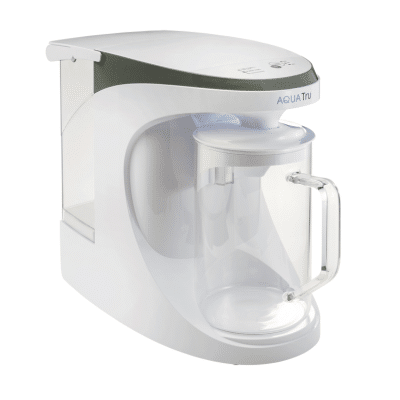
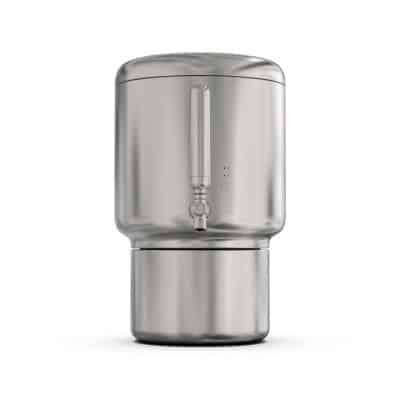
If you want to filter your water without the hassle of a difficult installation, comparing AquaTru vs Rorra makes sense as these are two no-fuss countertop systems that are worth consideration. While AquaTru has cemented itself as a reputable countertop RO system, Rorra is a newer brand, offering a modern take on a stainless steel gravity filter.
AquaTru
Best For:
Rorra
Best For:
Quick Verdict: AquaTru Carafe or Rorra?
The AquaTru Carafe wins this comparison, scoring 9.57 out of 10 against 8.33 for the Rorra Countertop System. In our Tap Score lab tests, AquaTru removed 100% of the 10 health-related contaminants in our water, while Rorra fully removed 5 of 10 and left fluoride untouched at 1.4 PPM. AquaTru is IAPMO certified to NSF/ANSI 42, 53, 58, and 401 for 83 contaminants; Rorra holds no certification. Rorra wins only on filtration speed (3 GPH versus 1.8 GPH), zero reject water, and an electricity-free stainless steel design.
Buy AquaTru if: you want lab-verified and certified removal of fluoride, uranium, and disinfection byproducts, and lower ownership cost.
Buy Rorra if: you need a filter that runs with no power and no wastewater, and fluoride is not in your water.
Methodology: both systems were tested with the same Tap Score lab analysis on separate source water; see https://waterfilterguru.com/how-we-test-water-filters/
The obvious difference between the two is that the AquaTru Carafe uses reverse osmosis, while Rorra uses gravity filtration. But while our expectations for these system types are different, the only way to know how they truly compare is by testing them ourselves. Here, you’ll find our comparisons across the following categories:
- Contaminant reduction performance and certifications
- Filtration rate
- Setup & maintenance processes
- Design quality & certifications
- Upfront & ongoing costs
- Manufacturer warranties & policies
At the end, we’ve summarized our findings, recommended different systems for different circumstances, and concluded by explaining which filter is objectively best.
AquaTru has a few different models, but for this review, we’ll be referencing our test of the AquaTru Carafe, which received the highest score of all the models we tested. We’ll occasionally mention various configurations of this system when necessary.
Rorra only offers the Rorra Countertop System in a single configuration, which is the model we’re reviewing here.
Both units performed well overall, but while AquaTru tops our list of the best countertop RO systems, Rorra isn’t among our recommendations for a gravity filter. AquaTru boasts extensive performance certifications and completely eliminated all contaminants in our test water, while Rorra removed some contaminants but struggled with others. Both units were easy to assemble, but AquaTru is more affordable (both upfront and to replace the filters).
📊 Our Testing Data
We tested and ranked the AquaTru and Rorra systems using 6 main assessment criteria. You can see their scores across each of these performance categories in the next table.
| Factor | Aquatru | Rorra |
|---|---|---|
| Contaminant Reduction | 9.91 | 7.71 |
| Filtration Rate | 7.00 | 10.00 |
| Design | 10.00 | 8.40 |
| Setup | 10.00 | 8.50 |
| Maintenance | 9.75 | 9.75 |
| Company | 8.80 | 8.50 |
Each category consists of several testing subcategories. The table below offers a more in-depth look at the data from each test we conducted.
| Factor | Aquatru | Rorra | Winner |
|---|---|---|---|
| Overall Score | 9.57 | 8.33 | Aquatru |
| Health Related Contaminants | 9.90 | 7.80 | Aquatru |
| Aesthetic Related Contaminants | 9.90 | 9.90 | Tie |
| Performance Certification | NSF/ANSI 42, 53, 58, & 401 | Not Certified | Aquatru |
| Filtration Rate | 0.03 GPM | 3 GPH | Rorra |
| Component Quality | Exceptional | Exceptional | Tie |
| Component Certification | Exceptional | Unsatisfactory | Aquatru |
| Setup | Exceptional | Good | Aquatru |
| Servicing Requirements | Outstanding | Exceptional | Rorra |
| Costs | $0.29/ gal | $0.37/gal | Aquatru |
| Warranty Length | 1 year | 1 year | Tie |
| Shipping | Free shipping on all orders | $16 shipping; free over an unspecified order minimum. | Aquatru |
| Returns | 30 days | 30 days | Tie |
🚰 Contaminant Reduction
Key Finding: AquaTru removed 100% of 10 health-related contaminants in Tap Score testing; Rorra removed 0% of fluoride and only 26.9% of barium.
Starting with the most influential category in our scoring system, we wanted to see how AquaTru and Rorra differed in contaminant reduction performance, especially given their different filtration methods.
We tested each filter separately, gathering data from unfiltered and filtered water samples to see which unwanted impurities were reduced. We also checked certification databases online to see if any of the systems had obtained official certifications for their contaminant reduction performance.
The Products We Tested
- We tested Rorra with one Enfinity filter.
- We tested the standard AquaTru Carafe model without remineralization, although you can buy the system with a pH+ Mineral Boost Alkaline VOC Filter instead of the standard VOC filter.
Our Lab Test Results
We used Tap Score lab tests to evaluate both AquaTru and Rorra’s contaminant reduction performance.

To collect our samples for testing, we followed an identical process for both systems. This involved filling a bucket with tap water, stirring it thoroughly to spread the contaminants evenly, and pouring water from the bucket into each filtration unit.
We then took a separate sample of the untreated water for baseline testing, before waiting for the water to filter through the systems. Finally, we took a second filtered water sample from each dispenser.
Our baseline and filtered water samples were sent to Tap Score’s laboratory for testing.
There are a couple of things to note here:
- We tested AquaTru and Rorra at separate times and with different water supplies. Each baseline sample has a unique composition and water quality, as we’ve highlighted in our test comparisons below.
- For consistency, we used the same Tap Score lab analysis test for all our tests.
For each system, we’ve listed the contaminants detected in our source water and the % of contaminants removed in the table below.
| Analyte | Unit | Aquatru Pre-Filtration | Aquatru Post-Filtration | % Reduction | Rorra Pre-Filtration | Rorra Post-Filtration | % Reduction |
|---|---|---|---|---|---|---|---|
| Alkalinity (as CaCO3) | PPM | 68 | 16 | 76.5% | 81 | 83 | -2.5% |
| Barium | PPM | 0.0228 | 0.0024 | 89.5% | 0.031 | Not Detected | 100.0% |
| Bicarbonate | PPM | 82.7 | 19.5 | 76.4% | 98.4 | 100 | -1.6% |
| Calcium | PPM | 30.5 | 1.8 | 94.1% | 26.9 | 17.8 | 33.8% |
| Carbonate | PPM | 0.0762 | 0.00899 | 88.2% | 0.181 | 0.368 | -103.3% |
| Chloride | PPM | 28.5 | Not Detected | 100.0% | 13.5 | 13 | 3.7% |
| Chloride-to-Sulfate Mass Ratio | 3.56 | N/A | N/A | 1.59 | 1.49 | 6.3% | |
| Chloroform | PPB | 2.08 | Not Detected | 100.0% | Not Detected | Not Detected | N/A |
| Copper | PPM | 0.31 | Not Detected | 100.0% | 0.0654 | Not Detected | 100.0% |
| Expanded Hardness | PPM | 107 | 6.45 | 94.0% | 94.9 | 69.9 | 26.3% |
| Fluoride | PPM | 0.9 | Not Detected | 100.0% | 1.4 | 1.4 | 0.0% |
| Grains per gallon | Grains | 6.21 | 0.376 | 93.9% | 5.51 | 4.08 | 26.0% |
| Hardness | PPM | 106 | 6 | 94.3% | 94 | 70 | 25.5% |
| Langelier Saturation Index | -0.992 | -3.04 | -206.5% | -0.663 | -0.532 | 19.8% | |
| Magnesium | PPM | 7.32 | 0.47 | 93.6% | 6.58 | 6.17 | 6.2% |
| Manganese | PPM | Not Detected | 0.0037 | N/A | Not Detected | 0.0017 | N/A |
| Molybdenum | PPM | 0.0019 | Not Detected | 100.0% | 0.006 | 0.0043 | 28.3% |
| Nitrate (as N) | PPM | 4.2 | Not Detected | 100.0% | 2.6 | 1.9 | 26.9% |
| pH | pH | 7.3 | 7 | 4.1% | 7.6 | 7.9 | -3.9% |
| Phosphorus | PPM | Not Detected | Not Detected | N/A | 1.1 | Not Detected | 100.0% |
| Potassium | PPM | Not Detected | Not Detected | N/A | Not Detected | 3.48 | N/A |
| Sodium | PPM | 11.2 | 1.91 | 82.9% | 10.7 | 19.5 | -82.2% |
| Sodium Adsorption Ratio | 0.472 | 0.327 | 30.7% | 0.479 | 1.01 | -110.9% | |
| Specific Conductivity | umhos/cm | 279 | 20.9 | 92.5% | 234 | 234 | 0.0% |
| Strontium | PPM | 0.135 | 0.011 | 91.9% | 0.144 | 0.044 | 69.4% |
| Sulfate | PPM | 8 | Not Detected | 100.0% | 8.5 | 8.7 | -2.4% |
| Total Dissolved Solids | PPM | 164 | 14 | 91.5% | 138 | 138 | 0.0% |
| Total THMs | PPB | 2.08 | Not Detected | 100.0% | Not Detected | Not Detected | N/A |
| Uranium | PPM | 0.0096 | Not Detected | 100.0% | 0.0322 | Not Detected | 100.0% |
| Zinc | PPM | Not Detected | Not Detected | N/A | 0.248 | Not Detected | 100.0% |
Health-Related Contaminants
There was a clear difference in contaminant reduction performance when we compared AquaTru and Rorra. AquaTru removed 100% of all the contaminants in our water, earning it the highest score of 9.90, compared to Rorra’s score of 7.80.
Our AquaTru Results
Starting with the AquaTru Carafe, our baseline tap water sample contained 10 contaminants with possible health effects: uranium, sulfate, chloroform, copper, nitrate, molybdenum, fluoride, barium, strontium, and manganese.
4 of these contaminants were detected at levels exceeding the Tap Score Health Guideline Level (HGL): uranium, chloroform, copper, and fluoride.
We also detected around 2 PPM of chlorine using our own on-site test strips.
In comparison, our filtered water test showed that not a single one of these contaminants remained. That’s an exceptional result, even for a reverse osmosis system. Most similar units we tested failed to remove everything entirely.
How Rorra Compared
Rorra had a lot to match up to, and we knew we needed to manage our expectations. As a non-RO system, we knew that it would likely target some contaminants very well, and others less effectively.
Our baseline sample contained 10 contaminants with possible health effects, including uranium and fluoride (both exceeding the HGL), along with sulfate, zinc, nitrate, strontium, molybdenum, barium, phosphorus, and copper. We also detected chlorine with an on-site test strip.
Post-filtration, copper, uranium, zinc, chlorine, and phosphorus had all been completely eliminated. But strontium was only reduced by 69.44%, molybdenum by 28.33%, and barium by 26.92%, and fluoride wasn’t removed at all.

Unexpectedly, manganese and potassium were detected post-filtration at 0.0017 PPM and 3.48 PPM respectively, when they were both absent in our baseline sample.
This initially sounded like a classic case of leaching from a potassium- and sodium-loaded ion exchange resin, but the product description only mentions an electrokinetic nanofilter.
Aesthetics, pH, and Mineral Content
As an RO system, the AquaTru Carafe removes minerals during the membrane separation process. But we tested the full-sized Classic system (which uses the same filters as the Carafe) with the optional remineralization filter, which is designed to add minerals back into the purified water, boosting its pH.
It’s worth mentioning the results for this system in the context of how they compare to Rorra, which doesn’t use reverse osmosis.
AquaTru
The AquaTru Carafe reduced calcium by 94%, magnesium by 93%, and sodium by 82%.
To reiterate, we haven’t used this particular AquaTru model with a remineralization filter, but we have used the AquaTru full-size countertop system with this filter (which is exactly the same but slightly bigger).
The AquaTru Alkaline Classic increased the pH of our water from 7.3 to 10.7 in our Tap Score test, or 10.22 in our on-site pH meter tests.
But calcium and magnesium were reduced by 97% and 94%, and sodium was reduced by 100%. That said, carbonate (an indicator of alkalinity) increased by 17,775%, which demonstrates the remineralization filter’s alkalinity-boosting properties even if mineral reduction still occurred.
Rorra
When we tested Rorra, calcium was reduced by around 33% and magnesium by around 6%, while sodium increased by 82%. pH increased slightly, too, from 7.6 to 7.9, likely incidental.
Since Rorra doesn’t use a semi-permeable membrane or remineralization filter, we didn’t expect it to make significant alterations to the pH and mineral content of our water. But the increase in sodium is too significant to be incidental, which again suggests the filter uses an ion exchange resin of some form, which is removing certain charged ions in exchange for sodium.
Certifications
The AquaTru Carafe has been certified by IAPMO to remove 83 contaminants, while Rorra has been NSF tested (not the same as being NSF certified).
AquaTru’s certifications cover NSF Standards 42, 53, 58, and 401, validating its ability to remove contaminants including lead, fluoride, copper, TDS, PFOA/PFOS, barium, chromium, cysts, nitrate/nitrite, radium 226/228, selenium, arsenic perchlorate, and BPA.
🚦Filtration Rate
Key Finding: Rorra filtered at 3 GPH with no reject water; the AquaTru Carafe filtered at 1.8 GPH with a 4:1 efficiency ratio.
There are some notable differences between how water is filtered through AquaTru and Rorra.
| Product | Filtration Rate Score | Filtration Rate |
|---|---|---|
| AquaTru | 7.00 | 0.03 GPM |
| Rorra | 10.00 | 3 GPH |
The AquaTru Carafe uses an electric pump to send water through the filters, dispensing it into the glass carafe.
Rorra is gravity-fed, so it doesn’t use a pump. Instead, water filters gradually down through the filter into the bottom chamber. That said, it had one of the fastest flow rates of all the gravity filters we’ve tested: 3 gallons per hour (GPH).
In comparison, we measured the AquaTru Carafe’s filtration rate as 0.03 GPM (gallons per minute), or 1.8 GPH.
Efficiency Ratio
Efficiency ratio (or the volume of water wasted against the volume of water purified) is something we only measure with reverse osmosis systems like AquaTru. Wastewater production is part of the RO performance, as contaminants are flushed from the RO membrane with a small amount of reject water.
The AquaTru Carafe is one of the most efficient countertop RO systems we’ve tested, with a 4:1 performance efficiency. That means only 1 gallon of water is wasted for every 4 gallons of filtered water produced.
Even so, if you don’t want any water to go to waste, you’ll prefer Rorra. 100% of the water you put into Rorra comes out as filtered product.
Upfront Cost
AquaTru is one of the most affordable countertop RO systems we’ve tested. Rorra is on the other end of the spectrum, being one of the most expensive stainless steel gravity filters:
- The AquaTru Carafe costs $375 (the Alkaline Carafe is $395)
- The 2.5-gallon Rorra Countertop System, including one Enfinity filter, costs $549.
Rorra is unjustifiably expensive given that many of the other gravity systems we tested performed better in our tests overall and have lower upfront costs.
AquaTru is priced according to its features. We think it offers exceptional value given that it was one of the few RO systems that removed every single contaminant in our water, and it’s certified for 100% of its contaminant reduction claims.
📐 Design
Key Finding: AquaTru holds NSF 372 lead-free and IAPMO materials safety certification; Rorra holds neither, which cost it 4 points in the certification subcategory.
AquaTru and Rorra have different designs by default of their unique filtration processes. Here, we’re comparing their different models and finishes, as well as the types and quality of materials used in their construction.
We also assign scores in this category based on the presence (or lack of) certifications for materials safety.
| Product | Design Score | Component Quality | Materials Safety |
|---|---|---|---|
| AquaTru | 10.00 | Exceptional | Certified |
| Rorra | 8.40 | Exceptional | Not Certified |
Filter Models
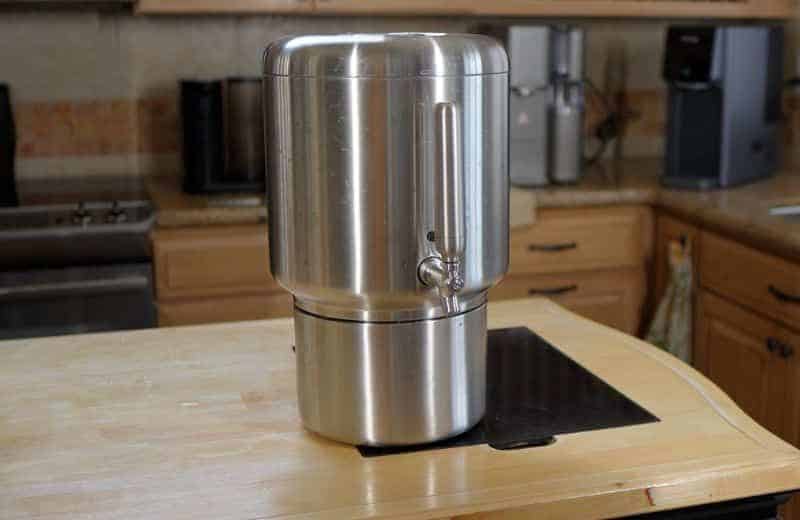
Rorra is currently available in just one unit size: a 2.5-gallon vessel. You can buy it in one of two colors: the traditional silver stainless steel, and matte black (which costs an extra $50).
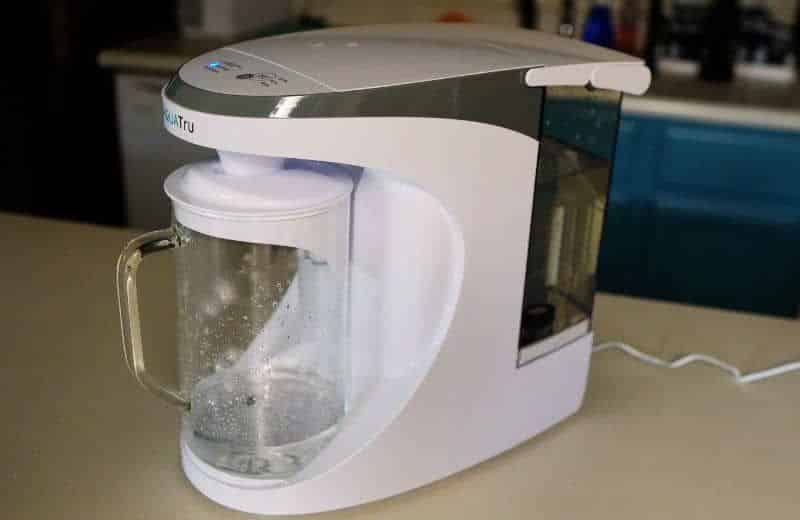
AquaTru is available in two different models: the AquaTru Carafe and the full-size AquaTru Classic. There are a few differences between the two: the Carafe has a smaller 0.625-gallon water-holding capacity (versus the Classic’s 0.75 gallons) but dispenses water directly into a glass carafe, avoiding plastic contact.
Each model is available in 4 different configurations:
- The base model with a standard VOC filter
- An alkaline model that uses an alkaline remineralization VOC filter
- A WiFi model, which connects to an app that provides helpful system data and status updates
- An alkaline and WiFi model, with app connectivity and a remineralization VOC filter
AquaTru offers the most choice, but that doesn’t mean it’s the best. It just depends on what you’re specifically looking for.
Component Quality
Component quality comes down to the types of materials used in a filter’s design, and we based our scores in this category on our notes on sturdiness and durability.
Rorra is made from stainless steel, and its plastic use is limited to small silicone o-rings and the filter’s end caps and mesh core, which are made from FDA food-grade virgin polypropylene.
The AquaTru Carafe is made from Tritan plastic, which is BPA- and BPS-free. We thought that the plastic design felt sturdy but not too heavy or bulky, and didn’t seem likely to shatter.
If you’re wary about your water coming into contact with plastic, Rorra may seem like the obvious choice. But the AquaTru Carafe provides a solution: a glass carafe for purified water collection, which means that (unlike with the Classic) water doesn’t come into contact with a plastic tank after it has been purified.
Filter Materials
When we look at the filters used in each system, this is where we see some real differences between AquaTru and Rorra.
Rorra sells just one filter: the Enfinity filter, which uses electrokinetic nanofiber media. We don’t know much about how this media works, but from our research, it seems to use charged nanofibers to attract and immobilize contaminants as water passes through.
The AquaTru Carafe has multiple filtration stages, including a sediment pre-filter, an activated carbon VOC filter (which can be upgraded to a remineralization model), and a semi-permeable membrane. There are three separate filter cartridges, while Rorra uses just one filter.
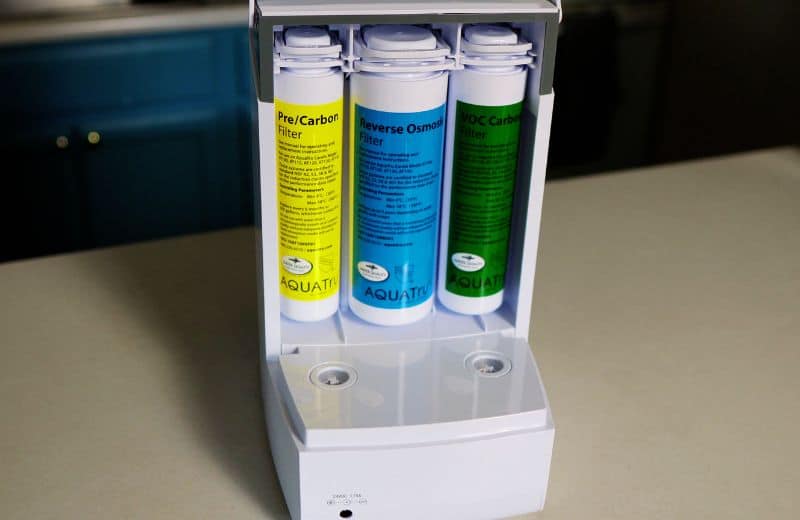
AquaTru’s multi-stage filtration, including an RO membrane, enables it to deliver a more comprehensive water purification compared to Rorra.
Materials Safety Certification
The AquaTru Carafe holds an NSF 372 certification for lead-free design. It’s also certified for materials safety and structural integrity under its IAPMO performance certification.
Rorra hasn’t obtained a materials safety certification, nor does it have a lead-free design certification.
Filter manufacturers don’t have to obtain these certifications, but they’re a useful confirmation of design quality and safety.
⚙️ Setup
Key Finding: AquaTru assembled in 5 to 10 minutes and Rorra in 25 minutes; both required about 20 minutes of filter priming.
To compare the setup process for the AquaTru Carafe and Rorra systems, we evaluated their ease of assembly.
Both are countertop systems, so they don’t require a difficult connection to your plumbing. But we still found differences in how they’re assembled and prepared
We’ve shared our setup times and scores in the table below.
| Product | Setup Score | Setup Time |
|---|---|---|
| AquaTru | 10.00 | 5-10 minutes (plus priming) |
| Rorra | 8.50 | 25 minutes |
AquaTru’s filters arrived in vacuum-sealed bags, so we installed them ourselves. Aside from that, we just had a few basic assembly steps to follow, including washing the tank and glass carafe, then inserting them into the unit.
Rorra is also quick and easy to set up, taking us just under 25 minutes from start to finish.
For both systems, we needed to prime the filters before we could start using them:
- For the AquaTru Carafe, we ran 4 tanks of water through the system and discarded the purified water each time. The process was time-consuming but didn’t require any specialist knowledge or tools.
- Rorra’s filter flushing process took 20 minutes and involved filtering and discarding a batch of water.
🔧 Maintenance
Key Finding: Both scored 9.75 for maintenance, but Rorra’s single Enfinity filter costs $0.37 per gallon against [CONFIRM $0.19 or $0.29] for the AquaTru Carafe.
We compared AquaTru and Rorra in the maintenance category by analyzing their servicing requirements and ongoing filter costs.
See the scores we awarded to both systems in the next table.
| Product | Maintenance Score | Servicing Requirements | Costs |
|---|---|---|---|
| AquaTru | 9.75 | Outstanding | $0.29/gal |
| Rorra | 9.75 | Outstanding | $0.37/gal |
Servicing Requirements
AquaTru and Rorra have the same basic maintenance requirements, including the two key tasks:
- Replacing the filters
- Cleaning out the water chambers
For both units, the filter replacement process is simple: you just remove the old filter and insert the replacement filter.
Rorra has only one filter to replace, so it’s the most low-maintenance unit.
The AquaTru Carafe has 3 separate filters: the sediment pre-filter, the activated carbon VOC filter, and the semi-permeable membrane.
For both units, we also washed out the water tanks once a week and wiped down the exterior with a damp cloth when needed. AquaTru has an extra maintenance task (recommended but not mandatory): flushing the unit with pure water once a week to clean the filters.
The AquaTru Carafe’s digital display screen indicates when to replace each filter. Uniquely for a stainless steel gravity filter, Rorra also has a timer-based filter replacement indicator, which eliminates the need to make your own reminders.
Maintenance Costs
We calculated each system’s maintenance costs based on their predicted lifespans.
The AquaTru Carafe is surprisingly affordable to maintain. Rorra is also affordable, although not as much. That, at least, does something to make up for its expensive upfront cost.
Here’s how the maintenance costs compare for AquaTru and Rorra:
| Filter/System | Cost Per Gallon |
|---|---|
| AquaTru Classic Pre/Carbon Filter | $0.03 |
| AquaTru Classic VOC Carbon Filter | $0.04 |
| AquaTru Classic Reverse Osmosis Filter | $0.04 |
| Total AquaTru Filter Replacement Cost | $0.11/gal |
| Rorra (1 Enfinity Filter) | $0.37/gal |
- AquaTru*:
- Classic Pre/Carbon Filter: $0.03/gallon
- Classic VOC Carbon Filter: $0.04/gallon
- Classic Reverse Osmosis Filter: $0.04/gallon
= $0.11 per gallon
- Rorra with one Enfinity filter = $0.37 per gallon
The AquaTru Carafe model has a slightly higher filter replacement spend compared to the full-size Classic (which has a cost-per-gallon of $0.11) because its filters are smaller, so their lifespans are shorter.
🏢 Company
Key Finding: Both offer a 1-year warranty and 30-day returns; AquaTru’s free shipping to all 50 states is the only difference and the reason for its 8.80 versus 8.50.
Finally, we’re comparing AquaTru and Rorra as companies, putting their warranty offerings and their shipping and returns policies head-to-head.
Below, you can see the data we used to award the scores in this category.
| Product | Company Score | Warranty Length | Shipping | Returns |
|---|---|---|---|---|
| AquaTru | 8.80 | 1 year | Free shipping on all orders | 30 days |
| Rorra | 8.50 | 1 year | $16 shipping; free over an unspecified order minimum | 30 days |
Warranty Length
All AquaTru products (excluding the filters themselves) are covered by a 1-year limited warranty against defects in materials and workmanship. Under the warranty, you’re entitled to a repair or a replacement as needed, but you’ll be expected to cover shipping and processing fees.
All Rorra systems are also backed by a 1-year warranty, entitling you to a repair or a replacement under the warranty terms.
Here’s AquaTru’s warranty information.
See Rorra’s warranty terms here.
Shipping
AquaTru offers free shipping to all 50 states, Canada, and Puerto Rico, so it got the best score in this category.
Standard shipping on the Rorra website costs $16.00. The company does offer free shipping over a certain threshold, which isn’t defined anywhere on the site, but the countertop system qualifies.
Find out more about AquaTru’s shipping here.
Returns
Both the AquaTru and the Rorra systems can be returned within 30 days of the purchase.
However, AquaTru customers have to pay for the return shipping fees, and with Rorra, you’ll only be able to return the product if it’s in its original packaging, you have the receipt or proof of purchase, and you request the return first.
AquaTru’s returns policy can be viewed here.
You can view Rorra’s returns and refund policy here.
🆚 AquaTru or Rorra: Which One’s for You?
Ultimately, our testing data shows that the AquaTru Carafe is the best filtration system in this comparison. It offered an unbeatable contaminant reduction performance and is backed by extensive certifications. It’s also more affordable than Rorra, despite offering a better performance, and its glass carafe makes it a great option if you want to minimize contact with plastic post-filtration. But there are still a few occasions in which you might consider Rorra instead:
We Recommend AquaTru to:
- Anyone looking for a high-performing RO system that has been certified for both performance and design.
- People who want the best all-rounder (both AquaTru systems currently top our list of the best countertop RO systems).
- Folks who want to avoid plastic with a glass dispensing option.
We Think Rorra is Worth Considering If:
- You prefer a gravity-fed filter that doesn’t use electricity.
- You’re more attracted to Rorra’s design.
- You want to replace just one filter, rather than three.
❔ FAQ
Q: Is AquaTru or Rorra better at removing contaminants?
A: AquaTru. In our Tap Score lab tests, the AquaTru Carafe removed 100% of the 10 health-related contaminants detected in our water, including uranium, fluoride, chloroform, and copper, and scored 9.90 for health-related contaminant reduction. Rorra fully removed 5 of the 10 health-related contaminants in its test water (copper, uranium, zinc, chlorine, and phosphorus), reduced strontium by 69.4%, molybdenum by 28.3%, and barium by 26.9%, and removed 0% of fluoride. Rorra scored 7.80 in the same category.
Q: Does Rorra remove fluoride?
A: No. In our Tap Score test, fluoride measured 1.4 PPM before and 1.4 PPM after filtration through the Rorra Enfinity filter, a 0.0% reduction. The AquaTru Carafe reduced fluoride from 0.9 PPM to not detected in our test, and it is certified under NSF/ANSI 58 for fluoride reduction.
Q: Is Rorra NSF certified?
A: No. Rorra states its filter has been NSF tested, which is not the same as NSF certification. It holds no performance certification and no materials safety certification, so it scored 6.00 in both of our certification subcategories. The AquaTru Carafe is IAPMO certified to NSF/ANSI 42, 53, 58, and 401 for 83 contaminants and holds NSF 372 lead-free certification, scoring 10.00 in both subcategories.
Q: Which is faster, AquaTru or Rorra?
A: Rorra. We measured Rorra at 3 gallons per hour, one of the fastest gravity filters we have tested, earning a 10.00 filtration rate score. We measured the AquaTru Carafe at 0.03 gallons per minute, or about 1.8 gallons per hour, which earned a 7.00. AquaTru is slower because water is pumped through three filter stages including a reverse osmosis membrane.
Q: Does AquaTru waste water, and does Rorra?
A: AquaTru wastes some water and Rorra wastes none. The AquaTru Carafe has a 4:1 efficiency ratio, meaning about 1 gallon of reject water for every 4 gallons of purified water, which is among the most efficient countertop reverse osmosis systems we have tested. Rorra is gravity fed with no membrane, so 100% of the water you pour in comes out as filtered water.
Q: Why did sodium increase in the Rorra filtered water?
A: Our Tap Score test showed sodium rising from 10.7 PPM to 19.5 PPM after Rorra filtration, an 82.2% increase, and potassium appearing at 3.48 PPM when it was not detected in the unfiltered water. That pattern is consistent with an ion exchange resin releasing sodium and potassium as it captures other charged ions, although Rorra only describes its media as an electrokinetic nanofiber. The AquaTru Carafe reduced sodium by 82.9% in our test.
Q: Which system is cheaper to own?
A: AquaTru. The AquaTru Carafe costs $375 upfront versus $549 for the Rorra Countertop System, and its three replacement filters work out to $0.29 per gallon versus $0.37 per gallon for Rorra’s single Enfinity filter. Both systems scored 9.75 for maintenance overall because both are easy to service, but AquaTru scored 10.00 for filter costs versus 9.50 for Rorra.
Q: Should I choose Rorra over AquaTru?
A: Only if you need a filter that runs without electricity, want a stainless steel body with minimal plastic, or want to replace one filter instead of three. On our lab data, certifications, and cost, the AquaTru Carafe wins: it scored 9.57 out of 10 versus 8.33 for Rorra. If you want a gravity filter, we recommend reading our best gravity water filter roundup, because Rorra did not make that list.
Q: AquaTru Carafe vs AquaTru Classic: which one should I compare against Rorra?
A: The Carafe. It scored 9.57 and is the highest-scoring AquaTru unit we have tested, so it is the model used throughout this comparison. The Classic uses the same three filters and posted the same contaminant reduction result, but it holds purified water in a plastic tank rather than a glass carafe and scored 9.54 overall. Read our AquaTru Carafe review and our AquaTru Classic review for the full test data on each.