


The Aquasana Shower Filter is sold by one of the more established water filter manufacturers, but when we tested this filter ourselves, it got one of the worst scores of all the shower filters we used.
In this guide, we’ll be breaking down the Aquasana filter’s performance score, assessing its contaminant reduction abilities, flow rate, ongoing cost, installation and maintenance requirements, and overall value for money. The data shared in this guide is a combination of our subjective and objective testing across a range of performance categories.
What We Like
What We Don’t Like
| Price | $119.99 |
| Contaminants Reduced | 9+ |
| Certifications | Not Certified |
| Process | Coconut Shell Carbon + KDF |
| Filter Capacity | 10,000 gallons |
| Annual Cost | ~$125.98 |
| Warranty | 180 days |
📊 Scoring Data
The Aquasana Shower Filter is pretty expensive for what it is, costing $120 at the time of our review. Our main testing outcome was to deduce whether or not the filter was worth its upfront spend. We used 6 key scoring categories to analyze the filter, combining and averaging the scores into an overall performance score. Our testing data is displayed in the table below.
| Criteria | Results |
|---|---|
| Overall Score | 7.36 |
| DBPs | 6.00 |
| Disinfectant Residual | 6.00 |
| Hardness | 6.00 |
| Performance Certification | Not Certified |
| Filtration Rate | 1.54 GPM |
| Component Quality | Excellent |
| Component Certification | Not Certified |
| Setup | Excellent |
| Servicing Requirements | Outstanding |
| Costs | $0.022/ gallon |
| Warranty Length | 180 days |
| Shipping | Variable Shipping Costs |
| Returns | 90-day Guarantee |
🚰 Contaminant Reduction
Score: 6.00Contaminant reduction is the performance category that most heavily influences a water filter’s overall score in our testing system. To assess filters in this category, we test our own water before and after running it through the filter, then compare the results.
This category is split into two subcategories: our own test results, and evidence of official third party contaminant reduction certifications by the NSF, IAPMO, or the WQA.
Our Performance Testing
Score: 6.00
We used Tap Score, a laboratory testing service, for all our shower filter contaminant reduction tests. This involved sending a couple of samples of water to the lab:
- Unfiltered water straight from our existing showerhead
- Filtered water from the shower filter

Our results were delivered in an interactive test report, which allowed us to compare contaminants against different health standards. There’s the option to use the EPA’s Maximum Contaminant Levels (MCLs) for this purpose, but we decided to use Tap Score’s Health Guideline Levels (HGLs), because these are stricter than the MCLs and prioritize human health.
We also tested for chlorine in our water using a digital colorimeter. Chlorine dissipates quickly so couldn’t be accurately detected with our main testing kit, which requires a waiting period while the sample is shipped to the lab.
DBPs
Score: 6.00
Our Tap Score test detected more than 10 contaminants with known health effects, but for this review, we only focused on those that can be harmful to health in shower water, either due to inhalation or dermal exposure (rather than ingestion).
Of these contaminants, four disinfection byproducts in the trihalomethanes (THMs) group were detected in our water sample:
- 5.47 PPB of chloroform
- 2.62 PPB of bromodichloromethane
- 0.74 PPB of dibromochloromethane
- 0.25 PPB of bromochloromethane
The concentrations of chloroform, bromodichloromethane, and dibromochloromethane exceeded the Tap Score HGL, meaning they were potentially harmful to health. Bromochloromethane was detected in concentrations below the Reporting Limit, so the testing lab was unable to evaluate its safety in our water.
Why are DBPs dangerous in shower water? A 2020 study linked exposure to these contaminants in shower vapor with an increased risk of “cancer and non-cancer risks” when inhaled.
Aquasana claims to reduce over 90% of chlorine, but there’s no mention of DBPs or any other contaminants in the product description. So, did the filter perform as anticipated or exceed our expectations?

Surprisingly, there was a 73% decrease in total THMs, including a 20% reduction in bromochloromethane, a 77% reduction in bromodichloromethane, a 71% reduction in chloroform, and a 72% reduction in dibromochloromethane. This was a nice surprise, especially as most of the other shower filters we tested didn’t reduce these.
However, chloroform and bromodichloromethane were still detected above the HGL post-filtration, and so were total THMs (the group of DBPs that chloroform and bromodichloromethane fall into). That’s why the Aquasana filter still received a low score here despite these reductions.
Disinfectant Residual
Score: 6.00
We used chlorinated city water to test all the shower filters we’ve reviewed so far.
The Aquasana Shower Filter is apparently “is independently tested to NSF/ANSI Standard 177 to reduce more than 90% of chlorine”, so we expected a similar result in our own testing.
We didn’t use Tap Score for this portion of water quality analysis. Instead, we conducted our own on-site tests using a digital colorimeter, which gave us accurate, immediate results.
We took the reading after calibrating the colorimeter and preparing the water sample by adding reagent paper and shaking it for 20 seconds.
The first reading we took was of our unfiltered baseline sample, which contained 2.70 PPM of chlorine. We then repeated the test after installing the filter, and this time, the reading was 57% lower, at 1.14 PPM.
This was a disappointing result. We expect shower filters to be able to reduce 80% chlorine at a minimum, especially when they’re still new and the media isn’t depleted.
Water Hardness
Score: 6.00
We combined data from our Tap Score lab test and our more precise on-site titration test to compare our water hardness before and after filtering it through the Aquasana shower filter.
Aquasana doesn’t claim to reduce water hardness, and we didn’t anticipate this outcome. Why? Because to address hardness minerals, you need an ion exchange resin, and the Aquasana filter only contains KDF and coconut shell carbon.
Here are our unfiltered water results from both tests:
- In our Tap Score test report, our water had a total hardness reading of 128.19 PPM, or 7.49 GPG, which put it in the “hard” category.
- Our on-site titration test detected a water hardness of 8 GPG.
Note: Hardness minerals aren’t classed as “health-harmful” contaminants in our Tap Score report, but hard water can still have mild-to-moderate skin and hair effects in shower water, especially if you have a skin condition like eczema.
Here’s how our filtered water results compared:
- In our Tap Score test, the total hardness of our water had dropped by just over 1%.
- Our titration test detected the same 8 GPG of hardness.
This was as we had expected. Many of us assume that shower filters can address water hardness because so many manufacturers falsely claim this. But hardness reduction is an outcome that we rarely saw in our shower filter testing.
Unexpected Results
The presence of contaminants aside from chlorine, DBPs, and hardness doesn’t affect our scoring in our shower filter reviews. But we still want to mention an unexpected result with the Aquasana Shower Filter.
Our Tap Score lab data showed that copper increased by 58%, and zinc increased by a massive 40,924%, up to 3.7 PPM (exceeding the lab’s HGL of 2 PPM). We believe this is a result of leaching from the KDF media, but it’s concerning that such a substantial amount of zinc leached from the filter.
There’s minimal information on the possible health effects of zinc in shower water, but one 2019 research paper noted that zinc can be absorbed through breathing and skin contact, and around 20-30% of consumed zinc is absorbed. The same paper noted that zinc can affect gastrointestinal and immune processes, and has neurological, cardiovascular, and carcinogenic (cancer-causing) effects with exposure to excessive concentrations.
Performance Certifications
Score: 6.00
Shower filter manufacturers can obtain certifications for the reduction of select contaminants. The most common certification is NSF 177, for the reduction of free available chlorine.
We were disappointed to see that the Aquasana Shower Filter isn’t certified for chlorine reduction (which we’d expected from a more established brand like Aquasana). The filter has only been independently tested—you can view the datasheet here.
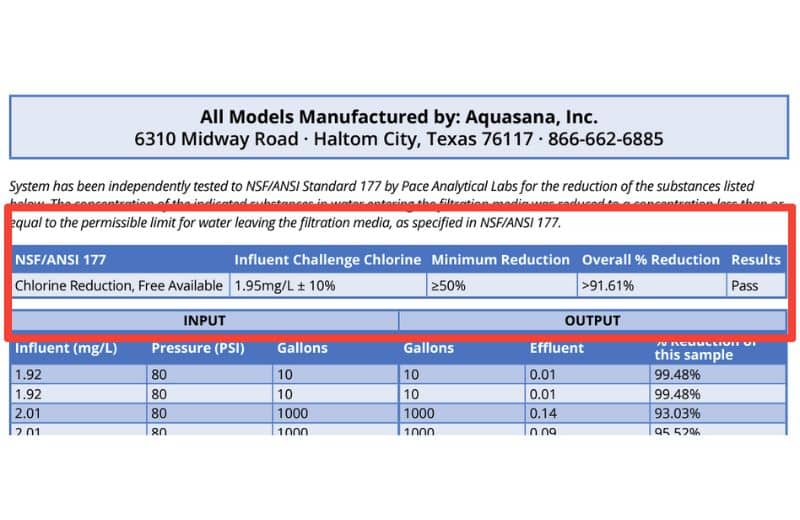
Aquasana’s independent testing is for chlorine reduction only, with an average of 91.61% chlorine removal over a series of 22 tests. We’d like to see Aquasana test for additional contaminants with potential health effects in shower water, like DBPs, PFAS, and microplastics, even if they choose not to get the filter officially certified.
Related: Sprite Slim-Line 2 Certified Shower Filter Review
🚦Filtration Rate
Score: 10.00We used the same process to measure the flow rate of all the shower filters we tested. This involved timing how long it took to fill 2 cups of water from the filtered showerhead, then combining and averaging these timings before converting them into a gallons-per-minute (GPM) flow rate.
Our recorded 1.54 GPM flow rate for the Aquasana filter put it in the bottom three, but we awarded it a 10.00 score in this category. Its flow rate is still fast for a shower filter, and we didn’t notice a reduction in water pressure.
The maximum flow rate cited in the owners’ manual is 2.5 GPM.
📐 Design
Score: 7.80The Aquasana Shower Filter redeemed itself with its slightly higher design score of 7.80, this time putting it in the top three of all the shower filters we tested.
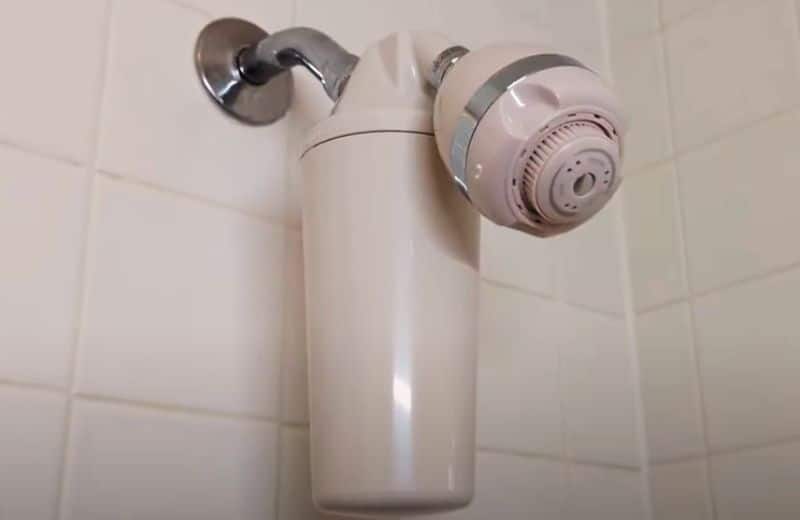
Aquasana is one of the only manufacturers that offers different styles of shower filter, rather than just the same style in different colors. The available options are:
- A handheld wand in chrome or white
- A standard fixed showerhead that screws directly onto the filter
You can also buy the filter on its own to use with your existing showerhead (a slightly more affordable option) if you prefer.
Appearance-wise, this isn’t the most attractive filter we’ve seen. It’s definitely more of a practical-looking unit, but, in our opinion, quality is far more important than appearance.
Component Quality
Score: 9.00
We were pretty impressed with the Aquasana filter’s component quality. It’s made from sturdier plastic than other filters and doesn’t feel thin or flimsy, which suggests it should be a more durable option.
The filter hangs down from below the unit, rather than extending the showerhead downwards, so it doesn’t change the height or positioning of the showerhead itself.
This helpful design feature also means that you can unscrew the filter housing without having to detach the showerhead, making maintenance easier.
Filter Materials
The Aquasana system contains coconut shell carbon and KDF media. These are commonly used in shower filters, primarily offering chlorine reduction. KDF also reduces select heavy metals, and carbon addresses other chemicals like pesticides, although this isn’t super relevant in a shower filter.
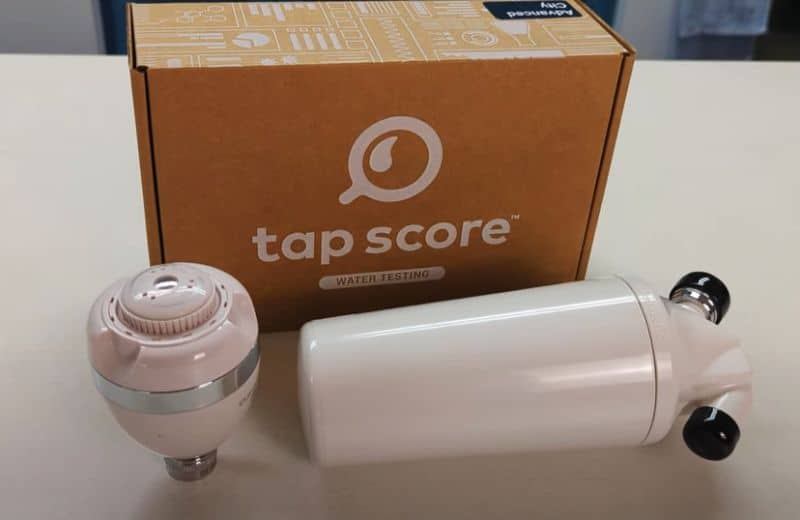
It’s not clear whether the filter uses carbon block or granular activated carbon. Usually, when a carbon filter addresses disinfection byproducts, it means it uses carbon block, which is more densely packed and offers more comprehensive contaminant reduction.
But the Aquasana filter has a unique upflow design that extends the contact time between the water and the media, and this could be why it’s capable of DPB reduction when similar filters are not.
Materials Safety Certification
Score: 6.00
Aquasana doesn’t have a materials safety certification, which is a shame—this, combined with its sturdy design, would have pushed it ahead of its competitors in the design category.
While materials safety certifications aren’t legally required, they reassure us that a filter has been tested and approved for design safety.
⚙️ Setup
Score: 9.00Setup is nice and easy for the Aquasana Shower Filter, as simple as replacing your existing showerhead with a new one.
The installation instructions in the owner’s manual are easy to follow, and setup took us around five minutes. You don’t need any special tools or equipment—just pliers and plumber’s tape to wrap around the shower pipe and ensure a tight fit.
Once installed, the filter needs to be flushed, and this process is also easy. We just turned on the cold water and let it flow through the shower for two minutes, then, at a normal temperature, turned the water on and off three times until the water ran clear.
You’ll be able to install this Aquasana model yourself even if DIY isn’t your strong point.
🔧 Maintenance
Score: 9.50Aquasana also got one of the highest scores in the maintenance category, being easier to maintain than most other shower filters and having one of the lowest ongoing spends.
Servicing Requirements
9.50
The Aquasana Shower Filter is super simple to maintain, with just one filter to replace. The filter’s design made maintenance much easier than other filters because we could unscrew the housing without having to first remove the shower head.
Aquasana’s predicted lifespan for the filter is up to 6 months, equating to a water filtering capacity of around 10,000 gallons. The lifespan of a filter depends on water quality, but on average, you’ll only need to replace the filter around twice a year.
Costs
Score: 10.00
As for maintenance costs, we calculated the cost-per-gallon of the Aquasana shower at just $0.022. This gives it a 5-year ownership cost of around $750, making it one of the most affordable options.
| Product | Cost per gallon |
|---|---|
| Hello Klean | $0.052 |
| Afina | $0.042 |
| FilterBaby | $0.034 |
| Aquatru Shower | $0.031 |
| Jolie | $0.026 |
| Canopy | $0.026 |
| Eskiin | $0.025 |
| HammerHead | $0.024 |
| Aquasana | $0.022 |
| Weddell Duo | $0.012 |
| AquaBliss | $0.012 |
| Sprite SL2 | $0.007 |
🏢 Company
Score: 8.60Since Aquasana is an established brand, we were expecting it to lead the pack with its warranty, shipping, and returns offerings. But while it got a decent score in this category, it wasn’t actually one of the best.
Warranty
Score: 8.00
Aquasana offers a 6-month warranty, which is pretty decent, but not the best we’ve seen for a shower filter (1 year).
Under the warranty, Aquasana says they’ll “provide a replacement that fulfills the remaining estimated lifespan/capacity of your original purchase and send it to you with installation instructions” within this 6-month warranty period.
The warranty only applies to manufacturing defects and doesn’t cover issues caused by misuse or water damage.
Learn more about Aquasana’s warranty here.
Shipping
Score: 8.00
Aquasana’s shipping costs are variable depending on the product you buy and where you’re located. As well as the U.S., the company also ships to Canada, but notes that shipments are “subject to provincial duties and taxes at time of delivery”, at the responsibility of the customer.
Click here for more information on Aquasana’s shipping policy.
Returns
Score: 10.00
We awarded Aquasana the highest score in the “returns” subcategory because of the company’s impressive 90-day guarantee.
This guarantee is three times the length of most other shower filter manufacturers’ return policies (30 days) and allows you to trial the filter and return it if, for whatever reason, you decide it’s not for you.
To return the filter, you’ll need to request a Return Authorization Code on the Aquasana website, which entitles you to a full refund of the purchase price of the filter.
There’s some fine print to be aware of, including that you (the customer) will be responsible for return shipping costs.
View Aquasana’s 90-day guarantee here.
💰 Value For Money
Now we’ve reached the end of our review, would we recommend the Aquasana Shower Filter?
The filter definitely has its positives: it’s sold by a reputable manufacturer and was one of the few shower filters to reduce disinfection byproducts in our testing. It’s also easy to install and is one of the easiest to maintain thanks to its design.
But there are some issues, too: we were concerned about the amount of zinc that leached from the KDF media, and the design, while sturdy, isn’t very attractive. At over $100, it doesn’t offer much more than the filters selling for half its price, especially since it only reduced chlorine by around 50%, and we were disappointed with its lack of a chlorine reduction certification.
Ultimately, the Aquasana Shower Filter might be a good fit for you if you want a reliable filter that reduces chlorine and DBPs from a well-known manufacturer.
But if you’re looking for a filter with a superior, certified performance, it’s worth considering the Weddell Duo instead, which was the best shower filter we tested. Or, if hardness reduction is your top priority, the ShowerStick is the only effective water softening shower filter that we used.