

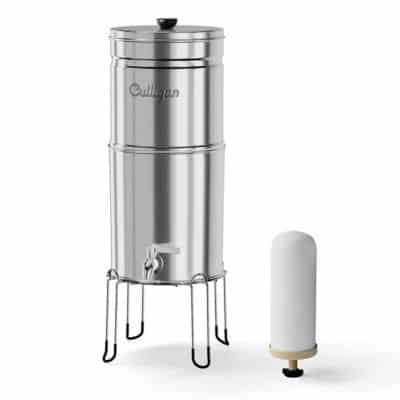
If you like the idea of filtering drinking water in a countertop gravity system, you’ve probably considered the Culligan MaxClear Gravity Water Filter. This filter is compatible with Culligan’s stainless steel gravity filtration units (the 2.25-gallon Scout and the 3-gallon Venture) and is marketed as the only gravity filter with certifications for removing microplastics, lead, and total PFAS.
What We Like
What We Don’t Like
| Price | $229.99+ |
| Contaminants Reduced | 13 |
| Certifications | NSF 42, 53, 401 & 372 |
| Process | Ceramic + Activated Carbon + KDF |
| Filter Capacity | 50 gallons |
| Annual Cost | ~$160+ |
| Warranty | 5 years (unit only; filters not covered) |
▶️ Video Review
We’ve tested a bunch of the most popular stainless steel gravity filters, from Berkey to British Berkefeld, Boroux, and Waterdrop. We analyzed the Culligan MaxClear filter using the exact same assessment process, to see how the system performed, ranked, and compared to its competitors.
📊 Scoring Data
We evaluate every filtration system with a set of six performance checks, using a combination of lab data and feedback from hands-on use to generate scores across each area. The Culligan MaxClear Filter was assessed using the same scoring system that we use for all water filters, allowing us to get a good understanding of how it compared to similar models based on where it placed in our weighted scoring system.
Each performance category draws on multiple factors, including how effectively the filter reduces contaminants, the unit’s build quality, the effort and cost involved in ongoing upkeep, any design and performance certifications, and the manufacturer’s warranty, returns, and shipping policies. You can see the results for Culligan MaxClear in the next table.
| Criteria | Results |
|---|---|
| Overall Score | 8.55 |
| Health Related Contaminants | 8.70 |
| Aesthetic Related Contaminants | 9.90 |
| Performance Certification | NSF/ANSI 42, 53, 401 |
| Filtration Rate | 0.3 GPH |
| Component Quality | Exceptional |
| Component Certification | NSF/ANSI 372 |
| Setup | Good |
| Servicing Requirements | Good |
| Costs | $1.20-$1.58/ gallon |
| Warranty Length | 5 years (unit only; filters not covered) |
| Shipping | Free shipping within the continental US on orders above $99. |
| Returns | Unclear, case-by-case returns policy |
🚰 Contaminant Reduction
Score: 8.88Gravity filters use a simple, pressure-free filtration process, which gives them a more toned-down design compared to other types of filters, with no need for mechanical force or multiple filter stages. But this shouldn’t take away from the quality of the filtration media, and a capable gravity filter should still reduce a wide range of impurities.
The Culligan MaxClear is competitively priced upfront in its product category, but it’ll still set you back almost $100 just for a replacement filter alone. So, the results need to justify the cost, and that’s what we set out to test in our contaminant reduction analysis.
We used Tap Score lab testing to see what the filter removed and how it changed the overall quality of our drinking water. This heavily influenced the score we awarded in this category.
The score also accounts for third-party performance certifications, since these verify the reduction of contaminants not present in our own test water.
Our Performance Testing
Score: 8.76
To test the Culligan MaxClear’s contaminant reduction performance, we collected two water samples:
- One “baseline” sample of our tap water before filtration
- One sample dispensed from the Venture Gravity System
Both samples were sent to Tap Score for lab analysis. A few days later, we were sent links to two digital reports that we could access on the SimpleLab dashboard.
We used Tap Score’s lab testing to obtain the majority of the test data we’re about to discuss, except for chlorine. Because chlorine evaporates quickly, we used on-site test strips for this particular reading.
For scoring, we compared our results to conservative Health Guideline Levels (HGLs). These limits are more health-focused than the EPA’s Maximum Contaminant Levels (MCLs), so they give a clearer picture of how well a filter performs from a residential usage and safety standpoint.

Health-Related Contaminants
Score: 9.70
11 contaminants with possible health effects were detected in our baseline water sample: nitrate, chlorine, barium, copper, fluoride, sulfate, zinc, strontium, uranium, molybdenum, and phosphorus.
| Analyte | Type | Unit | Pre | Post | Difference |
|---|---|---|---|---|---|
| Alkalinity (as CaCO3) | Properties | PPM | 81 | 43 | -46.91% |
| Barium | Metals | PPM | 0.031 | 0.0008 | -97.42% |
| Bicarbonate | Minerals | PPM | 98.37 | 52.29 | -46.84% |
| Calcium | Minerals | PPM | 26.9 | 26.2 | -2.60% |
| Carbonate | Minerals | PPM | 0.18 | 0.061 | -66.11% |
| Chloride | Inorganics | PPM | 13.5 | 13.2 | -2.22% |
| Chloride-to-Sulfate Mass Ratio | Properties | 1.59 | 0.19 | -88.05% | |
| Copper | Metals | PPM | 0.0654 | 0 | -100.00% |
| Dichloromethane | VOCs | PPB | 0 | 6.51 | #DIV/0! |
| Fluoride | Inorganics | PPM | 1.4 | 0 | -100.00% |
| Grains per gallon | Properties | Grains | 5.55 | 6.28 | 13.15% |
| Hardness | Properties | PPM | 94 | 107 | 13.83% |
| Hardness (Ca,Mg) | Properties | PPM | 94 | 107 | 13.83% |
| Hardness (Total) | Properties | PPM | 94.94 | 107.51 | 13.24% |
| Langelier Saturation Index | Properties | -0.66 | -1.2 | 81.82% | |
| Magnesium | Minerals | PPM | 6.58 | 10.2 | 55.02% |
| Manganese | Metals | PPM | 0 | 0.0053 | #DIV/0! |
| Molybdenum | Metals | PPM | 0.006 | 0 | -100.00% |
| Nitrate (as N) | Inorganics | PPM | 2.6 | 1.7 | -34.62% |
| pH | Properties | pH | 7.6 | 7.4 | -2.63% |
| Phosphorus | Inorganics | PPM | 1.1 | 0 | -100.00% |
| Potassium | Minerals | PPM | 0 | 1.92 | #DIV/0! |
| Sodium | Minerals | PPM | 10.7 | 12.5 | 16.82% |
| Sodium Adsorption Ratio | Properties | 0.48 | 0.52 | 8.33% | |
| Specific Conductivity | Properties | umhos/cm | 234 | 262 | 11.97% |
| Strontium | Metals | PPM | 0.144 | 0.068 | -52.78% |
| Sulfate | Inorganics | PPM | 8.5 | 70.1 | 724.71% |
| Total Dissolved Solids | Properties | PPM | 138 | 154 | 11.59% |
| Uranium | Metals | PPM | 0.0322 | 0 | -100.00% |
| Zinc | Metals | PPM | 0.248 | 0 | -100.00% |
Two of these contaminants exceeded the HGL:
- 0.032 PPM (parts per million) of uranium was detected, exceeding the HGL of 0 PPM
- 1.4 PPM fluoride, exceeding the HGL of 0.799 PPM
While these contaminants are generally not considered health-harmful in the low levels found in tap water, they’ve still been linked to cancer, developmental issues, and gastrointestinal, liver, and kidney problems with prolonged exposure to varying concentrations.

Our test results post-filtration using Culligan MaxClear were a mixed bag. 100% copper, uranium, molybdenum, zinc, phosphorus, and fluoride were removed, and barium was reduced by 97%, strontium by 52%, nitrate by 34%, and chloride by just 2%.
But 0.0053 PPM of manganese was detected post-filtration, along with 6.51 PPB (parts per billion) dichloromethane (a manufacturing chemical). Neither of these contaminants was detected in our unfiltered water. Plus, sulfate increased by 724.71%, from 8.5 PPM to 70.1 PPM.
Most likely, manganese and sulfate were released from the filtration media itself.
As for dichloromethane, this is the more concerning outcome. It’s a widely used organic solvent that seems to be used in the manufacturing of numerous water filters.
The concentration of dichloromethane in our filtered water exceeded the HGL of 0 and the EPA’s MCLG (Maximum Contaminant Level Goal), also of 0, based on health effects including damage to the nervous system and blood.
Our original theory was that this chemical was leaching from an adhesive used in the unit itself, which raises questions about the safety of the system for long-term use. But after a discussion with our contact at the NSF, we’re now not sure that this is the case.
When a water filter is submitted for official testing and certification to NSF/ANSI standards, it’s tested for methylene chloride (dichloromethane) during the extraction testing portion. The Culligan Max Clear has a number of official performance certifications, which means it passed extraction testing for methylene chloride.
Ultimately, we don’t have a good explanation as to why this chemical showed up in our testing. We tested 8 countertop filters at the same time, using the same baseline sample from a bucket, and this was the only filtered water sample in which dichloromethane was detected. The filters were relatively new when testing, so one possible theory is that methylene chloride was transferred onto the filters from the packaging materials. However, without further testing and data, we can’t say for sure.
Aesthetics, pH, and Mineral Content
Score: 9.90
We don’t usually comment on aesthetics when we’re testing non-reverse osmosis water filters, as they generally aren’t affected by most filter media.
But our testing results are worth discussing for the Culligan MaxClear Filter:
- Alkalinity was reduced by 46.91% from 81.0 PPM to 43.0 PPM.
- Bicarbonate was reduced by 46.84%, and carbonate by 66.11%.
- Magnesium actually increased by 55.02%, from 6.58 PPM to 10.2 PPM.
- Plus, potassium was detected post-filtration at 1.92 PPM when it was absent pre-filtration, and sodium increased by 16.82%, from 10.7 PPM to 12.5 PPM.
The pH of our water also reduced slightly, from 7.6 to 7.4. These outcomes didn’t have a significant aesthetic effect, but they’re interesting to discuss since they’re generally not expected for a non-RO filter.
Culligan only claims that the MaxClear filter uses ceramic and carbon media, but we initially suspected that the increases and decreases in certain mineral concentrations points to the use of dual ion exchange media.
We reached out to Culligan to learn more, and our contact explained that the filters also contain KDF media (this is mentioned nowhere on the Culligan website). KDF isn’t known to add impurities like potassium and magnesium. This points to the ceramic shell itself being the source of these detections in the filtered water.
Performance Certifications
Score: 8.50
The MaxClear’s performance certifications are a big part of Culligan’s marketing, and in our research, we found evidence that the filter is certified to reduce 13 out of the 13 contaminants listed in the ‘Certified to Reduce’ table on the main product page.
Specifically, the filter is certified to NSF Standards 42, 53,,and 401, for the reduction of chlorine, chloramine, and particulates class I, lead, total PFAS, atenolol, carbamazepine, meprobamate, trimethoprim, DEET, linuron, metolachlor, and microplastics.
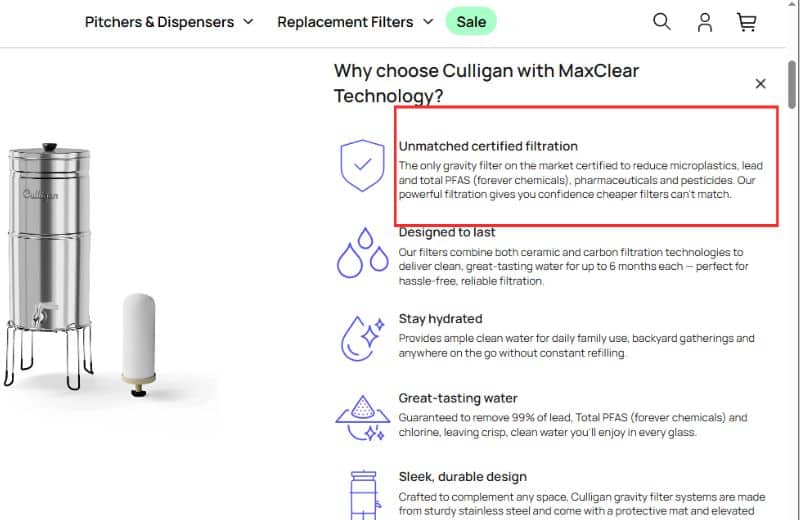
Culligan claims that the MaxClear is the only gravity filter that’s certified for removing microplastics, lead, and total PFAS. This is true. While it’s not the only certified filter in this category (the British Berkefeld Ultra Sterasyl Filter and the Boroux Fluoride Filter also have certifications), it is the only gravity filter we’ve tested to have this specific combination of certifications.
🚦Filtration Rate
Score: 6.50Gravity filters are slower to filter water by design, given that they rely on gravity alone to pull water through the filter media. The Culligan MaxClear is one of the slowest of a slow bunch, with a recorded filtration rate of just 0.3 GPH (gallons per hour). It took a total of 8 hours to filter a full upper chamber of water, even with all three filters installed.
To put this into perspective, most other countertop gravity filters had flow rates ranging from 0.7 to 1 GPH. Only British Berkefeld’s filters had a similarly slow filtration rate.
Is this a dealbreaker? No, unless you want instant access to filtered water (in which case, a gravity filter isn’t the most suitable choice anyway).
📐 Design
Score: 10.00The Culligan Max Clear Filter element itself is compatible with most countertop gravity systems, but for the sake of this review, we’re looking specifically at the Culligan Scout and Venture systems.
The only real difference between these two units is size. Both are made from stainless steel, with polished (shiny) and brushed (matte) finishes to choose from. They’re the typical cylindrical shape, with an unfiltered water chamber stacked on top of the filtered water chamber, separated by the filter elements.
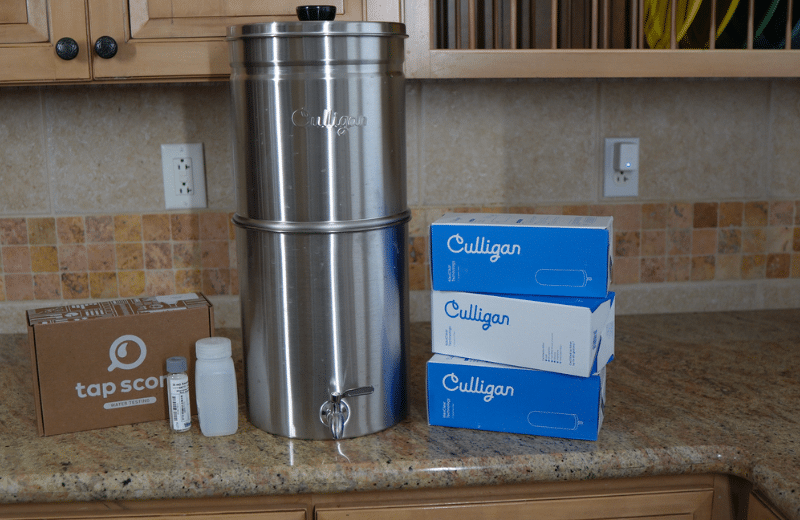
You can remove the lid to add water to the top, and twist the spigot handle to dispense filtered water from the bottom. Both units also come with a wire stand, so you can easily dispense water without having to place the unit at the very edge of your countertop.
Since they’re designed for countertop gravity filtration, both the Venture and Scout are standalone units that don’t need hooking up to a water line or an electricity supply. The Scout holds 2.25 gallons of water, and the Venture holds 3 gallons.
Component Quality
Score: 10.00
As a reminder, we installed the MaxClear filters in the Culligan Venture. We noted that the unit feels sturdy and durable, and a big selling point is its lack of plastic components.
Similar systems we’ve tested have plastic spigots and dispenser spouts (some offering optional stainless steel upgrades, and some not). The Venture only has a few small plastic parts, including a silicon washer and filter brackets. This is important given that Culligan’s marketing focuses on the dangers of microplastics and why they should be removed with a certified filter like the MaxClear.
Filter Materials
There are two MaxClear filter media that Culligan mentions: activated carbon and ceramic technologies. And as we shared earlier, our contact at Culligan also disclosed that the filter contains KDF media.
These are a common pairing in gravity-fed countertop filters. The chemical reduction and taste-enhancing benefits of activated carbon complement both:
- The mechanical filtration offered by the ceramic media,
- And the KDF media’s heavy metals-removing and bacteria inhibiting redox process.
All media are considered safe and effective when used for filtering water.
Interestingly, our Culligan contact explained that the carbon and ceramic media can contribute to reducing fluoride, and in our testing, fluoride was completely eliminated. This suggests that the activated carbon block inside the ceramic shell may be made of bone char carbon, which is capable of reducing fluoride (activated carbon from other sources is not).
Materials Safety Certification
Score: 10.00
The MaxClear filters have an IAPMO-awarded NSF 372 certification for lead-free design.
This is a great start and tells us that the filter won’t leach lead into our water (something we’d like to assume anyway, but it’s nice to have the official confirmation!).
⚙️ Setup
Score: 8.00We’ve had a variety of setup experiences with stainless steel gravity-fed filters, ranging from quick and relatively easy (British Berkefeld, ProOne, AlexaPure, and Boroux) to tear-your-hair-out frustrating (Berkey and Waterdrop).
The good news is that the Culligan Venture fell into category 1, with a quick and easy setup process that took around 20 minutes.
The key factor that determines the level of effort required in setting up a countertop filter is whether or not the filters need to be primed, and if so, how. The MaxClear filters don’t need priming and can be installed immediately, saving a lot of time and hair-tearing.
The Culligan Venture user manual contains a scannable code that links to an installation video for the unit. It outlines all the parts you should have and walks you through the setup process, which includes:
- Screwing the knob onto the lid
- Assembling and installing the spigot
- Scrubbing the filter(s) with a brush under running water to remove any dust
- Installing the filter(s)
- Stacking the containers vertically
We then filled the top container and allowed it to filter completely, before dumping the filtered water and repeating the process twice more, as recommended by Culligan. This flushes the filters and, while time-consuming, is our much preferred alternative to manual priming using fiddly equipment.
🔧 Maintenance
Score: 7.25The Culligan Venture with MaxClear filters received the poorest maintenance score of all the countertop gravity filters we’ve tested so far, mainly due to having the highest ongoing filter replacement spend.
Servicing Requirements
8.50
The servicing requirements for Culligan’s countertop gravity models are essentially a rinse and repeat of the setup process. The replacement filters need to be prepared for use with the same filter-3-batches-and-discard procedure, so you’re not committing much more than your time.
There’s no filter life tracker (this is typically only a feature of countertop RO systems), so you’ll have to make a note of when the filters need replacing based on how long you’ve used them.
Between filter replacements, Culligan recommends cleaning the filters’ ceramic shell by scrubbing them with a sponge under cool running water. We also washed out the containers around once a week, and Culligan advises using a 50/50 solution of white vinegar and water for a deeper clean.
Costs
Score: 6.00
The MaxClear filter has a cost-per-gallon of $1.20-$1.58, based on the current cost of a replacement filter, how many filters you purchase at once (discounts if you buy more, lowering cost per gallon) and its 50-gallon capacity (equating to up to 6 months, according to Culligan).
Most of the competitor filters we’ve tested have claimed capacities of 200-800+ gallons, with costs-per-gallon ranging from $0.10 to $0.50, so the MaxClear is on the more expensive end for a countertop gravity filter. That said, many of these competitors also don’t have official certifications backing up those capacity claims which is important to keep in mind when making comparions.
| Filter Option | Filter Cost | Capacity | Cost per Gallon |
|---|---|---|---|
| Culligan MaxClear (Single Filter) | $78.99 | 50 gallons | $1.58 |
| Culligan MaxClear (6-Pack) | $60 per filter | 50 gallons | $1.20 |
The good news is that replacement filters are cheaper if you buy them in larger quantities. The $1.58 per gallon cost is the most expensive if you only buy a single filter, but there are options to buy packs of filters that reduce the cost. If you buy the largest 6-pack, each filter costs $60 instead of $78.99, lowering the cost per gallon to $1.20. Even so, that’s still much more expensive than any other filter we’ve tested.
🏢 Company
Score: 8.80Culligan offers a great warranty for the MaxClear products, as well as good shipping options, but it was let down in this category by its confusing returns language (the worst of any countertop water filter brand we’ve reviewed).
Warranty
Score: 10.00
The Culligan Scout and Venture systems are warranted for an impressive 5 years; one of the best warranties we’ve come across within this product category.
This warranty entitles you to a replacement or repair of any component that’s found defective by Culligan, assuming that the defect wasn’t caused by misuse or abuse, improper installation, or any conditions that are beyond Culligan’s control.
You can find warranty information on this page.
Shipping
Score: 9.00
Culligan’s shipping policy entitles you to free delivery on all orders over $99. That means your initial purchase will incur no additional shipping fee, although you will need to pay for replacement filter shipping if purchasing individually.
Free shipping over $99 only applies to orders on the Culligan website, and you’ll need to be based within the continental US. The average processing period is 1-2 days, with a 3-5-day shipment time.
Returns
Score: 7.00
Culligan’s returns policy is pretty confusing, using ambiguous language and saying that each return is treated uniquely. From what we can tell, your return entitlement will be determined by whichever customer support staff you speak to, depending on how they interpret your situation.
We awarded Culligan a lower score for returns since there’s no specific guarantee of free returns within a time range.
Culligan’s shipping and returns policy can be viewed here.
💰 Value For Money
Overall, the MaxClear filters have a lot going for them: performance certifications, a quick and easy setup process, and a high-quality design.
They performed well in our testing, reducing or removing most contaminants. But the presence of dichloromethane in our purified water is concerning.
Since we know that the unit passed extraction testing for methylene chloride in order to obtain its performance certifications, we don’t believe this chemical was leaching from the unit or filters themselves. Knowing this, we think the dichloromethane detection in our testing is likely a one-off and we feel comfortable still recommending this unit. It was tested for methylene chloride leaching and passed that testing. This is a great example of why official certification to NSf/ANSI standards is so important for water filters.
If you’re looking for a stainless steel gravity unit that’s also certified (albeit less extensively), with the same minimal-plastic construction and easy setup, we recommend the British Berkefeld. The unit with the Ultra Sterasyl and Ultra Fluoride Filters received the highest scores of all the gravity filters we’ve tested so far, and it has a few advantages over the MaxClear models, with a lower ongoing spend and a 30-day money-back guarantee.
Found this review helpful?
Comment below or share this article!
Plz what is the best filter replacement for my travel Berkey?
I’m worried about the outcomes found in the mulligan ultra max. I have the British berkefeld for city water but learned the Pro One ( now bought out by mulligan) have d/c the 5” filter.. after selling out pro one stock, they will only be selling Culligan max ultras. Plz keep us updated.on any explanation about the increase in minerals etc. I’d also like to be in your mailing list to receive updates. I have followed you on Utube but then lost your channel. Thanks for all your work and detail information.
Hello,
I do not understand this paragraph, it seems contradictory: “Culligan claims that the MaxClear is the only gravity filter that’s certified for removing microplastics, lead, and total PFAS. This is true. While it’s not the only certified filter in this category (the British Berkefeld Ultra Sterasyl Filter and the Boroux Fluoride Filter also have certifications), it is the only gravity filter we’ve tested to have this specific combination of certifications. ”
Thanks for clarifying!
This is saying that while the Culligan MaxClear is not the only filter in this category (stainless steel gravity) to hold certifications to NSF/ANSI standards, they are the only one I’ve found so far that holds certifications for microplastics, lead, and total PFAS.
For example, British Berkefeld filters are also certified to NSF/ANSI standards, but for turbidity, particulates, cysts, and microplastics.
Does this help clarify?