

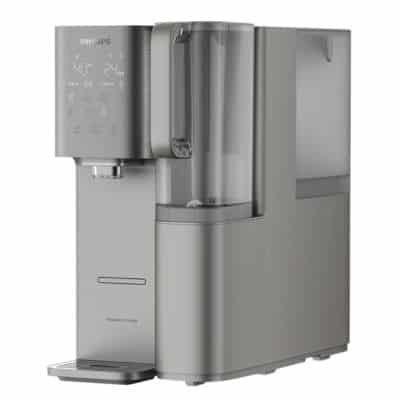
The Philips Water Dispenser is a 6-stage RO unit, that provides both hot and cold purified water on demand. In our performance testing, the system demonstrated high contaminant reduction capability without significantly affecting the pH of our water. We were pleased with its easy setup and maintenance requirements and built-in remineralization stage, but it’s not performance certified and it has one of the highest price tags of all the RO units we’ve tested.
What We Like
What We Don’t Like
| Price | $799.00 |
| Contaminants Reduced | 10+ |
| Certifications | – Not Certified |
| Process | Mechanical + Carbon + RO + UV + Remin |
| Filter Capacity | 528 gal. |
| Annual Cost | ~$130 |
| Warranty | 2 years |
📊 Scoring Data
We use the same data-driven scoring system to test and rank all the water filters we review at Water Filter Guru. Our aim is to see how each filter can perform when it’s used in real customer conditions with a residential tap water supply.
Every filter is scored across six performance categories, measuring their contaminant reduction abilities, filtration rate, ease of setup and maintenance, design quality, and manufacturer policies. We calculate these scores based on our own subjective testing, along with objective data provided by the manufacturer and obtained by our Tap Score lab tests.

See how the Philips Countertop RO filter performed in the table below.
| Criteria | Results |
|---|---|
| Overall Score | 8.98 |
| Health Related Contaminants | 9.70 |
| Aesthetic Related Contaminants | 9.90 |
| Performance Certification | Not Certified |
| Filtration Rate | 0.07 GPM |
| Component Quality | Good |
| Component Certification | Unsatisfactory |
| Setup | Excellent |
| Servicing Requirements | Exceptional |
| Costs | $0.23/ gallon |
| Warranty Length | 2 years |
| Shipping | Free shipping to lower 48 states |
| Returns | 30 days with conditions |
🚰 Contaminant Reduction
Score: 9.34As a reverse osmosis system, we went into our contaminant reduction testing expecting to be impressed by the Philips RO water dispenser. Reverse osmosis is a comprehensive water purification process that reduces dissolved solids down to extremely minimal trace levels, often removing them altogether.
The score we awarded in this category was based on the filter’s performance in our Tap Score tests. It was also influenced by the presence of (or, in Philips’ case, the lack of) performance certifications for contaminant reduction.
Our Performance Testing
Score: 9.71
We evaluated the Philips RO system’s contaminant reduction capacity by testing two samples of water: a baseline sample (so we knew what our water contained without being filtered), and a post-purification sample dispensed from the Philips machine.
Tap Score has a strict sample-taking protocol, which we followed to achieve the most accurate testing outcomes. This involved:
- Filling a clean bucket with tap water and swirling it around to make sure it was well-mixed.
- Pouring most of the water into the Philips system, then dispensing our “post-filtration” sample from the unit.
- Taking a “before” sample directly from the bucket.
We then shipped the samples to the Tap Score testing lab for analysis.
The only exception was chlorine, which we tested at home using on-site test strips included with our sample kit. Chlorine is highly volatile, so testing for it immediately before it can dissipate helps keep our results accurate.
Health-Related Contaminants
Score: 9.70
10 contaminants with possible health effects were detected in our baseline sample, including:
- 0.032 PPM uranium (exceeding the HGL* of 0 PPM)
- 1.4 PPM fluoride (exceeding the HGL of 0.799 PPM)
Copper, sulfate, barium, zinc, strontium, molybdenum, phosphorus, and nitrate were all detected at levels not exceeding the HGL. These impurities have all been linked to health effects ranging from gastrointestinal and kidney problems to cancer and skeletal issues with high, prolonged exposure.
Post-filtration in the Philips RO, nearly all metals and inorganics were removed by 80–100%, including total elimination of nitrate, sulfate, zinc, phosphorus, copper, molybdenum, and uranium. Barium was reduced by 82.9% (from 0.031 PPM to 0.0053 PPM), strontium by 81.25% (from 0.144 PPM to 0.027 PPM), and fluoride by 92.86% (from 1.4 PPM to 0.1 PPM). This is exactly the outcome we’d expect from a reverse osmosis system.

Aesthetics, pH, and Mineral Content
Score: 9.90
Since minerals and ions are also dissolved solids, these are removed by reverse osmosis systems along with the unwanted, health-related contaminants.
Our purified water contained much lower concentrations of minerals compared to our baseline sample:
- Alkalinity was reduced by 74.07%, from 81.0 PPM to 21.0 PPM.
- Calcium was reduced by 84.39%, from 26.9 PPM to 4.2 PPM.
- Carbonate was reduced by 93.33%, from 0.18 PPM to 0.012 PPM
- Bicarbonate was reduced by 74.0%, from 98.37 PPM to 25.58 PPM.
- Magnesium was reduced by 95.9%, from 6.58 PPM to 0.27 PPM.
Total hardness was, unsurprisingly, reduced by 87%, from 94 PPM to 12 PPM. We also saw a 78% reduction in sodium, and the pH of our water dropped modestly, from 7.6 (slightly alkaline) to 7.0 (neutral).
| Analyte | Unit | Pre | Post | Difference | Type |
|---|---|---|---|---|---|
| Alkalinity (as CaCO3) | PPM | 81 | 21 | -74.07% | Properties |
| Barium | PPM | 0.031 | 0.0053 | -82.90% | Metals |
| Bicarbonate | PPM | 98.37 | 25.58 | -74.00% | Minerals |
| Calcium | PPM | 26.9 | 4.2 | -84.39% | Minerals |
| Carbonate | PPM | 0.18 | 0.012 | -93.33% | Minerals |
| Chloride | PPM | 13.5 | 3 | -77.78% | Inorganics |
| Chloride-to-Sulfate Mass Ratio | 1.59 | Too numerous to count | #VALUE! | Properties | |
| Copper | PPM | 0.0654 | 0 | -100.00% | Metals |
| Fluoride | PPM | 1.4 | 0.1 | -92.86% | Inorganics |
| Grains per gallon | Grains | 5.55 | 0.68 | -87.75% | Properties |
| Hardness | PPM | 94 | 12 | -87.23% | Properties |
| Hardness (Ca,Mg) | PPM | 94 | 12 | -87.23% | Properties |
| Hardness (Total) | PPM | 94.94 | 11.64 | -87.74% | Properties |
| Langelier Saturation Index | -0.66 | -2.6 | 293.94% | Properties | |
| Magnesium | PPM | 6.58 | 0.27 | -95.90% | Minerals |
| Manganese | PPM | 0 | 0.0021 | #DIV/0! | Metals |
| Molybdenum | PPM | 0.006 | 0 | -100.00% | Metals |
| Nitrate (as N) | PPM | 2.6 | 0 | -100.00% | Inorganics |
| pH | pH | 7.6 | 7 | -7.89% | Properties |
| Phosphorus | PPM | 1.1 | 0 | -100.00% | Inorganics |
| Potassium | PPM | 0 | 1.58 | #DIV/0! | Minerals |
| Sodium | PPM | 10.7 | 2.29 | -78.60% | Minerals |
| Sodium Adsorption Ratio | 0.48 | 0.29 | -39.58% | Properties | |
| Specific Conductivity | umhos/cm | 234 | 43.3 | -81.50% | Properties |
| Strontium | PPM | 0.144 | 0.027 | -81.25% | Metals |
| Sulfate | PPM | 8.5 | 0 | -100.00% | Inorganics |
| Total Dissolved Solids | PPM | 138 | 27 | -80.43% | Properties |
| Uranium | PPM | 0.0322 | 0 | -100.00% | Metals |
| Zinc | PPM | 0.248 | 0 | -100.00% | Metals |
Interestingly, TDS was reduced by just 80.43%. We usually see more thorough eliminations from a reverse osmosis system, but, as proven by our test data, the system did a great job of eliminating most contaminants. Likely, this lower reduction in TDS simply tells us that the remineralization filter is working.
Unexpected Outcomes
There were a couple of surprises with our results:
- Manganese was detected post-filtration at 0.0021 PPM when it was absent pre-filtration.
- Potassium was detected post-filtration, this time at 1.58 PPM, when it was also absent pre-filtration.
Most likely, the increase in these contaminants was due to minor media leaching in the remineralization stage; especially potassium, which contributes to alkalinity and could be introduced intentionally for this reason. It’s also possible that manganese simply wasn’t detected in our baseline test even though it was present, since it’s detected in very low trace levels post-filtration.
Neither of these outcomes had a significant effect on the quality of health properties of the purified water.
Performance Certifications
Score: 6.00
Many of the countertop RO systems we’ve tested have obtained performance certifications for reducing contaminants, but we were unable to find any for the Philips reverse osmosis water filter dispenser. This resulted in the lowest score in this category.
🚦Filtration Rate
Score: 7.50Philips also failed to impress us with its filtration rate. It took 6 minutes and 20 seconds to filter a full tank of water, equating to a flow rate of 0.07 GPM (gallons per minute).
It’s not the slowest-to-filter countertop RO unit we’ve ever used, with competitors ranging from 0.03 to 0.1 GPM.
Efficiency Ratio
A performance feature that applies only to reverse osmosis systems is efficiency ratio, or recovery rate. This is a measure of how much water is wasted for every gallon of water purified.
Why do RO filters waste water?
It’s a part of the membrane separation process: when contaminants are rejected by the membrane, they’re flushed away along with some wastewater.
The amount of water wasted by an RO system depends on a few factors, including how quickly water flows through the system and whether it has any water-conserving features like wastewater recycling.
The Philips Countertop RO unit has a pure-to-wastewater ratio of 3:1, making it one of the more efficient systems we’ve tested. For reference, most countertop units have efficiency ratios ranging from 1:1 to 4:1.
📐 Design
Score: 7.50The Philips water filter dispenser is a silver unit with a sleek, modern design. It’s similar to a typical countertop water dispenser, but with filters for purification and a few high-tech features.
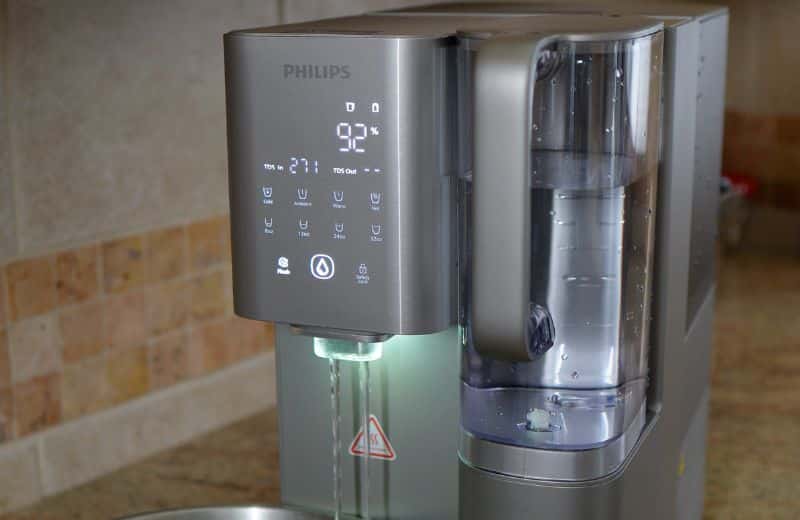
The design score we awarded in this category was influenced by the unit’s component quality and evidence of certifications for design or materials safety.
Component Quality
Score: 8.50
In our testing, we noted that the unit feels pretty sturdy and durable. Like its competitors, it’s predominantly made from plastic. Don’t be fooled by the pictures—it’s not made from stainless steel.
The system is made from Acrylonitrile Butadiene Styrene, or ABS, a plastic known for its impact resistance. It’s considered to be generally safe for use by the EWG and is BPA-free, but as with any type of plastic, its true safety depends on the quality of the particular materials used by the manufacturer, and whether it has been enhanced or combined with any other materials.
You may have concerns about exposing your purified water to plastics, but plastic water tanks are the norm in most countertop RO systems. The only exceptions to this that we’ve personally tested are the AquaTru Carafe and Bluevua which collect purified RO water in a glass container.
Materials Safety Certification
Score: 6.00
Many of the countertop RO systems we’ve tested are also certified for their designs, typically for lead-free construction or materials safety. These optional certifications offer the reassurance that your purified water shouldn’t be exposed to any potentially dangerous or health-harmful materials in the RO machine.
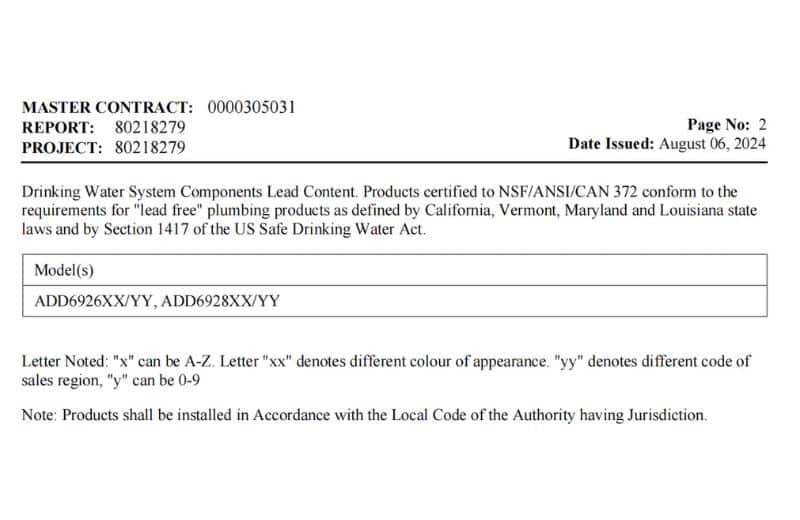
Philips’ marketing and user manuals state its countertop RO unit is “certified to NSF/ANSI-372” for lead-free materials, but we were unable to find a corresponding formal listing for the Philips water dispenser model ADD6928DG in the IAPMO or WQA searchable databases, nor could we find a definitive NSF DWTS certificate entry that matches the Philips water filter product pages we checked.
We emailed Philips to see if a link to a certification could be provided, and they shared an image of the certification (see below). However, when we asked for a link to view the certification online, they said they were unable to provide one.
Filter Materials
The Philips water filter uses six stages of filtration in just a single filter cartridge. These are:
- Sediment filter
- Activated carbon media
- Additional sediment filter
- Reverse Osmosis membrane with Aquaporin Inside™ technology (a biomimetic water purification method that uses nature-inspired aquaporin proteins)
- Activated Carbon (post-filtration)
- A mineralizer filter
These filtration stages are all typically found in reverse osmosis systems, although remineralization filters aren’t always included or are upsold as optional extras. We’re pleased to see this filtration media included as a mandatory final stage in the cartridge as it plays an important role in enriching water with essential minerals and boosting its pH.
Tech Design Features
It’s now becoming the norm for countertop RO systems to have techy design features that go some way to justifying their high price tags. While filtration performance still comes first in our eyes, we still think it’s helpful to compare the technology offered by different units.
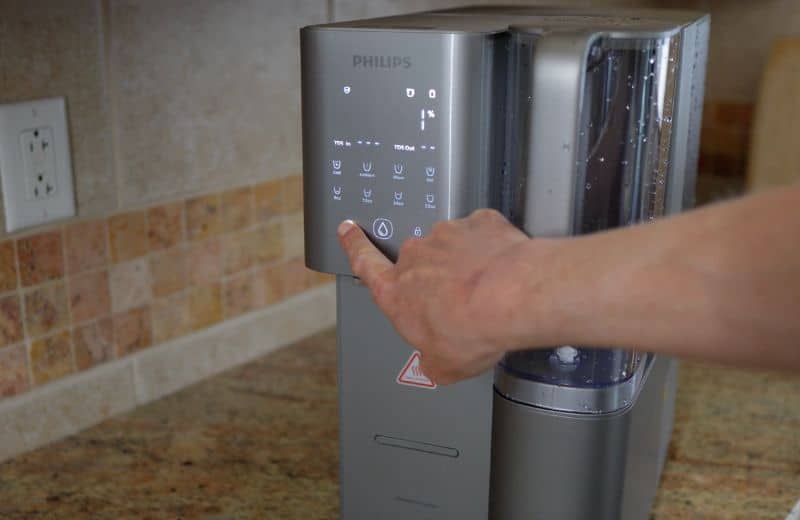
The Philips water dispenser has a digital display screen featuring a real-time TDS monitor, comparing the dissolved solids content of your unfiltered tap water vs the dissolved solids in your purified water, making it easy to check that the filters are working at a glance. It also has 6 water temperature presets (ranging from a cool 40°F to a hot 203°F) and 4 water volumes, plus a child safety lock and an automatic flush button.
We don’t personally think that any of these features are essential, and they don’t affect how we score RO systems. But you might be specifically looking for a filter that can, say, provide purified hot water at the press of a button. If so, certain tech features may be a must-have for you.
⚙️ Setup
Score: 9.00A big perk of countertop RO systems is that, unlike under-sink units, they don’t need to be plumbed into your water line.
The Philips water dispenser has a simple setup process that took just under half an hour from start to finish. This involved cleaning the tanks with soap and water and flushing water through the filters, which is easy thanks to the automatic flush button and took us just over 24 minutes (despite the user manual stating it takes 1.5 hours).
You can see the full instructions for setup, including flushing the system, in the product manual.
🔧 Maintenance
Score: 10.00With its affordable and easy ongoing maintenance requirements, maintenance was the first performance category in which the Philips Countertop RO system earned top scores.
Servicing Requirements
10.00
The key maintenance task for any reverse osmosis unit is replacing the filters. This is necessary to keep the system purifying your water properly, since filters start to lose their effectiveness after several months of use.
We could simply check the digital display screen on the Philips water dispenser unit to know when it was time to replace the filter, eliminating the guesswork or the need to make our own calendar reminders for filter changes.
The unit is also one of the only countertop RO systems we’ve tested to combine all filtration and purification stages into a single filter cartridge, and having just one filter to replace is a big maintenance selling point.
Other maintenance tasks recommended by Philips include:
- Cleaning the waterway (if you haven’t used the machine for a week or longer)
- Cleaning and descaling the tap water tank
- Cleaning the filtered water jug as necessary
- Draining the cooling tank
- Cleaning the air filter
There’s a bit more maintenance involved than you’d get with, say, a water filter pitcher, but that’s a tradeoff for owning a more technically complex and capable system.
Costs
Score: 10.00
We calculated the Philips system’s ongoing spend at $0.23 per gallon, making it just as affordable as the other countertop RO systems we’ve tested.
For comparison, the counter reverse osmosis filters in our scoring database have filter replacement costs of 0.08 to 0.27 per gallon.
🏢 Company
Score: 8.65Philips’ warranty and shipping policy are good, but its returns policy isn’t as beneficial to the customer as it initially seems.
Warranty
Score: 9.00
The Philips Countertop RO system is backed by a 2-year warranty for “any damages caused by manufacturing process problems”, or any damage to components “under normal use conditions”.
The warranty excludes frequently replaced consumables, meaning it won’t cover the filter cartridge itself. You’ll also need to show proof of purchase to be eligible, and any shipping fees will be covered by you.
You can see the warranty information on the last page of the user manual.
Shipping
Score: 9.50
We couldn’t find a defined shipping policy on the Philips website, but from what we can tell, the manufacturer offers free shipping to lower 48 states. Shipping appears not to be available at all to other regions (we tried entering a Hawaii address and were unable to checkout).
Returns
Score: 8.00
Philips’ warranty is 30 days, entitling you to a refund if you’re not satisfied with the system for any reason. But to be eligible for a return, there are a few stipulations to be aware of:
- Your item must be “in the same condition that you received it, unworn or unused, with tags, and in its original packaging”.
- You’ll also need the receipt or proof of purchase.
Here’s the Philips returns policy for more information.
💰 Value For Money
Overall, the Philips water dispenser ticked a lot of boxes in our testing. It performed well at removing harmful impurities while maintaining alkalinity thanks to the included remineralization filter, and its 3:1 efficiency ratio is great.
We think the big feature that will appeal to many folks is its ability to dispense RO water at various temperatures, which does go some way to justify its higher price tag. But price is the key issue for us. The unit costs $800, making it one of the most expensive we’ve tested (even compared to similar systems offering hot water dispensing).
When we consider the fact that it’s not performance certified, we have to wonder whether the price is really justified. Maybe if you’re happy to trust the fact that reverse osmosis is universally known to be effective, this won’t be an issue for you. But we think the price is still steep for a few extra tech features.
It all depends on what you’re looking for. If you’re not actually that bothered about dispensing water at any temperature, you might prefer the AquaTru as another option. It’ll cut around $300 off your upfront spend and has official performance certifications for every single contaminant it’s claimed to remove.
You could also consider the Waterdrop A1, another hot water dispensing RO unit that performed slightly better than the Philips model overall, with certifications for performance and lead-free design and an upfront cost of around $500.
Found this review helpful?
Comment below or share this article!
Did you check the PFAS reduction? Thank you for your answer!
I did not. Testing for PFAs requires additional, specialized analysis outside of the Tap Score city water test kit I used for this project. PFAs tests are currently super expensive and cost prohibitive for me to include in all my projects. Hoping this changes in the future so I can include that by default