

ZeroWater and Berkey are both manufacturers of gravity-fed water filtration systems. ZeroWater is best known for its water filter pitchers and dispensers, while Berkey’s stainless steel countertop filtration systems are its best-selling product.
How do the ZeroWater pitchers* and the Big Berkey water filter system compare, and which one is best for you? We conducted our own hands-on testing of these systems, and we’ve shared everything you need to know here.
*We’ve reviewed the original Legacy ZeroWater filter and the more recently released Culligan ZeroWater filter. We’re discussing them both in this review, but it’s worth being aware that Culligan acquired the ZeroWater brand in 2020 and relaunched the product in 2025, so the Culligan ZeroWater is now the main focus.
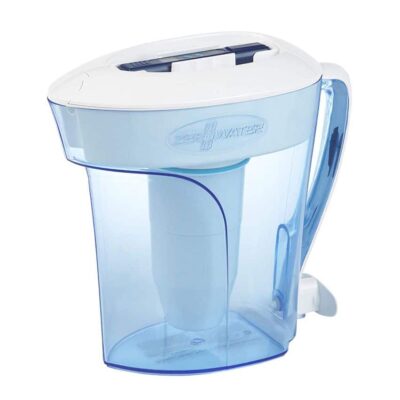
ZeroWater
Best For:
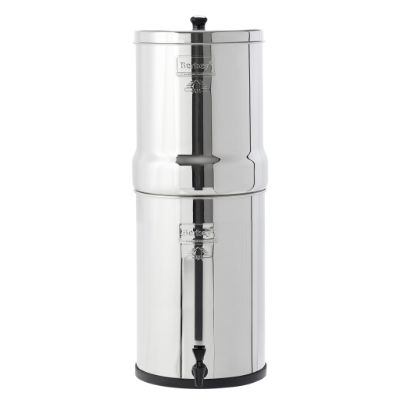
Berkey
Best For:
The filters target different contaminants, with Berkey claiming to remove 200+ contaminants and ZeroWater reducing TDS down to 0. In our testing, both ZeroWater filters did a great job of reducing most contaminants from our water, and the Culligan ZeroWater filter is certified for every single contaminant it’s claimed to reduce. We preferred that Berkey didn’t remove healthy minerals, but we had problems with activated alumina leaching from its fluoride filters.
📊 Our Testing Data
At Water Filter Guru, we put each water filter to the test. We test 6 different factors that impact the performance and usability of a system. The table below shows how the ZeroWater and Berkey water filters performed in each category.
| Factor | ZeroWater | Berkey |
|---|---|---|
| Contaminant Reduction | 8.34 | 8.25 |
| Filtration Rate | 10.00 | 7.50 |
| Design | 8.80 | 7.80 |
| Setup | 9.50 | 6.50 |
| Maintenance | 8.25 | 8.50 |
| Company | 7.50 | 9.10 |
We use a series of different performance tests and data points to generate these scores. Here’s how we assigned them.
| Factor | ZeroWater | Berkey | Winner |
|---|---|---|---|
| Overall Score | 8.62 | 8.02 | ZeroWater |
| Health Related Contaminants | 8.30 | 8.60 | Berkey |
| Aesthetic Related Contaminants | 9.90 | 6.70 | ZeroWater |
| Performance Certification | NSF/ANSI 42 & 53 | none | ZeroWater |
| Filtration Rate | 2.62 GPH | 0.75 GPH | ZeroWater |
| Component Quality | Fair | Excellent | Berkey |
| Component Certification | NSF Certified | none | ZeroWater |
| Setup | Outstanding | Failing | ZeroWater |
| Servicing Requirements | Outstanding | Weak | ZeroWater |
| Costs | $0.70/ gal | $0.13/ gal | Berkey |
| Warranty Length | 90 days (vessels and TDS meters), 30 days (filters) | Lifetime | Berkey |
| Shipping | $60 order threshold | $99 order threshold | ZeroWater |
| Returns | None | 30 days | Berkey |
🚰 Contaminant Reduction
To compare ZeroWater and Berkey in this category, we combined our own data from our Tap Score testing with official performance certification data.
Our Lab Test Results
We tested our water before and after filtering it in the ZeroWater and Berkey filters, then compared the contaminant reduction performances of both units.
Zero Water’s filters are designed to filter treated water only, so we tested them with our treated groundwater supply.
The Big Berkey system can filter both treated water and untreated water, so we conducted two tests:
- One with water from a municipal source
- One with river water from our testing location in Colorado
You can see which contaminants were detected in our source water, and how the ZeroWater and Berkey water filters reduced these, in the table below.
| Contaminant | Measurement | ZeroWater Pre-Filtration | ZeroWater Post-Filtration | % Change | Berkey Test 1 Pre-Filtration | Berkey Test 1 Post-Filtration | % Change | Berkey Test 2 Pre-Filtration | Berkey Test 2 Post-Filtration | % Change |
|---|---|---|---|---|---|---|---|---|---|---|
| Aluminum | PPM | ND | ND | ND | 0 | 1.44 | n/a | 0.052 | 0.069 | 33% |
| Barium | PPM | 0.0158 | 0 | -100.00% | 0.0317 | 0 | -100% | 0.0127 | 0 | -100% |
| Bromodichloromethane | PPB | ND | ND | ND | 4.04 | 0 | -100% | ND | ND | ND |
| Calcium | PPM | 25.6 | 0.2 | -99.22% | ND | ND | ND | 8.8 | 34.6 | 293% |
| Chloride | PPM | 14.9 | 0 | -100.00% | ND | ND | ND | 6.9 | 8.7 | 26% |
| Chloroform | PPB | 0 | 3.4 | n/a | 23 | 0 | -100% | 35.2 | 0 | -100% |
| Cobalt | PPM | ND | ND | ND | 0.0031 | 0.003 | -3% | ND | ND | ND |
| Copper | PPM | 0.163 | 0.0047 | -97.12% | 0.255 | 0 | -100% | 0.0434 | 0 | -100% |
| Fluoride | PPM | 1.1 | 0 | -100.00% | 0.2 | 0.1 | -50% | 0.1 | 0 | -100% |
| Iron | PPM | ND | ND | ND | 0.1PPM | 0.03 | ND | ND | ND | ND |
| Lead | PPM | ND | ND | ND | 0.0027 | 0 | -100% | 0.0006 | 0 | -100% |
| Magnesium | PPM | 6.32 | 0 | -100.00% | ND | ND | ND | 2.19 | 9.88 | 351% |
| Manganese | PPM | ND | ND | ND | 0.0014 | 0 | -100% | 0.001 | 0 | -100% |
| Potassium | PPM | ND | ND | ND | ND | ND | ND | 0 | 1.68 | n/a |
| Sodium | PPM | 9.63 | 0 | -100.00% | ND | ND | ND | 10.4 | 9.29 | -11% |
| Strontium | PPM | 0.11 | 0 | -100.00% | 0.168 | 0 | -100% | 0.062 | 0.138 | 123% |
| Sulfate | PPM | 8.4 | 0 | -100.00% | 16.6 | 1.6 | -90% | 10 | 23 | 130% |
| Total Coliforms | CFU/100mL | ND | ND | ND | 15 | 0 | -100% | ND | ND | ND |
| Total THMs | PPB | 0 | 3.4 | n/a | 27.04 | 0 | -100% | 35.2 | 0 | -100% |
Both filters received very similar scores for contaminant reduction, but Berkey got the slightly better score for removing health-related contaminants from our water, so it just took the winning spot.
Health-Related Contaminants
The ZeroWater filter’s score for reducing health-related contaminants was based solely on our treated water test. The Big Berkey’s score was calculated from the combined scores of our treated water and untreated water testing.
Our Treated Water Test
We tested the Big Berkey twice due to an anomaly with our test results in our first treated water test. We awarded its city water score based on an average of the scores obtained from both tests.
Our unfiltered city water contained 10 contaminants with potential health effects. Five of these contaminants – lead, cobalt, chloroform, total THMs, and bromodichloromethane – were detected in concentrations higher than the Tap Score HGL. Strontium, copper, fluoride, sulfate, and barium were also present in trace amounts below the HGL.
| Contaminant | Measurement | Detection Test 1 | Detection Test 2 | HGL |
|---|---|---|---|---|
| Lead | PPM | 0.0027 | 0.0006 | 0.0 |
| Cobalt | PPM | 0.0031 | ND | 0.002 |
| Chloroform | PPB | 23 | 35.2 | 0.22 |
| Total THMs | PPB | 27.04 | 35.2 | 0.32 |
| Bromodichloromethane | PPB | 4.04 | ND | 0.0 |
| Strontium | PPM | 168 | 0.062 | 3.0 |
| Copper | PPM | 0.255 | 0.0434 | 0.3 |
| Fluoride | PPM | 0.2 | 0.1 | 0.8 |
| Sulfate | PPM | 16.6 | 10 | 500 |
| Barium | PPM | 0.0317 | 0.0127 | 2.0 |
In our initial test, the Big Berkey removed 100% lead, disinfection byproducts, copper, and barium, and reduced cobalt by 3.23%.

But our water’s aluminum concentration had shot up to 1.4 PPM – exceeding the EPA’s MCL of 0.2 PPM by a good deal. We determined that the Berkey fluoride filters, which use activated alumina filtration media, were leaching aluminum oxide into our water.
Another disappointing outcome of test 1 was that our water’s fluoride concentration was only reduced by 50%, when Berkey claims its filters remove up to 99.99%.
So, we retested the Berkey, after following the priming and installation instructions very carefully. This included running 100 gallons of water through the filters as part of the priming process. This time, 100% of fluoride was removed from our water, and just 0.069 PPM of aluminum was detected. This was still a slight increase from our water’s initial 0.052 PPM aluminum concentration, but not as alarming.
There was one other anomaly we noticed when testing the Big Berkey: potassium and sodium both increased in our filtered water. We spoke to the chemists at the lab, who said the likely reason for this was that these ions were present in higher concentrations in the separate 100 gallons of water we sent through the filters initially. So Berkey isn’t to blame here.
We tested the ZeroWater pitchers with our treated water just once.
We tested different water supplies than for the Big Berkey, so a slightly different range of contaminants were detected in our water, including fluoride, uranium, barium, copper, molybdenum, nitrate, strontium, and sulfate. Of these, fluoride and arsenic were our biggest concern, being detected in concentrations above the Tap Score HGL.
| Contaminant | Measurement | Detection | HGL |
|---|---|---|---|
| Uranium | PPM | 0.014 | 0 |
| Chlorine | PPM | 1 | 0.0003 |
| Molybdenum | PPM | 0.0026 | 0.03 |
| Copper | PPM | 0.163 | 0.3 |
| Fluoride | PPM | 1.1 | 0.8 |
| Barium | PPM | 0.0158 | 2 |
| Strontium | PPM | 0.11 | 3 |
| Nitrate (as N) | PPM | 3.5 | 10 |
| Sulfate | PPM | 8.4 | 500 |
| Phosphorus | PPM | 1 | none |
| Magnesium | PPM | 6.32 | none |
| pH | 7.4 | none | |
| Sodium | PPM | 9.63 | none |
| Chloride | PPM | 14.9 | none |
| Calcium | PPM | 25.6 | none |
| Total Dissolved Solids | PPM | 137 | none |
Like Berkey, the ZeroWater filters completely removed barium from our water. Both the Legacy and the Culligan ZeroWater filter also removed 100% fluoride, uranium, molybdenum, nitrate, strontium, and sulfate, and copper (the Legacy reduced 97% copper, just shy of Berkey’s 100% copper removal). The Culligan ZeroWater filter also reduced 100% zinc, a contaminant that was uniquely detected in our baseline sample for this test.
Unusually, 3.4 PPB of chloroform, a common trihalomethane (THM), was detected in our water filtered by the Legacy filter. We believe the chloroform was actually present in our unfiltered water, but had dissipated before it could be detected by the lab. The fact that it was still detected in our filtered water means that the Legacy filter only reduces disinfection byproducts slightly (while Berkey’s reduction rates are much better). Note: chloroform wasn’t detected in our test water for the Culligan ZeroWater filter.
Our Untreated Water Test
Berkey did an excellent job of reducing contaminants in our river water test.
The Big Berkey removed 100% total coliform (which can be an indicator of harmful bacteria strains).
Aesthetic Contaminants
Both our unfiltered water samples contained chlorine – the test water used for the Big Berkey contained around 0.5 PPM of free chlorine, while the water used for the ZeroWater pitchers contained around 1 PPM of this disinfection chemical.
Berkey and ZeroWater removed 100% of chlorine from our water, and did a good job of adsorbing tastes and odors associated with the chemical.
But Berkey’s score in this category was pulled down by its test 1 aesthetic score, due to the aluminum oxide in our water, which caused a pH increase to 8.7.
Certifications
Water filter manufacturers have the opportunity to get their products performance-certified by the NSF/ANSI, IAPMO, or WQA, to prove that they can reduce certain common drinking water contaminants.
Unfortunately, Berkey only has third-party test results as proof of performance, which aren’t as reassuring as an official certification.
The Culligan ZeroWater filter gets the better score here because it’s IAPMO certified to NSF Standards 42, 53, and 401 for every single contaminant it’s claimed to reduce. The Legacy filter also has performance certifications, but it’s only certified to reduce 6 out of the 43 contaminants that ZeroWater claims it can reduce.
🚦Filtration Rate
We calculated the filtration rate for the ZeroWater pitchers and Big Berkey based on how long it took them to filter our water. We converted this data into a gallons-per-hour (GPH) measurement.
See the table below for a comparison of the filtration rate for both systems.
| Product | Filtration Rate Score | Filtration Rate |
|---|---|---|
| ZeroWater | 10.00 | 2.62 GPH |
| Berkey | 7.50 | 0.75 GPH |
ZeroWater came out on top in this category: Berkey’s filtration rate was just 0.75 GPH using 2 black filters and 2 fluoride filters, while ZeroWater’s was 1.9 GPH for the Culligan ZeroWater filter and 2.62 GPH for the Legacy filter – really good for a water filter pitcher.
Read Also: Our PUR and Brita data-driven comparison
💲 Upfront Cost
ZeroWater is significantly cheaper upfront than the Big Berkey. At the time of writing this review, the 12-Cup Ready-Pour Pitcher was priced at $39.99 including the initial filter, so upfront, it’s an affordable filtration system. ZeroWater’s dispensers are more expensive, but none exceed $100.
The Big Berkey is almost 10 times the cost of ZeroWater at $447. This price includes the upfront cost of two Black Berkey filters, but the fluoride filters cost another $99.99 on top of this.
Berkey is sold by a number of different distributors, so you might find it cheaper on some sites than on others.
| Product | Price | Filters Included |
|---|---|---|
| ZeroWater | $39.99 | Initial filter |
| Berkey | $447.00 | 2 Black Berkey filters (excludes fluoride filters) |
📐 Design
We compared the Berkey and ZeroWater systems in this category by combining our own analysis of the component quality with metrics on whether or not the systems were certified for materials safety.
The next table highlights the design scores we awarded to ZeroWater and Berkey, and the data we gathered for each sub-category.
| Product | Design Score | Component Quality | Materials Safety |
|---|---|---|---|
| ZeroWater | 8.80 | Fair | NSF Certified |
| Berkey | 7.80 | Excellent | Not Certified |
ZeroWater got the higher score overall in this category due to the fact that its pitchers are certified for component quality.
Filter Models
Both ZeroWater and Berkey sell a number of different vessels that can be used with their gravity filters.
The full range of ZeroWater models* is:
- 7-Cup Ready Pour Pitcher
- EcoFilter 10-Cup Pitcher
- 10-Cup Pitcher
- 10-Cup Ready Pour Pitcher
- 10 Cup Round Ready Pour Pitcher
- 12-Cup Ready Pour Pitcher
- 12-Cup Ready Read Dispenser
- 20-Cup Ready Pour Dispenser
- 22-Cup Ready Read Dispenser
- 30-Cup Dispenser
- 32-Cup Ready Read Dispenser
- 40-Cup Glass Dispenser
- 52- Cup Ready Read Dispenser
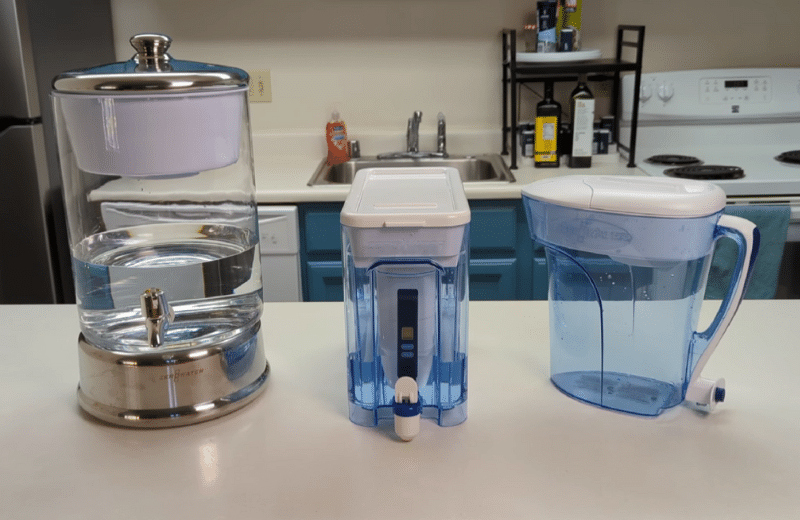
Most models are sold in just the one blue and white color combination, and all are made from plastic apart from the Glass Ready Pour Dispenser.
*We recommend getting one of the Culligan ZeroWater products, as this filter has more certifications and performed better in our testing.
The Black Berkey Elements and PF2 Fluoride Filters can be used in any of the 6 models in the Berkey filter range:
- The Travel Berkey (1.5 gallons)
- The Big Berkey (2.25 gallons)
- The Royal Berkey (3.25 gallons)
- The Imperial Berkey (4.5 gallons)
- The Crown Berkey (6 gallons)
- The Berkey Light, (2.75 gallons)
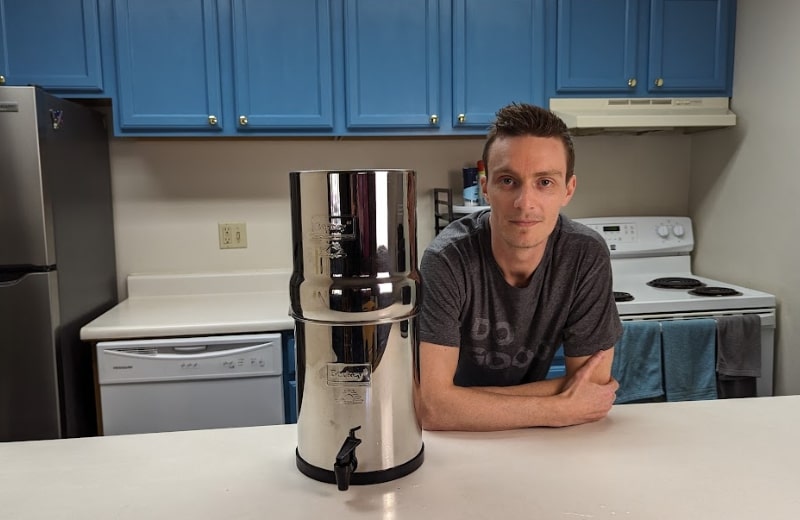
These are all stainless steel units, apart from the Berkey Light, which is made from BPA-free plastic.
Component Quality
Berkey is more appealing than ZeroWater design-wise because the Big Berkey is made from 304 stainless steel, which is super sturdy and doesn’t carry the risk of plastics or BPA leaching. It’s also supposed to be rust-free, and we noticed no rusting during our testing period, although other customers said they did notice signs of corrosion (we have no way to validate these claims).
The ZeroWater pitchers are made of BPA-free polypropylene and ABS (a terpolymer), which are popular due to their low cost (hence why ZeroWater products are so much more affordable). They’re also known for being durable and lightweight, but they’re obviously not ideal if you want to avoid plastics as much as possible, and there’s still a potential for microplastics leaching.
We found that the Culligan ZeroWater pitcher felt slightly sturdier and better quality than the Legacy filter, which felt thin and flimsy in comparison.
The Big Berkey isn’t completely plastic-free, though: its filter is attached to a plastic mount, and its spigot is also plastic – unnecessary given that Berkey sells a stainless steel spigot, but at an extra cost.
Filter Materials
Although they’re tested to remove different contaminants, ZeroWater and Berkey actually use very similar filter materials.
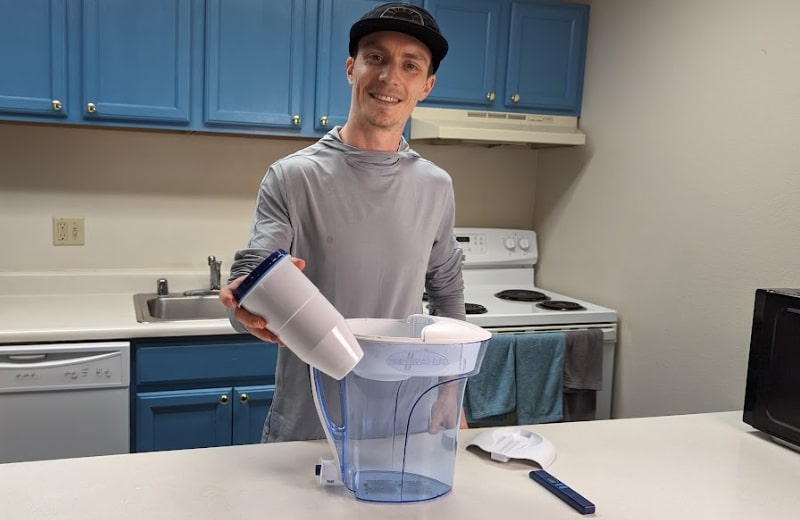
The ZeroWater Legacy filter combines three layers of physical filtration, activated carbon media, and ion exchange resin. The newer Culligan ZeroWater filter also contains KDF media.
The Black Berkey filters are also made from activated carbon and ion exchange resin, as well as four other undisclosed media. The PF2 fluoride filters have a plastic housing that contains activated alumina.

All these filter media are commonly used and considered safe for use in water filters, although we remain unconvinced of the safety of Berkey’s fluoride filter design due to the aluminum oxide leaching we experienced in our first test.
Materials Safety Certification
As a component of their performance certifications, manufacturers can obtain materials safety certifications for their filters to demonstrate that they’re made from safe materials.
The ZeroWater pitchers have a materials safety certification, but Berkey doesn’t, so ZeroWater got the best score in this category.
⚙️ Setup
We compared ZeroWater and Berkey in this category by timing how long it took us to set up each of the systems, and how easy we found the process.
See our setup score and setup time for both brands in the next table.
| Product | Setup Score | Setup Time |
|---|---|---|
| ZeroWater | 9.50 | Less than 5 minutes |
| Berkey | 6.50 | 1 hour and 20 minutes |
The ZeroWater pitchers got the best score in this category because they were much quicker and easier to set up than the Big Berkey.
The setup process for ZeroWater took us less than 5 minutes. It was quick and easy because we didn’t have to prime, soak, or flush the filter. We simply washed our pitcher in warm, soapy water, dried it, inserted the filter into the bottom of the reservoir, and filled the reservoir with cold water to be filtered.
The Berkey setup process took around 1 hour and 20 minutes because we had to prime the filters, which was time-consuming and difficult.
There were a few things we struggled with in this process, including getting a proper seal with the tan priming washer on our faucet. We also found that the blue priming nipple only works well with older faucets, and none of the priming methods work with modern faucets, like those that pull out or have sprayer handles.
Related: Zerowater and AquaTru comparison
🔧 Maintenance
We compared the maintenance requirements for the Berkey and ZeroWater systems by assessing their ease and frequency of maintenance, and calculating their long-term servicing costs.
See the maintenance scores we awarded each of the filters in this table.
| Product | Maintenance Score | Servicing Requirements | Costs |
|---|---|---|---|
| ZeroWater | 8.25 | Outstanding | $0.70/ gal |
| Berkey | 8.50 | Weak | $0.13/ gal |
Berkey had the better score here, but it was close. ZeroWater’s maintenance was much easier, but Berkey was much cheaper to maintain in the long run.
Servicing Requirements
For both Berkey and ZeroWater, the predominant maintenance task is to replace the filters.
As with the first filter that we were given with the pitcher, we didn’t have to prime any of ZeroWater’s replacement filters, so maintenance was quick and easy – as simple as removing the old filter and putting the new one in its place.
For the Big Berkey, replacing the filters was also easy. But again, it was the filter priming process that was a hassle and a time drain. We also followed Berkey’s recommendation and cleaned the filters every 3-6 months with a Scotch Brite pad, which improved their flow rate and extended their lifespan.
Alongside filter changes, we cleaned the ZeroWater pitcher every few days, and the Big Berkey around once a week. The ZeroWater pitcher was significantly easier to clean because it fitted in our sink, while the Big Berkey unit is bulky even when the two chambers are separated.
Maintenance Costs
Berkey’s maintenance costs are much lower than ZeroWater’s, and that’s because Berkey’s predicted lifespan for a pair of its Black Berkey elements is 6,000 gallons, while ZeroWater’s projected filter lifespan is just 25-50 gallons.
We calculated Berkey’s ongoing filter cost as $0.13/gallon (the Black Berkey elements cost $0.034/gallon for a pair and the fluoride filters cost $0.09/gallon).
ZeroWater’s ongoing filter cost is $0.90/ gallon for the Culligan ZeroWater and $0.70/ gallon for the Legacy ZeroWater, which we calculated using 25 gallons based on the “typical” information on this chart.
We have to trust Berkey that its filters really do have this incredibly long lifespan.
🏢 Company
Finally, we wanted to compare Berkey and ZeroWater as companies, in particular their warranties, shipping, and returns policies.
You’ll find our company scores for the ZeroWater pitcher and Big Berkey in the next table.
| Product | Company Score | Warranty Length | Shipping | Returns |
|---|---|---|---|---|
| ZeroWater | 7.50 | 90 days (vessels & TDS meters), 30 days (filters) | Free shipping on orders above $60 to continental US | None |
| Berkey | 9.10 | Lifetime | Free shipping on orders over $99 to the lower 48 states | 30 days |
Berkey took the top spot here because BigBerkeyWaterFilters.com offers a much longer warranty, while ZeroWater was let down by its lack of a returns policy.
Warranty Length
BigBerkeyWaterFilters.com warrants all Berkey systems against manufacturing defects with an unbeatable lifetime warranty. ZeroWater’s is less impressive, at just 90 days for all vessels (pitchers, dispensers, and so on), and 30 days for its filters.
Shipping
Customers spending more than $99 on BigBerkeyWaterFilters.com and living in one of the lower 48 states get free shipping, while deliveries to Canada, Alaska, and Hawaii, incur a shipping fee.
ZeroWater has a similar shipping situation – all orders above $60 to customers in continental US are shipped for free. However, unlike Berkey, many of ZeroWater’s pitchers are actually priced below this free shipping cutoff, so you’ll probably have to supplement your order with additional products (such as packs of replacement filters) if you want to take advantage of the free shipping.
Returns
BigBerkeyWaterFilters.com offers a 30-day returns period, while we were disappointed to see that ZeroWater doesn’t offer anything in the way of a returns policy.
⛔️ System Setbacks & Flaws
As well as their positive aspects, we also wanted to compare the setbacks and flaws that we noted for ZeroWater and Berkey.
ZeroWater Setbacks
- All-plastic design – The ZeroWater pitchers are made from plastic, which might be off-putting to some folks (although you can upgrade to ZeroWater’s glass dispenser if you prefer).
- Reduces healthy minerals – We don’t like the fact that the ZeroWater filters reduce healthy minerals as well as harmful contaminants. We prefer to retain these minerals in our water for their taste and health benefits.
- Didn’t reduce disinfection byproducts (Legacy filter only) – In our Legacy filter testing, disinfection byproducts were detected in our filtered water, telling us that the filter doesn’t reduce them.
- Smaller water capacity requires more refills – ZeroWater pitchers and dispensers hold less water than the 2.25-gallon Big Berkey unit, so they need to be refilled more often and might not be the most practical solution for a large family.
Berkey Setbacks
- Expensive – Berkey is almost 10 times more expensive than the ZeroWater pitcher we tested.
- Overflow risk – The Big Berkey’s design means that water can leak out between the two chambers if you continue to add water to the top chamber without realizing that the bottom chamber is full.
- Not certified – Berkey doesn’t have performance certifications for reducing contaminants, and the Big Berkey isn’t certified for materials safety.
- Needs separate fluoride filters, which have possible performance issues – Berkey’s fluoride filters are sold separately, and these filters leached aluminum oxide into our water in our testing.
🆚 ZeroWater or Berkey: Which One’s for You?
We think ZeroWater and Berkey both have their pros and cons, but one might be more suitable for you than the other.