

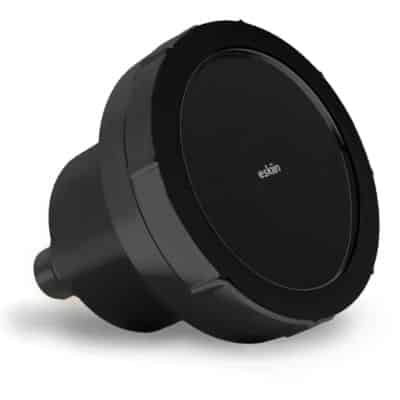
The eskiin shower head filter is heavily marketed to improve skin and hair issues caused by showering in chlorinated water. It’s claimed to remove chlorine, heavy metals, and “those pesky impurities” from shower water to boost “your skin’s glow and your hair’s shine”.
What We Like
What We Don’t Like
| Price | $149 |
| Contaminants Reduced | 0 |
| Certifications | Not Certified |
| Process | KDF-55 + Activated Carbon + Vitamin C + Mineral Media |
| Filter Capacity | Not specified |
| Annual Cost | ~$144 |
| Warranty | None |
Quick Verdict: Is the Eskiin Shower Head Filter Worth It?
The Eskiin Shower Head Filter scored 7.29/10 in our testing, one of the lowest weighted scores of any shower filter we have tested to date. In our third-party lab and on-site testing, it removed 0% of chlorine (1.68 PPM before filtration, 1.79 PPM after), failed to reduce any of the three disinfection byproducts detected in our baseline water, and had no effect on hardness.
Buy it if: You only want an attractive, easy-to-install showerhead with strong flow (1.74 GPM in our testing) and affordable cartridge replacements ($0.025 per gallon), and actual contaminant reduction is not your goal.
Skip it if: You want a filter that reduces chlorine, DBPs, or hardness. It reduced none of these in our testing, holds no NSF/ANSI 177 performance certification, and offers no warranty.
Methodology: We lab test every shower filter with before-and-after water samples analyzed by an independent laboratory, weighting contaminant reduction at 55% of the overall score. See how we test water filters.
📊 Scoring Data
At Water Filter Guru, all our water filter reviews are structured around data obtained from our own independent testing and analysis.
For every filter we test, we use our data-driven scoring system to assess 6 different factors that affect its performance, ease of use, and overall value. Primarily, we focus on a filter’s contaminant reduction abilities, and this category has the most influence on the overall score awarded. We also assess design quality, filtration rate, ease of installation, maintenance requirements and costs, and the manufacturer’s own policies.
Once we’ve finished testing a filter, we’ll take the data gathered and compare it to every other product we’ve analyzed to date.
The table below shows how this eskiin filtered showerhead matches up to the other shower filters we’ve tested
| Criteria | Results |
|---|---|
| Overall Score | 7.29 |
| DBPs | 6.00 |
| Disinfectant Residual | 6.00 |
| Hardness | 6.00 |
| Performance Certification | Not Certified |
| Filtration Rate | 1.74 GPM |
| Component Quality | Fair |
| Component Certification | Not Certified |
| Setup | Excellent |
| Servicing Requirements | Excellent |
| Costs | $0.025/gallon |
| Warranty Length | None |
| Shipping | Free to contiguous US |
| Returns | 60 days |
▶️ Video Review
🚰 Contaminant Reduction
Score: 6.00Key Finding: The filter removed 0% of chlorine in our testing, with 1.68 PPM measured in our baseline sample and 1.79 PPM measured post-filtration, and it also failed to reduce any detected DBPs or water hardness.
The eskin Shower head gives the impression of a premium product, both from its marketing materials online and from its nearly $150 price tag. We wanted to see if this price was reflected by a solid performance, especially for contaminant reduction.
We used data from both Tap Score lab testing and on-site tests to award a score for contaminant reduction. This category is also influenced by the presence of performance certifications, which are optional but provide verified proof of a filter’s contaminant reduction ability.

Our Performance Testing
Score: 6.00
In our performance testing, we compared water quality before and after installing the eskiin Shower Filter. This involved taking a baseline sample of unfiltered water from our existing, non-filtering showerhead, then taking a sample of filtered water directly from the eskiin filtered showerhead.
We sent both samples to Tap Score for laboratory testing.
Our contaminant scoring system for shower filters differs from how we usually score water filters in this category. Rather than focusing on contaminants with health effects from an ingestion perspective, we specifically tested each filter’s ability to reduce contaminants that are problematic in shower water:
- Disinfection byproducts, which have been found to increase the risk of cancers, including bladder cancer, with exposure in shower water
- Disinfection residual (chlorine, chloramine, etc.), which is associated with dry skin and has several known hair effects, including shortening the life of hair treatments
- Water hardness, which has been linked to a “statistical decrease” in hair strength and an increased risk of eczema in children and adults
For a fair assessment of contaminant reduction, we scored each filter only for these shower-specific risks. A filter’s ability to reduce each contaminant was analyzed based on a unique scoring system.
For DBPs, we looked at whether the filter could reduce any detected DBPs to below the Health Guideline Level (or to undetectable levels). For disinfection residual, we based our scores on the remaining concentration post-filtration, and for hardness, our scoring corresponded to percentage reduction.
We weighted each contaminant reduction scoring category based on possible health effects. Since DBPs are the most health-harmful in shower water, these had the biggest impact on the overall contaminant reduction score (50%), followed by disinfectant residual (35%) and impact on water hardness (15%).
You can see more detail exactly how we score shower filters here.
DBPs
Score: 6.00
More than 600 types of disinfection byproducts are known to exist, and many types occur commonly in disinfected water supplies around the world. They’re formed when chlorine and similar disinfectants react with naturally occurring organic matter in the water.
In our baseline water sample, 3 DBPs were detected:
- 8.24 PPB (parts per billion) bromoform
- 2.12 PPB bromodichloromethane
- 4.67 PPB dibromochloromethane
The eskiin Shower Head Filter was unable to reduce any of these contaminants. In fact, they all increased post-filtration: bromoform by 10%, bromodichloromethane by 25%, and dibromochloromethane by 43%.
We believe this data points to an incidental increase in these DBPs between our two tests. While it’s highly unlikely that the filter added DBPs, it’s disappointing to see that it didn’t remove them even partially.
Disinfectant Residual
Score: 6.00
If your home is on a municipal water system, it’s most likely treated with a disinfectant chemical like chlorine or chloramine. These chemicals are considered safe in the low, measured concentrations used by water utilities, but they can still cause skin and hair effects, including dryness and irritation, in shower water.
Our test location was a property that uses chlorinated water, so this is the contaminant we tested for in our baseline and filtered water samples.
For this particular test, we took our own on-site chlorine reading using a digital colorimeter. Since chlorine is highly volatile, lab testing isn’t viable, as it’d dissipate from the water during shipping and lead to a “false low” reading.
Our testing process involved the following steps:
- First, we filled a vial with the water sample and capped it with a lid.
- We inserted the vial inside the handheld colorimeter and pressed the button to zero out the device.
- We took the vial back out of the device and added the reagent powder to the water, then shook the vial for 20 seconds.
- We then re-inserted the vial back into the colorimeter and waited for two-and-a-half minutes for the reading to appear on the LCD screen.
1.68 PPM of chlorine was detected in our baseline sample.
We then repeated our test with filtered water from the eskiin Shower Filter. This time, 1.79 PPM of chlorine was detected: a 6.55% increase.
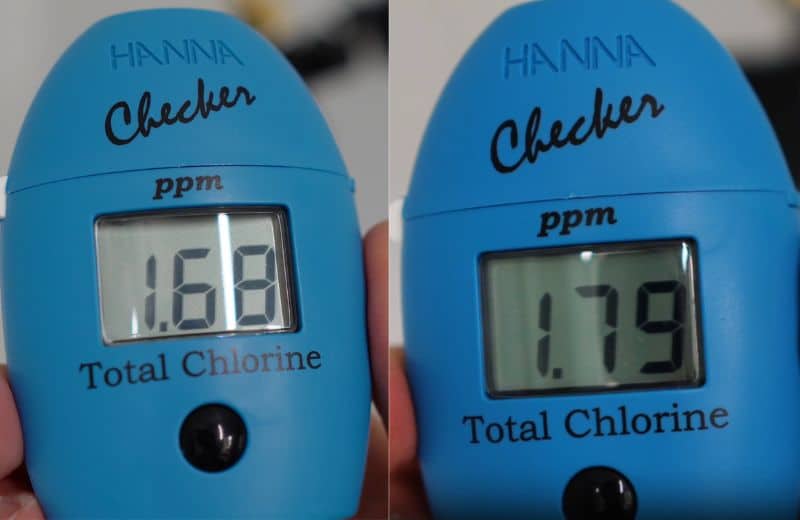
Again, we don’t think the filter added chlorine to our water—it was most likely an incidental increase between testing. But this does tell us that the filter was incapable of reducing chlorine even slightly in our testing.
This result is both disappointing and confusing, given that the filter has obviously been manufactured with chlorine reduction as its primary purpose. It’s possible that we received a faulty product, but we’d need to re-test with another filter to confirm.
See how eskiin compares with the Jolie showerhead here.
Hardness
Score: 6.00
Hardness refers to the concentration of scale-causing calcium and magnesium minerals in water. Hard water is a nuisance in showers, associated with poor soap lathering, dry hair, a “sticky” feel on skin, and scale buildup on showerheads, glass doors and walls.
We used our lab data from our Tap Score tests to evaluate the eskiin Shower Filter’s hardness reduction performance.
Our baseline water was very hard, with a total hardness of around 250 PPM.
Post-filtration, hardness actually increased by just under 4%, to 260 PPM. Most likely, this was simply an incidental fluctuation in hardness levels between our test times, and it just tells us that the filter doesn’t address hard water.
If you’re specifically looking to protect your skin and hair from hardness minerals but you don’t want to (or can’t) invest in a whole home water softening system, check out our guide to the best hard water shower filters (rental-friendly).
eskiin’s Contaminant Reduction Claims
Since eskiin makes so many incorrect (and frankly baffling) contaminant reduction claims, we believe they deserve a section of this review.
The manufacturer makes numerous statements about the effects of showering in hard water, claiming that the filter’s KDF-55 media can “reduce hard water”—not true. KDF-55 uses a redox process to provide filtration, not water softening. Some sources say that KDF can help address scale by altering the chemical structure of hardness minerals, but even if it did, the hardness minerals would still be in the water, causing the same skin and hair issues.
The filter also uses coconut activated carbon media, which is claimed to absorb “chlorine, oxygen, and fluorine”. Activated carbon can adsorb chlorine, and it can also adsorb dissolved oxygen, though chlorine reduction is its primary purpose in water treatment. AC can’t adsorb or remove fluorine (the pure form of fluoride), so this claim is incorrect.
Also, this may be nit picky, but they also used the wrong word. Activated carbon adsorbs (with a D), it does not absorb (with a B). There’s a difference, and this tells me whoever wrote this info doesn’t understand this important distinction as it relates to activated carbon water filtration.
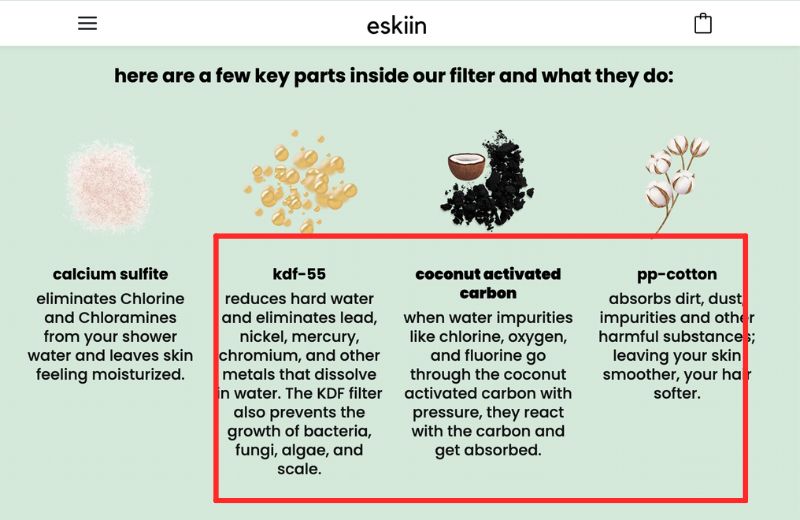
eskiin claims that the filter’s PP cotton media “absorbs dirt, dust, impurities and other harmful substances; leaving your skin smoother, your hair softer”. It’s true that PP cotton can trap suspended solids, but its main role is to protect downstream filter media, so this particular stage is unlikely to make much of a difference to skin and hair softness or smoothness.
We also found the following claims about two filter stages in the product FAQ:
- “Magnetic Energy Ball: Boosts the amount of good air ions and raises the level of dissolved oxygen in water.”
- “Ceramic Ball: Makes the water active and charged, kills bacteria, and lessens the bad effects of chlorine.”
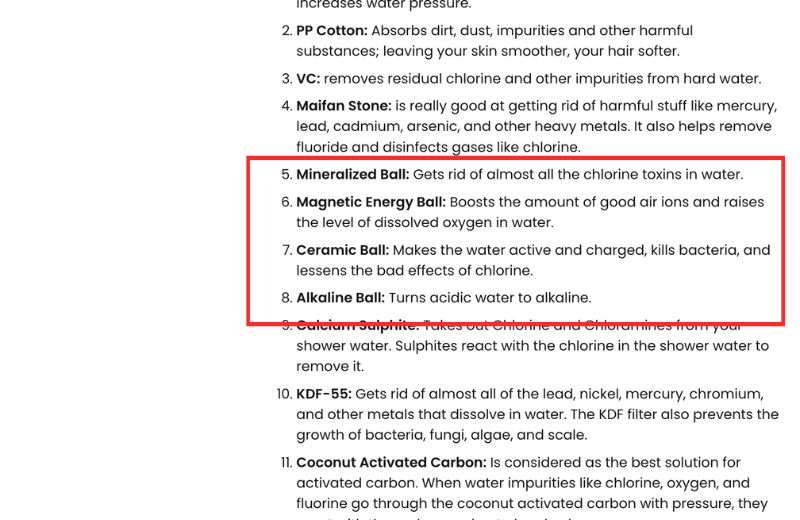
Actually, magnetic energy balls offer scale reduction and are unlikely to boost “good air ions” (whatever that actually means). Ceramic balls are generally used for alkalization and mineralization purposes, and the lingo around making the water “active and charged” is ambiguous and confusing.
In all, the eskin shower head has been marketed to sound a lot more impressive than it actually is. That’s why it’s so important to do your research before investing in any water filtration product, so you can identify when marketing claims seem “off”, rather than simply believing this information at face value.
Performance Certifications
Score: 6.00
Shower filter manufacturers can obtain an official performance certification by the NSF, WQA, or IAPMO to NSF Standard 177, for chlorine reduction.
The eskiin Shower Head isn’t currently certified, so it received the lowest score from us in this category.
Related: eskiin vs Filterbaby head to head comparison
🚦Filtration Rate
Score: 10.00Key Finding: We recorded an average flow rate of 1.74 GPM at 48 PSI feed pressure, retaining 100% of our 1.72 GPM baseline flow with no change in dynamic pressure.
Since shower filters contain dense filtration media, they introduce physical resistance that slows down water flow as it travels through the showerhead. This can slightly impact flow rate and water pressure, although not enough to have a significant effect on your showerhead usability.
We measured the “normal” flow rate from our existing, non-filtering showerhead, then repeated testing for the eskin Shower Filter.
To get an accurate flow reading, we held a graduated measuring cup beneath the shower, then recorded the time it took to fill to the 1-gallon mark. We repeated this test three times for each showerhead to take an average time in seconds, which we then converted into gallons per minute.
We measured our timings down to the millisecond, using a video-editing software to move through our video footage of the process frame-by-frame, starting when the cup was fully under the shower stream and ending when the water had reached the 1-gallon mark.
At a feed water pressure of 48 PSI and a temperature of 62°F*, we recorded an average flow rate of 1.74 GPM for the filter. This meant it retained 100% of our baseline flow (and then some!) of 1.72 GPM. There was no change in dynamic PSI, which we measured in our testing using a pressure gauge, so the flow retention result is a clean comparison.
While it might sound surprising that our water flow wasn’t reduced at all after installing the filter, we had a similar experience (90-100% of flow rate retained) with the majority of the shower filters we tested. The eskiin filtered showerhead has an internal “pressure boost” feature that is likely helping to maintain water flow here.
📐 Design
Score: 7.20Key Finding: The filter cartridge is nearly identical to the AquaBliss shower filter cartridge with an eskiin label, and neither the unit nor its materials carry any safety or lead-free certification.
The eskiin Shower Filter has an all-in-one design, meaning that the filter cartridge sits inside a dedicated showerhead rather than being installed inline, upstream of your existing shower head.
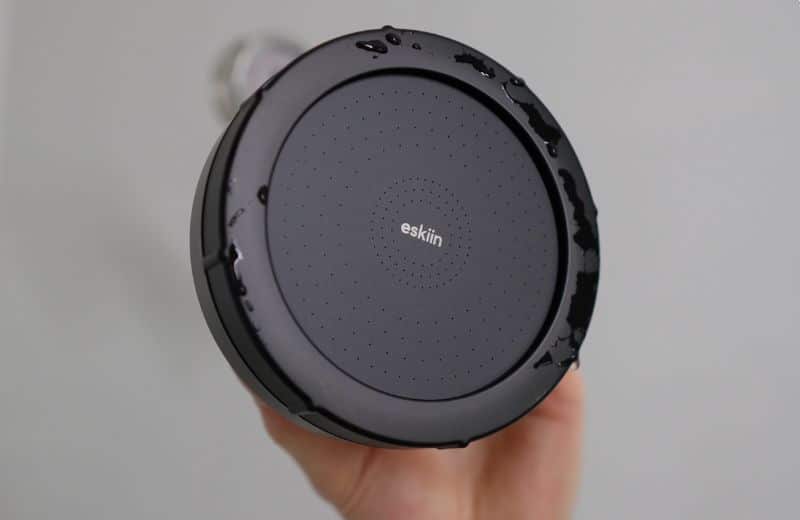
There are two showerhead options: a wall-mounted model (which we personally tested) and a handheld shower option. As far as we can tell, the filter itself is identical in both products; the only difference is that the wall-mounted model is designed to attach directly to a shower arm, while the handheld option replaces the handheld shower on the end of the flexible hose.
Visually, it’s an attractive, modern-looking showerhead, available in three finishes: chrome, black, and brushed nickel. Unlike many similar filters, it doesn’t have any adjustable stream settings.
The design score awarded to the filter was based on two factors: component quality and certifications for lead-free design and/or materials safety.
Component Quality
Score: 8.00
According to the manufacturer, the eskiin Shower Filter is made from metal and high-quality ABS plastic.
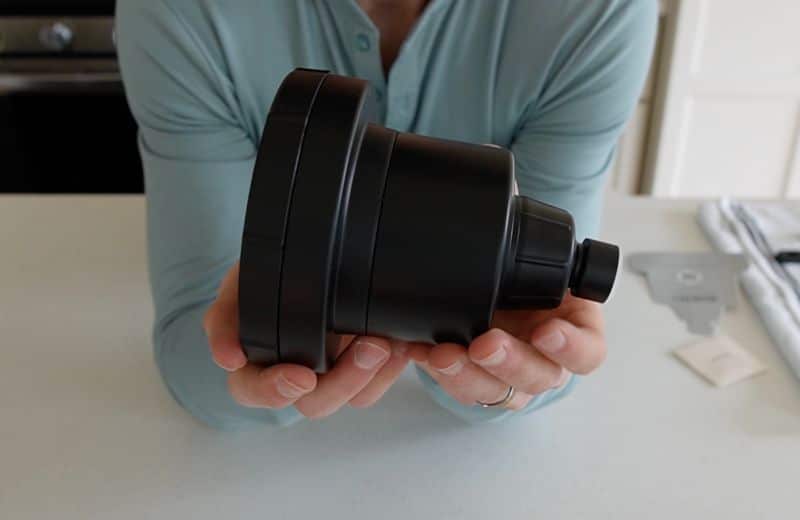
The packaging has a velvet cover on the styrofoam, which gives the impression that you’re unboxing a premium product. But the filter itself definitely doesn’t have a luxury feel, and we identified several issues with its design.
Our biggest concern was that the plastic used in the showerhead construction felt cheap and flimsy, something that’s unfortunately pretty standard for these types of filters. We also found what appeared to be a bug or seed in the cartridge, but it turned out to be a small piece of rubber.
Interestingly, the filter uses a very similar filter cartridge as the Aquabliss shower filter, just with the eskiin brand labelled on it.
Filter Materials
Several shower filter manufacturers have taken the approach of “the more filter stages we say our product has, the more impressive it sounds”, and eskiin is one of them. They claim there are “15 layers” of filter media inside the filter cartridge, including:
- A couple of pre-filter stages: high-density stainless steel mesh and PP cotton
- Vitamin C media, which should remove chlorine
- Maifan stones, which target chlorine and heavy metals
- Mineralized balls, magnetic energy balls, ceramic balls, alkaline balls, and calcium sulphite — all essentially do the same thing, so these have likely been listed separately purely to bulk up the number of claimed filter stages
- KDF-55 and coconut activated carbon: again, to address chlorine and heavy metals
- A repeat of the two pre-filtration stages, this time for post-filtration
- 2 “toxin ultra filter membranes” — it’s unclear what these actually are, but they definitely aren’t traditional UF membranes, since these have a setup that’s similar to reverse osmosis and require high pressure to force water through the membrane
We can deduce from our own testing that the number of claimed filter stages does not correlate to a filter’s contaminant reduction capability, since this product was incapable of reducing any of our problematic shower contaminants.
Materials Safety Certification
Score: 6.00
The eskiin Shower Filter doesn’t have any materials safety certifications.
So far, none of the 10+ shower filters we’ve tested have been certified for materials safety or lead-free design, so eskiin isn’t the exception here.
⚙️ Setup
Score: 9.00Key Finding: We hand-tightened the showerhead and had it running leak-free within minutes, though the initial flush water was noticeably discolored with black carbon specks from the filter media.
We got the filter installed and ready for use within minutes, following the paper instructions that came in the box. There’s also a “How to Install” video guide that’s useful if you’re more of a visual learner.
It’s the same basic process as installing any shower filter: You remove your old showerhead, wrap plumber’s tape (included in the box) around the shower arm, screw the new showerhead in its place, and adjust it until it’s tight enough.
The filter comes with an adjustable wrench, but we were able to hand-tighten it with no leaks. There were no spray or fit issues, and we identified just 2 potential leak points at the joints and connections.
We flushed the filter for 1 and a half minutes before we conducted any of our other testing. The initial water leaving the showerhead was significantly more discolored than the other filters we’ve tested, with noticeable black carbon specks in the washout from the filter media.
🔧 Maintenance
Score: 9.50Key Finding: At $0.025 per gallon and roughly $144 per year in replacement cartridges, the Eskiin is cheaper to maintain than 6 of the 12 shower filters in our cost comparison.
Based on our cost calculations and maintenance observations, the eskiin Shower Filter is both affordable and easy to service in the long term.
Servicing Requirements
9.00
The biggest recurring maintenance task for this eskiin model is replacing the filter cartridge. This is quick and easy, especially as you don’t have to remove the entire showerhead — you just remove the spray plate at the front to access the filter cartridge inside.
After replacing the filter, you screw the face back onto the showerhead, and eskiin recommends flushing the filter for 30-60 seconds.
The filter should be replaced every 90 days, or when you notice a drop in water flow or “a change in water feel” (we wouldn’t suggest relying on this second observation, since the working filter doesn’t address hardness and is therefore unlikely to affect water feel anyway).
Alongside filter changes, you’ll also need to clean the showerhead as part of your normal cleaning routine, to prevent scale and other buildup from clogging the shower jets.
Costs
Score: 10.00
While it’s on the expensive side in terms of upfront costs, the eskiin model is one of the more affordable shower filters we’ve tested when it comes to ongoing maintenance.
| Product | Cost per gallon |
|---|---|
| Hello Klean | $0.052 |
| Afina | $0.042 |
| FilterBaby | $0.034 |
| Aquatru Shower | $0.031 |
| Jolie | $0.026 |
| Canopy | $0.026 |
| Eskiin | $0.025 |
| HammerHead | $0.024 |
| Aquasana | $0.022 |
| Weddell Duo | $0.012 |
| AquaBliss | $0.012 |
| Sprite SL2 | $0.007 |
Assuming the filter is replaced every 3 months, you’ll spend around $144 per year on maintenance, equating to a cost-per-gallon of $0.025. The unit has an estimated 5-year ownership cost of $869.
🏢 Company
Score: 8.35Key Finding: eskiin offers no product warranty, only a 60-day return policy and a replacement filter for products reported damaged or defective within 7 days of delivery.
eskiin’s shipping and returns offerings are pretty good, but it’s let down in this category by its lack of a warranty.
Warranty
Score: 7.00
A good warranty is reassurance from the manufacturer that they stand by their product and will offer some form of compensation (either a refund or repair/replacement) if you discover defects due to manufacturing or workmanship.
eskiin is one of the few manufacturers we’ve come across that appears not to offer any warranty at all, with nothing listed besides the 60-day return period.
That said, the company will send a replacement filter if you contact them about a damaged or defective product within 7 days of delivery, which could be classified as a warranty of sorts.
Shipping
Score: 9.50
eskiin offers free shipping on all US orders, with an average shipping time of 3-5 working days after fulfillment.
Find out more about shipping here.
Returns
Score: 9.00
eskiin’s returns policy entitles you to a refund (minus shipping fees) if you return your filter within 60 days of your purchase.
According to the manufacturer, you can return your filter if “you’re not completely satisfied”, but it needs to be undamaged and returned in its original packaging. You’ll need your order number and shipping address to request a return in the returns portal.
A restocking fee may apply to some items, including subscription replacement filter cartridges.
Read eskiin’s returns T&Cs here.
💰 Value For Money
We wouldn’t recommend the eskiin Shower Filter to anyone. Since it didn’t actually reduce (let alone completely remove) any of the concerning shower water contaminants in our testing, the value for money is, in our opinion, nonexistent. It received the poorest weighted score of all the shower filters we’ve tested so far, meaning that it had the worst average performance across all our testing categories.
Yes, it was easy to install and affordable to maintain, and it didn’t significantly impact flow. But these benefits are fairly pointless when the filter didn’t serve its purpose in addressing any of the contaminants that folks want to remove from their shower water. eskiin makes a lot of claims about how the filter can improve skin and hair, even with “before and after” photos, but in our testing, it removed no chlorine whatsoever.
If you’re looking for a shower filter that can remove chlorine, we recommend the Weddell Duo. It’s the only shower filter we’ve tested so far that has reduced 100% chlorine and 100% DBPs, having the biggest effect on shower water quality and safety
Frequently Asked Questions about Eskiin
Q: Does the Eskiin shower filter actually remove chlorine?
A: Not in our testing. We measured 1.68 PPM of free chlorine in our baseline shower water and 1.79 PPM after filtration using a digital colorimeter. The small increase was most likely incidental fluctuation between tests, but the result shows the filter did not reduce chlorine at all. It is possible we received a faulty unit, but we would need to re-test a second filter to confirm.
Q: Is the Eskiin shower filter NSF certified?
A: No. The Eskiin Shower Head Filter has no NSF/ANSI 177 performance certification for chlorine reduction and no materials safety or lead-free certification. Its performance claims are unverified by any third-party certification body.
Q: Should I buy the wall-mounted or handheld Eskiin model?
A: The filter cartridge appears identical in both versions, so filtration performance should be the same. Choose based on your shower setup: the wall-mounted model attaches directly to a standard shower arm, while the handheld model replaces the shower handset on a flexible hose. We tested the wall-mounted version.
Q: Is the Eskiin the same as the AquaBliss shower filter?
A: The Eskiin uses a filter cartridge that is nearly identical to the AquaBliss cartridge, just labeled with the eskiin brand. The Eskiin costs $149 upfront while its per-gallon maintenance cost ($0.025) is roughly double the AquaBliss ($0.012) in our cost comparison.
Q: How often does the Eskiin filter need replacing, and what does it cost?
A: eskiin recommends replacing the cartridge every 90 days. Based on that schedule, expect around $144 per year in maintenance, a cost of $0.025 per gallon, and an estimated 5-year ownership cost of $869 including the $149 purchase price.
Q: What shower filter should I buy instead of the Eskiin?
A: Based on our testing, the Weddell Duo. It is the only shower filter we have tested that reduced 100% of chlorine and 100% of DBPs, and it costs less per gallon to maintain ($0.012 vs $0.025). Read our full Weddell Duo review.
Found this review helpful?
Comment below or share this article!
Which shower filters do you recommend for well water.
None, shower filters are intended for use with treated city water and really only reduce chlorine.
Found this after a very convincing television commercial for eskinn. So glad you exist and keep up the good work! Who knew the world of shower filters was so vast and that there was somebody out there who cared enough to educate the rest of us? Kudos on an unbiased job well done!
Thanks for the feedback!