

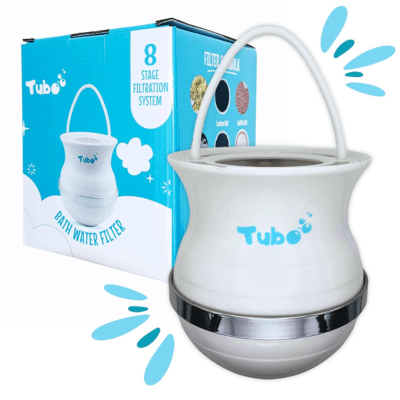
The Tubo 2.0 Bath Filter is designed to make bathwater safer and gentler for babies and young children. It uses an 8-stage filter that’s said to reduce skin dryness and irritation, and is an upgrade from the original Tubo, with an overflow-resistant design, a 30 ppi hydrophilic sponge for better water dispersion, enhanced filtration, and a stronger velcro clip for a more secure fit.
What We Like
What We Don’t Like
| Price | $64.99 |
| Contaminants Reduced | Chlorine |
| Certifications | Not Certified |
| Process | Calcium Sulfite + Activated Carbon + KDF |
| Filter Capacity | 2,500 gallons |
| Annual Cost | ~$70 |
| Warranty | 60 days, Lifetime for an extra $5 |
We tested the filter in a residential property in Colorado to see how, in a real use case, its performance matched up to the manufacturer’s claims. This involved conducting a contaminant reduction analysis with Tap Score test kits, as well as subjectively analyzing the filter’s flow rate, installation and maintenance requirements, design quality, and warranties and policies.
Table of Contents
📊 Scoring Data
We evaluated the Tubo Bath Filter under “normal use” test conditions to determine how it changed the quality of our bath water. Our Tubo analysis was part of a bigger project that involved testing five of the most popular bath filters, so we could compare their performance side-by-side and rank them using our data-driven scoring framework.
We rank all water filters across six key areas of performance, each divided into smaller scoring criteria. For every bath filter we test, we combine these results and calculate a weighted average. See the next table for the scores awarded to the Tubo Bath Filter.
| Criteria | Results |
|---|---|
| Overall Score | 7.91 |
| Health Related Contaminants | 7.70 |
| Aesthetic Related Contaminants | 6.00 |
| Performance Certification | Not Certified |
| Filtration Rate | 0.97 GPM |
| Component Quality | Weak |
| Component Certification | Unsatisfactory |
| Setup | Outstanding |
| Servicing Requirements | Outstanding |
| Costs | $0.014/gallon |
| Warranty Length | 60 days, Lifetime for an extra $5 |
| Shipping | $85 for free shipping |
| Returns | 60 days |
🚰 Contaminant Reduction
Score: 7.45The primary goal of using a bath filter is to reduce contaminants that can affect the skin and hair, as well as those that may be harmful when they’re inhaled in water vapor. We conducted contaminant reduction tests to see whether the Tubo bath filter could noticeably improve bath water quality using our own testing standards.
We based our scores in this category on our Tap Score lab results from our filtered bath water. Scoring was also influenced by whether or not the filter had official performance certifications from the NSF/ANSI, IAPMO, or the WQA for specific contaminant reduction.
Our Performance Testing
Score: 7.62

To assess how well the Tubo Bath Filter performed, we used SimpleLab’s Tap Score service to test our bath water before and after filtration. We collected two samples:
- One unfiltered baseline sample
- One sample of water filtered through the Tubo filter
We sent both samples to the lab for professional analysis, and received detailed interactive reports showing the difference in contaminant levels between the two.
Tap Score results can be compared against various quality standards, including the EPA’s Maximum Contaminant Levels (MCLs) and the more protective Health Guideline Levels (HGLs). For consistency, we compared all our test data to the HGLs.
Here are a couple of key details you should know about our testing setup:
- We focused on contaminants most relevant to bath water: chlorine, hardness minerals, and disinfection byproducts. These are known to affect skin, hair, and indoor air quality. We also discussed several other contaminants detected in the samples for reference, though they weren’t our main focus.
- We conducted all our testing using cold water. We know that most people will use the Tubo filter exclusively with hot water, but higher water temperatures cause disinfection byproducts to dissipate more quickly. Testing with cold water allowed us to get a more accurate understanding of whether or not Tubo could actually remove these contaminants, rather than losing them through natural dissipation.
Health-Related Contaminants
Score: 7.70
The Tubo Bath Filter received the same score for removing health-related contaminants as most other bath filters we tested. Its performance in this category was good, but definitely not exceptional.
Our baseline water sample contained the following health-related contaminants:
- Around 2 PPM of chlorine (a common disinfectant)
- 24.7 PPB of chloroform (a disinfection byproduct)
Chloroform concentrations exceeded the protective Health Guideline Level of 0.221 PPB by 11,075%, while chlorine was within the “safe” range (up to 4 PPM) established by the EPA.
We tested chlorine reduction by running two separate analyses at different faucet flow rates and comparing the results. We used test strips rather than sending our samples to the lab, as chlorine is highly volatile and can dissipate during sample collection and shipping.
Our first chlorine test was taken after filtering water at the highest faucet flow rate possible without overflowing the filter (we found that some overflow is still possible, even with the updated design). At this faster rate, chlorine reduction was limited for most filters we tested, including Tubo. To assess whether flow rate affected performance, we then ran a second test at a slower faucet flow.
Here’s how the filter performed:
- In our “fast flow” test (with an average flow rate of 3.61 GPM), Tubo failed to remove chlorine at all.
- In our “slow flow” test (with an average flow rate of 0.87 GPM), it eliminated 100% chlorine.
The fact that Tubo removed absolutely no chlorine at a faster faucet flow is disappointing, especially since Tubo has intentionally improved the design of the 2.0 filter to allow it to be used with a faucet at full flow with no overflowing. The manufacturer even says that you can “use at any tap at your preferred flow”, with no small print explaining that faster flow significantly impacts chlorine reduction.
Based on our flow rate testing, we calculate that using the filter at the slower faucet flow will take around 34 minutes to fill a 30-gallon bath. Most folks will find this an impractical compromise to guarantee chlorine removal.
How do these results compare to Tubo’s performance claims? The filter is said to eliminate “up to 99% of harsh contaminants”, including chlorine and heavy metals.
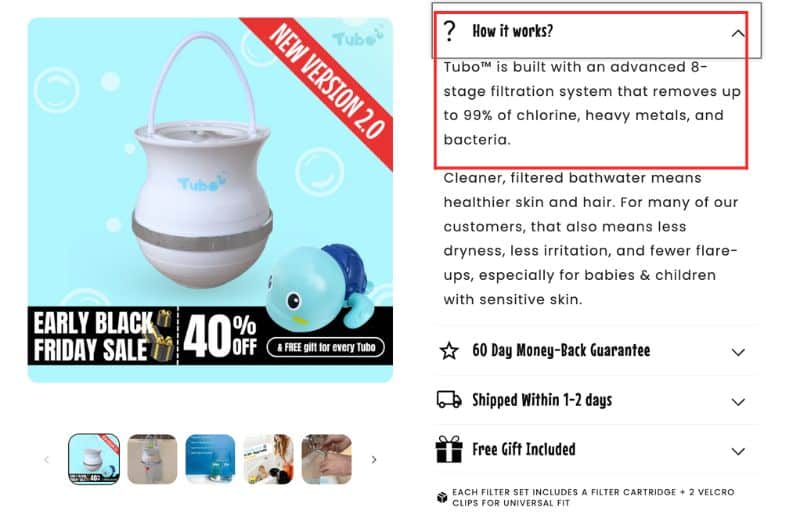
Disinfection byproducts aren’t listed, but Tubo does claim to remove bacteria and viruses. We didn’t test for these since they’re very rarely found in chlorinated tap water, but we think this claim is highly unlikely to be true. Bacteria and viruses can generally only be removed by purification methods like reverse osmosis and distillation, or disinfection methods like chemical (chlorine) and UV.
Tubo is misleadingly marketed to “purify” bath water, which suggests it removes all impurities—not true, as proven by our own test results.
Hardness
Our baseline water sample’s total hardness concentration was 17.13 PPM, making it only slightly hard according to the NSF/ANSI 44 and NSF/ANSI 330 definition of soft water (containing <17.1 PPM of hardness).

After filtering through the Tubo Bath Filter, our water’s total hardness had increased by 8%, to 18.53 PPM. Magnesium increased by 3% (from 0.53 to 0.55 PPM) and calcium increased by 10% from 5.9 to 6.5 PPM). Carbonate decreased by 17% (from 0.012 to 0.0099 PPM), and bicarbonate concentrations stayed almost exactly the same.
The pH of our water reduced slightly from 7.2 to 7.1, and TDS increased by 10%.
This tells us that Tubo neither softens water (which we didn’t expect, since this is something that only a dedicated water softener can achieve) nor significantly increases minerals that contribute to water hardness.
Other Detections
The most notable outcome of our testing was a 405% increase in copper post-filtration, from 0.0017 to 0.0086. This result points towards the use of a copper-zinc KDF media, which is introducing copper into the filtered water. Concentrations were still within the HGL of 0.3 PPM.
We also saw a 12% increase in barium and 5% increase in strontium. Fluoride and phosphorus concentrations remained the same, and aluminum was completely eliminated, from 0.05 down to 0 PPM.
This data is telling, since Tubo claims to purify water and remove heavy metals, which wasn’t the case in our own testing.
Performance Certifications
Score: 6.00
The NSF/ANSI, the WQA, and IAPMO all provide testing and certifications to NSF Standards for water filters that want to prove select contaminant reduction claims. We could find no dedicated performance certifications for bath filters; only for shower filters that “attach directly to the pipe just in front of the homeowner’s showerhead”.
Tubo says its bath filter is “clinically tested”, but we could not find proof of official performance certifications. In fact, we were unable to find even third-party test data on the manufacturer’s website.
🚦Filtration Rate
Score: 8.50Bath filters hang directly beneath the faucet, meaning their flow rate (the speed and volume of water leaving the filter) directly affects how long it takes to fill a tub. Flow rate was an essential metric in our performance testing, since a poor flow will result in impractical fill times.
For consistency, we measured the flow rate of all the bath water filters we tested using our “slow” faucet flow, since this generally produced stronger chlorine reduction results. This particularly applies to Tubo, since the filter was essentially useless in our faster flow testing, reducing no chlorine whatsoever.
To calculate flow rate, we timed how long it took Tubo to fill two cups of water, then repeated the process three times to find an average. We converted that figure into gallons per minute (GPM) to represent overall filtration speed.
Tubo recorded a flow rate of 0.89 GPM, earning it a score of 8.50, just like the other bath filters we tested.
📐 Design
Score: 6.60The Tubo Bath Filter has a familiar design for a bath filter, with a cylindrical plastic housing that stores the filter cartridge and a strap to secure it onto a faucet. The opening of the housing sits underneath the faucet spout, so when you turn the water on, the flow is diverted through the filter before it exits into the bathtub.
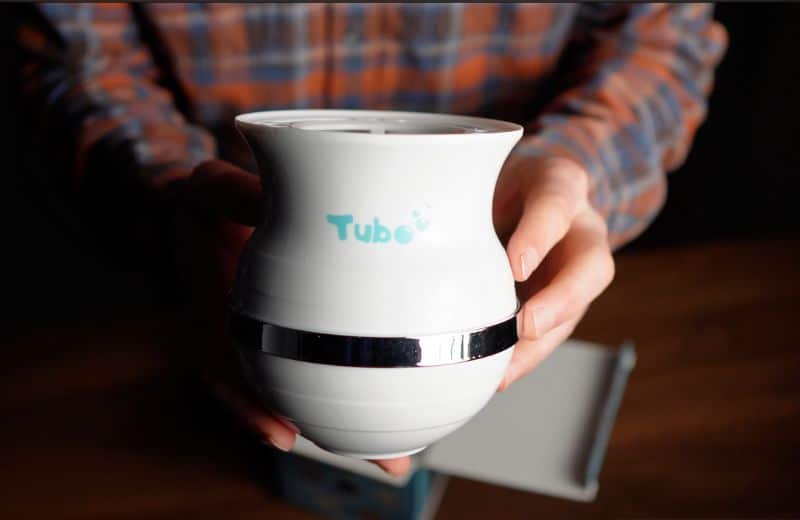
The filter presented several build quality and longevity concerns, which resulted in a lower score in the design category.
Component Quality
Score: 7.00
Tubo has a flimsy all-plastic construction. It’s made from ABS plastic, which is BPA- and BPS-free and is ranked as one of the safest materials in the EWG’s Skin Deep® scoring system.
However, there’s still the potential for microplastics leaching, and plastic doesn’t hold up as well as other filter materials. Since the main housing unit is intended for years of use (you’re only swapping out the internal filtration cartridge), we do have concerns about how long it’d actually last before breaking.
Filter Materials
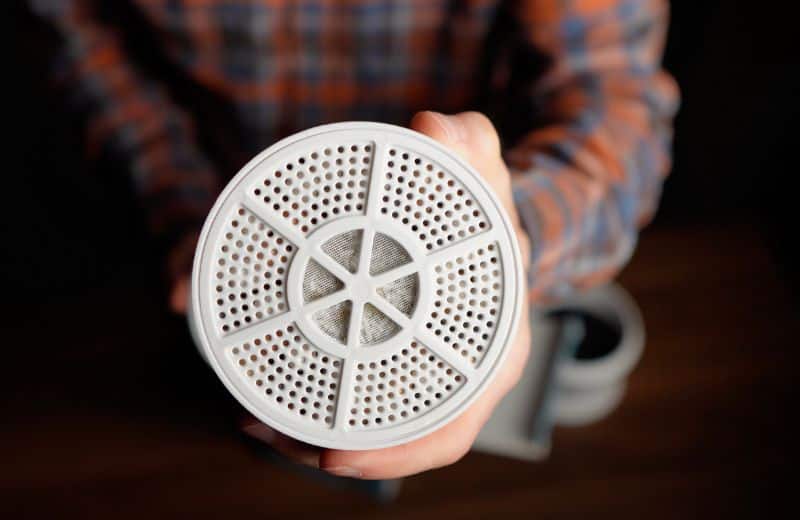
It’s common for manufacturers in the bath and shower filter space to make their filters look as impressive as possible with extensive lists of filter media, and Tubo is no different.
You might be drawn into Tubo’s marketing, which positions the filter as better than others because it uses 8 stages of filtration, not 2. But in our research, we discovered that 5 of these 8 stages are mineral balls (the other 3 are carbon, zeolite, and KDF), which other manufacturers usually class as a single stage of filtration—so Tubo is less impressive than it’s made out to be.
Materials Safety Certification
Score: 6.00
Another scoring factor in the design category is the presence (or lack of) certifications for materials safety or lead-free design. Tubo isn’t design certified, which, while not a legal requirement, did pull down its score in this category.
⚙️ Setup
Score: 9.50Setup is quick and easy for the Tubo Bath Filter, following three simple steps:
- Clean and dry the surface of your bath faucet
- Apply the velcro clip, then give the adhesive 24 hours to cure
- Hook the filter onto the faucet and secure it in place with the velcro clip
The only setback is having to wait 24 hours for the adhesive to cure before you can use the filter, but aside from that, setup is tool-free and doesn’t require any DIY experience.
🔧 Maintenance
Score: 9.75Tubo also has straightforward, affordable maintenance requirements, resulting in a high score of 9.75 in this category.
Servicing Requirements
9.50
The Tubo Bath Filter is low-maintenance and simply requires filter changes after every 2,500 gallons of water filtered. You can unscrew the bottom of the housing, remove the old cartridge, and insert the new one without having to remove the unit from your faucet. The plastic housing is easy to wipe down, which you’ll need to do every so often to prevent the buildup of mold and algae.
Tubo recommends replacing the filter every 6-8 months, or if you notice a decrease in water flow, for optimal performance.
Costs
Score: 10.00
Tubo is one of the more expensive bath filters, with an upfront cost of around $65. But replacement filters are around $35, which, assuming you replace the filter twice a year, is pretty good value for money.
| Bath Filter | Price | Cost per gallon |
|---|---|---|
| Santevia | $19.99 | $0.008 |
| Canopy | $89.00 | $0.014 |
| Sprite | $29.99 | $0.022 |
| Crystal Quest | $64.95 | $0.016 |
| Tubo | $64.99 | $0.014 |
🏢 Company
Score: 7.60As a company, Tubo received the worst scores of all the bath water filters we tested, mainly due to the limitations of its warranty.
Warranty
Score: 7.00
Tubo offers a lifetime guarantee for its bath filter, but there’s a catch: it’s sold as an upsell (currently for $4.49). That means the filter itself doesn’t come with this guarantee, and you’ll only benefit from its protection if you’re willing to pay for it (sneaky, we know).
We emailed Tubo to ask exactly what the lifetime guarantee covers, and how long it lasts, since we couldn’t find this info on the website. They replied simply saying that they will stand by the product “for the long term” as long as we follow the product instructions and replace the filter as recommended:
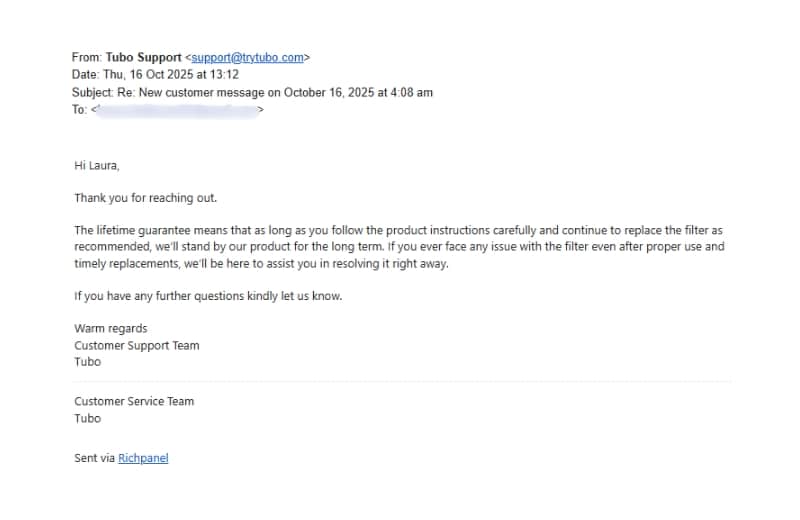
Without this warranty, you’ll only have the backing of the 60-day money-back guarantee—something that many other bath filter brands offer alongside a warranty of up to 1 year.
You can see Tubo’s lifetime guarantee here.
Shipping
Score: 9.00
All Tubo customers receive free shipping on orders over $85, and Tubo has warehouses around the world, meaning global shipping is offered. That means you’ll probably end up paying shipping fees unless you buy multiple filters at once. Fees for shipping are variable depending on where you’re located and the method you choose.
Tubo’s shipping policy can be viewed here.
Returns
Score: 7.00
Tubo’s returns policy is 60 days. There are a few terms that you’ll need to meet in order to receive a refund:
- The product should be in the condition you bought it in, with tags, in its original packaging
- You need to prove that the filter doesn’t work or failed “to fulfil its function”
- You’ll need to have the receipt as proof of purchase
If you meet these criteria, note that you’ll be expected to cover returns shipping costs.
Read the full refund policy terms and conditions here.
💰 Value For Money
Based on our own experience with the Tubo Bath Filter, we don’t think it offers good value for money.
The main issue for us is the filter’s complete inability to remove chlorine at a faster faucet flow rate. We just don’t think it’s practical to fill the tub slowly just to benefit from any chlorine reduction whatsoever.
Tubo is also more expensive than some of the other bath filters we tested, and since it doesn’t offer anything extra performance-wise, we don’t think it’s worth the extra cost.
If you just want a reliable bath filter that removes chlorine, we recommend the Santevia Bath Filter instead. This one was the only filter in our testing that removed 100% chlorine with slow and fast faucet flows, and it’s around a third of the price of Tubo.
That said, you might still choose the Tubo Filter if you’re attracted to its design and you’re happy to use a slower faucet flow.
Found this review helpful?
Comment below or share this article!