

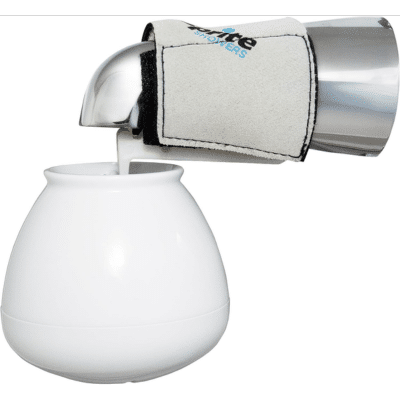
The Sprite Bath Filter is one of the OG bath filters designed by Sprite, a company that started manufacturing shower filters way back in 1987. We wanted to find out whether Sprite’s long-standing reputation and experience as a manufacturer would tie into the quality of its Bath Pure Filter, so we assessed the unit in our home to see how it performed across a range of testing categories.
What We Like
What We Don’t Like
| Price | $29.95+ |
| Contaminants Removed | Chlorine |
| Certifications | Not Certified |
| Process | Calcium Sulfite + KDF |
| Filtration Capacity | ~900 gallons |
| Annual Cost | ~$240 |
| Warranty | 1 year |
The filter uses a proprietary media made from a blend of copper, zinc, and calcium sulfite and is said to neutralize “free chlorine, dirt, and odors”. We sent samples of our filtered water to Tap Score for lab testing and conducted our own assessments for chlorine reduction, filtration speed, design quality, ease of installation, ongoing maintenance, and Sprite’s company policies.
Table of Contents
📊 Scoring Data
We use our own in-house testing to score every water filter we review. Each product we test is assessed and ranked by our team across six scoring factors, which are then combined into a weighted average to determine the overall score. In our bath filters testing project, we tested the Sprite Bath Pure Filter alongside four other water filters, comparing them across all performance categories.
You can see how Sprite performed in the table below.
| Criteria | Results |
|---|---|
| Overall Score | 8.00 |
| Health Related Contaminants | 7.70 |
| Aesthetic Related Contaminants | 8.00 |
| Performance Certification | Not Certified |
| Filtration Rate | 1.01 GPM |
| Component Quality | Weak |
| Component Certification | Unsatisfactory |
| Setup | Outstanding |
| Servicing Requirements | Outstanding |
| Costs | $0.022/ gallon |
| Warranty Length | 1 year |
| Shipping | Variable Shipping Costs |
| Returns | 45 days, in original unused condition |
🚰 Contaminant Reduction
Score: 7.54We test bath filters for contaminant reduction to see how effectively they can improve our water quality and protect the skin from potentially irritating impurities.
For both bath and shower filters, the main contaminants we focused on were chlorine, disinfection byproducts (DBPs), and hardness minerals. Chlorine and hardness can cause skin dryness and irritation, while long-term exposure to disinfection byproducts has been linked to reproductive effects and cancer.
The overall score we awarded in this category reflects both our lab testing data and whether the Sprite filter holds any NSF, WQA, or IAPMO performance certifications for contaminant reduction.
Our Performance Testing
Score: 7.72
For our performance testing, we sent samples of unfiltered and filtered bathwater to Tap Score for professional lab analysis. Lab testing gives us much more reliable, comprehensive, and accurate testing data than we could achieve with a DIY at-home test kit, and Tap Score’s interactive test reports are the best we’ve come across for clearly explaining detections and their potential health concerns.

The exception here was chlorine, which we tested for ourselves using test strips included in our Tap Score sample kit. This disinfection chemical is highly volatile, so we wanted to make sure our detections were accurate and not affected by dissipation.
We conducted both tests using cold water, as heat can cause disinfection byproducts to evaporate and potentially skew the results.
Health-Related Contaminants
Score: 7.70
The Sprite Pure Bath Filter failed to impress us with its health-related contaminant reduction data.
Our baseline water sample contained:
- 24.7 PPB of chloroform (a disinfection byproduct), exceeding the HGL* 0.221 PPB by 11,075%.
- Around 2 PPM of chlorine (well within the EPA’s “safe” range for chlorine in drinking water).
In our first chlorine test, the majority of bath filters we tested were unable to effectively reduce this contaminant at all. This led us to conduct a second test (only for chlorine) at a slower faucet flow, since we know that slower flow = longer media contact time = more thorough contaminant reduction.
Here’s how Sprite performed across both tests:
- In our “fast flow” test (with an average flow rate of 2.53 GPM), the filter reduced chlorine by 50%, down to 1 PPM.
- In our “slow flow” test (with an average flow rate of 1.01 GPM), the filter eliminated chlorine to undetectable levels.
Our results show that Sprite can only effectively eliminate chlorine when the water has an impractically long contact time with the filter media. At this slower flow, we calculated that it’d take just under 30 minutes to fill an average 30-gallon bathtub.
As for our lab tests, we saw only a slight incidental decrease in chloroform (less than 1%) post-filtration. It’s possible that the filter might have done a better job at reducing DBPs at the slower faucet speed too, but this isn’t something that we’ve yet had the chance to clarify with additional lab testing.

Hardness
Our baseline water sample had a total hardness concentration of 17.13 PPM, classifying it as slightly hard based on American National Standards NSF/ANSI 44 and NSF/ANSI 330 (soft water contains less than 17.1 PPM of hardness).
In our testing:
- Total hardness reduced only slightly post-filtration (by around 3%)
- Calcium also decreased by 5%
- Magnesium concentrations remained the same
Calcium sulfite is one of the media used in the Chlorgon media, but our results show that no detectable calcium leaching occurred in our testing.
TDS was reduced by just 2%, and the pH of our water increased only slightly, from 7.2 to 7.3. These outcomes are all likely due to incidental fluctuations between taking our two samples rather than being influenced by the filter itself.
Other Detections
Aluminum, fluoride, strontium, phosphorus, barium, and copper were also detected in our baseline sample.
Lower concentrations of these contaminants in tap water aren’t known to be harmful to health through dermal exposure or inhalation in water vapor. But their detections in our testing were helpful in painting a bigger picture of Sprite’s overall contaminant reduction abilities.
The Sprite bathtub filter removed 100% aluminum from our water, and copper concentrations also decreased by 11% (from 0.0017 PPM to 0.0015 PPM). Fluoride, phosphorus, and strontium concentrations remained the same, while barium increased post-filtration by 6% (from 0.0066 PPM to 0.007 PPM).
Since we saw similar results with our other filtered water tests, we believe they’re due to incidental differences in our water quality between testing, which simply tells us that the filter can’t remove any of these impurities.
Performance Certifications
Score: 6.00
If a water filter manufacturer wants to prove their product’s performance beyond their own claims, they can apply to get their filter tested and certified to NSF/ANSI Standards by the NSF, WQA, or IAPMO.
Certifications offer reassuring proof that a water filter performs as intended, and testing can sometimes confirm performance abilities that we’re unable to test ourselves (such as removing contaminants that aren’t present in our own water).
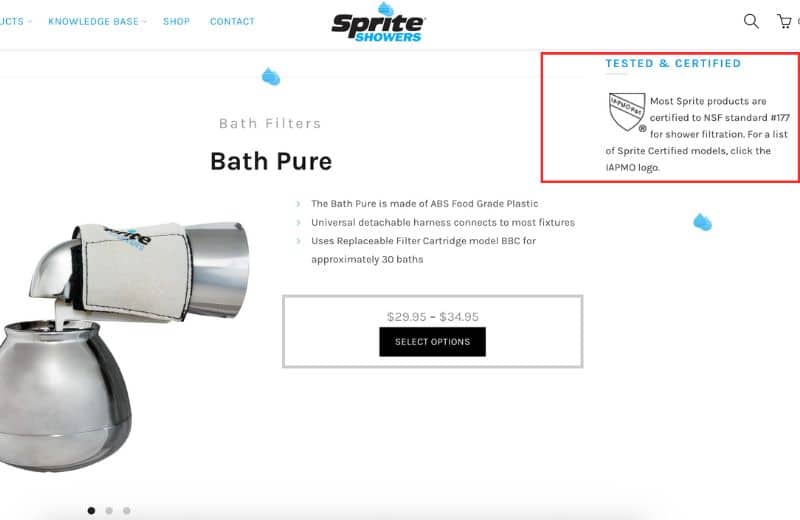
The Sprite Bath Pure Filter has been tested to NSF/ANSI 177 (for shower filters that remove free chlorine), but it doesn’t hold any official certifications. However, it does use the same NSF.ANSI 177 certified Chlorgon & KDF filter as Sprite’s Shower Filters, making it the closest to being certified of all the bath filters we tested.
🚦Filtration Rate
Score: 8.50We scored all our bath filters in the “filtration rate” category based on our gallons-per-minute calculations for the slower faucet flow. Since the Sprite bath ball struggled to remove chlorine at the faster flow, we’re assuming that we’d use the filter at a slower faucet speed to allow for 100% reduction.
The filter’s flow rate measured at 1.01 GPM, resulting in a score of 8.50. Based on this flow rate, it has an estimated fill time of just under 30 minutes for an average 30-gallon tub, making it the fastest of all the filters (for the slower flow only) that we tested.
📐 Design
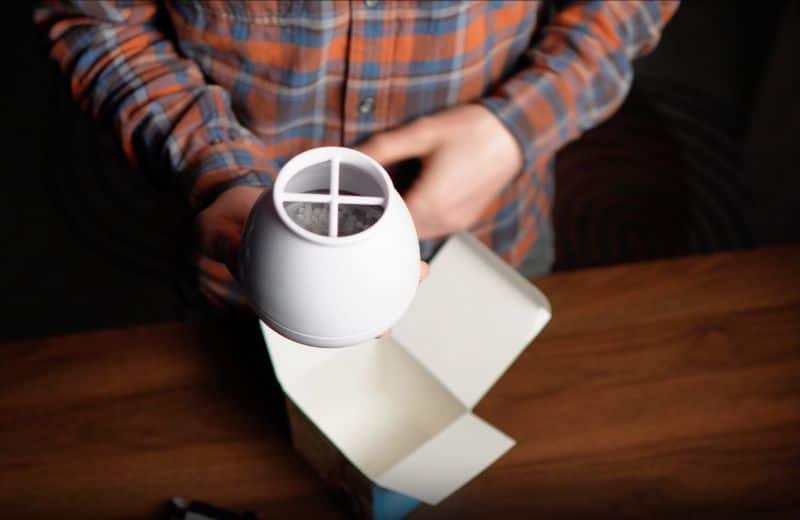
Score: 6.60The Sprite bath ball filter has a traditional, no-nonsense design, with a cylindrical unit that hangs underneath a bath faucet, catching and filtering water from the spout. The filtered water then exits the housing through holes at the bottom.
We awarded Sprite’s design score based on the quality of its components and whether or not it holds any design-related certifications. We’ve also commented on the media design, although this isn’t a ranking factor in this category.
Component Quality
Score: 7.00
The Sprite bath filter has a majority-plastic build, which does feel pretty well-made but still raises concerns about long-term durability (especially the plastic hook, which is quite thin).
As with any filter constructed with plastic, there’s also the potential for microplastics and bisphenols leaching from the unit into the bathwater. ABS (acrylonitrile butadiene styrene) is known to be safe and food-grade, and leaching is only likely to occur as the plastic degrades, but you may still prefer to avoid plastic in general in your water filters for peace of mind.
One particular design issue we noticed was that the filter would overflow even at a moderate faucet flow. Because of this, its faster flow rate was slower than most other filters we tested, as we had to reduce our faucet flow to prevent water from spilling out of the top of the filter. This is just something else to keep in mind if you want a filter that’ll still let you fill your tub efficiently.
Filter Materials
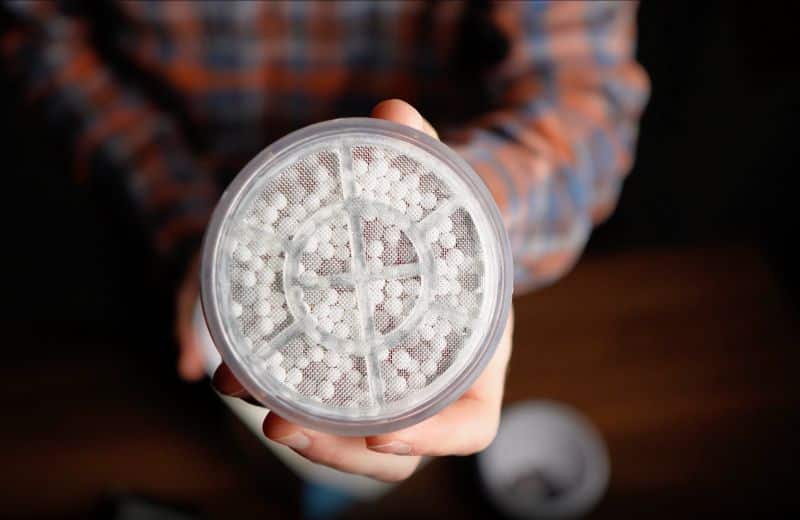
There are three key filter materials used in the Sprite Bath Pure Filter:
- Copper
- Zinc
- Calcium sulfite
Sprite has actually patented this media (it’s called Chlorgon), but unless there are undisclosed materials, it doesn’t seem that different from the other bath filters we’ve tested. Copper and zinc are commonly used in KDF media, which is known for reducing chlorine and heavy metals, and calcium sulfite is often found in chlorine-removal bath and shower filters.
Materials Safety Certification
Score: 6.00
Like all the other bath filters we tested, Sprite doesn’t have any materials safety certifications, so it received the lower score in this category.
These certifications aren’t mandatory, but proof of materials safety is reassuring, especially for filters with a plastic construction.
⚙️ Setup
Score: 9.50The Sprite bath filter is easy to install in just a couple of steps, with no tools required. You don’t need any DIY knowledge to get it hooked onto your faucet (it attaches with a velcro strap) and ready to use.
Given the filter’s universal design, it should also fit nicely onto most bath faucets, excluding those that are curved or at an angle that would cause the filter to slip off.
🔧 Maintenance
Score: 9.75We awarded Sprite’s maintenance score based on its ease and affordability of servicing (primarily replacing the filters).
| Bath Filter | Price | Cost per gallon |
|---|---|---|
| Santevia | $19.99 | $0.008 |
| Canopy | $89.00 | $0.014 |
| Sprite | $29.99 | $0.022 |
| Crystal Quest | $64.95 | $0.016 |
| Tubo | $64.99 | $0.014 |
Servicing Requirements
9.50
Sprite’s bath filters contain a removable cartridge, so replacing the filter just involves taking out the old one and slotting a new one in its place. That’s the extent of the manual effort required, and you don’t have to prime or flush the filter before use.
Aside from swapping out the filter, the unit will need to be wiped down every so often to prevent the buildup of mildew and mold, which is easy to do given its hard plastic design.
Costs
Score: 10.00
Not only is the Sprite bath filter one of the most affordable bath filters upfront, but it also has one of the lowest maintenance costs of all the products we tested.
Replacement filters cost just under $20, and Sprite estimates each filter lasts for approximately 25 to 30 baths. That might mean replacing the filter once a month, once every couple of months, or once every 3-4 months, depending on your frequency of use.
🏢 Company
Score: 8.35Sprite earned one of the highest company scores in our bath filter testing, although we still think its shipping offerings and returns policy could be better.
Warranty
Score: 8.50
Sprite warrants all its plastic filter housings (excluding filter cartridges) for 1 year against manufacturing defects.
You’ll only be eligible if you complete the product warranty information and submit it to Sprite within 15 days of your purchase. You’ll also need proof of purchase for the main unit and any replacement filters to prove that you performed maintenance as outlined in the user manual.
You can see the full terms for Sprite’s 1-year warranty here.
Shipping
Score: 8.00
Sprite’s shipping fees are variable depending on where you buy your filter from. Filters aren’t sold directly through the Sprite website; instead, they’re sold by stores including The Home Depot and Lowe’s. That means the price you’ll pay for shipping depends on the website you buy the filter from.
Returns
Score: 8.50
Sprite also offers a returns policy that allows you to send your filter back for a full refund within 45 days of your order. But, the filter has to be “in new condition” (suggesting unused), with no missing parts, and you’ll need to cover shipping costs if you’re returning the filter because you’re generally dissatisfied.
Read the full returns policy terms and conditions here.
💰 Value For Money
Based on our experience testing and using the Sprite Bath Pure Filter, we wouldn’t recommend it to most folks.
The main reason is that the filter didn’t remove 100% chlorine at a normal faucet flow rate. In our eyes, a bath filter only serves its purpose if it can eliminate chlorine while still allowing us to fill the tub efficiently. This is something that Sprite doesn’t offer. It also didn’t remove DBPs at all.
That said, Sprite is a trusted, reputable name, and the Bath Pure Filter is closest to being certified out of all the bath filters we tested. So, if you value reputation and legitimacy, you might decide that using this filter with a slower faucet flow is worth it for you.
Alternatively, we recommend the Santevia Bath Filter, which is at the same affordable price point as Sprite, as well as being the only bath filter in our testing to remove 100% chlorine at the faster faucet flow.
And if you want to soften your bath water, the only real effective way to do this is with a whole-home water softener.
Found this review helpful?
Comment below or share this article!