


We installed and tested the Kind Water Softener S-650 in our own home, and collected real world usage data and a certified lab analysis of its performance.
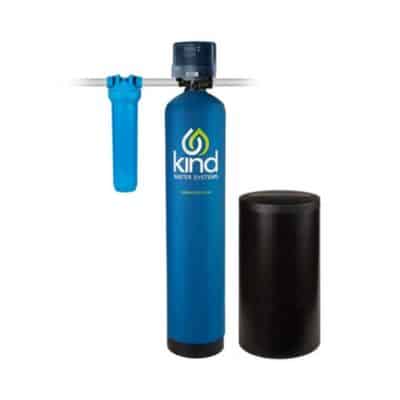
The Kind S-650 is a salt-based water softener that’s said to “eliminate hardness minerals” and “deliver truly soft water” throughout your home’s fixtures and plumbing.
We put those claims to the test.
Buy It If
Skip It If
| Price | $2,123.52 |
| Contaminants Reduced | Hardness minerals |
| Certifications | NSF/ANSI 61 (control valve only) |
| Process | Cation exchange (salt-based) |
| Grain Capacity | 27,000 |
| Annual Cost | ~$164.19/year |
| Warranty | 7 years (control valve); 10 years (tanks) |
Quick Verdict: Is the Kind S-650 Worth It?
The Kind S-650 delivered one of the strongest performances of all the water softeners we tested. Even after we pushed 900 gallons of water through the system (around half its rated capacity), it still removed virtually 100% of hardness, with no measurable hardness slipping through, even at higher flow rates.
The trade-off, though, is that it uses more water during regeneration than many similar systems, and it’s lacking a whole-unit NSF 44 certification (for safe, reliable softening systems that perform as advertised). But if consistent soft water is your priority, it’s a great option to consider.
Buy It If:
- You’re looking to treat very hard city water or well water.
- You want consistently soft water, even as the system approaches regeneration.
- You don’t want issues with pressure drop.
- You value smart features, like Bluetooth monitoring and demand-based regeneration.
Skip It If:
- You want to keep your water usage as low as possible (this system uses more water when it regenerates than many similar models).
- You’re only looking to buy a certified water softener.
Methodology
Every water softener we review undergoes hands-on testing using the same methodology. We measure softening performance, efficiency, flow rate, noise, ease of installation, and more using repeatable tests, then combine these results into our final score.
📊 Scoring Data
How did the Kind S-650 Score in Our Testing?
| Criteria | Results |
|---|---|
| Overall Score | 8.69 |
| On-site stress reduction (worst case) | 100% reduction |
| On-site immediate post-regen reduction | 100% reduction |
| Lab-confirmed reduction | 100% reduction |
| Salt efficiency (gr/lb) | 2,813 |
| Water efficiency (gal per 1,000 gr) | 4.63 |
| Certification | Not fully certified |
| Pressure drop at service flow (psi) | 5.0 |
| Peak flow vs rated | 66.80% |
| Warranty Length | 7 years valve, 10 years tank |
| Shipping | Free shipping |
| Returns | 120 days; customer pays return shipping |
| Parts standardization | Fully proprietary valve, parts only from the manufacturer |
| Smart and metering features | Demand-metered plus app, alerts, outage memory, variable reserve, and diagnostics |
| Component and tank quality | Quality fiberglass mineral tank |
| Setup | DIY-friendly |
| Noise | 67.9 dB |
⚖️ What We Measured and What We Didn’t
Our scores are based on hands-on testing using the same methodology across every water softener we review.
When we tested the Kind S-650, we measured its real-world performance, including its hardness reduction, salt and water efficiency, pressure loss, and noise. We also checked certification databases to verify manufacturer claims where possible.
We reported on things like design features (including resin type and regeneration method) for context, but these don’t receive scores as they aren’t guaranteed to affect measurable performance.
See how the Kind water softener compares to the best water softener systems we’ve tested.
💧 Softening Performance (50%)
Key Finding: The Kind S-650 maintained virtually complete hardness removal in our testing, even after treating around 900 gallons of water, although its regeneration cycles used more water than many competing systems.
How Much Hardness Did the Kind S-650 Remove?
The Kind S-650 impressed us with its highly capable softening performance in our testing.
Our Tap Score lab test data showed that our baseline sample was very hard, measuring at 251 PPM (parts per million; anything over 180 PPM is calssified as “very hard”).
After treatment, hardness was not detected in our softened water: a reduction of 100%. That’s a complete removal of hardness minerals.
Another datapoint worth mentioning is the TDS reading of our water, which dropped from 779 PPM to 744 PPM post-softening. We wouldn’t expect to see a big difference in TDS because the calcium and magnesium ions are being replaced with equal concentrations of sodium, so this change is likely incidental.
| Analyte | Unit | Baseline | Post-Filtration | % Change |
|---|---|---|---|---|
| Calcium | PPM | 74.9 | 0.163 | -99.78% |
| Chloride | PPM | 102 | 102 | 0.00% |
| Hardness | PPM | 251 | Not Detected | -100% |
| Iron | PPM | Not Detected | Not Detected | n/a |
| Magnesium | PPM | 15.7 | Not Detected | -100% |
| Manganese | PPM | 0.00262 | Not Detected | -100% |
| pH | pH | 8.1 | 8.1 | 0.00% |
| Sodium | PPM | 178 | 288 | 61.80% |
| Total Dissolved Solids | PPM | 779 | 744 | -4.49% |
Does it Still Soften at Half its Rated Capacity?
Instead of only testing the system straight after regeneration (when the sodium levels are replenished in the tank), we sent approximately 900 gallons of water through the system — around half its rated capacity — before we tested it again. It continued producing 0 GPG (grains per gallon) soft water, with no measurable reduction in performance.
That’s a great result because it shows the system is capable of delivering consistently soft water throughout its working cycle, not just immediately after the sodium is replenished.
How Much Sodium Does the Kind S-650 Add to Your Water?
As with any salt-based water softener, the Kind S-650 adds sodium to the water to replace the hardness minerals being removed.
In our testing, sodium concentrations increased from 178 PPM in the incoming water supply to 288 PM after softening.
We detected a slightly saltier taste, resulting in a score of 3/10 in our subjective testing. This won’t concern most folks, but it’s worth considering if you’re following a sodium-restricted diet.
That said, our softened water had a skin feel score of 9/10 thanks to its smooth, silky feel, with none of the “stickiness” of hard water.
Does Hardness Slip at Higher Flow Rates?
Key Finding: The S-650 produced virtually 100% soft water throughout our testing, with no measurable hardness breakthrough even after treating around 900 gallons or at higher low rates.
No, in our testing, hardness didn’t slip at higher flow rates. We confirmed this by testing the Kind S-650 at a range of water demands: 1 GPM (gallons per minute), 3 GPM, 5 GPM, and peak flow.
Throughout our testing, we found no measurable hardness slipping through the system, even under higher demand.
🧂 Salt & Water Efficiency (16%)
Key Finding: The S-650 uses salt efficiently enough to support its claimed capacity, but its regeneration process uses considerably more water than many similar systems we’ve tested.
How Much Salt Does the Kind S-650 Use Per Regeneration?
The Kind S-650 used 9.6 pounds of salt during regeneration, which is slightly above the 9-pound test setting. This small difference falls within normal operating tolerances, so we’re not concerned about it materially affecting the system’s performance.
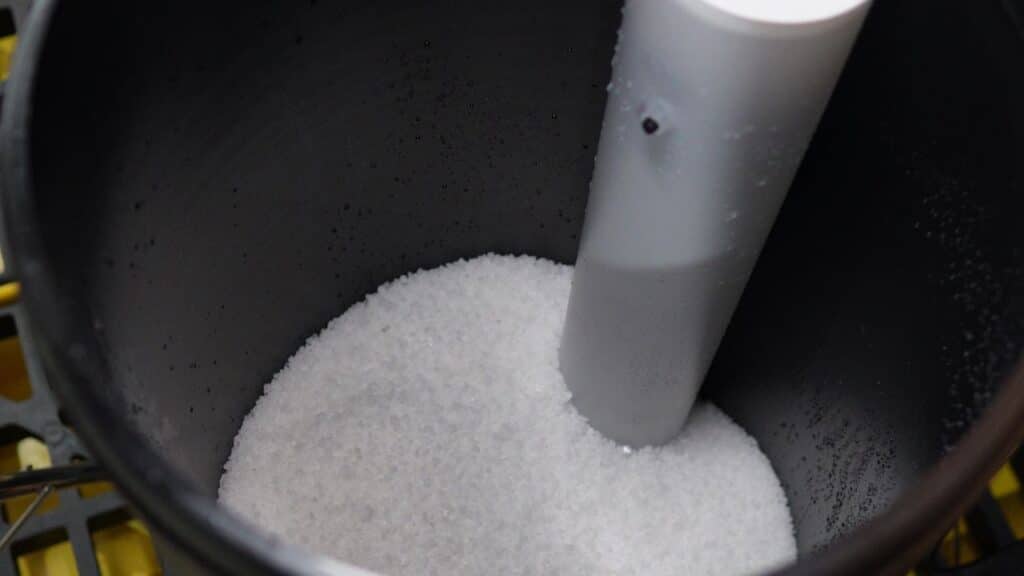
How Does Measured Salt Efficiency Compare to its Rating?
We measured the S-650’s salt efficiency at 2,813 grains per pound of salt. That’s around 6% below the manufacturer’s rated figure, but it’s still close enough to confirm that this published performance is realistic under our test conditions.
That said, this efficiency does fall short of the highest-efficiency water softeners, and it’s not efficient enough to qualify for NSF-44 efficiency-level performance (at least 4,000 grains per pound).
How Much Water Does One Regeneration Waste?
Water waste was the Kind S-650’s weakest area in our testing. Each regen cycle used around 125 gallons of water, which equates to 4.63 gallons for every 1,000 grains of hardness removed.
Compared with other water softeners we’ve tested, that’s a relatively high water consumption, and the difference will add up (and cost more) over time.
What Does That Mean Per Year?
Based on our standard usage assumptions, the S-650 would send approximately 7,300 gallons of water to drain each year from its regeneration cycles.
In most cases, that shouldn’t dramatically affect your water bills, but if minimizing water waste is one of your priorities, it’s worth being aware that this Kind model isn’t the most economical option available.
✅ Certifications (10%)
Key Finding: The Kind S-650 uses certified components, but the complete system isn’t independently certified to NSF/ANSI 44 for water softener performance.
Is the Kind S-650 NSF/ANSI 44 Certified?
No, the Kind S-650 doesn’t have a whole-unit NSF/ANSI Standard 44 certification, so it received the lowest score of 6.00 in this category.
NSF/ANSI 44 is an optional certification that manufacturers can obtain as proof of performance capabilities and design quality, including structural integrity, softening capacity, brine system accuracy, pressure drop, and materials safety. Because it encompasses more than just a system’s ability to soften water, it’s a really reassuring datapoint to have.
What do its Component Certifications Cover?
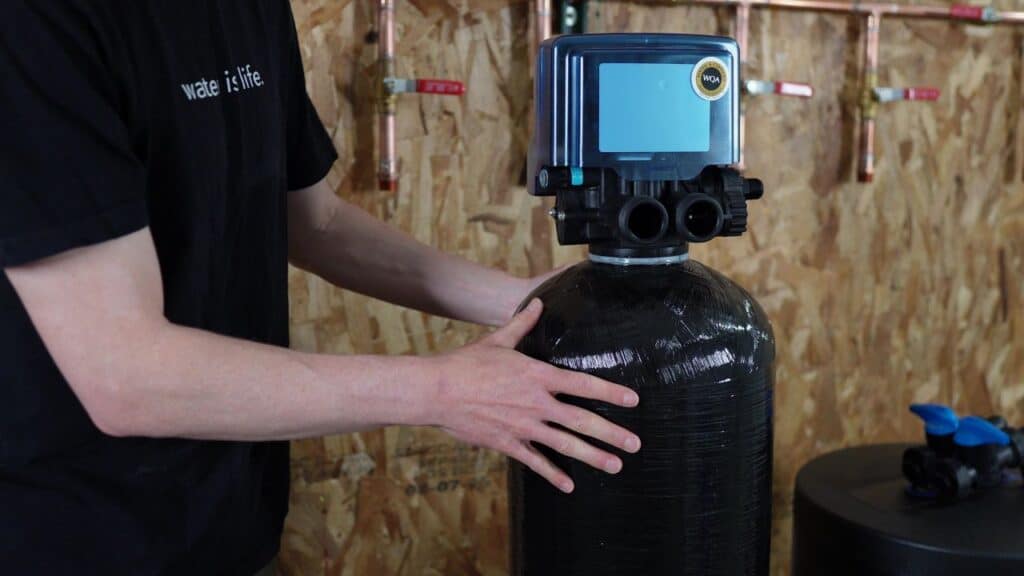
Some of the components used in the S-650 are certified to NSF/ANSI 61 and NSF/ANSI 372. The control valve also carries the WQA certification mark.
These certifications apply only to the individual components and materials, confirming that they meet drinking water safety requirements. Certified components are a nice touch, but importantly, they don’t certify the complete water softener’s performance. Don’t confuse them with the whole-unit NSF-44 certification!
🚦Flow Rate & Pressure (10%)
Key Finding: The Kind S-650 maintained a good flow of water during normal use, although in our own test conditions, we were unable to reproduce its maximum rated flow rate.
How Much Pressure Did the Kind S-650 Drop at 5 GPM?
Pressure loss is one of the easiest ways that a water softener’s everyday performance can be affected. If there’s too much resistance, you may end up with a weaker flow of water from your showers, faucets, and other fixtures.
In our testing, the Kind S-650 caused a pressure drop of 5.0 PSI at a flow rate of 5 GPM. That’s a barely perceptible change, and we didn’t notice any reduction in water pressure with normal use in our 2-bathroom home.
Did it Hit its Rated Flow Rate?
The S-650’s product page lists a maximum flow rate of 12 GPM. In our own tests, with a static feedwater pressure of 54 PSI (45 PSI dynamic pressure) and a water temperature of 67.8°F, the highest flow rate we measured was 8.02 GPM. That’s around 66.8% of the claimed maximum flow rate.
It’s worth noting that the advertised figure of 12 GPM comes from the manufacturer’s specification sheet, and we couldn’t find a published supporting flow curve (different expected flow rates based on different operating conditions). We were limited to our own test conditions.
While the S-650 has an operating pressure range of 20–125 PSI and a temperature range of 33º F–120º F, it’s possible that we may have obtained different results with different test conditions.
Will it Keep Up with Your Household?
For most homes, the Kind S-650 will be able to provide soft water at the rate it’s needed. Our own test results demonstrate this: the system maintained excellent softening performance throughout our flow testing and produced very little pressure loss under our normal household demand.
It might not have matched its advertised maximum flow rate, but our results suggest that this water softener should comfortably supply most homes without any noticeable pressure issues.
📐 Design & Build (5%)
Key Finding: The Kind S-650 has a good range of smart features, and we were generally pleased with its build quality, although its proprietary control valve may mean you’re dependent on the manufacturer for servicing in the future.
How is the Kind S-650 Built?
The Kind S-650 feels like a well-built premium water softener. The main cabinet and tank have a solid construction, and there’s installation hardware included in the box to simplify the setup process.
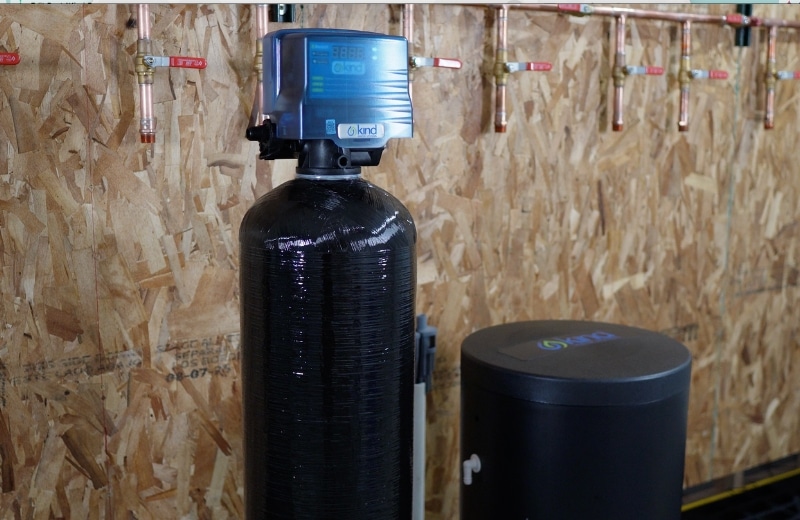
That said, the included documentation was a bit of a letdown. Since the S-650 is on the higher end of the price scale, we expected something better than the basic stapled printed sheets that came with our order.
What Can the Control Valve Do?
The electric control valve for this unit has a good range of modern features.
Like most of the modern softeners we test nowadays, it uses demand-based regeneration, which means the system only regenerates once a specified volume of water has been treated, rather than relying on a timer (which doesn’t factor in water usage and can result in unnecessary regenerations and water waste).
The control valve also has Bluetooth connectivity for controlling the system from a smartphone, as well as variable reserve capacity, which calculates and sets aside a portion of the softener’s total softening capacity, so you don’t run out of soft water before the system regenerates.
The power outage memory is another useful feature, allowing the system to restart and operate correctly after a power cut.
In our testing, we found the onboard control panels straightforward to use, and the app was a nice touch with genuinely useful features. The dashboard is a little outdated, but it works as intended. We could use the app to easily set the valve settings, including inputting our specific water hardness to optimize the regeneration cycle based on our water usage.
You can also use the app to initiate a manual regeneration, as well as force it to skip to the next regeneration step if needed. It’s worth noting that the app is connected through Bluetooth, so you need to be physically near to the water softener for it to work.
Are Replacement Parts Standard or Proprietary?
The S-650 uses a proprietary control valve, rather than one with an industry-standard design. That means you’ll more than likely need to buy any replacement parts directly from Kind, rather than them being widely available through multiple suppliers.
Nobody buys a water softener with the thought of conducting repairs several years down the line, but it’s worth being aware of the fact that you’ll probably be dependent on the manufacturer for repairs over the long term.
⚙️ Setup (2%)
Key Finding: The Kind S-650 can realistically be DIY-installed, but if you’re inexperienced with plumbing work, hiring a plumber might still be the sensible option.
How Long Does the Kind S-650 Take to Install?
When we installed the Kind S-650, the process took around 2 hours from start to finish.
Most of that time was actually spent on the initial commissioning process, which involved sanitizing the system and running the first regeneration cycle, as well as flushing everything through before we could start using it for softening.
Do You Need a Plumber?
You don’t necessarily need a plumber to install this Kind water softener, but we recommend hiring a pro if you’re not a confident DIY-er with basic plumbing experience, especially since the warranty will be void if you install the system incorrectly. Note that installing this kind of whole-house water treatment system involves cutting into your main water pipe, which has the potential to become an expensive problem if you do it wrong.
The unit comes with 1-inch MNPT connections and a pre-filter sump, so if you’re not afraid to get stuck into a couple of hours of hands-on problem-solving, you’ll probably be capable of the install.
How Hard is the Initial Programming?
We found that programming the S-650 after the install was relatively easy, and the control valve doesn’t require too much of a learning curve to understand.
The commissioning process takes longer than the programming itself, but once the system is installed, the setup is relatively simple to complete following the supplied instructions.
| Setup Factor | Result |
|---|---|
| Installation Time | ~2 hours |
| DIY Installation | Possible |
| Plumber Required | Possible, but professional installation may be preferred |
| Connections | 1-inch MNPT |
| Included Pre-Filter | Yes |
| Initial Programming | Relatively easy |
| Commissioning | Requires sanitizing, regeneration, and flushing |
🔊 Noise (2%)
We used a sound measuring app on our phone to measure the noise volume emitted from the Kind S-650 while it was regenerating.
How Loud is a Regeneration?
We measured a peak regeneration noise level of 67.9 decibels from a distance of 1 foot away from the unit.
That’s noticeable, but not excessive. For some context, a washing machine has a sound level of 50–75 dB on average, while a vacuum cleaner emits 60–85 dB.
If you install the softener away from your living spaces (such as in a garage or utility room), you’re unlikely to find the noise distracting. But if your only choice is to install it close to a bedroom or living room, just keep in mind that you’ll hear it while it’s regenerating, which takes around 86 minutes.
🏢 Company (5%)
Key Finding: Kind offers a strong valve and tank warranty, and its generous 120-day trial offers extra peace of mind before you commit long-term. The free shipping throughout the US is a nice bonus, too.
What Warranty Does Kind Offer?
Kind provides a 7-year warranty on the S-650’s control valve and a 10 year warranty on the tanks. We couldn’t find a published warranty for the resin, so this wasn’t included in our assessment.
The warranty only applies if you buy directly from the Kind website or from an authorized seller, and you’ll need to have proof of purchase to make a claim. There are a few circumstances that aren’t covered by the warranty, including improper installation, misuse, and natural disasters.
You can read the full warranty terms here.
What Are Shipping and Returns Like?
If you buy from the Kind website, you’ll be eligible for free shipping with no minimum spend, as long as you’re based in the US. You can contact Kind directly for an international shipping calculation.
Kind offers a generous 120-day satisfaction guarantee that can provide a bit of reassurance when you’re making an eye-watering upfront investment of more than $2,000. This guarantee gives you plenty of time to decide whether the system is right for you before you officially commit.
You’ll need to get the return authorized by Kind in advance, and the product should be repackaged in the original box, including all items and documentation that came with your order. As the customer, you’ll be responsible for the return shipping fee.
Find out more about Kind’s shipping and returns policy here.
🔧 Maintenance & Cost to Own
Key Finding: Overall, the Kind S-650 has decent salt efficiency. Its relatively high water consumption during regeneration cycles increases its long-term running costs when compared to more efficient systems, but it’s still competitively priced and not significantly more expensive than the norm when it comes to maintenance.
What Does the Kind S-650 Cost to Run Per Year?
The main ongoing costs of owning the Kind S-650 are:
- Buying salt to top up the brine tank
- Using water for regenerations
Our testing found that the system uses salt efficiently enough to support its rated capacity, but it also uses around 125 gallons of water every time it regenerates. Over the course of the year, that works out to approximately 7,300 gallons of water sent to drain under our standard testing assumptions.
Based on our normal use calculations, we estimate a total annual running cost of $164.19 for the S-650, including the annual cost of salt refills and water usage, as well as an annualized resin cost.
Your actual running costs will depend on your local water rates, as well as the cost of the salt you choose to buy and how much water your household uses.
How Often Will You Refill Salt?
How often you’ll refill the Kind S-650’s salt tank will depend on your household water usage and hardness levels.
The system uses around 9.6 pounds of salt per regeneration, but how often it regenerates will vary depending on your use case. If you’re buying for a larger household or you have very hard water, the system will regenerate more often and get through the available salt more rapidly, so you’ll need to refill the brine tank more often.
We estimated an annual cost of $126.14 for refilling the salt tank, based on an estimated number of 58.4 regenerations per year.
When Does the Resin Need Replacing, and What Does That Cost?
Kind states that the resin used in the S-650 lasts between 15 and 20 years.
Since it’s a quality water softener, we’d expect the resin in this system to last for many years under normal operating conditions. But, as chlorinated water can shorten resin lifespan, we assumed a lifespan of 15 years in our resin cost calculations.
The cost of replacing the resin will depend on the brand you buy from and the type of resin you go for. We estimated a resin replacement cost of $160 for 1.0 to 1.5 cu ft of standard cation resin. Kind doesn’t sell replacement resin, so this price assumes you’re buying from another manufacturer.
What Does Five Years of Ownership Cost?
The S-650 has an estimated 5-year ownership cost of $2,833. This figure factors in the initial purchase cost, as well as 5 years of annual salt, water, and resin costs.
| Ownership Cost | Estimated Cost |
|---|---|
| Annual Salt Cost | $126.14 |
| Resin Replacement Cost | $160 |
| Assumed Resin Lifespan | 15 years |
| Annual Running Cost | $164.19 |
| 5-Year Ownership Cost | $2,833 |
❔ FAQ
Q: Will the Kind S-650 make my water taste salty?
No, the S-650 won’t make your water taste unpleasantly salty, but it can slightly change the taste. In our testing, we did notice a slightly salty taste, but nothing off-putting. We think most people won’t find this a problem, but it’s worth considering if you’re sensitive to taste changes.
Q: Can I drink softened water?
Yes, it’s safe to drink water that has been softened by a legitimate system like the Kind S-650. These softeners only add enough salt into your water to replace the hardness (calcium and magnesium) minerals, so your water doesn’t become so salty that it’s unsafe to drink, even if it was initially very hard. That said, some people choose to keep a faucet that delivers unsoftened water for drinking, especially if they’re following a medically-advised low-sodium diet.
Q: Is the Kind S-650 septic safe?
Our test data doesn’t specifically assess septic compatibility, but Kind has answered this question on its product page, saying that the S-650 can be used with a septic tank. As a modern softener, it doesn’t use as much salt as traditional softeners, and Kind has reportedly “never received feedback from customers over damaged septic systems due to our salt-softener”.
Q: How much salt will I go through in a year?
The amount of salt you’ll use per year in the Kind S-650 depends on your water usage, which dictates how often the system will regenerate. In our testing, each regeneration used approximately 9.6 pounds of salt. Assuming our “normal” use rate, we estimated that the system will regenerate 58.4 times per year, meaning it’d use a total of 560.64 pounds of salt annually.
Q: Can I install the Kind S-650 myself?
Yes, you can install the Kind S-650 yourself, but you’ll need to have some level of DIY competency and be comfortable with basic plumbing. Our installation took around two hours, and while the plumbing itself wasn’t too difficult, it does involve cutting into your main water pipe, which can have expensive repercussions if you do it incorrectly.
Q: Is the Kind S-650 for well water only?
The S-650 is categorized as a well water softener on the Kind website, but that doesn’t mean it’s exclusively for well water. We installed and tested it on very hard city water. It works no differently on city water than well water to address hardness.
Q: What’s the difference between the Kind S-650 and SF-600?
The key difference between the Kind S-650 and SF-600 models is that the S-650 is Kind’s salt-based water softener, while the SF-600 is a salt-free conditioner. While the S-650 removes hardness minerals using ion exchange, the SF-600 simply crystallizes them, so they remain in the water but are unable to stick to surfaces and form scale.
Q: Are there any other configurations of the Kind S-650?
Yes, Kind sells the S-650 in several configurations alongside the base model. You can upgrade to buy the system combined with Kind’s whole-house water filtration and UV systems for additional water treatment all in one. You can also buy the softener alongside Kind’s iron and carbon filters to target specific contaminants you might also be concerned about.