

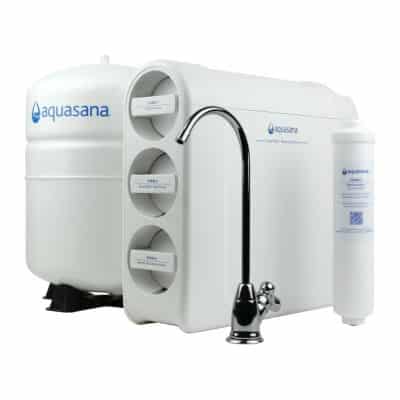
The Aquasana SmartFlow reverse osmosis system is a conventional under-sink RO system that uses four individual filtration stages to purify and remineralize tap water. It’s claimed to remove “up to 99.99% of 90 contaminants” and has been performance certified to five NSF Standards for performance and design.
What We Like
What We Don’t Like
| Price | $239.99 |
| Contaminants Reduced | 15+ |
| Certifications | NSF/ANSI 42, 53, 58, 401, & 372 |
| Process | Carbon Block + RO Membrane + Advanced Carbon + Remineralization |
| Filter Capacity | Carbon Filters: 6 months; RO Membrane: 12 months |
| Annual Cost | ~$464.93 |
| Warranty | 2 years |
Quick Verdict: Is the Aquasana SmartFlow Worth It?
The Aquasana SmartFlow earned an overall score of 8.39/10 in our hands-on testing. It eliminated 100% of fluoride, boron, and all three disinfection byproducts detected in our baseline Tap Score lab report, reduced TDS by 95.4%, and is one of the only RO systems we’ve tested with certifications covering every single one of its contaminant reduction claims.
Buy it if: you want an under-sink RO system with WQA certifications across the board (NSF/ANSI 42, 53, 58, 401, and 372), proven fluoride and DBP removal, and a low upfront cost.
Skip it if: you want the cheapest system to maintain long term (annual filter costs run $464.93, the highest ongoing cost of any conventional RO we’ve scored), or you want true remineralization rather than pH adjustment.
See how we test and score water filters for the full methodology behind these results.
We put this system through a comprehensive testing process, assessing factors such as contaminant reduction, efficiency, flow rate, TDS creep, noise levels, and the overall ease of installation and maintenance. Our findings from each stage of testing are covered throughout this review.
📊 Scoring Data
To get a clear understanding of its performance, we tested the Aquasana SmartFlow against the other 10+ under-sink RO systems we’ve reviewed, using our internal benchmarking system. This allowed us to evaluate our testing data in context, so we could clearly see how Aquasana’s performance compared to similar systems currently on the market.
We calculated our overall scoring using a weighted system that pulls together results from several key categories, including contaminant removal, flow rate, build quality, ease of installation, ongoing maintenance costs, and the brand’s policies around delivery and returns, as well as its warranty.
Alongside these core metrics, we also recorded RO-specific performance details, including pure-to-wastewater production, recovery rate, and several other technical data points. These don’t currently influence the final scores, but they help us understand the full picture of how the system performs with real-world use.
You can view Aquasana’s results in the table below.
| Criteria | Results |
|---|---|
| Overall Score | 8.39 |
| Health Related Contaminants | 8.50 |
| Aesthetic Related Contaminants | 9.90 |
| Performance Certification | NSF/ANSI 42, 53, 58, 401, & 372 |
| Filtration Rate | 44.64 GPD |
| Component Quality | Outstanding |
| Component Certification | Exceptional |
| Setup | Below Average |
| Servicing Requirements | Good |
| Costs | $0.42/ gallon |
| Warranty Length | 2 years |
| Shipping | May cover shipping costs for select order types |
| Returns | 90 days |
🚰 Contaminant Reduction
Score: 8.71Key Finding: The SmartFlow eliminated 100% of fluoride, boron, and all three disinfection byproducts detected in our baseline water, and it holds WQA certifications for every one of its contaminant reduction claims.
If you’ve got your eye on the Aquasana SmartFlow, you’re probably interested in purifying your water thoroughly, rather than simply removing select contaminants. That’s why our contaminant reduction scores have the biggest influence on the system’s overall weighted performance score.

Our own results from Tap Score lab testing determined the scores awarded in this category. We also allocate scores based on the presence of official certifications from organizations like the NSF, IAPMO, or the WQA, which contribute to the contaminant reduction score we’ve awarded here.
Our Performance Testing
Score: 8.57
We wanted to compare real-world test data with Aquasana’s performance claims, which involved conducting our own testing.
To evaluate the filter’s contaminant reduction performance, we took pre- and post-filtration* water samples and sent them to Tap Score for laboratory testing. The lab documented all contaminants detected in each sample, outlining this data in detailed reports.
We then compared these results to see how effectively the SmartFlow RO system could reduce each contaminant detected in our baseline sample. This involved reviewing our data against the Health Guideline Levels (HGLs) as our primary benchmark.
Additionally, we evaluated chlorine reduction ourselves using a digital colorimeter. On-site testing is the most accurate chlorine detection method due to the chemical’s volatility, which causes it to dissipate from water quickly.
Health-Related Contaminants
Score: 8.50
Our priority when testing the Aquasana SmartFlow was to see how effectively it could reduce contaminants with health effects detected in our unfiltered water sample.
The baseline Tap Score report highlighted trace levels of more than 15 contaminants of concern, including 3 disinfection byproducts (bromodichloromethane, bromoform, and dibromochloromethane), as well as barium, molybdenum, total chromium, manganese, boron, fluoride, copper, nitrate and nitrite, selenium, vanadium, uranium, and strontium.
5 of these contaminants were detected at levels exceeding the HGL: uranium, fluoride, and the 3 disinfection byproducts.
The next table shows the full list of contaminants detected and their concentrations.
| Analyte | Unit | Result Value | Aquasana SmartFlow | Difference |
|---|---|---|---|---|
| Alkalinity (as CaCO3) | PPM | 356 | 0 | -100.00% |
| Barium | PPM | 0.0319 | 0 | -100.00% |
| Bicarbonate | PPM | 430 | 0 | -100.00% |
| Boron | PPM | 0.41 | 0 | -100.00% |
| Bromodichloromethane | PPB | 4.38 | 0 | -100.00% |
| Bromoform | PPB | 8.01 | 0 | -100.00% |
| Calcium | PPM | 73.3 | 1.85 | -97.48% |
| Carbonate | PPM | 1.98 | 0 | -100.00% |
| Chloride | PPM | 99.7 | 5.5 | -94.48% |
| Chloride-to-Sulfate Mass Ratio | 0.639 | Very High | n/a | |
| Chloromethane | PPB | 0 | 30 | n/a |
| Chromium (Total) | PPM | 0.00308 | 0.000214 | -93.05% |
| Copper | PPM | 0.233 | 0 | -100.00% |
| Dibromochloromethane | PPB | 10.3 | 0 | -100.00% |
| Expanded Hardness | PPM | 248 | 4.62 | -98.14% |
| Fluoride | PPM | 2.2 | 0 | -100.00% |
| Grains per gallon | Grains | 14.4 | 0.27 | -98.13% |
| Hardness | PPM | 247 | 4.62 | -98.13% |
| Langelier Saturation Index | 0.744 | N/A | n/a | |
| Magnesium | PPM | 15.5 | 0 | -100.00% |
| Manganese | PPM | 0.0011 | 0 | -100.00% |
| Molybdenum | PPM | 0.00119 | 0 | -100.00% |
| Nitrate (as N) | PPM | 2.5 | 0 | -100.00% |
| Nitrite (as N) | PPM | 0.5 | 0 | -100.00% |
| pH | pH | 8 | 9.3 | 16.25% |
| Potassium | PPM | 3.03 | 0 | -100.00% |
| Selenium | PPM | 0.00361 | 0 | -100.00% |
| Sodium | PPM | 178 | 15.5 | -91.29% |
| Sodium Adsorption Ratio | 4.92 | 3.13 | -36.38% | |
| Specific Conductivity | umhos/cm | 1210 | 77.9 | -93.56% |
| Strontium | PPM | 0.757 | 0 | -100.00% |
| Sulfate | PPM | 156 | 0 | -100.00% |
| Total Dissolved Solids | PPM | 707 | 47 | -93.35% |
| Total THMs | PPB | 22.7 | 0 | -100.00% |
| Uranium | PPM | 0.0118 | 0 | -100.00% |
| Vanadium | PPM | 0.00118 | 0.000519 | -56.02% |
After filtering our water through the SmartFlow RO system, the majority of these contaminants (including those detected above the HGL) were eliminated. And in our on-site colorimeter testing, 2.15 PPM of chlorine was reduced all the way down to 0 PPM.
There were a couple of exceptions:
- Total chromium was reduced by 93%
- Vanadium was reduced by just 56%
It’s still one of the most comprehensive contaminant reductions we’ve ever recorded, even for a reverse osmosis system.
We were particularly impressed that 100% of boron was removed, since it’s known to pass through RO membranes easily, and many of the similar systems we tested failed to reduce it by more than 50%.
We were also pleased that the Aquasana SmartFlow reduced 100% fluoride, since this is a contaminant that many folks are specifically looking to remove with an RO system. Plus, its complete DBP elimination is reassuring, since disinfection byproducts are a legitimate long-term health concern in water, linked to adverse effects including bladder cancer.
Anomalies & Unexpected Results
There was just one anomaly highlighted by our test data comparison: 30 PPB of chloromethane appeared in our filtered water when it wasn’t detected in our baseline sample.
Chloromethane is a VOC that can cause harmful liver, kidney, and nervous system effects, slower growth, brain damage, and possible carcinogenic effects with exposure. There’s no EPA MCL for chloromethane in drinking water.
In our research, we found that this chemical can off-gas from plastic components, including silicones. Under normal conditions, this is apparently not likely (off-gassing usually occurs when plastics are burned or subject to high-heat processes, which definitely wasn’t happening with our RO setup!). That said, the concentrations of chloromethane in our water were very low (30 parts per billion), so the most likely explanation is leaching from materials in the SmartFlow unit.
It’s possible that the offgassing was a residual effect from the manufacturing process, and that the elevated chloromethane was simply a short-term issue in our initial use of the system. To test this theory, we’d need to retest our water after a longer flushing cycle.
Aesthetics, pH, and Mineral Content
Score: 9.90
The SmartFlow system comes with an included remineralization post-filter. From testing other RO systems with these filters, we expected the minerals in our water to be reduced by 70-80% (as opposed to 100%, as we typically see without remineralization). We also anticipated improvements in alkalinity and pH due to the filter’s mineral-enhancing effects.
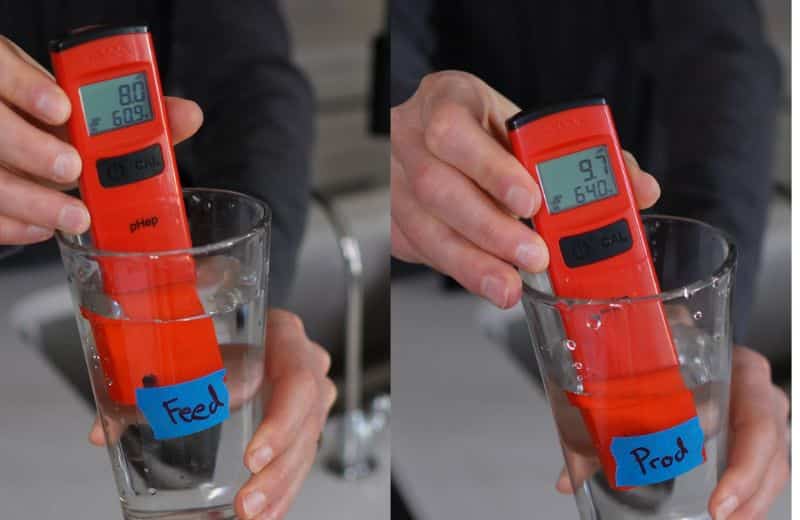
Post-filtration, pH increased significantly, from 8.0 to 9.3. This is a pretty unusual result given that calcium dropped to 1.85 PPM, potassium and magnesium to 0, and alkalinity to 0. That tells us that this elevated pH is happening without any obvious reintroduction of minerals, suggesting that the filter might be using an alkalizing agent rather than true remineralization.
It’s not necessarily a dealbreaker, as the filter did increase pH, preventing the taste effects associated with RO purification (which typically reduces pH to slightly acidic). But Aquasana claims the system “restores beneficial minerals for healthier, delicious water”, which is not consistent with our own results.
Our on-site results (measured using a pH meter) showed an even more significant increase in pH, from 8.0 to 9.7.
TDS & TDS Creep
TDS creep is an issue that’s mostly known to affect tankless RO systems. But in our tests, several tank-based systems have also shown signs of TDS creep, so it’s something that we analyze with all under-sink reverse osmosis models.
If you’ve never heard of TDS creep, the basic explanation is that it causes a temporary increase in TDS levels in the initial draw of filtered water. It happens when the reverse osmosis system hasn’t been used for some time (such as overnight), when the pressure in the semi-permeable membrane begins to equalize.
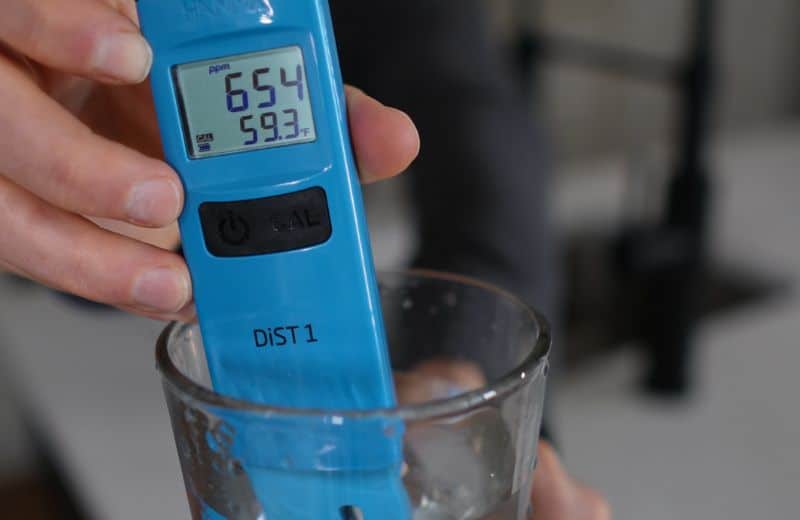
We evaluated TDS by comparing TDS measurements from our on-site testing using a TDS meter. Our feed water reading was 654 PPM, and our first-draw sample from the SmartFlow faucet (taken after letting it sit idle overnight for 10 hours) measured 67 PPM—not indicative of TDS creep.
After leaving the system switched on and filtering water for 2 minutes, we took a second draw reading from a sample collected in a separate glass. This time, the TDS reading was 30 PPM.
The difference between the 1st and 2nd draw was just 37 PPM, telling us that TDS creep is not a significant issue with this unit.
| Test Condition | TDS (PPM) |
|---|---|
| Feed Water | 654 |
| 1st Draw (After 10 hrs Idle) | 67 |
| Stable TDS (Final Draw) | 30 |
| TDS Reduction | 95.4% |
| TDS Creep | 37 PPM |
Performance Certifications
Score: 10.00
Our on-site testing gives us great insight into how a water filter performs in real-world conditions, but we’re only able to evaluate a filter’s ability to remove the contaminants our water contains.
That’s why our contaminant reduction score is also influenced by the presence of certifications, which manufacturers can obtain from independent testing companies including the NSF, the WQA, and IAPMO.
The Aquasana SmartFlow is one of the few systems we’ve tested so far that has certifications to perform every single one of its contaminant reduction claims. That’s a huge green flag. Rather than having to take these claims at face value, certification provides proof of performance from a trusted third-party source.
Specifically, the system is certified by the WQA to the following NSF/ANSI Standards:
- 42 (for aesthetic effects), for the reduction of chlorine, chloramine, particulates class I, taste, and odor
- 53 (contaminants with health effects), for the reduction of asbestos, cysts, lead, mercury, methyl tert-butyl ether (MTBE), PFOS, PFOA, and VOC (as chloroform)
- 58 (for RO systems), for the reduction of arsenic, barium, cadmium, copper, fluoride, hexavalent chromium, nitrate, nitrite, radium 226/228, selenium, TDS, trivalent chromium, and turbidity
- 401 (for emerging compounds and incidental contaminants), for the reduction of atenolol, BPA, carbamazepine, DEET, estrone, ibuprofen, linuron, meprobamate, metolachlor, microplastics, naproxen, nonyl phenol, phenytoin, TCEP, TCPP, and trimethoprim
We can corroborate our own test data with some of these certified contaminants: barium, copper, fluoride, nitrate, nitrite, and selenium were all completely removed, and total chromium was reduced by 93%.
🚦Filtration Rate
Score: 6.00Key Finding: We measured a real-world production rate of 44.64 GPD against Aquasana’s claimed 51.4 GPD, tested with challenging feed conditions of 51 PSI and 59.2 degrees Fahrenheit.
As a tank-based system, the Aquasana SmartFlow has a listed flow rate of 51.4 GPD (very specific!). Unlike tankless models, there’s no internal pump to boost the flow of water. Instead, air pressure from the tank propels the water out and up through the faucet.
That said, the flow from Aquasana’s dedicated faucet is virtually the same as you’d get from a standard kitchen faucet, which averages 1.5–2.2 GPM, or 36–52.8 GPD.
We wanted to measure flow rate in our own real-world test conditions, with a recorded feed water temperature of 59.2°F and water pressure of 51 PSI. So, we timed the process of filling a graduated measuring container with purified water, uploading video footage of the test onto an editing tool and moving through frame by frame to get precise start and end points, measuring down to the millisecond.
In our first test, we recorded the time taken to fill our measuring jug to the 12-ounce line. We repeated this three times, recording an average time of 181.46 seconds. This translates to a flow rate of 0.03 GPM (gallons per minute), or 1.86 GPH (gallons per hour).
In gallons per day, that’s approximately 44.64 GPD, which is only slightly lower than Aquasana’s claimed 51.4 GPD — pretty good, especially since our cooler feed water and lower incoming pressure likely affected how quickly water could pass through the RO membrane.
| Test Metric | Result |
|---|---|
| Time to Fill 12 oz | 181.46 seconds |
| Measured Flow Rate | 0.03 GPM |
| Gallons Per Hour | 1.86 GPH |
| Converted GPD | 44.64 GPD |
| Manufacturer Claim | 51.4 GPD |
Efficiency Ratio
To demonstrate how much purified water an RO system produces against the volume of water it sends to drain during this process, manufacturers use a measurement known as efficiency ratio (otherwise called recovery rate or pure-to-wastewater ratio).
In our tests, we’ve found that conventional tank-based under-sink RO systems tend to waste more water than tankless models because of their slower filtration that relies on water pressure rather than an internal pump.
The Aquasana SmartFlow is reportedly 57% more efficient than Aquasana’s previous model, which would sound more impressive if the product page contained actual numbers for reference. We did find mention of efficiency in the user manual, which noted that the reject water flow is 2–4x the product (purified water) flow. That means for every 1 gallon of water purified, 2–4 gallons are wasted.
We wanted to measure the SmartFlow system’s efficiency in our own real-world test conditions. To do this, we disconnected the drain line and directed the wastewater into a measuring container, while we filled a separate container with 12 ounces of purified water.
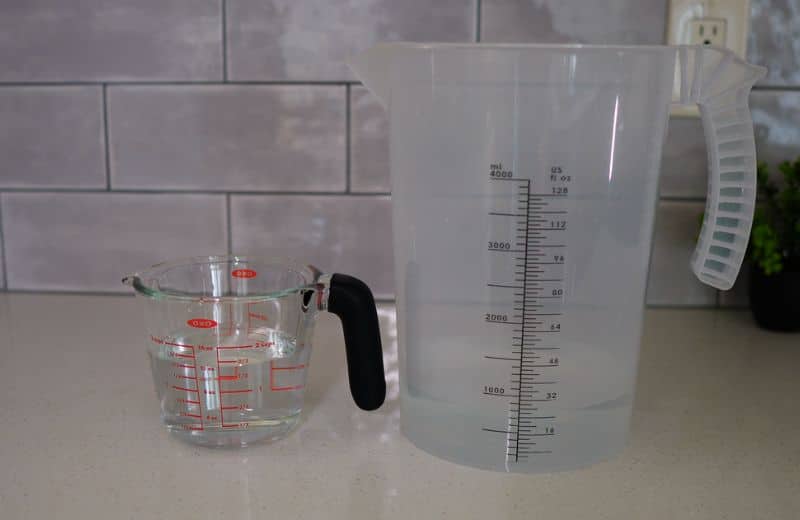
When the 12-ounce line was reached, we’d collected 27 ounces of wastewater, a ratio of 1:2.25 (2.25 ounces sent to drain per 1 ounce purified). That’s an efficient result for a conventional tank based RO system, and close to the best we’ve recorded in this category alongside Cloud.
And that’s even with our challenging test conditions — RO systems are typically rated for use with a water pressure of 60–80 PSI and a temperature of around 77°F, so our own water pressure of 51 PSI and temperature of 59.2°F likely reduced the system’s efficiency.
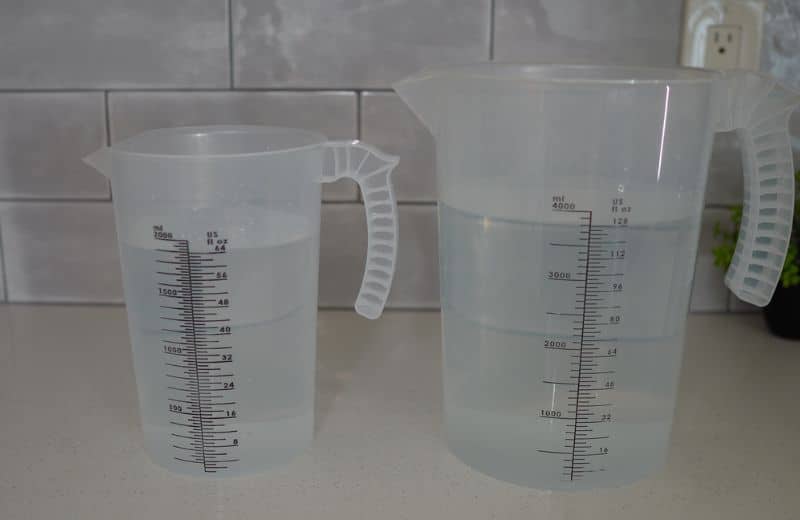
We then repeated the process with a larger purified water draw of 64 ounces (½ gallon). This time, 128 ounces of drain water were produced, equating to a recovery rate of 1:2 (so, 2 ounces wasted per 1 ounce purified). That’s pretty in line with Aquasana’s estimated recovery rate of 1:2–4.
| Test Volume | Wastewater Produced | Pure-to-Drain Ratio |
|---|---|---|
| 12 oz Test | 27 oz | 1:2.25 |
| 64 oz Test | 128 oz | 1:2 |
| Claimed by Manufacturer | — | 1:2–4 |
Interestingly, most other RO systems we tested were more efficient in this larger-draw test, because the smaller-draw test captures more of the system’s less efficient start-up stabilization phase. But since the SmartFlow is tank-based, we think it was able to operate at a steadier pressure and flow from the moment we started using it, making it more consistently efficient compared to tankless models.
📐 Design
Score: 9.70Key Finding: The SmartFlow is certified for materials safety, lead-free design under NSF/ANSI 372, and Canada’s CSA B483.1 standard, and uses NSF certified John Guest fittings throughout.
Our scores in the design category are influenced by two factors: component quality and the presence of certifications for design or materials safety.
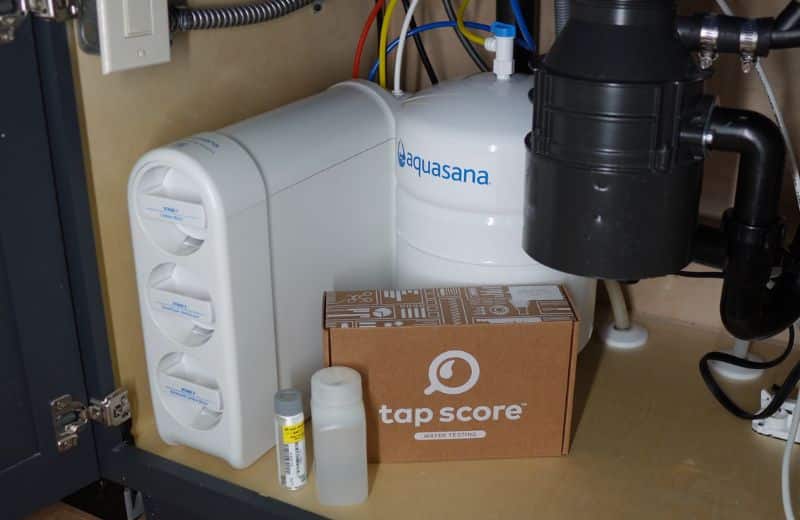
The Aqausana SmartFlow has a simple design, with the three main filters housed inside a unit that sits on the base of your under-sink cupboard, a remineralization filter that attaches to a wall with a bracket, and a 2.5-gallon storage tank for the purified RO water. The tank and housing sit vertically and are fairly tall (around 15.5 inches), so make sure to measure your space to check it will fit before you buy.
The unit also comes with a dedicated faucet, which is available in various finishes: chrome, brushed nickel, oil-rubbed bronze, and matte black. This is installed alongside your existing faucet, so you can use it for purified drinking water while continuing to use your non-RO water for washing your hands, dishwashing, and so on.
Component Quality
Score: 9.50
We were pleased with the SmartFlow system’s component quality. It uses NSF-certified John Guest fittings, which are known for being high-quality and easy to install.
We also noted that the design is similar to tankless systems, with a manifold that filter cartridges slip into. That tells us that the filters are proprietary, rather than universal or interchangeable like with most of the other conventional RO systems we tested.
The housings and filter cartridges are made from BPA-free plastics. The exact materials used aren’t listed online, but when we reached out to Aquasana, they told us that the plastic components are made from BPA-free polypropylene, one of the most popular materials for water filters because of its food-grade, non-toxic status.
The faucet is “premium” and “all metal”, but Aquasana offers a “no faucet” option too, so you can buy your own (must be air gap) if you prefer.
In terms of look and feel, we got the impression that the whole unit is built to last, with numerous thoughtful design touches that contribute to its quality and durability.
Filter Materials
There are 4 separate filter stages in the SmartFlow:
- A stage-1 carbon block filter
- A stage-2 RO membrane
- A stage-3 advanced carbon filter
- A final remineralization stage
The carbon filters also use Aquasana’s Claryum® Technology, a proprietary, multi-stage water filtration method developed by Aquasana, which helps the filters reduce a broader range of contaminants.
This is the common sequence of filtration stages for an RO system, with the RO membrane targeting the majority of impurities, and the carbon filters addressing dissolved gases and several chemical contaminants that the semi-permeable membrane can struggle to remove.
Materials Safety Certification
Score: 10.00
A materials safety certification awarded by the NSF, IAPMO, or the WQA offers proof of construction quality outside the manufacturer’s own claims.
Water filters can be certified within the following two design categories:
- NSF/ANSI 372, for lead-free design
- Materials safety, which is obtained as a component of a performance certification
The Aquasana SmartFlow has both of these certifications: its materials safety certification is a component of its performance certification, and it also has a WQA certification for lead-free design.
But that’s not all: the filter has also been WQA certified to CSA B483.1. This is a Canadian standard that specifies materials, construction, and performance requirements for water treatment systems, ensuring that the system complies with national health guidelines.
⚙️ Setup
Score: 7.50Key Finding: Installation took us around 90 minutes, but tank sanitizing and the required triple flush added roughly 9 more hours of fill and empty cycles before the water was ready to drink.
Under-sink RO systems have more components than non-RO systems, as well as additional installation requirements, such as hooking up a drain line and drilling a hole for the RO faucet.
As a tank-based system, the SmartFlow also has the extra requirement of installing the purified water storage tank. But we did find it slightly less challenging than similar models because of the differences in the filter housing compared to others.
We installed the system ourselves, and the process took around 90 minutes from start to finish. The instructions in the user manual are easy to follow, with labeled diagrams and a clearly defined step-by-step process. That said, if you’re not a handy person or you don’t have much DIY experience, you might feel more comfortable paying a plumber to do the install for you.
There were a few issues we had with the installation:
- First, we found the faucet horrible to install. Unlike on other systems, there’s no hand-tight nut, which means you have to use a wrench, turning it into a much fiddlier job than it needs to be.
- Second, the unit leaked internally when we initially started it up, and we had to reach out to customer support. They were super slow to respond, taking six days until their first response. But once we’d gotten through, they honored the warranty by sending us a replacement system manifold after asking us to send a video of the issue.
- Finally, adding the bleach to the tank to sanitize it was a super tedious job. We followed the instructions, using the included dropper to put it into the tubing while attached to the tank. This creates a vacuum, meaning that it was really difficult to get the bleach in and all too easy to spill it and make a mess.
Flushing the filters is an unavoidable part of any RO system install. We followed Aquasana’s instructions, which involved leaving the faucet to trickle for 15 minutes for depressurization, then filling and emptying the sanitized tank three times (which took 3 hours per fill). On the fourth refill, the water in the tank was safe to use.
Once we’d installed the system (with the replacement manifold), we identified 11 different leak points, or points at which the system could leak at fittings or fixtures. But with the new manifold installed, the system didn’t leak at any point during our testing.
Noise
Nobody wants an RO system to be disruptively loud, which is why we measure the noise volume of all the units we test after setup.
We used a phone app to measure the noise produced (in decibels) by the Aquasana SmartFlow during operation. As a tank-based model, the system doesn’t use an internal pump, so we assumed it would be quieter than a tankless system with a built-in pump.
We measured sound decibels at 1 foot and 3 feet away:
- At 1 foot, the unit produced 26.5 decibels.
- At 3 feet, it produced 26.5 decibels: exactly the same.
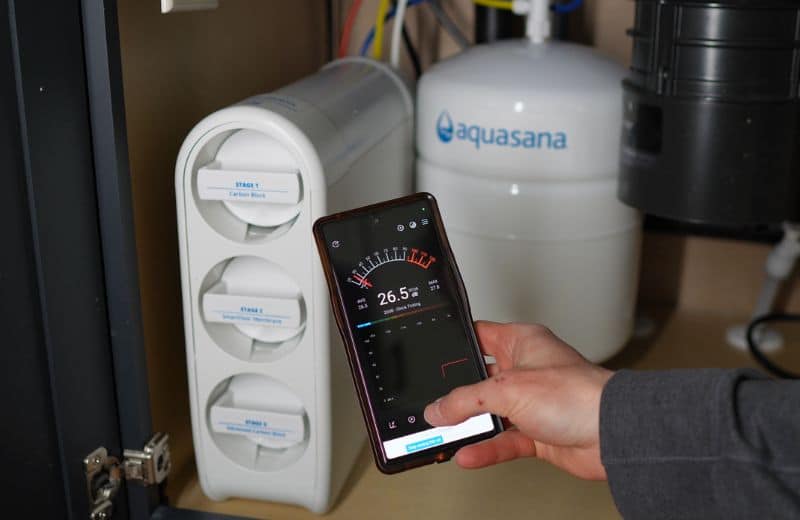
That’s very quiet, and there’s every chance that the readings were influenced by noise from the refrigerator in the kitchen rather than the RO unit itself.
🔧 Maintenance
Score: 8.75Key Finding: At $0.42 per gallon and $464.93 per year, the SmartFlow earned the lowest maintenance cost score of any conventional RO system in our benchmarking.
We evaluated the Aquasana SmartFlow from a maintenance standpoint by assessing its servicing requirements and ongoing filter replacement costs.
Servicing Requirements
Score: 8.50
The SmartFlow has 4 filters to change, and this is the key maintenance task to maintain effective RO performance throughout the system’s lifespan.
You’ll need to make your own filter change reminders (we do this on our phone calendar), as there’s no digital display on the unit itself that indicates when filters need replacing.
You can find the filter replacement schedule for each cartridge in the user manual. Both carbon filters and the remineralization cartridge should be replaced every 6 months, while the RO membrane has a longer lifespan of 12 months. Exact replacement timelines depend on your water usage, hardness, pH, and sediment levels.
Replacing the filters involves shutting off the water supply and opening the faucet to release pressure. You then twist the old filter housings to the right to unlock, pull down, and swap in the new filters by pushing up and locking to the left. Every time you install a new filter, you have to repeat the same tedious flushing process, filling and emptying three tanks of water. It’s simple but time-consuming.
Costs
Score: 9.00
We calculated that the SmartFlow has an overall ongoing spend of $0.42 per gallon, equivalent to a total annual cost of $464.93, or a 5-year ownership cost of $2,564.62.
That makes this Aquasana model one of the most expensive systems to maintain in the long run compared to the other units we’ve tested, which purify water for less than $0.25 per gallon.
🏢 Company
Score: 8.10Key Finding: Aquasana honored its 2 year warranty when our unit’s manifold failed, sending a replacement part after a slow six day initial support response.
To round off this review, we’re discussing our scores awarded to Aquasana as a company, based on its warranty, shipping, and returns offerings.
Warranty
Score: 9.00
The SmartFlow RO system is backed by a 2-year warranty, as outlined in the user manual.
The warranty covers “defects in materials and workmanship” throughout the 2-year period, as long as it’s “installed, operated and maintained in accordance with the instructions accompanying the water filter” on the Aquasana website. You need to be able to show proof of purchase from an Aquasana retailer to be eligible.
We made a warranty claim when we discovered that one of the components was faulty, and, aside from a slow initial response, we were able to successfully receive a replacement part after sending a video documenting the issue.
You can also join Aquasana’s Water For Life program, which sounds a bit like a charity project but is actually the brand’s filter subscription service. In exchange for signing up for regular filter replacements when needed, you get an extended limited warranty on your system and a 15% discount on replacement filters, plus free shipping.
You can find the warranty information at the bottom of the user manual.
Shipping
Score: 8.00
Aquasana says it “may cover shipping costs for select order types at our discretion”. That’s pretty ambiguous and essentially means that you might have to pay for shipping, but you might not, likely influenced by your location and the carrier you choose.
Orders are typically shipped within two days, and the company ships to Alaska, Hawaii & Puerto Rico (something that not every manufacturer does).
View Aquasana’s shipping policy here.
Returns
Score: 7.00
Under Aquasana’s returns policy, you can return your order within 90 days of the purchase date, as long as you’ve bought the system directly through Aquasana.
However, the company score in this category was pulled down by a number of stipulations:
- As the customer, you’re responsible for the return shipping costs on all products.
- You’re also responsible for the cost of insuring the product during return shipping.
Here’s Aquasana’s returns policy for more information.
💰 Value For Money
Key Finding: The SmartFlow pairs the most complete certification coverage we’ve seen on a conventional RO system with a 5 year ownership cost of $2,564.62 including purchase, among the highest we’ve recorded.
The Aquasana SmartFlow has a lot of things going for it, and we think it offers good value for money overall.
From our testing perspective, it has two clear selling points: first, it reduced almost every contaminant by 90%+ or to below detection in our tests; and second, it’s certified for 100% of the manufacturer’s contaminant reduction claims.
Plus, it has materials safety certifications, including a Canadian certification, and its flow rate and efficiency ratio exceeded our expectations in our tests.
That said, there were some aspects of the installation process that we found frustrating, and it’s more expensive to maintain than similar systems in the long run. The appearance of 30 PPB of chloromethane in our filtered water is also concerning.
If you’re after an RO system with remineralization and certifications across the board, we think the Aquasana SmartFlow should tick your boxes. But if you’re looking for a more affordable alternative, you might want to check out some of our other top-recommended under-sink RO systems.
❔ Aquasana SmartFlow FAQ
Q: Does the Aquasana SmartFlow remove fluoride?
A: Yes. In our Tap Score lab testing, the SmartFlow reduced fluoride by 100%, and the system is WQA certified to NSF/ANSI 58 for fluoride reduction.
Q: Is the Aquasana SmartFlow certified?
A: Yes. The SmartFlow is WQA certified to NSF/ANSI Standards 42, 53, 58, 401, and 372, covering 100% of its contaminant reduction claims plus materials safety and lead-free design. It also holds a certification to CSA B483.1, a Canadian standard for water treatment systems.
Q: How much does the Aquasana SmartFlow cost to maintain?
A: We calculated an ongoing cost of $0.42 per gallon, or around $464.93 per year in replacement filters. That makes it one of the most expensive RO systems to maintain among the models we have tested.
Q: Does the Aquasana SmartFlow waste water?
A: Yes, like all reverse osmosis systems. In our 64 ounce test, the SmartFlow sent 2 ounces of water to drain per 1 ounce purified, which falls within Aquasana’s estimated range and is an efficient result for a conventional tank based system.
Q: Does the Aquasana SmartFlow remineralize water?
A: Only partially. The final stage raised our water’s pH from 8.0 to 9.3 in lab testing, but calcium measured just 1.85 PPM and magnesium and potassium measured 0 PPM afterward, so the filter behaves more like an alkalizer than a true remineralizer.
Q: Aquasana SmartFlow vs OptimH2O: which should you buy?
A: The SmartFlow replaces the OptimH2O as Aquasana’s current under sink RO system, and Aquasana claims it is 57% more efficient than the previous model.
Found this review helpful?
Comment below or share this article!
We bought a whole house Aquasana system about 8 years ago and had several issues with it which the company did not adequately address. We finally gave up and trashed it. We will never do business with this company again.
Care to elaborate?