

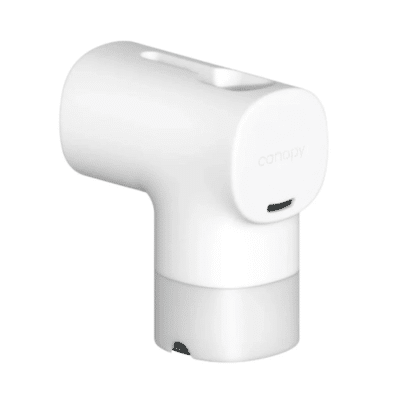
The Canopy Bath Filter is a unique take on the traditional bath filter, with a modern design that slots over the entire bath faucet. It’s easy to look at the filter and assume that its fancier exterior means it delivers a fancier performance, too—but, from experience, we know that this isn’t always the case.
What We Like
What We Don’t Like
| Price | $89 |
| Contaminants Reduced | Chlorine |
| Certifications | Not Certified |
| Process | Calcium Sulfite + Activated Carbon + KDF |
| Filter Capacity | 2,700 gallons |
| Annual Cost | ~$74 |
| Warranty | 1 year |
To find out how the filter performs in real-world conditions, we analyzed it across a series of subjective and objective testing categories in a residential property in Colorado. As well as using Tap Score test kits to detect contaminants pre- and post-filtration, we also measured the filter’s flow rate, evaluated its design quality, and compared its installation and maintenance requirements to the other bathtub filters we’d tested.
📊 Scoring Data
Reading information about water filters online can be a helpful start when it comes to understanding their performance. But we’re well aware that manufacturers can easily make bold claims without having to back them up with real data. Many folks don’t know whether they should fall for marketing promises, and that’s why we conduct our own independent performance testing to see how these filters actually perform under real-world conditions.
We tested 5 of the most popular products for our bath water filters project, including the Canopy Bath Filter. We then compared our data across 6 performance categories and ranked the filters using our scoring framework.
Canopy performed better than some, taking second place after Santevia. You can see how we calculated its total score with category breakdowns in the table below.
| Criteria | Results |
|---|---|
| Overall Score | 8.08 |
| Health Related Contaminants | 7.70 |
| Aesthetic Related Contaminants | 8.00 |
| Performance Certification | Not Certified |
| Filtration Rate | 8.5 GPM |
| Component Quality | Fair |
| Component Certification | Unsatisfactory |
| Setup | Outstanding |
| Servicing Requirements | Outstanding |
| Costs | $0.014/gallon |
| Warranty Length | 1 year |
| Shipping | Free to US on orders over $25 |
| Returns | 60 days |
🎬 Video Review
🚰 Contaminant Reduction
Score: 7.26Our contaminant reduction testing analyzed how well the Canopy Bath Filter could improve our bathwater quality. We focused on three key contaminants that are the most likely to impact the overall bathing experience:
- Chlorine, which is often responsible for skin and hair dryness
- Disinfection byproducts (DBPs), which can form when chlorine reacts with organic matter in the water
- Hardness minerals like calcium and magnesium, which also have skin and hair effects
Obtaining measurable lab data was one of our testing priorities. We sent samples of our water before and after filtration to a Tap Score testing lab, and these results directly influenced the scores in this category.
We also took into account whether or not the filter had a third-party performance certification by a recognized organization, such as the NSF, IAPMO, and WQA.

Our Performance Testing
Score: 7.72
For our performance testing, we collected two separate water samples*: one directly from the faucet, and one after passing through the filter. We sent both samples to the lab for independent analysis, and we received separate Tap Score reports for each.
Tap Score compares every contaminant detected against several sets of standards, including the EPA’s legal limits and the more stringent, non-enforcable Health Guideline Levels (HGLs), which are more protective of human health. For our testing, we chose to compare our results against the HGLs, since they set a higher bar for water quality and safety.
Although most of us prefer a hot bath, we deliberately used cold water for our tests. Using hot water could cause some of the DBPs to dissipate, potentially skewing the results. We wanted our readings to accurately reflect how well Canopy could reduce contaminants without interference from temperature effects.
Health-Related Contaminants
Score: 7.70
Canopy’s performance was relatively average when it came to removing health-related contaminants.
24.7 PPB of chloroform, a disinfection byproduct that’s known to have health effects when inhaled in water vapor, was detected in our unfiltered baseline sample. The HGL for chloroform is just 0.221 PPB, which our own water detections had exceeded by 11,075%.
Around 2 PPM of chlorine, which has hair and skin effects, was also detected. Chlorine is commonly used by public water systems for disinfection purposes, and it’s considered safe to drink in concentrations up to 4 PPM (there is no safety measure for possible hair and skin effects when bathing in chlorinated tap water).
Across the bath filters we tested, we were disappointed with chlorine reduction in particular. At a normal, faster flow rate (mimicking how most people would fill a tub as efficiently as possible), most filters were unable to remove chlorine effectively (if at all). Because of this, we decided to conduct a second test, this time with a much slower faucet flow, to see how a longer contact time with the filter media would affect our results.
Our results for Canopy were slightly better than for other filters, although still not great:
- In our “slow flow” test (with an average flow rate of 0.60 GPM), the filter reduced 100% chlorine.
- In our “fast flow” test (with an average flow rate of 3.60 GPM), the filter only reduced chlorine by 50%, down to 1 PPM.
This tells us that the filter can only effectively eliminate chlorine when the media contact time increases. It would take almost 50 minutes to fill an average 30-gallon bathtub with water at this slower faucet flow, and most folks will be unwilling to fill their tub very slowly —not only because of how long it’d take, but also because it’d make it difficult to maintain the desired water temperature by the time the bath is full.
As for disinfection byproducts, our filtered water actually contained 6% more chloroform than our unfiltered baseline sample. Is this concerning? Probably not. We think the increase was likely due to an incidental difference between sample collections. However, it does tell us that Canopy is unable to address disinfection byproducts, which is disappointing.

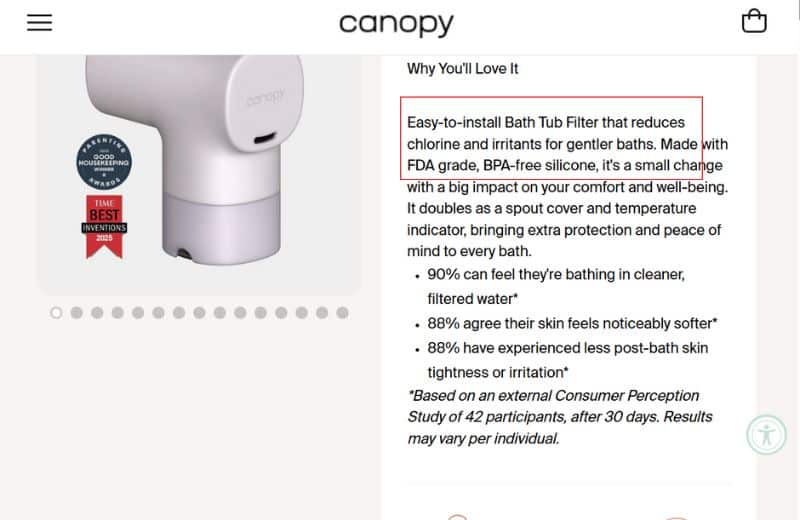
How do our results compare to Canopy’s claims? The filter is marketed to “reduce chlorine” and mostly focuses on the skin benefits (“hydrated, glowing skin” and “for people with sensitive skin”). These outcomes are less tangible than specific data points about contaminant removal and may be different for each individual, although Canopy does reference an external Consumer Perception Study of 42 participants conducted externally (the results aren’t available online).
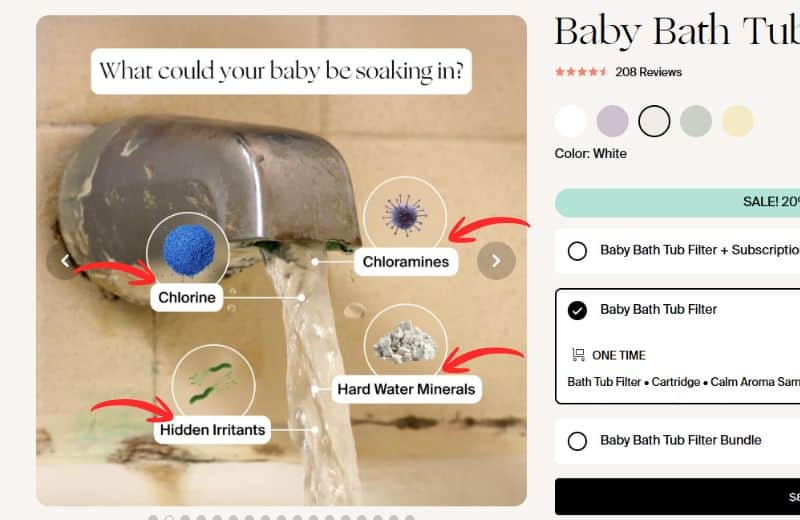
We also found an image listing the contaminants that might be present in bathwater, implying (without directly saying so) that Canopy can reduce these contaminants, which was only actually true for chlorine in our own tests.
Hardness
Our baseline water sample was only slightly hard, with a detected total hardness concentration of 17.13 PPM. For reference, soft water contains less than 17.1 PPM of hardness.
After installing and using the Canopy Bath Tub Filter, our water hardness was impacted only slightly, along with TDS and alkalinity:
- Total hardness increased by just 5%, from 17.13 to 18.02 PPM
- TDS was reduced by just over 2%, from 39 to 38 PPM
- pH stayed the same (7.2)
As for individual mineral detections, magnesium increased by around 15% (from 0.53 to 0.61 PPM), calcium by 5% (from 5.9 to 6.2 PPM), sulfate by 10% (from 5.9 to 6.5 PPM), and carbonate by 16% (from 0.012 to 0.014 PPM). We’re not surprised that Canopy can’t reduce water hardness, since you generally need a water softener for this purpose. But it’s helpful to know that it doesn’t increase hard water mineral concentrations, as we experienced with some bath filters.
Other Detections
Several other contaminants were detected in our baseline and filtered water samples. While they’re not known to have health effects in bath water, we think they’re interesting enough to share here.
Our baseline sample contained 0.05 PPM of aluminum, which Canopy effectively removed, bringing concentrations down to 0 PPM. This was the same outcome that all the other bath filters achieved in our testing.
0.0066 PPM barium, 0.0017 PPM copper, 0.5 PPM fluoride, 0.018 PPM strontium, and 1.2 PPM phosphorus were also detected. These either increased or remained the same post-filtration: fluoride increased by 20%, barium by 12%, copper and strontium by 5%, and phosphorus not at all. 0.0011 PPM of manganese was also introduced (it wasn’t detected in our baseline sample).
The increase in copper could be due to the filter’s KDF-55 media, but most likely, these minor elevations are all due to fluctuations in contaminant concentrations between the unfiltered and filtered water tests.
Performance Certifications
Score: 6.00
Water filter manufacturers can choose to get their product officially tested and certified to NSF performance standards. These involve rigorous testing under controlled conditions to confirm that a filter actually performs as advertised, adding a layer of credibility and accountability that marketing claims alone can’t provide.
The Canopy Bath Filter has supposedly been tested to NSF/ANSI 177, a certification standard that’s awarded to shower filters for free chlorine removal. We couldn’t find any test data or proof of official performance certifications online.
🚦Filtration Rate
Score: 10.00For our filtration rate testing, we measured the flow of water through the filter in gallons per minute (GPM).
People expect to be able to fill a bathtub in a reasonable amount of time, even with a filter installed. However, because most filters were unable to effectively address chlorine at the faster faucet flow, the scores awarded here are based on our slower flow testing with more reliable and consistent chlorine reduction.
The Canopy filter had a flow rate of 0.60 GPM in our low-flow testing, based on its average time to fill 2 cups of water out of three tests (just under 12.5 seconds).
📐 Design
Score: 7.20Canopy received one of the better design scores we awarded in our bath filter testing. It has a silicone outer shell that feels better quality than filters with a plastic construction, with a reduced potential for microplastics or bisphenols leaching. But it’s lacking a materials safety certification, which prevented it from getting a higher score in this category.
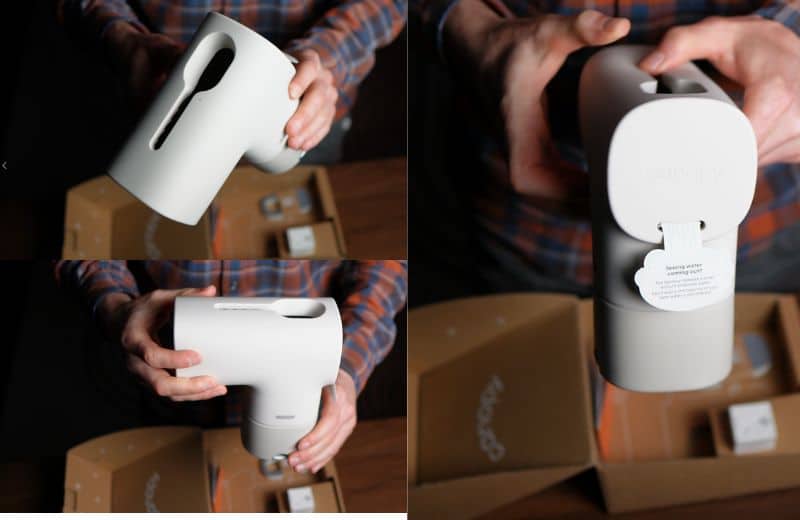
The housing design is unique, with Canopy choosing to step away from the traditional “bath ball” look with a unit that slots over the entire faucet. There’s the potential for some compatibility issues here, as instead of simply hanging it beneath the faucet spout, it needs to fit comfortably over the whole thing. But the filter does come with 2 attachment band sizes to make it fit comfortably on several faucet sizes and styles.
A unique design feature of the housing is the temperature indicator, which changes color as the water warms. While it doesn’t give you a precise temperature reading, it’s a nice safety feature that you might appreciate, especially if you have young children.
Component Quality
Score: 8.00
Canopy’s silicone outer shell earned it a slightly higher score than the other filters with plastic housings that we tested.
That said, the design doesn’t entirely avoid plastic, as the filter cartridge itself is plastic, and this prevented the score from being any higher.
Filter Materials
There are three key filter materials used in the Canopy Bath Tub Filter:
- Calcium sulfite beads
- Coconut shell activated carbon media
- KDF 55 beads
All three media are commonly used in chlorine-removal water filters, and they’re generally all effective for this purpose.
We do have some concerns about the coconut shell carbon in a filter that’s intended for use with hot water, as higher temperatures can affect carbon’s adsorption ability and even damage the media. Since we tested the filter with cold water, we can’t theorize about the potential effects of heat on the media performance.
Materials Safety Certification
Score: 6.00
Alongside optional performance certifications, water filters can also obtain design certifications, usually for materials safety or lead-free design. We could find none of these certifications for the Canopy Bath Filter, leading to a lower score awarded in this category.
⚙️ Setup
Score: 9.00As long as you have a compatible bath faucet, setting up the Canopy filter is quick and easy. There are just three steps involved in the installation:
- Slide the attachment band onto your faucet (Canopy provides two, so pick the one that fits).
- Slide the silicone housing over the faucet and press it onto the attachment band.
- Make sure the housing is positioned so the filter is directly beneath the faucet spout.
Although Canopy might look a bit more complicated to install than other bath filters, it’s not. You won’t need any tools or DIY knowledge, and the process takes less than 5 minutes from start to finish.
Canopy doesn’t mention flushing the filter before use, but we did this anyway, simply by running warm water through the filter and letting it run down the drain for 5 minutes. This is standard practice for most faucet and shower filters and removes any loose media before the filter is put to use.
🔧 Maintenance
Score: 9.50The Canopy Bath Filter is also quick and affordable to maintain, earning its highest score in this performance category.
Servicing Requirements
9.00
Canopy recommends replacing the bath filter cartridge every 90 days, depending on your water quality and usage.
Replacing the cartridge is an important maintenance task because it keeps the filter in proper working order. The more you use the filter, the more saturated the media will become, and the less effective its filtration performance. There’s also an increased risk of bacteria and mold buildup in the filter materials.
Canopy’s projected 90-day filter lifespan is shorter than many of the other bath filters we tested. But we haven’t used any of the filters for long enough to confirm the accuracy of their lifespan claims. In reality, since they’re all similarly sized and use similar media, they’re all probably pretty similar in media capacity, too.
Aside from replacing the filter, Canopy minimizes any other manual servicing required. The silicone housing has built-in ventilation and an antimicrobial coating to prevent the buildup of mildew and mold (an important feature, since silicone can be quite sticky and isn’t as easy to wipe clean as plastic). It’s also dishwasher-safe, so you don’t have to manually clean it when it needs a deeper clean.
Costs
Score: 10.00
Canopy is the most expensive bath filter we reviewed, with an upfront cost of $89. The good news is that you don’t have to replace the entire unit every 90 days—it’s just the filter cartridge inside the housing that gets replaced.
| Bath Filter | Price | Cost per gallon |
|---|---|---|
| Santevia | $19.99 | $0.008 |
| Canopy | $89.00 | $0.014 |
| Sprite | $29.99 | $0.022 |
| Crystal Quest | $64.95 | $0.016 |
| Tubo | $64.99 | $0.014 |
Replacement filters cost around $37, with the option to save by signing up for the subscription delivery service or buying multiple filters in bulk. ere
🏢 Company
Score: 8.80Canopy’s warranty, shipping, and returns policies are collectively better than any other bath filter we reviewed, earning a high overall score in this category.
Warranty
Score: 8.50
The base-level warranty offered to all Canopy customers is the 12-month warranty, which means you’ll be entitled to a repair, replacement, or refund if your filter has a problem that’s covered by the warranty terms.
The warranty doesn’t cover normal wear and tear or accidental damage, which is pretty standard for any water filter. It’s one of the longer warranties we’ve seen for filters in this category.
Learn more about Canopy’s warranty here.
Shipping
Score: 9.00
Regardless of where in the US you’re based, you’ll receive free shipping on any orders with Canopy when you spend over $25. Since Canopy bath filters and replacement filters exceed this minimum spend, you should never need to pay out of pocket for shipping.
Shipping is also offered to Canada, but at a flat fee of $30, and only for customers who have signed up for subscription refills before March 2025.
Canopy’s shipping policy can be viewed here.
Returns
Score: 9.00
Canopy also offers one of the longest return policies we’ve seen for a bath filter, spanning 60 days from the date of purchase. This entitles you to return your filter for any reason if you’re not satisfied within this returns window.
There are a few stipulations to be aware of:
- Refunds only apply to filters purchased directly on the Canopy website.
- A $10 handling fee may be deducted from your refund “in some cases”.
- You’ll receive a free returns shipping label if you’re based in the US, but only if your return request is accepted by Canopy’s Customer Experience team.
- Canopy will then evaluate your return once received and decide whether or not to approve the refund.
Read the full refund policy terms and conditions here.
💰 Value For Money
After reviewing every aspect of the Canopy Bath Filter’s performance, we don’t think it offers the best value for money.
It’s on the expensive end for a bathtub filter, suggesting that it should be superior to other, more affordable products—but our own test data shows that it’s not. In fact, it was unable to effectively remove chlorine at a “normal” faster faucet flow rate, and it didn’t reduce DPBs at all.
The filter was the second-highest scoring of all the bath filters we tested, but only because most of them performed pretty poorly, especially when it came to chlorine reduction. Only the Santevia Bath Filter (which is literally a quarter of the price of Canopy) removed 100% chlorine at a faster faucet flow.
We’d hesitantly recommend this filter to anyone who prefers its unique design and is happy to simply reduce, not remove, chlorine in their bathwater. If you want to address a broader range of contaminants more effectively, you’ll need to consider a whole-home POE filtration system. And for addressing water hardness, nothing performs better than a water softener.
Found this review helpful?
Comment below or share this article!
This review was amazing!! Exactly what I was looking for. Thank you for doing this work!
Glad it was helpful! Thanks for your feedback