

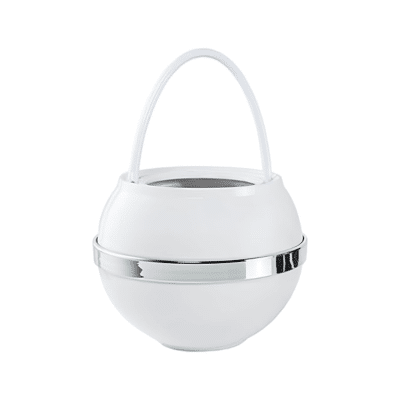
The Crystal Quest Bath Ball Filter is one of the most popular bath filters sold today, marketed to remove “pollutants and contaminants” and deliver “clean, pH-balanced water”. It’s another “traditional” take on a bath filter, with a cylindrical unit that hangs beneath your faucet spout and contains three types of media: GAC (granular activated carbon), redox (KDF), and chlorine removal (possibly calcium sulfite).
What We Like
What We Don’t Like
| Price | $64.95 |
| Contaminants Reduced | Chlorine |
| Certifications | Not Certified |
| Process | Calcium Sulfite + Activated Carbon + KDF |
| Filter Capacity | 2,500 gallons |
| Annual Cost | ~$80 |
| Warranty | 1 year |
We conducted our own series of tests on the filter using city water in Colorado to analyze its performance with real-world use. Alongside contaminant reduction testing using Tap Score kits from SimpleLab, we also measured flow rate, weighed in on setup, maintenance, and design quality, and researched the manufacturer’s warranties and policies.
📊 Scoring Data
We were keen to see how the Crystal Quest Bath Filter could alter the quality of our bath water under normal use conditions. We tested the filter as part of a larger project that involved five of the most popular bath filters. This gave us context when analyzing each filter’s performance, so we could understand the “norm” and determine the best-performing filters using our data-driven scoring framework.
Every water filter we test is assessed against six key areas of performance, which are each segmented into smaller scoring criteria. We then combine these results to reach a weighted average. You can see how Crystal Quest scored across these categories in the table below.
| Criteria | Results |
|---|---|
| Overall Score | 7.94 |
| Health Related Contaminants | 7.70 |
| Aesthetic Related Contaminants | 6.00 |
| Performance Certification | Not Certified |
| Filtration Rate | 0.97 GPM |
| Component Quality | Weak |
| Component Certification | Unsatisfactory |
| Setup | Outstanding |
| Servicing Requirements | Outstanding |
| Costs | $0.016/ gallon |
| Warranty Length | 1 year |
| Shipping | Free on orders > $150 |
| Returns | Only on perfectly new & unused items |
🚰 Contaminant Reduction
Score: 7.45Most folks choose to invest in a bath filter because they expect it to remove contaminants that might be harmful in their water, such as chlorine and hardness minerals (which have skin and hair health effects), as well as disinfection byproducts (which can have health effects when inhaled in water vapor). Our contaminant reduction testing examined how Crystal Quest could remove these contaminants detected in our bathwater.
The overall score in this category was primarily influenced by data from our Tap Score lab testing. A smaller sub-category also looked at whether or not the filter had official performance certifications from the NSF/ANSI, IAPMO, or the WQA to support Crystal Quest’s contaminant reduction claims.

Our Performance Testing
Score: 7.62
We evaluated the filter’s performance by running a full comparison of our bath water before and after filtration, using SimpleLab’s Tap Score lab testing service. We took two separate water samples, one straight from the faucet, and the other filtered through the Crystal Quest unit. This allowed us to see how much of a difference it made to our overall water quality.
Comparing our Tap Score reports helped us to understand the filter’s performance by seeing which contaminants were reduced after filtration. Tap Score lets you view your results against a few different benchmarks, including the EPA’s Maximum Contaminant Levels (MCLs) and the stricter protective Health Guideline Levels (HGLs). We referenced the HGLs for this review, giving us a more health-focused comparison.
| Analyte | Unit | Pre | Post | Difference |
|---|---|---|---|---|
| Alkalinity (as CaCO3) | mg/L | 14 | 15 | 7.14% |
| Aluminum | mg/L | 0.05 | 0 | -100.00% |
| Barium | mg/L | 0.0066 | 0.0073 | 10.61% |
| Bicarbonate | mg/L | 17.04 | 18.25 | 7.10% |
| Calcium | mg/L | 5.9 | 6.4 | 8.47% |
| Carbonate | mg/L | 0.012 | 0.017 | 41.67% |
| Chloride | mg/L | 5 | 5.6 | 12.00% |
| Chloride-to-Sulfate Mass Ratio | 0.85 | 0.89 | 4.71% | |
| Chloroform | µg/L | 24.7 | 25.8 | 4.45% |
| Copper | mg/L | 0.0017 | 0.0026 | 52.94% |
| Fluoride | mg/L | 0.5 | 0.6 | 20.00% |
| Grains per gallon | Grains | 1 | 1.09 | 9.00% |
| Hardness (Ca,Mg) | mg/L | 17 | 19 | 11.76% |
| Hardness (Total) | mg/L | 17.13 | 18.61 | 8.64% |
| Langelier Saturation Index | -2.4 | -2.3 | -4.17% | |
| Magnesium | mg/L | 0.53 | 0.63 | 18.87% |
| pH | pH | 7.2 | 7.3 | 1.39% |
| Phosphorus | mg/L | 1.2 | 1.2 | 0.00% |
| Sodium | mg/L | 5 | 5.61 | 12.20% |
| Sodium Adsorption Ratio | 0.53 | 0.57 | 7.55% | |
| Specific Conductivity | umhos/cm | 65.4 | 66.1 | 1.07% |
| Strontium | mg/L | 0.017 | 0.018 | 5.88% |
| Sulfate | mg/L | 5.9 | 6.3 | 6.78% |
| Total Dissolved Solids | mg/L | 39 | 40 | 2.56% |
| Total THMs | µg/L | 24.7 | 25.8 | 4.45% |
While we tested for contaminants broadly (and will discuss everything detected in this review), our main focus was on impurities that most affect bathwater quality:
- Chlorine*
- Disinfection byproducts
- Mineral hardness
These are often linked to skin dryness and irritation, as well as poor indoor air conditions.
We took all samples using cold water. Although most folks will be using the filter with hot water, elevated water temperatures can cause disinfection byproducts to dissipate faster. By using cold water, we could more accurately measure how Crystal Quest removed these substances without skewing the results due to heat-related dissipation.
Health-Related Contaminants
Score: 7.70
The Crystal Quest Bath Filter delivered a fairly subpar performance when it came to removing contaminants with health effects.
Our baseline water sample contained 24.7 PPB of chloroform, a disinfection byproduct with known health effects, including an increased cancer risk, when inhaled in water vapor. These concentrations exceeded the HGL 0.221 PPB by 11,075%.
We also detected around 2 PPM of chlorine (a common disinfectant), which can have hair and skin effects, as well as affecting water aesthetically (taste and smell). The EPA’s “safe” range for chlorine in drinking water is up to 4 PPM, but you may still experience skin and hair issues with these lower concentrations.
While disinfection byproducts were detected in our lab test, we used test strips to detect chlorine on-site, since it’s a highly volatile chemical that is likely to dissipate after collection, affecting the accuracy of the results.
We conducted two chlorine tests:
- The first after filtering water at the highest faucet flow rate possible without it leaking out of the top of the filter.
- The second at a slower faucet rate, to assess whether flow rate affected performance.
Starting with chlorine reduction, here’s how the Crystal Quest Bath Ball Filter performed:
- In our “fast flow” test (with an average flow rate of 3.79 GPM), the filter didn’t remove any chlorine.
- In our “slow flow” test (with an average flow rate of 0.97 GPM), the filter reduced chlorine levels by 85%, from 2 PPM to 0.3 PPM.
Our results showed that Crystal Quest performed the worst of all the products we tested for chlorine reduction. It was the only filter that wasn’t capable of removing 100% chlorine at the slower faucet flow, which would take an impractically long time to fill a 30-gallon bath (around 31 minutes) anyway.
As for DBPs, Crystal Quest claims that the filter can remove chloroform, which is the specific disinfection product that was detected in our water. We had high hopes going into testing, but our filtered water sample data actually shows a 4.45% increase in chloroform. That tells us that (in our circumstances at least) the filter can’t remove disinfection byproducts at all.

This is a disappointing outcome, but it highlights something we warn about again and again: water filter manufacturers can claim pretty much anything without having to offer supporting proof. It’s only when we conduct our own testing that we can get a better understanding of how a water filter actually performs in a real use case. That’s why we always recommend doing your research, reading reviews like these, and contacting the manufacturer with questions whenever something isn’t clear.
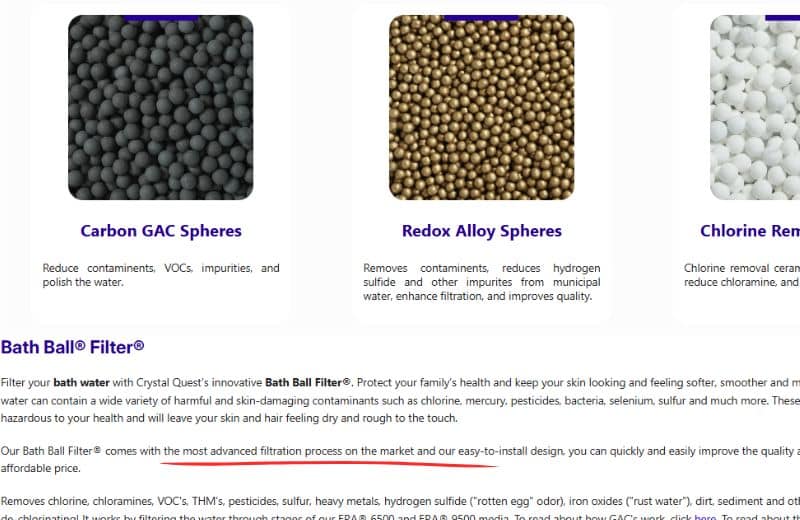
In Crystal Quest’s case, we could find no testing, either by the manufacturer or a third-party lab, to validate these performance claims. Our own data certainly doesn’t support the claim that the filter uses “the most advanced filtration process on the market”.
Hardness
Our baseline water sample had a detected total hardness concentration of 17.13 PPM. That means it was only slightly hard, as defined by the NSF/ANSI 44 and NSF/ANSI 330 (soft water contains <17.1 PPM of hardness).
We saw very little difference in hardness and related mineral concentrations post-filtration. Total hardness increased by just over 8%, while carbonate increased by 41%, magnesium by nearly 19%, and calcium by 8.5%. These results suggest that the filter may contain mineral beads or similar media.
We also saw a small increase in pH, from 7.2 to 7.3, and TDS increased by just 2%.
Other Detections
Aluminum was also detected in our baseline water sample, along with fluoride, strontium, phosphorus, and copper.
The Crystal Quest filter removed 100% aluminum, from 0.05 to 0 PPM: the same result as with all the other bath filters we tested. Phosphorus concentrations remained the same post-filtration.
Interestingly, barium increased by 10% (from 0.0066 to 0.0073 PPM), fluoride by 20% (from 0.5 to 0.6 PPM), and strontium by 5% (from 0.017 to 0.018 PPM). Since these contaminants are only present in very low trace amounts, these fluctuations point towards incidental changes to our water quality between tests.
Crystal Quest claims to remove heavy metals, which (aside from aluminum) is not conclusive with our test results. It doesn’t claim to reduce fluoride or phosphorus.
Copper increased by 52% (from 0.0017 to 0.0026 PPM), likely due to leaking from the KDF filter media. While there are no specific claims about copper, the product page does feature a customer review that claims the filter works to remove copper and its associated “blue ring” staining. It’s possible that copper was only leaching from our KDF filter because it was fairly new, but we’d need to conduct another test after using the filter for several more weeks to confirm this.
Performance Certifications
Score: 6.00
If a water filter manufacturer wants to prove that their filter can remove a certain contaminant beyond a specific threshold, they can obtain testing and certification through an official body, like the NSF/ANSI, WQA, or IAPMO, to NSF Standards.
There’s no dedicated performance certification for bath water filters, but there are certifications for many of the contaminants that Crystal Quest claims to remove, like chlorine (NSF 42), as well as heavy metals, VOCs, and other contaminants with health effects (NSF 53). However, we could find no evidence of performance certifications for the filter.
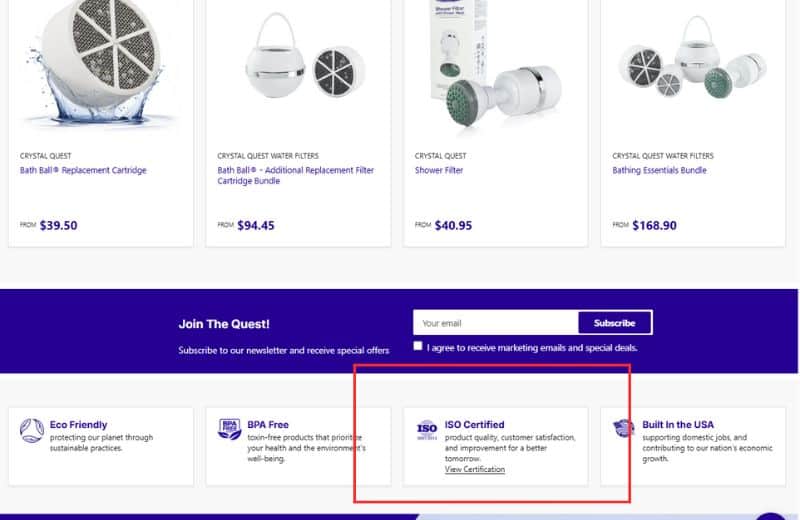
The company is ISO certified, specifically assessed and approved to ISO 9001 (Quality Management System), a framework that helps organizations consistently provide products and services that meet customer and regulatory requirements. Don’t mistake this for a performance certification—it’s about Crystal Quest’s manufacturing processes and not about the ability of its filters to reduce select contaminants.
🚦Filtration Rate
Score: 8.50There are a couple of factors that affect the flow of water through a bath filter:
- The flow/volume of water from the bath faucet
- The speed at which water travels through the filter media and is expelled into the bathtub
The Crystal Quest Bath Ball Filter had a flow rate of 0.97 GPM at the slower faucet flow, receiving a score of 8.50 in this category.
As we mentioned earlier, we did originally test the filter with a faster flow rate (essentially the strongest flow we could achieve from the faucet without causing overflow).
At this faucet flow, the filter had a much faster flow rate of 3.79 GPM. But since it removed no chlorine whatsoever at this flow and was essentially unfit for purpose, we’re using its slower flow (which offered more thorough chlorine reduction) as a performance metric in this category.
📐 Design
Score: 6.60Crystal Quest has the traditional “bath ball” filter design, consisting of a cylindrical unit that’s suspended underneath the bath faucet and held in place by a strap.
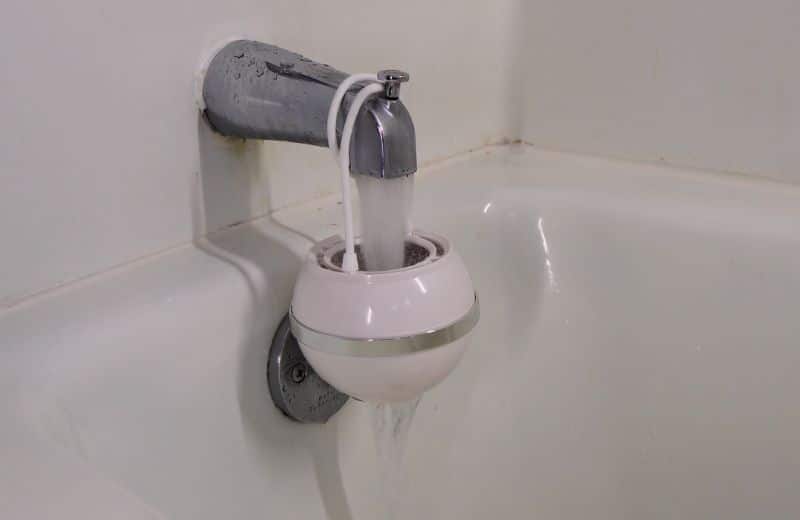
Rather than being physically screwed onto the faucet (as with a typical inline filter), the filter is simply positioned beneath the faucet spout, so water flows through the unit before exiting into the bathtub below.
We had a few issues with the durability and build of this particular filter, resulting in a lower design score overall.
Component Quality
Score: 7.00
The key components used in Crystal Quest’s housing are made from flimsy plastic, and this left us questioning its overall component quality. Specifically, the type of plastic used is BPA-free Acrylonitrile Butadiene Styrene, or ABS, which, according to the EWG’s Skin Deep® scoring system, is one of the safest materials.
That said, some folks may prefer a filter that doesn’t put their filtered water in contact with plastics. We also can’t guarantee that the specific type of ABS used in the Crystal Quest filter doesn’t leach any other bisphenols, since it’s only claimed to be BPA-free.
Given the durability issues that we know plastic can have, we’re not sure exactly how much use we could get out of the filter while its design remained intact. This is something we could only determine with months of ongoing testing.
Filter Materials
There are three key filter materials used in the Crystal Quest Bath Filter:
- Carbon GAC spheres
- Redox alloy (KDF) spheres
- Chlorine removal ceramic spheres
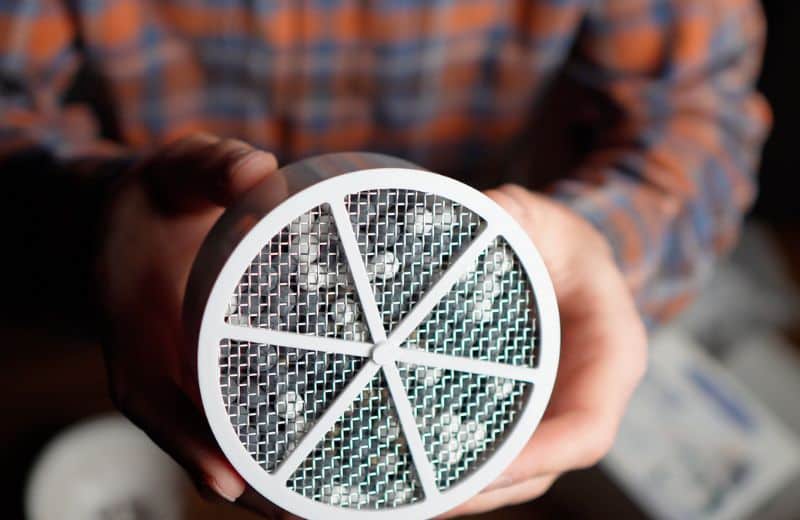
GAC (granular activated carbon) is commonly used in water filters because of its widely researched ability to improve aesthetic water quality. However, high temperatures can affect adsorption ability—an EPA study of carbon’s ability to adsorb VOCs noted that while “adsorption can take place as low as 32°F and even higher than 104°F”, an increase in temperature was associated with a decrease in equilibrium adsorptivity.
In fact, many carbon-based faucet water filter manufacturers warn their customers not to use their filters with hot water for this reason. We tested Crystal Quest with cold water to accurately measure DBPs, but we’re planning to conduct testing to see how heat affects filtration rate in the future*.
KDF is also commonly used in water filters, particularly KDF-55, which is used to reduce chlorine and heavy metals. Ceramic media is less commonly found in bath water filters but can filter out things like rust and particulates, making it a complementary addition to the other two media.
Materials Safety Certification
Score: 6.00
Some water filter manufacturers obtain materials safety certifications, either as add-ons to performance certifications or separately, to prove that their filters are constructed from safe components.
The Crystal Quest Bath Filter has no certifications for component safety or lead-free design, which further pulled down its design score.
⚙️ Setup
Score: 9.50Setup is an area in which Crystal Quest achieved higher scores. The user manual outlines how to prepare the filter for use in just two steps: you simply hang the unit from your faucet and activate the media (flushing out any loose particles) by running hot water through it for 2-3 minutes.
There are no complicated installation requirements, and no tools or DIY experience needed.
🔧 Maintenance
Score: 8.5The filter also has a simple, affordable maintenance schedule.
Servicing Requirements
9.50
Replacing the filter is the key maintenance job for bath filtration systems like Crystal Quest. There’s a cartridge inside the housing that can be accessed and replaced by unscrewing the bottom of the unit.
The cartridge used in the Bath Ball Filter reportedly lasts 12 to 18 months, which equates to around 2,000-2,500 gallons of water. That’s one of the longest projected bath filter lifespans we’ve come across, but keep in mind that the capacity-to-lifespan predictions are estimates only and can vary from one manufacturer to the next.
A benefit of this particular filter is that you can backflush it by turning it upside down and running water through in an opposite direction, to sustain flow and filtration performance before a new cartridge is needed.
Aside from replacing the filter, you’ll need to wipe down the housing as part of your usual bathroom cleaning process to keep it free from algae and mold.
Costs
Score: 10.00
The Crystal Quest Bath Filter is one of the more expensive bath filters we reviewed, costing around $65 upfront. It’s affordable to maintain, though, with a replacement filter cost of around $40 (you can knock a few dollars off by buying multiple filters at once).
| Bath Filter | Price | Cost per gallon |
|---|---|---|
| Santevia | $19.99 | $0.008 |
| Canopy | $89.00 | $0.014 |
| Sprite | $29.99 | $0.022 |
| Crystal Quest | $64.95 | $0.016 |
| Tubo | $64.99 | $0.014 |
Since the projected lifespan of each filter cartridge is 18-24 months, you’ll only need to pay for a replacement filter around once a year, maximum—assuming that the manufacturer’s estimate is accurate.
🏢 Company
Score: 8.05Crystal Quest impressed us with its warranty and shipping offerings, but its returns/refund policy was a letdown in this category.
Warranty
Score: 8.50
All of Crystal Quest’s products (excluding filter cartridges) are backed by a 1-year limited warranty against “all defects in materials and workmanship”. That means you’ll be entitled to a free repair or replacement if your bath filter is proven to be defective within a year after your purchase.
There are a few terms to be aware of:
- You must have used the filter in compliance with the user manual (aka. the warranty doesn’t cover defects due to misuse).
- As the customer, you’ll be responsible for paying for return shipping.
You can see the full terms for Crystal Quest’s 1-year warranty here.
Shipping
Score: 9.00
Free shipping is offered by Crystal Quest only on orders totalling $150 or more, so you’ll be required to pay to ship your bath filter and any filter replacement. Exact shipping fees depend on your location and the type of shipping you choose.
Crystal Quest’s shipping policy can be viewed here.
Returns
Score: 6.50
Crystal Quest’s returns policy is for 30 days after the date of purchase, and there’s a lot of fine print to be aware of:
- Returns for refunds are accepted ONLY on perfectly new, unused items in the original packaging and without any damaged or missing parts.
- You can return a used filter, but only for exchange.
- You’ll be expected to pay shipping fees for any items you return.
- You’ll also be hit with a 30% restocking fee, which will be deducted from your refunded amount if your situation allows for a refund.
Many of the similar bath filters we tested could be returned used for a full refund, so Crystal Quest is comparatively the less appealing option if you’re looking for the reassurance of a good returns policy.
Read the full refund policy terms and conditions here.
💰 Value For Money
In all, we don’t think the Crystal Quest Bath Filter is worth it for most folks.
It’s pretty expensive for what it is, especially when we look at the fact that it couldn’t even remove 100% chlorine at an impractically slow faucet flow rate.
Plus, we have concerns about the quality of its plastic construction, and the manufacturer claimed to remove several contaminants that weren’t addressed in our own testing.
It’s also around three times the price of the Santevia Bath Filter, which was the only bath filter in our testing to remove 100% chlorine at the faster faucet flow, making it our top recommended product for this purpose.
That said, Crystal Quest is one of the more reputable, long-standing brands selling bath filters, and the 1-year warranty is pretty decent. If you have relatively low expectations and just want to reduce chlorine, and you’re happy to fill your bathtub at a much slower rate, we would hesitantly recommend this filter to you.
Found this review helpful?
Comment below or share this article!