


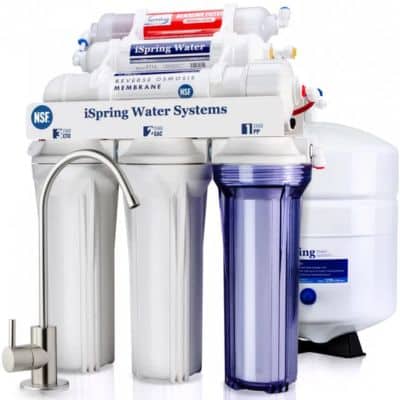
The iSpring RCC7 is a multi-stage tank-based under-sink reverse osmosis system. It sits in the mid-tier of iSpring’s RO offerings, and has a few configuration options including remineralization, a booster pump and UV stage.
What We Like
What We Don’t Like
Product Specs
| Price | $268.99 |
| Contaminants Reduced | 9+ |
| Certifications | NSF/ANSI 58 |
| Process | Sediment Filter + Granular Activated Carbon + Carbon Block + RO Membrane + Post Carbon + Remineralization |
| Filter Capacity | Pre & Post Filters: up to 12 months; RO Membrane: up to 3 years |
| Annual Cost | ~$180 |
| Warranty | 1 year (Limited) |
We tested the RCC7-AK using a highly involved and comprehensive analysis, recording everything from contaminant reduction to wastewater production, flow rate, TDS creep, noise levels, ease of installation and maintenance, and more.
📊 Scoring Data
We review all water filters using our scoring system, which includes each of our testing categories and combines the individual scores awarded for each. We tested the iSpring RCC7 to see how it compared to the top-ranking RO systems that we’ve reviewed so far.
Each filter we test receives an overall weighted performance score, which is determined by its individual scores across six sub-categories of contaminant reduction, flow rate, design quality, installation requirements, maintenance and costs, and the manufacturer’s warranty, shipping, and returns offerings. We also conducted tests to evaluate the RCC7’s efficiency ratio, noise levels, and several other factors that are interesting to note, although these currently are not ranking factors.
The table below displays the iSpring RCC7’s performance scores.
| Criteria | Results |
|---|---|
| Overall Score | 6.64 |
| Health Related Contaminants | 4.70 |
| Aesthetic Related Contaminants | 8.50 |
| Performance Certification | NSF 58 |
| Filtration Rate | 75 GPD |
| Component Quality | Outstanding |
| Component Certification | NSF 58 |
| Setup | Weak |
| Servicing Requirements | Good |
| Costs | $0.17 per gallon |
| Warranty Length | 1 year |
| Shipping | Free shipping within the contiguous 48 U.S. states. |
| Returns | 30 days with stipulations |
🚰 Contaminant Reduction
Score: 5.25If you’re considering a reverse osmosis system like the RCC7, there’s a good chance that you’re looking for a water purification solution, rather than something offering a more targeted approach for select contaminants.
Generally, the RO systems we’ve tested have greatly reduced or completely removed the majority of impurities, so, going into testing the RCC7 in this category, our expectations were high.
Our contaminant reduction scoring is primarily influenced by the data we gather from our own water quality testing, but we also take into account evidence of official performance certifications by IAPMO, the NSF, or the WQA.
Our Performance Testing
Score: 4.89
We wanted to know how the RCC7 affected our water quality in real-world testing conditions, so we took samples of our feed water and water directly from the RCC7’s faucet. We then sent these to our lab-testing partner, Tap Score, for analysis.

Our Tap Score interactive reports highlighted all the impurities detected in both water samples, so we could easily compare the two to understand the RCC7’s performance. We compared our test data against the health-protective Health Guideline Levels (HGLs), and the report also lets you compare against MCLs for reference.
We tested for one contaminant on-site: chlorine. Our sample-testing kit contained Hach chlorine test strips, which we used to detect this volatile contaminant immediately for the most accurate data.
Health-Related Contaminants
Score: 4.70
The RCC7 received one of the lowest scores we’ve awarded to an RO system for reducing contaminants with health effects. While it reduced most contaminants without issue, two new contaminants were detected post-filtration.
Our unfiltered water sample contained 16 contaminants with possible health effects, including:
- 3 disinfection byproducts
- Uranium
- Fluoride
- Copper, barium, strontium, and boron
- Nitrate
- Chromium
All 3 disinfection byproducts (dibromochloromethane, bromodichloromethane, and bromoform) were detected at levels exceeding the HGL, as well as uranium and fluoride.
See the full list of contaminants detected in the next table.
| Analyte | Unit | Unfiltered | iSpring RCC7 | Difference |
|---|---|---|---|---|
| Alkalinity (as CaCO3) | PPM | 391 | 35 | -91.05% |
| Arsenic | PPM | 0 | 0.00333 | N.A |
| Barium | PPM | 0.033 | 0.00306 | -90.73% |
| Bicarbonate | PPM | 471.09 | 18.87 | -95.99% |
| Boron | PPM | 0.487 | 0.395 | -18.89% |
| Bromodichloromethane | PPB | 4.29 | 0 | -100.00% |
| Bromoform | PPB | 11.4 | 0 | -100.00% |
| Calcium | PPM | 52.1 | 7.94 | -84.76% |
| Carbonate | PPM | 2.74 | 8.7 | 217.52% |
| Chloride | PPM | 128 | 3 | -97.66% |
| Chloride-to-Sulfate Mass Ratio | 1.05 | Too numerous to count | N.A | |
| Chromium (Total) | PPM | 0.0047 | 0.0028 | -40.43% |
| Copper | PPM | 0.287 | 0 | -100.00% |
| Dibromochloromethane | PPB | 11.9 | 0 | -100.00% |
| Fluoride | PPM | 2.4 | 0.3 | -87.50% |
| Grains per gallon | Grains | 10.7 | 1.34 | -87.48% |
| Hardness | PPM | 182 | 22.9 | -87.42% |
| Hardness (Total) | PPM | 183.11 | 22.99 | -87.44% |
| Langelier Saturation Index | 0.73 | 0.89 | 21.92% | |
| Magnesium | PPM | 12.6 | 0.759 | -93.98% |
| Manganese | PPM | 0.0011 | 0.0019 | 72.73% |
| Molybdenum | PPM | 0.002 | 0.00179 | -10.50% |
| Nitrate (as N) | PPM | 1.4 | 0.2 | -85.71% |
| pH | pH | 8.1 | 10 | 23.46% |
| Potassium | PPM | 3.96 | 1.11 | -71.97% |
| Selenium | PPM | 0.0041 | 0 | -100.00% |
| Sodium | PPM | 237 | 5.04 | -97.87% |
| Sodium Adsorption Ratio | 7.64 | 0.46 | -93.98% | |
| Specific Conductivity | umhos/cm | 1500 | 75 | -95.00% |
| Strontium | PPM | 0.566 | 0.0284 | -94.98% |
| Sulfate | PPM | 122 | 0 | -100.00% |
| Total Dissolved Solids | PPM | 875 | 45 | -94.86% |
| Total THMs | PPB | 27.59 | 0 | -100.00% |
| Uranium | PPM | 0.0036 | 0 | -100.00% |
| Vanadium | PPM | 0.0017 | 0.111 | 6429.41% |
Post-filtration, the 3 disinfection byproducts, and uranium were eliminated by 100%, and fluoride was reduced by 87%.
Copper, selenium, and sulfate were also completely eliminated, while strontium was reduced by 94%, barium by 90%, and nitrate by 85%.
Less impressively, chromium was reduced by just 40%, boron by 18%, and molybdenum by 10%.
There were also two concerning anomalies with our test results: arsenic and vanadium were both detected post filtration when arsenic hadn’t been detected in the baseline sample, and only tiny trace amounts of vanadium (0.0017 PPM) were originally detected.
We suspect that these contaminants may be coming from the remineralization stage*, but this is an unusual result since the system is NSF certified (including the remineralization filter).
Arsenic is part of NSF extraction testing and can be reported down to 0.001 PPM, and the Tap Score test uses the same reporting limit. Our test found 0.003 PPM, which is just above that detection level, while the Health Guideline Level (HGL) for arsenic is 0.
Vanadium is also included in NSF extraction testing, and it was measured at 0.111 ppm in our test. The HGL for vanadium is 0.05 PPM.
Aesthetics, pH, and Mineral Content
Score: 8.50
Because we used the iSpring RCC7 with the remineralization upgrade, we expected it to aesthetically improve our water quality compared to a setup without remineralization.
The system did just that, increasing the pH of our water from 8.1 to 10 in our Tap Score test and from 7.58 to 9.16 in our own on-site tests with a pH meter. Without the remin filter, we’d likely see a dip in pH; RO water is typically mildly acidic.
We did still see a significant reduction in calcium (by 84%), magnesium (by 93%), sodium (by 97%), and potassium (by 71%), but without the remineralization stage, we’d expect these to all be reduced to close to 99%.
The system also eliminated 100% chlorine in our on-site tests—another box checked in this testing category.
Why didn’t it achieve the highest score for aesthetics? The Tap Score algorithm flagged the higher pH of our filtered water as having potential taste impacts, and we applied a lower score accordingly.
TDS & TDS Creep
To evaluate TDS creep, we compared TDS measurements recorded in our Tap Score reports, as well as measuring TDS ourselves on-site using a TDS meter.
We wanted to know the TDS of our water at different phases of using the system. This data also allowed us to determine whether there was an issue with TDS creep.
If you’re not familiar with it, we’ve written an article all about TDS creep here. The short explanation is that it’s characterized by high TDS levels in the initial draw of filtered water, resulting when the reverse osmosis system hasn’t been used for some time (such as overnight).
When the system is out of use, the pressure in the semi-permeable membrane begins to equalize, which temporarily raises TDS. We’ve found that this is more of an issue with tankless systems, which have no means of buffering the initial, lower-quality water produced immediately after the system turns on. Since the RCC7 is a tank-based system, we didn’t anticipate this being an issue.
We measured TDS creep by taking a TDS reading from a first-draw sample from the unit’s faucet, after letting it sit idle overnight for 10 hrs.
| Test Condition | TDS (PPM) |
|---|---|
| Feed Water | 635 |
| 1st Draw (After 10 hrs Idle) | 114 |
| Stable TDS | 44 |
| TDS Reduction | 93% |
| TDS Creep | 70 PPM |
Our feed water had a TDS of 635 PPM, which the WHO classifies as “poor” based on the taste effects of dissolved solids.
Our 1st draw TDS reading from the iSpring RCC7 measured 114 PPM. Although TDS has been reduced significantly, this is indicative of TDS creep compared to other tank-based systems we tested (which had 1st draw readings in the range of 40-60 on average).
After keeping the water flowing through the system for 2 minutes, we then took a 2nd draw sample from a separate glass, measuring the lowest stable TDS. This time, our TDS reading was 44 PPM.
That means the RCC7 has a TDS creep (i.e. the difference between the 1st and 2nd draw) of 70 PPM. This is still not significant compared to many tankless systems we tested, which had TDS creep measuring in the hundreds.
Performance Certifications
Score: 8.50
We know the limitations of our own contaminant reduction testing—we’re only able to evaluate a water filter’s ability to remove the impurities detected in our feed water.
That’s why performance certifications also contribute to the scores we award in this category. Note the distinction here: we’re looking for official certifications awarded by the NSF, WQA, or IAPMO, not third-party testing conducted by a lab on the manufacturer’s behalf.
The iSpring RCC7 has been NSF certified to Standard 58 (for RO systems) to remove 9 contaminants: asbestos, barium, cadmium, trivalent chromium, copper, fluoride, lead, selenium, and TDS.
It’s one of the more extensively certified reverse osmosis units we’ve tested, since many are only certified to reduce TDS (if they’re even certified at all). But it’s not the best—AquaTru, for instance, is certified for every single contaminant it’s claimed to reduce.
So, how do the RCC7’s certifications match up to iSpring’s own contaminant reduction claims? On the product page, we found the following claim:
“…removing up to 99% of over 1,000 harmful contaminants like sediment, vinyl chloride, chlorine, fluoride, lead (removes up to 98%), arsenic, PFAS, asbestos, calcium, sodium and more.”
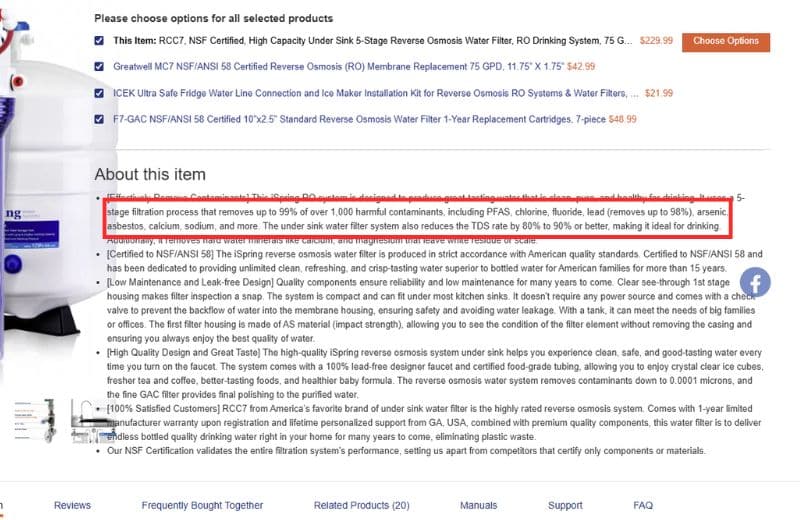
Of the contaminants listed there, the unit is only certified for 3 out of 10 (TDS, lead, and fluoride). We calculated the certification score accordingly based on the percentage of contaminants the unit is certified to remove versus the claims made.
It would make much more sense for iSpring to make claims about removing contaminants the unit is actually certified to reduce, rather than mentioning the likes of vinyl chloride, arsenic, and PFAs.
🚦Filtration Rate
Score: 6.0The RCC7 has a listed flow rate of 75 GPD (gallons per day), which is within the typical range (50-75 GPD) for a tank-based unit.
We tested flow rate in real-world conditions to see how our own readings compared to iSpring’s. With a feed water temperature of 60.6°F and an incoming water pressure of 48 PSI, we measured how long it took to fill a graduated measuring container up to a specified fill line with purified water.
| Test Metric | Result |
|---|---|
| Time to Fill 12 oz | 230.18 seconds |
| Measured Flow Rate | 0.02 GPM |
| Gallons Per Hour | 1.48 GPH |
| Converted GPD | 35.32 GPD |
| Manufacturer Claim | 75 GPD |
To achieve the most precise timings (down to the millisecond), we took video footage of the process and uploaded it onto an editing tool. We then moved through the video frame by frame until we had the precise starting point (water leaving the faucet) and the exact ending point (container filled to the specified fill line).
First, we recorded how long it took to fill to the 12-ounce line of our measuring jug, repeating the same test 3 times to take an average recording of 230.18 seconds. This translated to a flow rate of 0.02 GPM (gallons per minute), or 1.48 GPH (gallons per hour).
In gallons per day, that’s approximately 35.32 GPD ( the manufacturer claims up to 75 GPD, depending on factors including feed water temperature and pressure). This is one of the slowest water production rates of all the under-sink RO systems we’ve tested so far.
Efficiency Ratio
To demonstrate how much water an RO system purifies versus how much is wasted for any given volume, manufacturers use a measurement known as the efficiency ratio.
We’ve found that generally, conventional tank-based under-sink RO units are less efficient than tankless systems, meaning they waste more water during the purification process. The RCC7’s claimed efficiency ratio is 1:3, meaning that 3 gallons of water are wasted per up to 1 gallon of pure water produced.
| Test Volume | Wastewater Produced | Pure-to-Drain Ratio |
|---|---|---|
| 12 oz Test | 31 oz | 1:2.5 |
| 64 oz Test | 137 oz | 1:2.14 |
| Claimed by Manufacturer | — | 1:3 |
To test the system’s efficiency ratio with our own setup, we unhooked the end of the wastewater line and placed it inside a 1-gallon measuring cup. We then collected 12 ounces of purified water in a separate cup, recording the volume of wastewater produced during this time.
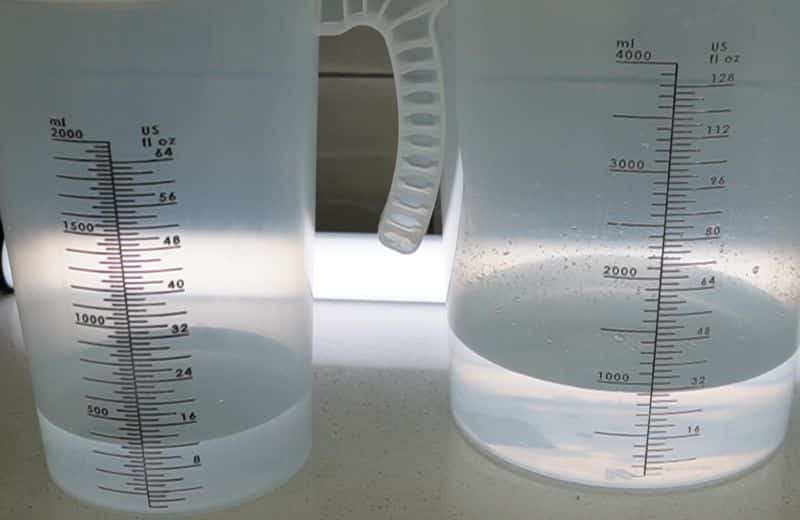
The RCC7 produced 31 ounces of wastewater for the 12 ounces of water purified, which equates to approximately 1:2.5 (meaning that for every 1 ounce of water purified, about 2.5 ounces go to drain).
So, in practice, the system was slightly more efficient than claimed by iSpring. This is even with our own water supply having a lower incoming feed pressure of 48 PSI and temperature of 60.6°F, which isn’t optimal for RO performance. For context, most residential membranes are the most efficient with a water pressure of around 60–80 PSI and a temperature of 77°F.
We repeated the test following the same process, but this time dispensing 64 ounces (half a gallon) of purified water. In this test, 137 ounces of wastewater were recorded, equal to a pure-to-wastewater ratio of approximately 1:2.14. That means for every 1 ounce of water purified, 2.14 ounces of water goes to drain—a slightly better result.
Seeing slightly better efficiency on a larger draw makes sense. When you first turn the RO system on, it doesn’t instantly run at its “normal” operating conditions. The pressure and flow inside the system take a short moment to settle into their steady rhythm.
If you only take a small amount of water, most of that draw happens during this brief startup phase, when the system is still stabilizing. During that time, the waste-to-pure ratio can be slightly worse. But when you take a larger draw, the system has time to settle into steady operation, where the membrane works more efficiently. A bigger draw includes more time at this efficient, steady state, which slightly improves the overall pure-to-waste ratio.
Even so, the RCC7 is much more efficient than other conventional tank-based systems we tested, which wasted up to 5 ounces of water per 1 ounce purified.
Booster Pump Efficiency
We wanted to see if we could increase the RCC7’s efficiency by installing a booster pump upstream of the unit to increase incoming water pressure.
After installing the pump, we collected 0.5 gallons (64oz) of purified water and took another wastewater volume measurement during this process. We recorded 0.81 gallons (or 104 ounces) of wastewater in just over 9 and a half minutes, resulting in a flow rate of 3.11 GPH (or 74.64 GPD) and a pure-to-drain ratio of 1:1.63.
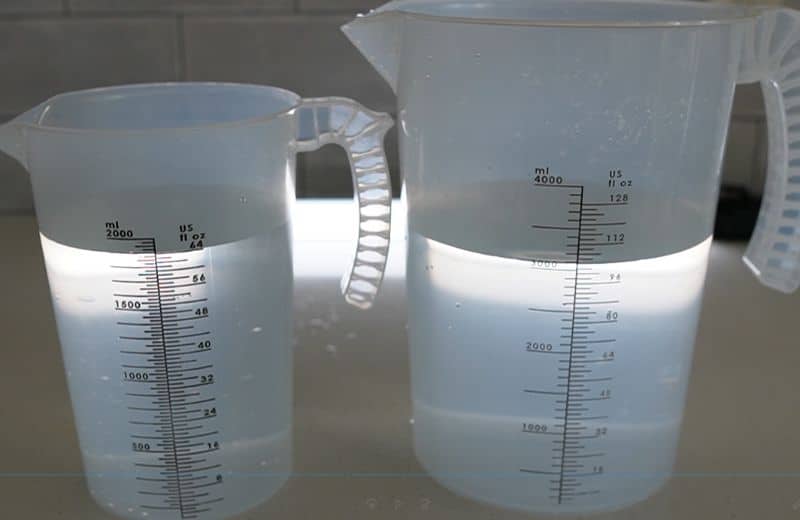
We can see from these results that installing a booster pump effectively improved filtration and recovery rate. Flow rate was boosted by around 39 GPD, and recovery rate was increased by 19% (compared to our first 64-ounce draw).
If you plan to install a booster pump, energy use is something to factor in. We recorded that the pump used 0.002 kilowatt hours; similar to the readings we were getting for tankless RO systems with built-in pumps.
📐 Design
Score: 9.70We evaluated the RCC7 in the design category based on two factors: component quality and the presence of certifications for design or materials safety.
The system has a main housing with three filters mounted vertically below, and three stacked horizontally on top, as well as a 3.2-gallon water storage tank. It measures 15.5 (length) x 5.10 (width) x 19 (height) inches and weighs 25 lbs.
The unit also comes with a dedicated faucet (available in black and chrome), which you install next to your existing faucet, giving you access to a separate purified water supply.
Don’t expect any of the fancier smart features on this unit. Like many conventional systems, it has a no-frills design, with no built-in TDS monitors or filter lifespan trackers.
There are several upgrades from the base model that you can consider. We got the remineralization upgrade, but there’s also:
- A model with a UV light
- Note: we wouldn’t recommend using any RO system, even one with UV, with untreated water without disinfection first. This final UV stage is simply a protection against any bacteria growth within the unit itself, not as a means of disinfection. Since it’s downstream of the RO membrane anyway, it wouldn’t be the main barrier against microorganisms in untreated water, as they would be rejected by the RO membrane (and cause it to foul).
- A model with a UV light and remineralization filter.
- A model with a deionization filter that achieves “distilled water quality”.
You can also get the unit with a built-in booster pump if you want to increase efficiency and water flow and prefer not to buy and install a separate pump.
Component Quality
Score: 9.50
The RCC7 has a mostly plastic design, with some metal components. It uses NSF-certified plastics and feels nice and sturdy, earning it a high component quality score.
We contacted iSpring to find out the exact plastics used in the system, and a customer rep told us that the filter housings are made of polypropylene and the tubings are polyethylene (both BPA-free and commonly used in water filters). The faucet is made from solid brass and finished with lead-free brushed nickel.
Filter Materials
The RCC7 alkaline configuration consists of 6 separate filter cartridges:
- A polypropylene sediment filter
- A granular activated carbon filter
- A carbon block filter
- An RO membrane
- A post-activated carbon filter
- A mineral ball, calcite, and corosex remineralization filter
These media are all commonly used in RO systems, with the sediment filter removing impurities that could affect the RO membrane performance and lifespan, the carbon filters improving taste and addressing chemicals that the membrane can’t remove, and the remineralization filter restoring pH and healthy minerals.
Materials Safety Certification
Score: 10.00
Manufacturers can make claims about materials safety, but the only official way to confirm this is with official certifications. Again, these can be obtained through the NSF, IAPMO, and the WQA, and the most common certifications are:
- NSF/ANSI 372, for lead-free design
- Materials safety, typically obtained as part of a performance certification (NSF/ANSI 42, 53, 58, etc.)
The RCC7 has a materials safety certification as a component of its NSF 58 performance certification, so it earned the top score from us in this category.
⚙️ Setup
Score: 7.00There’s a significant amount of work involved in the setup process for the RCC7, which is unfortunately a common setback of under-sink RO systems.
You can install this system yourself, but keep in mind that it’s a time-consuming job that does require some level of plumbing knowledge and DIY ability. It took us 90 minutes to install overall.
Something to note about this unit is that it comes more disassembled than others, which means it needs more “putting together” initially before you can install it. For instance, the RO membrane isn’t already in the housing and comes vacuum sealed, so you have to disconnect the housing to insert the membrane. It’s not a big task, but even small jobs like these contribute to the overall time taken on the install.
There are a couple of features that we did appreciate when it came to the simplicity of the install:
- First, the faucet has an easy mounting nut assembly for the bottom mount. It also comes with a top-mount kit for the faucet that works with 1/2″-1-1/2″ holes.
- The tubing and matching quick-connects are all color-coded, which means we didn’t have to spend much time deciphering what went where.
We noted that the user manual specifically states to check the tank pressure and adjust to 7-10 PSI if needed. We used our portable Viair compressor to top it off, and when connected, the digital meter read 6.5 PSI. We set it to 9.5 PSI.
Interestingly, none of the other tank-based systems we’ve tested so far have mentioned checking the pressure valve (in fact, they actually say not to touch it).
Another unique instruction was to disconnect the RO housing inlet tubing and flush water through the first three filter stages into a bucket until it runs clear. We noticed a small amount of carbon washout, but it didn’t take long for the water to turn clear. Disconnecting the tubing makes sense, so loose carbon from the filters doesn’t get transported into the membrane, yet iSpring is one of the few manufacturers to specify this.
Speaking of the initial flushing process, this took us 3 hours and 30 minutes in total, including 30 minutes of flushing with the tank bypassed and 3 hours to fill and flush the tank once.
Once flushing was complete, we detected 19 possible leak points (weak spots in the system’s water containment, i.e. where two parts join together or where a seal is involved), and there were no initial post-startup leaks.
In all, the installation process took a bit longer than for similar systems due to extra steps of checking the water tank pressure and adjusting it, and installing the RO membrane.
Noise
Another feature we wanted to measure was the noise level produced by the RCC7 when it was up and running. It uses incoming water pressure rather than a built-in water pump, so we expected it to operate fairly quietly.
We measured sound decibels at 1 foot and 3 feet away using a phone app, then compared the results:
- At 1 foot, the unit produced 23.4 decibels.
- At 3 feet, it produced 23.5 decibels.
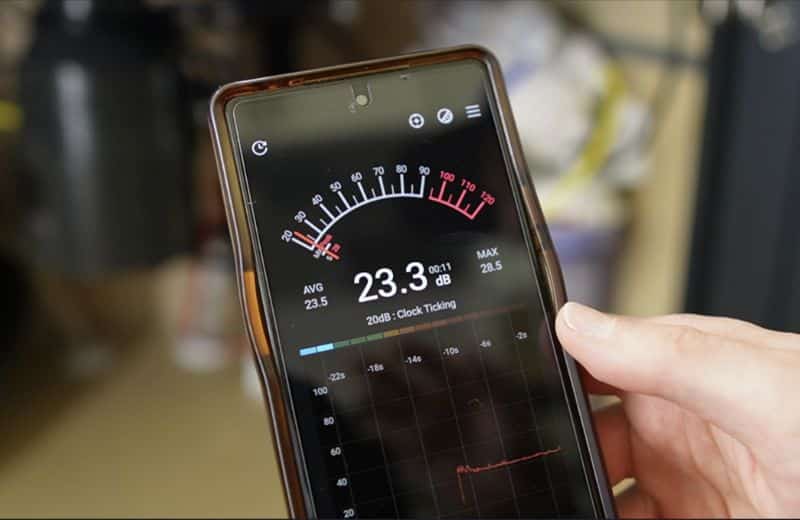
That’s very quiet—literally whisper-quiet, since a whisper is measured at around 25 decibels. Some of the noise picked up from the app might have even been from the refrigerator in the kitchen rather than the RO unit itself.
🔧 Maintenance
Score: 9.20The RCC7 is easy and affordable to maintain, but it’s not quite as simple as some of the tankless systems we’ve tested.
Servicing Requirements
8.50
The key maintenance task for the unit is replacing the filters. iSpring indicates their lifespans (up to 1 year for all filters aside from the RO membrane, which lasts up to 3 years), but recommends replacing the filters whenever you notice a significant decrease in water flow or detect an unpleasant taste or smell, rather than relying on lifespan alone.
Unlike with the tankless systems we’ve tested, there’s no display on the faucet or the main unit with filter change reminders, so you’ll need to make your own phone or calendar reminders. This isn’t a deal-breaker, but it’s inconvenient, resulting in a slightly lower score in this category.
To replace any of the filters, you’ll need to shut off the under-sink water supply and the tank valve, turn on the faucet to release pressure inside the system, disconnect the entire unit, and remove it from under the sink. You then have to use specific filter housing wrenches to open the housings (which, speaking from experience, can be difficult if they’re over-tightened!) to remove the filters. If you’re looking for a system with quick-change filters, the RCC7 isn’t the one.
When replacing the pre-filters, you’ll follow the same flushing process as for the installation, disconnecting the housing inlet tubing and flushing water into a bucket until it runs clear.
Replacing the RO membrane and post filters is a bit different: after swapping out the cartridge, you turn on the feed water valve and let water trickle for 15 minutes (to flush the membrane) or 5 minutes (to flush the post or add-on filters). You can then turn the tank valve back on for normal operation.
iSpring also advises replacing the o-rings every three years or sooner if you notice a leak, emptying and refilling the tank at least once a month (this may will happen anyway if you use the system for long enough to completely empty the tank—otherwise, it’ll just continue to automatically top up what’s already in there), and shutting off the system and draining the tank when you’re not using it for an extended time.
Costs
Score: 10.00
We calculated that the RCC7 has an overall ongoing spend of $0.13-$0.24 per gallon (assuming that we use the system to purify 2-4 gallons of water per day).
How did we make these calculations?
Typically, we’ll look for each filter’s capacity in gallons, but iSpring doesn’t provide this information, so we used our time-based “effective gallons” cost estimator instead.
This involved multiplying the recommended replacement interval by our assumed daily usage to estimate how much water each filter would realistically treat before needing replacement, and then dividing the replacement cost by that figure to calculate the cost per gallon.
The RCC7 is one of the more affordable under-sink RO systems we’ve tested, earning it the top score in this category.
🏢 Company
Score: 8.20iSpring offers decent warranty and shipping policies, but we were less impressed with its returns policy.
Warranty
Score: 8.50
iSpring’s 1-year warranty applies to all its water filters, including the RCC7.
Under the warranty, you’ll be entitled to a replacement or repair if the system is found to be defective due to manufacturing errors.
If you want to extend your warranty protection, iSpring also offers 3-year, 5-year, and 10-year warranties that you can purchase by contacting the company directly.
You can find the warranty registration form here.
Shipping
Score: 9.50
All orders made on the iSpring website are shipped for free within the contiguous states of the U.S. Shipping charges apply to Alaska, Hawaii, Puerto Rico, Guam, the U.S. Virgin Islands, and all international regions.
iSpring prepares and ships orders within 24 hours on working days, and estimates a delivery timeframe of 2-5 days.
View iSpring’s shipping policy here.
Returns
Score: 6.50
iSpring offers a 30-day returns policy, meaning you can return the RCC7 within 30 days of your purchase date and receive a refund. But there are a few stipulations to be aware of:
- The system has to be in the same condition that you received it (i.e. unopened and unused).
- You won’t be refunded in full—there’s a 15% restocking fee.
You can actually return your system within the 1-year warranty period, again, providing it hasn’t been opened or used. The percentage of your purchase price you’ll be refunded ranges from 50% to 70%, depending on exactly when you return it.
Here’s iSpring’s returns policy for more information.
💰 Value For Money
Overall, we think the iSpring RCC7 is decent value for money, especially since it’s one of the most affordable systems to buy upfront out of all the RO units we’ve tested so far. It’s certified to remove more contaminants than many of its competitors, the remineralization filter is a convenient add-on, it’s more efficient than other tank-based systems we tested, and we were satisfied with the quality of construction.
But it’s not without its issues: in particular, we’re very concerned that the system added arsenic and vanadium to our water. Plus, installation is time-consuming and tricky, and the filtration rate is pretty slow (although better when we used a booster pump).
Because of our experience with arsenic and vanadium being introduced into our water, we’re hesitant to recommend the RCC7 as the top conventional, tank-based under-sink RO system. If you’re specifically looking at tank-based units for their affordability, we recommend considering a very similar system that didn’t introduce contaminants in our testing: the APEC ROES-PH75.
Found this review helpful?
Comment below or share this article!