

PUR and ZeroWater are two popular brands best known for their water filter pitchers.
In this comprehensive evaluation ofPUR vs ZeroWater, we’ve put the PUR Plus and ZeroWater water filter pitchers* head-to-head, comparing their performance features using our own generated test data and metrics from official reliable sources.
*We’re discussing both water filter pitchers currently offered by ZeroWater: the original Legacy filter and the recently-launched Culligan ZeroWater filter, which is more extensively performance certified and achieved a higher overall score in our testing.
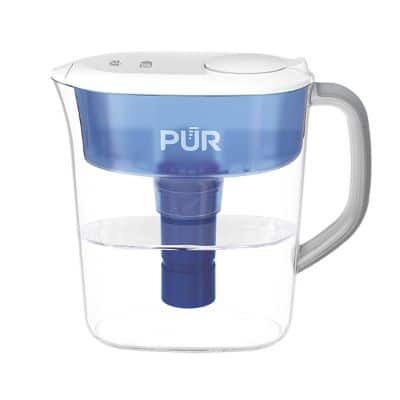
PUR
Best For:
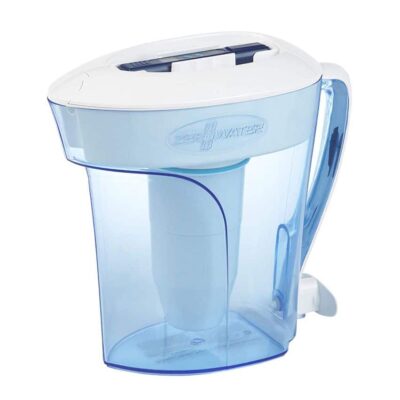
ZeroWater
Best For:
PUR and ZeroWater both sell a series of water filter pitchers and dispensers, which provide a convenient, affordable at-home water filtration solution.
Both brands are affordable, but ZeroWater’s ongoing cost of filters is much higher than PUR’s. That said, the Culligan ZeroWater has the most performance certifications, and in our testing, both ZeroWater pitchers did a better job at reducing the contaminants detected in our water. We were disappointed that PUR and ZeroWater’s filters all greatly reduced healthy minerals.
Table of Contents
📊 Our Testing Data
The next table highlights the 6 key metrics we used to test and rank the ZeroWater and PUR water filter pitchers. You can compare the results for the filters here.
| Factor | PUR | ZeroWater |
|---|---|---|
| Contaminant Reduction | 5.28 | 8.34 |
| Filtration Rate | 10.00 | 10.00 |
| Design | 8.80 | 8.80 |
| Setup | 9.50 | 9.50 |
| Maintenance | 9.75 | 8.25 |
| Company | 7.50 | 7.50 |
Here’s the data behind each of our scoring categories, so you can see all the factors we considered when awarding our scores.
| Factor | PUR | ZeroWater | Winner |
|---|---|---|---|
| Overall Score | 7.08 | 8.62 | ZeroWater |
| Health Related Contaminants | 4.50 | 8.30 | ZeroWater |
| Aesthetic Related Contaminants | 9.50 | 9.90 | ZeroWater |
| Performance Certification | NSF/ANSI 42, 43, & 401 | NSF/ANSI 42 & 43 | PUR |
| Filtration Rate | 2.82 GPH | 2.62 GPH | PUR |
| Component Quality | Fair | Fair | Tie |
| Component Certification | NSF Certified | NSF Certified | Tie |
| Setup | Outstanding | Outstanding | Tie |
| Servicing Requirements | Outstanding | Outstanding | Tie |
| Costs | $0.27/ gal | $0.70/ gal | PUR |
| Warranty Length | 90 days (vessels); 30 days (filters) | 90 days (vessels & TDS meters); 30 days (filters) | Tie |
| Shipping | Depends on distributor | $60 order threshold | Tie |
| Returns | None | None | Tie |
🚰 Contaminant Reduction
Our first step was to see how effectively the PUR Plus and ZeroWater pitchers reduced the contaminants in our water. We also wanted to know whether or not the filters were performance certified, and if so, how their certifications compared.
Our Lab Test Results
We used Tap Score tests by SimpleLab to test our water before and after filtering it through the PUR and ZeroWater pitchers. We then analyzed our test data against Tap Score’s own HGL (Health Guideline Level), which places a higher emphasis on human health and maintains stricter criteria than the federal MCLs.

See the contaminants in our source water, and the % reduction by PUR and ZeroWater, in this next table.
| Contaminant | Measurement | PUR Pre-Filtration | PUR Post-Filtration | % Change | ZeroWater Pre-Filtration | ZeroWater Post-Filtration | % Change |
|---|---|---|---|---|---|---|---|
| Chloroform | PPB | ND | ND | ND | 0 | 3.4 | n/a |
| Total THMs | PPB | ND | ND | ND | 0 | 3.4 | n/a |
| Chloride | PPM | 14.9 | 14.8 | -0.67% | 14.9 | 0 | -100.00% |
| Chlorine | PPM | 1 | 0 | -100.00% | 1 | 0 | -100.00% |
| Fluoride | PPM | 1.1 | 1.1 | 0.00% | 1.1 | 0 | -100.00% |
| Nitrate (as N) | PPM | 3.5 | 2 | -42.86% | 3.5 | 0 | -100.00% |
| Phosphorus | PPM | 1 | 1.2 | 20.00% | 1 | 0 | -100.00% |
| Sulfate | PPM | 8.4 | 8 | -4.76% | 8.4 | 0 | -100.00% |
| Barium | PPM | 0.0158 | 0.0151 | -4.43% | 0.0158 | 0 | -100.00% |
| Copper | PPM | 0.163 | 0.0028 | -98.28% | 0.163 | 0.0047 | -97.12% |
| Molybdenum | PPM | 0.0026 | 0.002 | -23.08% | 0.0026 | 0 | -100.00% |
| Strontium | PPM | 0.11 | 0 | -100.00% | 0.11 | 0 | -100.00% |
| Uranium | PPM | 0.014 | 0.0028 | -80.00% | 0.014 | 0 | -100.00% |
| Bicarbonate | PPM | ND | ND | ND | 85.14 | 8.53 | -89.98% |
| Calcium | PPM | 25.6 | 1 | -96.09% | 25.6 | 0.2 | -99.22% |
| Magnesium | PPM | 6.32 | 0.32 | -94.94% | 6.32 | 0 | -100.00% |
| Potassium | PPM | 0 | 1.66 | n/a | ND | ND | ND |
| Sodium | PPM | 9.63 | 47 | 388.06% | 9.63 | 0 | -100.00% |
ZeroWater was the best-performing offering in this category because both its filters targeted a lot of contaminants that PUR was unable to reduce.
Health-Related Contaminants
The ZeroWater pitchers got a much higher score than the PUR Plus for removing health-related contaminants from our water.
A handful of contaminants with potential health effects were detected in our unfiltered water (see the table below). We were most concerned about fluoride and uranium, which were detected at concentrations above the Tap Score HGL.
| Contaminant | Measurement | Detection | HGL |
|---|---|---|---|
| Fluoride | PPM | 1.1 | 0.8 |
| Uranium | PPM | 0.014 | 0.0 |
| Nitrate | PPM | 3.5 | 10 |
| Barium | PPM | 0.0158 | 2.0 |
| Molybdenum | PPM | 0.0026 | 0.03 |
| Strontium | PPM | 0.11 | 3.0 |
| Sulfate | PPM | 8.4 | 500 |
| Copper | PPM | 0.163 | 0.3 |
In our PUR Plus pitcher testing, strontium was reduced by 100%, copper by 98%, uranium by 80%, nitrate by 42%, molybdenum by 23%, and sulfate and barium by just 4%. Our water’s fluoride concentrations were exactly the same post-filtration – a 0% reduction.

Like PUR, both ZeroWater filters reduced 100% strontium in our water. The Legacy filter also reduced 97% copper (just shy of PUR’s 98% copper removal), while the Culligan ZeroWater filter removed it completely.
Both filters outperformed the PUR Plus for all other contaminants, removing 100% uranium, nitrate, molybdenum, sulfate, and barium, and fluoride, as well as 100% zinc (the Culligan ZeroWater only; zinc wasn’t detected in our baseline sample for the Legacy filter).
There was one anomaly with our Legacy filter results: 3.4 PPB of chloroform was detected. We believe this volatile disinfection byproduct had dissipated from our unfiltered water sample before we could fill the collection vials. Its presence in our filtered water told us that the Legacy filter doesn’t effectively target disinfection byproducts.
Given that we used the same water supply in our PUR test, does that mean that the PUR Plus definitely can reduce disinfection byproducts? Potentially, yes. But there’s always the possibility that chloroform had also dissipated from our PUR filtered water before we could collect our water sample*. We can’t know for certain either way.
*Our sample collection method involved filling a large bucket with the water sample, which was then used to fill a selection of pitchers we were testing. We took the unfiltered water sample from the bucket last when it had less water in it to make sample collection easier.
Aesthetic Contaminants
PUR and ZeroWater did an equally good job of addressing aesthetic contaminants in our water.
We used the chlorine test strip included in our Tap Score kit, which detected around 1 PPM of free chlorine in our tap water.
We repeated the test on our filtered water, and 0 PPM of chlorine was detected, telling us that both ZeroWater filters and the PUR Plus filter had eliminated chlorine by 100%. We’d expected this given that both filters have an activated carbon element, which is commonly used specifically for addressing chlorine tastes and odors in water.
After filtering our water, we taste-tested samples from both filters and detected a noticeably cleaner taste, with no “swimming pool” odors or chemical tastes. However, some customers complain that ZeroWater’s filtered water has a “fishy” taste, which often comes from trimethylamine (TMA), a byproduct of the filter’s ion-exchange resin.
Minerals, Salts, & Hardness
The PUR and ZeroWater pitchers are filters, not purifiers, which generally means that they target harmful contaminants while retaining healthy minerals and salts.
But ZeroWater’s marketing is heavily focused on its filters’ ability to reduce TDS, so we knew that our filtered water’s dissolved solids, minerals, and hardness concentrations would reflect this.
Our unfiltered water contained trace amounts of calcium, magnesium, and sodium, along with 90 PPM of hardness and 137 PPM of total dissolved solids (TDS).
Post-filtration in the ZeroWater pitchers, our water’s magnesium and sodium concentrations had been reduced by 100%, calcium by 99%-100%, and hardness down to 0 PPM. The pH of our water also dropped slightly to 6.6 (Culligan ZeroWater) and 7.0 (Legacy ZeroWater).
TDS was reduced down to 5 PPM (Culligan ZeroWater) and 8 PPM (Legacy ZeroWater), as we’d expected – although ZeroWater claims to reduce TDS to 0, and our included TDS meter gave a reading of 0 too, suggesting it isn’t a completely precise measurement tool.

What we didn’t expect was for the PUR filter to produce a similar outcome.
The PUR Plus pitcher reduced magnesium by 95%, calcium by 96%, and hardness down to 3.83 PPM. Even more surprising, our water’s sodium concentration actually increased 388%, from 9.63 PPM to 47 PPM.
pH remained the same, and TDS was only reduced by 10 PPM (likely because calcium and magnesium were exchanged for sodium).
We believe that the PUR Plus reduced minerals similarly to the ZeroWater pitcher because they both use a cation exchange resin. The likely reason for the increase in sodium in the PUR filtered water is that the sodium ions in the filter’s resin were ‘kicked off’ in exchange for calcium and magnesium ions.
Certifications
We know that many folks look for performance certifications as a non-negotiable when choosing a water filtration system to buy. Both PUR and ZeroWater have obtained performance certifications to support their contaminant removal claims, which is great.
The PUR Plus has an NSF certification to Standards 42, 53, and 401 for 100% of contaminants that PUR claims to remove.
The Culligan ZeroWater filter goes one step further: it’s IAPMO certified to NSF Standards 42, 53, and 401 for every single contaminant it’s claimed to reduce. It’s one of the few water filters we’ve tested that’s this extensively certified.
The Legacy ZeroWater is NSF certified to Standard 42 and Standard 53 for reducing mercury, lead, chlorine taste and odor, chromium 6, PFOA, and PFOS. This is reassuring, but doesn’t compare to the Culligan ZeroWater filter’s certifications.
🚦Filtration Rate
The PUR Plus and ZeroWater pitchers are gravity filters, so their flow rates are measured in gallons per hour (GPH).
We’ve compared the filtration rate for the three filters in the table below.
| Product | Filtration Rate Score | Filtration Rate |
|---|---|---|
| PUR | 10.00 | 2.82 GPH |
| ZeroWater | 10.00 | 2.62 GPH |
We timed how long it took to filter water in the systems, then compared their filtration speeds. The PUR Plus just won this one, but all were pretty fast for gravity filters.
In our testing, thePUR Plus filtered 0.25 gallons of water in 5:19 minutes, giving it a filtration rate of 2.82 GPH, while the Legacy ZeroWater filtered 0.391 gallons in 08:56 minutes, giving it a filtration rate of 2.62 GPH. The Culligan ZeroWater took just under 7 minutes to filter a full pitcher of water, with a slightly slower filtration rate at 1.9 GPH.
When we tested the filters, they were both relatively new. That means their rate of filtration was fastest because the filter media was uncompromised. Over time, it’s normal to see a decrease in flow rate, particularly in gravity filters that aren’t pressurized, as the filter media becomes clogged with contaminants.
💲 Upfront Cost
For this review, we got the PUR Plus 7-cup pitcher (it was the only size available in our local Walmart), which cost $26.99 including the initial filter. The initial filter was the basic PUR filter, so we purchased the PUR Plus filter separately to use for this project.
As for ZeroWater, we went for the 12-Cup Ready-Pour Pitcher, which was priced at $39.99.
We can’t directly compare these prices because ZeroWater’s pitcher is bigger, but we think both brands offer a very similar value for money upfront. PUR’s 11-cup pitcher costs $37.49 – so very similar to ZeroWater’s 12-cup pitcher price.
PUR is exclusively sold by third parties, while ZeroWater can be bought directly from the manufacturer or from some big box stores. Expect to see different prices at different stores.
Take a look at the price comparison for PUR and ZeroWater in the next table.
| Product | Price | Filters Included |
|---|---|---|
| PUR Plus 7-cup pitcher | $26.99 | Basic PUR filter |
| ZeroWater 12-Cup Ready-Pour Pitcher | $39.99 | Not mentioned |
📐 Design
There were two factors that we considered when comparing PUR and ZeroWater for design:
- How the systems looked, felt, and held up in our own testing
- Whether or not the systems were certified for materials safety
We’ve shared our individual and overall design scores for both filters below.
| Product | Design Score | Component Quality | Materials Safety |
|---|---|---|---|
| PUR | 8.80 | Fair | NSF Certified |
| ZeroWater | 8.80 | Fair | NSF Certified |
Both ZeroWater and PUR have similar plastic designs, and all three pitchers are certified for materials safety. But Culligan ZeroWater just pushed ahead thanks to its better overall design quality.
Filter Models
PUR currently sells three water filter pitchers and one dispenser that use the PUR Plus water filter. These are:
- PUR Plus 7-cup pitcher $26.99
- PUR Plus 11-cup pitcher $37.49
- PUR Plus 12-cup pitcher $42.99 (only at Target)
- PUR PLUS 30 Cup Dispenser
A few PUR pitchers can be bought with different colored lids and handles, including black, grey, and blue.

The two filters can be used in multiple different water filter pitchers and dispensers:
- 7-Cup Ready Pour Pitcher
- EcoFilter 10-Cup Pitcher
- 10-Cup Pitcher
- 10-Cup Ready Pour Pitcher
- 10 Cup Round Ready Pour Pitcher
- 12-Cup Ready Pour Pitcher
- 12-Cup Ready Read Dispenser
- 20-Cup Ready Pour Dispenser
- 22-Cup Ready Read Dispenser
- 30-Cup Dispenser
- 32-Cup Ready Read Dispenser
- 40-Cup Glass Dispenser
- 52- Cup Ready Read Dispenser
ZeroWater doesn’t offer a choice of colors – most of its systems are blue, white, and clear. All the pitchers and dispensers are plastic apart from the Glass Ready Pour Dispenser.
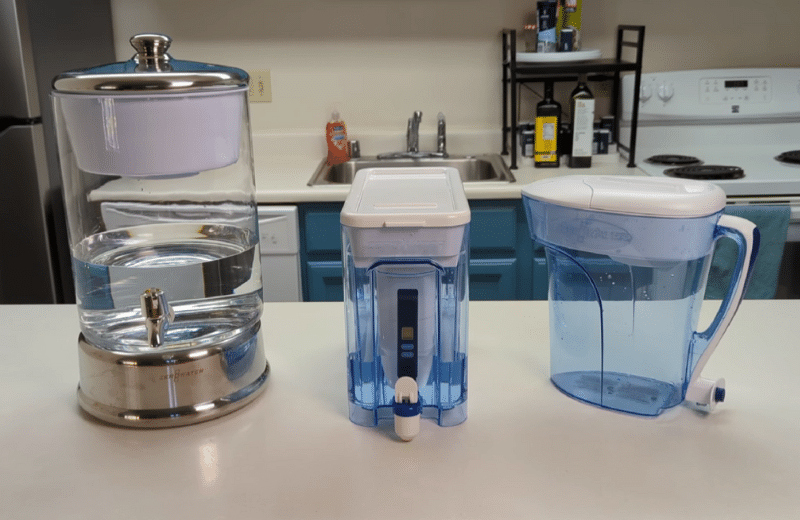
In terms of product diversity, ZeroWater offers a few more choices, including a glass dispenser for folks who want to avoid plastic use. But PUR gives a better choice of colors.
Component Quality
We noted that the PUR and ZeroWater pitchers we tested had a very similar feel and quality, so their scores were close in this category.
Both systems are made from plastic:
- The PUR pitcher and reservoir are made from NAS or SAN plastics, and the filter housings and lids are made of BPA-free polypropylene plastic.
- The ZeroWater pitchers are made of BPA-free polypropylene and ABS (a terpolymer).
All the plastics used in ZeroWater and PUR pitchers are BPA-free, and are widely used in products that store food and water due to their durable and lightweight qualities.
The Culligan ZeroWater pitcher had the most solid, durable design feel. In comparison, the Legacy ZeroWater and PUR Plus pitchers felt equally pitchers thin and flimsy, resulting in a lower design score for both.
Neither of these pitchers is ideal if you want to limit your exposure to plastic wherever possible, especially given the research into microplastics leaching from polypropylene.
ZeroWater’s glass water filter dispenser is the best option for folks who don’t want an all-plastic filter, although there’s still plastic in the filter itself.
Filter Materials
The filters used in the PUR and ZeroWater pitchers have super similar designs.
PUR filters are granular activated carbon-based, and they also use an ion exchange media.

ZeroWater’s 5-Stage Filter also uses activated carbon media, as well as a combination of cation and ion exchange resins and three additional layers of physical filtration. Additionally, the new Culligan ZeroWater filter contains KDF media.
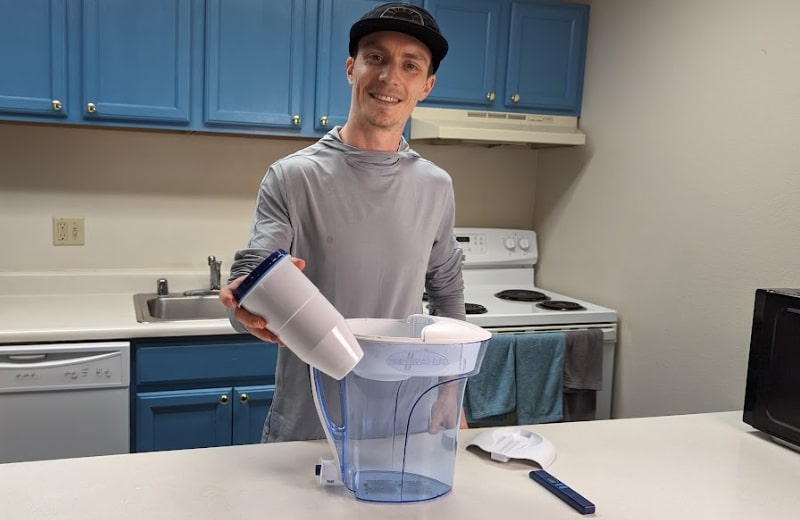
In both filters, the media is housed inside a plastic cartridge.
Materials Safety Certification
A component of PUR and ZeroWater’s performance certifications is a certification for materials safety. That means both manufacturers got equally high scores in this category.
Both manufacturers obtained their materials safety certification from the NSF.
We find this super reassuring because it tells us that the pitchers have been tested by a trusted third-party organization and deemed safe and suitable for their purpose.
⚙️ Setup
We timed the setup process for the PUR and ZeroWater pitchers to see which was easier and quicker to assemble.
We’ve shared these timings, and our setup scores for both systems, below.
| Product | Setup Score | Setup Time |
|---|---|---|
| PUR | 9.50 | Less than 5 minutes |
| ZeroWater | 9.50 | Less than 5 minutes |
Both filters were essentially equal in this category, so they obtained the same setup scores.
The ZeroWater pitchers were ever so slightly quicker to set up because we didn’t have to prime, soak, or flush the filter before we could use it, while the PUR filter needs to be held under running water for 30 seconds before it can be installed.
Otherwise, setup was identical for both pitchers. We just:
- Washed the pitchers and reservoirs in warm, soapy water
- Dried them thoroughly
- Inserted the filter into the bottom of the reservoir
- Filled the reservoir with cold water, ready to filter
Setup took less than 5 minutes for both filters and couldn’t have been easier. We think it’s great that many water filter pitcher manufacturers have addressed previous complaints regarding filter soaking and priming before use, and have determined how to fast track or avoid this process altogether.
🔧 Maintenance
We assessed PUR and ZeroWater’s maintenance requirements, including how often their filters needed replacing, how difficult the filter change process was, and how much they cost to maintain in the long run.
The table below indicates the maintenance scores we assigned to the pitchers.
| Product | Maintenance Score | Servicing Requirements | Costs |
|---|---|---|---|
| PUR | 9.75 | Outstanding | $0.27/ gal |
| ZeroWater | 8.25 | Outstanding | $0.70/ gal |
PUR got the better score here. ZeroWater’s score was pulled down because of its more expensive ongoing maintenance cost.
Servicing Requirements
Replacing the filters was the primary maintenance task for the PUR and ZeroWater pitchers.
Again, ZeroWater’s replacement filters needed no priming, soaking, or flushing, so all we had to do was remove the old filter and put the new one in its place.
PUR was similar, except we had to hold the new filter under running water for 30 seconds first, as we’d done with the initial filter.

Many of PUR’s pitchers use a filter change indicator light that changes color to let you know when a filter replacement is needed. ZeroWater recommends using the included TDS meter and changing the filter once the TDS reading increases to 006.
Another maintenance task was cleaning the pitchers every few days, which was quick and easy to do. PUR pitchers are dishwasher safe (not the filters themselves, which must be removed), but ZeroWater pitchers should be hand-washed only.
Maintenance Costs
According to our calculations, PUR is much cheaper to maintain than ZeroWater.
We determined the ongoing costs of both filters based on the manufacturers’ projected filter lifespan information.
The PUR Plus’ long-term filter cost is $0.27/gallon, while ZeroWater’s is much higher, at $0.90/ gallon for the Culligan ZeroWater filter and $0.70/ gallon for the Legacy filter (we calculated this using 25 gallons based on the “typical” information on this chart).
That means that although both filters have similar lifespans, ZeroWater is the more expensive system to own in the long run because its filters are costlier to replace.
🏢 Company
It’s important to look not only at the filter, but at the company behind it. In this category, we compared PUR and ZeroWater as manufacturers, analyzing their shipping and returns policies, and the warranties they offer.
In the next table, we’ve shared our company scores for PUR and ZeroWater based on the individual data.
| Product | Company Score | Warranty Length | Shipping | Returns |
|---|---|---|---|---|
| PUR | 7.50 | 90 days (vessels); 30 days (filters) | Depends on distributor | None |
| ZeroWater | 7.50 | 90 days (vessels & TDS meters); 30 days (filters) | Free shipping on orders over $60 to customers in continental US | None |
Both brands were equal here because none of them blew us away in this category.
Warranty Length
PUR warrants its pitchers for 90 days and its filter cartridges for 30 days. ZeroWater’s warranty is exactly the same: 90 days for all vessels (pitchers, dispensers, etc.), and 30 days for the filters.
Shipping
PUR systems are only sold through distributors: Target, Amazon, Walmart, etc. That means there’s no specific PUR shipping policy – just the varying policies of the different distributors, which typically require customers to meet an order threshold to qualify for free shipping.
ZeroWater’s shipping policy is more straightforward: it ships all orders above $60 to customers in continental US for free.
Returns
Both companies were disappointing here – neither offers a dedicated returns policy.
⛔️ Pitcher Setbacks & Flaws
We want our readers to know the full story before they invest in a water filter, which means sharing the not-so-good as well as the good. Here, we’ve compared the setbacks we noticed when testing the PUR and ZeroWater filter pitchers.
PUR Plus Setbacks
- Revoked its lead certification – The PUR Plus filters used to be certified to reduce lead, but now this certification has been replaced by a microplastics reduction certification.
- Only tested to reduce a handful of contaminants – There are only 19 contaminants listed on the PUR Plus contaminant datasheet that the filter can reduce. The filter hasn’t been tested to reduce chromium-6, fluoride, arsenic, nitrates, or other common harmful contaminants.
- No non-plastic pitcher options – Unlike ZeroWater, PUR only sells plastic water filter pitchers.
ZeroWater Setbacks
- Didn’t address disinfection byproducts (Legacy filter only) – Disinfection byproducts were still present in our water supply after filtering it through the ZeroWater pitcher.
- Not dishwasher safe – ZeroWater pitchers should be hand-washed only, which might be a dealbreaker for folks who use their dishwasher whenever possible.
- Expensive ongoing cost – We found ZeroWater’s ongoing filter cost more expensive than any other pitcher we tested.
Setbacks of Both Pitchers
- Reduced minerals – In our testing, both filters almost completely eliminated the healthy minerals present in our water.
- Short filter lifespan – Both PUR and ZeroWater systems have disappointingly short filter lifespans.
🆚 PUR or ZeroWater: Which One’s for You?
We think both PUR and ZeroWater are solid offerings in the water filter pitcher market, but one might be better suited to you depending on your preferences and situation.