


The Frizzlife PD600-TAM3 is a tankless reverse osmosis water filtration system with an external alkaline remineralization filter. It sits mid-to-upper range in price and is one of Frizzlife’s more advanced offerings in the reverse osmosis category, with perks like real-time TDS readings and a claimed 2:1 pure-to-drain ratio.
What We Like
What We Don’t Like
| Price | $376 |
| Contaminants Reduced | 14+ |
| Certifications | NSF 372 (lead-free materials only) |
| Process | Carbon pre-filter + RO membrane + Alkaline remineralization filter |
| Filter Capacity | 900 – 1,800 gallons |
| Annual Cost | ~$130 |
| Warranty | 1 year |
Table of Contents
▶️ Video Review
We tested the PD600-TAM3 to see how its performance compares to the other reverse osmosis systems we’ve tested so far. In our most comprehensive analysis to date, we took detailed measurements of the system’s recovery rate, flow rate, TDS creep, noise level, install time, and ongoing costs—as well, of course, as the impurities removed from our water.
📊 Scoring Data
We use six key performance assessments to test all the water filters we review, with scores awarded based on our own detailed analysis. We tested the Frizzlife PD600-TAM3 alongside a batch of the most popular RO systems available today, ranking the system based on its overall weighted score.
There are several criteria that influence a water filter’s performance scoring, including sub-categories of contaminant reduction, servicing requirements and costs, flow rate, design quality, and the manufacturer’s warranty, shipping, and returns offerings. For this RO testing series, we also measured efficiency ratio, noise, TDS creep, and several other factors that apply specifically to reverse osmosis systems, although these currently do not influence overall scoring in the current version of our system.
See the Frizzlife PD600-TAM3’s scores in the table below.
| Criteria | Results |
|---|---|
| Overall Score | 8.94 |
| Health Related Contaminants | 9.30 |
| Aesthetic Related Contaminants | 9.90 |
| Performance Certification | Not Certified |
| Filtration Rate | 600 GPD |
| Component Quality | Fair |
| Component Certification | NSF 372 |
| Setup | Weak |
| Servicing Requirements | Exceptional |
| Costs | $0.10/ gallon |
| Warranty Length | 1 year |
| Shipping | Free on orders > $25 for US orders |
| Returns | 30 days |
🚰 Contaminant Reduction
Score: 9.00In the contaminant reduction category, we expect a lot from a reverse osmosis system like the Frizzlife PD600-TAM3. Most of the RO units we’ve tested reduce the majority of impurities down to trace levels, offering almost guaranteed protection against virtually any contaminant you might be concerned about.
To score this Frizzlife model for contaminant reduction, we combined data from our own real-world water quality testing with evidence of official performance certifications by IAPMO, the NSF, or the WQA.
Our Performance Testing
Score: 9.62

We used Tap Score water quality testing kits to test our water before and after filtering it through the PD600-TAM3:
- Our first sample came directly from the kitchen faucet.
- The second sample was taken after installing the Frizzlife system, from the dedicated faucet, after following the manufacturer’s flushing instructions and conducting all our other testing for flow rate, recovery rate, and so on.
We sent both samples to Tap Score for testing. Our two digital reports (one for each sample) were viewable on the Tap Score platform after several days.
The only contaminant we tested on-site was chlorine, since its volatility causes it to dissipate quickly and means it needs to be detected as quickly as possible. We used Hach chlorine test strips included in our Tap Score sample-taking kit for this.
Health-Related Contaminants
Score: 9.30
16 contaminants with possible health effects were detected in our baseline water sample, including:
- 3 disinfection byproducts
- Uranium
- Fluoride
- Several heavy metals, including copper and barium
- Nitrate
- Several metals and metaloids, including strontium and boron
- Chromium
5 of these contaminants were detected at levels exceeding the HGL: all 3 disinfection byproducts (dibromochloromethane, bromodichloromethane, and bromoform), as well as uranium and fluoride.
See the next table for a full list of the contaminants detected, and their concentrations, in the baseline sample.
| Analyte | Unit | Unfiltered | Frizzlife PD600-TAM3 | Difference |
|---|---|---|---|---|
| Alkalinity (as CaCO3) | PPM | 391 | 36 | -90.79% |
| Barium | PPM | 0.033 | 0.00111 | -96.64% |
| Bicarbonate | PPM | 471.09 | 43.75 | -90.71% |
| Boron | PPM | 0.487 | 0.298 | -38.81% |
| Bromodichloromethane | PPB | 4.29 | 0 | -100.00% |
| Bromoform | PPB | 11.4 | 0 | -100.00% |
| Calcium | PPM | 52.1 | 7.19 | -86.20% |
| Carbonate | PPM | 2.74 | 0.064 | -97.66% |
| Chloride | PPM | 128 | 7.1 | -94.45% |
| Chloride-to-Sulfate Mass Ratio | 1.05 | 1.42 | 35.24% | |
| Chromium (Total) | PPM | 0.0047 | 0.000434 | -90.77% |
| Copper | PPM | 0.287 | 0.00348 | -98.79% |
| Dibromochloromethane | PPB | 11.9 | 0 | -100.00% |
| Fluoride | PPM | 2.4 | 0.1 | -95.83% |
| Grains per gallon | Grains | 10.7 | 1.18 | -88.97% |
| Hardness | PPM | 182 | 20.1 | -88.96% |
| Hardness (Total) | PPM | 183.11 | 20.16 | -88.99% |
| Langelier Saturation Index | 0.73 | -1.7 | -332.88% | |
| Magnesium | PPM | 12.6 | 0.522 | -95.86% |
| Manganese | PPM | 0.0011 | 0 | -100.00% |
| Molybdenum | PPM | 0.002 | 0 | -100.00% |
| Nitrate (as N) | PPM | 1.4 | 0.7 | -50.00% |
| pH | pH | 8.1 | 7.5 | -7.41% |
| Potassium | PPM | 3.96 | 0 | -100.00% |
| Selenium | PPM | 0.0041 | 0 | -100.00% |
| Sodium | PPM | 237 | 11.3 | -95.23% |
| Sodium Adsorption Ratio | 7.64 | 1.1 | -85.60% | |
| Specific Conductivity | umhos/cm | 1500 | 102 | -93.20% |
| Strontium | PPM | 0.566 | 0.042 | -92.58% |
| Sulfate | PPM | 122 | 5 | -95.90% |
| Total Dissolved Solids | PPM | 875 | 61 | -93.03% |
| Total THMs | PPB | 27.59 | 0 | -100.00% |
| Uranium | PPM | 0.0036 | 0 | -100.00% |
| Vanadium | PPM | 0.0017 | 0 | -100.00% |
Post-filtration with the PD600-TAM3, our water quality was significantly better. Barium, total chromium, copper, the 3 disinfection byproducts, fluoride, manganese, molybdenum, selenium, strontium, uranium, sulfate, and vanadium were all reduced by at least 90%.
But there was still room for improvement: only 38.8% of boron was reduced, along with just 50% of nitrate. This was an unexpected outcome for nitrate, since RO systems are typically highly effective at removing this contaminant at 85% or higher. Our only theory is that it was somehow re-entering our water from the remineralization filter, although this seems unlikely.
As for boron, reverse osmosis typically requires a high water pH of above 9–10 to effectively remove this impurity. Since our feed water had a pH of 7.41, it makes sense that boron reduction wasn’t higher.
Alternatively, boron could have been reduced during the purification process, then reintroduced from the remineralization media. While it isn’t a deliberate additive in standard RO remineralization filters, it’s possible that it could be present as a trace impurity in the mineral media used.
Aesthetics, pH, and Mineral Content
Score: 9.90
The Frizzlife PD600-TAM3 secured the highest score for aesthetics, removing 100% chlorine in our testing and introducing minerals to positively influence the alkalinity of our purified water.
Our feedwater had a pH of 7.4, making it slightly alkaline. The pH of our purified water was higher: 8.13.
To compare results, we also measured pH after filtering our water through the unit without the remineralization filter. This time, the pH of our water had dropped to 6.6: slightly acidic.
This tells us that the remineralization filter is effective at reintroducing minerals that restore an alkaline pH, improving the taste and health properties of the purified water.
Even so, calcium was still reduced by 86%, magnesium and sodium by 95%, and potassium by 100%. While remineralization filters do help to prevent complete mineral elimination and the aesthetic side effects, the overall mineral content of the water is still lower.
This is unsurprising when we consider the PD600-TAM3’s 93% reduction in TDS. Most impurities are removed by RO, not just the bad stuff—and remin filters aren’t effective enough to balance out this mineral loss.
TDS & TDS Creep
As well as using Tap Score’s TDS measurements, we also measured TDS ourselves on-site using our own TDS meter.
We wanted to have a better understanding of how the system affected TDS at different phases of use, and whether or not TDS creep was an issue.
We’ve written in detail about TDS creep here, but the key thing to know is that it happens when a reverse osmosis system isn’t used for a short period, which causes the pressure in the semi-permeable membrane to equalize and raises the TDS levels in the initial draw of permeate (filtered water).
To measure TDS creep, we let the system sit idle overnight for 10 hrs. We then opened the faucet and filled a glass of water with the first draw sample, then immediately measured TDS with a handheld TDS meter.
The PD600-TAM3 had a 1st draw TDS reading of 474 PPM, which is indicative of TDS creep, since the feed water TDS was 645 PPM.
| Test Condition | TDS (PPM) |
|---|---|
| Feed Water | 645 |
| 1st Draw (After 10 hrs idle) | 474 |
| Stable TDS (With Remin Filter) | 49 |
| Stable TDS (Without Remin Filter) | 40 |
| TDS Reduction | 93% |
| TDS Creep | 434 PPM |
We kept the water flowing through the system for 2 minutes after taking the initial reading of the first draw sample. Once 2 minutes had passed, we filled a separate glass and measured the lowest stable TDS. We repeated this process again without the remineralization filter:
- With the remineralization filter, the lowest stable TDS was 49 PPM
- Without this filter, TDS was 40 PPM
That means this Frizzlife unit had a TDS creep of 434 PPM (the difference between the 1st and 2nd draw), which isn’t ideal. However, you can see that running water through the system results in a significant reduction in TDS, so we recommend running your faucet for around 10-15 seconds to flush out the water with elevated TDS from TDS creep.
Performance Certifications
Score: 6.00
Despite offering a pretty solid performance, this Frizzlife model received a slightly lower overall contaminant reduction score because it lacks performance certifications.
Certifications are now becoming much more commonplace, especially for reverse osmosis systems, so Frizzlife’s lack of official performance testing and verification is a little disappointing here.
Even worse, the manufacturer has shared misleading certification information on the product page, including the IAPMO Platinum Seal logo and the statement “NSF/ANSI 58, 42, 58 & 372 certified”. We also found wording saying that the product “has been tested under NSF/ANSI Standards”, which contradicts the certification claims, as testing isn’t the same as being certified.
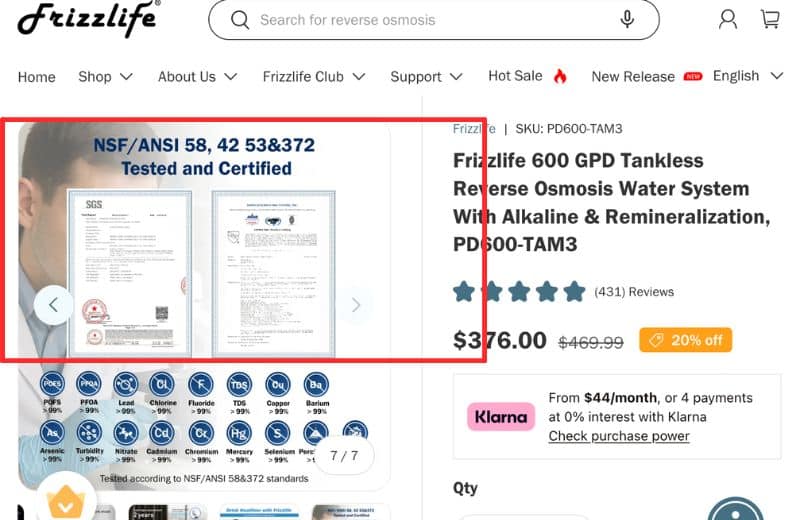
It’s possible that the system has been tested by IAPMO to NSF/ANSI Standards, but testing alone is not the same thing as official certification. In addition to testing the manufacturer’s performance claims, certification also involves extraction testing for materials safety to ensure the unit isn’t leaching anything into the purified water, as well as inspections of the manufacturing facility. It’s much more comprehensive and therefore more meaningful when a water filter is officially certified versus when it has been tested to NSF Standards.
When we search the PD600-TAM3 on the IAPMO database, only its lead-free design certification appears. As far as our research shows, the system is not performance certified, but some of the wording and IAMPO logo on the product page insinuate that it is.
🚦Filtration Rate
Score: 10.00The Frizzlife PD600-TAM3 has a maximum flow rate of 600 GPD (gallons per day), which means it has the capacity to provide more than enough water even for a large family. The higher the GPD rating of a tankless RO system, the faster the water flow from the dedicated faucet. So, while you will never actually need to use even close to 600 gallons per day, it tells you that the water flow should be fast.
In our own flow rate testing, at a feed water temperature of 60.9°F, we measured the time it took for the unit to fill a graduated measuring container up to the 12-ounce mark with purified water in seconds.
We wanted to get the most precise time measurement as possible, down to the millisecond. So, we took video footage of the process and uploaded it onto an editing tool, then moved through the video frame by frame until we had the precise starting point (water leaving the faucet) and ending point (container filled to the 12-ounce line). The average time was 12.67 seconds, amounting to a flow rate of 0.44 GPM (gallons per minute), or 26.63 GPH (gallons per hour).
Converted into GPD, the average flow rate for water leaving the unit is just over 639 GPD—quite a bit faster than the manufacturer’s claimed 600 GPD.
| Test Metric | Result |
|---|---|
| Time to Fill 12 oz | 12.67 seconds |
| Measured Flow Rate | 0.44 GPM |
| Gallons Per Hour | 26.63 GPH |
| Converted GPD | 639 GPD |
| Manufacturer Claim | 600 GPD |
Efficiency Ratio
A reverse osmosis system’s efficiency ratio is a measure of how much water is purified versus how much is wasted for any given volume.
Of the RO systems we’ve tested so far, the highest-efficiency models have claimed pure-to-wastewater ratios of 4:1. The Frizzlife PD600-TAM3 claims 2:1, meaning 1 gallon of water is lost for every 2 gallons purified.
To see how the system’s claimed efficiency ratio measured up to our own testing, we unhooked the end of the wastewater line and placed it inside a 1-gallon measuring cup. We then recorded the volume of wastewater produced in the time it took to fill 12 ounces of water.
In this test, for 12 ounces of purified water produced, the PD600-TAM3 produced 12 ounces of wastewater, giving it a pure-to-drain ratio of 1:1. That means only 50% of the water entering into the system ends up being usable, also known as the recovery rate.
Why was our own efficiency ratio measurement lower than Frizzlife’s? Perhaps our feed water was cooler and at a lower pressure than the manufacturer’s. But we still wouldn’t expect the result to be off by an entire gallon—especially when the system has an integrated pump to increase pressure during the purification process.
We then repeated this test, measuring up to the 64-ounce line on our container. This time, when the purified water reached this level, we measured 42 ounces in the wastewater container. That equates to a slightly better pure-to-drain ratio of 1.52:1, which is closer to the manufacturer’s 2:1 claim.
| Test Volume | Wastewater Produced | Pure-to-Drain Ratio |
|---|---|---|
| 12 oz Test | 12 oz | 1:1 |
| 64 oz Test | 42 oz | 1.52:1 |
| Claimed by Manufacturer | — | 2:1 |
We think this improved pure-to-drain ratio with the larger draw is because of backpressure on the RO membrane. When the system sits idle, water remains on both sides of the membrane and the pressures gradually equalize across it, so when you turn it back on, the membrane isn’t immediately operating at full differential pressure. Because of this, it takes a short moment to re-establish proper crossflow and flushing.
During that brief startup phase, more water goes to drain relative to the purified product. So, our smaller 12-ounce draw captured mostly that less efficient period, while our larger 64-ounce draw allowed the system to stabilize and operate at its normal, better recovery rate.
Automatic Flushing
The system flushes automatically at programmed intervals, to clean the membrane and reduce TDS creep. Automatic flushing occurs when:
- The unit is powered on; 30 seconds flushing
- The unit produces water for 10 minutes constantly; 15 seconds flushing = 32oz
- The unit produces water for 10 minutes cumulatively; 10 seconds flushing = 22oz
- The unit is in standby status; 18 seconds flushing every 6 hours = 38oz
Converted into gallons, that’s 0.25 gallons used for a 15-second flush, 0.17 gallons used for a 10-second flush, and 0.30 gallons per standby flush (every 6 hours), which, at 4× per day, is ~1.2 gallons of water down the drain even if you barely use RO water.
| Flush Trigger | Water Used |
|---|---|
| Power On (30 sec) | 0.25 gal |
| 10-min Continuous Use | 0.25 gal |
| 10-min Cumulative Use | 0.17 gal |
| Standby (Every 6 hrs) | 0.30 gal |
| Daily Standby Waste | 1.2 gallons |
This is something worth keeping in mind when we consider water waste. The 2:1 pure-to-drain ratio only tells some of the story, since it’s basically describing the RO process while the unit is actively making water.
But because the system also runs maintenance flushes that send additional water to the drain, more water is wasted outside of when it is being actively used. That “extra” drain water is likely not included in the simple 2:1 headline.
So, the total drain water is a combination of the normal RO drain and the automatic flush drain.
📐 Design
Score: 8.80The PD600-TAM3 is a space-saving under-sink unit that consists of one main tank (containing two filter cartridges) and a separate external remineralization filter. It measures 14.7 x 5.3 x 15.5 inches and weighs just over 33 lbs.
As a tankless model, it uses an internal pump to provide pressure to push water through the filters and out the faucet. That makes it a good option if you have limited under-sink space or you just don’t want a bulky unit taking up lots of room.
You might choose to buy the system with the Mini Water Tank, which holds 0.13 gallons of purified water and will help you avoid the 1-2-second lag in water delivery (as is normal with a tankless system).
We scored the system in this category based on:
- The quality of its components
- Whether it has certifications for design or materials safety.
Component Quality
Score: 8.00
The Frizzlife PD600-TAM3 is made from BPA-free plastics, with a lead-free stainless steel faucet. The product page doesn’t list the types of plastics used in the design. We reached out to Frizzlife, and a customer service rep confirmed that the plastic used is food-grade polypropylene.
We noted that the ¼” quick-connect components feel cheaper and flimsier than in similar RO systems we tested, although we were pleased to see that the shutoff valve is stainless steel rather than plastic.
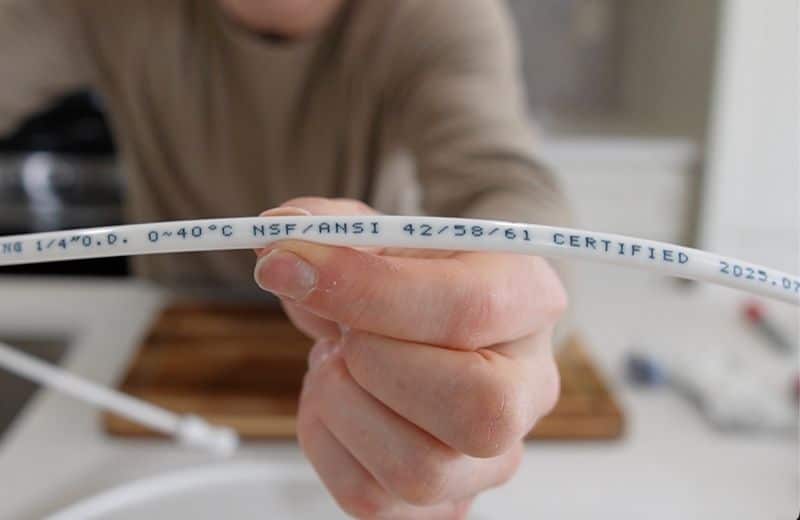
We also observed that the tubing has “NSF/ANSI 42,53,401” printed on it, although there’s no clarification in the user manual or on the website that the tubing is NSF certified.
Filter Materials
There are two filter cartridges inside the main housing unit, which offer a combined total of 7 claimed filtration stages. These are:
- A pleated polyester and coconut shell carbon block filter
- An RO membrane
There’s also the alkalizing remineralization filter. We couldn’t find information on what materials this filter is made from, but it likely uses some form of calcium carbonate media.
Tech Design Features
Like many modern RO systems, the PD600-TAM3 has several tech features that make it more helpful and user-friendly.
The unit has a digital display that gives you a real-time TDS reading for water leaving the system. That makes it easy to see at a glance that the system is working properly, since low TDS compared to the tap water tells you that the filters are effectively purifying your water.
The display also features a filter lifespan indicator, which is timer-based and changes color to indicate how long each filter has before a new one is needed.
For safety, there’s a long-time operation feature that enters the system into protection status and stops working if you use it to continually purify water for longer than 30 minutes. You can override this by unplugging the power for 10 seconds and then plugging it back in.
Materials Safety Certification
Score: 10.00
The PD600-TAM3 has an IAPMO certification to NSF 372, for lead-free design.
That’s a good start, especially since water with a low mineral content (like RO water) is more susceptible to lead leaching. We’d love to see the product gain an additional certification for materials safety (as part of performance certification) for extra reassurance.
⚙️ Setup
Score: 7.00Frizzlife claims that the PD600-TAM3 takes less than 30 minutes to install. The user manual provides detailed installation instructions and diagrams, and there’s an installation video you can follow if you’re more of a visual learner.
There are a couple of reasons why this filter scored poorly for setup:
- It took a long time to install (90 minutes in total; 3x the time suggested by Frizzlife)
- We experienced a few issues along the way that could have been avoided.
The unit fit nicely in our under-sink cabinet, and the faucet wingnut is easy to attach and hand-tighten.
We found that the 1/4 tubing isn’t pre-cut or color-coded like many other systems we’ve installed. This isn’t too big a deal, but you have to measure the specific length you need for each port and cut it. This does give you more flexibility with placement but might be a setback if you want a system that’s shipped as “ready to install” as possible.
We also found that the gasket in the 3-way feed water valve falls out easily, and we noted a total of 10 leak points at the fittings. Leak points are places where potential leaks can happen. While the system didn’t leak during our testing, we look for leak points to get an understanding of the likelihood of experiencing a leak at any point throughout the system’s operation. There are likely more leak points in the internal plumbing of the unit, but we didn’t take the housing apart to check this.
After installing the system, we flushed 8.87 gallons of water through the filters, following the initial flush procedure in the product manual. This flushing process took 20 minutes from start to finish. We conducted our other performance and wastewater analyses once the full flush was complete.
In all, it’s not the most difficult installation, but the PD600-TAM3 loses points in this category simply for the nature of an under-sink RO install, including the extra work required to install the faucet and drain line. These two processes can be very time-consuming and require you to work with precision to avoid making mistakes, since they involve making permanent changes to your existing plumbing setup and possibly countertop.
For us, there were a couple of ways we were able to save time:
- We used an RO drain adapter, which allows for quick connection (no drilling required) to the disposal dishwasher drain and has 1/4″ and 3/4″ quick-connect fittings compatible with all under-sink ROs.
- We already had a hole drilled in our countertop that was previously used for a soap dispenser, so we didn’t have to do that either. If you have to drill holes for both, this part of the installation could take significantly longer.
| Time Saver | Why It Helped |
|---|---|
| RO drain adapter | No drilling required |
| Existing countertop hole | Avoided faucet drilling |
| Clear manual instructions | Reduced guesswork |
Noise
With the unit up and running, we took the opportunity to test its noise levels. This isn’t something that we currently use as a ranking factor, but we think it’s interesting to compare.
Tankless systems like this Frizzlife model use an integrated water pump, which means they’re noisier than tank-based systems that use incoming water pressure. We used a phone app to measure sound decibels when the unit was running, at 1 foot and 3 feet away. Here are our results:
| Distance | Noise Level |
|---|---|
| 1 Foot | 48.4 dB |
| 3 Feet | 44.7 dB |
| System Type | Pump-Based (Tankless) |
The system was one of the loudest RO systems we tested, producing almost twice as much noise as systems including the Express Water RO5DX and the iSpring RCC7. But it’s worth noting an important distinction here: these two systems are both tank-based and don’t use a pump, which is why they run more quietly.
🔧 Maintenance
Score: 10.00The PD600-TAM3 has simple, affordable maintenance requirements, earning it the highest score in this category.
Servicing Requirements
10.00
The main servicing job for this system is replacing the filters, which, according to Frizzlife, takes 3 seconds.
This is somewhat optimistic, but the process is easy: just shut off the power, turn off the water, depressurize the system, then twist out the old filter and twist the new one in its place. Press the “reset” button to reset the filter lifespan tracker, then turn the power back on.
The only slight annoyance is that you have to flush the new filter following the same 20-minute flushing process as you did during setup, so you’ll need to have more than just “3 seconds” if you want to use the system to produce water that’s ready to drink instantly.
There’s no guesswork involved in replacing the filters because the filter life tracker will beep to remind you.
Aside from replacing the filters, we followed Frizzlife’s maintenance guidance in the user manual, including cleaning the system with cool water and checking the unit and pipe fittings regularly for leaking (no built-in leak detectors with this one, sadly).
Costs
Score: 10.00
The PD600-TAM3 has a low ongoing spend of just $0.10/ gallon. We calculated this by dividing the cost of each filter by its projected water filtering capacity to get individual costs-per-gallon, then combining them to reach a total.
Here’s how each filter contributed to the total cost-per-gallon:
| Filter | Cost Per Gallon |
|---|---|
| ASR211 Carbon Filter | $0.03 |
| ASR212-600G RO Membrane | $0.04 |
| FZ-4 Remineralization Filter | $0.03 |
| Total Cost Per Gallon | $0.10 |
Energy usage is another helpful cost to consider when we’re looking at ongoing spend for a tankless RO system. We measured the PD600-TAM3’s energy usage using a device that plugged into our under-sink outlet, with the RO unit plugged into the device. In 2 minutes and 22 seconds (the time it took to purify 1 gallon of water), the device recorded that the PD600-TAM3 had used 0.003 kWh, which we converted to 3 watt hours per gallon.
This equates to an annual electricity spend of just $0.58. Of course, this cost can vary from place to place, but we based our calculation on the average US national electricity cost of $0.1778 per kWh and average 3 gallons of purified water per day used for drinking and cooking, which equates to roughly 1,095 gallons for the year.
🏢 Company
Score: 8.70We also evaluated Frizzlife as a manufacturer, since this gives us an insight into the reliability and support you can expect as a customer. This is equally important as you never know when you might need help with a product.
Warranty
Score: 8.50
Frizzlife provides a 1-year warranty against any defects or material workmanship that occur during the warranty period. Under this warranty, you’ll be entitled to a free repair or replacement if your product is deemed to be “broken within the limits of the warranty”, with shipping costs covered by the manufacturer.
There’s also the option to register for a 150% extended warranty, either by emailing your order ID and full name to [email protected] or registering online. That means your 1-year warranty can be extended to 1.5 years, and since registering is free, it’s well worth doing.
You can find warranty information at the bottom of the user manual.
Shipping
Score: 9.00
All orders exceeding $25 on the Frizzlife website are shipped for free to customers in the US. Shipping costs $5 for any order below this threshold.
View Frizzlife’s shipping policy here.
Returns
Score: 7.00
Frizzlife offers a 30-day returns policy, but it’s not as lenient as those offered by many other manufacturers. To be eligible for a return, your item needs to be unused and in the same condition that you received it. It must also be in the original packaging.
That means you can’t return your product if you decide it isn’t for you or doesn’t meet your expectations after using it during the returns period.
Here’s Frizzlife’s returns policy for more information.
| Pros | Cons |
|---|---|
| Strong contaminant reduction | Not performance certified |
| Excellent flow rate | Expensive upfront |
| Simple maintenance | Flimsy quick-connect fittings |
| Adds alkalinity | Lower nitrate reduction than expected |
| Real-time TDS display | Loud compared to tank systems |
💰 Value For Money
Looking at value for money overall, we think this Frizzlife system is a solid choice. It’s priced similarly to other under-sink RO systems, and with its external remineralization filter and space-saving tankless design, it offers a bit more than some of its competitors. We were generally impressed with its contaminant reduction, flow rate, and efficiency ratio.
That said, it’s still not the best choice. It did a poor job of reducing nitrate in our testing, and it’s lacking official certifications for performance and materials safety. Plus, we have concerns over some of its flimsier components.
If you’re not bothered about certifications and are looking for the benefits of tankless RO filtration, the PD600-TAM3 is worth considering. But if certifications are a non-negotiable for you, we recommend the Waterdrop G3, the highest-scoring tankless RO system we’ve tested so far, which is IAPMO certified to 100% of its performance claims.
Found this review helpful?
Comment below or share this article!