
Is Your City Breaking You Out? The Best and Worst Cities for Skin
You can spend a small fortune on serums and follow a 10-step routine and still splash your face every morning with water that may be working against you. To find where skin feels hardest to manage in America, we ranked the 98 largest U.S. cities using environmental data and Google search demand, then surveyed 1,000 Americans about how they feel about their skin and what they blame when it acts up. The results point to an overlooked culprit hiding in plain sight, right at the bathroom sink. Here is where your city lands and why your shower might matter more than your next serum.
📌 Key Takeaways
- Orlando and Miami, FL, are the worst cities for your skin.
- Lincoln, NE, is the best city for your skin.
- Riverside, CA, ranks No. 1 for worst air quality, and El Paso, TX, has the strongest UV risk, an environmental condition that can cause skin irritation.
- Americans in Atlanta search for breakout and acne solutions more than anywhere else in the country (1,948 per 100K).
- People in Orlando are the most concerned about their water, searching for hard water, filters, and water-quality fixes more than any other city per capita (9,105 per 100K).
- Nearly a third of Gen Z (32%) name TikTok as a go-to source for skincare advice, just ahead of dermatologists (31%).
The Skin Stress Index: The Worst and Best Cities for Skin Health
Geography turns out to be an important variable in skin health, shaping everything from sun exposure to the minerals running through your shower. Some metros stack the deck against clear skin, while others give residents an easy ride.
Orlando, Florida, landed at the top of the Skin Stress Index, searching more than anywhere else in the country for breakouts, irritation, and water concerns, all under a heavy dose of UV. Miami, Florida, followed close behind, ranking among the top three for skin-problem searches while contending with strong sun and warm, humid air. Atlanta, Georgia, rounded out the toughest three as the nation’s number one city for breakout searches, with high demand across every skin and water cluster.
At the other end of the ranking, Lincoln, Nebraska, came out as the easiest place to keep skin happy, combining low UV, clean air, and some of the lowest skin and water search interest in the study. Toledo, Ohio, and Fort Wayne, Indiana, were not far behind, both northern cities with low sun exposure, low pollution, and little sign that residents struggle with either the causes or the symptoms.
How Each City Works Against Your Skin
No two cities pressure skin in quite the same way. Mapping each metro’s dominant stressor reveals whether residents are mostly fighting sun, smog, hard water, or breakouts.
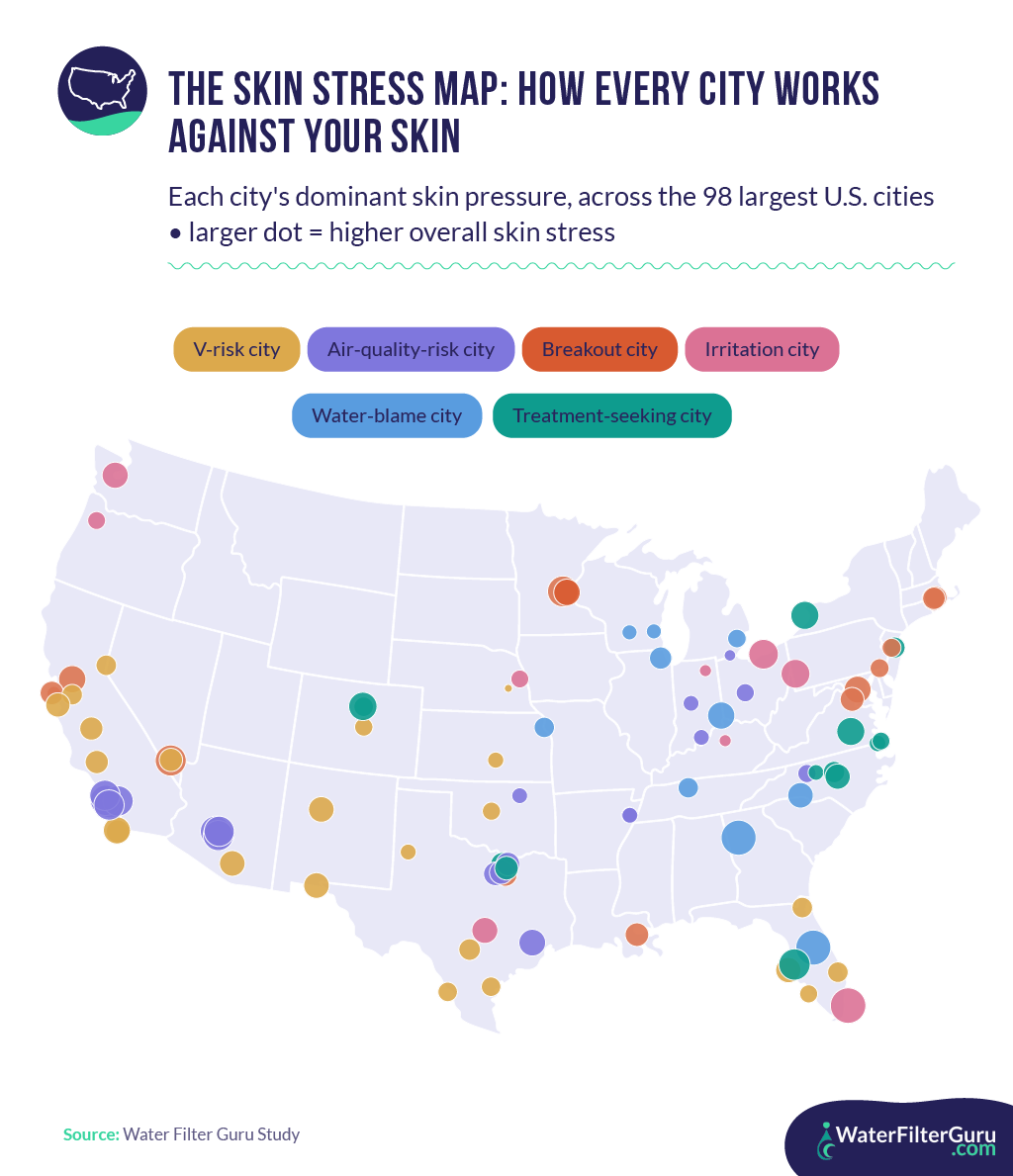
Each city carried a signature pressure, the single factor that set it apart most. Water defined Orlando, which led all 98 cities in water-blame searches, while irritation drove Miami, and UV shaped El Paso. Air quality marked Riverside, breakouts characterized Minneapolis, and treatment-seeking distinguished Denver, where residents searched hardest for dermatologists, facials, and skincare routines.
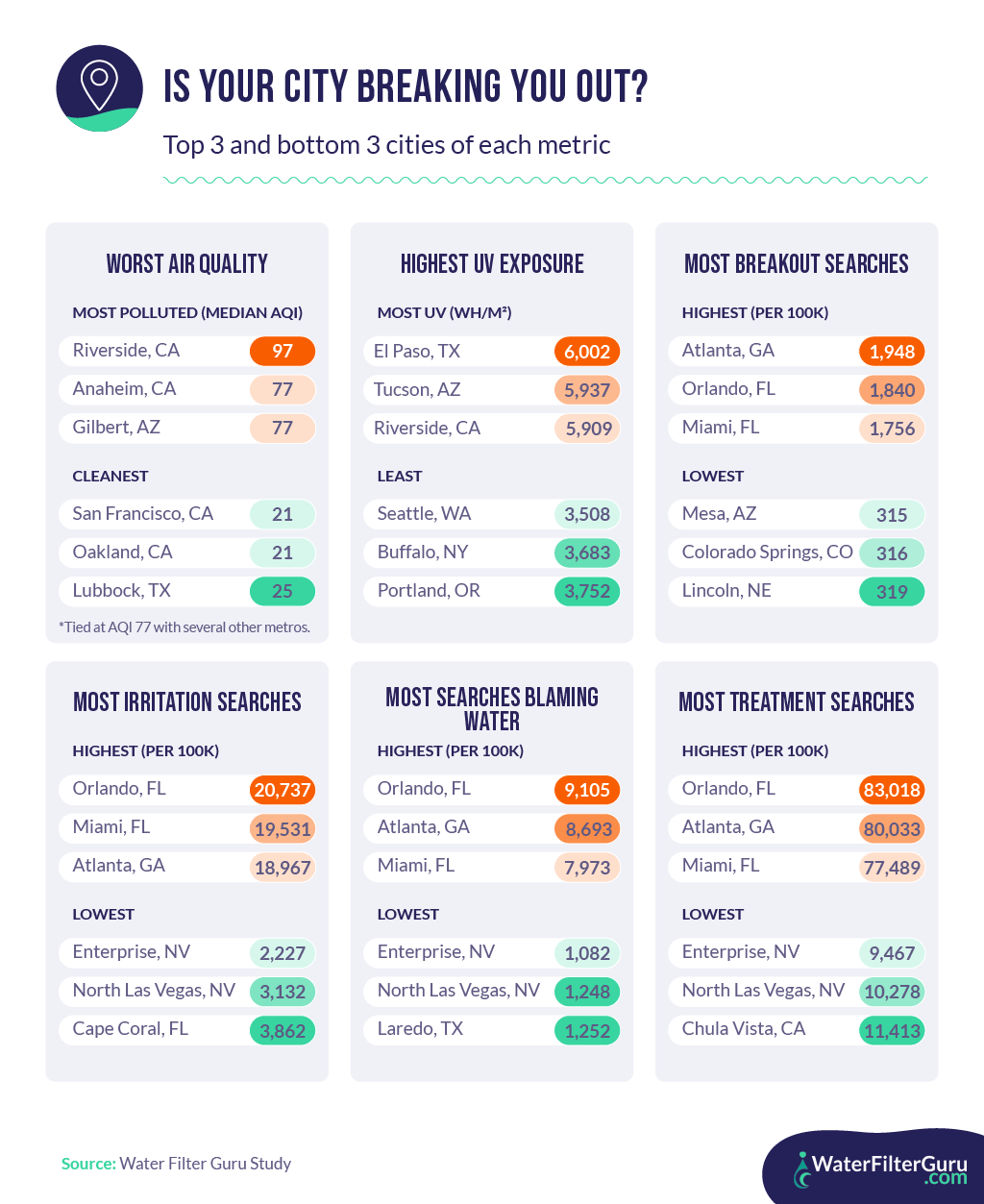
On the environmental side, Riverside, California, ranked as the most polluted city studied, with a median air quality index of 97, while El Paso, Texas, absorbed the strongest UV exposure in the country. Those conditions are linked to skin irritation, premature aging, and barrier stress. For contrast, San Francisco and Oakland breathed the cleanest air of any cities measured, both at a median AQI of 21, and Seattle saw the least UV.
Search behavior told its own story. Atlanta, Georgia, residents looked for breakout and acne solutions more than anyone else in the country, with 1,948 searches per 100,000 people. Orlando, Florida, proved the most worried about its water, logging 9,105 searches per 100,000 for hard water , filters, and water-quality fixes, more than any other city per capita.
The Emotional Side of Clear Skin
Skin is rarely just a physical concern. It shows up in how people carry themselves, who they spend time with, and how they feel walking into a room.
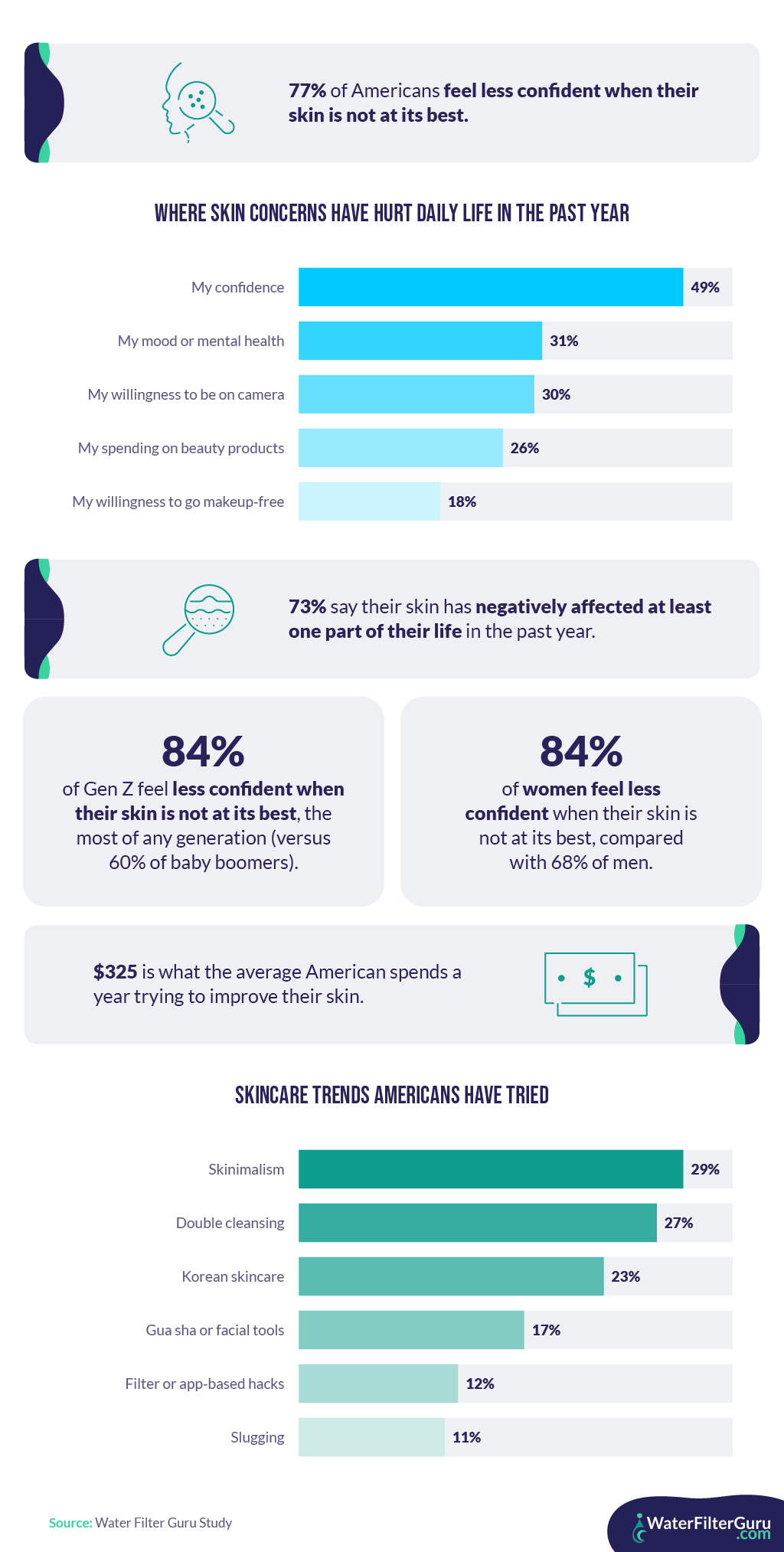
More than three-quarters of Americans (77%) said they felt less confident when their skin was not at its best, and nearly as many (73%) reported that skin concerns had hurt at least one part of their life in the past year, from their mood to their willingness to be on camera.
The pressure landed hardest on the youngest adults. Gen Z was the most likely generation to feel less confident about their skin, at 84%, compared with 78% of millennials. They also leaned furthest into the newer, social-driven trends, trying glass skin (18% versus 10% of all Americans) and hypochlorous acid sprays (12% versus 6%) at a higher rate than the country as a whole.
All that worry adds up. Americans spent roughly $27 a month chasing better skin, which works out to about $325 a year.
The Water Blind Spot
When skin flares up, people tend to interrogate their diet, their stress, and their hormones long before they think about the faucet. That instinct may be steering them away from a cause they could actually fix.
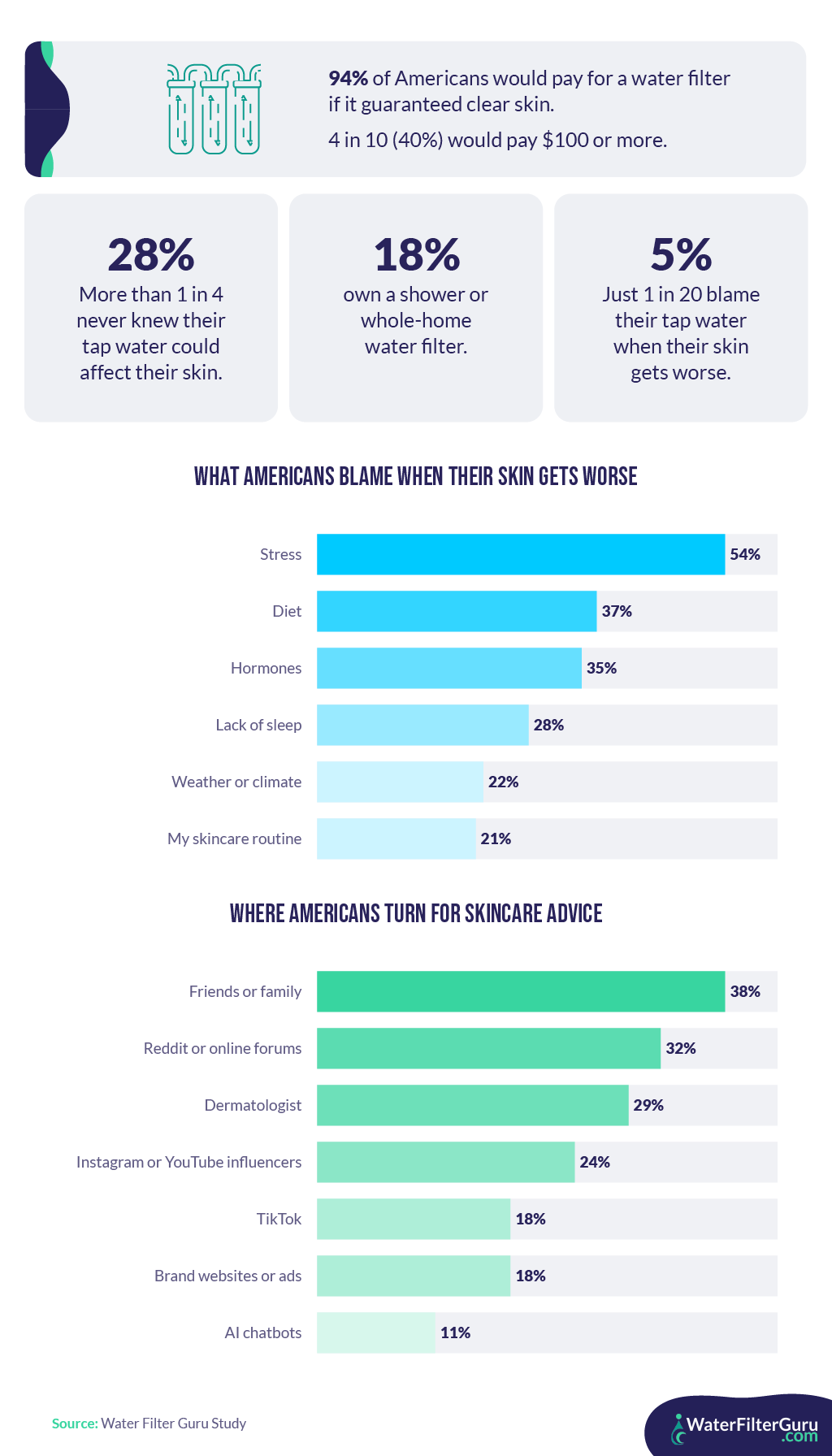
Here is the twist: most Americans say they would gladly treat their water if it meant better skin. A striking 94% would buy a water filter if it guaranteed clear, healthy skin, and 40% would spend $100 or more to get it.
The catch is that few connect the dots on their own. More than a quarter (28%) never knew their tap water could affect their skin at all, and just 5% blamed it when their skin got worse, the least-suspected cause on the list.
When they did go looking for help, Americans leaned on people over professionals. Friends and family (38%) and Reddit (32%) both outranked dermatologists (29%) as go-to sources for skincare advice. Among Gen Z, the dermatologist slipped even further: 32% named TikTok as a go-to source, just ahead of the 31% who named a derm.
The Bottom Line on Your City, Your Water, and Your Skin
Where you live clearly shapes how hard your skin has to work, from the sun overhead to the minerals in your shower. Yet the most overlooked factor sits closest to home, in water that most people never think to question. Paying attention to what you wash with is a simple, empowering first step, one that costs nothing but a little curiosity. Clearer skin may have less to do with the next trending product and more to do with what comes out of the tap.
Methodology
To explore Americans’ skincare concerns and habits, we surveyed 1,000 American adults: 18% Gen Z, 48% millennials, 25% Gen X, and 10% baby boomers. The gender breakdown was 57% women, 40% men, 2% nonbinary, and 1% preferred not to answer. Percentages may not total 100% due to rounding.
This study combined environmental data and search demand to rank the 98 largest U.S. cities with available data on how stressful they are for skin. Each city was scored on six metrics, grouped into two categories. For each metric, the city with the most skin stress is ranked 1, and the city with the least is ranked 98. For example, El Paso, TX has the highest UV exposure and is ranked 1 for UV, while Seattle, WA has among the lowest UV exposure and is ranked near the bottom at 98.
- Environmental Factors (40%)
- UV: measured as average daily global solar radiation in Wh/m² from the National Cancer Institute . Higher raw value = worse. More cumulative sun exposure, more skin stress. UV data is reported at the county level, so each city was matched to its county’s value. Some cities share a county with another city in the study, so they carry identical UV values (e.g., the six Phoenix-area cities all in Maricopa County; Dallas/Garland/Irving in Dallas County; the four Vegas-area cities in Clark County).
- AQI: measured as the median AQI from the EPA . AQI data is reported at the metropolitan-area (CBSA) level, so each city was matched to its metro’s value. Some cities share a metro/CBSA with another city, so they carry identical AQI values (e.g., all eight DFW cities; the five LA-area cities; the six Phoenix-area cities). AQI runs opposite to a grade; low is clean air, and high is polluted, so a higher raw value = more pollution = worse.
- Acne and Breakouts search per 100k (15%): terms are breakout causes, clogged pores, why is my skin so bad
- Irritation and barrier search per 100k (15%) : terms are dry skin, redness, skin irritation, rosacea, flaky skin, itchy skin, and skin barrier.
- Water-blame search per 100k (15%): terms are hard water, shower filter, water filter, sink filter
- Treatment-seeking search per 100k (15%): terms are dermatologist, dermatologist near me, esthetician near me, facial near me, skincare routine
Search volumes represent concern and demand, not measured skin outcomes, so findings describe how often residents search for skin and water issues, not clinically observed skin health.
In addition to the overall ranking, each city was assigned a dominant pressure, the factor that most defines its skin stress. Because the six metrics are measured on very different scales, raw values were converted to z-scores expressing how far above or below the 98-city average each city fell on each metric, in standard deviations. A city’s dominant pressure is the metric with its highest z-score, classifying it as a UV-risk city, air-quality-risk city, breakout city, irritation city, water-blame city, or treatment-seeking city. This identifies not which metric is largest in absolute terms, but where each city most exceeds the national norm.
About Water Filter Guru
Water Filter Guru is the most comprehensive online resource for unbiased, research-backed information on residential water treatment. From hard water and common contaminants to choosing the right filter for your home, the team helps people understand exactly what is flowing from their taps and what to do about it. Since clearer skin can start with cleaner water, getting to know your supply is a smart place to begin.
Fair Use Statement
The findings and graphics in this article are available for noncommercial use only. If you share them, please include a link with proper attribution to Water Filter Guru so readers can explore the full study.