

If you’re looking for a modern version of the conventional under-sink reverse osmosis system, Cloud RO and Waterdrop are two products you’ve probably considered.
Both are intended for an under-sink install, delivering purified water whenever you need it. They’re also both performance certified, and both use remineralization (although Waterdrop’s is an added inline filter rather than being built in).
But Cloud RO uses a tank to store water, the Waterdrop G3 has an internal pump, which sends water straight through to the faucet. We wanted to evaluate whether this key design difference resulted in a noticeably different performance, particularly when it comes to contaminant reduction, filtration rate, efficiency ratio, and TDS creep.
We tested both systems using our suite of objective analyses, and we’ll be putting Cloud RO vs Waterdrop head-to-head in this review.
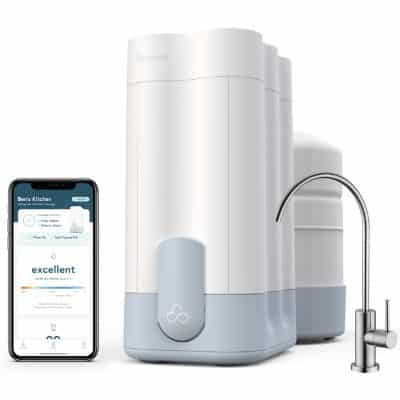
Cloud RO
Best For:
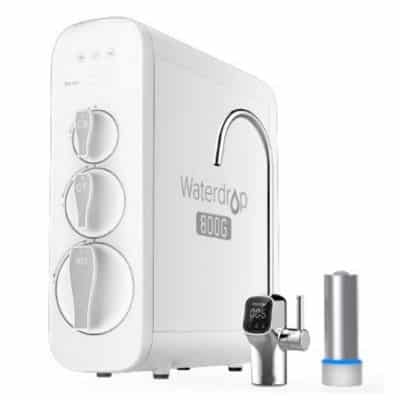
Waterdrop
Best For:
Quick Verdict: Cloud RO or Waterdrop G3 P800?
Cloud RO wins our head-to-head by 0.03 points, scoring 9.24/10 to the Waterdrop G3 P800’s 9.21/10. The margin is the closest we’ve recorded in a comparison, and the right pick depends on what you prioritize.
- Choose Cloud RO (9.24/10) for stronger lab-tested health contaminant reduction (9.90 vs 9.50, with 100% removal of fluoride, uranium, and all disinfection byproducts), a pH boost to 8.7 or higher, a 5 year warranty, and 90 day returns.
- Choose the Waterdrop G3 P800 (9.21/10) for a measured 886.54 GPD filtration rate (more than 10x faster than Cloud RO), IAPMO certifications to NSF/ANSI 42, 53, and 58 covering 6 contaminants, lower running costs ($0.11 vs $0.18 per gallon), and a first-draw TDS reading just 24 PPM above its stable level (Cloud RO’s first draw spiked 216 PPM, which Cloud attributes to mineral release from its new remineralization media rather than TDS creep).
Both scores come from our first-party testing, with before and after water samples analyzed by Tap Score, an accredited laboratory. Read our full testing methodology.
Cloud RO is available in just one variation: the compact, battery-powered 4-stage unit with a 2.8-gallon tank.
Waterdrop sells a few models in the under-sink G3 series, including 600 GPD (gallons per day) and 800 GPD units, a version with a remineralization filter, and a version with a UV light. We tested the Waterdrop G3 P800 Remineralization RO System.
In our testing, both systems reduced or removed most contaminants in our water, but Cloud RO performed slightly better, while Waterdrop is more extensively certified. Both have high-quality designs and accompanying certifications, and both are easy and affordable to maintain. We experienced some installation challenges, particularly with Waterdrop, and Cloud’s company policies are better.
📊 Our Testing Data: Cloud RO Scores 9.24/10, Waterdrop G3 P800 Scores 9.21/10
We follow the same structured testing process for all the water filters we review. This involves carrying out individual tests and assigning scores across the 6 main assessment criteria in our scoring system: contaminant reduction, design quality, ease of installation, maintenance, filtration rate, and company policies.
How We Tested: We installed both systems ourselves and ran identical structured tests. Contaminant reduction was measured by sending unfiltered and filtered samples from each system to Tap Score, an accredited laboratory, with on-site colorimeter testing for chlorine. We also measured filtration rate with a timed fill test, TDS creep after 10 hours idle, wastewater ratios at two draw volumes, noise at 1 and 3 feet, and installation time. Each system’s overall score weights contaminant reduction at 55%, with filtration rate, design, setup, and maintenance at 10% each and company policies at 5%.
| Factor | Cloud RO | Waterdrop |
|---|---|---|
| Contaminant Reduction | 9.42 | 9.28 |
| Filtration Rate | 8.50 | 10.00 |
| Design | 10.00 | 9.70 |
| Setup | 7.50 | 7.00 |
| Maintenance | 10.00 | 10.00 |
| Company | 9.20 | 8.65 |
The next table highlights how Cloud RO and Waterdrop compare across these categories.
Some of our tests are broken down into several testing subcategories. See the table below for a more in-depth look at this data.
| Factor | Cloud RO | Waterdrop | Winner |
|---|---|---|---|
| Overall Score | 9.24 | 9.21 | Cloud RO |
| Health Related Contaminants | 9.90 | 9.50 | Cloud RO |
| Aesthetic Related Contaminants | 3.50 | 3.50 | Tie |
| Performance Certification | NSF/ANSI 58 | NSF 42, 53 and 58 | Waterdrop |
| Filtration Rate | 80 GPD | 800 GPD | Waterdrop |
| Component Quality | Exceptional | Outstanding | Cloud RO |
| Component Certification | NSF/ANSI 58 | NSF/ANSI 42, 53, 58 and 372 | Tie |
| Setup | Below Average | Weak | Cloud RO |
| Servicing Requirements | Exceptional | Exceptional | Tie |
| Costs | $0.18/gal | $0.11/ gal | Waterdrop |
| Warranty Length | 5 years | 1 year | Cloud RO |
| Shipping | Free shipping all orders in the US | Free shipping to lower 48 | Cloud RO |
| Returns | 90 days | 30 days | Cloud RO |
🚰 Contaminant Reduction: Cloud RO Wins, 9.42 vs 9.28
Reverse osmosis delivers superior contaminant reduction results — but did Cloud RO or Waterdrop perform more impressively in this category?
To answer this question, we compared our test data for both systems. We also checked certification databases online to see if their performance was validated by the NSF, IAPMO, or the WQA.
Our Lab Test Results
Key Finding: Cloud RO removed 100% of fluoride, uranium, chlorine, and all disinfection byproducts in our Tap Score lab tests, earning a 9.90 health contaminant score, the higher of the two systems.
We evaluated Cloud RO and Waterdrop’s contaminant reduction performance by comparing our unfiltered and filtered water tests for each system. Each test was conducted separately on a different water supply. For consistency, we used the same Tap Score laboratory test kits to detect contaminants.
Only one test was conducted on-site: chlorine detection. We used Hach chlorine strips (included in our Tap Score kits) to detect this volatile contaminant immediately after collecting water from the faucet for the most accurate data.
We’re comparing our lab test results for Cloud RO and Waterdrop next.
You can also see an overview of the contaminants detected in our source water and the % of contaminants removed by each system in the table below.
Cloud RO Test 1
| Analyte | Unit | Baseline Test 1 | Cloud RO Test 1 | Difference |
|---|---|---|---|---|
| Alkalinity (as CaCO3) | PPM | 53 | 15 | -71.70% |
| Aluminum | PPM | 0.164 | 0 | -100.00% |
| Barium | PPM | 0.0264 | 0.0057 | -78.41% |
| Bicarbonate | PPM | 62.98 | 10.36 | -83.55% |
| Bromodichloromethane | PPB | 2.65 | 0 | -100.00% |
| Calcium | PPM | 18.1 | 1.2 | -93.37% |
| Carbonate | PPM | 0.729 | 2.39 | 227.85% |
| Chloride | PPM | 15 | 1 | -93.33% |
| Chloroform | PPB | 8.22 | 0 | -100.00% |
| Conductivity | umhos/cm | 128 | 22.1 | -82.73% |
| Copper | PPM | 0.0099 | 0 | -100.00% |
| CSMR | 0.75 | 0.91 | 21.33% | |
| Fluoride | PPM | 0.6 | 0 | -100.00% |
| Grains per gallon | Grains | 3.5 | 0.55 | -84.29% |
| Hardness (Ca, Mg) | PPM | 59.2 | 9.3 | -84.29% |
| Hardness (Total) | PPM | 59.95 | 9.34 | -84.42% |
| Langelier Saturation Index | 0.1 | -0.12 | -220.00% | |
| Magnesium | PPM | 3.4 | 1.53 | -55.00% |
| Manganese | PPM | 0.0016 | 0 | -100.00% |
| Molybdenum | PPM | 0.002 | 0 | -100.00% |
| pH | 8.4 | 9.7 | 15.48% | |
| Potassium | PPM | 1.03 | 0 | -100.00% |
| Sodium | PPM | 15.3 | 1.44 | -90.59% |
| Sodium Adsorption Ratio | 0.86 | 0.21 | -75.58% | |
| Strontium | PPM | 0.097 | 0 | -100.00% |
| Sulfate | PPM | 20 | 1.1 | -94.50% |
| Total Dissolved Solids | PPM | 76 | 14 | -81.58% |
| Total THMs | PPB | 10.87 | 0 | -100.00% |
| Zinc | PPM | 0 | 0.024 | N.A. |
Cloud RO Test 2
| Analyte | Unit | Baseline Test 2 | Cloud RO Test 2 | Difference |
|---|---|---|---|---|
| Alkalinity (as CaCO3) | PPM | 356 | 38 | -89.33% |
| Barium | PPM | 0.0319 | 0.000679 | -97.87% |
| Bicarbonate | PPM | 430 | 44 | -89.77% |
| Boron | PPM | 0.41 | 0.301 | -26.59% |
| Bromodichloromethane | PPB | 4.38 | 0 | -100.00% |
| Bromoform | PPB | 8.01 | 0 | -100.00% |
| Calcium | PPM | 73.3 | 0.674 | -99.08% |
| Carbonate | PPM | 1.98 | 1.02 | -48.48% |
| Chloride | PPM | 99.7 | 11.3 | -88.67% |
| Chloride-to-Sulfate Mass Ratio | 0.639 | 1.47 | 130.05% | |
| Chromium (Total) | PPM | 0.00308 | 0.000215 | -93.02% |
| Copper | PPM | 0.233 | 0 | -100.00% |
| Dibromochloromethane | PPB | 10.3 | 0 | -100.00% |
| Expanded Hardness | PPM | 248 | 21.6 | -91.29% |
| Fluoride | PPM | 2.2 | 0 | -100.00% |
| Grains per gallon | Grains | 14.4 | 1.26 | -91.25% |
| Hardness | PPM | 247 | 21.6 | -91.26% |
| Langelier Saturation Index | 0.744 | -1.46 | -296.24% | |
| Magnesium | PPM | 15.5 | 4.84 | -68.77% |
| Manganese | PPM | 0.0011 | 0 | -100.00% |
| Molybdenum | PPM | 0.00119 | 0 | -100.00% |
| Nitrate (as N) | PPM | 2.5 | 1.3 | -48.00% |
| Nitrite (as N) | PPM | 0.5 | 0 | -100.00% |
| pH | pH | 8 | 8.7 | 8.75% |
| Potassium | PPM | 3.03 | 0 | -100.00% |
| Selenium | PPM | 0.00361 | 0 | -100.00% |
| Sodium | PPM | 178 | 13.9 | -92.19% |
| Sodium Adsorption Ratio | 4.92 | 1.3 | -73.58% | |
| Specific Conductivity | umhos/cm | 1210 | 114 | -90.58% |
| Strontium | PPM | 0.757 | 0 | -100.00% |
| Sulfate | PPM | 156 | 7.7 | -95.06% |
| Total Dissolved Solids | PPM | 707 | 68 | -90.38% |
| Total THMs | PPB | 22.7 | 0 | -100.00% |
| Uranium | PPM | 0.0118 | 0 | -100.00% |
| Vanadium | PPM | 0.00118 | 0.000582 | -50.68% |
Waterdrop G3P800 Test
| Analyte | Unit | Result Value | No-Remin | Difference vs Baseline | With-Remin | Difference vs Baseline | Remin vs No-Remin Difference |
|---|---|---|---|---|---|---|---|
| Alkalinity (as CaCO3) | PPM | 392 | 0 | -100.00% | 27 | -93.11% | #DIV/0! |
| Barium | PPM | 0.0307 | 0 | -100.00% | 0 | -100.00% | #DIV/0! |
| Bicarbonate | PPM | 473 | 0 | -100.00% | 32.8 | -93.07% | #DIV/0! |
| Boron | PPM | 0.421 | 0.338 | -19.71% | 0.34 | -19.24% | 0.59% |
| Bromodichloromethane | PPB | 2.65 | 0 | -100.00% | 0 | -100.00% | #DIV/0! |
| Bromoform | PPB | 8.48 | 0 | -100.00% | 0 | -100.00% | #DIV/0! |
| Calcium | PPM | 73.4 | 0.365 | -99.50% | 3.16 | -95.69% | 765.75% |
| Carbonate | PPM | 2.18 | 0 | -100.00% | 0.0479 | -97.80% | #DIV/0! |
| Chloride | PPM | 96.8 | 7.4 | -92.36% | 6.4 | -93.39% | -13.51% |
| Chloride-to-Sulfate Mass Ratio | 0.605 | Very High | #VALUE! | Very High | #VALUE! | #VALUE! | |
| Chromium (Total) | PPM | 0.00267 | 0 | -100.00% | 0.000297 | -88.88% | #DIV/0! |
| Copper | PPM | 0.24 | 0 | -100.00% | 0 | -100.00% | #DIV/0! |
| Dibromochloromethane | PPB | 8.24 | 0 | -100.00% | 0 | -100.00% | #DIV/0! |
| Expanded Hardness | PPM | 248 | 0.911 | -99.63% | 8.38 | -96.62% | 819.87% |
| Fluoride | PPM | 1.9 | 0.4 | -78.95% | 0 | -100.00% | -100.00% |
| Grains per gallon | Grains | 14.4 | 0.0532 | -99.63% | 0.489 | -96.60% | 819.17% |
| Hardness | PPM | 247 | 0.913 | -99.63% | 8.36 | -96.62% | 815.66% |
| Langelier Saturation Index | 0.783 | N/A | #VALUE! | -2.12 | -370.75% | #VALUE! | |
| Magnesium | PPM | 15.5 | 0 | -100.00% | 0.115 | -99.26% | #DIV/0! |
| Molybdenum | PPM | 0.00122 | 0 | -100.00% | 0 | -100.00% | #DIV/0! |
| Nitrate (as N) | PPM | 3.3 | 0.8 | -75.76% | 0 | -100.00% | -100.00% |
| Nitrite (as N) | PPM | 0 | 0 | #DIV/0! | 0.24 | #DIV/0! | #DIV/0! |
| pH | pH | 8 | 7 | -12.50% | 7.5 | -6.25% | 7.14% |
| Potassium | PPM | 2.96 | 0 | -100.00% | 0 | -100.00% | #DIV/0! |
| Selenium | PPM | 0.00447 | 0 | -100.00% | 0 | -100.00% | #DIV/0! |
| Sodium | PPM | 177 | 11 | -93.79% | 10.9 | -93.84% | -0.91% |
| Sodium Adsorption Ratio | 4.89 | 5.01 | 2.45% | 1.64 | -66.46% | -67.27% | |
| Specific Conductivity | umhos/cm | 1330 | 57.4 | -95.68% | 79.7 | -94.01% | 38.85% |
| Strontium | PPM | 0.755 | 0 | -100.00% | 0.0155 | -97.95% | #DIV/0! |
| Sulfate | PPM | 160 | 0 | -100.00% | 0 | -100.00% | #DIV/0! |
| Total Dissolved Solids | PPM | 776 | 35 | -95.49% | 48 | -93.81% | 37.14% |
| Total THMs | PPB | 19.4 | 0 | -100.00% | 0 | -100.00% | #DIV/0! |
| Uranium | PPM | 0.0117 | 0 | -100.00% | 0 | -100.00% | #DIV/0! |
| Vanadium | PPM | 0.00111 | 0 | -100.00% | 0 | -100.00% | #DIV/0! |
Health-Related Contaminants
The systems performed similarly when reducing health-related contaminants in our water, eliminating the majority of impurities but struggling to remove several.
Our Cloud RO Results
We tested Cloud RO twice: once with a relatively uncontaminated water supply, and once with a much trickier water supply that was highly contaminated. We’ll break down our results for both tests here.
Test 1
In our initial Cloud test, our source water had a TDS reading of 76 PPM. It contained 2 disinfection byproducts, chloride, fluoride, sulfate, and trace levels of a number of metals, including strontium, aluminum, and barium.
Post-filtration, our results showed that Cloud RO had removed 100% of both disinfection byproducts, fluoride, chlorine, aluminum, copper, manganese, molybdenum, and strontium. It also greatly reduced barium (by 78%) and sulfate (by 94%).
Test 2
In our second test, our water had a TDS reading of 707 PPM — that’s almost 10x the dissolved solids concentration of our test 1 water source.
Uranium and 3 disinfection products (exceeding the Health Guideline Level) were detected, along with barium, nitrate, nitrite, total chromium, copper, molybdenum, fluoride, manganese, and boron.
Cloud actually performed better on a percentage basis when it was challenged with this more contaminated water supply. It completely eliminated fluoride, all disinfection byproducts, chlorine, uranium, copper, strontium, selenium, manganese, potassium, and molybdenum. It also greatly reduced barium (by 97%), sulfate (by 95%), and total chromium (by 93%).
Less impressively, it reduced just 50% vanadium, 48% nitrate, and 26% boron.
How Waterdrop Compared
In our Waterdrop tests, our unfiltered water contained trace levels of 14 contaminants with possible health effects, including 3 disinfection byproducts, fluoride, uranium, nitrate, strontium, barium, molybdenum, and vanadium.
The G3 eliminated all contaminants detected above the HGL, including fluoride, molybdenum, and barium. It also eliminated nitrate and vanadium (which the Cloud RO model struggled to remove), along with copper, chlorine, and selenium. Additionally, strontium was reduced by 97%, and total chromium by 88%.
Boron was reduced by just 19%, similar to Cloud. Most RO systems struggle to remove this contaminant as it primarily exists as uncharged boric acid in water, which mimics the size of water molecules and can easily slip through RO membrane pores.
Unexpectedly, 0.24 PPM nitrite (not nitrate — similar spelling but different contaminant!) appeared in our filtered water. Our theory is that the remineralization cartridge contains biofilm, which converted trace nitrate to nitrite.
Aesthetics, pH, and Mineral Content
Cloud RO comes with built-in remineralization. We tested the Waterdrop G3 with and without remineralization, but we’ll be discussing our with-remin results here to fairly compare each system’s effects on pH, alkalinity, and hardness.
pH
- Cloud RO increased pH significantly in both our tests, to 9.7 in Test 1 and 8.7 in Test 2. This demonstrates the system’s ability to deliver high-pH, alkaline water.
- In our Waterdrop G3 test, pH reduced slightly, from 8.0 to 7.5. But the remin filter was clearly doing something, as without this filter, pH was reduced to 7.0.
Minerals
- In our Cloud RO test, calcium was reduced by 93% (test 1) and 99% (test 2), magnesium by 55% (test 1) and 68% (test 2), potassium by 100% (in test 1 and 2), and sodium by 90% (test 1) and 92% (test 2).
- With remineralization, the G3 reduced calcium by 95%, magnesium by 99%, and sodium by 94%.
TDS & TDS Creep
TDS creep occurs when the initial draw of water, after the RO system hasn’t been used for some time, has higher-than-normal TDS levels. It’s more common with tankless systems, so we expected that it would be an issue with the G3, but not Cloud.
We measured TDS creep by taking a TDS reading from a first-draw sample from the unit’s faucet, after letting it sit idle overnight for 10 hours. Here’s how our data compared:
Cloud RO:
| Test Condition | TDS (PPM) |
|---|---|
| Feed Water | 657 |
| 1st Draw (After 10 hrs idle) | 284 |
| Stable TDS (With Remin Filter) | 68 |
| Stable TDS (Without Remin Filter) | — |
| TDS Reduction | 89.6% |
| First Draw TDS Spike | 216 PPM |
- Our feed water had a TDS of 657 PPM
- Our 1st draw TDS reading from Cloud RO measured 284 PPM: indicative of TDS creep
- Our 2nd draw reading (after keeping the water flowing through the system for 2 minutes) was 68 PPM
- That means Cloud RO has a TDS creep (i.e. the difference between the 1st and 2nd draw) of 216 PPM.
Waterdrop G3:
| Test Condition | TDS (PPM) |
|---|---|
| Feed Water | 656 |
| 1st Draw (After 10 hrs idle) | 67 |
| 2nd Draw (With Remin Filter) | 43 |
| 2nd Draw (Without Remin Filter) | 34 |
| TDS Reduction | 93–95% |
| TDS Creep | 33 PPM |
- Our feed water had a TDS of 656 PPM
- The 1st draw TDS reading was 67 PPM: not indicative of TDS creep
- Our 2nd draw reading was 43 PPM
- That means the G3 had a TDS creep of just 33 PPM.
We didn’t expect these results. Cloud has a dedicated solenoid valve, which shuts off water flow once optimal volume has been reached in the tank, boosting faucet flow rate while preventing TDS creep (in theory). So we expected that TDS creep wouldn’t really be an issue with this system.
But when we spoke to our contact at Cloud, they explained that this “TDS creep” was actually caused by minerals leaching from the new remineralization media:
“When a new Cloud system sits overnight, the product water becomes saturated by the minerals in the post filter, which causes the spike you saw in TDS. This is not due to TDS creep and will actually normalize after a few weeks of use.“
Our second draw shows TDS levels drop back to stable once the system is running. We have not yet retested after the break-in period Cloud describes, so we’re reporting the manufacturer’s explanation as their claim rather than a verified finding.
Performance Certifications
Key Finding: Waterdrop is IAPMO certified to NSF/ANSI 42, 53, and 58 for 100% of its contaminant reduction claims, while Cloud RO’s NSF/ANSI 58 certification covers TDS reduction only, producing certification scores of 10.00 and 8.00.
Performance certifications make up the final area of scoring in the contaminant reduction category. Here, we look for official contaminant reduction certifications awarded by the NSF, WQA, or IAPMO.
Both Cloud and Waterdrop are performance certified, but Waterdrop’s certifications are more extensive:
- Cloud RO has obtained an NSF 58 certification for TDS reduction.
- The Waterdrop G3 has been IAPMO certified to NSF 42, for removing chlorine, and NSF 58 and NSF 53, for reducing TDS, fluoride, cadmium, hexavalent chromium, and selenium.
🚦 Filtration Rate: Waterdrop Wins, 10.00 vs 8.50 (886.54 GPD Measured)
Key Finding: The Waterdrop G3 P800 filled 12 ounces in 9.14 seconds, a measured 886.54 GPD that beats its claimed 800 GPD rating and runs more than 10x faster than Cloud RO’s measured 65.17 GPD.
Cloud RO has a listed flow rate of 80 GPD (gallons per day), which is slightly faster than the typical range (50-75 GPD) for a tank-based unit. The Waterdrop G3 has an internal pump that sends water quickly through the system, with a claimed purified water production rate of 800 GPD (that’s exactly 10x Cloud’s flow rate!).
To see how our own readings compared to the manufacturers’, we timed how long it took each system to fill a graduated measuring container up to a specified fill line with purified water.
Here’s how our results compared:
| Product | Filtration Rate Score | Filtration Rate |
|---|---|---|
| Cloud RO | 8.50 | 80 GPD |
| Waterdrop | 10.00 | 800 GPD |
Cloud RO:
- With a feed water temperature of 57.5°F and an incoming water pressure of 50 PSI, it took Cloud RO 124.29 seconds to fill to the 12-ounce line of our measuring jug. This translated to a flow rate of 0.05 GPM (gallons per minute), or 2.72 GPH (gallons per hour).
- That’s approximately 65.17 GPD (gallons per day), slightly behind Cloud’s listed max flow rate of 80 GPD.
Waterdrop G3:
- At a feed water temperature of 58.3°F (no water pressure reading because of the unit’s inlet valve size), it took the G3 9.14 seconds to fill to 12 ounces, translating to a flow rate of 0.62 GPM, or 36.94 GPH.
- That’s approximately 886.54 GPD (gallons per day), which actually exceeds Waterdrop’s claimed flow rate and makes it more than 10x faster than Cloud RO.
If you want to filter large volumes of water quickly, Waterdrop is the obvious choice. But that doesn’t mean it’s necessary by any means. You still get a steady flow of water from Cloud’s faucet, and if you’re just using it to fill a glass for drinking, the slower filtration rate shouldn’t be an issue.
Efficiency Ratio
All RO systems waste water during purification. To see whether Cloud or Waterdrop was the most wasteful, we measured and compared their efficiency ratios, or pure-to-wastewater rates.
Cloud’s listed efficiency ratio of 1:1 means that only 1 gallon of water is wasted for every 1 gallon purified, making it much more efficient than many conventional RO systems we’ve tested. The Waterdrop G3 has an even better listed 3:1 pure-to-wastewater ratio, meaning that only 1 gallon of water is lost for every 3 gallons purified.
To test each system’s recovery rate, we measured wastewater production while purifying different water volumes:
12-OunceTest
- Cloud RO produced 16 ounces of wastewater for the 12 ounces of water purified, which equates to an efficiency ratio of 1:1.3 (meaning that for every 1 ounce of purified water, about 1.3 ounces go to drain). That’s pretty close to the manufacturer’s claimed 1:1 efficiency ratio.
- The G3 produced 8 ounces of wastewater for 12 gallons of water purified, which equates to approximately 1:0.6 (meaning that for every 1 ounce of purified water, about 0.6 ounces go to drain). That means it’s over twice as efficient as Cloud.
64-Ounce Test
- When dispensing 64 ounces of purified water, Cloud RO produced 66 ounces of wastewater, equal to a pure-to-wastewater ratio of approximately 1:1.03. That means for every 1 ounce of water purified, 1.03 ounces of water goes to drain.
- The G3 produced 29 ounces of wastewater in our 64-ounce test, equal to a pure-to-wastewater ratio of approximately 1:0.45. So, for every 1 ounce of water purified, 0.45 ounces of water goes to drain. Again, that means it produces less than half the volume of wastewater compared to Cloud.
We can see that both systems were more efficient on the larger-draw test. This is because they had more time to settle into steady operation, allowing the membrane to work more efficiently.
📐 Design: Cloud RO Wins, 10.00 vs 9.70
In the design category, we assigned scores to Cloud and Waterdrop based on their component quality and whether they had any certifications for their design materials.
| Product | Design Score | Component Quality | Materials Safety |
|---|---|---|---|
| Cloud RO | 10.00 | Exceptional | Certified |
| Waterdrop | 9.70 | Outstanding | Certified |
At a glance, Cloud and Waterdrop are obviously different: the Cloud RO system houses all the filters inside a rectangular unit and comes with a water tank while the G3 is a slim, tankless unit that houses three filters vertically (the remineralization filter is inline, installed separately).
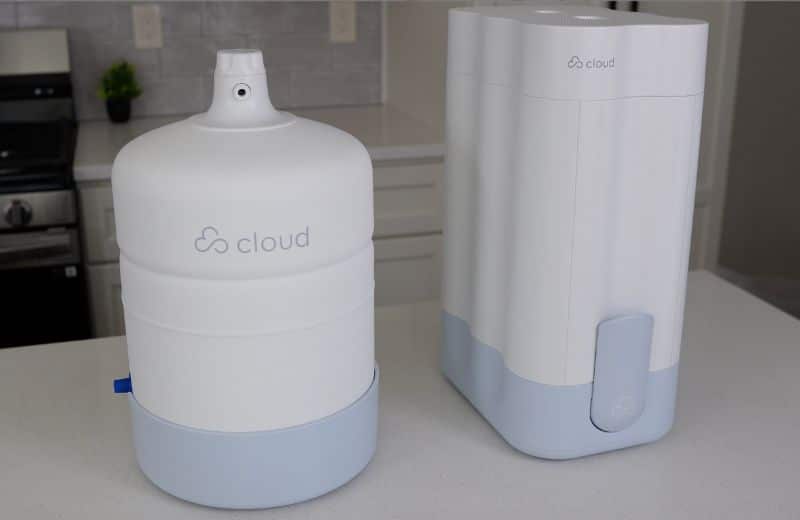
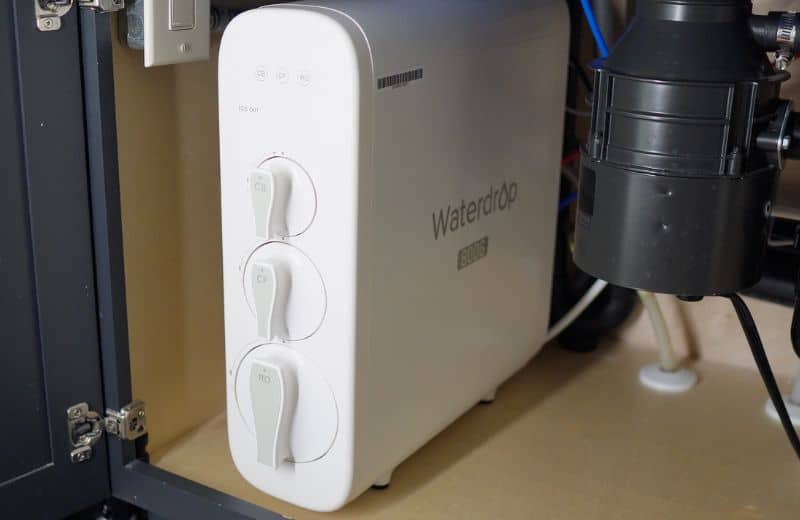
Both units come with a dedicated faucet, so you can dispense RO water for drinking, while still using your non-RO faucet for non-drinking purposes.
Both systems also have several smart features. You can connect Cloud to a mobile app and view tracking data (water consumption, tank volume, filter lifespan) thanks to its built-in sensors. The Waterdrop G3 doesn’t have an app, but its smart faucet and the unit itself have digital TDS meters, and there’s also a filter life tracker.
Component Quality
The Cloud RO and Waterdrop G3 systems have a mostly plastic design, with some metal components.
We found that Cloud has a more premium quality and presentation than many other conventional RO units we tested. The system feels sturdily built, with all the filters housed in a solid box, so there are no flimsy components on the outside.
Waterdrop’s design is also impressive, with a polypropylene (PP) and polyethylene (PE) construction and a single housing unit for the three main filters.
Cloud’s faucet is made from lead-free stainless steel, while the G3’s is made from lead-free brushed nickel.
Filter Materials
There are several basic filtration stages that are generally always found in a reverse osmosis system. Along with some form of pre-filter, there’s the RO membrane, post-filtration, and sometimes, remineralization.
But the exact filters and their materials used can vary from one system to the next — and can help us understand more about their quality and contaminant reduction performance.
Cloud RO uses 4 separate filters:
- A 5-micron sediment filter.
- An activated carbon block & anti-scale filter.
- A reverse osmosis membrane (uses DOW Filmtec technology, the global industry standard for purifying water)
- A remineralization post filter made from coconut carbon block with a blend of three pH and mineral-boosting media.
The Waterdrop G3 uses 3 separate filters:
- A carbon block and sediment pre-filter
- An activated carbon coconut filter
- A semi-permeable RO membrane
Waterdrop also sells an optional alkaline filter, which we installed as an inline post-filter downstream of the main unit.
Materials Safety Certification
We also assigned Cloud RO and Waterdrop scores based on whether they had any materials safety certifications, obtained through the NSF, IAPMO, or the WQA.
Both Cloud and Waterdrop have materials safety certifications as a component of their performance certifications. The Waterdrop G3 is also certified to NSF Standard 372 for a lead-free design.
⚙️ Setup: Cloud RO Wins, 7.50 vs 7.00
We installed the Cloud RO and Waterdrop systems ourselves, which puts us in a good position to evaluate and compare their ease of assembly.
| Product | Setup Score | Setup Time |
|---|---|---|
| Cloud RO | 7.50 | 45 minutes |
| Waterdrop | 7.00 | 120 minutes |
Both systems were tricky to install, but this is characteristic of all under-sink RO systems. You’re not just installing the system at your water line — you’ll also need to drill a hole for the faucet and connect a waste line.
The good news is that Cloud and Waterdrop had a few features that helped simplify and speed up setup:
- Cloud’s faucet has a metal push-to-connect male piece on the bottom, and the nut has wings for hand tightening. The base is detachable from the main unit body, so you can install it alone without having to work around the bulk of the filter unit, and all the fittings and filters were pre-installed.
- The G3 comes with an included pipe cutting tool, and the feed line was already connected to a cold water shutoff valve.
Cloud required an extra installation job: installing the water storage tank. (The tank is designed so it can “stack” with the main body of the unit and sits behind; a nice space-saving benefit!) Waterdrop also had an extra installation task: installing the inline remineralization filter.
After installing the systems, we had to flush them to prepare the filters for use. This took 35 minutes for the G3, and a staggering 6 hours and 15 minutes for Cloud RO.
🔊 Noise: Cloud RO Runs 17 Decibels Quieter Than Waterdrop
With setup complete, we measured and compared the noise level produced by both systems when they were purifying our water.
Cloud uses incoming water pressure to send water through the filters, while the Waterdrop G3 comes with a built-in internal water pump. We assumed that this would make Waterdrop the noisier system of the two.
Here’s how they compared:
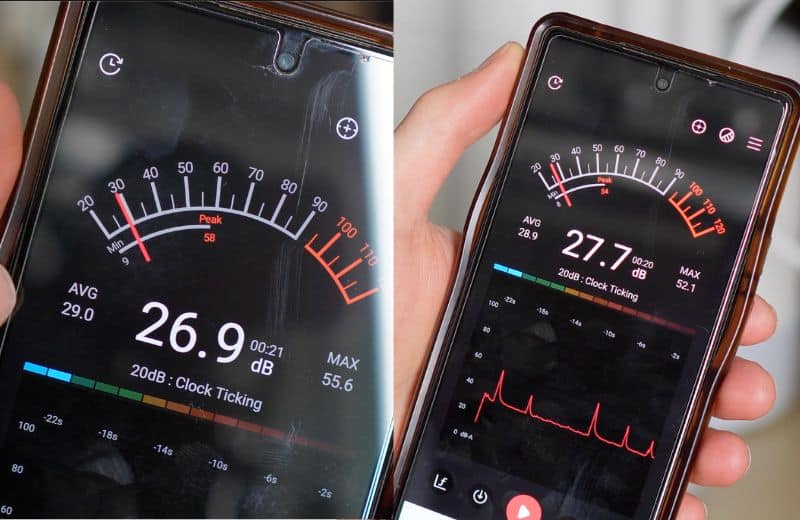
- At 1 foot away, Cloud produced 29.0 decibels. At 3 feet, it produced 28.9 decibels.
- At 1 foot away, the G3 produced 46.4 decibels, and at 3 feet, it produced 43.6 decibels.
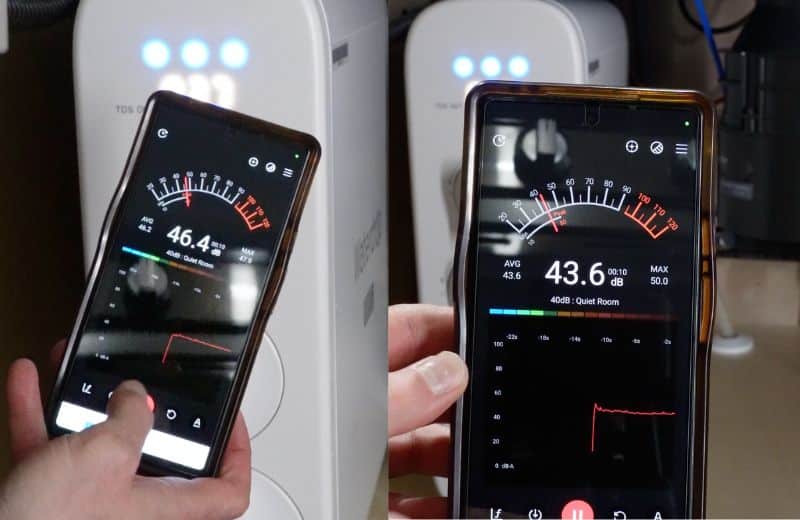
As expected, Cloud was the quietest of the two, while the G3 was slightly louder (producing a volume similar to a fan oven) while in operation.
🔧 Maintenance: Cloud RO and Waterdrop Tie at 10.00
All water filters need ongoing maintenance, and we compared Cloud and Waterdrop in this category by analyzing their servicing requirements and ongoing filter costs.
See the scores we awarded to both systems in the next table.
| Product | Maintenance Score | Servicing Requirements | Costs |
|---|---|---|---|
| Cloud RO | 10.00 | Exceptional | $0.18/gal |
| Waterdrop | 10.00 | Exceptional | $0.11/gal |
Servicing Requirements
Replacing the filters is the main servicing requirement for the Cloud RO and Waterdrop G3.
- Cloud’s filters last 9-12 months, depending on the size of your household and your water usage. Cloud also uses a battery, which lasts 1.5+ years (you’ll receive a new battery pack with your replacement RO membrane).
- The G3 filters last 6–12 months, aside from the RO membrane, which lasts for 2 years
Both systems have a built-in filter change reminder, so we didn’t have to make our own phone calendar reminders. Cloud also has an app, so you can view status updates on your phone, without having to check the unit itself. Plus, the app tracks water usage, so you’ll only replace filters when you actually need to, rather than based on a timer.
When it comes to replacing the filters, this is easy for both systems, with no need to shut off the water supply and no tools required. With Cloud, you just remove the magazine (the main unit body), open the lid, and swap out the filters. The G3’s filters twist in and out easily.
Maintenance Costs
Here’s how the maintenance costs compare for Cloud and Waterdrop:
- Cloud: $0.18 per gallon, equating to a total annual cost of $200.00, and a 5-year ownership cost (including the cost of the upfront purchase) of $1,599.00
- Waterdrop: $0.11 per gallon, or $124.75 per year, and a 5-year ownership cost of $1,622.77.
Cloud is clearly the more expensive model, but we still think it’s fairly priced for its premium feel and the features it offers. Waterdrop is also great value for money, and might be the better option if you can’t stretch your budget as far as Cloud.
🏢 Company Policies: Cloud RO Wins, 9.20 vs 8.65
Our final point of comparison focuses on Cloud and Waterdrop as companies, including their warranty, shipping, and returns offerings.
The table below shows the scores awarded to each manufacturer.
| Product | Company Score | Warranty Length | Shipping | Returns |
|---|---|---|---|---|
| Cloud RO | 9.20 | 5 years | Free shipping on all orders in the US | 90 days |
| Waterdrop | 8.65 | 1 year | Free shipping to the lower 48 states | 30 days |
Warranty Length
Cloud RO is backed by an unbeatable 5-year warranty against mechanical issues, defects, and performance/cosmetic flaws due to improper manufacturing. This entitles you to replacement components as needed.
The Waterdrop G3 P800 is backed by a 1-year warranty, which covers any defects that occur during the warranty period (due to a quality issue and not misuse).
- You can find Cloud’s warranty terms on the product FAQ page here
- See Waterdrop’s warranty terms on page 18 of the user manual.
Shipping
All orders made on the Cloud RO and Waterdrop websites are shipped for free within the contiguous states of the U.S.
Waterdrop currently doesn’t ship to Alaska, American Samoa, Hawaii, Guam, Marshall Islands, Micronesia, Northern Mariana Islands, Palau, Puerto Rico, or the U.S. Virgin Islands.
Cloud does ship to Alaska and Hawaii. If you live in Canada, the manufacturer recommends contacting [email protected].
Returns
Waterdrop offers a 30-day returns policy, meaning you can return your system within 30 days of your purchase date and receive a refund. Cloud’s is slightly longer, at 90 days.
There are some T&Cs to be aware of:
- Cloud: You’ll pay for return shipping. There’s a 3% fee charged for canceling an order before shipping.
- Waterdrop: The product should be disassembled and returned in its original packaging, and you’ll need to cover the return shipping fee.
Waterdrop also allows you to make a return beyond the 30-day returns window, but there’s a 10% restocking fee, as well as the return shipping fee.
- You can find Cloud’s returns info on the product FAQ page here
- Here’s Waterdrop’s returns policy for more information.
🆚 Cloud RO vs Waterdrop: Which Do We Recommend?
We think Waterdrop and Cloud are equally worth your money, but one or the other might be better suited to you depending on your preferences and requirements.
Here’s Why Waterdrop is Great:
- It has an extremely fast filtration rate and was very efficient in our tests, with no TDS creep issues.
- It reduced or removed all contaminants with health effects in our water, and it’s more extensively certified than Cloud.
- It’s more affordable than Cloud, both upfront and in the long term.
- It also has a smaller footprint because it doesn’t use a water storage tank, which makes it better suited to under-sink spaces with limited room.
You Might Prefer Cloud If:
You want a system that can boost pH significantly (Cloud increased pH to 8.7–9.7, while pH actually dropped slightly with Waterdrop).
You want a conventional tank-based RO system, but you’re specifically looking for a smarter, modern upgrade, with app connectivity and a built-in battery.
You have the budget for a premium system with app connectivity.
❔ Cloud RO vs Waterdrop FAQ
Q: Is Cloud RO or the Waterdrop G3 P800 better?
A: Cloud RO edged out the Waterdrop G3 P800 in our overall scoring, 9.24 to 9.21. Cloud RO won on contaminant reduction (9.42 vs 9.28), design (10.00 vs 9.70), setup (7.50 vs 7.00), and company policies (9.20 vs 8.65), while Waterdrop won on filtration rate (10.00 vs 8.50) and certifications. Both scored a perfect 10.00 for maintenance.
Q: Which removes more contaminants, Cloud RO or Waterdrop?
A: In our Tap Score lab tests, Cloud RO earned a 9.90 health contaminant score versus Waterdrop’s 9.50. Cloud RO removed 100% of fluoride, uranium, chlorine, and all disinfection byproducts in our most contaminated test water. Waterdrop eliminated nitrate and vanadium, two contaminants Cloud RO struggled with, but 0.24 PPM of nitrite appeared in its remineralized filtered water.
Q: Is the Waterdrop G3 P800 faster than Cloud RO?
A: Yes. We measured the G3 P800 at 886.54 GPD, exceeding its claimed 800 GPD rating, while Cloud RO measured 65.17 GPD against its listed 80 GPD. That makes Waterdrop more than 10 times faster in real-world use.
Q: Does Cloud RO have TDS creep?
A: Cloud RO’s first draw after 10 hours idle measured 284 PPM against a stable reading of 68 PPM, a 216 PPM spike. Cloud attributes this to minerals releasing from the new remineralization media rather than TDS creep, and says it normalizes after a few weeks of use, a claim we have not independently verified. The tankless Waterdrop G3 measured just 24 PPM above its stable reading under the same conditions.
Q: Which is cheaper to run, Cloud RO or Waterdrop?
A: Waterdrop. The G3 P800 costs about $0.11 per gallon, or $124.75 per year in replacement filters. Cloud RO costs about $0.18 per gallon, or around $200.00 per year, which also covers its replacement battery pack.
Q: Which has better certifications, Cloud RO or Waterdrop?
A: Waterdrop. The G3 is IAPMO certified to NSF/ANSI 42, 53, and 58, covering chlorine, TDS, fluoride, cadmium, hexavalent chromium, and selenium, plus NSF/ANSI 372 for lead-free materials. Cloud RO holds an NSF/ANSI 58 certification for TDS reduction only.